







Abstract

Polymers are among the most important materials and their applications permeate all areas of production and life.1–16 They are essential, but they are also often seen as a modern-day scourge, especially in terms of their negative impact on the environment.17–21 For example, tens of millions of tons of waste plastic particles are discarded into the ocean every year, negatively impacting marine biodiversity 22 ; not to mention the large amounts of fossil fuels used to produce these plastics. The increasingly serious environmental pollution problem has led to a worldwide plastic restriction and ban, and the use of renewable and environmentally friendly biodegradable polymers and its composites is considered to be one of the effective ways to solve this problem.23–32 The application of biodegradable polymers and its composites can not only effectively solve the problem of white pollution and reduce the dependence of synthetic polymers on petroleum resources but also help to reduce excessive greenhouse gas emissions and promote the high-value utilization of biomass resources, which is in line with the goal of sustainable development and the core concept of circular economy.33–38 However, the current challenge is that compared with general-purpose plastics and engineering plastics, biodegradable polymers and its composites still have many performance bottlenecks, such as low/limited strength, poor toughness, low modulus, poor heat resistance, and lack of functionality, which greatly limit their application in high value-added and high performance requirements. 39 Therefore, the processing of high-performance biodegradable polymers and its composites has become an important research area in polymer science and technology today.
For a biodegradable polymeric materials with known physical properties, morphology control is an important way to achieve high-performance materials without changing the proximal structure, composition, and components of the molecular chain.
40
Traditional polymer processing techniques, such as extrusion, injection molding, blow molding, compression molding and spinning, have mild effects on the morphological structure of polymeric materials. They are not able to significantly change their morphology and have limited ability to regulate the formation of special morphological structure. With the progress of polymer science and technology, the development of polymer processing technology and device has also been greatly improved and developed, especially the development of new processing device.
41
Based on the new polymer processing device, it can apply a special external field effect during the polymer processing. Therefore, it can induce a unique morphological structure in the polymer matrix by adjusting the external field conditions, thus affecting the final properties of the products. Therefore, the use of special external fields to regulate the formation of special morphological structures in the biodegradable polymers, which is beneficial to the performance enhancement, has become a hot research topic in the processing of polymer materials in recent years. At present, the main research works carried out by scholars in this field are introduced as below (Figure 1).32,42–61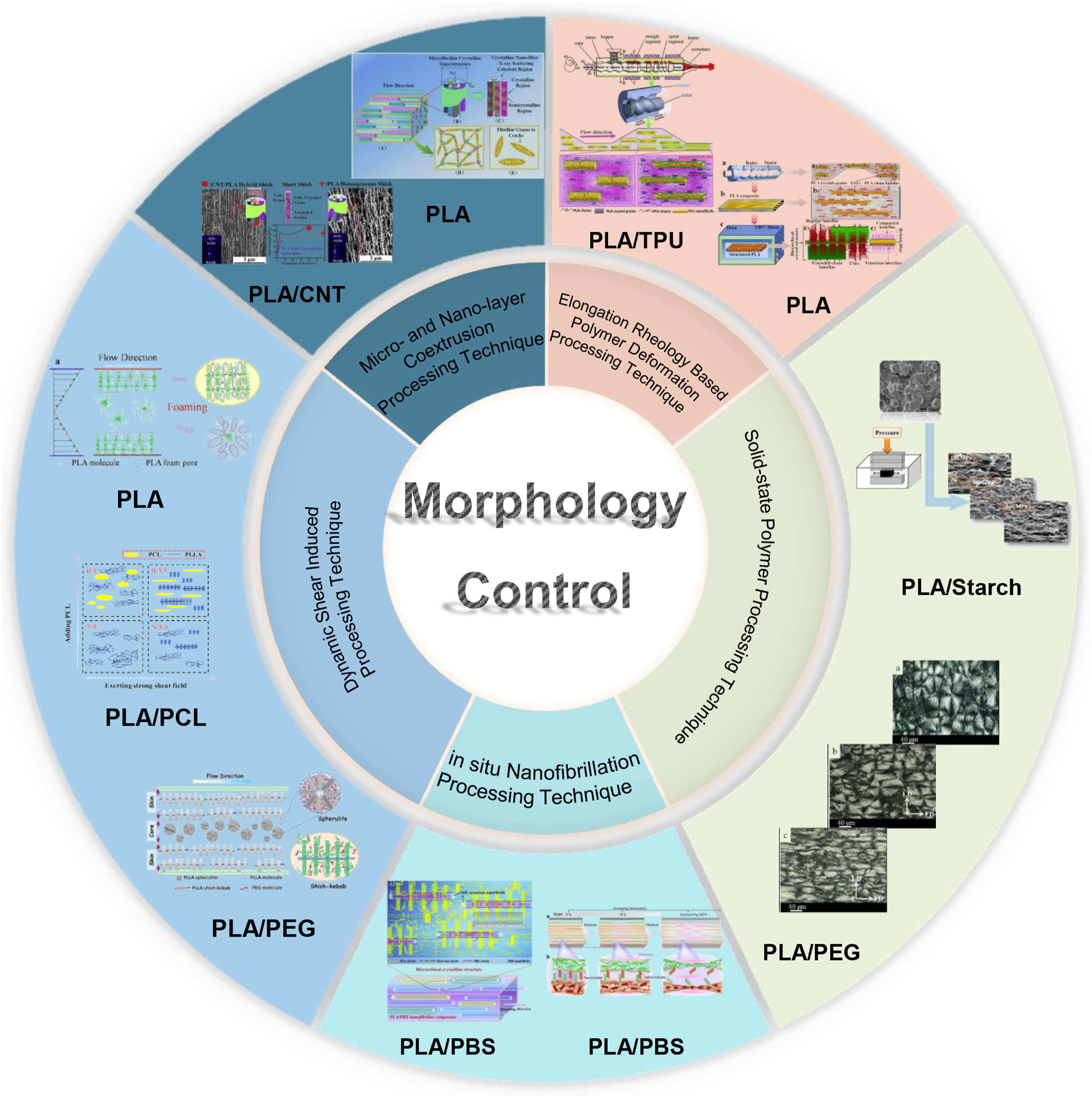
Dynamic shear induced processing technique
In the past few decades, a series of dynamic shear induced processing techniques and device have been successfully developed, including shear controlled orientation in injection molding (SCORIM), 42 vibration assisted injection molding (VAIM), 43 dynamic packing injection molding (DPIM) and oscillation shear injection molding (OSIM),44–46 multi-flow vibration injection molding (MFVIM), 47 loop oscillating push–pull molding (LOPPM),32,48 and so on. Based on these novel device, researchers found that through effectively adjusting the external processing conditions, such as screw speed, temperature, pressure, oscillation frequency, amplitude, and number of push-pull, different intensities of dynamic shear fields can be applied to the polymer processing, which can induce the formation of multi-level oriented morphological structures (e.g., shish-kebab crystal structure and nano-hybrid shish-kebab crystal structure) in the polymer matrix that are beneficial for the improvement of mechanical properties, thus achieving self-toughening and self-reinforcing. For example, poly(lactic acid) (PLA), because of its semirigid and linear molecular structure, has difficulty in generating a large number of crystalline structures in a short processing and molding cycle, resulting in performance defects in its final products. Li et al. used OSIM device to provide a continuous and stable dynamic shear field to promote the highly oriented PLA molecular chains in the mold cavity to induce flow-induced crystallization behavior and induce a large number of crystalline structures and oriented interfacial crystal structures in the blends through the synergistic effect of strong dynamic shear field and polyethylene glycol (PEG) plasticizer, thus significantly improving the overall performance of the PLA blends. 44 Moreover, Li et al. developed shell-mimicking PLA composites by the synergistic effect of intense dynamic shear field and ZnO nanowhiskers. Beneficial from the shell-mimicking features, the obtained PLA composites exhibited excellent tensile strength and impact toughness. In addition, both of the resistance to heat distortion and UV-shielding properties were enhanced as well. 45
Elongation rheology based polymer deformation processing technique
The principle of this method is that by reversing the primary and secondary relationship between shearing and stretching during polymer processing. The volume of the material changes periodically during processing to realize the transformation from drag flow shearing to volume elongational in the polymer processing. Qu et al. have developed a series of new processing device based on elongation rheology theory, such as vane extruder and eccentric rotor extruder. These devices have the advantages of short thermomechanical history, low energy consumption, wide material adaptability, good mixing and dispersing effect, etc. Thus, it is especially suitable for the processing of biodegradable polymers, which can realize the preparation of high efficiency, low energy consumption and less degradation. 49 For example, Qu et al. used the intense and continuous volume elongational flow field provided by eccentric rotor extruder to induce the in situ formation of highly oriented nanofiber structures of thermoplastic polyurethane (TPU) in the PLA matrix. 50 Then, combined the elongational flow field with the annealing process to produce PLA/TPU blends with bone-like structure, in which the TPU nanofibers generated in situ by the elongational flow field are similar to collagen fibers in compact bone. The TPU nanofibers generated in situ by the elongational flow field are similar to collagen fibers in compact bone, and the PLA nanosheet crystals arranged in a regular orientation are similar to hydroxyapatite (HA) nanocrystals in compact bone. 51 The results show that the formed unique multi-layered morphological structure greatly contributes to the improvement of PLA toughness, but the strength is still reduced.
Solid-state polymer processing technique
The principle is that at a temperature lower than the melting temperature T m , crystalline polymers under the action of external forces undergo obvious macroscopic solid-state plastic deformation. The internal microscopic crystal structure deformation and lamella slip and molecular chains along the direction of the external force field action orientation arrangement, resulting in the high strength and high modulus of polymeric materials. So far, different solid-state processing technologies such as solid-state extrusion, cold stretching, roll forming, die drawing, rotary extrusion process, solid-state shear pulverization, and pressure-induced flow (PIF) processing have emerged. Among them, PIF processing has been mainly applied to the structural manipulation of biodegradable polymers.52,53 PIF is a processing technique that places polymer materials in the limited space of a mold at a certain temperature and pressure to make the materials flow in a semi-solid state in the uniaxial direction, especially for semi-crystalline biodegradable polymers. For example, Yu et al. investigated the morphology evolution and performance changes of PLA and its blends before and after PIF processing, and found that the formation of layered orientation structures at appropriate temperatures and pressures had different degrees of simultaneous improvement in strength and toughness, but little impact on elongation at break.52,53
Micro- and nano-layer coextrusion processing technique
The principle is that two single-screw extruders are used to plasticize two different polymer materials, which are compounded into two layers by the converging unit and then enter the layer multiplier. After several divisions, extensions and laminations occur to form products with micro- and nano-layer structures. In recent years, by improving and updating the flow channel structure of the layer multiplier, researchers have developed a series of new micro–nano multi-layer coextrusion devices, which can not only prepare products with tens or thousands of different micro–nano-layer structures, but also realize the macroscopic property control of the material by changing the number of micro-layers and micro-layer thickness. 54 Among them, the layer-multiplying coextrusion system developed by Guo et al. is the main one for the morphology control of biodegradable polymers. The strong shear field generated by the layer-multiplying coextrusion system can effectively regulate the formation of ordered and oriented shish-kebab crystal structure in the polymer matrix, and then significantly improve the comprehensive performance of the material. 54 For example, compared with neat PLA, the tensile strength of samples prepared by 9-layer multiplier extrusion was increased by 50%, and the elongation at break and heat deflection temperature were also improved. 54 On this basis, Guo et al. continued to propose a new multistage stretching extrusion system, that is, by analyzing the flow channel of the layer multiplier of the micro(nano)-layer extrusion composite system, it was found that the fluid is actually subjected to a bi-directional stretching effect during the splitting and stacking process. This provides the possibility of in situ regulation of the morphological structure of the dispersed phase in the melt. They reported that PLA microfibrillated composites 55 and PLA/CNT composite 56 prepared by multistage stretching extrusion system showed obvious improvement in elongation at break, strength, and modulus. This mainly ascribed to the formation of ordered and oriented crystalline structures or fibrous crystalline structures induced by external fields.
In situ nanofibrillation processing technique
The principle is that the dispersed phase is deformed and oriented along the flow direction during polymer processing due to shearing and stretching. Then, in situ formed high strength and high modulus nanofibers are dispersed in the polymer matrix to improve the final performance of materials. In recent years, in situ nanofibrillated fully biodegradable polymer blends and their products have received widespread attention from academia and industry. Li et al. developed slit-die extrusion-hot stretching-quenching technology. During the melt extrusion process, the melt is thermally stretched before the material is solidified to in situ form nanofibers from the high melting point dispersed phase, and then quenched and cooled to maintain the fiber morphology. in situ nanofibrillated PLA/polybutylene succinate (PBS) blends prepared by this technique exhibited excellent strength, modulus and toughness. 57 In order to explore more universal phase morphology control methods, Li et al. also proposed another high speed injection-shear flow field method. The shear flow field during the melt blending is first used to control the size of the dispersed phase to realize the preorientation and pre-deformation of the dispersed phase, and then the high-pressure shear flow field formed during the injection molding process is used to realize the transformation of the preoriented dispersed phase to continuous nanofibers. The PLA/PBS in situ nanofiber composite films obtained by this technique showed high impact toughness, tensile strength and elongation at break, and the substantial improvement of these properties is attributed to the enhancement effect of PBS nanofibers and the strong interfacial interactions due to the nano-effect. 58
Other processing techniques
Ultra-high speed shear processing technology, which is used to improve the compatibility of incompatible blends, polymer/filler, blend/filler systems by applying high shear stress and blending only by adjusting the screw speed (above 1000 rpm). In recent years, ultra-high speed shearing has been reported for biodegradable polymer blends such as PLA/polyamide 12 (PA12) 59 and PLA/olefin block copolymer (OBC)/ethylene glycidyl methacrylate (EGMA) 60 . It has been found that ultra-high speed shearing can improve the blend morphology and affect the final mechanical properties of the products.
In summary, the existing polymer processing techniques have made tremendous advances to processing biodegradable polymers and the morphology control during polymer processing is considered as a key factor to achieve biodegradable polymers with excellent comprehensive properties. In the future development, morphology control under coupled external fields will still attract a lot of attention from scientific and industry. Understanding the morphology changes during these processing processes is always an issue that requires continuous in-depth study. Visualization of polymer processing is also worth investigating. Modeling and simulation should be paid more attention to increase the insight into polymer processing. In addition new techniques for processing biodegradable polymers are still awaiting further development and high-performance biodegradable polymers and its composites always require more innovative processing strategies. In the coming decades, we will face many challenges in the relevant fields that will be solved by close cooperation in mechanical engineering, materials science, electronics, control technology, chemistry, and so on.
Footnotes
Acknowledgments
The corresponding author, Prof. Tairong Kuang appreciated Prof. Mohammad Reza Saeb, Editor-in-Chief of this journal from Gdansk University of Technology for invitation to write this “Letter to the Editor.”
Funding
The author(s) disclosed receipt of the following financial support for the research, authorship, and/or publication of this article: This work was supported by the Ningbo Scientific and Technological Innovation 2025 Major Project (No. 2020Z097) and the Fundamental Research Funds for the Provincial Universities of Zhejiang (No. RF-A2020008).
