







Abstract

The rise of renewable resources signifies a crucial shift in scientific inquiry and advancement, particularly amidst escalating global concerns regarding sustainability and environmental preservation. Within this sphere, nanotechnology emerges as a pivotal discipline with the potential to harness renewable resources to a remarkable extent. Cellulose and lignin, prominent polysaccharides known for their abundance and versatile properties in nanomaterial science, stand out at the forefront. By exploiting these renewable polymers' distinctive attributes, a diverse array of plant-based nanoparticles can be engineered, offering promising prospects across various domains, including advanced materials and medical innovations. The integration of renewable resources and nanotechnology not only underscores the multifaceted nature of natural resources but also propels us toward a future where the harmonious amalgamation of cutting-edge technological approaches and sustainable practices facilitates the prudent utilization of natural resources, thereby enhancing overall societal well-being while safeguarding environmental integrity.
A comprehensive review by Monika Österberg et al. (Chem. Rev. 2023, 123, 5, 2200–2241) critically addressed the current knowledge on surface interactions of plant-based nanomaterials (PNMs) from biomass (cellulose nanomaterials (CNMs), lignin nanomaterials (LNMs), and their combination) with water, chemical solvents, polymers, proteins and cells from intermolecular forces standpoint. 1 The assigned review paper supports researchers working in the filed in selecting PNMs nanoparticles for specific applications, followed by exploration of surface-sensitive techniques in CNMs and LNMs research, providing invaluable insights for future investigations. With utmost respect for the authors of the aforementioned paper, the present letter discusses key objectives and goals in utilizing PNMs through the lens of sustainability, providing further insights for researchers. It also poses questions about potential challenges in the interfacial nanomaterials of PNMs. Finding answers to these questions may open innovation avenues for future research programs.
The review paper explores the intricate interaction between CNMs and unfamiliar environments. In the realm of non-polar solvents, challenges associated with chemical functionalization have been thoroughly examined, and the impact of amphiphilic solvents on CNMs performance has been elucidated. The significance of solvent selection in shaping the characteristics of CNMs-based papers is proposed as a novel focal point of investigation. In the domain of polymer composites, the complexities of achieving compatibility with anionic polymers have been scrutinized (Figure 1(a)), and the exploration of chemical modifications and covalent attachments is extended.
2
The review further extends into the domain of proteins and cells, unveiling the enzymatic degradation of cellulose and venturing into biomedical applications such as drug delivery and tissue engineering.
1
Moreover, it counts the advantages of LNPs, with a particular focus on homogeneous morphology, solvent-free properties, and increased surface area that facilitates environmental interactions. Methodological differences, notably a preference for solvent transfer, are also emphasized, reflecting collaborative efforts between research and industry. (a) Illustration delineating the adsorption dynamics of CMC in the presence of CaCl2, with emphasis on the influence of polymer charge on the swelling of the adsorbed polymer layer. Anionic polymers exhibit pronounced swelling due to electrostatic repulsion among charged groups and osmotic pressure arising from counterion accumulation. In contrast to their nonionic counterparts, ionic polymers' adsorption and swelling are notably influenced by factors such as pH and ionic strength. Noteworthy is the distinctive impact of divalent cations, where Ca2+ ions promote CMC adsorption on cellulose more favorably than Mg2+ ions, attributed to inherent ion polarity. (b) Schematic illustration elucidating the envisioned interactions between hybrid LNPs and polymeric chains before and after deformation during tensile testing. The depicted interactions contribute to the observed improvement in tensile strength without compromising elasticity when compared to pure polystyrene (PS) and poly (butyl methacrylate) (PBMA). The robust self-interactions inherent among lignin molecules, a consequence of their numerous polar functional groups, play a pivotal role in dictating the structural and property outcomes within polymer/lignin blends. (c) Schematic representation elucidating the preparation of polymer composites through a melting process, involving free radical polymerization of polystyrene and poly (butyl methacrylate) within oil-in-water Pickering emulsions. These emulsions are stabilized by LNPs coated with chitosan and glucose oxidase. (d) SEM micrographs providing visual insight into the top and cross-sectional surfaces of composite films comprising PS, GOx-chi-LNPs at 15 wt%. The images highlight the homogeneous dispersion of hybrid LNPs within the polymeric matrices.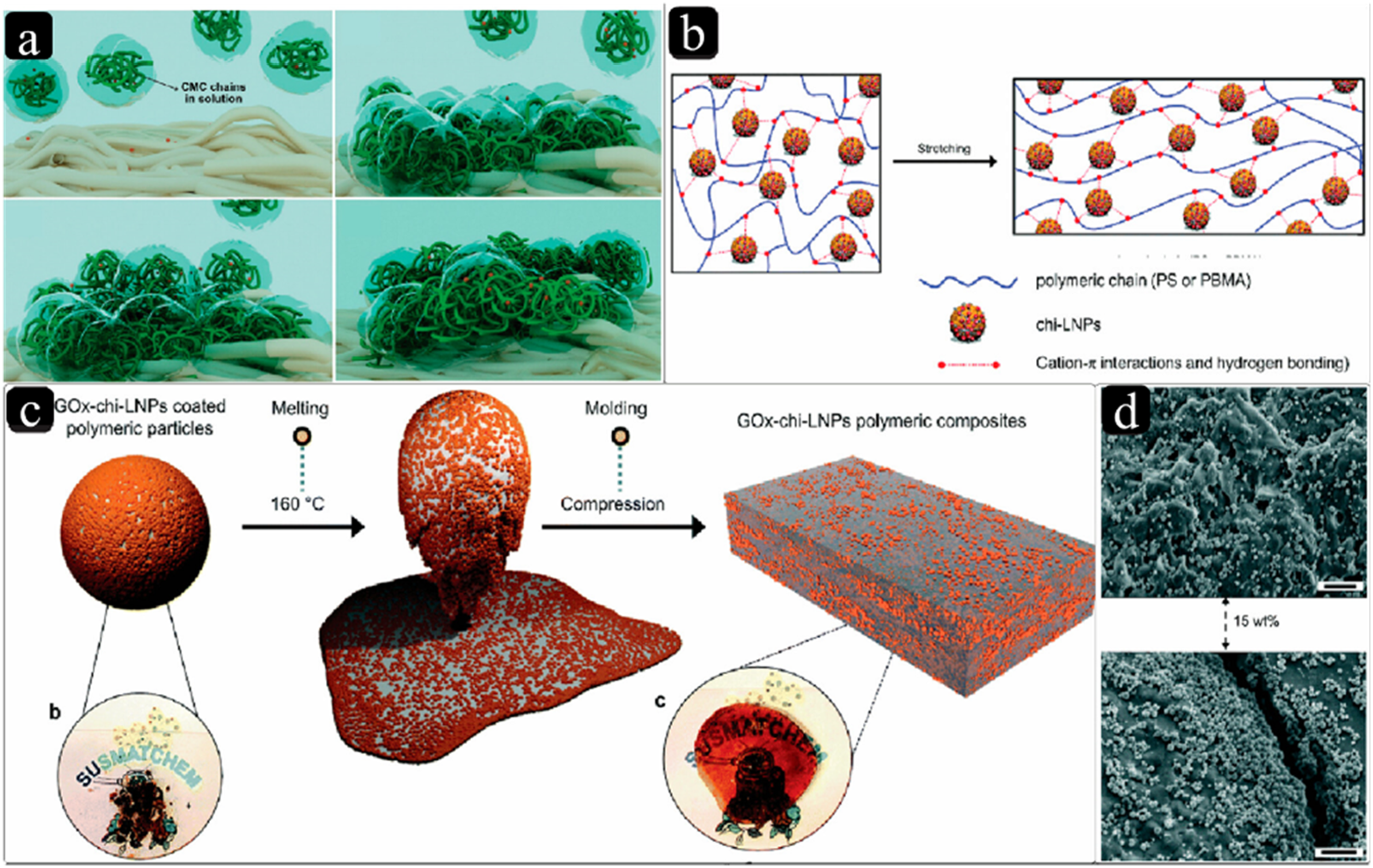
The critical analysis extends beyond synthesis to address influencing factors governing LNPs formation. These factors include the lignin source, chemical structure, molecular weight, and process parameters. The interaction between LNPs and polymers is explored, detailing molecular complexities such as surface charge, functional groups, and nanoscale dimensions. Additionally, the review of LNPs applications in composite materials delves into Pickering emulsions and their stabilizing role in diverse polymer matrices (see Figure 1(b)–(d)). Shifting the focus to cellular interactions, the narrative seamlessly transitions to the growing field of drug delivery. Amphiphilic LNPs emerge as promising carriers for hydrophobic materials, with investigations into internalization efficiency to particle properties. This discussion extends to the toxicity considerations, emphasizing the necessity of precisely controlled particle size distribution. Furthermore, the discovery of LNPs in tissue engineering highlights their multifaceted role in scaffolds, mechanical reinforcement, and antioxidant-mediated reduction of reactive oxidative species during tissue regeneration. 1 The integration of lignin into CNMs to exploit their synergistic effects was delved into by this scholarly exploration, with diverse production methods such as unbleached pulp fibrillation and biorefinery residue extraction being classified. The influence of lignin content on the fibrillation efficiency is scrutinized, revealing nuanced effects on radical stabilization and fiber mechanical properties. Despite challenges in obtaining high-quality Lignin-Containing CNMs (LCNMs) from bioethanol residues, the resultant composite films exhibited promising barrier properties. Noteworthy was the lower surface charge in LCNMs, potentially affecting colloidal stability. The text also underscores the dual motivations of sustainability and functional advantages, emphasizing LCNMs' compatibility with polymer matrices and enhanced water resistance. 1
Concurrently, the role of PNMs in the grand schema of the food chain and biomass cycling commands greater scrutiny, particularly about plant-based food waste, as highlighted in the prologue of a pertinent review paper. Biomass, the biologically produced organic matter derived from living or once-living organisms, is a remarkable substrate for generating nanoscale materials. As a robust and renewable reservoir, it facilitates the procurement of diverse nanoparticles, notably those composed of cellulose and lignin, the foundational constituents of vegetation. These particulates, designated as PNMs, capitalize on the intrinsic qualities bequeathed by their biomaterial sources to furnish dynamic, eco-friendly alternatives to traditional, non-renewable counterparts. As the urgency for sustainability intensifies, the transformation of biomass into cutting-edge nanomaterials has burgeoned into a vibrant research frontier, harboring the potential for sweeping breakthroughs in disciplines as varied as material science and biomedicine. In the context of this discourse, synthesizing nanoparticles from biomass—harnessing renewable resources—is congruent with ecological ambitions and serves as a catalyst for technological progress. The molecular precision involved in detaching cellulose and lignin from assorted biomass feedstocks and configuring them into nanoparticles is a testament to innovation. These tailor-made nanoparticles, distinguished by traits such as biodegradability, superior tensile strength, and active surface functionalities, are integral to a spectrum of applications that maximize the manifold bounties of nature in a manner that is both sustainable and ecologically responsible.
The layered analysis of these materials, especially given their interfacial dynamics with polymers, aqueous media, proteins, and cells, is critical in addressing carbon dioxide emission concerns. The judicious appraisal of plant-derived waste, inclusive of CNMs and LNMs, is now at a research crescendo, compelled by overarching global sustainability challenges and the formulation of long-term policymaking. Although potentiality is transformative by yielding cellulose nanofibers, techniques such as carboxymethylation invoke substantial environmental impact, stemming from the prodigious use of solvents derived from petrochemicals.3,4 Furthermore, the methods by which these wastes are repurposed and recycled currently need more energy efficiency. The integration of early-stage Life Cycle Assessment (LCA) and Techno-Economic Analysis (TEA) into the research and development (R&D) process is indispensable for forecasting environmental and economic indicators, shaping both methodological advancements and product innovations. Ergo, an extensive evaluation of such surface modification strategies is crucial in diminishing carbon emissions and aligning with net-zero carbon goals.
5
To attain the synchrony of exploiting these plant-based sustainable materials optimally, abidance by rigorous environmental regulations that preside over industry and healthcare sectors is requisite. To ensure the harmonization of the utilization of these plant-based sustainable materials at an optimal level, guided by regulatory governing environmental standards in both industrial and healthcare domains, this letter posits the following top-10 concerns that remain ahead of future studies on PNMs: 1-How can the surface interactions of CNMs be optimized to control the rheological behavior and viscosity of suspensions, facilitating their processing for various engineering applications? 2-How do surface interactions between CNMs and functional additives impact the properties of the resulting nanocomposites, and what role does this play in the creation of multipurpose materials? 3-How do surface interactions between cellulosic CNMs nanomaterials and various chemical entities contribute to the development of smart and responsive materials for controlled drug release, sensing applications, and innovative healthcare and medical applications? 4-How can biomedical applications, such as tissue engineering and drug delivery, be advanced by controlling the interactions of CNMs and LNMs with living cells? 5-How can the inherent surface properties of bio-based nanomaterials be utilized to develop new, value-added, and sustainable materials, and what are the key considerations in this process? 6-What methods can be employed to assess the interplay between cellulose nanomaterials, water, and ionic solutes across varied applications, including advanced materials, biomedical applications, and the formulation of nanocomposites? 7-How can the inherent surface properties of biological nanomaterials be employed to develop new, value-added, and sustainable materials? 8-What challenges and opportunities arise when incorporating LCA to quantify environmental footprints from the interactions among cellulose nanomaterials, water and ionic solutes in various applications and how can it contribute to the development of environmentally friendly processes? 9-What strategies can be employed to integrate sustainability principles into the development of smart materials based on cellulosic nanomaterials for controlled drug release and sensing applications, ensuring minimal environmental impacts during the life cycle? 10-How can the manipulation of surface interactions between cellulose nanomaterials (CNMs) and external stimuli, such as heat or water, enhance the self-healing properties of CNM-based materials, and what implications does this hold for the development of resilient and durable engineering applications?
