







Abstract

Energy storage devices (ESDs) such as rechargeable batteries, capacitors, cryogenic systems, and flywheels have become building blocks for modern portable devices, cars, and inter-vehicle communication. However, worldwide and accelerated development of ESDs was unavoidably a matter of growing concern about over-estimate consumption of materials served in their manufacturing including cathode, anode, separator, electrolyte, and salt materials. Bearing in mind that the aforementioned materials are typically expensive and fabricated synthetically, they imply the high price and environmental issues. In this sense, industrial and academic communities should endeavor to make use of safe, clean, inexpensive, and sustainable material resources in fabrication of new generations of ESDs. To name, one of the most key components of ESDs is the separator or solid electrolyte, which prevents from short-circuiting between electrodes. In terms of materials, separators are classified into ceramics and polymers. Ceramics usually suffer from inappropriate interphase with electrodes, which leads to instability of device performance. However, polymers with their flexibility, robust mechanical properties, and compatibility with electrodes are known as the best choices for separators and solid electrolytes. Evidently, polymers have been widely used as gel electrolytes and composite electrolytes with outstanding cycle life, electrochemical stability, cycle performance, etc.1,2
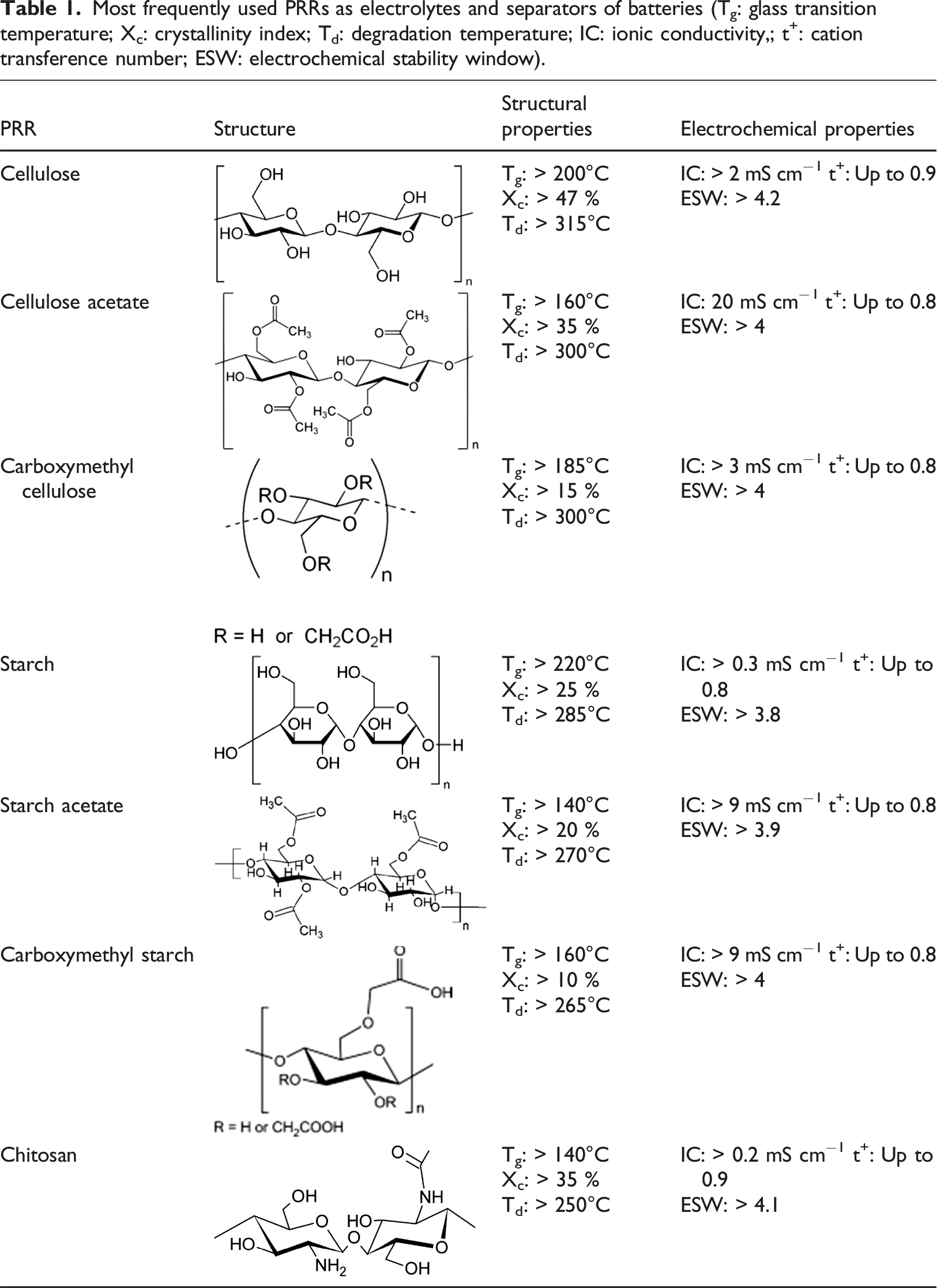
Most frequently used PRRs as electrolytes and separators of batteries (Tg: glass transition temperature; Xc: crystallinity index; Td: degradation temperature; IC: ionic conductivity,; t+: cation transference number; ESW: electrochemical stability window).
As a unique source, carbon-based renewable resources are abundantly available in nature, which are used as biomass-based carbonaceous materials. These types of renewable resources are utilized in electrode materials in batteries and supercapacitors. Generally, carbonaceous renewable resources are produced through thermal or hydrothermal treatment of biomass resources, which prevents environmental pollution and support application of green chemistry in energy storage devices. Thus, they are the best alternative for conventional carbon-based electrode materials such as graphite, graphene, etc. 9
Among different PRRs, cellulose is the one most frequently used in electrochemical devices in various forms such as the neat cellulose, cellulose acetate, carboxymethyl cellulose, bacterial cellulose, etc. It is used as separator even in commercial separators, solid polymer electrolyte and gel polymer electrolytes. It possesses promising mechanical properties beside appropriate ionic conductivity, decent cycle life, and the most importantly an acceptable sustainability. Its oxygen-containing groups can coordinate with lithium salts in Li-ion batteries, which itself results in high ionic conductivity. Moreover, its derivatives such as carboxymethyl cellulose have been widely used as binder in fabricating electrodes. 10 Nanocrystalline cellulose has also been used to reinforce separators and polymer electrolytes in ESDs. The main challenge of using cellulose-based electrolytes is its poor solubility in different solvents that results in a poor processability. This can be overcome upon using different salts in dissolution process or by modification of its structure. Furthermore, cellulose has crystalline structure and high glass transition temperature that limit chain mobility and ion hoping mechanism and act against ion conductivity. 11
Chitosan is another sustainable polymer among PRRs regularly used in ESDs, specifically in supercapacitors and batteries. It contains numerous oxygen groups, which facilitate salt dissociation and Li-ion coordination with its structure. Moreover, its functional groups such as –OH and –NH2 provide one with an opportunity to modify its structure. 12 The ionic conductivity of chitosan can be regulated and modified upon using different acidic dopants and salts. It is generally applied as separator and polymer electrolyte, while some binder applications have also been reported. Its electrochemical performance as polymer electrolyte depends on its molecular weight and modification state. Although low molecular weight chitosan may guarantee its processability, high molecular weight chitosan supports appropriate physical-mechanical properties. The main challenge in using this polymer in ESDs is its low solubility in different solvents. This leads to low electrolyte uptake in gel polymer electrolytes. Moreover, it is generally soluble in the mixture of acetic acid and water, where residual moisture in the membrane ends in deactivation of lithium-based salts. 13
Carrageenan, a naturally available PRRs derived from seaweed, benefits its high solubility in water, cytocompatibility, biodegradation, and sustainability. Although its solubility in water limits its application in some battery applications, the presence of sulfate groups (SO42-) on its structure improve the durability of Li–S batteries by polysulfide entrapping. 14 Moreover, its oxygen-containing groups aid coordination of metal ions with its structure besides favoring its adherence on electrode materials. Of note, carrageenan enjoys a decent electrochemical performance at high current density and superior durability in cyclic performance compared to synthetic polymers like PVDF. 15
Starch as another PRRs is a cost-effective, sustainable, functional polymer, which can be derived from natural plants. It is carbon-enriched and biodegradable, and have been used as a precursor for activated carbon-based electrode materials in electronic gadgets. It has also been served as polymer electrolyte in Li-ion batteries in the neat, modified, and semi-interpenetrated structures. It contains oxygen-containing groups similar to cellulose facilitating dissolution of lithium salts in its structure and its coordination with Li+ ions leading to high ionic conductivity in the order of 10−3-10−4 S cm−1. It also showed broad electrochemical stability window and proper cycle performance in Li-ion batteries. Nevertheless, its main challenge of applications as separator and polymer electrolyte is its brittleness and poor mechanical properties, which should be enhanced through modification of its structure, e.g., with polymers like poly[poly(ethylene glycol) methacrylate]. Modification of starch structure not merely improves its film formation features, but also disturbs its crystallinity in aid of chain mobility and improving ionic conductivity. 16
Alginate in two forms of sodium and potassium alginate servs as another environment-friendly carbohydrate biopolymer among PRRs, which can be obtained from brown algae cell membrane. It has been applied as binder, especially for anode materials, and as polymer electrolyte in metal-ion batteries. It contains massive amounts of –OH and –COOH functional groups, which favor coordination of its structure with metal ions to improve ionic conductivity of polymer electrolyte. It also possesses acceptable film formation features, biocompatibility, and sustainability. It has appropriate mechanical properties, which favors it in applications of polymer electrolytes. Moreover, its functional groups allow it for being well-adhered on the framework of electrodes in ESDs. 17
Gelatin obtained from collagen comprises numerous amino acids in its structure and is one the most important biopolymers among PRRs. Gelatin is a renewable biopolymer and its properties depend on its pretreatments, the resource from which it is taken, pH, temperature, and the degree of hydrolysis of collagen. Although it is mainly used as hydrogel in sensors, drug delivery systems, food industries, etc., because of being nitrogen-rich structure it has been used in developing N-doped carbon materials through carbonization process. This type of structure can act as a sulfur host in Li–S batteries in order to prevent shuttle effect. Moreover, it can be efficiently applied in electrodes of supercapacitors as a binder. Although gelatin is a functional polymer that makes it a decent candidate for electrolyte application, its nitrogen-containing groups can prevent metal ion transfer through its structure. Moreover, it can highly absorb water, which disturbs the performance of alkali metal ions, and affects the cyclic performance of ESDs. 18
All in all, it is apparent that polymers have been widely used over years as different components of ESDs. Although many synthetic polymers have shown properties superior over natural counterparts as binders for electrode materials and electrolytes, the former class of polymers usually suffer from being costly, their crystalline structure, lack of functional groups, resources, and also environmental pollution consequences. These concerns outline the introduction of PRRs as important and key candidates to replace synthetic polymers. The importance of PRRs in ESDs can be summarized as follow: • The PRRs guarantee sustainability, biocompatibility, biodegradability, and cost effectiveness in applications of ESDs. • The PRRs generally reveal comparable ionic conductivity, but a broader electrochemical stability window, good salt dissolution and dissociation, proper physical-mechanical properties, and long cycle life in cyclic performance of electrochemical ESDs.
However, PRRs have some consequences and challenges that should be taken into account as follow: • The PRRs generally suffer from low solubility in different organic solvents that limits their processability to make mechanical-stable films as separators and polymer electrolytes. • Low liquid electrolyte uptake of PRRs in gel polymer electrolytes negatively affects their ionic conductivity and also compatibility of electrolyte with the electrodes. • In solid state, PRRs show high crystallinity that prevents chain mobility and limits ion hoping mechanism in transference of ions through polymer. • In preparation of carbonaceous compounds, which are widely used in electrode materials, it is time-consuming and less cost-effective to prepare fine powders without natural contaminants.
Although some methods have been applied to overcome these challenges, such as high-temperature processes, acid and base treatments, these methods make some environmental challenges and remain less cost-effective. Therefore, a long way should be paved in developing ESDs based on PRRs, but decarbonization and circular economy concepts and instructions give value to consideration of greener and more sustainable polymers for future developments.
