







Abstract
We propose a model that explores the consequences of justice failure. We conceptualize justice failure as a threat to meaning and suggest belief in a just world and justice climate as two moderators for the proposed relationship. We propose that individuals react to justice failure by engaging in fluid compensation and that third parties are more likely than victims of justice failure to engage in this process. We further propose that identity influences individuals’ reaction to justice failure such that individuals high in moral identity are more likely to affirm their moral domain than other domains. As a result of fluid compensation, we finally propose that individuals who affirm their moral domain are (a) more likely to act morally and less likely to act immorally (b) more punitive towards others who violate social norms and (c) more supportive of corporate social responsibility programs. Implications and future research directions are discussed.
Justice…is the main pillar that upholds the whole edifice. If it is removed, the great, the immense fabric of human society, that fabric which to raise and support seems in this world, if I may say so, to have been the peculiar and darling care of Nature, must in a moment crumble into atoms.
Adam Smith (1867)
In 2009, Bernard Madoff was sentenced to 150 years in prison for stealing billions of dollars by orchestrating the largest Ponzi scheme in history. At the age of 71, Madoff will spend the rest of his life behind bars, which for most people seems a fitting punishment for the magnitude of his crimes. But commensurate justice is one thing, quite another is unsatisfied justice. Compare the fate of Bernard Madoff to that of Joseph Cassano, the so-called “patient zero” of the ongoing global economic crisis (Taibbi, 2009). As the head of the American International Group Financial Products Division (AIGFP), the world’s largest insurer of collateralized debt obligations (CDOs), Cassano made the decision not to reserve any real money for the possible collapse of the market for CDOs. When the collapse happened in 2008, AIGFP was unable to compensate their clients for losses because they lacked sufficient reserve capital, which then triggered a meltdown of the global financial market. However, federal prosecutors brought no criminal charges against Cassano because they were unable to find enough evidence of wrongdoing. Furthermore, Cassano was able to keep the 315 million dollars he made as the head of AIGFP and was also retained by AIGFP as a consultant, a position that pays 1 million dollars per month.
Joseph Cassano’s escape from accountability for his failure to take the interests of his clients into account was not uncommon during the 2008 financial crisis. After playing key roles in causing the largest economic crisis since the Great Depression, no major Wall Street executive was penalized for what many people believed to be highly questionable and perhaps even illegal activities committed by the firms they led (e.g., failure to disclose the scope of risks on their books and the amounts of low-quality loans bundled into the derivatives they sold to their clients, issuance of bonuses based on overly optimistic valuation, and possible insider trading; for more, see Morgenson & Story, 2011). Executives were not pursued largely because federal regulators were reluctant to further unsettle the market (Morgenson & Story, 2011). If Bernard Madoff’s sentence is an example of justice upheld, what do we call the case of Joseph Cassano and other Wall Street executives who were unpunished despite the fact that they too made decisions and supported actions that caused millions of people enormous financial, emotional, and psychological pain?
In this paper, we use the term justice failure to refer to a situation in which one or more persons in an organization intentionally cause harm to others but goes unpunished 1 . We argue that when a justice failure occurs, it can produce psychic distress for individuals who are made aware of it because the event threatens an important meaning framework they habitually and unconsciously rely on to make sense of the world. Of particular interest to us is explaining the reactions of people in organizations who are neither the perpetrators of wrongdoing nor its direct victims. We refer to such persons as third parties and by drawing attention to how they react to justice failure we contribute to an emerging area of interest within the broader organizational justice literature (e.g., O’Reilly & Aquino, 2011).
We use the term meaning framework to refer to a system of beliefs adopted by third party observers that gives order and coherence to experience. The specific meaning framework that can be unsettled by exposure to a justice failure consists of the set of beliefs a person holds about the expected relationship between doing wrong and being punished as a result. The punishment needs not to be immediate, but it should be anticipated to occur eventually. The agent who exacts the punishment can be an organizational authority, a social entity, or, for those who believe in it, a divine being. It is also possible for punishment to be self-inflicted, as when the wrongdoer is haunted by guilt and self-loathing. Punishment can even take the form of misfortune befalling those who are intimately connected to the wrongdoer. As an example, consider the collateral effect of Madoff’s conviction on his family, particularly his two sons, one of whom, 46-year-old Mark, committed suicide in December 2010 while the younger son, Andrew, continued his business activities with noticeable constraint.
However, when neither the wrongdoer nor anyone he or she cares about pays a price for his or her misdeeds, and may even prosper as a result, we contend that an important psychological thread that binds crime and punishment will be severed in the minds of third party observers. As a result, we expect some of them to experience an uncomfortable feeling whose source may not be readily apparent, but that may be sufficiently disturbing that it motivates efforts on their part to alleviate it. We trace the source of this discomfort to a meaning threat and contend that one method for hastening its expiation is to restore a sense of meaning. But we go further by suggesting that how a person attempts to restore meaning will partly depend on what identity is particularly salient in the persons’ mind when they are confronted with a justice failure. Our theoretical model, which we refer to as an identity-based meaning maintenance model, is depicted in Figure 1.
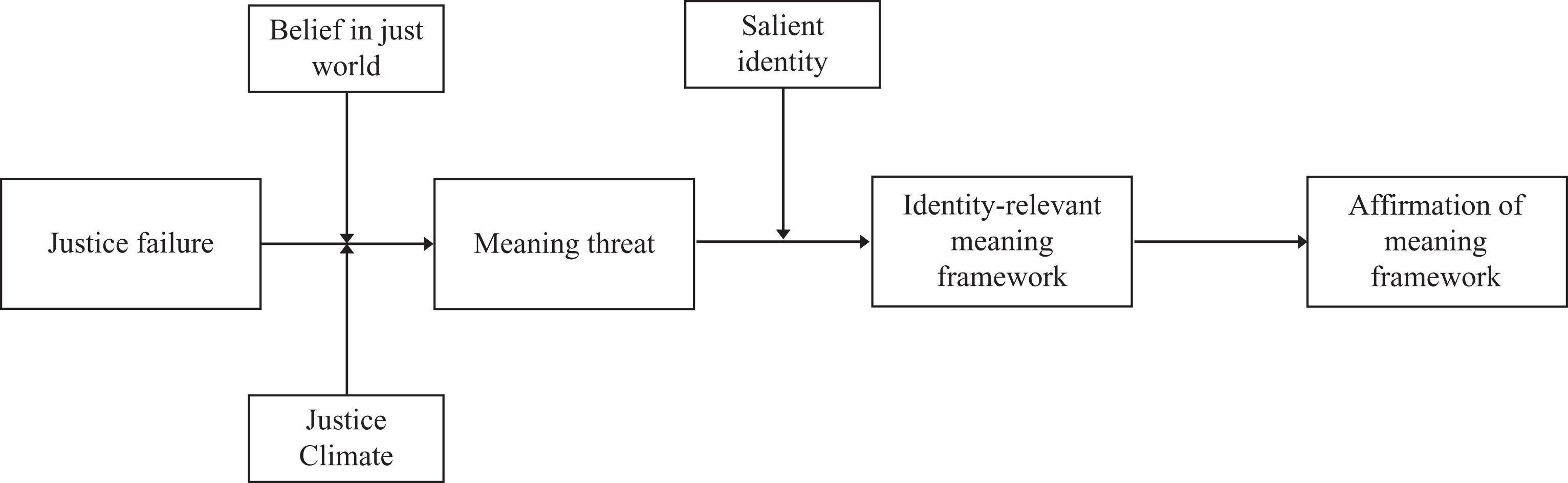
An identity-based meaning maintenance model.
The model makes several novel contributions to the organizational psychology literature. First, we introduce what we refer to as an existential perspective into the study of organizational justice. We argue that this perspective unifies the three dominant justice models—the instrumental model, relational model, and deontic model—that have guided nearly all of the research on organizational justice over the last decades. Second, our model contributes to the literature on moral psychology and behavioral ethics by showing how the failure to deliver justice can have an unexpected moralizing effect on third parties, one that actually makes people who witness justice failure more rather than less moral. Third, we offer an important refinement of extant models of how people respond to meaning threats, most notably the meaning maintenance model (MMM; Heine, Proulx, & Vohs, 2006), by suggesting that a person’s response to threat is at least partly driven by individual predispositions to interpret the world in certain ways as well as contextual information about whether an organization is generally just or unjust.
We begin the explanation of our theory by reviewing key propositions of the meaning maintenance model.
The meaning maintenance model
The MMM (Heine et al., 2006) was developed to parsimoniously integrate a variety of psychological phenomena that are presumably driven by the same underlying motivation to establish meaning. Although scholars from various disciplines have described meaning in many different ways, the MMM draws from existentialist philosophy (e.g., Camus, 1955; Heidegger, 1953/1996; Kierkegaard, 1848/1997) and previous work by psychologists (e.g., Baumeister, 1991; James, 1911/1997) to define meaning as revolving around mental representation of expected relationships. This claim is based on the observation that human beings naturally form associations that relate anything to anything else and these associations are melded together to comprise a person’s meaning framework. For example, we understand snow as cold and falls from the sky. This understanding is part of a meaning framework concerning physical natural laws. Meaning frameworks include not only physical elements of the outside world, but also more abstract elements, such as the self in the form of identity (e.g., I’m a psychologist who studies human mind) or roles (e.g., I conduct research so I know about the scientific method).
The MMM situates the loci for maintaining meaning into four domains: self-esteem, certainty, belongingness, and symbolic immortality (Heine et al., 2006). The domain of self-esteem satisfies the need for meaning by allowing people to sustain a belief that their existence has value, relevance, and purpose. The ability of finding generally predictable relations between the events of the world, as opposed to experiencing them as chaotic and haphazard, provides people with certainty. This constitutes the second domain from which meaning can emerge. A third domain involves social relationships. Affiliation or belongingness, is a critical source of meaning and so when people, as a social species, experience relationships with others that are reliable, predictable, and consistent with their expectations, the integrity of this meaning domain is preserved. Finally, symbolic immortality provides people with a link that endures after death and thus intensifies a belief that human life itself possesses meaning. In other words, the human race is more than just an accidental chord struck by chance to punctuate the silence of eternity, but exists for some greater purpose that we are not yet fully capable of divining.
Another key proposition of the MMM is that these four domains of meaning are interchangeable. Based on the mechanism termed fluid compensation (Heine et al., 2006; McGregor, Zanna, Holmes, & Spencer, 2001; Steele, 1988), the MMM asserts that a threat to one domain can be dealt with by affirming an alternative domain. Previous research has found ample evidence for this proposition. For example, one study showed that when an experimenter was changed unbeknownst to participants, it produced a meaning threat (i.e., an implicitly perceived visual anomaly) that participants reacted to by affirming a completely unrelated meaning framework (i.e., an explicitly held moral belief; Proulx & Heine, 2008). In another study participants were found more likely to affirm their cultural identity after reading a challenging passage by the modernist writer Franz Kafka that violated expected relationships (Proulx, Heine, & Vohs, 2010). It has also been shown that threat and fluid compensation can occur completely outside of conscious awareness (Randles, Proulx, & Heine, 2011; van Tongeren & Green, 2010), suggesting that people automatically attempt to deal with meaning threats even if they are not able to recognize and articulate having done so. We argue in what follows that the concept of justice is a common source of meaning for many people; hence, it represents a belief system that is vulnerable to meaning threat.
Justice as a source of meaning
Justice is one of the most widely studied constructs in the organizational sciences. To date, researchers have published more than 250 papers in the field’s major journals (i.e., Academy of Management Journal, Academy of Management Review, Administrative Science Quarterly, and Journal of Applied Psychology) on justice-related topics. In these papers, scholars have examined questions concerning the various types of justice (e.g., procedural justice, distributive justice, interactional justice) and their independent and joint effects on outcomes ranging from employee well-being (e.g., Greenberg, 2006) and job satisfaction (e.g., McFarlin & Sweeney, 1992) to individual (e.g., van den Bos, Vermunt, & Wilke, 1996) and team performance (e.g., Colquitt, Conlon, Wesson, Porter, & Ng, 2001). The general conclusion that emerges from all of these studies is that justice matters to employees. But a more fundamental question that needs to be answered is: Why?
Reviews of the justice literature (Cropanzano, Byrne, Bobocel, & Rupp, 2001; Rupp, 2011) point to three models that have been most frequently used to explain why people care about justice. The instrumental model (Tyler, 1987) asserts that the yearning for justice arises from people’s need for control over the favorability of desired outcomes. From an instrumental perspective, justice matters because it allows people to get what they want or think they deserve. Alternatively, the relational model (Tyler & Lind, 1992) argues that justice helps fulfill the human need for belongingness. In an organizational context, employees care about justice because it allows them to assess the degree to which organizations value them and see them as part of the organization. The more just the organization and its authorities, the more people feel a sense of belongingness and inclusion with the group. More recently, a third model of justice labeled the deontic model (Cropanzano, Goldman, & Folger, 2003; Folger, 1998; Folger & Skarlicki, 2008), conceptualizes justice as a moral imperative and proposes that people care about justice simply because it is the right thing to do (Folger, 2001). What differentiates the deontic model from the other two is that it assumes justice concerns can arise even though a person is not even a member of the organization and has no interest at stake in an outcome. For these reasons, the deontic model has been used to explain why third parties can experience strong emotional reactions to seeing others treated unjustly (O’Reilly & Aquino, 2011).
We propose that the existential perspective provides an overarching explanation for why people care about justice. The existential perspective posits that people possess a meaning framework organized around expected relationships between right and wrong behaviors and the consequences of each (i.e., reward and approbation or, punishment and disapproval). The function of this framework, like all meaning frameworks, is to help people make sense of what might otherwise appear to be the random events of social life. Existentialist literature, from Kierkegaard to Camus, is replete with interrogations of this kind, into the meaning of life and the incoherency of belief.
As noted previously, human beings have a fundamental need for meaning and they can satisfy this need by maintaining a stable framework consisting of relationships that link anything to anything else. Yet the events and sensations that confront us on daily basis can often appear incomprehensible. Relationships can be irreparably damaged by trivial provocations, the behavior of friends and strangers alike can seem irrational or bizarre, and people who do mischief often amass riches and hordes of admirers while those who do good are unappreciated, marginalized, or even killed. We are persuaded that these uncertainties in relationships that link events within the social domain can pose an existential threat to human beings. Once the fabric of metaphysical justice begins to unravel as a result of a discrete justice failure event, we propose that a sense of unease and discomfort with how the universe operates can arise among those who bear witness to it. Moreover, this state of disorientation about the comprehensibility of life can occur even in the most quotidian of settings, such as the workplace. The proper administration of justice is one way through which groups and institutions can ease the psychic burden of existential threat by ensuring that, in most cases, people’s actions lead to a predictable outcome. When justice is upheld, people are better able to sustain a belief that the world is a meaningful place that consists of reliable relationships between doing good/bad and being rewarded/punished.
Unfortunately, life teaches us at an early age that bad people sometimes prosper and the good are sometimes plagued by misfortunes of Jobian proportion. By the time we reach adulthood, we have therefore been exposed to myriad examples of justice failure with which, of fierce necessity, we must contend. When justice failure happens, it can crystallize a discomforting view of the world by reminding people of its ambiguous and provisional nature. For people who happen to have a meaning framework that assumes a stable relationship between good or bad deeds and their consequences it can be difficult to maintain the integrity of this particular framework in the face of invalidating evidence. For example, if you believe the world is just, then one expected relationship that is likely to form part of your justice-based meaning framework is that people who wrong others will suffer in some way for what they did. If, as a third party observer, you are confronted with something that violates this expectation (e.g., an irresponsible banker whose actions cause millions of people to lose their life savings receives a lavish bonus and continues to enjoy the esteem of his or her peers), it can threaten the integrity and coherence of your system of beliefs, making the world seem less meaningful. Proposition 1: Justice failure threatens individuals’ sense of meaning.
When does justice failure become a meaning threat?
Not all observers will experience justice failure as a meaning threat. An important condition that determines whether it does so is the anomalousness of the event. If a justice failure is expected to occur routinely in an organization, then the psychological processes depicted in our theory will not unfold. We introduce two factors that can affect whether a justice failure becomes a meaning threat. The first is a product of individual psychology; the second of context. The psychological variable is the extent to which a third party observer believes in a just world (Lerner, 1980).
Belief in a just world
Justice, while important, is not the only source of meaning. Recall that meaning was defined as relationships that link anything to anything else. Relations between good and bad behaviors and their consequences are only one among the multitude of life experiences that a person can draw from to construct meaning. This observation begs the question of whether a justice-based meaning framework is equally important to all people. We believe it is not.
Belief in a just world (Lerner, 1980; Rubin & Peplau, 1975) is the psychological construct that we deduce to be a strong determinant of whether a person has a coherent meaning framework organized around ideas pertaining to justice. Just world theory states that people vary in the degree to which they believe the world is one in which people are rewarded for their good deeds and punished for their wrongdoings (Lerner, 1970). The theory further assumes that “any evidence that other people in the individual’s environment are not getting what they deserve distresses the individual” (Miller, 1977, p. 114), which the careful reader will notice is analogous to the predictions of the MMM. However, since people vary in the degree to which they believe the world is just (e.g., Rubin & Peplau, 1975), we argue that the sense of meaning is more dependent on justice for individuals who strongly accept this belief. If so, then being confronted with a justice failure should be more threatening to people whose justice-based meaning framework assumes a generally predictable relation between wrongdoing and punishment (i.e., they are high in belief in a just world). Supporting this claim, research has shown that people high in belief in a just world are more unsettled, and hence more motivated to try and preserve the image of the world as a just place, by derogating victims of injustice (e.g., Ball, Treviño, & Sims, 1994). Proposition 2: Belief in a just world moderates the relationship between justice failure and meaning threat such that employees are more likely to view justice failure as threatening when they are high rather than low in this belief.
Individual differences in a just world beliefs are one possible determinant of whether a justice failure threatens meaning. Our model shows that the context in which the justice failure occurs also matters. There are many contextual variables that could potentially influence how people react to justice failure. We emphasize justice climate because of its logical connection to abstract concepts of justice and their practical administration in organizations.
Justice climate
Organizational climate refers to employees’ shared perceptions of organizational policies, practices, and procedures that are developed through group interaction (James, Joyce, & Slocum, 1988; Schneider & Reichers, 1983). Justice climate is one type of climate perception. It has been defined as “a distinct group-level cognition about how a work group as a whole is treated” (Naumann & Bennett, 2000, p. 882). We propose that when an organization has a strong justice climate, its members have shared perceptions that the systems and processes designed to administer justice do so in a predictable, reliable, and coherent way. When justice climate is weak, employees perceive that justice systems are inadequate. As a result, when an employee is confronted with an example of justice failure in an organization with a strong justice climate, he or she is more likely to perceive that failure as anomalous and therefore threatening than if the same event occurred in an organization where justice climate is weak. Justice climate therefore exerts the same influence on individual psychology as belief in a just world because it too determines whether a person is likely to construct a meaning framework in which there is an expected relation between doing wrong and being punished for it.
The reason why justice climate will influence the content of an employee’s meaning framework is based on the assumption of the MMM that while meaning frameworks tend to be relatively stable, they are not impervious to change. However, changing one’s meaning framework is not easy and is only possible when a person is confronted with repeated and convincing evidence suggesting that the existing meaning framework does not reflect the observed reality and requires modification. In a workplace context, we maintain that being exposed to a shared perception that the organization has either a strong or weak justice climate can be a source of such evidence and contributes to the construction of a particular type of justice-based meaning framework.
A strong justice climate will not emerge in an organization that frequently fails to deliver justice. If an employee is exposed to this type of climate, over time we expect him or her to construct a justice-based meaning framework in which a relation between wrongdoing and punishment within the confines of the organization is not assumed. Consequently, any discrete case of justice failure inside the organization, being no longer anomalous, will appear less threatening. Proposition 3: Justice climate moderates the relationship between justice failure and meaning threat such that employees are more likely to view justice failure as threatening when the organization has a strong rather than weak justice climate.
Having explained why justice failure poses a meaning threat and the conditions under which a threat is more and less likely to be experienced by a third party observer, we now consider how these observers might restore the integrity of their meaning framework.
Mechanisms people use to combat meaning threats
Meaning threats produce psychic discomfort that people are motivated to eliminate (Festinger, 1957; Greenberg, Pyszczynski, Solomon, Simon, & Breus, 1994; Jost & Banaji, 1994; Jost, Banaji, & Nosek, 2004; Steele, 1988). Thomas Kuhn (Kuhn, 1962/1996) proposed two ways that people can respond to a meaning threat: assimilation and accommodation. Assimilation involves reinterpreting an anomaly in a way that is consistent with one’s existing meaning framework. For example, when roughly 5,000 birds fell from the Arkansas sky in January 2011, some people were quick to invoke the Bible as a way of interpreting the event as a sign that the apocalypse was upon us. Interpreting this event as the apocalypse allows people to make sense of it while keeping an existing meaning framework intact. Accommodation is more complete, and occurs when expected associations are modified to eliminate an anomaly. One example would be when psychologists, instead of relying solely on behaviorism, started to study and accept cognition as a cause of human behavior. In this case, their existing meaning framework, which was grounded on the belief that behaviorism could explain all behavior, had to be revised to accommodate new findings in cognitive psychology, thereby establishing a new association that cognition was also a cause.
The MMM proposes fluid compensation as a third way of responding to a meaning threat. The principle of fluid compensation states that if people perceive an element of self or of their worlds that does not find a place in their existing frameworks, they may react by adhering more to other relational structures, even if these structures are unrelated to the expected relationships that are under attack. (Heine et al., 2006, p. 92)
As an example of fluid compensation, Navarrete, Kurzban, Fessler, and Kirkpatrick (2004) showed that participants who were asked to imagine their home being burglarized (a threat to one’s control over his or her valued resources) projected a less favorable view of someone who criticized their country. Another example of fluid compensation can be found in theories of self-affirmation which posit that when one aspect of the self is threatened (e.g., people are told they are stupid) people affirm other unrelated positive aspects of the self (e.g., they view themselves as physically attractive) (Steele, 1988).
Of the three ways of responding to a meaning threat, assimilation can often be relatively easy to execute because it does not require large amounts of cognitive resources. However, it may not completely resolve the negative arousal elicited by a meaning threat (Bruner & Postman, 1949; Proulx & Heine, 2010). The incompleteness of assimilation implies that other mechanisms may need to be executed once assimilation has occurred to fully reduce psychic distress. Furthermore, in some cases it can be difficult to assimilate an anomaly into an existing meaning framework because of the preponderance of evidence clearly pointing against it. These cases will necessarily demand a greater expenditure of cognitive effort, which could diminish the attractiveness of assimilation as a dissonance reduction strategy.
Accommodation requires even more cognitive resources than assimilation, and is therefore more difficult to successfully accomplish, especially when meaning frameworks are well established in adulthood (Proulx & Heine, 2010). Accommodation can also be time consuming and impractical for short-term threats, since a meaning threat in some extreme cases can take several years or even a lifetime to resolve (e.g., scientific paradigms; Kuhn, 1962/1996).
A third problem, which affects both assimilation and accommodation equally, is that they require continuous and conscious processing of the meaning threat. For assimilation, such processing takes the form of reinterpreting the meaning threat so that it fits one’s existing meaning framework, for accommodation, such processing takes the form of restructuring one’s existing meaning framework so as to make the anomaly nonthreatening. Sometimes, the conscious processing of the meaning threat may elevate the salience of the anomaly and thus make it far more existentially threatening than it already is (Arndt & Greenberg, 1999; Blanton, Cooper, Skurnik, & Aronson, 1997; Sherman & Cohen, 2006; Sivanathan, Molden, Galinsky, & Ku, 2008). Under these conditions, assimilation and accommodation may exacerbate, rather than diminish, existential angst.
This leaves fluid compensation as the psychologically more efficient and effective short-term option. Although it is not a long-term solution to a meaning threat (i.e., it does not resolve the threat in the way that successful accommodation does), fluid compensation can allow people to assuage the uncomfortable feeling associated with ephemeral threats and may provide a more complete and satisfying resolution than assimilation when the person is unable to or incapable of interpreting the anomaly within an existing meaning framework. For these reasons, we propose that among adults who have multiple established meaning frameworks of relations among ideas, objects, or events, fluid compensation will be the cognitive “default” strategy for reducing the angst associated with short-term meaning threats. Moreover, this will be particularly true for third parties.
The direct victims of a justice failure should be most threatened by justice failure and therefore most motivated to make sense of it as a way of coping with psychic distress. This assumption is consistent with the predictions of the instrumental model of justice. It is also consistent with the relational model because it too associates justice concerns with self-interest, although in this case the interest at stake is being valued by the organization and its members. What is less obvious is why people whose interest is not directly impacted by justice failure (i.e., third party observers) might also be motivated to restore meaning after being exposed to it.
According to Folger’s (2001) deontic model of justice, people hold moral assumptions about how people should or ought to be treated and that a violation of such assumptions can evoke emotionally charged reactions from third party observers. This claim is the basis for the deontic model’s predictions that third parties care about injustice even when they are not its targets and it is one we accept as a premise of our theory. However, we extend Folger’s (2001) argument by asserting that one reason why people have these emotional reactions to begin with is that they possess a justice-based meaning framework consisting of collective assumptions not only about how people should be treated but also about how the world should operate in general. Justice failure can threaten the validity of this framework and it is this threat that produces the emotional reactions experienced by third parties. In the absence of any meaning threat, we contend that a third party will not experience the emotional reactions predicted by the deontic model or, if they do, it will be at a relatively low level of intensity. As evidence to support our claim, we need only direct the reader to recall a time when they, as impartial observers, were unmoved by seeing justice fail. The vast literature on bystander intervention (e.g., Darley & Latane, 1968) also offers ample testimony to the troubling fact that a callous disregard for others’ misfortune is a more common feature of humanity than we may want to believe.
The deontic model might account for individual differences in the lack of any emotional responses to justice failure by attributing them to characteristics of the transgressor (e.g., prior history of rule violations), the victim (e.g., whether the victim deserves the treatment), other bystanders (e.g., reactions of present third parties), or the third party (e.g., whether the third party identifies with the victim). In contrast, the MMM assumes substitutability between different meaning frameworks and therefore suggests another explanation for why some third parties might be unmoved by justice failure, at least in a way that is observable. According to the MMM explanation, a threat to one meaning framework is compensated by affirming an alternative framework. If so, then the affirmation of an alternative meaning framework as a third party response to justice failure might show itself through the absence of an emotional response. Instead, third parties may have a largely cognitive response of affirming an alternative meaning framework. By making this substitution, third parties can reduce the intensity of any initial emotional disturbance they may have felt when confronted with justice failure before it becomes transformed, perhaps through further rumination, into more powerful emotions like anger and indignation. This prediction extends current models of justice by identifying a response to justice failure—fluid compensation—that has not been considered in any of the extant justice models proposed by organizational scholars and that would not be detected by focusing only on the readily observable emotional responses of third parties (i.e., verbal reports of emotional unrest). Proposition 4: Third party observers are more likely to react to justice failure by engaging in fluid compensation than either accommodation or assimilation.
A novel prediction of our model is that even third parties who do not reveal a particularly strong emotional reaction to injustice might nevertheless become less tolerant of it. This prediction qualifies some models of third party responses to injustice (e.g., Folger, 2001; O’Reilly & Aquino, 2011) that emphasize the importance of emotions as a motivator of such responses. Although it might seem logical to assume that a third party observer should become more tolerant of injustice as a result of fluid compensation because it diminishes their emotional unease over the event, we propose that this will not necessarily occur. In fact, as we explain below, an unexpected consequence of fluid compensation by third parties is that they will not only be more motivated to punish norm violators, but will also be more motivated to act morally themselves. But for these effects to occur, a particular type of meaning framework must be affirmed, the selection of which is driven by the activation and availability of a certain kind of identity within the working self at or around the time a person is confronted with justice failure.
Identity as a moderator of fluid compensation
MMM principles suggest third parties who respond to justice failure with fluid compensation will reaffirm an alternative meaning framework that is readily available, intact, and compelling (Heine et al., 2006). But multiple meaning frameworks can be readily available, intact, and compelling for any individual at a given time. One of the limitations of the MMM in its present formulation is that it does not tell us why a person should choose to reaffirm one framework over the other. Previous empirical studies of the MMM fail to offer much guidance since they allowed participants to not have a choice of affirming one among multiple meaning frameworks, confining them instead to a single meaning framework (e.g., Proulx & Heine, 2008, 2009; Proulx et al., 2010; Randles et al., 2011; van Tongeren & Green, 2010). A typical study design involves presenting participants with a single meaning framework and testing if participants in the threat condition affirm it. For example, Proulx and Heine (2008) found that participants who were presented with a perceptual anomaly subsequently punished a woman arrested for prostitution more severely compared to participants who were not presented with the anomaly. This procedure makes it difficult to know whether participants in those studies would reaffirm a different framework than the one provided by the researchers if they were given the freedom to do so.
We increase the theoretical precision of the MMM by proposing that the affirmation of an alternative meaning framework following a meaning threat will be partly driven by constructs associated with the self and the identities of which it is comprised. Drawing from the identity literature, we propose an identity-based MMM which predicts that people will reaffirm a meaning framework associated with an identity that is cognitively accessible at the time of exposure to justice failure.
Identity is what people use to define the self (Erikson, 1964). In most contemporary models, people are assumed to possess multiple identities (Carver & Scheier, 1981; Epstein, 1980; Greenwald, 1982; Greenwald & Pratkanis, 1984; Kihlstrom & Cantor, 1984; Markus, 1983; Markus & Sentis, 1982; Markus & Wurf, 1987; Rogers, 1981; Schlenker, 1980). For example, people can define the self in terms of both their gender (e.g., I am a woman) and ethnicity (e.g., I am an Asian). But even though multiple identities are available, not all of them are used to define the self at any given time. The self can therefore be conceptualized as a dynamic construct consisting of a set of cognitively accessible identities collectively known as the working self-concept (Markus & Kunda, 1986; Markus & Wurf, 1987). The working self-concept is comprised of two types of identities that can be distinguished by their level of accessibility. The first type is known as core self-conceptions or self-schemas (Markus, 1977). These self-schemas tend to be chronically accessible because they are experienced as central to a person’s overall self-definition (Higgins, King, & Mavin, 1982). The second type excludes core self-conceptions but encompasses instead those that can be temporarily activated by people’s “affective or motivational states, or…prevailing social conditions” (Markus & Kunda, 1986, p. 859). Our identity-based MMM model adopts the working self-concept model of the self as consisting of both chronic and temporarily activated elements. By introducing identity as a dynamic construction, we are able to connect aspects of the self to other related knowledge structures that have implications for third parties’ attitudes and behavior.
Based on identity principles, we propose that people will affirm a meaning framework during fluid compensation from a domain that is closely related to the identities that happen to exist within the working self-concept. Given that the working self-concept consists of both core self-conceptions, which are chronically accessible, and other noncore identities, which are made accessible by stimuli in the immediate environment, it is possible for any identity (and thus the knowledge bases associated with them) to be salient following a meaning threat. The malleable nature of the working self-concept makes the compensation process following a meaning threat truly fluid: one may cope with the same meaning threat by reaffirming drastically different meaning frameworks depending on one’s immediate social circumstances. Proposition 5: Third parties who engage in fluid compensation will affirm a meaning framework that is closely associated with an identity that is salient at the time they are exposed to justice failure.
The malleable nature of the working self means that at any given time a person may define him- or herself in terms of different identities. Consequently, for our model to have predictive validity, it is important to know which particular identity is most salient within the working self of a third party at or near the time he or she is confronted with justice failure. We illustrate how our general identity-based MMM framework can be made more precise by using the construct of moral identity (Aquino & Reed, 2002; Blasi, 1983) as the salient identity that moves fluid compensation in a particular direction. There are three reasons why we chose moral identity to illustrate how our model can be used to make specific predictions about behaviors that might result when third parties are exposed to justice failure. First, morality is among the most intensively socialized values in all cultures, which presumably would make a person’s moral identity more chronically accessible than other identities he or she might use as a basis for core self-definition. Second, because justice and morality are closely related, it is likely that moral identity will be more readily activated following a justice failure than other identities. Finally, compared to other possible identities we could have introduced into our model, moral identity is likely to provide the best explanation of how fluid compensation following justice failure can influence people to act more morally, which is the unexpected outcome that we believe can sometimes occur following justice failure.
Moral identity and fluid compensation
Aquino and Reed (2002) conceptualized moral identity as a schema consisting of a network of moral trait associations (e.g., caring, compassionate, fair, friendly, generous, helpful, hardworking, honest, and kind) that more or less centrally occupy a person’s overall self-definition. Based on this social-cognitive definition, people whose moral identity has high centrality within the working self would be those for whom moral schemas are chronically available, readily primed, and easily activated for information processing (Lapsley & Lasky, 2001). Moreover, following the principle that identity schemas are associatively linked to other related knowledge structures, people whose moral identity is highly accessible should also have readily available access to meaning frameworks that have moral content. It is this principle that explains why we expect third parties whose moral identity is either chronically or temporarily accessible to affirm a moral meaning framework following justice failure.
How does affirming a certain meaning framework affect via fluid compensation third parties’ attitudes and behavior? According to social cognitive theory (Fiske & Taylor, 1991), individuals process information by selectively attending to some aspects of the stimulus information while ignoring others. What captivates attention is partly determined by what is vivid and accessible in working memory. Adopting this social-cognitive perspective, Butterfield, Treviño, and Weaver (2000) found that business professionals had greater moral awareness when issues were framed in moral terms or when there was social consensus about the issues as being ethically problematic. Similarly, we argue that affirming a moral framework as a form of fluid compensation will activate the knowledge structures associated with morality in working memory. As a result, third parties will consciously or unconsciously judge events in their environment as well as their own and others’ actions through a moral lens. At a psychological level this means that their judgments will be influenced by idealized (higher) moral standards acquired through socialization, which they then use as a benchmark for evaluating their own behavior. Proposition 6: Third parties whose moral identity is highly accessible within the working self-concept will adopt a higher moral standard for evaluating their behavior when they have been confronted by a justice failure compared to those whose moral identity is relatively less accessible.
Furthermore, when knowledge structures associated with idealized moral standards become accessible, people will be motivated to act morally to maintain consistency between their thoughts and actions. Humans have a natural desire for self-consistency (Festinger, 1957) and it is this motive that has been underscored as the key construct that links moral identity to moral action (Blasi, 1983, 1984, 2005). To act morally means showing concern for the needs and interests of others. The behavioral expressions of this concern can take many forms in organizations ranging from being a good organizational citizen to providing social and emotional support to coworkers facing difficult personal or career challenges. People whose idealized moral standards have been elevated as a result of fluid compensation should also be more motivated to suppress their desire to enact any malevolent or socially destructive thoughts they may be having because doing so would violate the consistency principle and might result in psychological distress (Festinger, 1957) and self-condemnation (Bandura, 1999). In other words, they will refrain from exhibiting antisocial behaviors that can potentially harm others or the organization. Proposition 7: Third parties who hold themselves to a higher moral standard will act more morally by performing more prosocial and less antisocial behaviors.
But the elevation of one’s personal moral standards will not only influence how they evaluate themselves, we contend that it will also change how they judge the morality of others’ behaviors. The direction of change will be such that they will evaluate behaviors performed by others that they might once have considered morally ambiguous (i.e., behaviors where there is no clear social consensus about whether they are wrong or right) as being more immoral, a process we refer to as moralization. The psychological function of moralization is the same as that of elevating one’s personal moral standards: it restores meaning by strengthening within the person’s mind the rules that regulate moral conduct, thereby allowing him or her to restore their sense that the world is orderly and coherent. Proposition 8: Third parties whose moral identity is highly accessible within the working self-concept will evaluate morally ambiguous behaviors performed by others as more immoral when they have been confronted by a justice failure compared to those whose moral identity is relatively less accessible.
A direct consequence of moralization is that the moralizer will act more punitively towards others who are perceived as violating social norms. Increased punitiveness could mean that they will directly harm a norm violator if they are in a position to do so or it can mean that they will support and foster efforts by the organization and its authorities to do so (O’Reilly & Aquino, 2011). Proposition 9: Third parties who moralize will be more punitive towards other organizational members who violate social norms.
The final consequence of justice failure according to our theory pertains to how a third party who has affirmed the moral meaning framework through the process of moralization will evaluate organizational practices or policies. We propose that as a result of moralization, third parties will show greater support for organizational policies that are meant to elevate ethical behavior. An illustrative example of such a policy is the implementation of a corporate social responsibility (CSR) program. McWilliams and Siegel (2001) define CSR as “actions that appear to further some social good, beyond the interests of the firm and that which is required by the law” (p. 117). As this definition suggests, CSR concerns the degree to which corporations contribute positively to the well-being of society, which could include both human and nonhuman (e.g., animals, the natural environment) stakeholders. We propose that as a result of affirming a moral meaning framework by moralizing, third parties will adopt more favorable attitudes towards CSR because such initiatives advance and support moral and not only economic goals. Proposition 10: Third parties who moralize will be more supportive of CSR programs.
Figure 2 presents a moral identity-based meaning maintenance model that summarizes the relationships stated in Propositions 6 through 10.
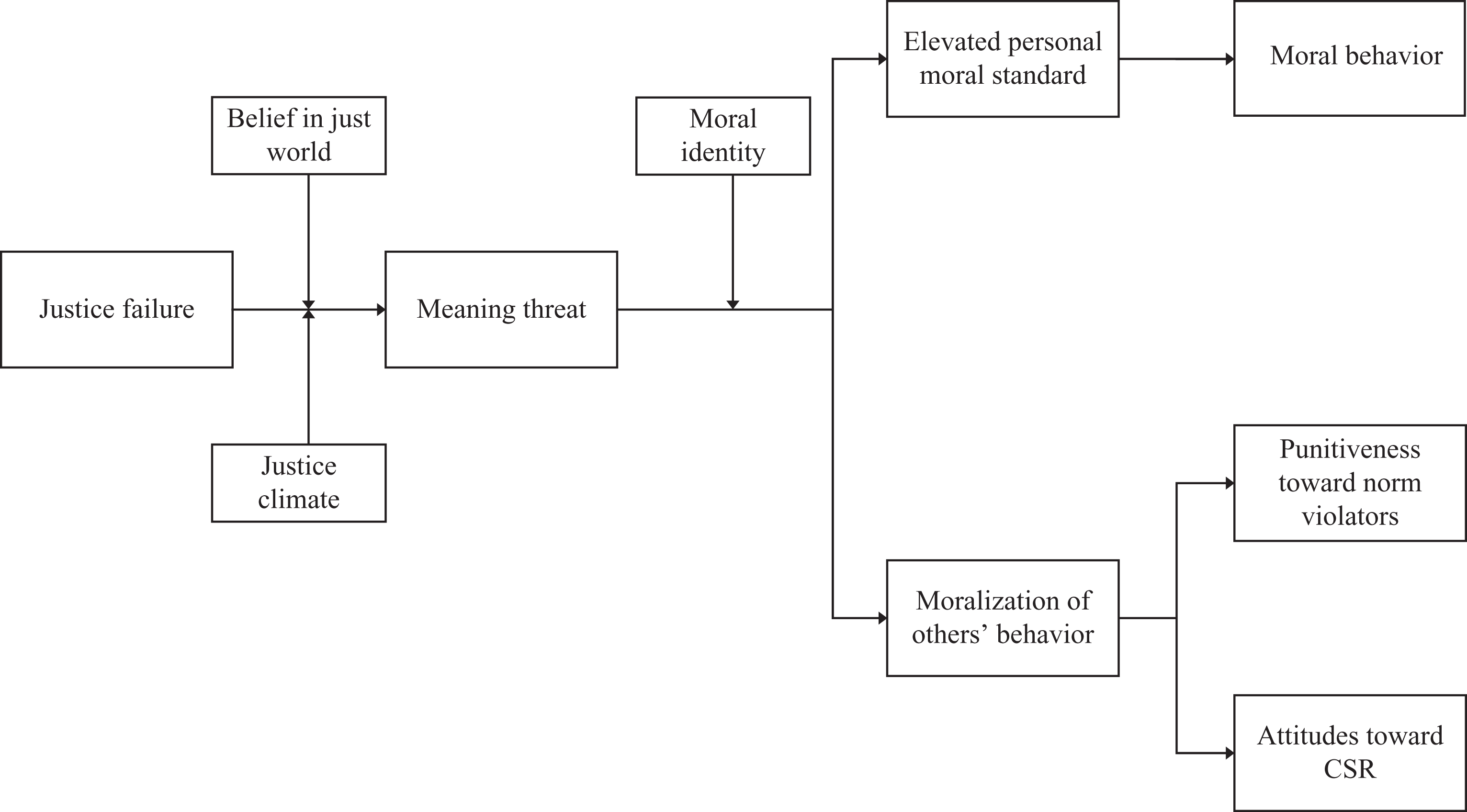
A moral identity-based meaning maintenance model.
We remind the reader that the model presented in Figure 2 pertains only to a case where a third party’s moral identity is the highly salient identity within the working self at the time of exposure to justice failure. As we noted before, our identity-based meaning maintenance model can incorporate any kind of identity as a source of fluid compensation provided that the identity is highly salient within the working self. However, the content of the meaning frameworks that will be associated with that identity, and the consequences that the affirmation of these frameworks produce, can differ substantially from those we proposed would occur when moral identity is salient. For example, imagine that a third party exposed to justice failure has a chronically accessible identity as an environmentalist, which happens to be highly salient at the time he or she is confronted with a justice failure. According to our theory, this person might react to the meaning threat resulting from justice failure by affirming a meaning framework that pertains to the natural world (for purposes of this example, it is not necessary to specify the content of this framework). As a result of affirming this framework, the person might then exhibit behaviors or adopt attitudes that are consistent with its content. They may, for example, become more conscientious about saving electricity in their office by turning off unnecessary lights. They may decide to donate money to someone who approaches them on the street asking for contributions to Greenpeace. Or they may feel inspired to plant flowers in their yard. All of these actions would be influenced by having reinforced a natural world framework and, furthermore, they may be performed without the person being able to articulate why they did any of them.
Discussion
This paper presents an integrative theoretical framework that advances our understanding of third party responses to justice failure. What is novel about our theory is its assertion that justice failure does not necessarily produce undesirable outcomes in organizations if it is perceived as anomalous and if third parties confronted by it experience their moral identity as being highly accessible. In fact, we believe that human beings’ natural propensities as “meaning makers” can motivate some third party observers to respond to justice failure by not only demanding more from themselves as moral agents, but to also be less tolerant of the moral transgressions of others.
As a metaphor for illustrating how justice failure might lead to moral improvement, consider the flu. The flu is always unpleasant and, if we have a particularly virulent case, it can make us anxious and fearful about dying. Yet one of the beneficial and unappreciated consequences of having the flu is that it provides the body with an opportunity to flex its immunological muscles. By mobilizing its natural defenses, the body can better fortify itself against future infestations by other, more deadly pathogens. Similarly, our theory suggests that the human mind’s natural propensity for constructing meaning when its assumptions are shaken by unexpected events can act as a kind of moral defense system within organizations.
By making this claim, we are not advocating for more justice failure or suggesting that organizational authorities should deliberately ignore wrongdoing. A moment’s reflection will reveal that doing so would make the organization unsustainable as a cooperative enterprise and cause much preventable suffering for its members. What we are arguing is that the providence of nature has built into the structure of our minds a mechanism that can potentially channel the inevitable and negative consequences of justice failure into socially desirable behavior under certain conditions.
A key feature of our model is that it focuses on the reactions of third parties rather than victims of injustice. Third party responses to injustice have begun to receive increasing attention in the management literature (e.g., O’Reilly & Aquino, 2011; Rupp & Bell, 2010; Skarlicki & Kulik, 2005; Turillo, Folger, Lavelle, Umphress, & Gee, 2002). Our theory contributes to this emerging research stream, but by doing so it is necessarily limited in scope for it does not consider the perspective of victims or perpetrators of injustice. However, we believe that focusing on third party reactions is the most effective way to test whether justice failure poses a general existential threat to meaning, or if it only matters when people have a personal stake in seeing justice prevail. Moreover, by attending to third parties rather than victims, our model permits us to contrast responses that are driven by fluid compensation with those that are driven by the victim’s desire to advance and defend his or her own interests or seek revenge. We are not claiming that third parties have no interest in seeing justice upheld; it is conceivable that in the absence of justice they too might one day be victims of justice failure. What we do suggest is that self-interest is not the sole or even primary reason why third parties will care about justice failure.
Distinguishing the existential perspective from other models of justice
We are not the first to consider the implications of the human need for meaning in organizational justice research. For example, van den Bos and Miedema (2000) showed that participants that were made conscious of their mortality reacted to a procedural justice violation more strongly than participants whose mortality was not made salient. The authors drew from terror management theory (TMT; see Greenberg, Solomon, & Pyszczynski, 1997, for a review) to explain their findings. Terror management theory shares with MMM the assumption that people attempt to construct meaning when faced with existential threats. In the case of TMT, the specific source of threat is physical annihilation. What distinguishes our model from the TMT-based model used by van den Bos and Miedema (2000) is how we conceptualize a meaning threat. According to van den Bos and Miedema (2000), injustices threaten people’s sense of meaning by reminding them of their eventual death. What is not obvious to us is whether justice failure will necessarily make people more conscious of the thought of death or whether, as we contend, it will directly threaten a meaning framework built around principles of justice. We propose that the MMM framework allows us to consider the latter possibility, which in our view represents a more direct explanation for why justice failure would be threatening than assuming it that it activates an awareness of one’s biological demise.
The model that is perhaps most similar to ours is the multiple needs model proposed by Cropanzano et al. (2001). Their model integrates the instrumental, relational, and deontic models of justice by associating each model with the corresponding psychological needs it fulfills. Specifically, their model associates the instrumental model with the need for control, the relational model with the needs for belonging and self-esteem, and the deontic model with the need for meaningful existence (see Figure 3a for a depiction of their model).
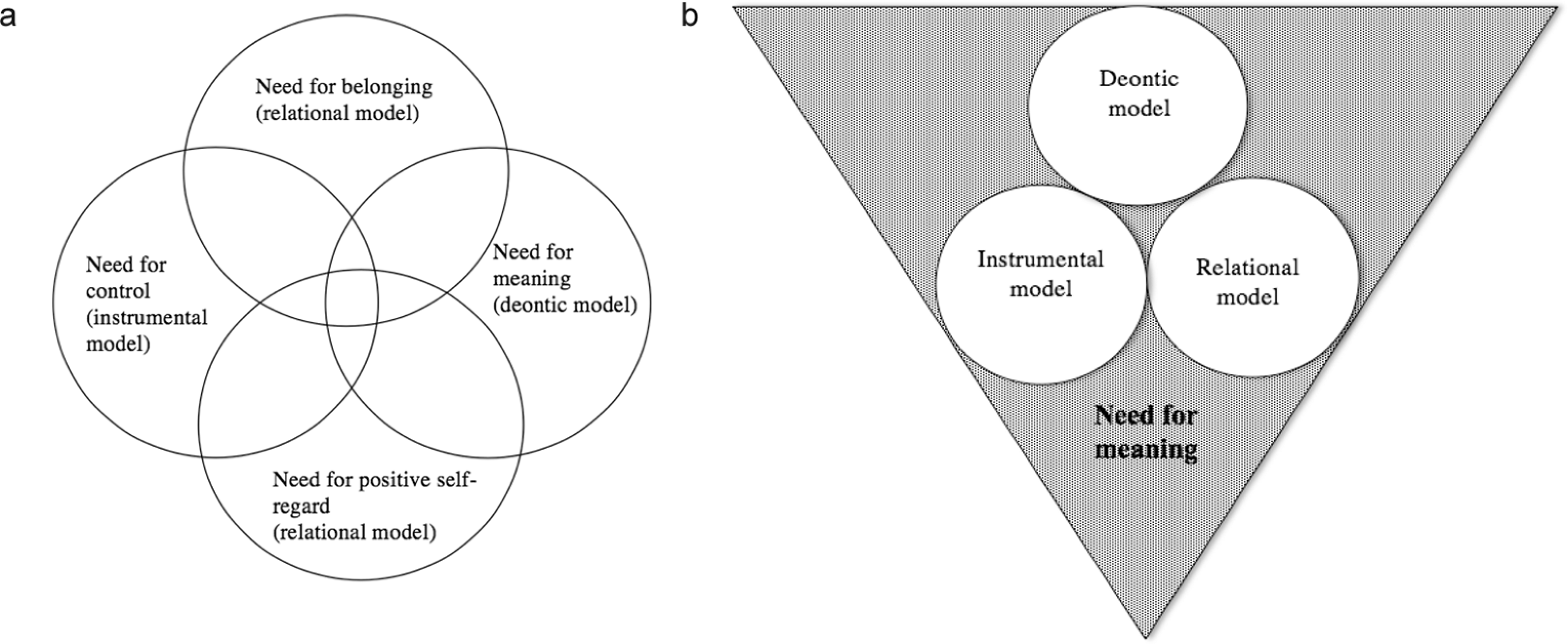
The multiple needs model (Cropanzano et al., 2001).
Our model differs from the multiple needs model because rather than conceptualizing having a meaningful existence as a separate need that parallels the needs for belonging, control, and self-esteem, we argue existential concerns subsume all the other needs. Thus, our model advocates for a new arrangement between the existential perspective and the instrumental, relational, and deontic models as illustrated in Figure 3b. The triangle in Figure 3 represents the fundamental human need to construct meaning out of expected relationships in the world. We argue that the motives associated with the instrumental, relational, and deontic models of justice are subsumed by this overarching need. Inside this existential triangle we find all of the meaning frameworks that a person has built up out of the raw materials of events, ideas, and objects that have entered into his or her awareness over the course of a lifetime, including frameworks associated with justice. The triangle represents the origin of the subjective world as it is known and interpreted by each individual.
Boundary conditions
At this point, it is important to discuss the boundary conditions of our theory and to acknowledge some remaining questions that it cannot definitively answer. A first boundary condition pertains to the temporal nature of the psychological processes it describes. Our assumption is that fluid compensation occurs quite rapidly once a person has been exposed to a justice failure. What we do not speculate on, primarily because empirical data and past theory provide little guidance for doing so, is how enduring the effects described in our model are likely to be. We theorize that moralization and the elevation of moral standards will be associated with certain behavioral and attitudinal outcomes, but we do not know how long these relationships will retain their motivational potency. For example, we might question whether these cognitive processes could be as predictive of moral behavior or attitudes that occur a week after as compared to only minutes after justice failure is perceived. We suppose not since by then a person will have been exposed to a multitude of other potential sources of influence that may overwhelm the elevated consciousness of morality wrought by fluid compensation. On the other hand, if the experience of justice failure is sufficiently powerful, the process of restoring a meaning framework that is badly shaken might require a long-term cognitive effort that may go beyond a few seconds, or even a few hours or days. If so, we might continue to chart the residual effects of fluid compensation on behaviors and attitudes that are measured well after initial exposure to justice failure. Only future empirical research will provide answers to how transitory the processes and outcomes depicted in our model might be and under what conditions we might anticipate justice failure to have enduring and perhaps even personally transformative consequences.
A second boundary condition concerns our model’s emphasis on justice climate and belief in a just world as moderators of the relationship between justice failure and meaning threat. It is likely that many other individual-difference, contextual, or structural variables might also moderate this relationship. Specifying what these variables might be is a task we leave to future theorizing. For now, we acknowledge that our theory is incomplete, but for the purpose of advancing a general theoretical idea built around identity-based meaning maintenance we thought it more important to emphasize parsimony over complexity. There are undoubtedly other boundary conditions of our theory, but at this time these two strike us as being most consequential. Let us now turn to the practical implications of our model for organizations.
Practical implications
No matter how committed they may be to principles of fairness all organizations and managers will eventually fail to deliver justice in a way that their employees have come to expect. Our theory contends that this situation need not always be lamented for we argue that it can sometimes yield unexpected and desirable consequences. However, for these consequences to occur, two conditions must be met. First, authorities must strive to deliver justice in the workplace consistently so that the failure to do so will be viewed as relatively anomalous. In this sense we are not saying anything that other scholars and moralists throughout history have not already advocated. What is somewhat different is our reason why doing so has value; namely, because it establishes a relationship in people’s minds between wrongdoing and punishment that will become the foundation for a justice-based meaning framework.
The second condition that must be present for justice failure to produce the benefits we have described is that a moral identity must be highly accessible for third parties at or near the time that they are confronted with justice failure. If it is not, then our theory predicts that they will not affirm a moral meaning framework and will instead affirm another framework that is linked to an identity that is more cognitively accessible. It could be that this framework will produce the same outcomes as affirming a moral framework, but this need not necessarily occur. Imagine, for example, that the identity that happens to be most accessible to a third party is their identity as an opportunist and egoistic exploiter of others for personal gain. If so, then this identity would lead them to affirm a meaning framework associated with it—perhaps one that contains Machiavellian assumptions about human depravity and the absence of universal standards for judging morality. Clearly, the affirmation of this framework will affect their behavior differently than if they had affirmed a moral meaning framework that contains contradictory assumptions.
Like other identities, moral identity is amenable to situational manipulation (Aquino, Freeman, Reed, Lim, & Felps, 2009). This fact about identity is the basis for our practical recommendation that if managers want employees to affirm moral meaning frameworks when confronted by justice failure, they need to create conditions where a moral identity is likely to effectively compete with or even supplant the other identities that are likely to exist within employees’ working self-concept. Giving advice on how to do this is the topic of another paper and it has already been addressed quite effectively in our opinion by Weaver (2006). What we would like to offer here, therefore, is a reminder that even if an employee’s moral identity may not be chronically accessible, there are ways to make it momentarily accessible. What is required is the creation of a work environment in which a mental image of the moral self is allowed to enter into consciousness with regularity. The identity thus becomes an instrument through which third parties can transmute the negative experiences wrought by justice failure into the socially beneficial outcomes of individual and organizational morality.
Conclusion
In a lecture he delivered at Harvard in 1900 titled What Makes a Life Significant, William James described a week he spent at the Assembly Grounds on the borders of Chautauqua Lake. His time there presented him with a seductive vision of order, prosperity, civility, and human achievement that would appear to satisfy all the deepest longings of our species. Wrote James, You have culture, you have kindness, you have cheapness, you have quality, you have equality, you have the best fruits of what mankind has fought and bled and striven for under the name of civilization for centuries. You have, in short, a foretaste of what human society might be were it all in the light, with no suffering and no dark corners. (James, 1992, p. 863)
Yet, despite the idyll and ease of the life around him, James found his stay strangely unsatisfying when he emerged back into the “dark and wicked world again.” The reason why was because the state of existence at Chautauqua Lake, while devoid of strife and want and care, lacked another quality that makes life meaningful. Contrasting his experience at the lake with the unruly world beyond it, James decided he preferred the latter: Let me take my chances again in the big outside worldly wilderness with all its sins and sufferings. There are the heights and depths, the precipices and the steep ideals, the gleams of the awful and the infinite; and there is more hope and help a thousand times than in this dead level and quintessence of every mediocrity. (James, 1992, pp. 863–864)
In this paper, we make a similar observation about the nature of organizational justice by suggesting that when it fails, it provides meaning-making creatures an opportunity to reaffirm their ideals. As a consequence, it gives to their lives a sense of order and coherence that elevates the demands it makes on them to become better than they are. By contrast, in a world of perfect justice, life may seem as staid and inconsequential as when a born adventurer sets adrift on a river only to discover that it has neither bend, nor sandbar, nor varying current, nor protruding rock to obstruct the way, leaving its disillusioned navigator with no more arduous task than holding steady the keel while gazing plaintively at the featureless horizon, waiting for the journey to reach its welcome and uneventful terminus.
Footnotes
This research was partially supported by a grant from the Social Sciences and Humanities Research Council of Canada awarded to Karl Aquino.
Acknowledgements
The authors thank Wilfredo P. Sanchez for his assistance in preparing this manuscript.