







Abstract
The implications of lean manufacturing for employee well-being remain unclear as previous research yields conflicting findings and struggles to identify an applicable model of job design. This paper adapts and integrates both the job characteristics model and the job demands–resources model to demonstrate the everyday implications of lean manufacturing for job design, and in doing so, how job designed according to lean manufacturing principles influence motivational and health-related outcomes for employees. A research agenda is created to improve our understanding of the employee experience of lean work, and a number of practical implications for the configuration of jobs under lean manufacturing are outlined.
Keywords
Is lean manufacturing good or bad for employees? The past two decades have seen this question debated time and time again by its advocates and critics. However evidence from both sides is largely anecdotal and any conclusions that can be drawn are speculative (de Treville & Antonakis, 2006). Lean manufacturing is a multidimensional approach to manufacturing which encompasses a wide variety of management practices within an integrated system dedicated to minimizing waste (Shah & Ward, 2003). Early research examining lean manufacturing has argued that it leads to work intensification (Delbridge, Turnbull, & Wilkinson, 1992) and represents “management by stress” (Delbridge & Turnbull, 1992; M. Parker & Slaughter, 1988). Other research has suggested that if lean systems were implemented effectively employees would work “smarter, not harder” and experience a decrease in work-related stress (Wickens, 1995; Womack, Jones, & Roos, 1990). Given these claims it is striking how little empirically grounded research exists to date to answer this question (Anderson-Connolly, Grunberg, Greenberg, & Moore, 2002; S. K. Parker, 2003). Studies which have empirically assessed the implications of lean manufacturing for employees have yielded contradictory findings which either demonstrate solely negative outcomes (S. K. Parker, 2003; Sprigg & Jackson, 2006) or contingent outcomes where improved well-being is dependent on specific management practices (Anderson-Connolly et al., 2002; Conti, Angelis, Cooper, Faragher, & Gill, 2006; Jackson & Mullarkey, 2000). However no applicable model has been identified to date which captures the complexity of job design under lean manufacturing despite attempts using models such as the job demands–control model (JD-C; Karasek, 1979) and the job characteristics model (JCM; Hackman & Oldham, 1976).
This paper proposes a framework of job design which represents a stable model of operations within a lean context using an integration of the job demands–resources model (JD-R; Demerouti, Bakker, Nachreiner, & Schaufeli, 2001) and current versions of the JCM (Campion, Mumford, Morgeson, & Nahrgang, 2005; Morgeson & Humphrey, 2008). The use of the JD-R model accommodates claims made by both advocates and critics as it incorporates dual health-impairment and motivational processes. The JCM captures the various levels of job design (task, knowledge, and social) under lean manufacturing and the mechanisms through which it impacts a range of psychosocial outcomes. We adapt and integrate both the JCM and JD-R frameworks to demonstrate the long-term everyday implications of lean manufacturing for job design, and in doing so, show how jobs designed according to lean manufacturing principles influence motivational and health-related outcomes. As both financial and nonfinancial organizational outcomes of lean manufacturing such as profit, reduced inventory, reduced manufacture times, increased quality, increased flexibility, and increased customer satisfaction have been well documented (Ahls, 2001; Alavi, 2003; Emiliani, 2001; Fullerton & Wempe, 2009; Womack & Jones, 1994), the present paper focuses on the more neglected topic of psychosocial outcomes at the employee level. A research agenda is created to improve our understanding of the employee experience of lean work and to promote the creation of contextualized job design models. A number of practical implications for the configuration of jobs under lean manufacturing are outlined.
What is lean manufacturing?
The focus of lean manufacturing in recent years has broadened beyond shop-floor tools to the lean principles which incorporate the notion of value and waste elimination into the production system (Womack & Jones, 1994). Increased pressure on organizations to remain competitive in terms of their product cost, service, and quality, has led to the establishment of lean manufacturing as one of the most widely used production systems, as its positive impact on organizational performance and competitive advantage has been widely demonstrated (C. B. Brown, Collins, & McCombs, 2006; Cua, McKone, & Schroeder, 2001; Fullerton & Wempe, 2009). As a result it has now extended beyond manufacturing into the service industry (Abdi, Shavarini, & Hoseini, 2006), the public sector (Kollberg, Dahlgaard, & Brehmer, 2006) and knowledge work (Staats, Brunner, & Upton, 2011).
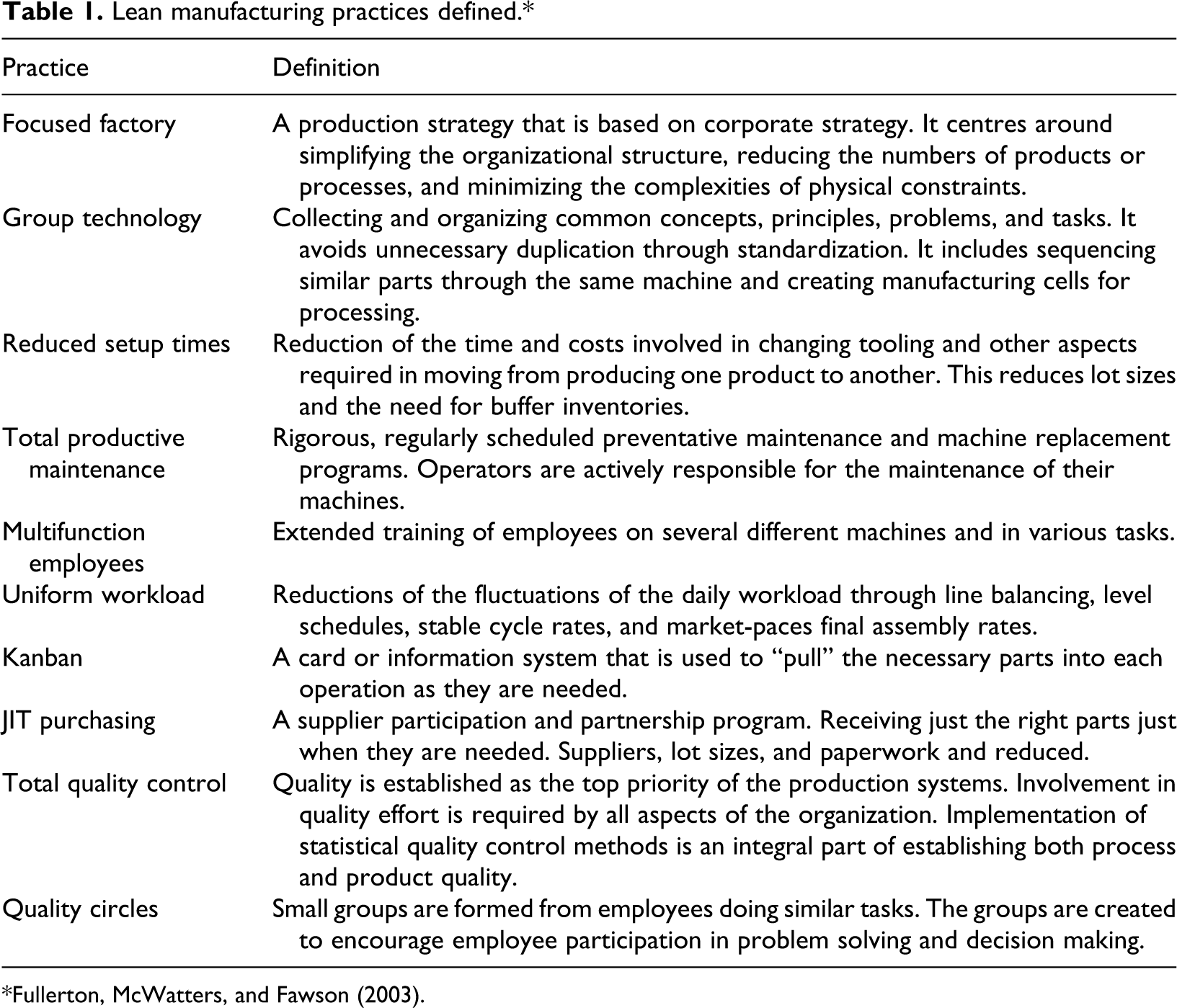
To date the precise meaning of the term lean manufacturing has been contested. It has more recently been described as a multidimensional approach to manufacturing which encompasses a wide variety of management practices within an integrated sociotechnical system dedicated to minimizing waste (Shah & Ward, 2003, 2007). The inclusion of the terms “socio” and “technical” support those who claim that it needs to be regarded as a “culture” which integrates both its technical tools and management philosophies (Birdi et al., 2008; de Menezes, Wood, & Gelade, 2010). The technical tools associated with lean manufacturing are used to reduce waste in human effort, inventory, time to market, and manufacturing space (see Table 1 for definitions). As a management philosophy lean manufacturing is intended to change how people work by giving them more challenging jobs, greater responsibility and an opportunity to work in teams (MacDuffie & Pil, 1995; Womack, Jones, & Roos, 1990). Therefore within a lean culture the focus switches from “potential efficient bundles of practices to this unobserved philosophy or management approach” (de Menezes et al., 2010, p. 13). In examining the well-being implications of lean manufacturing, its treatment as either a selection of purely technical practices or alternatively a sociotechnical culture has yielded contradictory findings. Those approaches which have addressed individual lean practices such as performance monitoring and moving assembly lines, and their isolated effects have primarily concluded that lean manufacturing is damaging for employees due to the deterioration of job characteristics necessary for job enrichment such as autonomy and skill utilization (S. K. Parker, 2003; Sprigg & Jackson, 2006). Alternatively those approaches which have addressed lean manufacturing as an integrated set of technical and human practices have concluded that it has the potential to be both empowering and exploitative (Anderson-Connolly et al., 2002; Conti et al., 2006; Jackson & Mullarkey, 2000). However no applicable model of job design has been identified which incorporates these contingencies.
Lean manufacturing practices defined.*
Job design under lean manufacturing
Until recently it had been accepted that within approaches to job design, there exists prominent trade-offs between the “mechanistic” design, which is grounded in industrial engineering and oriented toward process simplification and efficiency, and the “motivational” design, which is grounded in organizational psychology and oriented towards increasing employee satisfaction and intrinsic motivation. These trade-offs have also been acknowledged by critics of lean manufacturing who claim that its performance advantages are gained at the expense of employee welfare (Delbridge et al., 1992; M. Parker & Slaughter, 1988). Campion et al. (2005) have however identified a “synthesis” approach to job design which minimizes the trade-offs between these contrasting approaches. This interdisciplinary approach to job design specifies areas in which gains can be made by the motivational model without sacrificing the mechanistic model and vice versa (Morgeson & Campion, 2002). Campion et al. provide examples of the synthesis approach to job design which include total quality management, reengineering and the sociotechnical systems approach. The features associated with these management approaches such as continuous learning, cross-functional autonomous work teams, and management by data are however now heavily associated with the aforementioned conceptualization of lean manufacturing (Shah & Ward, 2003, 2007). Therefore a synthesis approach is necessary to capture these mechanistic and motivational aspects of lean manufacturing’s resulting job design.
The neglect of context in organizational behavior research is a growing concern (Grant, Fried, Parker, & Frese, 2010; Rousseau & Fried, 2001) as it is frequently “controlled away” by researchers rather than assessing its impact empirically (Johns, 2006, p. 389). The lean context in particular brings to light the limitations and problems associated with context-free job design models (de Treville & Antonakis, 2006). This is evident in the research addressing employee implications of lean manufacturing which tests these models using a predetermined set of job characteristics in a lean context, yielding unpredicted or nonsignificant findings. For example the JD-C model (Karasek, 1979) was found to be limited when used in lean contexts in terms of its exclusion of important job characteristics and treatment of job control as a single construct (Anderson-Connolly et al., 2002; Conti et al., 2006). The JCM, as originally proposed by Hackman and Oldham (1976) is also incompatible with the lean context as it overlooks a number of potentially important independent variables by directing attention to theoretically specific factors (de Treville & Antonakis, 2006; Jackson, Wall, Martin, & Davids, 1993; Wall & Martin, 1987).
In the following section we demonstrate how an integration of the JD-R model and updated interdisciplinary approaches to the JCM allow us first to contextualize the selection of job characteristics for lean manufacturing, and second to assess their impact on psychosocial outcomes. The JD-R model (Demerouti et al., 2001) moves beyond the JD-C proposition that the provision of control to employees would buffer the impact of job demands on stress and burnout. It focuses instead on both the interactive and independent effects of job demands and job resources, the theoretical and empirical differentiation of which is supported by the literature (Bakker & Demerouti, 2007; Crawford, LePine, & Rich, 2010; Demerouti et al., 2001; Halbesleben, 2010). Therefore although the resulting motivational and health-impairment processes of the JD-R model are related, they are in fact psychologically different (Bakker & Demerouti, 2007; Schaufeli & Bakker, 2004). Interdisciplinary research has also aided the identification of additional job characteristics and outcomes within the JCM (Grant, Fried, & Juillerat, 2010; Morgeson & Humphrey, 2008). In utilizing the proposed model both motivational and mechanistic approaches to job design are incorporated as we acknowledge that lean manufacturing can have both motivational and demanding implications for job design, which determine psychosocial outcomes through both their direct effects and interaction with one another.
Lean resources
The vital resources or “supporting conditions” required by lean employees to carry out their tasks and cope with the interdependent nature of the work (Oliver & Wilkinson, 1992) are often overlooked in the discussion of everyday lean practices. The findings of previous studies that address well-being implications of lean manufacturing have identified a number of job characteristics which were negatively related to stress within a lean context. These characteristics include team working (Conti et al., 2006), skill utilization (Sprigg & Jackson, 2006), autonomy (Anderson-Connolly et al., 2002), social climate (Jackson & Mullarkey, 2000) and participation (S. K. Parker, 2003), and there is significant overlap between the studies in their findings. Within the JD-R model job resources refer to those physical, psychological, social, or organizational aspects of the job that are either functional in achieving work goals, reduce job demands and the associated physiological and psychological costs, and stimulate personal growth, learning and development (Demerouti et al., 2001). These job resources set in motion a motivational process through which employees satisfy their basic needs for autonomy, competence, and relatedness (Hakanen & Roodt, 2010; Mauno, Kinnunen, & Ruokolainen, 2007) and foster motivational outcomes such as engagement and commitment. However despite its differentiation between aspects of the job within the definition, most JD-R studies do not differentiate between physical, psychological, social, or organizational resources therefore treating all resources in a similar fashion. Recent developments in job design research have however broadened the job characteristics of the JCM beyond the task level to also include social, contextual (Morgeson & Humphrey, 2008), knowledge, and physical characteristics (Grant et al., 2010). Using an integration of both approaches we will now demonstrate how the task (control and performance feedback), knowledge (skill utilization, variety, and development) and social (interaction and support) resources associated with lean manufacturing principles influence motivational outcomes.
Task resources
Control
The role of control in lean manufacturing is one of the most complex and tested resources in terms of its actual existence at employee level and its potential prediction of employee outcomes such as motivation and well-being (e.g., Delbridge, Lowe, & Oliver, 2000; Jackson & Mullarkey, 2000). In terms of its existence, the lean context is designed to increase employee control and involvement in decision making through their participation in problem-solving activities (Womack et al., 1990). This encouragement of worker control is intended to legitimize and value the inputs of employees which reverse the separation of conception and execution under mass production (Macduffie, 1995). However, despite the intentions of its design, this promotion of employee control has not been found to reflect the reality of lean manufacturing in studies which concluded that any redistribution of autonomy towards production operators is at best limited and at worst negative or nonexistent (Delbridge et al., 2000). Many have even described the provision of control to employees or teams as a means of manipulating employees into exerting more effort in their work (Delbridge et al., 1992; Graham, 1995; Pruijt, 2003). Therefore a tension exists between the lean practices which encourage autonomy such as employee involvement (Shah & Ward, 2007), and those which inhibit autonomy such as statistical process control using predetermined production rates and eliminate discretion and judgment in the assembly of products (Conti & Warner, 1997).
Of the studies which examine the well-being outcomes of job design under lean manufacturing, some have examined control as a single factor (Anderson-Connolly et al., 2002; S. K. Parker, 2003) which is argued to be inappropriate in this context and therefore accounts for contradictory findings regarding the effects of lean manufacturing on well-being (de Treville & Antonakis, 2006). Others however have differentiated between different types of control such as timing, method, and boundary (Jackson & Mullarkey, 2000; Sprigg & Jackson, 2006), or responsible and choice (de Treville & Antonakis, 2006). Research has demonstrated that although these dimensions are related to each other, they have unique predictive validity (Humphrey, Nahrgang, & Morgeson, 2007). Both Sprigg and Jackson (2006) and Jackson and Mullarkey (2000) predicted that employees exposed to lean manufacturing experienced a decrease in both timing and method control which were supported with the exception of method control in one study where levels were similar in both lean and nonlean teams (Jackson & Mullarkey, 2000). However these authors also predicted and established an increase in boundary control for lean employees. This type of control refers to the extent to which operators are responsible for secondary activities previously associated with supervisory roles which are completed in support of the primary operating tasks (e.g., machine maintenance, inspection, quality assurance, etc.) (Wall, Corbett, Clegg, Jackson, & Martin, 1990). Similarly de Treville and Antonakis (2006) propose that although lean manufacturing decreases choice concerning procedure and timing it has the potential to increase responsible autonomy where employees actively participate in decision making. Based on both these predictions and empirical findings we predict that under lean manufacturing employees can redefine their role boundaries to include more varied direct production tasks as well as indirect tasks in support of the production process (Wall, Corbett, Clegg, et al., 1990).
Boundary control in addition to general autonomy has been found to have different effects across studies. For example some studies found no effect of boundary control on job strain yet they found that when operators were given broader responsibilities and dealt directly with the majority of operating problems encountered they reported higher job satisfaction and reduced job pressure (Jackson & Mullarkey, 2000; Wall, Corbett, Martin, Clegg, & Jackson, 1990). A possible explanation for the independence of control and well-being in these studies is that employees in particular industries such as garment manufacturing have never expected to be offered significant autonomy (Jackson & Mullarkey, 2000) as they are accustomed to what is referred to as “specialist control” (Wall, Corbett, Martin, et al., 1990, p. 691). Mullarkey, Jackson, and Parker (1995) found that increases in boundary control following implementation of product-based manufacturing and total quality practices were associated with increased levels of psychological well-being. More generally both Conti et al. (2006) and Anderson-Connolly et al. (2002) found support for the negative impact of autonomy on job strain, particularly in terms of participation in improvement activities. Context aside, Knight and Haslam (2010) found that employees who felt they had autonomy over their work space, an important aspect of boundary control, reported higher levels of psychological comfort and organizational identification. Autonomy in general also holds the highest significance above other resources in its prediction of well-being using the JD-R model (Halbesleben, 2010) . Similarly job design meta-analyses demonstrate autonomy as the most influential job characteristic in the JCM in its prediction of well-being, attitudinal, and performance outcomes (Humphrey et al., 2007). We therefore predict that boundary control will be positively associated with positive health-related outcomes under lean manufacturing.
Proposition 1: Boundary control resultant from lean manufacturing leads to an increase in motivational outcomes.
Performance feedback
The lean system is designed to adapt quickly to small variations in demand and to reduce variability in its processes. In order to do so it creates a system where employees receive timely and highly visible feedback on current process quality, such as defect rate or machine breakdown frequency, using highly visible communication tools such as charts posted on the shop floor (Forza, 1996). Statistical process controls are fed by continuous data regarding process behavior which serves to greatly influence product quality through the short and fast feedback loops to the operator from the process (Greller & Herold, 1975). The minimizing of buffers in lean manufacturing also serves as a feedback mechanism regarding production problems where any discrepancies between the production target and actual performance are instantly made apparent (Schonberger, 1982). In a comparison of lean and nonlean plants Forza (1996) found feedback practices to be more heavily utilized in lean organizations. Based on the mentioned evidence we predict that lean manufacturing is associated with performance feedback due to practices such as statistical process control and visual management tools.
According to the JCM (Hackman & Oldham, 1976) feedback affects employee knowledge of results which, in addition to other characteristics, determines critical psychological states such as motivation and self-efficacy. Feedback plays an even more significant role in lean manufacturing than in traditional mass production as employees require direct and clear information regarding process performance in order to carry out their work activities (de Treville & Antonakis, 2006). Conti et al. (2006) note that although feedback reduces role ambiguity within the lean context through task and goal clarification, it is also a potentially stressful form of coercion for continuous performance improvements. It also, in its increase of individual and team accountability, has been argued to create a system where employees are essentially “hung out to dry” (Niepce & Molleman, 1998) in terms of any discrepancies in their performance which can act as a source of strain (Delbridge & Lowe, 2002; Rinehart, Huxley, & Robertson, 1997). However upon testing the hypothesis that job stress might be positively related to feedback no evidence was found to support the latter argument (Conti et al., 2006). The authors attribute this to the increasing interdependency within lean teams which no longer facilitates the performance tracking of individual employees and therefore displayed feedback tends to be at a more aggregate level (Conti et al., 2006). Therefore as the only evidence we are aware of shows that feedback is not predictive of stress under lean manufacturing we can assume the probability of a positive effect particularly based upon its positive relationship with motivational outcomes such as work engagement within JD-R research (Schaufeli & Bakker, 2004; Schaufeli, Taris, & van Rhenen, 2008) in addition to job satisfaction and motivation within job design research (Humphrey et al., 2007).
Proposition 2: Performance feedback resultant from lean manufacturing leads to an increase in motivational outcomes.
Knowledge resources
The multiskilling activities associated with lean manufacturing such as cross-training, job rotation, problem solving, and participation in decision making are said to promote more skill variety than traditional work environments (Adler & Cole, 1993; Macduffie, 1995; Mullarkey et al., 1995; Womack et al., 1990). Lean manufacturing is designed to develop teaching and learning through unique relationships between managers, supervisors, and employees with the aim of establishing a “learning bureaucracy” (Adler, 1990, p. 111). Within this “learning bureaucracy” supervisors and managers are instructed to avoid making decisions for their subordinates and to answer questions with questions in order to create implicit knowledge (Spear & Bowen, 1999). de Treville and Antonakis (2006) predicted that lean manufacturing is associated with employee skill variety where they participate in problem solving, receive training, and rotate jobs. Sprigg and Jackson (2006) found no support for their hypothesized decrease in skill utilization for those exposed to lean practices while S. K. Parker (2003) found partial support for a similar hypothesis. Contrasting findings from Jackson and Mullarkey (2000) who examined teams using an array of lean practices found that lean teams had a significantly higher level of skill utilization than those using traditional batch methods of production. Overall these findings suggest that employees under lean manufacturing use a broader variety of skills through job rotation and cross-training and utilize their skills through problem-solving activities over those using traditional manufacturing methods.
Some authors claim that by cross-training team members to perform a variety of tasks they can help each other to balance out workloads and solve production problems providing both resource and emotional support for its members (Conti & Gill, 1998). Its multiskilling activities are, in reality, methods of encouraging employees to multitask to accommodate short production cycle times (Rinehart et al., 1997). Conti et al. (2006) found no significance in the tested relationship between lean training and work-related stress whereas Anderson-Connolly et al. (2002) found skilling (development and utilization) to be positively related to stress for nonmanagers under lean manufacturing due to increased role ambiguity, while it was positively related to management satisfaction due to increased role challenge. These findings are inconsistent with assumptions of stress theorists which view training as a highly significant form of support in the alleviation of stress (Karasek & Theorell, 1990). However a number of other studies which took place in lean teams found skill utilization to have a significantly negative effect on job-related strain, anxiety, and depression (Jackson & Mullarkey, 2000; S. K. Parker, 2003; Sprigg & Jackson, 2006). Skill development and utilization have also been linked to positive outcomes using the JD-R framework such as task enjoyment and organizational commitment (Bakker, van Veldhoven, & Xanthopoulou, 2010). Similarly within job design studies “knowledge” characteristics have also been found to predict positive outcomes such as job satisfaction (Morgeson & Humphrey, 2006). Considering the aforementioned evidence we propose that the facilitation of skill variety and utilization by lean manufacturing through activities such as job rotation and problem solving leads to increased motivational outcomes.
Proposition 3: Skill variety and utilization resultant from lean manufacturing lead to an increase in motivational outcomes.
Social resources
Social aspects of lean manufacturing tend to receive less attention than task characteristics in the prediction of well-being largely due to its exclusion from job design models such as the original versions of the JCM (Hackman & Oldham, 1976) and JD-C model (Karasek, 1979). Conti and Gill (1998) propose that the teamwork element of lean manufacturing provides employees with the emotional support required to carry out their job. Its culture of team working, participation, and involvement is believed to foster shared values that engender mutual trust and support (Mullarkey et al., 1995). Many critics of lean manufacturing however would describe its social climate as characterized by peer pressure and competitiveness (Delbridge & Turnbull, 1992; Rinehart et al., 1997). They argue that social tensions can develop when the entire team is held accountable for the errors or slack of specific members (Delbridge & Lowe, 2002; Mullarkey et al., 1995).
The empirical evidence needed to determine whether a positive social climate under lean manufacturing can be facilitated is scarce. The redesign of the shop floor under lean manufacturing into production cells increases the level of interdependence between employees and subsequently the level of social interaction. Social interaction with those outside the immediate team such as technical specialists also increases due to the broadening of operational roles (Jackson & Mullarkey, 2000). Mullarkey et al. (1995) found that the introduction of cellular manufacturing and just-in-time (JIT) practices (producing in real time according to customer order) which brought all employees together within a single production cell led to a significant increase in coworker support and group cohesiveness. Similarly Jackson and Mullarkey (2000) found that lean teams reported higher levels of social interaction and trust in coworkers than nonlean teams, however group cohesion was significantly lower for lean employees. Their explanation for this was that although lean employees are less isolated and therefore receive more support from their colleagues, they have more opportunity for arguments within these systems due to high levels of interdependency and subsequent lack of tolerance for those not pulling their weight. Based on existing knowledge of social climate in lean contexts we predict that employees under lean manufacturing experience increases in the level of social interaction and support due to the design of interdependent production cells on the shop floor.
As social interaction has become more pervasive and prominent in contemporary work organizations, the importance of social and relational characteristics within job design theory is becoming increasingly recognized (Fried, Grant, Levi, Hadani, & Slowik, 2007; Grant & Parker, 2009; Morgeson & Humphrey, 2006; Oldham & Hackman, 2010). A recent meta-analysis by Humphrey et al. (2007) found that social characteristics were associated with performance, turnover, and satisfaction beyond nonsocial job properties. Studies of lean manufacturing have similarly found that support (i.e., task support and team working) has a stronger impact on job stress under lean manufacturing than job control (Anderson-Connolly et al., 2002; Conti et al., 2006). However others found social climate, with the exception of group cohesion, to be a nonsignificant predictor of strain in the lean context yet a strong predictor of job satisfaction (Jackson & Mullarkey, 2000; Mullarkey et al., 1995). Context aside, social characteristics have been found to negatively impact well-being outcomes such as stress and positively impact organizational commitment and job satisfaction (Humphrey et al., 2007; Watson, 1988).
Proposition 4: Social interaction and support resultant from lean manufacturing lead to an increase in motivational outcomes.
Lean demands
Within the JD-R model job demands refer to those physical, psychological, organizational, and social aspects of the job that require sustained physical/psychological effort or skills and therefore are associated with physical/psychological costs (Bakker & Demerouti, 2007). Studies carried out in a variety of occupations have confirmed that badly designed jobs or high job demands such as workload, emotional demands, and work–home conflict exhaust employees’ mental and physical resources and therefore lead to the depletion of energy and subsequently to health problems (Bakker, Demerouti, & Euwema, 2005; Bakker, Demerouti, & Verbeke, 2004; Bakker, van Emmerik, & van Riet, 2008). There is no shortage of evidence to suggest that first, lean manufacturing is a demanding work environment, and second that these intensified work demands can result in the deterioration of employee health (Landsbergis, Cahill, & Schnall, 1999). A common conclusion of early research carried out in automotive manufacturers is that the lean environment is characterized by standardized, short-cycled, heavily loaded jobs (Rinehart et al., 1997). Conti and Gill (1998) on the other hand argue that the implications for job demands are not predetermined and that “there is nothing inherent in the structure of lean manufacturing that requires the use of greater than normal pace and intensity level” (1998, p. 163). We will now demonstrate how the demands associated with lean manufacturing which are perceived as hindrances and challenges influence employee health-related outcomes.
Hindrance demands
MacDuffie (1995) identified three primary demands of lean manufacturing for employees which include “doing work,” “thinking work,” and “team work.” The “doing work” is similar to that of traditional manufacturing regimes where manual effort is difficult and demanding due to the use of moving assembly lines and narrow divisions of labor. The speed and volume of work is further accompanied by pressure on employees to monitor their processes which increases when operators are required to mind multiple machines, especially when such activities are tied closely to machine cycle-time (Jackson & Mullarkey, 2000). Many of the studies which have compared lean and nonlean employees have concluded that the former have a higher workload in terms of production pace and monitoring pressures (Jackson & Mullarkey, 2000; Sprigg & Jackson, 2006), whereas no empirical study to our knowledge has either predicted or found the opposite. Most of these studies found work intensity to be the most harmful aspect of lean manufacturing in terms of its effects on negative outcomes such as strain (Anderson-Connolly et al., 2002; Conti et al., 2006; Jackson & Mullarkey, 2000; S. K. Parker, 2003).
Although research in the area of job design has previously examined the health-related outcomes of physical demands and working conditions (Campion & McClelland, 1991; Edwards, Scully, & Brtek, 1999), these “doing” characteristics were predominantly excluded from job design models until recently (Grant et al., 2010; Morgeson & Humphrey, 2008). This inclusion of demanding work characteristics further reflects the increased uptake of multidisciplinary approaches to job design which integrate mechanistic and motivational characteristics (Campion et al., 2005). Meta-analytic results demonstrate that job satisfaction is positively related to working conditions and negatively related to physical demands, with the opposite effects for strain (Humphrey et al., 2007). In terms of evidence within the occupational health literature there is wide consensus that increased work pace is associated with health problems (Bakker et al., 2005; Bakker et al., 2004; Bakker et al., 2008). Although recent developments of the JD-R model have found workload to strengthen the motivational potential of job resources (Bakker, Hakanen, Demerouti, & Xanthopoulou, 2007), this is restricted to qualitative workload as opposed to the quantitative workload associated with lean manufacturing and production work in general. Hindrance demands have been found to trigger negative emotions and cognitions which result in passive, emotion-focused coping styles reflected in decreased engagement (Crawford et al., 2010). Using the JD-R model studies have demonstrated that this health-impairment process is buffered by the provision of job resources such as control, social support, and feedback (Bakker et al., 2005; Xanthopoulou et al., 2007). Therefore based upon the evidence presented we predict that hindrance demands associated with lean manufacturing which include work pace, physical demands, and monitoring pressure predict negative health-related outcomes such as exhaustion. We further predict that this health-impairment process is weakened by the existence of job resources.
Proposition 6a: Work pace, physical demands, and monitoring pressure resultant from lean manufacturing lead to an increase in negative health-related outcomes.
Proposition 6b: The positive relationship between hindrance demands and negative health-related outcomes is buffered by the provision of job resources.
Challenge demands
In contrast to the “doing” work, MacDuffie (1995) argues that the demands which are derived from continuous improvement programs (i.e., “thinking work” and “team work”) are quite different to those of mass production methods. These demands require employees to have a broader contextual knowledge of the production tasks and link this knowledge to the processes to which they are assigned. Therefore lean manufacturing should result in a higher degree of integration between conceptual activity and production tasks (MacDuffie & Pil, 1995). These types of demands where employees are under pressure to use their tacit knowledge to maintain the interdependent, repetitive flow of production are described by Conti and Gill (1998) as “psychological demands” or by Wall, Corbett, Clegg, et al. (1990) as “cognitive demands.”
Under lean manufacturing standardized production processes can only occur when operators are responsible for anticipating and preventing problems that could disrupt output (Womack et al., 1990). Delbridge et al. (2000) in their comparison of over 70 companies using lean and nonlean methods found that the majority of problem-solving activities took place within the production team where operators were responsible for improvement activities. However these authors note that increases in responsibility within lean teams are often not accompanied by the necessary level of autonomy to execute decisions. MacDuffie and Pil (1995) similarly found that employees under lean manufacturing are responsible for decision-making and problem-solving processes in order to deal with uncertainty and variability in the quality of raw materials, human performance, and machine efficiency. In traditional manufacturing systems these demands were primarily requirements posed by the supervisor. Jackson and Mullarkey (2000) also found that the level of production responsibility, which refers to the degree to which their alertness and behavior can prevent costly disruption to production and machinery (Jackson et al., 1993; Wall, Jackson, & Mullarkey, 1995) was greater in lean teams than nonlean teams. This was subsequently found to predict job satisfaction yet had a nonsignificant relationship with job strain.
The differentiation between the “doing” and “thinking” work in lean manufacturing is similar to the recent differentiation made between hindrance demands and challenge demands within the JD-R model (Crawford et al., 2010; van den Broeck, De Cuyper, De Witte, & Vansteenkiste, 2010). The “thinking” demands such as problem solving and information processing, which are also more recent additions to the JCM, have limited empirical evidence yet are predicted to have both demanding and satisfying attributes (Morgeson & Humphrey, 2008). Recent advancements of the JD-R model also demonstrate that this type of demand differs in its relationship with positive outcomes to that of hindrance demands. For example challenge demands like responsibility have been found to predict positive outcomes such as work engagement by triggering positive emotions and cognitions that result in active, problem-focused coping styles (Crawford et al., 2010; van den Broeck et al., 2010). However in order to enrich jobs these cognitive demands also require a minimal level of resources such as control to cope effectively (Karasek & Theorell, 1990). In light of the aforementioned findings these authors predict that challenge demands have a stronger role in their interaction with resources in the relationship with negative health-related outcomes than their direct effect.
Proposition 7: Problem solving and production responsibility resultant from lean manufacturing strengthen the relationship between lean resources and motivational outcomes.
Future directions and conclusions
Theoretical implications
In this paper we have demonstrated how job design according to lean manufacturing principles influences employee motivational and health-related outcomes. In doing so we propose that lean manufacturing impacts job design first in the form of increased task, knowledge, and social resources namely boundary control, performance feedback, skill variety and utilization, and social interaction and support, which in turn are positively associated with motivational outcomes. Second, we propose that lean manufacturing also influences job design in the form of increased job demands. Of these demands the hindrance demands (work pace, physical demands, and monitoring responsibility) predict negative health-related outcomes, and challenging demands (production responsibility and problem solving) strengthen the relationship between job resources and motivational outcomes. These propositions imply that lean manufacturing is simultaneously a highly demanding and highly resourceful work environment. The design of jobs which are equally efficient and motivational under lean manufacturing such as that presented by the synthesis approach to job design which minimized the trade-off between mechanistic and motivational job design (Campion et al., 2005) is the primary implication for future research.
As previously highlighted, the neglect of context has been a significant shortcoming of job design research (S. K. Parker, Wall, & Cordery, 2001; Rousseau & Fried, 2001). This paper demonstrates the fundamental influence of context in determining job characteristics which impact employee psychosocial outcomes. In ignoring the contextual issues associated with lean manufacturing, or alternative contexts, we inhibit the potential interpretations of our research findings. Recommended methods to contextualize research include comparative, cross-level research, or qualitative methods which provide rich description of the context under examination (Johns, 2006; Rousseau & Fried, 2001). Therefore contexts such as lean manufacturing can be examined with respect to their individual-level outcomes using either multilevel or comparative methods, or rich case studies utilizing triangulated methods. Additional analytic techniques more sensitive to the distributional properties of data (e.g., variances, distribution shapes, degrees of within-unit agreement, etc.) are also recommended as superior methods of attending to context than simply addressing means (Johns, 2006). This paper demonstrates how contingent models of job design can be created to more accurately fit a particular organizational context. This creation of a contingent job design model is not limited to lean manufacturing but lends itself to the study of different organizational structures, work relationships, environmental conditions, and/or management goals. We therefore strongly encourage contextual consideration not only when assessing the impact of lean manufacturing at shop-floor level, but in the realm of job design more generally. The model outlined in this paper which integrates the JD-R model and the JCM provides a clear example of how this can be achieved for alternative settings or phenomena.
Context can also act as a moderator in the relationship between work design and outcomes which can occur across different levels of analysis (Morgeson, Dierdoff, & Hmurovic, 2010). We therefore recommend the inclusion of contextual considerations termed as “omnibus” (Johns, 2006) such as the size and type of the company examined, length of lean manufacturing use, preexisting work design, and implementation methods as potential moderators in the job design–health related outcome relationship. S. K. Parker (2003) noted how these contingency factors account for the same phenomenon (i.e., lean manufacturing) to differ in its effect on job characteristics. The length of lean usage is a particularly evident contingency factor as Conti et al. (2006) found increases in stress during initial implementation, a middle stage where stress levels off until it reaches a modulation point, and a further stage where increased implementation is associated with decreased stress. Therefore caution must be taken when examining job design shortly after lean implementation as complications relating to any period of organizational change will impact the relationship between job design and outcomes and subsequently limit the interpretation of findings.
While this paper limits itself to the psychosocial outcomes of job design under lean manufacturing, there is also need for future research to examine the implications of this job design for organizational outcomes such as productivity, turnover, absenteeism, and financial performance. JD-R studies have demonstrated how the good health of an employee facilitates performance at the organizational level as employees who create their own resources are better able to deal with their job demands and to achieve their work goals (Bakker & Demerouti, 2007; Hakanen, 2009; Salanova, Agut, & Peiro, 2005; Salanova & Schaufeli, 2008). Similarly job design research has found evidence for the relationship between job characteristics such as those outlined in the aforementioned propositions and organizational outcomes such as worker compensation (Morgeson & Humphrey, 2006), training demands (Campion, 1988), skill requirements (Cappelli & Rogovsky, 1994) and organizational performance (Ketchen et al., 1997). Lean manufacturing has also been repeatedly associated with improved organizational performance and competitive advantage (C. B. Brown et al., 2006; Cua et al., 2001; Fullerton & Wempe, 2009). Critics of lean manufacturing however argue that its performance advantages can only be achieved through stressful work practices (Bruno & Jordan, 2002; Lewchuck, Stewart, & Yates, 2001). Evidence to the contrary demonstrates that stressful practices were not necessary to achieve the performance benefits of a lean system as Conti et al. (2006) found no statistical significance in the correlations between reported improvement in productivity, quality, and delivery and average stress levels within individual sites. The model outlined in this paper allows us to envisage the relationship between lean manufacturing and performance through the process of job enrichment in contrast to job enlargement (Campion et al., 2005), a relationship which warrants further investigation.
A number of additional job characteristics beyond those developed within the aforementioned propositions could also be associated with lean manufacturing. For example, as jobs under lean manufacturing are multifunctional in nature (Adler & Cole, 1993; Macduffie, 1995; Womack et al., 1990), resources such as task identity (the degree to which a job requires completion of a whole and identifiable piece of work; Hackman & Oldham, 1976) and demands such as equipment use (variety and complexity of the technology and equipment used in a job; Morgeson & Humphrey, 2006) could also be evident. In addition, the JCM identifies the potential mediating mechanisms which explain the processes through which job characteristics influence outcomes including experienced meaningfulness, felt responsibility, and knowledge of results (Hackman & Oldman, 1976). These mechanisms have remained within most recent job design models with the inclusion of additional potential mediators such as learning and development (S. K. Parker & Wall, 1998; Wall, Jackson, & Davids, 1992) and social facilitation (Morgeson & Humphrey, 2008). Recent studies on the JD-R model also suggest that satisfaction of basic psychological needs (i.e., need for autonomy, competence, and relatedness) represent a mediator between job demands and resources on the one hand and motivational and health-related outcomes on the other (van den Broeck, Vansteenkiste, De Witte, & Lens, 2008). Additional mediating processes have also been proposed in updated versions of the JCM such as skill utilization (Morgeson & Humphrey, 2008), goal generation and striving (S. K. Parker & Ohly, 2008), psychological empowerment (Thomas & Velthouse, 1990) and role breadth self-efficacy (S. K. Parker, 2000). Therefore in addition to empirically examining those outlined in this paper, future research should identify additional characteristics of jobs designed according to lean manufacturing principles and the mediating mechanisms through which they promote positive outcomes for employees and organizations.
Practical implications
The theoretical framework presented in this paper for understanding how job design under lean manufacturing impacts employee psychosocial outcomes has a number of implications to guide current practitioners and future implementers. The most pressing issue as presented within this model is the provision of job resources in lean work. The presented demands such as increased production pace and responsibility are inherent aspects of lean manufacturing. Therefore their impact on employee outcomes is dependent upon the provision of resources by management within the company. This would involve for example the provision of boundary control to shop-floor operators by allowing them to carry out their own quality inspection, train one another, and schedule their own work. This form of empowerment also stands out as the most likely resource to predict company performance (Birdi et al., 2008). Providing cross-functional training and job rotation would also develop operator skills allowing them to cope with increased problem-solving requirements (de Treville & Antonakis, 2006). To promote positive employee outcomes these acquired skills must be utilized by management in allowing shop-floor employees to participate in decision making related to the production process. In terms of performance feedback much of the feedback to employees within lean manufacturing comes from the job or process itself through statistical process controls. However management are nonetheless responsible for ensuring that additional feedback either in the form of visual management tools and charts on the shop floor or verbal feedback is timely, constructive, and provided at the aggregated team level to avoid the development of a “blame” culture. Therefore through the provision of such resources management can minimize the harmful effects of hindrance demands such as workload and pace, and optimize the effects of challenge demands such as increased responsibility to enrich jobs on their shop-floor.
Conclusion
Most of the previous research in this area has either assessed the implications of individual lean practices in isolation, used auto-manufacturer case study findings without statistical validity to generalize its effects, or used job design models which were rigid in their selection of job characteristics. In contrast this paper emphasizes the importance of understanding lean manufacturing as a culture which has several implications for job design and subsequent health-related outcomes at the employee level. In our extended use of the JD-R model and the JCM we have also identified the specific demands inherent in lean manufacturing and the necessary resources required to facilitate these demands. The processes, both dual and interactive, between these lean demands and resources and employee health-related outcomes are proposed according to the findings of previous research in the areas of both job design and occupational health. The resulting model (Figure 1) depicts both the potential health-impairing and motivational processes inherent in lean manufacturing. The model provides guidance to practitioners of lean manufacturing and additionally invites a body of research to investigate how jobs can be enriched within lean manufacturing organizations. On a final note we have attempted in this paper to prompt a shift in both the academic and practitioner perspective of lean manufacturing from being a system of “management by stress” (Delbridge et al., 1992; M. Parker & Slaughter, 1988) in which performance advantages are gained at the expense of employee health, to that of one which has the potential to enhance both organizational performance (e.g., waste reduction, quality improvements, etc.) and the quality of working life for employees through simple job redesign. Further research addressing lean manufacturing from this holistic angle and establishing statistical evidence representative of the current, multi-industry lean context is advisable.
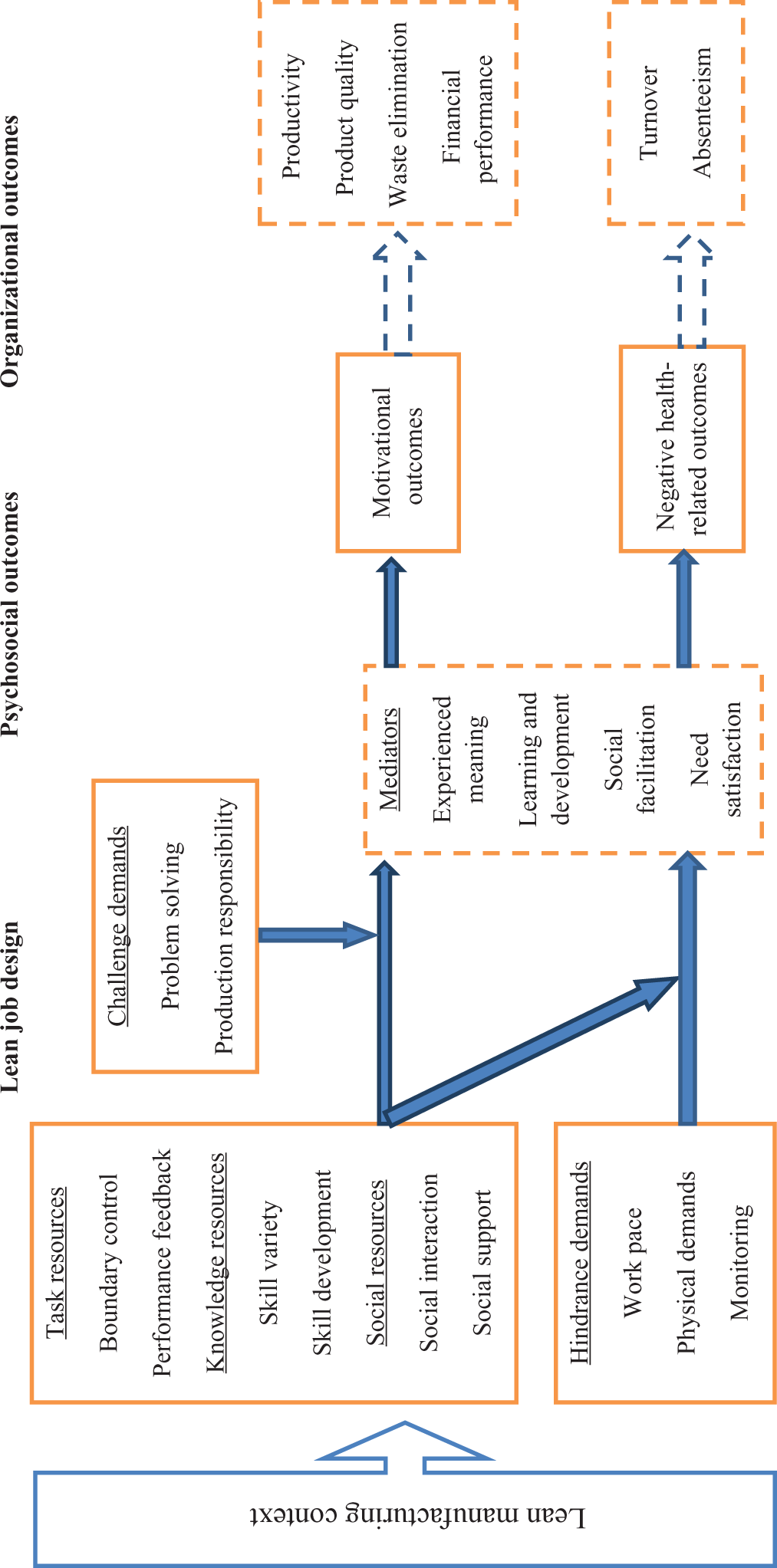
Model of job design under lean manufacturing and its impact on employee psychosocial outcomes.
Footnotes
Acknowledgements
The authors thank the Associate Editor of Organizational Psychology Review, Stephen Humphrey, and the two anonymous reviewers for their valuable and encouraging feedback in preparing this manuscript.
Funding
This research is funded by the Irish Research Council. Financial assistance was also received from DCU Business School.