







Abstract
Theory and research on self-regulation emphasizes the importance of goals for guiding human behavior. Critical phenomena within the self-regulation literature are discrepancies between actual states and goal states. When such discrepancies are detected, they capture attention and effort is mobilized to move actual states closer to goal states (or in some cases align the latter with the former). While discrepancy feedback, or the distance between actual and goal states, is important, so too is velocity feedback, or the rate at which actual–goal discrepancies are decreasing. Unfortunately, research has mostly ignored the role played by velocity in the self-regulation process. To redress this limitation, we review the concept of velocity, the empirical studies that have examined this concept, and how velocity is commonly measured. We then discuss the role of velocity as it pertains to three self-regulatory functions at work: achieving performance goals, satisfying belonging needs, and satisfying esteem needs.
Understanding employee behavior within organizations, regardless of whether such behavior involves completing work tasks or building relations with colleagues, necessitates an understanding of self-regulation (Lord, Diefendorff, Schmidt, & Hall, 2010). Self-regulation is the continual process of setting goals and then moving toward those goal states 1 via feedback (Carver & Scheier, 1998; Johnson, Chang, & Lord, 2006; Klein, 1989). Goals, or mental representations of desired states (Austin & Vancouver, 1996), guide people’s attention, effort, and action because they denote attractive states that are discrepant from one’s current state, leading people to modify their behavior or cognition in order to align the two states. These goal setting and goal striving functions have proven invaluable for enhancing not only employee performance but organizational performance as well (Locke & Latham, 1990; Mento, Steel, & Karren, 1987; Rodgers & Hunter, 1991; Tubbs, 1986).
Given the importance of goals, a considerable amount of research both within and outside organizational psychology has studied their effects (Austin & Vancouver, 1996; Johnson et al., 2006; Locke & Latham, 2002). Much of this research has focused on identifying the characteristics of goals that enhance their effects on performance. For example, it is consistently found that goals have optimal effects when they stipulate difficult (vs. easy or moderate) and specific (vs. vague or “do your best”) levels of performance (Locke & Latham, 1990). In addition, goal–performance links are stronger when people have sufficient ability (Kanfer & Ackerman, 1989), self-efficacy (Bandura, 1991), goal commitment (Klein, Wesson, Hollenbeck, & Alge, 1999), and when they form implementation intentions to engage in goal-related behaviors (Gollwitzer, 1999).
Perhaps most important of all is that goals must be accompanied by feedback (Erez, 1977; Neubert, 1998). Feedback refers to the communication of goal-relevant information from a source in the environment to a recipient who must perceive and interpret the information (Ilgen, Fisher, & Taylor, 1979). As Locke and Latham (2002, p. 708) noted, For goals to be effective, people need summary feedback that reveals progress in relation to their goals. If they do not know how they are doing, it is difficult or impossible for them to adjust the level or direction of their effort or to adjust their performance strategies to match what the goal requires.
As mentioned before, self-regulation involves altering one’s behavior or cognition in order to reduce discrepancies between one’s current and goal states. Without feedback, though, there can be neither discrepancy nor the corrective motivation that results from detecting a discrepancy, because feedback communicates to people the status of their current state (Bandura & Cervone, 1983; Campion & Lord, 1982).
While feedback is required in order for the motivating potential of goals to be realized, there are different types of feedback during the goal-striving process (Carver & Scheier, 1998; Chang, Johnson, & Lord, 2010; Johnson et al., 2006). Discrepancy feedback involves communicating to people where their current level is vis-à-vis their goal level. That is, discrepancy feedback indicates distance or how far people are from their goals. Velocity feedback, on the other hand, communicates the rate at which discrepancies between current and goal states are changing. Velocity feedback therefore tracks progress or how fast people are moving towards their goals, which is the first derivative of discrepancy feedback over time (Carver & Scheier, 1998). 2 To illustrate the difference between discrepancy versus velocity feedback, we can take a marathon runner for example. At the beginning of the race (Time 1), the discrepancy is 26.22 miles, or the full length of the race. If the runner passes the 5-mile checkpoint 1 hour into the race (Time 2), this indicates that at Time 2, the individual has a discrepancy of 21.22 miles, and the velocity is 5 miles per hour (i.e., difference between 21.22 miles and 26.22 miles). Thus, while discrepancy feedback represents a static snapshot of a person’s current state, velocity feedback is dynamic and incorporates the consideration of time. Although both types of feedback are important with respect to self-regulation (e.g., Johnson et al., 2006; Lord et al., 2010), the majority of research on goal setting and striving to date has emphasized discrepancy feedback while overlooking velocity feedback. This asymmetry is unfortunate because velocity feedback is believed to be uniquely responsible for generating certain outcomes during the self-regulation process (e.g., positive and negative affect; Carver & Scheier, 1998; Hsee & Abelson, 1991) and for facilitating communication across different levels in goal hierarchies (Johnson et al., 2006).
The aim of this paper is to introduce readers to the important role played by velocity feedback in self-regulation contexts and to review existing research which has examined the effects of velocity. We begin by providing an overview of the self-regulation process and highlighting where velocity is believed to fit within this process. We then present empirical evidence that has documented the consequences of different rates of change in discrepancies between people’s current and goal states. Finally, we conclude the paper by discussing implications of velocity for employees and work organizations. Specifically, we offer propositions concerning the effects of velocity feedback on employees’ evaluations of work tasks (e.g., task commitment), of themselves (e.g., work-based self-esteem), and of other people (e.g., quality of leader–member exchange). If velocity feedback has effects that are incremental to those of discrepancy feedback, which is suggested by both theory (Carver & Scheier, 1998) and initial empirical research (Chang et al., 2010), then greater attention to velocity is essential for understanding how the self-regulation process unfolds in organizations.
The process of self-regulation
Given the pervasiveness and utility of goals in organizational settings, it is not surprising that there is a rich literature devoted to self-regulation, which considers the motivational processes that drive goal-relevant behaviors (Carver & Scheier, 1998; Kanfer, 1990; Lord et al., 2010). Specifically, both the establishment and pursuit of goals play a central role in self-regulation theories. Both of these processes, which are generally referred to as goal setting and goal striving, respectively, are important to understanding and predicting organizational behavior.
Employees are increasingly required to pursue numerous, often conflicting goals in modern organizations (O’Leary, Mortensen, & Woolley, 2011; Schmidt & Dolis, 2009). Goal setting entails the processes related to the establishment of specific mental goal representations from these many potential pursuits. As mentioned previously, research has consistently shown that commitment to specific, challenging goals leads to increased performance via a variety of mechanisms, including increased attention, effort, and persistence (Locke & Latham, 2002). These mechanisms, by which internalized goals direct individual behavior toward goal attainment, are collectively referred to as goal striving (Austin & Vancouver, 1996).
Feedback loops within a control system
Though not without its critics (e.g., Bandura & Locke, 2003), control theory (Carver & Scheier, 1981, 1998; Powers, 1973) is a prevalent self-regulation theory that encompasses both goal-setting and goal-striving behaviors. From its beginnings, control theory has posited that goal setting takes place within a goal hierarchy (Powers, 1973) in which goals at higher levels constrain the goal choices made at lower levels by setting the standards against which performance at these lower levels is judged (Lord & Levy, 1994). These performance standards in turn are proposed to influence goal striving via a series of negative feedback loops. Specifically, the presence of a negative discrepancy (such that one’s current state falls short of the goal state) is thought to focus attention on a particular goal and motivate action to reduce and eventually eliminate the detected discrepancy (Carver & Scheier, 1998).
As in other theories of self-regulation (e.g., goal theory; Locke & Latham, 1990, 2002), in order for this goal-striving mechanism to function, feedback about the current level of performance must be available (Erez, 1977; Neubert, 1998). In control theory, discrepancies between current and goal states are important determinants of behavior. Specifically, feedback from the environment serves as the input signal for a comparator mechanism. The other signal is the goal level (established during the goal-setting process), typically referred to as the referent signal. The comparator evaluates the feedback-driven input signal against the referent signal and determines whether a discrepancy exists. If the comparator detects a discrepancy between these signals, a behavioral (or perhaps cognitive) change is elicited in an effort to eliminate the detected difference. An example feedback loop is illustrated in Figure 1.
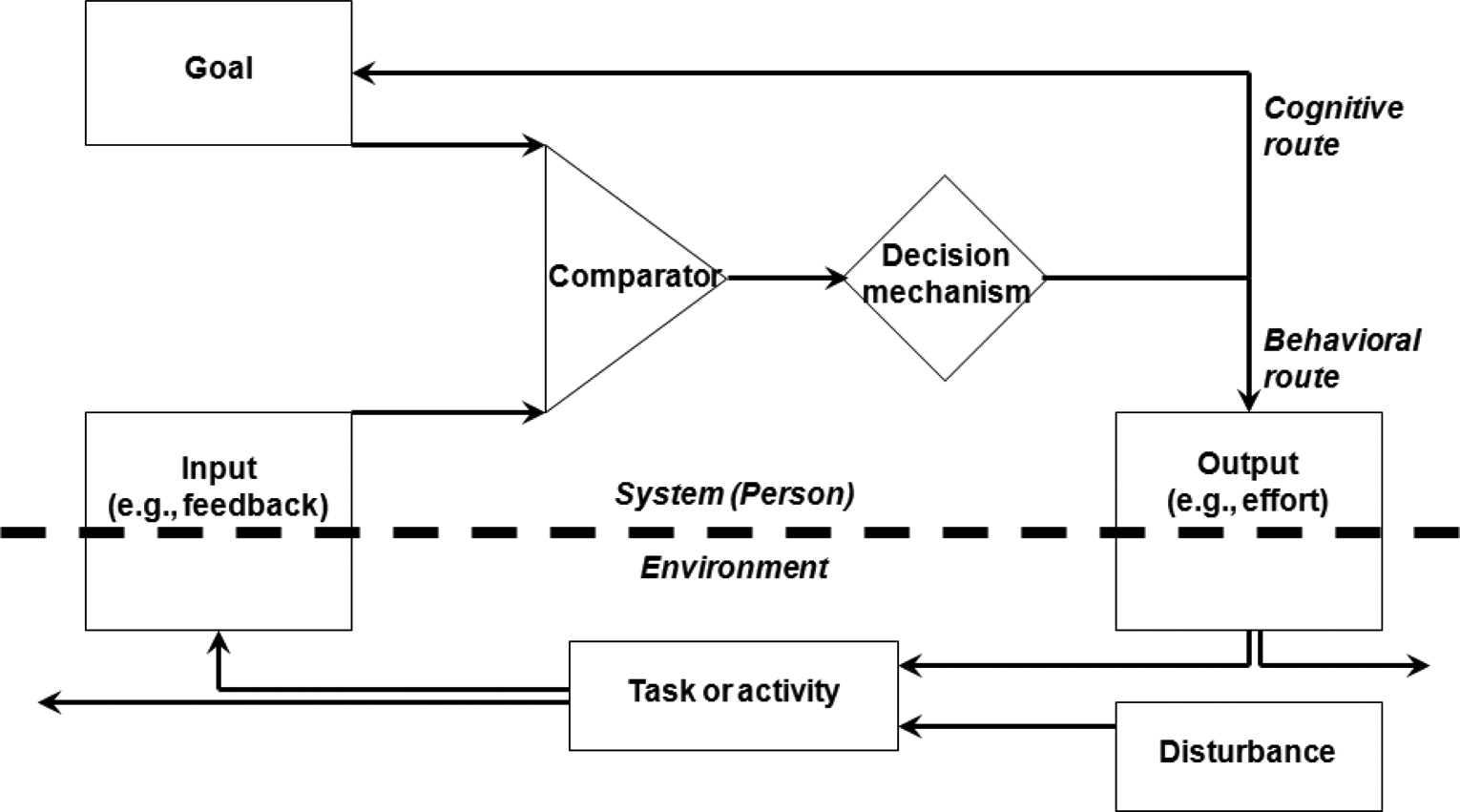
Feedback loop.
The previous discussion of Figure 1 is admittedly brief, but interested readers are directed to Powers (1973) and Carver and Scheier (1998) for more detailed explanations. Instead, we offer a task-based example in order to help illustrate the basic function of the various components of a control system. Consider a mason who is building a brick wall. In this case, the mason can literally see the completion status of the wall, and when the status is interpreted by the mason, this feedback becomes an input signal as indicated in Figure 1. The mason then evaluates this input vis-à-vis her goal, or desired level of wall completion. Assessing the existing wall in reference to the goal represents the comparator function. The output of the comparator is determined by the magnitude and rate of change of the difference between the input and the goal.
If this comparison indicates that the mason is falling short of her desired state, she must make a decision about how to address this discrepancy. She may decide to change her behavior by working harder and skipping a scheduled break (increased effort) or adopting a new way of laying bricks and using a laser guide to alleviate the need for frequent level measurements (increased efficiency). These behavioral modifications serve as an output that has the potential to impact the completion of the focal task. In turn, these changes in task performance subsequently serve as feedback signals and their effectiveness is evaluated as the process repeats.
As mentioned before, behavioral changes in response to feedback generally manifest as altering the level of effort exerted or the strategy employed to attain the desired goal or level of performance. Alternatively, a cognitive change may also result from a detected discrepancy. Rather than acting to modify the input signal (e.g., by working harder or more efficiently), the referent signal can be altered by selecting a goal that is more closely aligned with one’s current state. For example, if working harder or more efficiently does not produce the desired effect on the status of the existing wall, the mason may decide to extend her completion date, reducing her target level of wall completion at the present time (her current goal).
Regardless of the method of discrepancy reduction chosen, feedback about the success of the chosen course of action is obtained when the comparator subsequently reevaluate the performance input signal vis-à-vis the referent. Reduced or eliminated discrepancies signal that the course of action is working and no further actions are likely to be induced while no or minimal change (i.e., discrepancies remain the same) may signal the need for further attention and action (Carver & Scheier, 1998). While either type of change is potentially capable of reducing a detected discrepancy, goals often cannot be revised downward arbitrarily so behavioral change is generally the primary response to a noticed discrepancy while longer duration, stable discrepancies are more likely to elicit cognitive changes (Campion & Lord, 1982; Donovan & Williams, 2003).
Feedback loops at different levels within a goal hierarchy
As previously alluded to, control theorists note that the ability to change goal levels is constrained by the presence of a goal hierarchy. Changing a goal at one level may create larger discrepancies at higher levels in the hierarchy, something that people generally try to avoid (Lord & Levy, 1994). Building on the work of Powers (1973) and Newell (1990), Carver and Scheier (1998) noted that the highest levels of the goal hierarchy are generally reserved for broad, self-relevant “be” goals. Take, for example, the goal of “Be a great leader” at the top of the goal hierarchy illustrated in Figure 2. This abstract goal is achieved by pursuing more specific, actionable goals at lower levels in the hierarchy. As shown in the figure, the output of control loops at higher levels serves as the goal for control loops at lower levels. Midlevel, “do” goals, such as “Engaging in transformational leader behaviors,” deal with execution of programs or routines that are intended to move people closer to the higher level “be” goal. These “do” goals are achieved, in turn, by the completion of basic, discrete tasks or activities at lower levels in the goal hierarchy. In the case of our example, example activities might be “Communicating an appealing vision” and “Expressing confidence in subordinates.”
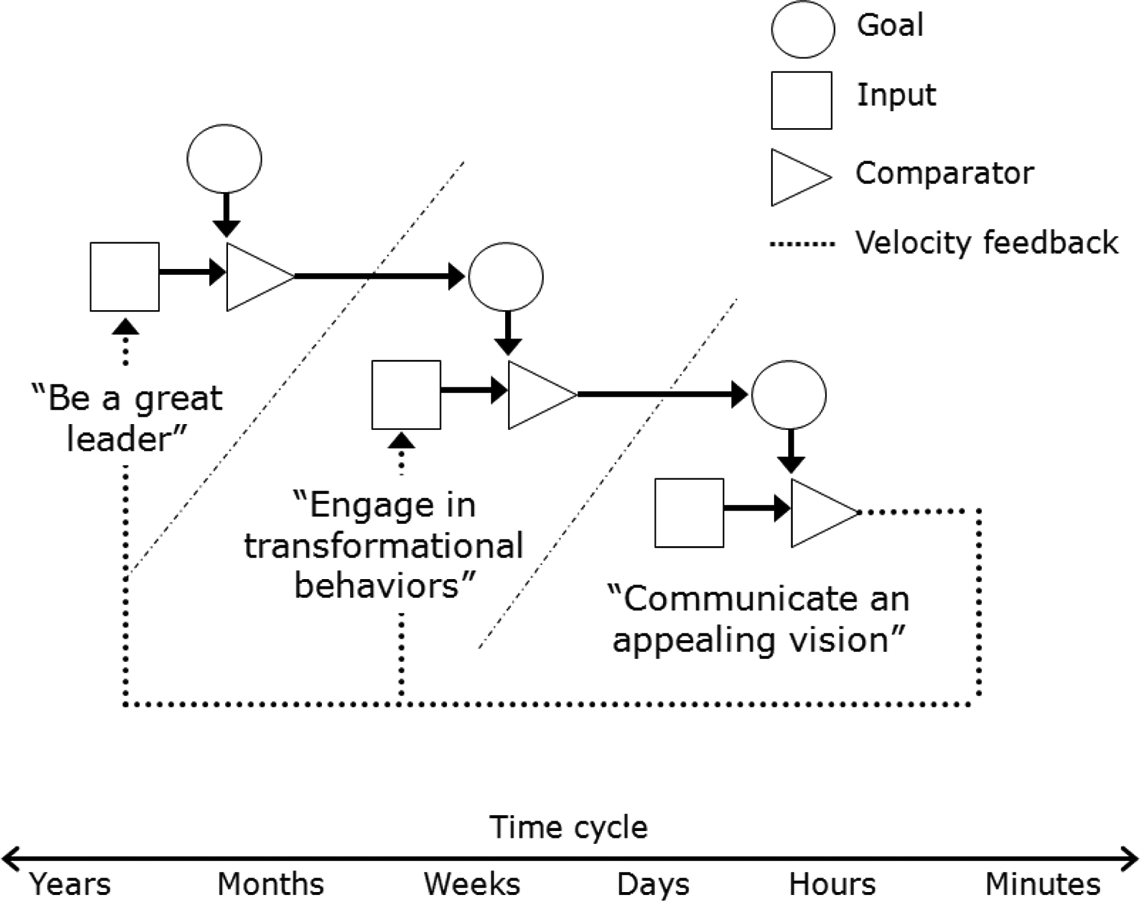
Hierarchical organization of feedback loops.
As pointed out by Lord and Levy (1994), the nature and characteristics of goals vary depending on their position in the goal hierarchy (see also Austin & Vancouver, 1996; Cropanzano, James, & Citera, 1992). For example, consider the high-level goal of personal environmental responsibility versus the lower level goal of turning off a light. First, the level of abstraction generally decreases with lower level in the hierarchy. While goals at the highest level may deal with abstract concepts and complex relationships (e.g., environmental responsibility), lower level goals concern concrete objects and simple relationships (e.g., turning off a light). Low-level goals, which serve as a means for achieving high-level goals, function as “guideposts and touchstones” as people move towards more abstract goals at higher levels in the hierarchy (Pacquiao, 2010, p. 158). Further, high-level goals give meaning to low-level goals, while low-level goals provide a means of accomplishment for high-level goals. As such, because low-level goals are generally a means to some other end, commitment to low-level goals and the accomplishment of such goals are less important than associated high-level goals, which can often be accomplished via several means (continuing with our example, minimizing water usage as opposed to turning off a light). Typically, the content of goals at the upper levels in people’s goal hierarchies represents fundamental values and beliefs that define who the person is (Cropanzano et al., 1992). As we discuss later, the regulation of esteem-based goals occurs at the top of the goal hierarchy. Finally, as one descends down the goal hierarchy, the cycle times of feedback loops at each level vary by orders of magnitude, with months or years typical for goals at the highest levels, hours or days at the middle levels, and minutes or seconds at the lowest levels. Thus, the stability of goals and goal-relevant action increases with level in the goal hierarchy. This also implies that goal-related information has to be aggregated over time before it can be fed back to higher levels in the goal hierarchy, which explains why velocity information (i.e., changes in goal–performance discrepancies over time) is crucial for upward communication across hierarchical levels (Johnson et al., 2006).
The previous discussion paints a relatively nuanced conceptualization of how current states are evaluated and regulated vis-à-vis goal states. Specifically, two sources of feedback inform behavior. The first is the magnitude of the discrepancy between the current state and the goal state. The second is velocity, which is equivalent to the rate (comprised of both the direction—increasing or decreasing—and speed) at which the magnitude of the discrepancy is changing with respect to time. In this case, the velocity feedback reflects a comparison between prior discrepancy information with the current discrepancy information, with the time lapse as the denominator. Whereas discrepancy feedback determines the direction of behavior, velocity feedback determines the intensity of behavior (Carver & Scheier, 1998). While recent work has highlighted the role of velocity in self-regulation (e.g., Chang et al., 2010; Elicker et al., 2010; Johnson, Taing, Chang, & Kawamoto, in press), the concept of velocity is not new. Over twenty years ago, researchers linked velocity to affect (i.e., fast velocity rates were proposed to elicit positive affect while slow rates elicit negative affect and average rates elicit no affect; Carver & Scheier, 1990). In addition to affect, velocity feedback is also associated with success expectancies for goal attainment (Carver & Scheier, 1998).
Research on velocity
Despite the important and unique role played by velocity in early theorizing on self-regulation, much of the empirical work conducted since has focused primary on discrepancy (vs. velocity) feedback. Nonetheless, a small body of organizational research investigating the effects of velocity has emerged. In this section we review the empirical work on velocity that has been conducted to date. This initial work provides a nice foundation for our later discussion of the implications of velocity feedback for employees’ evaluations of their work tasks, their self-worth, and the quality of their relations with other people.
In order to maintain a focus on velocity, our review excluded studies that included hybrid measures of goal progress and attainment (thus confounding two distinct constructs; e.g. Schmidt & Dolis, 2009; Wanberg, Zhu, & van Hooft, 2010) and hybrid measures of discrepancy and velocity (e.g., Scott, Colquitt, Paddock, & Judge, 2010). While progress rate information may have entered into the responses provided for the latter, such measures are more reflective of perceptions of remaining goal–performance discrepancies and fail to capture the specific rate at which discrepancies were changing at a particular point in time. Thus, given the complex relationship between discrepancies and velocities (cf. Johnson et al., 2006) and the unique roles of each (cf. Carver & Scheier, 1990), we excluded findings based on measures that appeared to inexorably confound the two types of feedback.
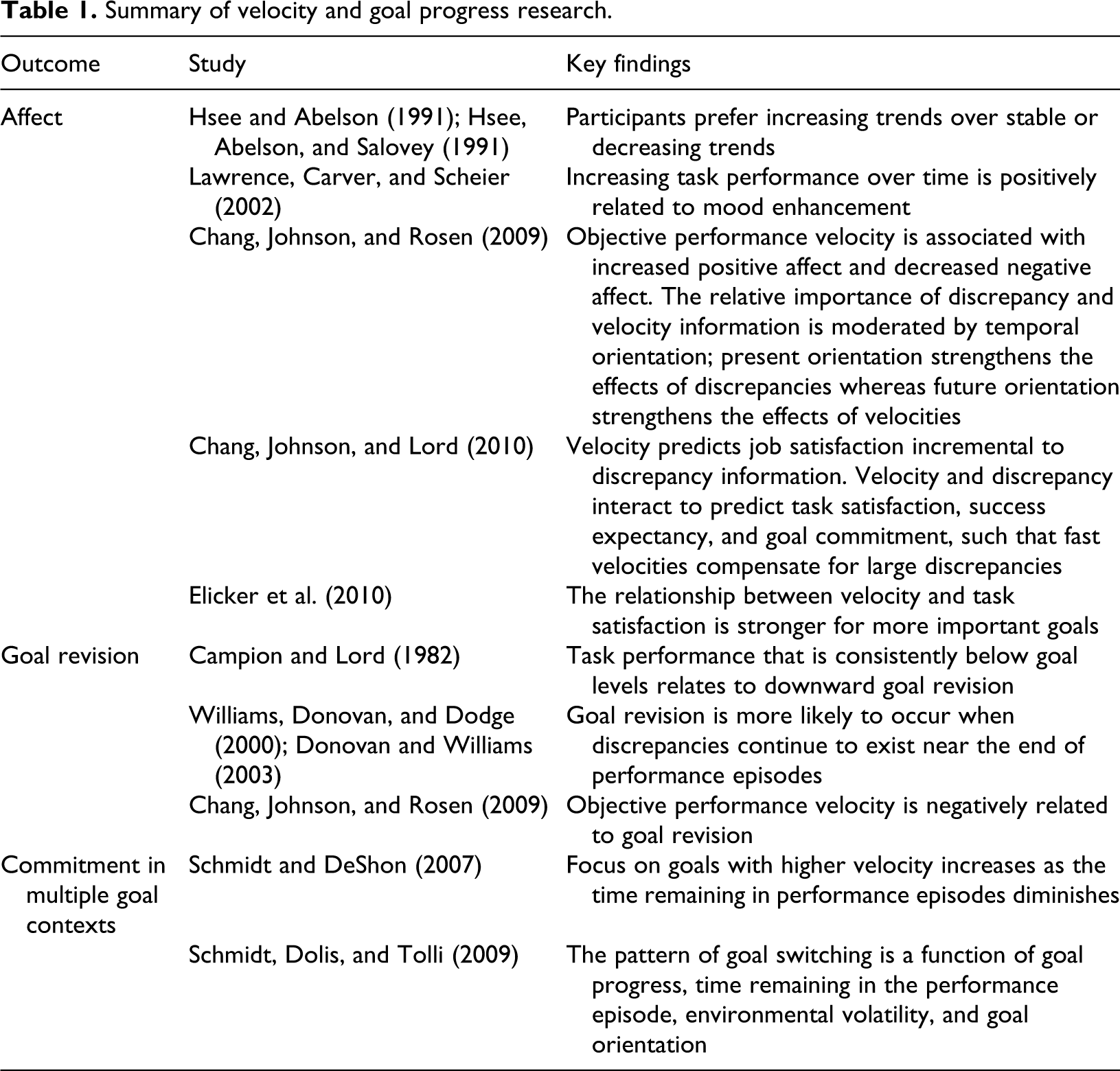
While goal attainment velocity has long been investigated in a variety of contexts (e.g., time perceptions; James, 1890; Meade, 1959), we have limited our review to research relevant to self-regulation, which itself dates back 30 years. Theoretical coverage of velocity within a self-regulation framework proposes that velocity feedback is a key antecedent of at least three outcomes: affective reactions to goal striving, success expectancies, and goal commitment (Carver & Scheier, 1998; Johnson et al., 2006; Lord & Levy, 1994). The three streams of research we review in what follows parallel these outcomes. The largest stream of research documents the affective implications of velocity, which was popularized in the control theory (Carver & Scheier, 1990). A second stream considers how velocity impacts behavioral (persistence) and cognitive (goal maintenance vs. revision) manifestations of success expectancies. The third stream touches on goal commitment, investigating the role played by velocity in dynamic, multiple goal-pursuit and goal-switching behavior. Each of these research streams is reviewed in what follows and summarized in Table 1.
Summary of velocity and goal progress research.
Effects of velocity on affect
Although self-regulation was not their main focus, Hsee and colleagues (Hsee & Abelson, 1991; Hsee, Abelson, & Salovey, 1991) were among the first to explicitly consider relations of velocity with satisfaction. They used choices among hypothetical situations to demonstrate that people have a preference for positive velocity compared to zero velocity, which was in turn preferable to negative velocity, finding that velocity is positively related to satisfaction, even when discrepancies are held constant across conditions. Interestingly, people preferred improving to a high hypothetical outcome (e.g., starting with a salary of $75,000 and receiving a 5% raise each year) over a constant high hypothetical outcome (e.g., a static salary of $100,000), even when the constant high outcome had a larger payout. One way to interpret this finding is that positive emotional responses are generated when people’s current state moves toward their goal state (in this case, their desired salary) independent of the size of the actual–goal discrepancy. In fact, emotional responses were less positive when actual–goal discrepancies were small but static. Due to the nature of Hsee and Abelson’s (1991) experiments however, it is difficult to determine whether the hypothetical situations are reflective of people’s preference for increasing goals (goal setting) or increasing performance relative to a stationary goal (goal striving).
Lawrence, Carver, and Scheier (2002) provided a more direct test of affective reactions to velocity via manipulated feedback on an ambiguous task. They demonstrated a similar pattern of results in the context of task performance relative to a goal, finding that the perceived performance trend was positively related to mood enhancement. Research has also demonstrated a positive relationship between velocity and positive affect as well as a negative relationship between velocity and negative affect using objective measures of velocity that involved tracking the rate of change in goal–performance discrepancies over time (Chang, Johnson, & Lord, 2010; Chang, Johnson, & Rosen, 2009).
More recent work in this area has begun to examine boundary conditions for these relationships. For example, velocity and discrepancy information interact to predict task satisfaction (as well as goal expectancy and commitment). The nature of the interaction is such that discrepancy feedback has a weaker effect on outcomes when velocity is fast versus slow—in other words, fast velocities compensate for large discrepancies (Chang et al., 2010). In addition, there is evidence that task importance may moderate the relationship between velocity and task satisfaction such that the relationship is stronger for more important goals (Elicker et al., 2010). This finding is consistent with affective events theory (Weiss & Cropanzano, 1996), which predicts that affective responses vary in intensity as a function of goal importance, though the theory does not discuss the role of velocity explicitly. As a final example, temporal orientation may influence the importance people place on velocity and discrepancy information, such that people with a strong present orientation care more about current goal–performance discrepancies whereas those with a strong future orientation care more about velocities (Chang et al., 2009).
Research in this area has also attempted to elucidate the difference between velocity and velocity discrepancy. As with performance, it is the discrepancy between perceived and desired velocity that is proposed as the relevant quantity for predicting outcomes (Carver & Scheier, 1990). Considering the rate of change in job characteristic perceptions relative to expectations, Chang et al. (2010) demonstrated that the difference between perceived and expected velocity was predictive of job satisfaction (specifically, smaller velocity discrepancies were associated with higher levels of satisfaction). Thus, over a relatively wide range of samples and methodologies, research in this area lends considerable support to the prediction that velocity impacts affective responses to goal-striving activities.
Effects of velocity on persistence and goal revision
In addition to affective outcomes, researchers have also considered the effects of velocity on success expectancies and goal revision. While they did not discuss velocity explicitly, Campion and Lord (1982) proposed that goal-relevant motivation is likely impacted not only by the size of goal–performance discrepancies but also by the stability of such discrepancies. Consistent with this idea, they found that consecutive performance episodes in which performance levels fell short of the desired goal (i.e., little or no velocity) were associated with more downward goal revision than the total number of episodes with subgoal performance levels. Subsequent longitudinal studies have found that the presence of goal–performance discrepancies near the end of the time allotted for a performance episode are more likely to result in downward goal revision for both distal and proximal goals than when there is more time remaining, providing some additional evidence that a lack of sufficient velocity in the past is associated with downward goal revision (Donovan & Williams, 2003; Williams, Donovan, & Dodge, 2000).
The relationship between velocity and goal revision has been explicitly tested as well using an objective velocity measure (calculated via differences in goal–performance discrepancies over time). In line with previous findings, objective velocity was negatively related to goal revision (Chang et al., 2009). One explanation as to why velocity affects goal revision is because people infer success expectancies from velocity feedback, such that fast versus slow velocities communicate that goal attainment is likely versus unlikely, respectively (Carver & Scheier, 1998; Chang et al., 2010; Johnson et al., 2006). Thus, in response to slow or negative velocities and thus the low probability of success, people revise their goals downward.
Effects of velocity on commitment in multiple goal contexts
A research stream considers the impact of velocity on goal striving in multiple goal contexts. Across a variety of conditions, when given multiple tasks to complete in a limited amount of time, Schmidt and DeShon (2007) found that participants initially focused on the more difficult goal. However, as the time allotted to the performance episode diminished, participants switched their focus to the task that they previously had more success in completing. In a subsequent study, these results were found to hold when goal progress was influenced by environmental factors; however, when goal progress was solely a function of individual effort, this pattern of results was reversed with participants initially focusing on the easier task and then switching to the more difficult task during the later parts of the episode (Schmidt, Dolis, & Tolli, 2009). Given our previous discussion on goal progress and velocity, it should be noted that the focus of the measures used in these studies is on relative goal–performance discrepancies across tasks. It is only because of the structured and relatively frequent progress assessment inherent in the experimental design that one can infer the role of velocity in the findings. In addition, while not conducted in an explicit multiple goal context, other research in this domain has found that explicitly measured velocity perceptions are positively associated with the mental focus devoted to a particular task, presumably at the expense of other tasks competing for limited attentional resources (Elicker et al., 2010). While the research in this domain is less mature compared to the other streams, initial findings indicate that velocity influences goal striving in multiple goal contexts, but the nature of these effects may vary as a function of time and environmental constraints.
Measurement of velocity
Prior to discussing the implications of velocity for employees in organizations, we first clarify how velocity has been operationalized in the empirical research described before. In general, researchers have developed three ways to measure or manipulate velocity. The first operationalization is based upon Carver and Scheier’s (1998) proposal that velocity is regulated by a separate feedback system (the metasystem), which compares actual velocity against ideal velocity. Along these lines, Chang et al. (2010, Study 1) measured participants’ subjective appraisal of their actual velocity and their ideal velocity. Both ideal and perceived velocity were then compared to examine their relative contribution to employees’ job satisfaction. This approach is akin to the subjective fit assessment in the person–environment fit literature (French, Rogers, & Cobb, 1974), where the individuals provide information about both the person and the environment (i.e., standards) for the comparison. The advantage of this approach is that it is theoretically driven and provides a direct test of the metasystem (Carver & Scheier, 1998). In addition, it takes individual differences in velocity standards into consideration. However, because this approach relies on individuals to provide information concerning both actual and desired velocity levels, cognitive biases that affect subject fit perceptions (e.g., consistency, dissonance; French et al., 1974) may also influence reports of perceived and ideal velocity.
A second approach involves providing participants with direct, objective progress rate as feedback. For example, Hsee and Abelson (1991) manipulated the velocity feedback by informing their participants that the rate of the salary change is 5% a year. This approach has the primary benefit of drawing causal inferences between velocity feedback and the outcome variables (e.g., efforts, goal commitment). However, the objective manipulation does not take individuals’ desired level of velocity into consideration. A final approach involves objective calculation of individuals’ changes in ideal–actual discrepancies over time. For example, Chang et al. (2009) measured students’ goal level and actual performance in class every 3 weeks over the course of the semester (15 weeks), and calculated the differences between discrepancies across two time points to indicate velocity. Donovan and colleagues (Donovan & Williams, 2003; Williams et al., 2000) used a similar approach when examining discrepancy changes over time regarding college athletes’ performance. The advantage of this approach is that velocity information is objectively generated rather than relying on individuals’ self-reports, which may be subjective to biases. In addition, researchers may space the delivery of measures across temporal intervals that is appropriate for the task under investigation. Unfortunately, similar to objective manipulation, objectively calculated velocity does not consider individuals’ preferred level of velocity. Lastly, it is possible that different measurements of velocity may represent conceptually different aspects of velocity. Given the infancy of the velocity literature, further research is needed to better assess the appropriateness of these measurement approaches for different research questions.
Implications of velocity feedback for employees and organizations
In this final section we discuss the implications of velocity feedback as they concern three different self-regulatory functions in work settings. The first involves goal attainment in achievement contexts, which requires employees to regulate their behavior and cognition around task-related goals associated with essential job duties (e.g., selling products, recruiting clients, publishing articles, etc.; Lord et al., 2010). We therefore discuss the effects of velocity on task-based outcomes and reactions, such as task satisfaction and persistence. The achievement goals associated with task-based regulation exist primarily at lower levels in people’s goal hierarchies, and much of the evidence for velocity presented thus far corresponds to this region.
A second self-regulatory function at work involves cultivating positive relationships with other people (e.g., supervisors, peers, subordinates, and external customers), which satisfies needs for relatedness and belonging (Baumeister & Leary, 1995). Employees desire a sense of camaraderie and to be accepted by others at work, as exemplified by the positive effects of social support (Rhoades & Eisenberger, 2002; Viswesvaran, Sanchez, & Fisher, 1999) and the detrimental effects of social exclusion (Ferris, Brown, Berry, & Lian, 2008). We therefore discuss the relevance of velocity for employees’ sense of belonging at work, which involves the phenomenon of person–environment fit (Edwards, 1991; Kristof, 1996). Belonging needs are broader than specific tasks goals, thus belonging-based regulation occurs at higher levels in people’s goal hierarchies.
The final self-regulatory function involves satisfying employees’ need for esteem (Maslow, 1954). Fulfilling this need elicits a sense of positive self-worth and the belief that employees serve useful and necessary roles in their organizations (Pierce & Gardner, 2004). In this section we discuss the effects of velocity on self-esteem. As one moves up the goal hierarchy, the standards and goals that people regulate around become more self-defining and important (Carver & Scheier 1998; Cropanzano et al., 1992). At the top of the hierarchy, then, are the fundamental values and ideal selves that people aspire to (Lord & Brown, 2004). For this reason, esteem-based regulation exists at the highest levels in people’s goal hierarchies, and influences the goals that emerge at the levels below it. For example, self-esteem derives in part from the quality of relationships that people have with others (Leary & Baumeister, 2000) and thus, one function of esteem-based regulation is to establish belonging goals at lower hierarchical levels. In what follows we discuss task-, belonging-, and esteem-based self-regulatory functions in turn.
Velocity and task-based self-regulation
As mentioned earlier, nearly all empirical studies concerning velocity have been conducted in achievement settings where participants must complete an assigned task or attain a specific performance level. As such, their results carry clear implications for employees’ task-based self-regulatory activities in organizational settings. In the case of task and job satisfaction, prior research (e.g., Chang et al., 2010; Hsee & Abelson, 1991; Hsee et al., 1991; Lawrence et al., 2002) has suggested that in addition to the discrepancy feedback, velocity, especially when it is faster than expected, is positively related to employees’ satisfaction at work. Fast velocity also encourages employees to sustain their goal pursuit efforts by enhancing the expectancy of successful goal attainment (Chang et al., 2010; Johnson et al., 2006). Lastly, velocity feedback may be particularly helpful for increasing employees’ persistence in goal pursuit when they experience large discrepancies between their current performance and the goal level (Chang et al., 2010; Chang et al., 2009). Interestingly, one byproduct of especially fast velocities may be reduced effort, owing to people’s belief that goal attainment is certain (Carver & Scheier, 1998). Such coasting effects have been observed in the case of high self-efficacy, which has negative relations with subsequent effort and performance (e.g., Vancouver & Kendall, 2006; Vancouver, Thompson, Tischner, & Putka, 2002). There is a need, then, for research that examines possible negative relations of velocity with performance, particularly when discrepancies are small.
While the aforementioned examples point to the possible direct generalization of effects associated with velocity, organizations may present some unique contextual characteristics that can either constrain or enhance these effects compared to those observed in the experimental setting. For example, while multiple studies have demonstrated the effects of velocity on downward goal revision (e.g., Chang et al., 2009; Donovan & Williams, 2003; Williams et al., 2000), these findings may be less applicable for employees in an organization. One of the objectives for the performance management system in the organization is to set standards for employees’ task performance. In this case, unless employees’ personal goal after their downward revision is still above the organizational standard, it is difficult to imagine that organizations will tolerate the continuous downward revision and not intervene to uphold a minimum level of task performance for employees.
On the other hand, there are other organizational settings where the effects of velocity are likely to be heightened. In particular, Chang et al. (2010) found that fast velocities compensate for large discrepancies, such that individuals maintain their task satisfaction, goal commitment, and success expectancy so long as velocities are fast (regardless of whether discrepancies are small or large). Interestingly, employees in organizations are often faced with situations where there are large discrepancies between their current standing and goal levels. For example, new employees face the daunting task of acquiring knowledge and attitudes that are necessary to function as effective organizational members (Chao, O’Leary-Kelly, Wolf, Klein, & Gardner, 1994). Similarly, employees in training may need to learn new and complex skills that involve a steep learning curve. In these situations, the satisfaction of employees who receive velocity feedback should be quite high owing to their rapid learning, despite large discrepancies between their current state and goal state. Over time, however, satisfaction may decline as employees become more expert and their rate of learning slows, consistent with the power law of practice (Newell & Rosenbloom, 1981). This suggests that the relative importance of velocity is greater during the early versus later stages of skill acquisition. Once employees have developed adequate skill, then the small discrepancy between employees’ current state and goal state may be sufficient for maintaining their satisfaction and motivation. This is consistent with Chang et al.’s (2010) finding that fast velocities and small discrepancies have compensatory effects.
There may also be cases where employees’ work environments are continually subject to changes in complexity, such that workers must handle higher levels of demands (i.e., component complexity), interact with constituents more frequently (i.e., coordinative complexity), or relearn how their behaviors translate into effective task performance (i.e., dynamic complexity; Wood, 1986). All of these changes in complexity result in sudden decrements in performance (Bell & Kozlowski, 2008; LePine, Colquitt, & Erez, 2000), requiring employees to adapt their behaviors in order to achieve task goals. Given that many employees respond to change with active or passive resistance (Kotter, 1995; Lawrence, 1954), communicating feedback that indicates positive velocity may encourage greater self-efficacy and persistence from employees, thereby enhancing their adaptive performance in response to environmental changes.
All of the aforementioned examples represent scenarios where large discrepancies are present, in which case velocity feedback may be particularly crucial in maintaining employees’ success expectancies, goal-directed efforts, and persistence. As such, organizations should assist employees’ self-regulatory activities by directing their attention to velocity, rather than discrepancy feedback. For example, goals should be set at the velocity level (i.e., standard for progress rate) for employees experiencing a large discrepancy. In addition, rather than providing employees with information that highlights the differences between their current states and the goal state, feedback should inform employees how much progress they have made towards the goal state. The increasing prevalence of computer-based management systems (e.g., enterprise resource planning and point of sale systems) and electronic record keeping means that in many cases the performance history information necessary to provide employees with velocity feedback is readily available. Doing so will likely offset the negative effects of discrepancy on employees’ task satisfaction, success expectancies, and goal persistence.
Interestingly, recent work by Reb and colleagues (e.g., Reb & Cropanzano, 2007; Reb & Greguras, 2010) pointed out that fast velocity may not only maintain individual employees’ own self-regulatory activities when they face large discrepancies, it may influence how others evaluate the focal employees’ performance. Reb and Cropanzano (2007) showed that holding average performance constant, when individual’s performance showed an improvement trend over time, participants rated the overall performance of such individual more positively than the performance of those who exhibited a flat or deteriorating trend over time. In this case, because the average performance was the same across different trend manipulations, an improvement trend can be considered as someone who started out with a large discrepancy from the goal (i.e., performance level was below the average), and demonstrated fast progress rate at reducing the size of the discrepancy. In a follow-up study, Reb and Greguras (2010) manipulated both average performance levels (i.e., below-average performance, average performance, above-average performance) and performance trends over time (i.e., improving, flat, deteriorating). They found that participants judged the overall performance to be more positive when an individual had a below-average performance but an improving trend, compared to one who had below-average performance and a deteriorating trend. These findings suggested that when employees experience large discrepancy but fast velocity, not only are they more likely to maintain their internal self-regulatory activities, but they may also experience external reinforcement (i.e., positive overall performance ratings) that may help maintain their motivation for goal pursuit.
A final implication is that providing velocity feedback may avoid some of the harmful effects of discrepancy feedback. Although task feedback may satisfy employees’ sense of competence (Gagné & Deci, 2005), in many cases it has weak or negative effects (Kluger & DeNisi, 1996). Detrimental effects occur because discrepancy feedback at high levels in the goal hierarchy invoke the self and indicate enduring person-based deficiencies, which elicit defensive responses and directs attentional resources to the self rather than tasks. Velocity feedback is different because it represents the aggregation of discrepancy feedback at lower task levels over time, which is then communicated to higher levels (Johnson et al., 2006; Lord et al., 2010). Although it is meaningful at higher levels in the goal hierarchy, velocity information is still about the task and not about the self. By providing information that is interpretable at higher levels yet information that is still task-focused, velocity feedback may promote the self-less focus that is needed to become sufficiently engaged in complex tasks (Gusnard, 2005).
Velocity and belonging-based self-regulation
One way that belonging and relatedness needs are satisfied at work is via person–environment fit, or when compatibility exists between ideal internal aspects (e.g., values and abilities) and experienced aspects of the external environment (Edwards, 1991; Kristof, 1996). Indeed, employees who perceive fit with their organization, supervisor, and/or coworkers report less strain and withdrawal cognitions, and are less likely to turnover than employees who perceive misfit (Hoffman & Woehr, 2006; Kristof-Brown, Zimmerman, & Johnson, 2005). Employees who perceive fit with their work environment also report more trust, group cohesion, and satisfaction, and they develop higher quality relationships and engage in more prosocial behaviors than employees who perceive misfit (Hoffman & Woehr, 2006; Kristof-Brown et al., 2005; Verquer, Beehr, & Wagner, 2003). These favorable consequences of person–environment fit owe to the successful regulation of belonging and relatedness needs.
Interestingly, the phenomenon of person–environment fit resembles the self-regulation processes we described earlier. That is, person–environment fit can be conceptualized as a discrepancy between people’s ideal conditions, which are derived from internal standards, and experienced conditions, which are derived from the external environment (Johnson et al., in press). Examples of ideal standards used to evaluate the environment include employees’ needs, values, traits, and task-based goals, knowledge, and skills (Kristof, 1996). These ideal standards are then used to judge the extent to which targets in one’s environment (e.g., supervisors, colleagues, and the organization) are compatible. Note that person–environment fit is not all-or-none; instead, employees vary in the extent to which they fit in with their environment (Edwards, Cable, Williamson, Lambert, & Shipp, 2006). Only when there are little or no ideal–actual discrepancies, then, do people experience a sense of belonging. When discrepancies are detected, however, it disrupts the system and motivates employees to alter their behavior (e.g., act in ways to reduce group conflict) or their cognition (e.g., deemphasize the ideal standard that is the source of misfit) in order to restore a sense of belonging. Thus, ideal–actual discrepancies play a central role in both self-regulation theories and person–environment fit theories.
If satisfying the needs for belonging and relatedness involves regulating ideal–actual discrepancies, then velocity feedback likely plays an important role (Johnson et al., in press). This is especially true because person–environment fit is not static, but rather it is a dynamic phenomenon that changes over time (Jansen & Shipp, in press; Shipp & Jansen, 2011). This suggests, then, that the extent to which employees fit with others changes over time, especially for new hires while being socialized (Cable & Parsons, 2001; Cooper-Thomas, van Vianen, & Anderson, 2004). During the socialization process, new hires are exposed to the values and beliefs of the organization and slowly begin to adopt them as they transition from outsiders to embedded members. An important part of this transition is how quickly new hires’ values and beliefs align with those of the organization. We therefore expect that person–environment velocity will predict newcomer adjustment and belonging outcomes (e.g., social acceptance, role clarity) incremental to person–environment discrepancy (Johnson et al., in press). In line with previous findings (Chang et al., 2010), discrepancy by velocity interactions are also expected, such that large person–environment discrepancies have little impact on adjustment and belonging outcomes so long as person–environment velocities are sufficiently fast.
Based on theoretical (Carver & Scheier, 1998) and empirical evidence (Hsee & Abelson, 1991), we expect that person–environment velocities will have stronger effects than person–environment discrepancies on affective reactions towards the targets of fit, such as liking for and satisfaction with supervisors, coworkers, or organizations. While not conducted in an organizational context, a recent experience sampling study by Laurenceau, Troy, and Carver (2005) found that the perceived velocity of interpersonal fit predicted affective responses in romantic couples above and beyond mean levels of perceived fit. Consistent with the current discussion, changes in intimacy, which reflects person–person emotion fit, were positively related to positive feelings about the relationship incremental to average intimacy level. There was also evidence that for some participants changes in relational conflict owing to values or goals misfit led to increased relationship anxiety incremental to average misfit level.
To the extent that positive reactions occur, they may spillover and cultivate a greater sense of loyalty and obligation to the other party, leading to the emergence of high-quality social exchanges rather than low-quality economic ones. For example, Jackson and Johnson (2012) found that supervisor–subordinate fit based on relational and collective values led to high-quality leader–member exchange, which in turn related to high levels of task and citizenship behaviors. Although the authors limited their focus to person–environment discrepancies, we suspect that fast person–environment velocities would have similar (and perhaps stronger) effects.
In addition to affective reactions, velocity also has stronger ties to persistence relative to discrepancy (Carver & Scheier, 1998; Chang et al., 2010). In terms of social contexts and belonging outcomes, this suggests that person–environment velocities will be important antecedents of commitment to the other party and, ultimately, continuation of the relationship with the other party. Given the affective undertones of velocity, fast person–environment velocities are likely to give rise to affective forms of commitment to one’s supervisors, coworkers, and organizations (see Meyer & Allen, 1997). When employees show affective commitment to another person or group, they internalize the values and goals of the other party and develop a strong emotional attachment to them (Johnson, 1991; Johnson, Chang, & Yang, 2010). This type of commitment creates a stronger bond in relationships than does commitment based on instrumental, quid pro quo exchanges. Thus, it is not surprising that employees who show affective commitment are unlikely to discontinue their working relationships with supervisors, coworkers, and companies (Meyer, Stanley, Herscovitch, & Topolnytsky, 2002; Taing, Jackson, Poteat, & Johnson, 2009). We therefore expect that person–environment velocities will have strong positive relations with affective commitment to partners and groups and negative relations with withdrawing from and quitting relationships and groups.
The final implications of person–environment velocity that we discuss involve the hierarchical organization of goals and feedback loops (as shown in Figure 2). This hierarchical organization also extends to person–environment fit, such that fit based on enduring person-level characteristics like needs, values, and traits exist at higher levels of the hierarchy whereas fit based on task-level characteristics like task-specific knowledge, skills, abilities, and goals exist at lower levels of the hierarchy (Johnson et al., in press). This suggests that not all types of person–environment fit are equally important given that the meaning and significance of standards decrease as you move down the hierarchy (Carver & Scheier, 1998; Johnson et al., 2006). Thus, person–environment discrepancies and velocities involving person-level characteristics will have stronger effects than discrepancies and velocities involving task-level characteristics. This idea is consistent with Kluger and DeNisi’s (1996) feedback intervention theory, which proposes that feedback elicits stronger reactions when provided at the person versus task level because the former invokes people’s sense of self. Although task feedback at the person level is harmful because it shifts people’s focus from the task to the self (Kluger & DeNisi, 1996), thus limiting the attentional resources needed to perform tasks effectively (Gusnard, 2005), fit feedback is more meaningful at the person level because it primes people’s defining values and goals. Fit based on these high-level, defining qualities should engender a stronger sense of belonging. Consistent with this prediction, empirical evidence suggests that needs–supplies fit tends to have stronger relationships with outcomes compared to task demands–abilities fit (Cable & Edwards, 2004). For example, the results of a meta-analysis conducted by Kristof-Brown et al. (2005) revealed that needs–supplies fit had stronger relations than demands–abilities fit with satisfaction (ρ = .61 vs. .41), commitment (ρ = .37 vs. .31), job performance (ρ = .20 vs. .12), and turnover intentions (ρ = −.50 vs. −.23).
Not only do the meaning and significance of standards differ across the goal hierarchy, but the importance of feedback may differ as well. Specifically, person–environment velocities likely have greater impact at higher (vs. lower) levels in the goal hierarchy because discrepancy information is aggregated over time at lower levels and is then fed back to higher levels in the form of velocity information (Johnson et al., 2006; Lord et al., 2010). In other words, velocity is the principal form of informational currency at the upper levels in goal hierarchies. Thus, person–environment velocities will be particularly influential when employees judge their fit with supervisors, coworkers, and companies on person-level characteristics like needs, values, and traits. Also, velocity feedback may not be as damaging as discrepancy feedback at higher levels because velocity is forward looking and emphasizes movement rather than people’s current states and degree of misfit. Taken together, velocity potentially plays an important role in the self-regulation of belonging and relatedness needs.
Velocity and esteem-based self-regulation
Self-esteem is a set of beliefs, attitudes, and emotional reactions that people hold about themselves, particularly about their self-worth and how others appraise them (Leary & Baumeister, 2000). Given the central role that work plays in many people’s lives, organization-based self-esteem (i.e., seeing oneself as an important, meaningful, effectual, and worthwhile member) contributes significantly to overall self-esteem (Pierce, Gardner, Cummings, & Dunham, 1989). Interestingly, just as people compare their current task performance to their ideal or goal level of performance, several scholars (Barkow, 1980; Bednar, Wells, & Peterson, 1989; Brockner, 1988; Korman, 1970; Leary & Baumeister, 2000; Swann, Rentfrow, & Guinn, 2002) have proposed that people compare information concerning their personal worth, which is gleaned from the environment, to their self-esteem level, which serves as the standard within a feedback system. Although there is debate regarding whether people desire positive, self-enhancing feedback (Shrauger, 1975) versus accurate, self-verifying feedback (Swann et al., 2002), both perspectives agree that “people want to avoid losses of self-esteem and so are loath to receive feedback that is more negative than their current self-appraisal” (Leary & Baumeister, 2000, p. 4). Nevertheless, the crucial detail is that self-esteem operates within a feedback system, which means velocity feedback is relevant.
The need for esteem is satisfied when instrumental and relational feedback from the environment is equal to or greater than a person’s ideal level of self-worth (i.e., his or her self-esteem). In terms of instrumental concerns, self-worth is used to judge the adequacy of one’s tangible and intangible economic outcomes, such as pay, recognition, and status symbols like job titles and offices. Equity theory (Adams, 1965) can be used to understand how this process unfolds, which posits that people compare their own input–outcome ratios to those of others. Inputs such as knowledge, expertise, effort, and academic credentials all contribute to employees’ perceived value to their companies (in other words, their organization-based self-esteem), and this perceived worth is judged against the outcomes that their company provides them. If a person’s own outcomes are not commensurate with his or her perceived worth, relative to the outcomes and worth of other employees, then the employee will take either behavioral or cognitive action aimed at eliminating the discrepancy. Usually employees deal with discrepancies first by altering their behavior (changing their own inputs or outcomes, or those of others), followed by altering their cognition (changing the referent standard or their perceptions of inequity) if initial attempts at reducing discrepancies are unsuccessful (Adams, 1965).
To date, research on equity theory has focused on discrepancies between inputs and outcomes and between one’s own input–outcome ratios and other people’s input–outcome ratios. Velocity, however, may also play a role. For example, given its unique ties to affect, velocity feedback may temper negative emotional reactions to perceived inequity if input–outcome discrepancies or own–other ratio discrepancies are shrinking at acceptable rates. In this vein, detecting a discrepancy is akin to a primary appraisal, whereas velocity information functions like a secondary appraisal that indicates whether or not a person is able to cope with the unfavorable discrepancy (see Lazarus, 2001). Although discrepancies produce an immediate negative emotional response, this initial reaction will subside if velocity feedback is favorable. Example actions that companies can take to increase employees’ outcomes and thereby increase the perceived velocity at which input–outcome discrepancies are shrinking include traditional means like pay raises and promotions, but also alternative means like training and development opportunities, and enhancing job autonomy and skill variety. Even low-cost means like increased recognition and opportunities for voice may create more favorable input–outcome discrepancies. So long as employees perceive these discrepancies are becoming smaller (i.e., positive velocity), employees’ affective reactions toward their job and themselves will be favorable.
Given its ties to withdrawal, velocity feedback may also prove valuable for predicting whether or not employees exit exchange relationships owing to perceptions of inequity. That is, if the rate at which input–outcome discrepancies or own–other ratio discrepancies are reducing is acceptable, then employees will be more likely to remain in employment relationships with their company or supervisor. In contrast, slow changing or stagnant discrepancies communicate that the self-worth of employees as members of their current organization is questionable, which may constitute a job-related shock that precipitates thoughts of quitting and external job searches. Thus, fast velocities may help employees to preserve their perceptions of self-worth in organizations, even in the face of current economic inequities.
Self-worth is also used to judge the adequacy of one’s relational outcomes, such as attention, deference, and eligibility for social inclusion (Barkow, 1989; Leary & Baumeister, 2000). According to sociometer theory (Leary & Baumeister, 2000), the feedback system monitors other people’s language and behavior and responds to discrepancies between incoming social inclusion information and self-esteem levels. Threats of social exclusion motivate people to take action in order to repair interpersonal relations. What drives emotional responses during this self-regulatory process, however, are changes in social inclusion status, such that increases and decreases in relational evaluations elicit positive and aversive emotions, respectively (Leary & Baumeister, 2000). A decrease in social inclusion status will push esteem-based regulation to the forefront of employees’ attention, with the goal to slow and ultimately reverse the decrease. Doing so would entail influencing the emergence of belonging-based goals at lower levels in the goal hierarchy in order to strengthen interpersonal ties. Unfortunately, research to date on the process of seeking feedback from others regarding how one is perceived and valued at work and comparing this feedback to internal standards (i.e., self-esteem) has been limited to discrepancy information (Swann, Johnson, & Bosson, 2009). As we discussed in the previous section though, velocity also influences interpersonal relations between people (e.g., Laurenceau et al., 2005), which has implications for both esteem and belonging needs.
Conclusion
In the current paper we discussed the role that velocity feedback—or changes in discrepancies between one’s current state and ideal state over time—plays in the process of self-regulation. We identified three major trends in the current research concerning velocity, including the effects of velocity on affective responses during goal pursuit, the effects of velocity on persistence and goal revision, and velocity in multiple goal contexts. We also discussed the implications of these basic research findings for employees within organizations. In particular, velocity feedback is likely to influence employees’ task-related regulation, particularly when in situations where employees are experiencing large discrepancies (e.g., newcomers to an organization, employees going through organizational change). Velocity feedback also plays a role in belonging- and esteem-based regulation because the rate at which discrepancies are changing between employees’ self-views and the relational and instrumental feedback they receive from the environment matters. Despite its relevance however, there has been little empirical work on velocity to date, which is a problem we hope to see addressed.
Footnotes
This research received no specific grant from any funding agency in the public, commercial, or not-for-profit sectors.