







Abstract
In the current paper, we provide a formal taxonomy of the organizational context relevant to newcomer socialization. We also propose that what newcomers learn during socialization periods (i.e., socialization content) and how they could learn the new information and knowledge (i.e., socialization process) are two distinct but related aspects of newcomer socialization. Based on these conceptual developments, we establish a theoretical model that articulates the mechanisms via which different contextual factors may impact newcomer socialization content and socialization process. Implications and future directions related to this theoretical model are discussed.
Newcomer socialization is an important research topic from both individual employee and organizational perspectives (Reichers, 1987). Organizations will have to facilitate adjustment for a considerable proportion of their workforce at any given time, whether it is employees who are new to the organization as a whole, or employees who are being transferred or promoted to completely new roles within the organization. For employees, entry into a new job represents a transition that thrusts one into unfamiliar situations where their initial expectations are often challenged by their actual experiences (Louis, 1980; van Maanen, 1977). Such a “reality shock” could produce stress and tension, which in turn could lead to behavioral, psychological, and physiological side effects such as lack of productivity, behavioral withdrawal, dissatisfaction, interpersonal conflict, turnover, and even physical illness (Ganster & Rosen, 2013; Halbesleben & Buckley, 2004; Kammeyer-Mueller, Wanberg, Glomb, & Ahlburg, 2005; Nelson, 1987). Therefore, it is desirable for individuals to minimize this anxiety and stress by effectively learning about and adjusting to the new environment. For organizations, high-quality socialization means that newcomers develop better perception of fit to the organization, devote themselves to their work role, and rapidly achieve satisfactory job performance (Bauer, Bodner, Erdogan, Truxillo, & Tucker, 2007; Wang, Zhan, McCune, & Truxillo, 2011).
Studies have explored the effects of both organizational practices and individual proactivity during newcomer adjustment. Research on organizational practices mainly focuses on socialization tactics (e.g., Ashforth, Saks, & Lee, 1998; Ashforth, Sluss, & Saks, 2007; van Maanen & Schein, 1979). Most of these studies suggest that organizations can increase newcomer commitment and role clarity by providing systematic institutionalized socialization practices (e.g., Ashforth & Saks, 1996; Gruman, Saks, & Zweig, 2006), but the manner in which the general social environment influences newcomer adjustment remains underinvestigated. Research has not systematically examined contextual antecedents of newcomer socialization like organizational climate or work group climate. As a result, there is no overarching taxonomy that can integrate and guide our understanding of contextual factors in predicting how newcomers become adjusted. Since socialization can only be interpenetrated within the specific setting in which it unfolds (Ashforth & Saks, 1996), we can only fully understand socialization in organizations if we establish a model concerning organizational context and link it to newcomer socialization and adjustment.
From another perspective, previous research has also examined how newcomers proactively acquire knowledge and build relationships (Ashford & Black, 1996; Fisher, 1986). Numerous studies have examined the antecedents (e.g., personality, pre-entry knowledge, and socialization tactics), behaviors (e.g., information seeking, relationship building, job-change negotiation, and positive framing) and outcomes (e.g., role clarity, social integration, job satisfaction, turnover, and job performance) of proactivity (e.g., Gruman et al., 2006; Kammeyer-Mueller & Wanberg, 2003; Morrison, 1993a, 1993b; Wanberg & Kammeyer-Mueller, 2000; Wang et al., 2011). However, little research has investigated what content newcomers acquire during socialization. Only one study has systematically explored possible dimensions of the content of newcomer socialization (Chao, O’Leary-Kelly, Wolf, Klein, & Gardner, 1994). Therefore, it is meaningful and critical for researchers to differentiate what newcomers should learn in terms of content from how they learn in terms of process during socialization.
Focusing on these two underexplored areas, this paper makes two important contributions to understanding newcomer adjustment. First, it makes use of a formal taxonomy of organizational contextual factors to help describe and understand newcomer adjustment content (Frederiksen, 1972; Kelly et al., 2003). The ways in which individuals interact with the new organizational context to learn about new environment will likely influence the way via which newcomers become integrated. For example, in an environment marked by high degrees of cooperation, newcomers will place more importance on learning how people relate to one another and can probably collaborate more with others to make this learning happen, whereas a less cooperative environment will lead newcomers to place more importance on individual performance, and newcomers will probably need to figure out more on their own. Therefore, it is necessary to incorporate considerations of contextual factors into newcomer adjustment theories to understand their socialization process. Although some previous theorizing offers preliminary taxonomies of organizational contexts (Johns, 2006), to our knowledge, no taxonomy articulates the processes by which organizational context influences newcomer adjustment. In the current paper, we identify three types of socialization contexts (i.e., formal organizational practices, climate, and socialization agents) that may influence how newcomers adjust themselves to the new environment.
Second, the current paper contributes to the newcomer adjustment literature by explicitly distinguishing content learned by newcomers from the process newcomers engage in to become adjusted. In particular, we argue that the socialization content concerns about what newcomers should learn during their socialization with organizations (e.g., Chao et al., 1994; Cooper-Thomas & Anderson, 2002), while the socialization process focuses on how newcomers learn necessary information, interpret, and cope with events in the new environment, and finally reach ideal functional levels on their new jobs (e.g., Ashford & Black, 1996; Morrison, 1993a). In other words, socialization content determines the information that newcomers are supposed to master and relationships they must establish. How well they do so, on the other hand, depends on the methods or tactics they use during the socialization process. Previous studies about newcomers’ information and knowledge acquisition emphasized more on the different types of social tactics and proactive behaviors, while rarely specifying how these processes are influenced by the content of the information and the relationships that are established (Chao et al., 1994). As such, the current paper not only distinguishes socialization content and process, but also proposes a model that offers different links between socialization contexts and these two distinct socialization components to help us understand the formation of socialization content and the emergence of socialization process.
Figure 1 illustrates our proposed model of the contextual influences on socialization content and process. The model begins with context variables (formal organizational practices, climate, and socialization agents), proceeds to newcomer socialization content and process, and ends up with amount of learning. We focus on amount of learning as an outcome of the socialization process in our model for two reasons. First, previous research has shown that amount of learning is the most proximal outcome during newcomer socialization, and therefore should be clearly related to the quality of socialization process. According to Morrison (1993a), the more newcomers learn about their new jobs and workplace, the more likely they are to become integrated into the new environment. Second, focusing on amount of learning as an outcome also highlights the importance of socialization content during newcomer adaptation. Although previous studies have examined many other outcomes of newcomer socialization (e.g., role clarity, social acceptance, self-efficacy, job performance, organizational commitment; Bauer et al., 2007; Saks, Uggerslev, & Fassina, 2007), the attainment of these attitudinal outcomes largely depends on what is learned. For example, it is possible that newcomers may experience more job satisfaction when they learn how to master organizational politics, or become less satisfied once they realize that an organization is a very political place. Socialization content mastery, on the other hand, is more likely to increase consistently in response to environments conducive to learning, and thus should be easier to predict in an unambiguous manner.
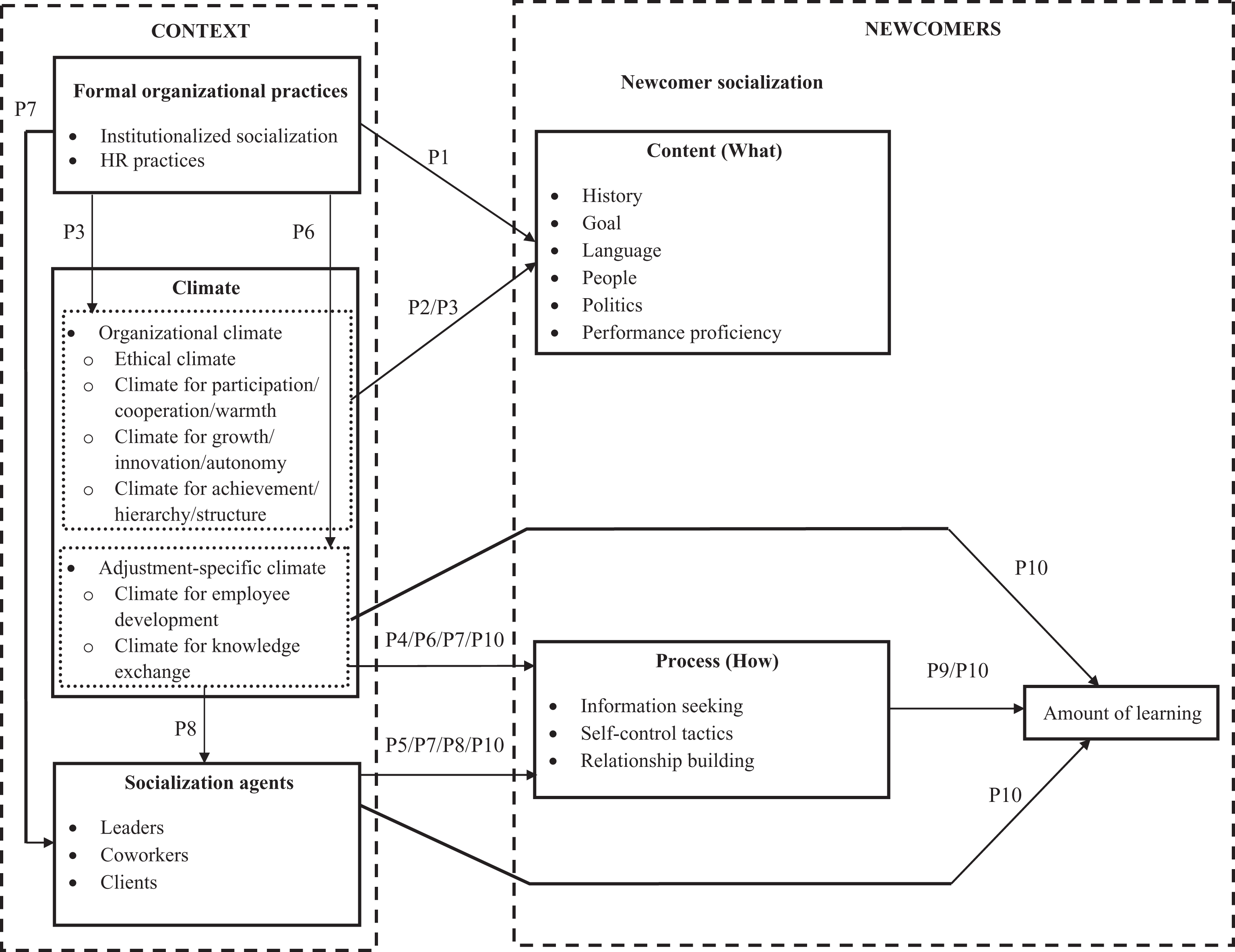
The proposed model of contextual influence on socialization content and process.
In the next sections, we first provide an overview of the key constructs in the proposed model regarding socialization context. We then offer propositions about the relationships among socialization context variables, socialization content and process, and learning outcomes. Lastly, we discuss both theoretical and practical implications of our model.
Key constructs in the theoretical model
Socialization contexts
Johns (2006) defined organizational context as “situational opportunities and constraints that affect the occurrence and meaning of organizational behavior as well as functional relationships between variables” (p. 386). Following this definition, we identify three types of organizational context relevant to newcomer socialization: formal organizational practices, climate, and socialization agents. This taxonomy of socialization context covers both objective context determined by organizational practices and subjective contexts that are influenced by objective organizational practices as well as the perceptions and social interactions among organizational members. It also includes organizational contexts for newcomer socialization at different levels—from the broad organization they work in to the specific persons they are interacting with. It is important to note that this taxonomy is heuristic in nature. In other words, we developed this taxonomy largely by assembling constructs that match the definition of organizational context offered by Johns (2006), and that can be logically expected to influence newcomer socialization. Although this taxonomy is not exhaustive, given its broad coverage and hierarchical nature, we contend that the overarching structure is inclusive enough to offer a solid framework for investigating how socialization context may influence newcomer socialization.
Formal organizational practices
In newcomer socialization literature, formal organizational practices are explicit policies and methods adopted by organizations to help newcomers successfully adjust to the new work environments (Bauer et al., 2007). Van Maanen and Schein’s (1979) six-dimension typology of organizational socialization tactics contrasts various strategies employed in different types of organizations. Jones (1986) argued that the six tactics could form a gestalt, which was termed institutionalized socialization on one extreme, and individualized socialization on the other extreme. Several studies have shown that institutionalized socialization (i.e., collective, formal, sequential, fixed, serial, and investiture tactics) is better at reducing uncertainty inherent in the work experience by encouraging newcomers to accept established roles, thereby reproducing the status quo (e.g., Ashforth et al., 1998; Cable & Parson, 2001; Kim, Cable, & Kim, 2005). At the same time, individualized socialization (i.e., individual, informal, random, variable, disjunctive, and divestiture tactics) has been shown to be better at fostering newcomer role innovation and questioning of the status quo (N. J. Allen & Meyer, 1990; Mignerey, Rubin, & Gorden, 1995). Whichever strategy is pursued by the organization will change climates and social contexts encountered by newcomers. As noted earlier, because institutionalized socialization encourages conformity and rule adherence, it will also teach newcomers something about the organizational goals and politics, whereas individualized socialization conveys the opposite impression.
Besides these adjustment-specific practices, human resource (HR) practices may also influence newcomer socialization. According to Noe, Hollenbeck, Gerhart, and Wright’s (2008) system-based view, three major components of HR practices are recruitment and selection, performance management and development, and reward and compensation. All of these HR practices are associated with newcomer socialization. Specifically, the initial recruiting and selection system communicates what types of knowledge, skills, abilities, values, and personality traits are expected of individuals who join the organization. The performance management and development systems, as well as the selection of individuals for promotion, define, often quite explicitly, the organization-relevant knowledge that newcomers should learn to achieve good fit and successful performance in the new work environment. This host of knowledge may include which behaviors are valued and encouraged, which behaviors are discouraged or forbidden, and whom they should interact with to acquire resources and social acceptance more quickly. Further, the company’s reward and compensation system has been identified as a mechanism via which newcomers are assimilated to the new organizations (Fisher, 1986; Graen, 1976). Since the reward and compensation system is one of the primary mechanisms by which organizations encourage behaviors and attitudes that are consistent with organizational strategies and values (Kerr & Slocum, 1987; Pfeffer, 1977), it communicates to both established organizational members and newcomers what types of behaviors are encouraged, and motivates them to enact these behaviors.
To sum up, both organizational socialization tactics and HR practices could determine what newcomers should learn in their socialization period, and could influence lower level contexts such as organizational climate and socialization agents, which will be discussed later.
Climate
As noted by Ostroff, Kinicki, and Muhammad (2012), climate refers to “employees’ perception of what the organization is like in terms of practices, policies, procedure, routines, and rewards” (p. 644). Schneider (1975) suggested that climate should be studied with a particular referent or strategic focus that could indicate organization’s goals and should be conceived of as a “climate for” something. Following this suggestion, we adopted Ostroff’s (1993) taxonomy of organizational climates, which groups climates into the affective facet, the cognitive facet, and the instrumental facet. The affective facet refers to interpersonal and social relations in organizations, including climate for participation, cooperation, and warmth. The cognitive facet represents psychological involvement, self-knowledge, and development in work activities, including climate for growth, innovation, and autonomy. The instrumental facet concerns work processes and task involvement in organizations, including climate for achievement, hierarchy, and structure.
Other types of organizational climate not included in this taxonomy may also influence newcomer socialization. For example, ethical climate is the shared perceptions of what ethically correct behaviors are and how ethical issues should be handled in organizations (Victor & Cullen, 1988). Therefore, ethical climate establishes behavioral norms, from which newcomers can learn which behaviors are encouraged and which are not encouraged (e.g., norms for sharing information with clients, maintaining honesty, product quality, social responsibility, and environmental stewardship). In general, organizational climates could provide newcomers with the general perceptions of organizations shared by the existing employees.
Organizational climates discussed in the previous lines are employees’ general perceptions of the organizational environment, and can be contrasted with the climate that is particularly relevant to newcomer adjustment. Climates specifically involving newcomer adjustment include the climate for employee development and the climate for knowledge exchange. A climate conducive to employee development encourages both supervisors and coworkers to attend to the knowledge and skills possessed by newcomers and develop remedies for any deficits in these areas. Therefore, a climate which views employee development positively may offer an environment in which members of the immediate social environment will feel that they should actively participate in facilitating newcomer adjustment. Similarly, climate for knowledge exchange has been identified as a driving force that encourages knowledge exchange and creation among organizational members, which can lead to improved innovation and efficiency (Lin, 2008). Prior research and theorizing suggest that sometimes newcomers may perceive high risk associated with reaching out to others and asking for information. This is because newcomers may fear the possibility that their help- and information-seeking behaviors could be interpreted as them being either dependent or ignorant (Ashford, Blatt, & Vande Walle, 2003; Bolino, Valcea, & Harvey, 2010). A climate for open knowledge exchange can certainly help eliminate such perceived risk by encouraging newcomers to actively inquire and learn about the job, the role, the work group, and the organization more efficiently.
Socialization agents
Socialization agents is the third category in our organizational context taxonomy. This context includes the socialization agents newcomers encounter in their adjustment process, including supervisors and mentors (hereafter referred to collectively as leaders; Kammeyer-Mueller & Wanberg, 2003), coworkers, and clients. These socialization agents could provide newcomers with two general types of resources that facilitate their adjustment: tangible and intangible resources. Tangible resources refer to assets that have physical form, such as economic resources (e.g., pay and financial bonus) and material resources (e.g., office materials and commodities), whereas intangible resources represent those are hard to quantify in financial terms, and can be further subdivided into informational resources (e.g., task instructions and feedback, advice, and developmental opportunities) and psychosocial resources (e.g., social support, personal attention, and respect; Cropanzano & Mitchell, 2005; Foa & Foa, 1974, 1980; Wilson, Sin, & Colon, 2010). Economic resources are likely to help newcomers meet their financial goals during organization entry (e.g., achieving monetary independence). Material resources are likely to improve newcomers’ ability to perform their jobs and accomplish their tasks with better efficiency. Informational resources are likely to help newcomers with the process of information acquisition, whereas psychosocial resources are more likely to facilitate relationship building.
In particular, leaders and coworkers serve as sources within the organization from whom newcomers can acquire tangible and intangible resources to facilitate their adjustment (Bauer & Green, 1998; Ostroff & Kozlowski, 1992). Kammeyer-Mueller and Wanberg (2003) proposed that people in influential positions, such as leaders, exert a unique influence on role adjustment and personal integration. Leaders may facilitate newcomer socialization by offering socialization information (e.g., Morrison, 1993a, 1993b), by providing guidance and information of work role expectations (e.g., Bauer & Green, 1998; Kammeyer-Mueller & Wanberg, 2003; Sluss & Thompson, 2012), by explaining how informal political processes work (e.g., Ostroff & Kozlowski, 1992, 1993), and by serving as role models (e.g., Holton & Russell, 1997; Sluss, Ployhart, Cobb, & Ashforth, 2012). Leaders also play instrumental roles in determining the economic and material resources received by newcomers, mainly through the control of monetary rewards and equipment/materials that are important for conducting the jobs (Ashforth, Sluss, & Harrison, 2007). Coworkers have also been shown as one of the most important sources of information regarding knowledge of the work group (Morison, 1993b; Ostroff & Kozlowski, 1992). They may influence newcomer socialization by facilitating group integration (e.g., Kammeyer-Mueller & Wanberg, 2003), by helping newcomers integrate various pieces of information in the work setting (e.g., van Maanen, 1984), by communicating subtle values, norms, or expectations that may not be well understood by leaders (e.g., Schein, 1968). Using interviews and observational data, Scott and Myers (2005) demonstrated that new firefighters learned about the implications of emotional regulation on the job by observing emotion management tactics consistently used by veteran members of their work group. Similarly, Levine, Choi, and Moreland (2003) suggest that newcomers are more likely to understand the value of generating and sharing innovative ideas when members of their work groups demonstrate behaviors favoring innovation.
Other important sources that may benefit newcomer socialization are clients and customers (Ashforth, Sluss, & Harrison, 2007; Reichers, 1987). These external stakeholders may facilitate newcomer socialization by offering direct feedback about products and service, clarifying role expectations on the side of customer, and urging newcomers to learn quickly. For instance, Sutton and Rafaeli (1988) offer numerous examples from the ethnographic literature as to how workers are attentive to customer behaviors in order to better understand customers’ general preferences and predict what types of service behaviors would lead to more rewarding job outcomes (e.g., tips). In many contemporary organizations, there is an increased pressure to provide exceptional solutions to clients (e.g., Ibarra, 1999). Accordingly, for newcomers obtaining information and learning behaviors that may facilitate the provision of such exceptional service are highly desirable and often explicitly encouraged.
Socialization content and process
Having outlined the major features of context, we now turn our attention to the content and process of socialization. Socialization content and process are distinguished in the current model and are proposed to be the outcomes of different contextual factors. Although it has been argued that both aspects of socialization are important to understand organizational socialization (Chao et al., 1994; Morrison, 1993a), the two components have yet been integrated in a coherent framework both conceptually and empirically. In addition, compared to socialization processes, few studies have investigated antecedents of socialization content, which may have important implications for newcomer learning.
Socialization content
As mentioned earlier, socialization content refers to what should be learned by newcomers to complete their transitions into organizational insiders. Several different categories of socialization content have been proposed, among which Chao et al.’s (1994) six-factor category is the most comprehensive one and therefore is adopted in our model. Specifically, Chao et al. (1994) identified history, language, politics, people, organizational goals and values, and performance proficiency as six different types of socialization content. History refers to the traditions, customs, myths, and rituals of the organization and the personal backgrounds of particular organizational members. Language represents individual’s knowledge of the profession’s technical language as well as knowledge of the acronyms, slang, and jargon that are unique to the organization. Politics concerns information regarding formal and informal work relationships and power structures within the organization. People represent work relationships with organizational members. Organizational goals and values refer to specific organizational goals, norms, and values, either those formally written by organizations or those unwritten and informal goals and values espoused by members in powerful or controlling positions. Performance proficiency concerns job skills, job knowledge, and work roles, all of which are closely associated with job performance.
Although prior research has measured newcomer perceptions of how well they have mastered relevant content, it is our position that to truly understand how context shapes socialization, we need to understand of which this content actually consists. For example, one might expect that in an organization that has a climate that embraces participation, cooperation, and warmth, newcomers will have to master content regarding how to collaborate with others, whereas a less participative climate requires newcomers to master content regarding working independently. Similarly, a newcomer who works in an organization with an orientation toward growth and innovation will learn language pertaining to new product or service development, whereas a newcomer to an organization with the opposite climate will learn language pertaining to established products and services. This content could help newcomers understand both formal and informal organizational structures and interpersonal networks, and eventually could guide them act appropriately in specific interactions and circumstances with various organizational members (Fisher, 1986; Schein, 1968). In other words, categories of socialization content serve as the raw material that newcomers acquire to understand their new jobs. However, socialization content only determines what newcomers should learn. As for how much information and knowledge newcomers actually obtain, a more significant role is played by socialization process.
Socialization process
Socialization process, as mentioned earlier, refers to how newcomers approach information and knowledge necessary for their adjustment periods. Different from socialization content that is determined by the objective organizational environment, socialization process addresses newcomers’ proactive role in seeking information, applying self-control strategies, and building relationships (Miller & Jablin, 1991; Reichers, 1987; Wang et al., 2011). One of the most important socialization processes identified in the newcomer adjustment literature is newcomers’ information seeking behavior, which is driven by their motives to learn about the new environment (Morrison, 1993a). As an important process in newcomer socialization, information seeking has been found as a good predictor of both proximal (e.g., role clarity and social acceptance) and distal (e.g., job performance and job satisfaction) adjustment-related outcomes (e.g., Ashford & Black, 1996; Bauer et al., 2007). In a word, information seeking could facilitate newcomers’ acquisition of the content required to adapt successfully.
Some other socialization processes may also be important for newcomers’ acquisition of socialization content. For example, Ashford and Black (1996) proposed job-change negotiating as a tactic of getting control over the environment. Specifically, newcomers with a strong desire for control could be motivated to push for job changes aimed at creating jobs that better suit their preferences, skills, and abilities. This tactic could modify the existing position into a new configuration that better matches the newcomer, therefore improving the rate of acquisition of job- and organization-related knowledge and the degree to which the newcomer is satisfied and motivated by his or her work. Another type of control-related tactic is impression management, which addresses the control of beliefs and attributions formed by others regarding the newcomer (Leary & Kowalski, 1990). For newcomers, impression management could contribute to their socialization process by maximizing the reward–cost ratio in socializing with organizational insiders, by enhancing their self-esteem as a new member, and by facilitating the development of desired identities among others (Rosenberg, 1979), all of which could reduce barriers of social integration. Therefore, both job-change negotiating and impression management are self-control tactics that newcomers use during socialization process.
Ashford and Black (1996) also suggested relationship building as an important component of socialization process. Different from information seeking, which addresses the acquisition of task- and organization-related information, and self-control tactics, which address the acquisition of self-related benefits and control, relationship building emphasizes more on the social relational aspect of the organizational entry. Specifically, this tactic is aimed at seeking out interaction opportunities (Reichers, 1987), which can give newcomers situational identities, sense of organizational policies and procedures, friendship networks, and social support (Morrison, 1993b; Nelson & Quick, 1991). Targets of relationship building may involve organizational insiders such as leaders and coworkers and even outsiders such as clients and customers. Given the obvious overlap between these relationship building targets and the scope of socialization agents, we include relationship building as the third component of the socialization process in our model.
Relating context to socialization content and process
Context and socialization content
Based on the proposed model, we offer propositions to guide prospective investigations on the relationships between organizational context, newcomer socialization, and learning outcomes. Specifically, we advance three propositions in this section to link formal organizational practice and organizational climate to socialization content. First, we propose that formal organizational practices could determine the content that newcomers need to master during the socialization process. Specifically, adjustment-specific practices include both institutionalized tactics (e.g., the use of mentors and orientation training programs) and individualized tactics (e.g., on-the-job learning), and they could have impacts on socialization content with respect to people, history, language, organizational goal, and performance proficiency. On the one hand, organizations emphasizing institutionalized tactics usually have clear and fixed goals, regular tasks, and conservative staff (Jones, 1986). As such, newcomers are socialized by collectively and formally going through a common set of experiences, being exposed to a narrow range of situations and acceptable responses, and being offered clear guidelines for the task (N. J. Allen & Meyer, 1990). Similarly, they are likely to receive same narratives of organizational history and same set of language that is commonly shared by organizational members. On the other hand, organizations emphasizing individualized tactics usually possess innovative goals, changing tasks, as well as creative organizational members (Jones, 1986). These organizations often encourage on-the-job learning and challenge newcomers to justify or modify their behaviors (N. J. Allen & Meyer, 1990). Accordingly, newcomers may develop diverse goals, define their own performance standards, form their own narratives of the organizational history, and have more opportunity to shape the existing language shared by organizational members.
Further, HR practices could also influence socialization content. For one thing, the selection criteria and performance evaluation standards could determine what job skill, ability, task knowledge, and personality are required for newcomers’ positions (Bowen, Ledford, & Nathan, 1991; Hackman & Oldham, 1975). For another, because the promotion and reward are important incentives for individuals, relevant policies largely determine the desired values, task requirement, work relationships, and power structures within the organization. In fact, HR practices have long been recognized to convey important message to employees about organization’s past history, work relationships among organizational members, and evolving organizational goals (Noe et al., 2008). Taken together, we have
As discussed earlier, organizational climate refers to employees’ shared perceptions of the organization (i.e., reflecting the agreed-upon knowledge about the organization), while adjustment-specific climate is a domain-specific climate and is more relevant to how newcomer socialization process is carried out (Patterson et al., 2005; Schneider, 1975). Therefore, we propose that organizational climate and adjustment-specific climate influence newcomer socialization through different mechanisms; that is, organizational climate could determine socialization content while adjustment-specific climate would have an impact on the socialization process.
Specifically, organizational climate could determine newcomer socialization content in the following ways. First, organizational climate reflects organizational values and culture, which can serve as important socialization content for newcomers to learn. According to Schein (1985), climate can best be characterized as a manifestation of organizational values and can be regarded as a surface level indicator of culture. Therefore, organizational climate may appear to carry the socialization content that is immediately observable by the newcomers. For example, organizational climate can signal collective values and goals held by the organizational members and reflect the history that has shaped the organization and its members. Further, the language used to describe the organizational climate may be unique to the organization, thus highlighting the organizational identity that newcomers need to transition into. More specifically, climate for participation/cooperation/warmth may communicate the level of formal and informal power structure existed in the organization, providing a reference point for newcomers to learn about the politics and people in the organization. In addition, climates for innovation and achievement may both carry important information about desirable performance content and standards, signaling the level of performance proficiency that newcomers need to get used to.
Second, organizational climate has been shown to impact organizational-level outcomes, such as collective attitudes, productivity, and customer satisfaction (e.g., Patterson, Warr, & West, 2004; Rogg, Schmidt, Shull, & Schmitt, 2001; Schulte, Ostroff, Shmulyian, & Kinicki, 2009). Those organizational-level outcomes can provide additional cues to inform newcomers the people, goal, and expected performance proficiency of the organization. For example, collective attitudes of organizational members are directly observable to newcomers and suggest to newcomers what socially acceptable attitudes toward various targets are in their new work environment. These collective attitudes may also manifest in the forms of language or politics, which are important for newcomers to get familiar with.
Finally, organizational climate might have top-down influence on organizational members’ behaviors. Carr, Schmidt, Ford, and DeShon’s (2003) meta-analysis demonstrated that the affective, cognitive, and instrumental facets of organizational climate might influence organizational members’ distal behaviors (e.g., effort, performance, and withdrawal) through its impact on their cognitive and affective states (e.g., job satisfaction and organizational commitment). As Sutton and Rafaeli (1988) argued, these behaviors are critical devices that carry the socialization content, because newcomers often learn organizational values, goals, and principles through both vicarious processes and imitation. Therefore, consistent behavioral patterns of organizational members serve as the basis for understanding what actions are desirable and how actions lead to outcomes at work, which has important implication for conveying information regarding organizational goal, politics, and performance proficiency.
As the higher levels of organizational context may have top-down effects on the lower levels of context (Johns, 2006), we further propose that formal organizational practices will influence the organizational climate, which in turn shapes the content of newcomer socialization in the organization. Since the relationship between the organizational climate and the content of newcomer socialization has already been discussed earlier to develop Proposition 2, here we only focus on the influence of formal organizational practice on the organizational climate.
Organizational practices are the means through which employees’ perceptions of climate are created and shaped (Ostroff et al., 2012; Schneider, 1975). Theoretically, this argument is consistent with the attraction–selection–attrition model proposed by Schneider (1987). According to this model, attraction, selection, and attrition will lead to the unique organizational structures, processes, and cultures through the employment cycle in the organization, starting with newcomer socialization. Further, this model suggests that formal organizational practices play an important role in shaping all three phases of the employment cycle (Schneider, Goldstein, & Smith, 1995). Therefore, it is conceivable that formal organizational practices will eventually shape employees’ shared perceptions of the organization. Empirically, the relationship between formal organizational practices and organizational climate has also been well established (e.g., Bowen & Schneider, 1988; Ngo, Foley, & Loi, 2009; Rogg et al., 2001). For example, Ngo et al. (2009) found that both top management support for equal opportunities and family friendly work practices were positively related to corresponding organizational climate. Further, Collins and Smith (2006) also showed that HR practices influenced growth/innovation-related organizational climate. Therefore, we hypothesize that formal organizational practices will influence the content of newcomer socialization via the mediation role of organizational climate.
Context and socialization process
In this section we offer seven specific propositions about the relationships among organizational context, socialization process, and learning outcome. To begin with, while organizational climate could determine the content of learning during socialization, adjustment-specific climate could influence how newcomers approach the content (i.e., the socialization process). A positive adjustment-specific organizational climate could make it easier for newcomers to socialize and encourage them to be proactive in the new settings (Ashforth, Myers, & Sluss, 2012). As discussed before, climate for knowledge exchange and climate for employee development are two facets of adjustment-specific climate that are important for newcomer socialization.
Climate for employee development could encourage and support individual learning and growth (van Dam, Oreg, & Schyns, 2008). According to the norm of reciprocity, perceptions of a supportive job development climate can create an obligation for employees to repay the organization (Armstrong-Stassen & Schlosser, 2007). Thus employees may tend to be more proactive and put in more efforts seeking information and building relationships. In addition, employees in such work settings are likely to have more opportunities for participation and to be given more trust. Consequently, employees are more open to job change, making newcomer job-change negotiation more frequent and much easier.
Climate for knowledge exchange could also facilitate newcomers’ information seeking process. Knowledge resides within individuals inherently (Nonaka & Konno, 1998). The movement of knowledge across individuals is dependent on employees’ knowledge exchange behaviors, which are influenced by knowledge exchange climate in the organization (Bock, Zmud, Kim, & Lee, 2005). According to Bock et al. (2005), a climate for knowledge sharing can affect subjective norms (i.e., normative beliefs and motivation to comply with these beliefs) regarding knowledge sharing, which in turn impact individuals’ intent to share knowledge. As a result, a friendly climate for knowledge exchange can promote actual knowledge sharing behaviors among employees. Such behaviors, in turn, can help newcomers seek information about the role and the work environment more easily and efficiently. Further, a climate of knowledge sharing may also provide more opportunity for newcomers to build relationships with others in the organization, because such climate encourages communication and interaction among organizational members.
Socialization agents (e.g., leaders, coworkers, and clients) are important social contacts in the workplace who interact with newcomers frequently. As such, a high level of responsiveness and support from them could have a positive effect on newcomers’ socialization process. First, both organizational insiders and clients could facilitate newcomer information seeking by actively engaging in clarifying behaviors and offering different types of information. In particular, supervisors could proactively interact with newcomers to continuously negotiate role expectations (Schaubroeck, Ganster, Sime, & Ditman, 1993). This proactivity will signal to the newcomer that it is acceptable to ask for assistance and participate in role shaping. Second, leaders, coworkers, and clients serve as different sources of feedback for performance and could influence newcomers’ feedback seeking behavior. When seeking feedback, newcomers must determine whether it is worthwhile to ask for feedback and whether they should seek it from a particular person by weighing costs and benefits (Morrison & Bies, 1991). Therefore, if the socialization agent owns rich knowledge, is easy to access, and possesses the reward power (i.e., a source’s ability to affect the outcomes that a feedback seeker may receive), newcomers will be more likely to engage in feedback seeking behavior with this agent (Morrision, 1993b; Vancouver & Morrison, 1995). Third, by expressing their expectations, leaders, coworkers, and clients could motivate newcomers to utilize self-control tactics. To reduce the discrepancies between their own behaviors and others’ expectations, newcomers may engage in self-control tactics accordingly such as job-change negotiation and impression management (Tsui, Ashford, Clair, & Xin, 1995). Fourth, through interacting with newcomers, leaders, coworkers, and clients can influence newcomer relationship building behavior. For example, supporting behavior is positively related to newcomer feeling of satisfaction with and acceptance by the socialization agent (Bauer & Green, 1998; Seers, McGee, Serey, & Graen, 1983), which in turn motivates newcomers to engage in building relationship with the agent.
Formal organizational practices (i.e., institutionalized socialization and general HR practices promoting adjustment-specific climate) could have positive effects on the adjustment-specific climate of the organization, which in turn increases newcomers’ information seeking, self-control tactics, and relationship building. As the positive relationship between the adjustment-specific climate and the newcomer socialization process has already been discussed when developing Proposition 4, here we only theorize how organizational practices influence specific climate relevant to newcomer adjustment.
Specifically, the argument of why organizational practices could influence organizational climate also applies to adjustment-specific climate. Adjustment-specific climate perceptions are psychologically meaningful molar descriptions agreed by people to characterize a system’s practices and procedures regarding newcomer socialization (Schneider, 1975). Therefore, relevant organizational practices can contribute to the creation and modification of adjustment-specific climate. In particular, organizational practices can directly contribute to the climate for employee development by adopting measures to create a supportive environment for personal development. For example, some typical employee development activities include institutionalized socialization tactics as well as HR practices like job rotation and assignments to special projects (McCauley & Hezlett, 2001). The organization can also take measures to create a knowledge sharing culture that will affect newcomer adaptation. Such practices may include promoting open communication, paying attention to informational and interactional justice, and providing organizational support (Cabrera & Cabrera, 2002; Robertson & O’Malley, 2000). The organization can also improve climate for knowledge exchange through work design. For example, knowledge flow can be improved among organizational members by establishing interdependencies among the jobs through adopting team-based structures and requiring frequent interaction across various job positions (Cabrera & Cabrera, 2005).
Formal organizational practices could also have positive effects on newcomers’ socialization processes via creating support from socialization agents. Specifically, institutionalized socialization tactics encourage leaders and coworkers to provide both material support and psychosocial support to newcomers (Takeuchi, 2009). Therefore, in such settings, newcomers would feel that they are valued and invested by the organization. According to the reciprocity norm (Gouldner, 1960), new employees will tend to be more proactive to fit in the new environment in return. HR practices can also motivate leaders and coworkers to help newcomers adjust the environment. For instance, the 360-degree/multisource appraisal practice (i.e., the process by which performance appraisals are collected from different sources including supervisors, peers, subordinates, and customers; London & Smither, 1995) links leaders and coworkers’ performance and reward to newcomers’ feedback. Therefore, such HR practice increases leaders and coworkers’ motivation to set up good role models for and offering help to newcomers, making it easier for newcomers to seek information, build relationships, and negotiate job changes. Finally, making provision of assistance to newcomers—a formally recognized and rewarded component of supervisor and coworkers’ jobs—can also encourage newcomers’ socialization agents to be more involved in the socialization process, which will facilitate proactivity from newcomers as well.
We further propose that the positive relationship between adjustment-specific climate of the organization and newcomers’ socialization processes (i.e., information seeking, self-control tactics, and relationship building) can also be mediated by support from socialization agents in the organization. According to Schneider, Smith, and Goldstein (2000), insiders in the organization tend to behave consistently with the organizational climate. Therefore, a specific organizational climate that benefits newcomer adjustment could motivate leaders and coworkers to actively help newcomers in their socialization process. In particular, climate for development encompasses different ways in which leaders and coworkers support and encourage newcomers’ learning and growth (van Dam et al., 2008). Therefore, insiders from an organization with a high level of climate for development are more likely to help newcomers to learn during socialization by actively engaging in clarifying behaviors, offering different types of information, providing constructive feedback, and building close relationships. In addition, since job enrichment is a typical practice to advance personal development (Hackman & Oldham, 1975), job changes are more likely to be allowed by leaders, increasing the opportunity for newcomers to engage in job-change negotiations.
As for climate for knowledge exchange, it is natural human tendency to hoard knowledge and look guardedly at the knowledge offered by someone else (Davenport & Prusak, 1998). Climate for knowledge exchange can counteract such tendency and motivate employees to engage in knowledge exchange communications. Therefore, in a friendly knowledge exchange climate, both leaders and coworkers are likely to be more willing to share information with newcomers, thus facilitating newcomers’ information seeking. Furthermore, frequent communication offers opportunities for interaction among newcomers, leaders, and veteran coworkers, thus facilitating newcomers’ relationship building.
Finally, socialization process directly results in newcomers’ acquisition of knowledge about their new work environment. Newcomers can increase their levels of organizational knowledge (i.e., amount of learning) by seeking different types of information. Equipped with the information, they are able to better assess their capabilities and social network, and understand their environment (Ashford, 1986, 1989). Moreover, self-control tactics can also facilitate the learning process. On one hand, job-change negotiation can help adjust task content and methods to match individuals’ skills and abilities (Ashford & Black, 1996), thus reducing the learning difficulty and increasing the learning amount regarding performance proficiency. On the other hand, impression management is used to escape unpleasant tasks and obtain valued outcomes such as job transfer, power, supervisor liking, perceived similarity, and high performance rating (e.g., Becker & Martin, 1995; Wayne & Ferris, 1990; Wayne & Liden, 1995). Hence, newcomers using more of self-control tactics would acquire an advantaged position and have more opportunities to learn in the organization. In addition, relationship building tactic also plays an important role in organizational learning. For one thing, relationship building can improve the information seeking outcomes, because someone in good relationship with a newcomer is more likely to provide information in a constructive manner (Roloff, 1981). For another, relationship building itself is an implicit way to learn about people, language, politics, and value in the new working environment.
Taking Propositions 4, 5, and 9 together, adjustment-specific climate and socialization agents could lead to various types of socialization process, which could in turn lead to newcomers’ amount of learning about the new environment. In other words, it is conceivable to argue that socialization process could mediate the relationship between some contextual factors (i.e., adjustment-specific climate and socialization agents) and amount of learning. To be more specific, we believe that this relationship can only be partially mediated by socialization process. This is because newcomers do not necessarily learn about the new environments proactively as a result of adjustment-specific climate and socialization agents. In some cases, a relatively passive newcomer might learn a great deal directly from helpful contexts. For example, if a newcomer’s boss takes him aside early on at work and tells him how to do a task in great detail, he could clearly increase the understanding of the job but has not done anything proactive. Therefore, in Figure 1 we link adjustment-specific climate and socialization agents to amount of learning directly and propose that:
Discussion
Newcomers provide fresh perspectives to the organizations and play a crucial role in determining the future development of the organizations. Therefore, facilitating a smooth transition into the new organization for newcomers has great importance. Among all the factors that could determine newcomers’ socialization process and outcomes, organizational context may be the one that most deserves scholar’s attention. In the current paper, we provide a formal taxonomy of the organizational context relevant to newcomer socialization, and articulate the mechanisms via which these different contextual factors may impact newcomer socialization. We also propose that what newcomers learn during socialization periods (i.e., socialization content) and how they could learn the new information and knowledge (i.e., socialization process) are two distinct but related aspects of newcomer socialization. Accordingly, we establish a series of propositions that link different types of organizational contexts to either socialization content or socialization process. In the next sections, we discuss the theoretical implications and future directions based on the proposed model.
Theoretical implications
Since newcomer socialization is a process during which newcomers interact with the new environment, the quality of socialization outcomes largely depends on the quality of these interactions. Therefore, from a theoretical perspective, organizational contexts should play important roles in determining the quality of newcomers’ interactions with the new environment. This is why we mainly focus on the main effects of organizational contexts on newcomer socialization in the current model. Three theoretical implications for newcomer socialization studies can be derived from our model.
First, the formal taxonomy we propose for organizational contexts could help integrate many different studies on newcomer socialization into one unified theoretical framework. Although previous studies have investigated one or multiple types of organizational contexts that are parts of our theoretical model (e.g., Ashforth & Saks, 1996; Kammeyer-Mueller & Wanberg, 2003; Ostroff, 1993), not all of them have considered these antecedents from the perspective of organizational contexts. For example, although it is reasonable to study institutionalized socialization tactics from the perspective of human resource management (e.g., Ashforth & Saks, 1996), an organizational context perspective could provide some additional insights about the process through which these organizational practices contribute to newcomer socialization, such as through organizational climate (i.e., Proposition 6) and socialization agents (i.e., Proposition 7) at lower level of organizational context hierarchy. Therefore, our propositions and taxonomy of organizational contexts could serve as an integration of previous studies concerning situational and organizational antecedents of newcomer socialization. Moreover, the links we establish among different components of organizational contexts describe the potential mechanisms of the contextual influence on newcomer socialization.
Second, we distinguish socialization content, socialization process, and socialization outcome (i.e., amount of learning) in the proposed model, which could help understand the unique effects of different organizational contexts on socialization content and process. Specifically, different from previous studies which usually treated socialization content as a single entity (and almost always positive in nature), we take the specific type of socialization content into consideration. Present research practices often leave us able to say how much employees or others around them think has been learned; but unfortunately, we cannot say anything conclusive about what has actually been learned. Our content-oriented approach encourages researchers to investigate not just a subjective impression of mastery, but also the actual information regarding history, goals, language, people, politics, and performance that employees have acquired. Content like this is more amenable to content analysis of qualitative statements across observers, or endorsements of specific statements regarding the organization and its practices. A natural extension of this theoretical distinction is that the effect of socialization process on socialization outcome may depend on the type of socialization content newcomers focus on. For example, information seeking may be more useful for newcomers to obtain task-related knowledge, whereas self-control tactics may be more effective to help newcomers get to know the political environment of the organization. Therefore, this distinction emphasizes the content-specificity nature of newcomer socialization and highlights the importance for organizations to adopt different strategies in facilitating newcomers’ socialization to different aspects of their organizational life.
Third, our approach builds on the person–environment interactionist model and may serve to bridge personological and situational approaches. The interactionist tradition posits that behavior and mental processes occur through a dynamic interplay between people and the environments they encounter (Funder, 2008; Magnusson, 1999; Pervin, 1989; Reichers, 1987). Most research on newcomer proactivity has focused primarily on the role of individual dispositions in shaping behavior (e.g., Ashford & Black, 1996; Wanberg & Kammeyer-Mueller, 2000), but by considering how contexts influence proactive processes of information seeking, self-control, and relationship building, a more complete picture of the newcomer and his or her motives can be developed. Specifically, our model proposes that individuals adapt their behavior to a situation, so that persistent patterns of activity are generated and sustained by environments. Contexts therefore have direct effects on terminal outcomes, as we show in Figure 1, but individual processes also mediate the relationship between contexts and outcomes. Those who engage in active processes in response to environmental situations will then acquire the most information. Following an interactionist approach also dovetails with our previous discussion of how tactic choice is situationally determined (Pervin, 1989).
Future directions
On the basis of the theoretical model, we have some specific recommendations for future research. First, we recommend that researchers test the relationships among different levels of context to get a better understanding of the underlying mechanism of contextual influence on newcomer socialization. We found that current literature largely focused on exploring the relationships between some contextual variables and socialization processes (e.g., Bock et al., 2005; Gruman et al., 2006). However, it remains unclear how organizational context at higher level could influence newcomer socialization via the context at lower level. The exploration of the underlying mechanisms of contextual influence on socialization content and process could provide us a better understanding of the role that organizational context plays in newcomer socialization.
Moreover, we recommend future empirical research to further distinguish socialization content and socialization process. We found that previous studies mainly tested the relationship between socialization process and socialization outcome (e.g., Ashford & Black, 1996; Kim et al., 2005; Morrison, 1993a; Wanberg & Kammeyer-Mueller, 2000). However, little is known about how socialization content might interact with socialization process to influence the learning outcome. Given that socialization content is a multifacet construct, as suggested by our model, it is possible that the relation between socialization process and outcome depends on the specific learning content (this may be especially true, if the socialization content is dysfunctional or maladaptive). Therefore, we suggest that future research examine the potential moderation effect of socialization content on the relationship between socialization process and learning outcome.
In addition, we recommend that future research test the effect of newcomer socialization process on more individual and organizational outcomes. In the proposed model, we only focus on the effect of socialization process on the amount of learning. Nevertheless, there are many other types of proximal adjustment outcomes (e.g., social acceptance and self-efficacy) as well as distal adjustment outcomes (e.g., job performance, job satisfaction, and turnover) that may be impacted by socialization context, directly or indirectly. In addition, as Ashforth et al. (2012) suggested, newcomer socialization may also be associated with positive outcomes, such as improved psychological capital and a sense of thriving. However, it is not theoretically clear whether linear relationships exist between socialization process and such outcomes. For example, overproactive behavior may contribute to stress and bring about friction between proactive and less proactive employees (Bolino et al., 2010). Therefore, we suggest that future research test the boundary conditions of the effect of socialization process on different types of adjustment outcomes.
Footnotes
Acknowledgements
The authors would like to thank Peter Bamberger and Songqi Liu for their helpful comments on earlier versions of this paper.