







Abstract
An important yet understudied element of the stigma disclosure calculus is the response of individuals who are the recipients of stigmatizing information—individuals who are essentially on the front lines of disclosure. Stigma disclosure recipients (SDRs) have a profound influence on disclosers’ workplace experience, yet there is a minimal understanding of how SDRs manage their responses during disclosure encounters. This article contributes to stigma identity management and workplace diversity research by focusing on the antecedents and outcomes of SDRs’ responses in organizations. We apply a novel event systems perspective to disclosure events, which allows us to develop a generalizable framework to understand the psychological and behavioral responses of SDRs across different types of stigmas. Our framework offers a unique perspective on how disclosure events trigger stigma-induced identity threat, which underlies a range of SDRs’ hostile and supportive behaviors. Overall, we propose that these responses of SDRs have important implications for the perpetuation and dismantling of stigma in the workplace. We offer implications for research and practice.
Keywords
In diverse workplaces, encounters with stigma are ubiquitous, as is the increasing acknowledgment that responding to stigma disclosure in ways that demonstrate inclusion represents an important organizational challenge. How coworkers, managers, supervisors, or HR professionals—individuals who are often on the front lines of these encounters—respond to information about an employee’s invisible stigma can have immense organizational consequences (Phillips et al., 2009). Consider a manager who learns that her direct report suffers from a chronic illness, an employee who learns that his coworker has received a mental health diagnosis, or a team leader who learns of a colleague’s sexual orientation. The successful inclusion of these potentially stigmatizing individual differences into the workplace is often reliant upon the day-to-day responses of stigma disclosure recipients (SDRs) to these disclosure episodes. Responding appropriately to information regarding an invisible stigmatizing identity can prove to be a challenge for SDRs, yet their responses also have far-reaching consequences for the overall inclusion, retention, and engagement of a diverse workforce.
Certainly, stigma scholars have recognized that a deeper understanding of how people respond to stigma is crucial for addressing the devaluation and discrimination that stigmatized individuals often experience in workplaces. Past research acknowledges the importance of the interaction partner or the “confidant” in disclosure (e.g., Chaudoir & Fisher, 2010; Collins & Miller, 1984; Wax et al., 2018). However, the outcomes of the disclosure are often attributed to the nature of the stigma and to the discloser’s identity management or presentation of the stigma during the disclosure event. Indeed, past research has often focused on what the discloser says or does during disclosure as antecedents of any benefits or harms that they may experience as a result. While important, we propose that the spectrum of disclosure outcomes ranging from support and validation to retaliation and discrimination can be more fully understood by examining the SDR’s reactions to the disclosure event. Therefore, we shift the focus of stigma research by bringing much-needed attention to the psychological and behavioral responses of the SDR in shaping the outcomes of disclosure encounters. In order to do so, we build on and integrate Jones et al.’s (1984) framework about the role of the “unmarked” interaction partner (i.e., individuals involved in the disclosure who do not share the discloser’s stigma) with event systems theory (Morgeson et al., 2015) to develop a generalizable framework for understanding SDRs’ responses to stigma disclosure.
Stigma disclosure is defined as “the verbal communication that occurs between a discloser and a confidant regarding the discloser’s possession of a concealable stigmatized identity” (Chaudior & Fisher, 2010, p. 240). Building on this definition, we emphasize the important role of the “confidant” or the significant interaction partner involved in the communication of a stigma. We develop a theory of how the initial communication of a stigmatized identity by the discloser makes a stigmatizing difference salient and triggers identity threat responses from managers, supervisors, or coworkers who are SDRs. In this way, we acknowledge that disclosure events are not only a context in which the discloser manages and presents his/her stigmatized identity; it is also an arena in which the SDR, who has more dominance and inherent power in this “marked relationship” (Lyons et al., 2017), manages their “unmarked” identity.
Building on past research that views stigma as socially constructed through interactional events (Clair et al., 2005; Goffman, 1963; Jones et al., 1984; Hyers & Swim, 1998; Major & O’Brien, 2005; Stephan & Stephan, 1985), we aim at breaking new ground in stigma disclosure research and, more broadly, in workplace diversity research in the following three ways. First, organizational researchers have been increasingly interested in unpacking the ways in which organizational events impact interpersonal interactions and behaviors at work. Based on event systems theory, we theorize about stigma disclosure events as an important and discrete class of events in organizational life for the following reasons: these events are part of the organizational context yet external to the perceiver (SDR), they are bounded in time and space with a beginning and an end representing a discontinuity in everyday work routines and interactions, and they occur between distinct entities (the discloser and the SDR) (see Morgeson et al., 2015, p. 520). Yet disclosure events also shape interpersonal interactions and relationships at work in ways that differ from other types of events such as a downsizing, the onboarding of a new CEO, a merger, or a corporate scandal. Therefore, we also theorize about how the characteristics of disclosure events—specifically, their novelty, disruptiveness, and criticality (Morgeson et al., 2015)—trigger important psychological processes in the SDR which, in turn, have important implications for the stigmatized employee’s access to resources and support. By unpacking disclosure, as a discrete event with specific attributes, our framework places disclosure events front and center of SDR responses.
Second, and as we noted above, where past research on the topic of disclosure has heavily focused on the person with a stigmatized identity, we emphasize the perspective of SDRs. Researchers have identified how the discloser’s management of their stigmatized identity, along with various contextual factors, can contribute to positive or negative consequences of disclosing an invisible stigma (Clair et al., 2005; Griffith & Hebl, 2002; Ragins, 2008). This research leaves open several questions, however, about the role of the SDR’s identity in shaping the consequences of a stigma disclosure event. Specifically, we focus on how a disclosure event shapes the SDR’s identity in the marked relationship and how these identity-based responses, in turn, translate into the level of support or validation that they express toward the stigmatized employee. We draw on stigma-induced threat research to theorize that behavioral reactions to disclosure are the more visible manifestations of the SDR’s subtle, yet potent identity threat responses to the revelation of stigmatizing information. By shifting the focus of stigma and disclosure research to the recipients of stigmatizing information, we highlight the vital role of SDRs in organizational efforts to dismantle the pernicious effects of stigma and to foster inclusion.
Finally, the proposed framework aims at contributing to the broader literature of workplace diversity and discrimination by highlighting how responses to disclosure events can build a foundation for “micro-inequity” or “micro-inclusion” in organizations. Research has noted that often covert forms of discrimination such as microaggressions can be more harmful than overt (in-your-face) discrimination, leaving the targeted employee unclear if bias was intentional or even worthy of notice (Sue et al., 2007). Indeed, behaviors such as questioning a team member’s commitment after disclosing a pregnancy or making a homophobic joke after hearing about an employee’s sexual orientation serves as a form of microaggression that is likely to generate emotional distress and disengagement for the discloser. By theorizing how the SDR’s identity threat responses to a disclosure event drive behaviors ranging from unsupportive to supportive, our framework highlights stigma disclosure as fertile ground for supportive and unsupportive behaviors to occur in organizations.
The remainder of this article is organized into four sections. We first present our overall framework and key constructs central to the proposed model delineating the antecedents and outcomes of disclosure responses. Second, we propose a three-stage process model and four sets of propositions. Our framework proposes that, upon disclosure, SDRs experience different perceptions of disclosure event strength and varying levels of identity threat (beneath the surface), which result in a variety of external, behavioral outcomes (above the surface) ranging from supportive (i.e., accommodations, empathy) to unsupportive (i.e., hostile, aggressive) behaviors. In theorizing about the effects of disclosure events as a discrete class of organizational events, we hold aspects of the stigma and attributes of the SDR constant. However, we recognize that these features are also integral to the SDR’s perceptions of—and responses to—the disclosure event. Therefore, we consider how the type of stigma, exposure to stigmatized identity, status distance between the discloser and SDR, and features of the organizational context play an active role in shaping responses to the disclosure event. We close by highlighting the implications of our framework for future research on stigma and workplace diversity, as well as for designing diversity management practices.
Organizing framework and key constructs
In this section, we define the overall framework and key constructs central to the proposed model by delineating the antecedents and outcomes of disclosure responses. We build upon the arguments that a disclosure event is a discrete and important moment in an organization (Morgeson et al., 2015), and we demonstrate how it is an important context for triggering internal processes of identity threat and external behaviors such as support or hostility toward the discloser.
Stigma disclosure events
The disclosure of a stigmatizing identity—an identity considered as devalued, tainted, and deviant from the norm—has the power to alter interactional patterns in organizations (Gibson, 2018; Jones et al., 1984). Stigma theory suggests that members of stigmatized and nonstigmatized groups typically limit interactions with each other because of the desire of the nonstigmatized to avoid confronting the social devaluation in the stigmatized and to avoid their own thoughts and interpersonal anxiety when interacting with someone who is deemed as such (Goffman, 1963; Staw et al., 1981; Stephan & Stephan, 1985). Even though existing research on disclosure in organizations devotes attention to the stigmatized employee’s disclosure strategies and outcomes, we examine the event of disclosure itself as an influential experience in organizations.
Event system theory (EST) offers a relevant framework to support our understanding of stigma disclosure events as arenas for critical shifts in interpersonal interactions in the workplace. EST acknowledges that relationships and structures in organizations are dynamic and that this dynamism is partly constituted by the occurrence of discrete events (Morgeson et al., 2015). As we noted earlier, a stigma disclosure represents a discrete event involving the initial communication of a stigma between a discloser and a colleague who have an ongoing work relationship (e.g., Chaudoir & Fisher, 2010; Collins & Miller, 1984; Wax et al., 2018). EST proposes that the characteristics of an event—specifically, its novelty, disruptiveness, and criticality—represent a discontinuity in the ongoing relationship between the discloser and the SDR. These distinct aspects of a disclosure event, discussed below, coalesce into the SDR’s perceptions of disclosure event strength and trigger specific cognitive and behavioral responses.
Disclosure event novelty
First, event novelty refers to the extent to which the event is distinct from previous organizational events (Morgeson et al., 2015). It propels organizational members to engage in reflection and information search processes in order to understand and interpret the event and its implications. SDRs may perceive novelty in disclosure events because the discloser’s behavior represents a marked contrast from their previous task-related and social interactions. That is, an SDR might perceive the disclosure event as novel because, up to that point, prior interactions have not alerted them to a new and hitherto “hidden” aspect of the discloser’s overall identity or persona at work (Lyons, et al., 2017). For instance, consider the disclosure of pregnancy by the sole female member of a team to a fellow team member. The SDR in this case may never have had to view the focal employee as a “mother” and is likely to engage for the first time in reflecting about the types of adjustments that may now be required by the team (Little et al., 2015). The disclosure event is therefore novel based on prior interactions with this employee and changes the pattern of interactions between the two entities engaged in the event—the discloser and the SDR.
Disclosure event disruption
Disruption in disclosure events “reflects a discontinuity in the environment (Hoffman & Ocasio, 2001), where the external situation has somehow changed” (Morgeson et al., 2015, p. 521). Whereas novelty reflects uniqueness of the disclosure event for the SDR relative to prior interactional events with the discloser, disruptiveness represents an interruption in more predictable routines, daily interactions, and workflow following the disclosure event. SDRs are likely to view a disclosure event as disruptive when they feel like the routines they rely on to interact and work with coworkers need to be revised. Upon the disclosure of a stigmatized identity, the SDR may perceive that certain interactions, policies, or practices need to be introduced into the organization’s day-to-day affairs in order to accommodate the individual (Colella, 2001). They may ask themselves, “What behavior, routines, or rules need to be revised in order to accommodate this person who has just disclosed to me? What are the consequences for me and/or the team if I/we do or do not make said changes?” For instance, returning to the example of the SDR who has learned about the pregnancy of a team member for the first time is also likely to consider how their team member’s pregnancy and eventual work leave might impinge upon team processes and the workload for other team members. Thus, for the SDR, the disclosure of pregnancy is disruptive relative to other interactions between the discloser and the SDR.
Disclosure event criticality
Event criticality refers to the extent to which the event is important and a priority to the person and/or organization (Morgeson et al., 2015). A critical event requires “unusual attention and action” (Morgeson et al., 2015, p. 521). While disruptive events suggest a change in daily routines and work processes, critical events may affect both team and organizational goals, missions, and strategies. An SDR may perceive a disclosure event to be critical when they consider the potential legal, financial, and/or moral consequences of either taking or not taking appropriate actions in response to the disclosure (i.e., providing support or accommodations for the focal employee; Baldridge & Swift, 2013; Colella, 2001; Stone & Colella, 1996). For example, they may see a need to educate themselves and other employees on appropriate behaviors, increase awareness of relevant legal requirements, or seek information about best strategies for developing an inclusive environment. In other words, unlike other interactional events involving the focal employee, the disclosure event can seem critical to the SDR, to the extent that they perceive that it represents a potential change in the climate, culture, and procedures within the team and/or organization.
All of these interrelated yet orthogonal event characteristics are likely to have a distinctive impact on the psychological responses of SDRs and on the type of support and resources that they provide to the discloser. Together these characteristics culminate in the subjective experience of Perceived Disclosure Event Strength for the SDR (Morgeson et al., 2015). Next, we theorize how perceived disclosure event strength is an antecedent of the SDR’s identity threat responses underlying a spectrum of supportive to unsupportive behaviors toward the discloser.
Beneath the surface identity processes
Stigma-induced identity threat
Existing literature on disclosure has highlighted the complexity of cognitive and affective processes that unfold during disclosure (Hebl & Dovidio, 2005). Indeed, stigma research clearly shows that interactions between the stigmatized and the nonstigmatized (in our case, the SDR) are fraught with cognitive and emotional barriers such as discomfort, anxiety, and threat (Goffman, 1963; Hyers & Swim, 1998; Jones et al., 1984). These barriers occur because interpersonal interactions are governed by implicit norms and expectations and a disclosure represents a violation of expectations or norms grounding most routine interactions (Burgoon & Hale, 1987; Burgoon & LePoire, 1993). Combining this research with event systems theory, we note that the novelty, disruptiveness, and criticality of disclosure events together translate into subjective perceptions of disclosure event strength that can trigger a specific identity-related psychological response in the SDR—identity threat.
In prior research, stigma-induced identity threat has been defined as a threat to the aspect of self that is derived from membership in a devalued social group or category (Johnson & Joshi, 2016; Steele et al., 2002; Tajfel & Turner 1986). In fact, for the most part, stigma-induced identity threat has been studied among individuals with devalued or stigmatized identities. However, research has shown that members of nonstigmatized groups also can experience identity threat (Blascovich et al., 2001). Individuals interacting with stigmatized others experience threat based on negative stereotypes about how members of the dominant group in society respond to stigmatized colleagues or peers (Blascovich et al., 2001). Blascovich and colleagues conceptualize threat experienced by nonstigmatized groups as a “motivational state resulting from individuals’ evaluations of situational demands and personal resources” (p. 253). They find that nonstigmatized individuals’ interactions with stigmatized individuals trigger situational demands such as uncertainty associated with the interaction, increased effort needed to suppress automatically activated negative emotional states, and awareness of negative stereotypes about their social group’s attitudes toward the stigmatized group. Nonstigmatized individuals experience identity threat when their appraisal of these demands exceeds their resources to cope with them (Blascovich et al., 2001; Major & O’Brien, 2005).
In the context of a disclosure event, perceived disclosure event strength triggers the SDR’s appraisal of the situational demands and personal resources relevant to the disclosure threatening his/her “unmarked” social identity (Blascovich et al., 2001; Lyons et al., 2017; Roberson & Kulik, 2007; Stelle, 1997; Steele et al., 2002). The level of novelty of the event is likely to induce threat in the SDR because it represents a departure from prior interpersonal and identity-based interactions between the discloser and the SDR. The level of disruptiveness perceived by the SDR is also likely to trigger similar processes because, as we noted earlier, disruptiveness induces uncertainty about the individual’s resources to cope with the disclosure. Similarly, the level of criticality is likely to induce threat because the SDR will view his/her ability to respond as being important to task-relevant as well as social processes for the immediate work group and even the organization as a whole. Overall, the subjective experience of perceived disclosure event strength (Morgeson et al., 2015) could threaten the SDR’s unmarked identity in the following ways: reduce the SDR’s self-esteem associated with membership in the unmarked social category, induce self-stereotyping toward the SDR’s own in-group, and lead to fears that involvement with a “marked” person could trigger backlash or derogation from their in-group (Branscombe et al., 1999; Roberson & Kulik, 2007).
Consider the team member confronted by the pregnancy disclosure. To the extent that the team member perceives the event as strong, he may become more self-aware of belonging to the privileged or dominant social category of males; based on awareness of membership in the dominant majority in the workplace, he may also be concerned about whether he is responding to the team member in the “right way”; given that he is in a position to offer support or resources in response to the disclosure, he may also fear some backlash from male team members who may feel burdened by additional tasks to accommodate the female team member’s pregnancy (Branscombe et al., 1999; Steele et al., 2002). Thus, the perceived strength of the disclosure event functions as a stigma-relevant stressor that triggers various dimensions of identity-based threat among SDRs. Furthermore, levels of stigma-induced identity threat should impact the SDR’s behavior, which we discuss in more detail next.
Above the surface responses
Range of supportive–unsupportive behaviors
We propose that the level of threat experienced by the SDR influences their behavioral response to stigmatizing information, ranging from supportive to unsupportive behaviors. Supportive behaviors include discussing and offering accommodations, offering safe spaces at work for conversations about challenges related to the stigma, providing resources to other employees to learn about the stigmatized identity, and advocating for and alongside the person with the stigmatized identity when they do experience bias and/or exclusion (Collela, 2001; Griffith & Hebl, 2002; Jones & King, 2014; Ragins & Cornwell, 2001).
At the opposite end of the spectrum lie a range of unsupportive behaviors which are typically more covert. Overt forms of discriminatory behaviors toward stigmatized group members such as withholding resources or wrongful termination could invite legal scrutiny and may be less likely to pass muster in contemporary organizations (Jones et al., 2016). Thus, instead of overt forms of unsupportive behaviors, we might expect more subtle forms of interpersonal discrimination or “microaggressions” in response to disclosure events (Sue et al., 2007). These insidious behaviors include “nonverbal, paraverbal, and even some verbal behaviors” (Hebl et al., 2002, p. 816) that may be harder to discipline or sanction against (Jones et al., 2016). In fact, behaviors such as being short or “standoffish,” avoiding eye contact, interrupting, excluding from conversations, or showing “cool neglect” (i.e., withholding basic liking and respect) are often instantaneous responses when individuals encounter stigmatized individuals (Cortina, 2008; Jones et al., 2016; Sue et al., 2007). Some researchers have identified a range of microaggressions from micro-insults (i.e., comments that “convey rudeness and insensitivity” but done under the guise of rationality or good intentions; Sue et al., 2007, p. 274) to micro-invalidations (i.e., “communications that exclude, negate, or nullify the psychological thoughts, feelings, or experiential reality” of a marginalized person; Sue et al., 2007, p. 274) to micro-assaults (i.e., “explicit derogations characterized primarily by verbal or nonverbal attack meant to hurt the intended victim”; Constantine, 2007; Constantine & Sue, 2007; Sue et al., 2007, p. 274). These less overt, unsupportive behaviors are important to consider as outcomes of disclosure events because they can have a powerful impact on the psyche and well-being of the stigmatized person. Indeed, Jones et al.’s (2016) recent meta-analytic findings demonstrate that subtle and covert forms of discrimination have similar, if not even more, negative effects on physical and psychological well-being than overt, traditional forms of discrimination.
To summarize our arguments so far, the strength of a disclosure event is by and large subjective—it lies in the eyes of the SDR. The strength of the disclosure event is a perceptual accumulation of observable disclosure event characteristics—novelty, criticality, and disruptiveness. In the next section, we more closely examine how these subjective perceptions trigger identity threat among SDRs and also propose that there are a range of behavioral responses that are a byproduct of the SDR’s stigma-induced identity threat. Finally, based on Johns (2006) expansive discussion of contextual variables as well as a wealth of prior stigma research, we specify how contextual factors (i.e., stigma characteristics, prior exposure to the stigma, status distance between the SDR and discloser, and an organization’s inclusive culture) moderate the effects of disclosure event strength on SDR’s responses. In the next section, we present propositions about these relationships.
A three-stage process model of disclosure events and responses
Figure 1 encapsulates the three-stage process of SDR responses. Beneath the surface responses are perceptions of the disclosure event strength and identity threat processes (i.e., the first two stages) that are less visible and refer to the cognitive and affective processes specific to the SDR that are shaped by the stigma disclosure event attributes. Above the surface responses refer to behaviors ranging from supportive to unsupportive that are outcomes of SDRs’ identity threat.
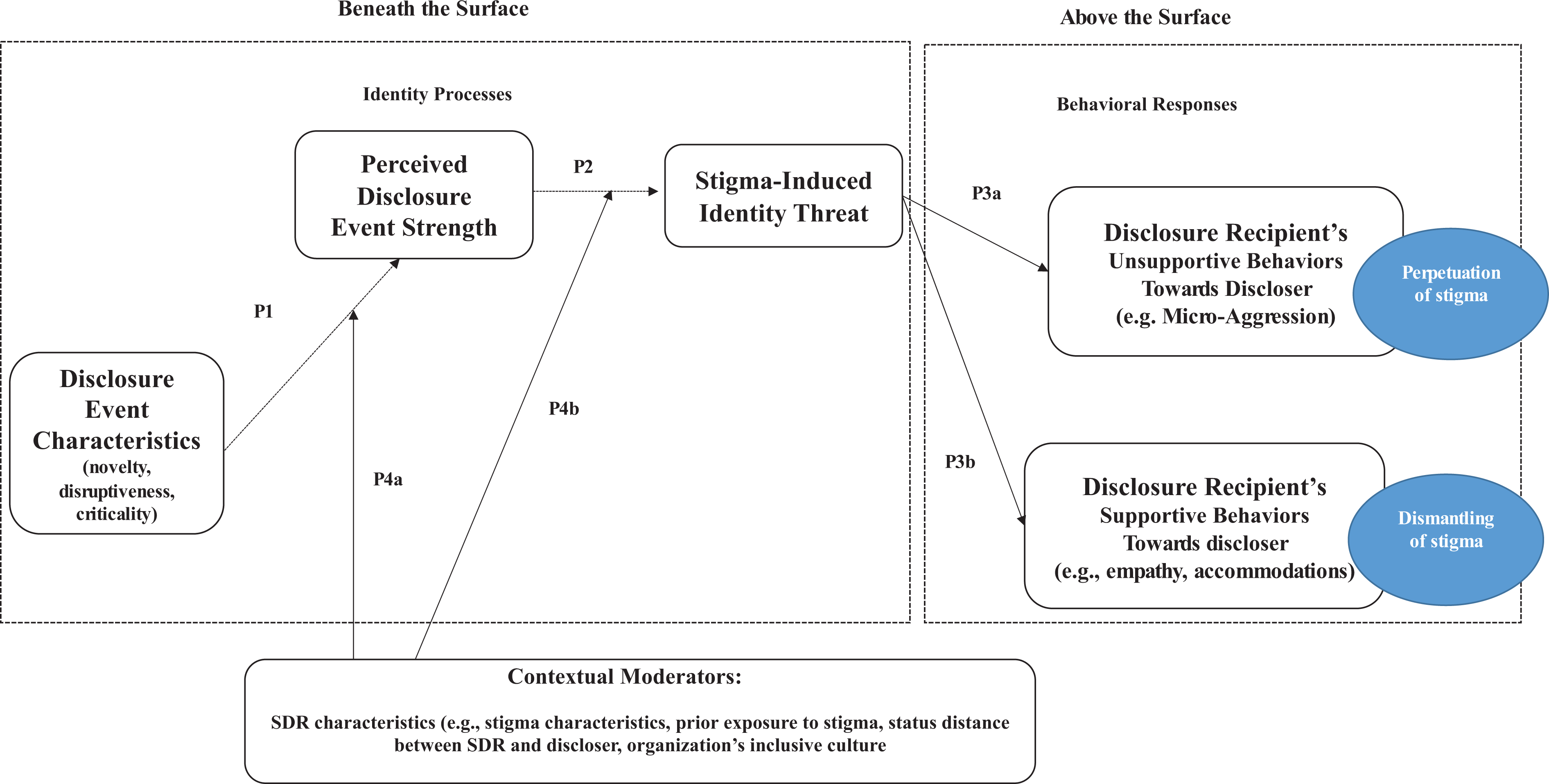
A model of disclosure events and disclosure recipients’ responses.
Beneath the surface: Disclosure event characteristics and perceived disclosure event strength
Integrating events systems theory with stigma research, we suggest that discrete and observable disclosure event characteristics are likely to combine and jointly influence the overall perception of disclosure event strength. This overall perception will have implications for the SDR’s concern or anxiety about how to respond to the discloser (Goff et al., 2008). Although each of the elements of a disclosure event, that we detailed above, differentiate the event from other interactions that the SDR has had with the discloser, these aspects of the event combine to reflect the SDR’s overall appraisal of the event’s strength. In other words, they reflect some combination of the extent to which the disclosure is novel relative to prior interactions with the discloser, the extent to which the event becomes critical to future work routine and practices, and the extent to which the disclosure event represents a departure or disruption for the entities involved in the event, all contribute to the SDR’s subjective strength perception of the event. Therefore, we formally propose:
Beneath the surface: Perceived disclosure event strength and stigma-induced threat
As we noted earlier, in the context of “marked” interactions, individuals belonging to nonstigmatized groups often grapple with expectations that they will discriminate against individuals from stigmatized groups (Goff et al, 2008; Richeson & Shelton, 2003; Roberson & Kulik, 2007). For instance, in studies where White respondents were asked to discuss racial profiling with Black individuals, they responded with higher levels of stigma identity threat because of their belief that they would be seen as racist by their Black interaction partners (Goff et al., 2008). A similar dynamic may be triggered among SDRs in the wake of a disclosure event.
Perceptions of event strength are likely to influence the SDR’s appraisal of the demands posed by the disclosure relative to their personal resources. These demand evaluations, in turn, are likely to shape the level of identity threat they experience as a result of the disclosure. When the disclosure event is perceived as strong, demands such as cultural expectations about dominant group members’ prejudice and/or bias may exceed the SDR’s personal resources to cope with the disclosure. Returning to a previous example, if an organizational member discloses that she is pregnant to a fellow team member, the SDR is likely to experience a high demand evaluation in this context because of uncertainty (“I don’t know what this means for our team”), increase in required effort to suppress automatically activated negative emotional states (“this is really a problem for the team”) as well as negative stereotypes (“she is likely to not be committed to work”), and pressures to ensure smooth interactions (“how are we as a team going to ensure that work proceeds smoothly”). The team member may also perceive a lack of communicative schemata necessary to effectively interact (“what am I supposed to say or do here?”). Moreover, the team member may also be apprehensive that male members of the team are likely to respond negatively or even retaliate against any efforts they may take to accommodate or advocate for the pregnant team member (Jones et al., 1984; Little, et al., 2015).
On the other hand, when a disclosure event is perceived as low strength, the SDR is unlikely to exert significant cognitive efforts to interpret the event (Morgeson et al., 2015). That is, any uncertainty emerging from the disclosure and negative cognitive or affective responses or concerns about negative responses of coworkers may simply not be as salient to the SDR. Likewise, the SDR may feel comfortable with the legal, financial, and/or moral consequences of responding to their coworker’s disclosure. An event that is perceived as low strength is also less likely to lead to any recalibrations of the SDR’s expectations or ability to interact with members of stigmatized groups in an organizational setting. The SDR should feel comfortable and confident with the options available to them to make workplace accommodations for the individual who has just disclosed to them (Goff et al, 2008; Richeson & Shelton, 2003).
Thus, SDRs who perceive a disclosure event to be low strength will experience lower levels of concern or anxiety about how to respond appropriately. That is, while they may still want to protect their own sense of self as a relatively nonstigmatized person, demand evaluations from the event are less salient to them. In these situations, SDRs responding to the disclosure event are likely to experience lower amounts of stigma-induced threat. For instance, the team member who perceives the disclosure of pregnancy as low strength may view the event as business as usual, reducing any anxiety about how to manage team workflow. Overall, if the team member views the event as low strength, there will be a lower likelihood of experiencing demand evaluations, negative emotional states and stereotypes, and other perceived pressures from team members. Therefore, we propose:
Above the surface: Range of supportive and nonsupportive behaviors
Research suggests that stigma-induced identity threat is likely to trigger an avoidance of difference or stigmatizing characteristics (Offerman et al., 2014; Sue et al., 2007, 2008). When the SDR’s identity as an unmarked person is threatened, he/she is likely to display mildly hostile, although possibly unintentional, harmful behaviors. In the context of the workplace, these include comments or behaviors that exclude, negate, or nullify the thoughts, feelings, or lived experiences of discloser. They may also include comments based on the SDR’s own negative stereotypes about the stigmatized group (Sabat et al., 2014).
Even within the purview of company policies against harassment and discrimination, as we noted above, a range of unsupportive behaviors are likely to be triggered by high levels of identity threat among SDRs. Although the behavioral response may ostensibly fulfill guidelines stipulated by organizational policies, a high level of threat represents a motivational state that is unlikely to translate into any genuine understanding or concern for the discloser’s personal or organizational experience. For instance, keeping with the example of the pregnancy disclosure, while the team member might recite congratulatory words to the discloser, they might also express stereotypical assumptions about pregnancy (e.g., “Are you going to be too distracted to get work done now?”; Shelton & Delgado-Romero, 2011). The manager might also make comments reflecting his/her discomfort about having to manage this type of issue within the team (Little, et al., 2015). Although not intended to harm, such comments are likely to minimize and invalidate the experiences of the discloser.
Conversely, when the SDR experiences low stigma-induced identity threat, we expect them to engage in supportive behaviors. Supportive behaviors in stigma-related interactions would be those that reflect empathy or “an understanding of experiences, concerns, and perspectives of another person, combined with the capacity to communicate this understanding” (Hojat, 2009, p. 249; Sabat et al., 2014, p. 260). Having low stigma-induced identity threat allows SDRs to have a more functional interpersonal connection with the dissimilar other, thus promoting empathetic and supportive responses from the SDR. These supportive behaviors extend beyond basic organizationally rooted utilitarian support (which may occur when a person has high stigma-induced identity threat) into support that is based on continual learning and sponsorship activities at work and potentially in their personal life. Therefore, we propose:
Contextual moderators of perceived disclosure event strength and stigma-induced identity threat
So far, we have theorized that disclosure events represent a discrete class of events in organizational life-shaping perceptions about the event’s strength and a range of supportive to unsupportive behaviors through an identity threat mechanism. We have also built propositions about the effects of the perceived strength of disclosure events on both beneath the surface and above the surface responses of SDRs in a ceteris paribus manner. Yet, given that all disclosure events represent a degree of novelty, criticality, and disruptiveness, why do perceptions of the strength of these events vary across SDRs? And, even if a disclosure event is perceived as strong across several SDRs, would some SDRs experience more threat than others? In this section, we address these open questions by proposing that various contextual features are also likely to play a role in how “strong” these events appear to SDRs and how they respond in disclosure situations.
Contextual factors can play a role in organizations in several ways in order to constrain or elicit behaviors (Johns, 2006). One way in which they can affect behaviors is as a stimulus for thoughts, moods, and behaviors in organizations, thereby creating strong or weak situations (Johns, 2006). Given that perceptions are not created in a vacuum, we submit that there are several contextual contingencies that shape the relationship between attributes of the disclosure event and perceptions of disclosure event strength for the SDR. We also believe that these contingencies shape the relationship between perceptions of disclosure event strength and the level of stigma-induced identity threat that the SDR experiences. In this section, we specifically consider the following contextual moderators: stigma characteristics, prior exposure to the stigmatized identity, status distance between the discloser and SDR, and organizational characteristics such as an inclusive culture.
Stigma characteristics
As we noted earlier, stigmatized identities are characterized in several ways and they can influence disclosure and disclosure responses. Prior research demonstrates that these characteristics influence the ways in which individuals with stigmatized identities disclose and how these characteristics may be perceived by others (Jones et al., 1984). Given that prior research establishes a relationship between stigma attributes and responses to disclosure, we argue that these attributes could shape the SDR’s responses as well. First, visibility (i.e., perceptibility; Goffman, 1963) refers to the extent to which an individual’s stigma is noticeable (Goffman, 1963). Besides sexual orientation and the early stages of pregnancy, some other examples of less visible stigmatized identities include mental health diagnosis (Follmer & Jones, 2018) and some chronic illnesses (Ragins, 2008). SDRs who have worked with a person with a noticeable stigmatized identity may not perceive their disclosure as being novel (because they have observed the identity from early stages of the relationship). However, other facets of the disclosure may still signal disruption (reflecting a change in thought processes and potentially the day-to-day priorities) and criticality (warranting a high-priority change in workplace structure and/or culture) from the standpoint of the SDR. These perceptions of high disruption and criticality could readily contribute to the overall perceptions of event strength and trigger identity threat upon their initial encounter with the discloser.
Second, a stigma’s disruptiveness refers to the extent to which it strains social interaction (Jones et al., 1984; Ragins, 2008). Like visibility, the disruptive nature of some stigmas may be evident before the individual discloses them (e.g., epilepsy, stuttering, autism spectrum disorders). SDRs who have been working with a person may have prior experience with the impediments caused by the stigma, but disclosure still makes the stigma more relevant and salient in future interactions. Once the stigmatized identity has been brought to their attention, a disruptive stigma may require a more conscious engagement with the stigma in day-to-day interactions and adjust work routines accordingly. Thus, when the stigma itself is disruptive, following its deliberate, voluntary, or formal disclosure, the SDR may perceive a higher degree of disclosure event strength and stigma-induced identity threat.
Third, stigma controllability pertains to the extent to which an individual can be held responsible for their stigma (Crocker, Major, & Steele, 1998; Ragins, 2008). Controllability can influence SDR’s perceptions of event strength and identity threat in complex ways. For instance, when a stigma is not generally considered to be “self-inflicted” (i.e., cancer), the SDR might access personal empathy to overcome demand evaluations and downplay event strength as well as stigma-induced threat. On the other hand, when a person discloses what is generally viewed as a controllable stigma (i.e., HIV, past imprisonment, etc.), the SDR may respond very differently because they may feel less empathetic and experience higher demand evaluations from the disclosure. The perceived strength of these disclosure events may be higher overall, and the SDR may also experience high stigma-induced identity threat upon their initial encounter with the discloser.
Fourth, the course of a stigma pertains to how the stigma may change over time as well as its ultimate outcome (Jones et al., 1984; Ragins, 2008) and may have important implications for the perceived disclosure event strength. Disclosures involving stigmas that follow a more predictable course and are not debilitating or associated with mortality could be perceived as less novel, disruptive, or critical (e.g., pregnancy). Those that have a more unpredictable or fatal trajectory over time represent a higher degree of novelty, disruptiveness, and criticality and thus could be perceived as a stronger disclosure event by the SDR because they may see a greater need to guard themselves and others from emotional or psychological consequences of the course of the stigma (e.g., Alzheimer’s disease, COVID 19).
Fifth, the peril or threat of a stigma refers to the amount and kind of danger associated with an individual’s stigma (Jones et al., 1984; Ragins, 2008). SDRs who have been working with a person with a stigmatized identity associated with contagion, threat to personal safety, or a threat to organizational safety may perceive their disclosure as being more novel, disruptive, and critical. They may also experience greater identity threat in these situations. For instance, it is easy to envisage how the disclosure of a contagious illness (e.g., COVID 19) is likely to require new and different types of interactions with the discloser with implications for disrupting social and workflow processes and critical implications for organizational policies and practices. These various attributes of stigmas likely shape event strength that in turn triggers identity threat among SDRs.
Prior exposure to the stigma
In addition to various characteristics of the stigma itself, the extent to which the SDR has been exposed to individuals with the disclosed identity in other domains of life, such as through family or friends, is likely to shape his or her reactions to the disclosure event. Given that the more the SDR has been exposed to a potentially stigmatizing difference, the more comfortable they feel around individuals carrying the stigma at work, we would theorize that he/she would perceive lower event strength and identity threats in the wake of a disclosure event. Not only will this prior exposure minimize the salience and influence of the disclosure event on perceptions of event strength, it can also affect identity threat responses to perceptions of disclosure event strength. On the other hand, if the SDR has never encountered the focal stigma in other domains of his/her life, the event is more likely to be perceived as strong, and this lack of prior exposure might also further exacerbate identity threat responses emerging from perceived event strength.
Status distance between SDR and discloser
Past research has theorized that the status distance between disclosers and SDRs influences the likelihood of a disclosure event (Phillips et al., 2009): greater status distance reduces the likelihood of a disclosure. We also extend this theorizing to propose that status distance as “an interpersonal dyadic construct that is determined by the perceived differences in status between a focal person and another individual” (Blau, 1977; McPherson & Smith-Lovin, 1987; Phillips et al., 2009, p. 713) is likely to influence perceptions of event strength and stigma identity threat. Greater status distance is likely to influence the relationship between the novelty, criticality, and disruptiveness of the disclosure event and perceived strength of the event because, in general, status distance increases discomfort and anxiety associated with the sharing of personal information (Phillips et al., 2009). The discomfort felt by the discloser is also likely to influence how the SDR perceives the disclosure event and could likely influence his/her identity threat. Further, if the status distance is larger, the possibility of informal social ties between the discloser and SDR is also likely to be lower reducing the opportunities for having personal knowledge about the discloser prior to the disclosure event. Therefore, greater status distance might enhance the relationship between disclosure and perceived strength of the event in the mind of the SDR and it may also enhance demand evaluations associated with the event and subsequently heighten the relationship between perceptions of event strength and identity threat.
Organization’s inclusive culture
Lastly, organizational characteristics may also play a role in influencing the proposed relationships between both disclosure and perceptions of event strength and perceptions of event strength and identity threat. For example, a diversity climate and culture of inclusion—one in which members develop and maintain intergroup relationships and members of stigmatized and nonstigmatized groups are able to weigh in on important organizational policies and practices (McKay et al., 2009; Nishii, 2013)—should influence the relationship between disclosure and perceptions of event strength. In inclusive organizational contexts, SDRs are likely to experience lower uncertainty and fewer challenges with implementing other structural, processual, and managerial practices necessary for supporting marginalized or stigmatized identities more generally. As such, in these settings, SDRs are not likely to experience a disclosure as a strong event. Even if the event is perceived as strong, they may also be less likely to be threatened by the disclosure because the inclusive culture provides resources to cope with disclosure events more generally. By suppressing the perceived strength of the disclosure event as well as the potential identity threat emanating from it, SDRs are also likely to consciously or subconsciously engage in supportive rather than unsupportive behaviors in response to the disclosure.
Overall, these aspects of the organizational context—stigma characteristics, prior exposure to the stigmatized identity, status distance between the SDR and the discloser, and an inclusive culture—can influence the three-stage process of SDRs’ responses at two points. First, these contextual attributes can influence the extent to which the novelty, disruptiveness, and criticality of the event augment the SDR’s perceptions of disclosure event strength. Second, these contextual features will also influence the SDR’s identity threat responses to perceptions of disclosure event strength. Formally, we propose:
Discussion
Disclosure in the workplace is often a basis for receiving formal or informal support and resources. Individuals who have potentially stigmatizing information to disclose—\chronic illness, disability, mental health diagnosis, sexual orientation—could be doing so because they desire support from organizational agents including supervisors, managers, HR professionals, or team members. Responses to disclosure are therefore immensely consequential for work relationships, engagement, and employee attitudes and behaviors that contribute to overall organizational performance. Individuals who are at the front lines of disclosure often have the power—informal and/or formal—to support or denigrate individuals belonging to stigmatized groups. Therefore, in order to fully understand how disclosure dynamics unfold in organizations, the theoretical framework offered above sheds light on disclosure events from the standpoint of the recipients of stigmatizing information.
Following Jones et al. (1984), our framework highlights how encounters with disclosure of stigmatizing information are “neither rare nor esoteric” and that they are “characterized by disruptive emotional, cognitive, and behavioral processes” (Jones et al., 1984, p. 1). During these encounters, disclosure recipients play a “decisive role” in facilitating the stigmatized person’s ability to successfully use strategies that allow for “successful avoidance, disruption, or reversal of the labeling process” (Jones et al., 1984, p. 219). The disclosure of an invisible stigmatized identity is a momentous event—it is the point at which the SDR becomes aware of the other’s “mark.” While past research has provided valuable insights into how the attributes of the stigmatized individuals and the embedding context may shape the type of disclosure and the outcomes of disclosure, less is known about how the SDRs—who are important actors in the social construction of a stigma—also influence the outcomes of disclosure.
These disclosure events serve as actual and symbolic “critical points of delivery” of organizational support and resources for the focal individual. They also represent the level of support and inclusion in an organization. Coworkers, supervisors, managers, HR professional, and executives—who are on the front lines of various disclosure events—are also representatives of the organization’s culture and level of inclusion. If their responses to disclosure are supportive, the focal employee is likely to experience psychological well-being and frame his/her own stigmatizing identity more positively and thereby support the dismantling of stigma in the workplace. If on the other hand, the response is hostile, the focal employee is likely to experience emotional distress and frame their identity more negatively. In the long run, these psychological responses can also lead to lower engagement and higher turnover. However, how do SDRs’ cognitive responses to the disclosure event influence varied (un)supportive behaviors toward the focal employees? Our framework has applied an event systems theory and stigma-induced identity threat lens to answer this important question.
Based on emerging research on events, which are ubiquitous in organizational life, we put forth the view that in increasingly diverse organizations, disclosures about personal and hitherto “hidden” identities represent a discrete class of events that can have distinct and powerful implications for organizational life. The novelty, criticality, and disruptiveness of these events combine to shape the SDR’s subjective perceptions of the strength of a disclosure event. We highlight how the perceived strength of these events triggers identity threat perceptions in SDRs (the ways in which they feel anxious and concerned about affirming negative stereotypes about how members of dominant group treat members of nondominant groups), and we position these threat perceptions as a key theoretical mechanism linking disclosure events to SDRs’ behavioral responses. We proposed that recipients of stigmatizing information engage in behaviors that range from supportive to unsupportive.
Theoretical contributions
We note three ways that our framework contributes to stigma, identity management, and diversity literatures. First, stigma and identity literatures continue to offer compelling insights into the identity management strategies of employees who possess an invisible stigmatizing identity. These scholars called attention to the “mark” or “stigma” as the “perceived or inferred condition of deviation from a prototype or norm that might initiate the stigmatizing process” (Jones et al., 1984, p. 8). Instead of the “mark,” we examine disclosure events initiating the (de)stigmatizing process and SDRs as key agents in the social construction of stigma within organizations. Our framework sheds new light on the question: how does a mark become a stigma (a devalued attribute) in organizations? We suggest that stigmas are reinforced through the thoughts and emotions of those who may be relatively nonstigmatized but come into contact with a stigmatizing identity following a disclosure event. By integrating event systems theory, we introduce the notion of disclosure events and the perceptions of disclosure events, and we theorize that responses to such perceptions are the focal point for either reinforcing or dismantling stigmas in organizations. Our theorizing and framework contribute to EST by delineating a very fundamental event in organizations that involves unique cognitive and affective processes and is likely to increasingly occur as organizations encounter greater workforce diversity—the disclosure of stigmatized identities. By building on EST’s view that events are important in organizations, we provide a framework for understanding how stigma disclosure events can be perceived and how these perceptions shape key identity-related processes and behaviors that can be extremely important to organizations (e.g., stigma-induced identity threat, discriminatory behaviors, inclusive behaviors, legal action, etc.).
Second, acknowledging that the social construction of stigma is a dynamic process, our framework suggests that equal attention be paid to the identity-based processes of nonstigmatized persons as well as stigmatized individuals. Researchers have examined how a discloser’s cognitive or dispositional attributes—along with various environmental factors—can contribute to positive or negative consequences of disclosing an invisible stigmatizing identity (Clair et al., 2005; Griffith & Hebl, 2002; Ragins, 2008). Although past research recognizes that supportive relationships are an important aspect of the overall organizational context (Griffith & Hebl, 2002; Law et al., 2011), responses to stigmatizing information may not be uniform even within any given organizational context (Stone & Colella, 1996). While extremely valuable, past research does not fully acknowledge the role of SDRs in shaping the consequences of a stigma disclosure event. This research points to cognitive, affective, motivational, and experiential antecedents to stigma responses (Hebl & Dovidio, 2005; Jones et al., 1984) and explains how nonstigmatized or unmarked individuals develop and maintain “false beliefs,” or stereotypes, about members of stigmatized social groups more broadly. Building on this research, we theorize how during the initial encounter of a stigma during the disclosure event, SDRs’ own cognitive baggage can have immense implications for their behavioral responses. We shed a spotlight on the importance of interactions specific to disclosure to show that how people respond to stigma can have lasting effects on the inclusion and engagement of a diverse workforce.
Third, our framework makes important contributions to literature on workplace diversity, more specifically how the dyadic interactions between members of stigmatized and nonstigmatized groups shape the experience of inclusion in the workplace. While examining the experiences of underrepresented groups is certainly important, dominant group members’ responses to minorities also offer important insights. Ultimately, dominant group members play important “gate keeping” roles in accessing organizational resources (Dwivedi et al., 2018). Although social categorization-based perspectives on dissimilarity and diversity in organizations would propose that these individuals are predisposed to withholding support to dissimilar others, our theorizing suggests that there are variations among dominant group members in how they experience, internalize, and confront encounters with dissimilarity. These variations provide important explanations for how marginalized group members experience support and inclusion in the organization. While dyadic in nature, such interactions can have spillover effects for the overall organization (also see Leslie, 2019; Nishii, 2013; Roberson, 2006). They can be observed and emulated by other members of nonstigmatized groups in the organization, allowing for a contagion of either supportive or unsupportive behaviors.
Our framework also contributes to an important and emerging recognition in diversity research on the role of subtle and invisible forms of bias and discrimination. Interactional processes between disclosers and SDRs serve as the bedrock of micro-inequity that is even more pervasive and insidious in organizations than overt discrimination. These micro-inequities resulting from micro-aggressive behaviors may even be a response to symbolic and ill-designed diversity management practices that although aimed at improving outcomes for underrepresented groups may have the opposite effect. Because of hastily implemented or ill-conceived diversity programs, individuals often continue to maintain biases toward stigmatized groups but couch these biases in more covert forms of harassment and discrimination. Disclosure events may serve as triggers for these microaggressions. Micro-invalidations and micro-insults are two ways through which covert forms of bias may manifest. Although harder to notice, these behaviors can have a greater impact on the psychological and physical well-being of members of stigmatized groups and reinforce micro-inequities at work. We theorize that when perceptions of stigma disclosure events are strong, SDRs experience higher threat and may proceed to engage in micro- or macro-aggressive behaviors which harm disclosers. Engaging in such behaviors only reifies the notion that the disclosed identity is devalued, less than worthy of being expressed, and not welcome in the organization. That is, such behaviors—especially when observed, accepted, and tolerated by other members and leaders within the organization—can be adopted as normative, allowing for cultures that stigmatize and discriminate to be maintained and perpetuated.
Given the kinds of outcomes related to stigma disclosure events, and unlike many other organizational events (including the disclosure of personal information that is not stigmatizing), we see the disclosure of a stigmatized identity as an extremely influential event to continue to unpack in theoretical and practical ways in future research.
Future research and practical implications
While we theorized responses to disclosure and event strength as dichotomous variables (i.e., high strength vs. low strength events), and distilled several contributions for doing so, we also acknowledge that this boundary condition is a limitation of our framework. If we view a disclosure encounter with a key organizational agent as an initial foray into managing the information regarding a personal and potentially stigmatizing identity, we can envision how disclosers’ subsequent strategies such as revealing or concealing may be shaped through these processes. Even if they choose to reveal their identity, these initial encounters may shape how the focal employee chooses to disseminate the stigmatizing information in the future. For instance, existing work on disclosure suggests up to six strategies that employees with invisible stigmas use; these six strategies represent a range of disclosure (i.e., signaling, normalizing, and differentiation) and nondisclosure (i.e., using discretion, fabricating, and concealing; Clair et al., 2005). A person who discloses by differentiating himself or herself with a supervisor who ends up feeling highly threatened may choose to not disclose in their subsequent encounter. Moreover, if they do choose to disclose in the future, they might choose to change up their disclosure strategy; this time instead of differentiating, they might expect normalizing to warrant a better response from SDRs. In addition, other organizational contextual variables such as disclosure tactics, employee and top management team diversity, and many others could affect the ways in which SDRs respond. Future empirical research that examines how identity threats are a consequence of different kinds of disclosure tactics would be beneficial. We foresee an experimental approach as fitting for these types of studies.
With this in mind, future empirical research might also benefit from field and lab studies that ask questions about stigma-induced identity threat and responses to disclosure—from both SDRs and disclosers. Such studies could seek to understand how individuals cognitively and affectively process their stigma identity threat and how their processing influences their workplace attitudes and behaviors. This research would benefit from including variables such as personality as another factor that influences the disclosure recipient’s response. Future research that takes this approach to studying disclosure in organizations will contribute greatly to our understanding of how SDRs make sense of disclosure and inform the design of interventions that can enable the processing of stigma identity threat in ways that are not detrimental for the discloser.
All employees find it edifying to have important identities and self-concepts verified and validated by others in their organization (Swann et al., 2004). However, individuals who disclose a stigmatized identity often fear SDR responses based on their own—or others’—past disclosure experiences (Griffith & Hebl, 2002; Ragins & Cornwell, 2001). They may have less trust in SDRs because they have experienced past disclosure recipients who responded through more explicitly aggressive behaviors. In addition, research on the identity development of individuals with stigmatized identities suggests that, across their lifetimes, these individuals continually encounter interactions and contexts that shape their emotions and thoughts about their identity (Cass, 1979). These responses range from shame and confusion to acceptance. Due to the basic human need for self-verification (Swann et al., 2004), the SDR’s support or rejection could have important implications for the discloser’s identity development, trust, and future identity management decisions (to disclose nor not to disclose). We propose that future research exploring these relationships would benefit theory and practice greatly.
From a practical perspective, as organizations continue to embrace managerial discretion in the implementation of employment practices (e.g., Nelson & Bridges, 1999), we acknowledge that the “confidant,” or SDRs, could be crucial conduits between corporate-level diversity management initiatives and the implementation of these policies at the work unit level. We posit that, in many of these situations, the success of a decision to disclose rests not only on the focal employee or specific attributes of the organizational context but also on the “in the moment” responses of the SDRs. This warrants more awareness regarding selection, training, and retention of employees that can respond accordingly.
Conclusion
In diverse organizations, not only are disclosure events settings where individuals from dominant groups acknowledge and grapple with their “unmarked” identities but also contexts where more covert and insidious forms of discrimination—microaggressions—are likely to play out. Indeed, diversity scholars have noted that in organizations today persistent inequality exists because, rather than overt discrimination, subtle biases manifest in language and behaviors that are more difficult to identify or remedy (Jones et al., 2016; Sue et al., 2007, 2008). Thus, our framework draws attention to the critical yet overlooked role of stigma disclosure events in (a) triggering stigma-induced identity threat among SDRs and (b) shaping a range of supportive to nonsupportive behaviors in the workplace. Moreover, recognizing that many disclosure decisions may not be a choice for focal employees, but a necessary step for obtaining discretionary organizational support, we view stigma disclosure events as arenas where these resources can be withheld (or offered), further cementing (or mitigating) the marginalization and devaluation of stigmatized groups.
