







Abstract
Intuition suggests that individual differences should play an important role in negotiation performance, and yet empirical results have been relatively weak. Because negotiations are inherently dyadic, the dyad needs to feature prominently in theorizing. In expanding the traditional treatment of individual differences to two systematically interconnected parties, a relational process model (RPM) emerges. The RPM illustrates how the individual differences of both negotiators spark complex behavioral dynamics through five distinct theoretical mechanisms. Individuals (a) select each other, (b) set expectancies for each other, (c) serve as behavioral triggers and affordances for each other, (d) reciprocate and complement each other’s behaviors, and (e) vary in their responses to identical behaviors. It also directs attention to new classes and dimensions of individual difference factors. The RPM helps explain why past research has been highly conservative. A more complete picture needs to incorporate the complex interplay starting with parties’ individual differences.
Keywords
Negotiation—a mutual decision-making process to allocate scarce resources (Pruitt, 1983)—is an important phenomenon woven throughout organizational life. We negotiate with buyers, suppliers, and employers and also for everything from who takes on which roles in a team to who gets access to needed resources and even who has to come into the office over the weekend. As such, the question of skill looms large: Who are the highly effective negotiators? This question has, somewhat surprisingly, been a source of some consternation and mystery in the academic literature. Large-scale review articles have suggested that either individual-level factors play a minimal role or that their role is unclear (Bazerman et al., 2000; Lewicki et al., 2014; Thompson, 1990). A prominent early review was particularly pessimistic, and the common interpretation of its conclusion is that it was misguided to pursue the topic (Rubin & Brown, 1975). This had a chilling effect on further research to the point that it was largely abandoned for decades (for a detailed review, see Sharma et al., 2013). Interest in the topic has been resurging (e.g., Dimotakis et al., 2012). Given that research on individual differences in negotiation has been critiqued for lacking an underlying theory (Thompson, 1990), along with newly rekindled interest in the topic, it is timely to develop an integrated theoretical model. This article attempts to do so and then uses this new model to consider new directions in individual differences research.
Individual differences in negotiation
This article starts with the question of why individual differences are such relatively modest zero-order predictors of negotiation performance across most empirical studies. By way of definition, an individual difference is any characteristic that can differ systematically from one person to another and includes everything from age and sex to height, personality, intelligence, and even enduring attitudes. This term is used interchangeably with characteristic or feature. The characteristics most often studied in negotiation have been sex (Kennedy & Kray, 2015; Mazei et al., 2015), culture (Gelfand & Brett, 2004), and personality traits (Barry & Friedman, 1998).
Recent reviews of the research on individual differences in negotiation have developed a typology of five categories of factors that have been studied to date (Elfenbein, 2013, 2015): (a) personal background characteristics—including sex and culture, social characteristics such as economic class, education level, or religion, and physical characteristics such as attractiveness, age, or masculinity; (b) abilities—including cognitive intelligence, creativity, and cultural intelligence; (c) personality traits—including the big five traits and trait affect; (d) motivations—including prosociality, competitiveness, and individualism; and (e) expectations and beliefs—including self-efficacy, implicit beliefs and other attitudes, and ethical and moral character. Elfenbein’s (2015) review incorporated findings from Sharma et al.’s (2013) meta-analysis, which included comprehensive literature searches and requests from the scholarly community for unpublished work. What emerges from this literature review is that there has been little emphasis on dyadic relationships and few consistent empirical findings.
Rather than to examine the range of individual differences as a set of categories, the current article focuses on several continua that may be particularly helpful for the theorizing below. These continua are (a) deep versus surface level, (b) degree of visibility, (c) relationship with stereotypes, and (d) relationship with cooperation versus competition, and are described in Table 1. There are two benefits for the sake of this theory development in examining continua rather than discrete categories. The first is practical, namely to limit the potentially vast proliferation of characteristics that could potentially be examined. The five categories reviewed by Elfenbein (2015) encompass potentially dozens of traits. The second reason is to make clearer the why involved with mapping these traits to the processes described in this article, which I attempt to do below.
Relevance of individual difference continua to processes within the relational process model.
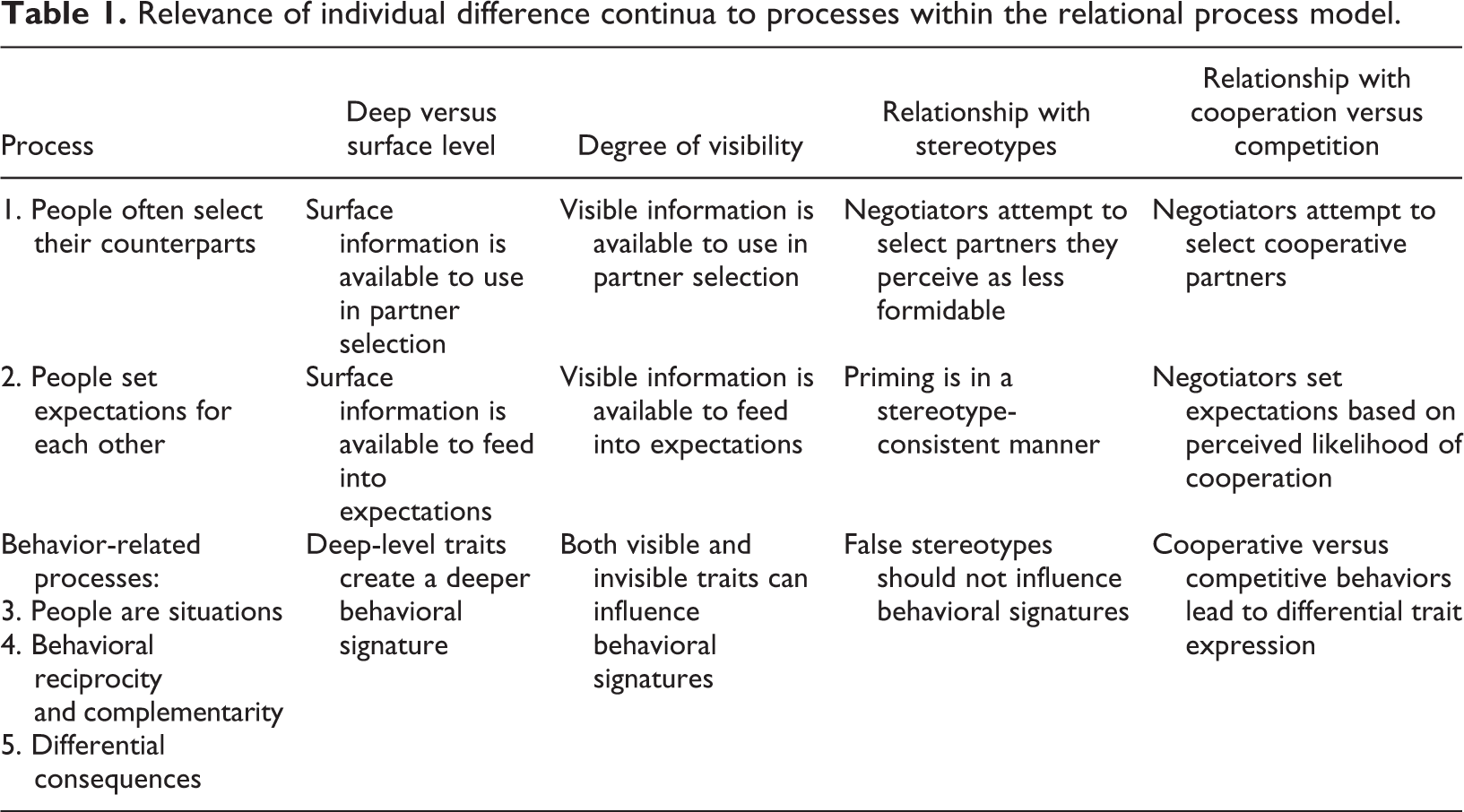
The long list of individual differences studied in negotiations can be arrayed along a continuum of deep versus surface-level characteristics (Harrison et al., 1998). Strictly surface-level characteristics have the potential to alter a counterpart’s behavior. These may include aspects of physical appearance such as attractiveness and height or aspects of demographic background. Whether or not these characteristics are personally meaningful to a negotiator—because that particular person may or may not have a strong identity related to them—it is possible for some of these characteristics to change a negotiator’s behavior due to reinforcement over time from their effect they have on the other people around them. Some characteristics are strictly at a deep level, such as motivations and attitudes. Some characteristics may be a combination of both surface and deep levels. For example, gender and cultural background can influence partners and can also influence habits and preferred ways of being.
The continuum of visibility is also important to emphasize. A characteristic can only influence a partner’s behavior directly if it can be seen. Some factors are readily apparent to observers, such as gender, age, and attractiveness. The zero acquaintance literature shows that judgments of personality traits can also be fairly accurate based on merely being in the same room with another person but not actually interacting (Levesque & Kenny, 1993). Further, research on thin slices shows that even brief exposure to another person can allow us to glimpse a wide range of traits and skills that are relevant to negotiation, such as job performance (Choi et al., 2005). Personal background factors that are easily visible and could influence a counterpart’s behavior may include age, physical attractiveness, and signals of masculinity such as height, vocal tone, and even facial shape. By contrast, some factors are hard to detect, such as beliefs.
A third continuum that connects the categories of individual differences is that of relationship with stereotypes—in particular, stereotypes about whether a counterpart may be more versus less formidable across the table. Expectation states theory argues that there are signs of status—known as status characteristics—that relate to a person’s background and that signal expectations about task rewards (Berger et al., 1977). Status characteristics can guide hypotheses about the types of background factors most likely to influence negotiator priming. In addition to gender (see also Ridgeway, 2001), these can include socioeconomic status and ethnic or cultural group membership. Overall, discrimination can be incorporated into a model of individual differences in negotiation through individuals’ statistical beliefs about how easily a counterpart can be pushed to yield (Gneezy et al., 2012).
The final continuum is the relationship between traits and the likelihood of cooperation versus competition. Some traits are associated with cooperativeness, such as agreeableness and empathy, whereas others are associated with greater competitive attempts to claim resources, such as Machiavellianism and entitlement.
The section below attempts to draw from these continua in the service of developing theory about the dynamic interplay of both parties’ individual differences with negotiation process and outcomes.
A relational process model (RPM) of negotiation
With the important exceptions of sex and culture, most individual differences have been studied in terms of a single focal individual in isolation from their interaction partner (cf. Wilson et al., 2016). Figure 1(a) shows the traditional model that one can infer from the existing work, in which individual differences predict outcomes for a single negotiator (Elfenbein, 2015). For example, Barry and Friedman (1998) examined associations between an individual negotiator’s level along with the big five personality variables and the performance of that individual. Although empirical research has not tended to model or measure the behavioral mechanism for this effect directly, the importance of individual-level behavior is implicit if not explicit in theorizing. That is, it is not merely, for example, that an intelligent person automatically creates more value (Sharma et al., 2013)—rather, a more intelligent person does something different than their less intelligent peers and that something different can assist in value creation. For example, they may ask more questions, process information from the other party more efficiently, spend more time making complicated calculations, and puzzle more deeply over potential areas for efficient trades. This straightforward mediation of individual differences to behavior to outcomes has been the prevailing model in the field.
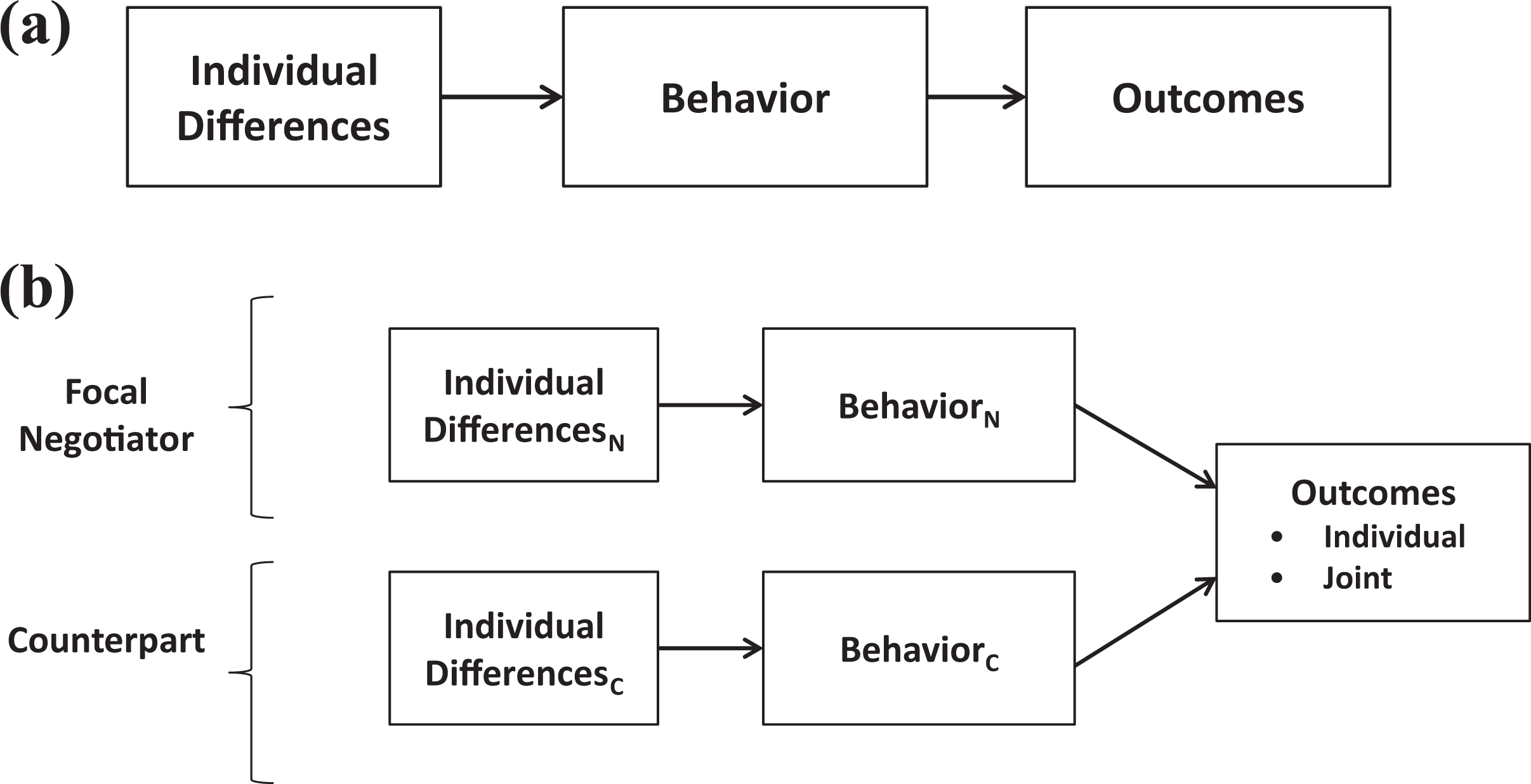
Theoretical models of individual differences and negotiation outcomes: (a) individual model and (b) dyadic model.
A new approach to modeling individual differences begins with the observation that negotiation is fundamentally relational. One is not negotiating in isolation; the individual actor depicted in Figure 1(a) does not exist as such. Rather, there is always at least one other counterpart, who has a profile of characteristics just as the negotiator does. In some way or another, researchers have grappled with this observation, although it is typically treated as a methodological nuisance. There is a mismatch in levels-of-analysis when examining individual differences vis-à-vis performance coming out of a multiparty process. Typically, researchers have resolved this issue either statistically or through research design, by examining only one role at a time, using multilevel modeling, or by having participants take part in multiple interactions (e.g., Barry & Friedman, 1998; Elfenbein et al., 2008; Mueller & Curhan, 2006). However, the core observation of this article is that the mismatch could be embraced instead and mined for its theoretical insight. Figure 1(b) illustrates the model that emerges from a dyadic approach to individual differences. It consists of two individuals as pictured in Figure 1(a) who are placed adjacent to each other and with their outcomes joined together in light of the parties’ interdependence. Note that this model is illustrated at the two-party level but could be expanded to three or more parties.
The key observation of this new RPM is that the individual characteristics of both negotiators set into motion a series of relational dynamics that can be mapped systematically. The RPM focuses on the chronological set of processes that emerge from the simple act of placing two individual models side-by-side and using a systematic procedure to map all of the links whereby (a) individual differences can influence the other negotiator’s behavior and (b) each negotiator’s behavior can, in turn, influence the other party’s behavior and both parties’ outcomes. Doing so produces the model in Figure 2, which reveals all of the possible linkages produced by following this procedure. Rather than a single linear mechanism as depicted in Figure 1(a), the relational model consists of an additional five distinct theoretical mechanisms whereby individual differences can cascade into an effect on negotiation outcomes. The figure illustrates that, in each case, effects are reciprocal: just as a counterpart influences a negotiator, the negotiator in turn influences the counterpart. Note that these processes map onto past literature in various ways, as described below, but do not flow from it; rather, the processes flow from the systematic procedure of mapping links within the RPM.
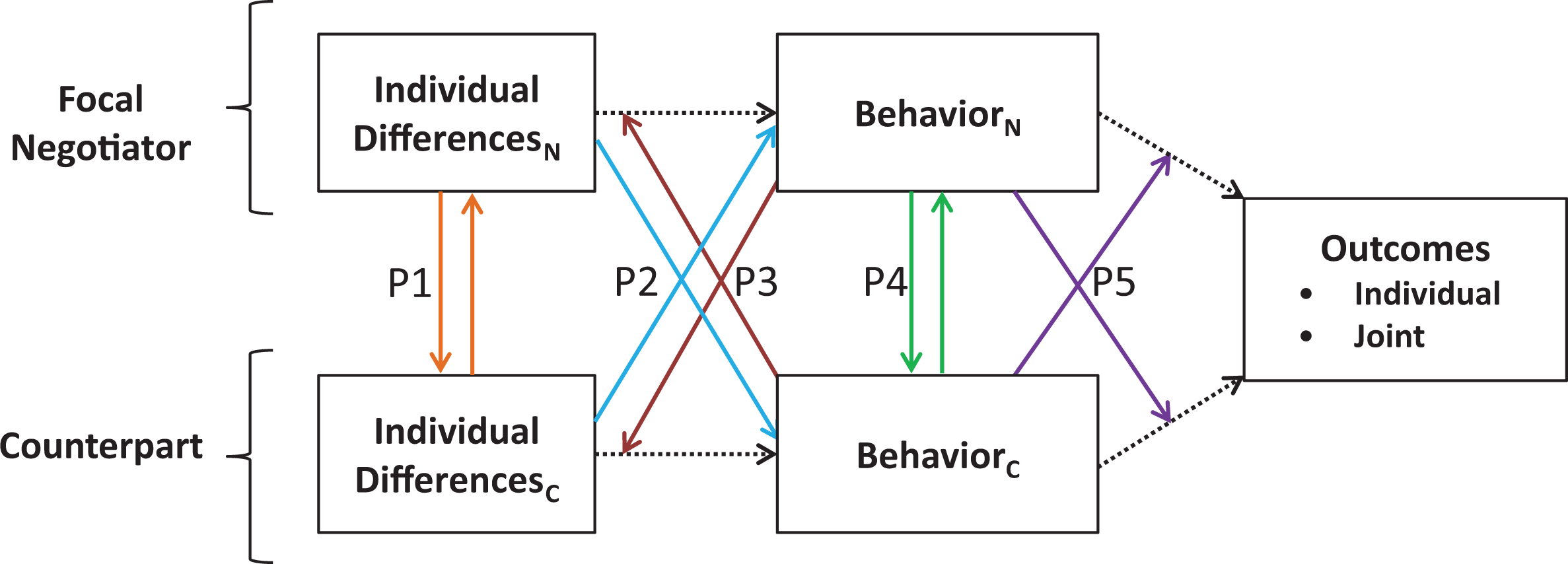
Relational process model of individual differences in negotiation: (a) traditional model of Person × Situation interactions and (b) relational process model of Person × Situation interactions.
Process 1: People often select their counterparts
In the first mechanism, individual characteristics can help to determine who works together. Most research in the negotiations field takes partners as given. In laboratory designs, two or more unacquainted individuals are assigned exogenously to partner with each other, in a one-shot interaction that has no lasting consequences and that is fully implemented at the moment of agreement. By contrast, in a real-world setting, one of the first questions a negotiator might ask is whether or not they are in a position to choose with whom to work. The ideal partner has a combination of qualities. In addition to being able to meet the negotiator’s needs for instrumental deal terms, the negotiator needs to be able to work effectively—and ideally harmoniously—with the counterpart and trust that they are reliable to implement the deal as promised (Mislin et al., 2011).
The search for partners involves judging their individual characteristics—both the absolute characteristics that everyone should seek, such as having a good reputation and generosity in offering favorable deal terms, and relational characteristics that vary from negotiator to negotiator. Negotiators may also experience transference and select partners who are similar to people with whom they have had good relationships in the past (Andersen et al., 1995). 1 Similarity-attraction theory (Byrne, 1961; Izard, 1960) argues that we tend to seek out interaction partners who are similar to ourselves. Consistent with this, negotiators who are similar along interpersonal trait dimensions such as extroversion and agreeableness tend to have a more positive and efficient experience (Wilson et al., 2016)—and negotiators may understand this implicitly and look for such partners. Given the mixed-motive nature of negotiation, one might also expect deliberate mismatching along certain traits. The degree of search for match versus mismatch could depend on negotiator motives. Those focused on affiliation needs may seek similarity for the sake of interpersonal harmony and those focused on achievement needs may seek submissive partners whom they can dominate.
Within the RPM, there are four levels of analysis that influence partner selection: negotiator effects, partner effects, interaction effects, and context effects.
Negotiator effects on partner selection involve the pool of potential counterparts in a negotiator’s network who are available to consider. As examples, introverts may have a smaller pool of available counterparts, and maximizers may have a larger pool. In general, individual differences should influence a negotiator’s pool of available counterparts for partner selection.
Counterpart effects involve choices about who is generally pursued as potential deal partners. Individuals with access to the necessary resources are desirable partners as are, for example, individuals high in agreeableness. Those who are extroverted are more likely to be present in the pool of potential counterparts. In general, individual differences related to the desirability and availability as a counterpart should influence partner selection. In the interest of reaching a favorable deal, counterparts may be sought whose social identity characteristics may make them seem like less formidable foes. As such, a relevant continuum is the extent to which any given characteristic has been associated with lay beliefs about its relationship with negotiation effectiveness. Individual differences should be important for partner selection if they relate to stereotypes suggesting that they make a counterpart more versus less effective across the table. This theorizing raises the continuum of visibility. A characteristic can only be used in partner selection if it can be seen. As discussed above, some factors are readily apparent to observers, such as gender, age, and personality traits that can be detected at zero acquaintance. Some factors are hard to detect, such as beliefs. In general, individual differences that are more versus less visible should be more influential at the stage of partner selection.
In addition to negotiator and counterpart influences on partner selection, there are relationship-level interaction effects between the two. In particular, homophily suggests that negotiators are likely to select partners who are similar to them along a range of characteristics. Wilson et al. (2016) found that negotiators who had similar levels of extroversion and agreeableness had a more harmonious experience together. One can extend this observation to theorize that such negotiator pairs are also more likely to select each other at the outset. Homophily and transference can take place along the range of visible characteristics and those traits that can be gleaned at zero acquaintance. Negotiators should be more likely to select each other if they are similar to each other along visible characteristics.
The context in which the negotiation takes place can also affect the search for partners. For example, in a highly regulated and lawful setting, negotiators need not invest quite as much time investigating their partner’s background. Taken to the extreme, in some marketplaces, people each receive a numerical score and any score above a certain value makes trading partners essentially equivalent. By contrast, in other settings, it may be difficult to enforce contracts and greater care is taken in partner selection. 2
Process 2: People set expectations for each other
The second mechanism consists of a direct link from one party’s individual differences to the other party’s behavior. That is, a partner’s characteristics can influence a negotiator’s behavior independently of anything that the partner actually does. Their mere presence can be enough to serve as a prime and to elicit a range of expectancies that alter the partner’s behavior. Primes are powerful influences on behavior (Bargh et al., 1996), and the person in front of a negotiator may be a particularly salient prime. Negotiators “size up” each other at the outset of their interaction and, to do so, have only the limited information that they can gather at minimal acquaintance. Particularly likely to influence their judgments are personal background factors that make people seem like more versus less formidable foes. Stereotypes abound about the types of people who make weak opponents, for example, women and members of underrepresented minority groups (Ayres, 1991; Kray & Thompson, 2005; Zussman, 2013)—and these stereotypes can influence a partner’s behavior whether or not the stereotypes are veridical. Along these lines, Bowles et al. (2005) found that negotiators set higher aspirations against female counterparts, even before the interaction began.
Theoretical models of stereotypes stress that they tend to represent a trade-off between the factors of warmth and competence (Fiske et al., 2002). Fiske and colleagues (2002) argue that these stereotypes can result from perceived competition at an intergroup level for valued resources and can spill over into competition at an interpersonal level. As mentioned earlier, status characteristics are used as signals to a person’s background (Berger et al., 1977) and can guide hypotheses about the types of background factors most likely to influence expectancies. In addition to surface factors that are physically visible, negotiators may size each other up based on indicators of underlying traits that can be seen at minimal acquaintance, such as personality traits (Choi et al., 2005; Levesque & Kenny, 1993).
Expectations about a counterpart matter. Classic studies in social psychology demonstrated the influence of expectancies and self-fulfilling prophesies (Rosenthal & Jacobson, 1968; Snyder et al., 1977). In addition to the effect of stereotypes about a counterpart on a focal negotiator’s behavior, the counterpart may adjust their behavior to confirm or react against the stereotype. In this process, people can treat others differently on the basis of a partner’s characteristics even when these characteristics are assigned through false feedback. In negotiations in particular, Tinsley et al. (2002) found that a person’s reputation for toughness set an expectation that was self-fulfilling even when that reputation had been randomly assigned. Taken together, negotiators can be influenced by many attributes of their counterparts even in the absence of actual differences in the counterpart’s initial behavior.
Process 3: People are situations
Whereas in Proposition 2, negotiators influenced each other by their mere presence, by contrast in Proposition 3, differences in their actual behavior are central. In particular, one party’s behavior moderates how the other party’s individual differences are expressed. The third mechanism imports a classic idea from personality psychology and brings it into the study of negotiations: the notion that people are situations.
The idea that people are themselves “situations” has been an emergent notion in personality theory (Buss & Craik, 1983; Funder, 2008; Mischel, 2004; Reis, 2009). Although personality is partly defined by what an individual regularly does, personality can also be conceptualized as what an individual regularly elicits other people to do (Buss, 1987; Eisenkraft & Elfenbein, 2010; Kenny, 1994). Intuitively, many common adjectives for describing people are less about the people than the effect the people have on others, for example, boring, annoying, amusing, and so on. Mischel (1977) wrote that “[i]n the conditions of life outside the laboratory the psychological ‘stimuli’ that people encounter are neither questionnaire items, nor experimental instructions, nor inanimate events, but involve people and reciprocal relationships” (p. 350). Within organizational scholarship, this view is echoed in Schneider’s (1987) influential notion that the people make the place.
This article introduces a person-as-situation approach to refer to the theoretical perspective that models a person’s interaction partner as their environment. In the person-as-situation approach, each person creates a unique environmental signature all around themselves. The RPM models this notion formally in a negotiation context. A counterpart serves as a “situation” in a special case of a Person × Situation (P×S) interaction. According to the generalized model of P×S, individual differences matter more in some situations than they do in others. In the special case of person-as-situation, individual differences matter more in the presence of some people than they do in the presence of others (Elfenbein et al., 2018).
Research more generally on P×S interactions in negotiations draws from the psychological concepts of triggers and affordances (Barker, 1968; Bowles et al., 2005). A trigger is a feature of the environment that draws out traits that are otherwise dormant. For example, White and colleagues (2004) argued that negotiating over the value of one’s own labor—that is, serving in the role of a candidate versus recruiter in a simulated job negotiation—was a trigger for people who are sensitive to the possibility of losing face. Bowles and colleagues (2005) argued that negotiating on behalf of others was a trigger for women to access the protective instincts to advocate for another person’s welfare. Triggers matter in negotiation because aspects of the bargaining environment can prime people—negotiators may draw from a part of their personal repertoire that is usually not salient or even deliberately hidden. In the process, they may fulfill or possibly react against the expectations of others. This is consistent with trait activation theory (Tett & Burnett, 2003), which argues that aspects of the work environment can make any given trait more versus less salient.
An affordance, by contrast, is an opportunity presented by the environment (Barker, 1968; Gibson, 1979). Typically, person-level differences are more influential under looser constraints. Personality psychologists discuss the distinction between strong and weak situations (Mischel, 1977); weak situations are more ambiguous and thus allow greater behavioral flexibility because there are lesser formal or informal expectations. The archetypical example of a strong situation is a red traffic light, which should elicit identical behavior across individuals. Weaker constraints, by contrast, afford more flexibility for individual differences to be expressed.
Just as the features of a stable, exogenous situation can serve to elicit or constrain behaviors, so too can the complex, changing, and unique person in front of us. If we take the metaphor literally that a person is a situation, then their unique behavioral signature can inspire us to draw out dormant traits—that is, triggers—and can allow versus stand in the way of our default tendencies from being expressed—that is, affordances. Other people can elicit in us the full range of human experience. Negotiation counterparts can bring out particular emotions, such as liking, loathing, fear, threat, contempt, guilt, suspicion, impatience, comfort, and relief. Strong feelings can trigger individual differences that might otherwise lurk beneath the surface, indeed sometimes that are deeply buried. Other people can also put us into a box. Just as a strong situation can constrain behavior, a strong personality is a situation that may limit a partner’s range of possible behavior. These dynamics together can create an interaction effect as much as a main effect—each person reacts differently to the complex interpersonal landscape that is created by person in front of them.
It is possible to map almost every trait onto some kind of trigger. For example, intelligence can be triggered by problem-solving behaviors, extroversion can be triggered by attempts at small talk, and gender can be triggered by sexist behavior. In terms of affordances, various behaviors can make a situation stronger versus weaker. Behaviors that constrain others can include stubbornness or a sincere lack of comprehension. Behaviors that afford a wider range of self-expression might include, for example, openness or naivete. Behaviors that constrain others should weaken the effect of individual differences on negotiation behavior and, thus, on performance.
Note that this discussion of people serving as triggers and affordances is a matter of a situation that is integral to the negotiation, which can emerge from the ebb and flow of interaction, as opposed to exogenous situations, which are discussed below.
Process 4: Behavioral reciprocity and complementarity
People react to each other. A negotiator’s individual differences influence both their own behavior and the behavior of their counterpart. In the fourth mechanism of the RPM, the two parties’ behaviors influence each other. Negotiation partners cocreate their situation as the bargaining stage is set. Note that, because the RPM is a cascading model, these processes are discussed here as a consequence of the earlier processes that result from individual difference characteristics, and the effects flow downstream with consequences for negotiation outcomes.
There is a dynamic loop whereby individual differences set a tone up front that leads to a cascade of responses and counterresponses. Consistent with the notion that personality is evocative (Buss, 1987), researchers have noted the reciprocal influence of partners responding to each other’s actions (Raush et al., 1974). Indeed, in the personality literature, Raush (1965) argued that “the major determinant of an act is the immediately preceding act” (p. 492; see also Gottman, 1979). We react to people who are reacting to us.
Likewise in negotiation and bargaining, partners tend to reciprocate each other’s behavior (Axelrod, 1984; Deutsch, 1973; Lawler & Yoon, 1996; Putnam & Jones, 1982; Weingart et al., 1990). For example, behaviors related to seeking information and providing information tend to be reciprocated, which can create a spiral of free information flow (Thompson & Hastie, 1990; Weingart et al., 1993). Reciprocity occurs even in conflict situations when it can cause spirals that could be productively interrupted through nonreciprocity (Brett et al., 1998). In addition to reciprocity, there can be behavioral complementarity. Particularly given the mixed-motive nature of negotiation, parties often deliberately mismatch their behavior (Bateman, 1980; Butt et al., 2005). According to interpersonal theory (Wiggins, 1979), behaviors related to affiliation tend to be matched and those related to dominance tend to be complemented (see also Moskowitz et al., 2007). However, interpersonal theory evolved in more cooperative contexts—compared with the mixed-motive nature of negotiation—and it is worth arguing that many dominance-related behaviors are also reciprocated in a bargaining context. As such, individual differences that map onto interpersonal dimensions—such as extroversion (dominance) and agreeableness (warmth)—are important in the cascading RPM.
To the extent that negotiation is an emotional arena, it is also important to note the role of emotional contagion (Barsade, 2002; Elfenbein, 2014; Hatfield et al., 1994; Parkinson & Simons, 2012). Individuals often “catch” other people’s emotions during interpersonal interaction. Although most contagion effects lead dyads to converge in their emotional states, interactions characterized by conflict—which can be part of the mixed-motive nature of negotiation—also have the potential to lead to countercontagion (Elfenbein, 2014; Hatfield et al., 1994; Van Kleef et al., 2012).
Process 5: Differential consequences
The fifth mechanism of relational process theory is illustrated by the final set of crossed arrows. The figure illustrates both a direct connection from a negotiator’s behavior to their outcomes and a moderation of this connection by the counterpart’s behavior. Both of these are discussed below. Note that in the cascading model of the RPM, this process relating to negotiation outcomes is a downstream consequence of earlier processes that are influenced by individual difference characteristics.
In terms of the direct effect, an extensive research stream has elaborated on the behaviors central to negotiation effectiveness (Adair & Brett, 2005; Pruitt & Lewis, 1975; Weingart et al., 1990, 1993). Consistent with Neale and Northcraft’s (1991) behavioral negotiation theory, a number of researchers have examined the tactics and behaviors that characterize more versus less effective negotiation outcomes (e.g., Adair & Brett, 2005; Weingart et al., 1990). Among these, communication behaviors loom large (Lewicki & Litterer, 1985), with effective information sharing being crucial for expanding the pie and shaping deal terms that are acceptable to the counterpart while as favorable as possible to the self (Pruitt & Lewis, 1975; Walton & McKersie, 1965). Parties make offers to communicate the potential outcomes that are acceptable (Neale & Northcraft, 1991), which also provides information about preferences, limits, and underlying priorities (Adair & Brett, 2005; Donohue, 1981; Pruitt & Lewis, 1975; Weingart et al., 1990). Parties also communicate in an attempt to persuade.
Neale and Northcraft (1991) created a three-part model of interpersonal influence in negotiation, which includes assertion, rational argument, and manipulation. Rational arguments tend to yield better results than assertion or manipulation for integrative gains, whereas assertion and manipulation tend to prioritize value claiming over value creation (Adair & Brett, 2005; Pruitt, 1981). In general, behaviors that establish a negotiator as dominant by having a strong position and resistance to yielding are effective for value claiming (Adair & Brett, 2005). As discussed above, dominance is theorized to be complemented by counterparts with submission-related interpersonal behaviors (Wiggins, 1979), although this may be less true in a mixed-motive setting. Numerous other behaviors have been studied for their effects on negotiation outcomes.
Even while establishing the direct effects of a negotiator’s behaviors on their outcomes, these effects are moderated by the counterpart’s behavior—which comprises the final process of the RPM. This is the law of differential consequences: the effect of any given behavior depends on the other party’s reaction to it. Behaviors that work with one partner may not work as well with another. Identical behavior can have different consequences depending on the setting—and one’s counterpart helps to define that setting. Two examples below help to make this point.
Conflict and cooperation are key behaviors that have been frequently studied for their association with negotiation outcomes. Kelley and Stahelski (1970) made arguments along the lines of differential consequences when they pointed out that the influence of cooperativeness in negotiation depends on the counterpart’s cooperativeness (see also Brett et al., 1998; Pruitt & Carnevale, 1993). Cooperation in the face of cooperation can lead to collaboration, whereas it opens vulnerability to exploitation in the face of competition. Competition in the face of cooperation can help a negotiator to dominate their partner, but in the face of competition, it can lead to spiraling conflict and the risk of impasse. To the extent that individual differences may lead a person to be more or less cooperative, the effect of that cooperation depends on the individual differences of the counterpart.
A second example is that of manipulation. In Neale and Northcraft’s (1991) three-part model of interpersonal influence, they noted that manipulation has a positive effect on value claiming and yet a negative effect on value creating. Likewise, providing false or misleading information to the other party limits the ability to create value by hindering the accurate understanding of the other party’s preferences (Pruitt & Lewis, 1975; Thompson & Hastie, 1990). Individual differences such as Machiavellianism (Christie & Geis, 1970) and moral character (Morse & Cohen, 2019) might be associated with the likelihood of manipulation. Just as competitive behavior is less effective in the face of a counterpart’s competitive behavior, the effectiveness of manipulation depends on a partner’s reaction to it. In this case, a moderating factor can be the counterpart’s ability to see through the deceit. This ability might stem from factors related to their individual differences: cognitive intelligence leading them to see inconsistencies in an argument, emotional intelligence leading them to pick up on nonverbal cues, or conscientiousness leading them to prepare carefully and have truthful information available.
Person × Situation interactions
The RPM can be expanded further to incorporate the importance of P×S interactions with exogenous situations. P×S effects have been a thriving area for research in negotiations (De Dreu & Carnevale, 2003), particularly in light of the pessimistic pronouncements that have surrounded the study of individual differences. This traditional P×S model can be embraced within the RPM. Whereas Figure 3(a) illustrates the prevailing moderating model, Figure 3(b) shows moderation at three different locations. Exogenous situations can serve as moderating factors when (a) situations lead people to opt in or out based on their individual differences, (b) situations change the way that individual differences are expressed, and (c) situations change the way that behaviors are linked with consequences.
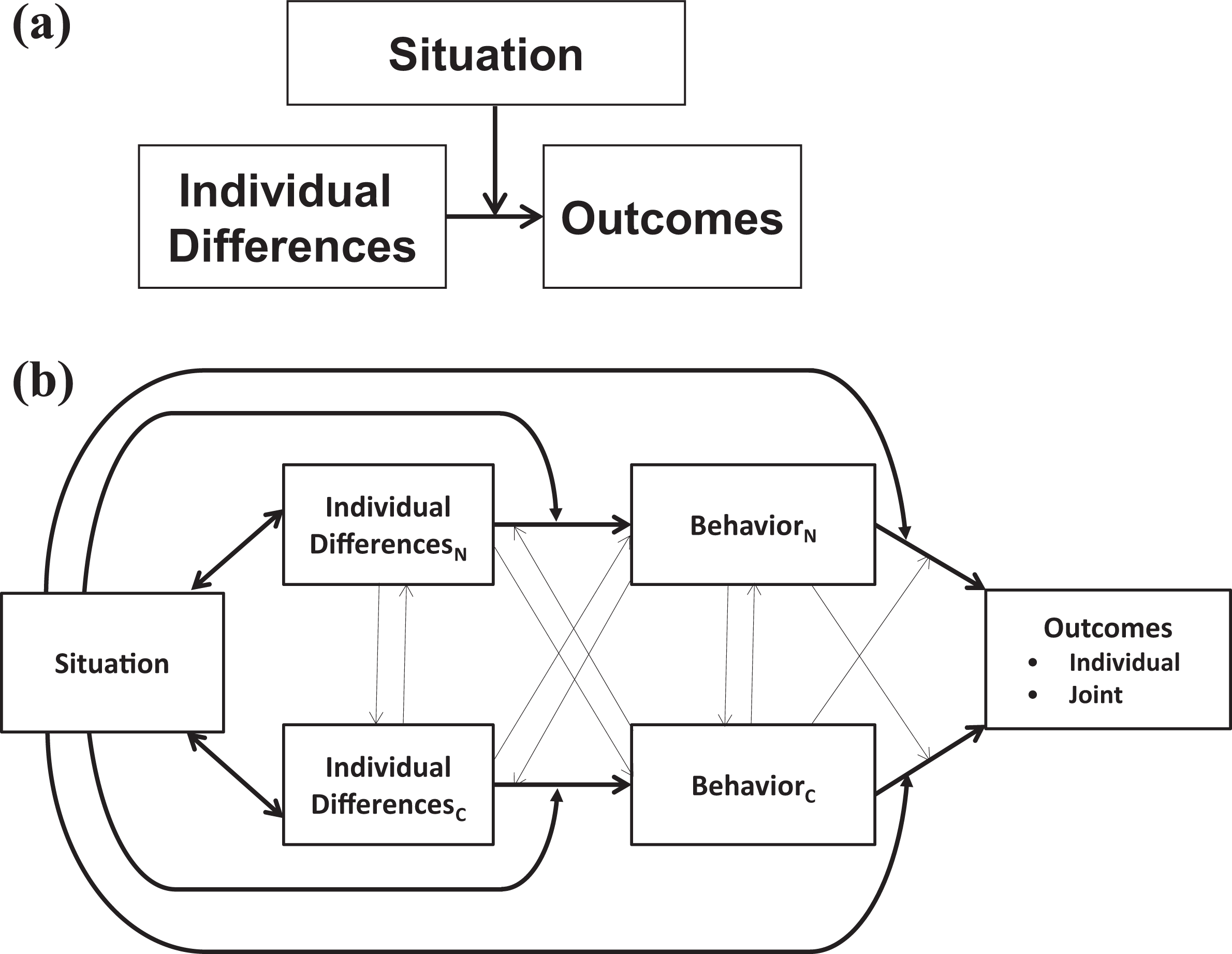
Theoretical models of Person × Situation interactions in negotiation: (a) traditional model of Person × Situation interactions and (b) relational process model of Person × Situation interactions.
For the first moderating relationship—whereby individual differences change people’s propensity to opt in—we draw from psychological theories related to how individuals take control of their environments. Buss’s (1987) model of selection and manipulation and Gross’s (2001) model of self-regulation both emphasize processes of situation selection and situation modification. Note that the arrows in Figure 3(b) running between the situation and individual differences are two-sided, representing both selection and modification. Each of these is discussed below.
The direction from situation to individual differences is a matter of self-selection into particular environments. Theoretical perspectives on this process have been particularly well developed in the personality literature. Personality includes the tendency to seek out situations to suit preferred behaviors (Ickes et al., 1997; Yang et al., 2009). For example, an extrovert doesn’t only approach strangers at parties but also seeks out parties. Personality characteristics tend to correspond to the types of situations people choose (Emmons et al., 1986). Recent work suggests that personality can also influence the types of negotiations that individuals find most rewarding. Dimotakis et al. (2012) found that more agreeable negotiators were more physiologically comfortable in contexts with the potential for win–win agreements, whereas less agreeable negotiators were more comfortable in strictly competitive contexts. Extending this theorizing from exogenously presented situations to self-selection, people are likely to seek out the situations that they tend to find comfortable.
Along these lines, a flourishing stream of work examines the propensity to initiate negotiations at all. Small et al. (2007) found that men versus women, those with greater entitlement, and those with less apprehension were more likely to enter into negotiations, and one can speculate that other individual differences could also influence this propensity. In particular, positive negotiation expectations and beliefs are likely to prompt individuals to seek out opportunities to negotiate. Indeed, certain characteristics—such as gender (Kolb & Williams, 2001)—may influence whether a person even realizes that a situation is a negotiation at all. Overall, a wide range of individual differences can influence a negotiator’s tendency to enter a negotiation.
The direction from individual differences to situation is a matter of people varying in the degree of taking control of their environment. The RPM draws on the notion from personality theory that there is a mutual interaction between people and situations (Mischel, 1977). That is, we do not merely act into a vacuum; we act toward and in response to a particular environment. In a pattern of reciprocal influence, people can change their environments—rather than merely accepting them (Mischel, 1977). Just as situation selection is a type of self-regulation strategy, so is situation modification (Buss, 1987; Gross, 2001). Negotiators need not treat their situation as entirely fixed. They may try, for example, to improve their outside alternatives (Lax & Sebenius, 2006). Negotiators may try to convert competitive situations into mixed-motive situations by bringing additional issues to the table. Note that this process may be underappreciated in the current literature because laboratory experiments tend to constrain participants’ ability to adjust their surroundings. Individual differences influence the extent to which negotiators attempt to alter the structural features of their negotiation. Some candidate characteristics to influence situation modification are the traits of maximization, creativity, cooperativeness, and conscientiousness.
The first exogenous P×S moderating factor, discussed above, acts before the negotiation begins. By contrast, the second and third moderating factors take the traditional P×S model and expand it.
The moderating factor whereby situations change the way that individual differences are expressed relates to earlier arguments that situations serve as triggers and affordances. In this case, the exogenous situation serves in this role of trigger or affordance rather than a counterpart serving in that role. As such, situational factors moderate the link between individual differences and negotiator behavior. This is the typical moderating argument made by researchers examining P×S interactions in negotiation. As such, there is a particular role for individual characteristics that are related to stereotypes that can be confirmed or reacted against (e.g., gender, race), as well as characteristics related to cooperation and competition (e.g., agreeableness, dominance), which are sensitive to signals of what kind of environment one is facing.
The final moderating relationship is that situational factors influence the link between negotiator behavior and outcomes. Notably, a weak versus strong situation can influence the degrees of freedom for behaviors to influence outcomes. For example, dominant behavior does not lead to greater value claiming when a counterpart has good alternatives. Misleading behaviors do not lead to positive outcomes when a situation is transparent or when parties are connected through a dense social network. In general, strong versus weak situations reduce the influence of all traits.
Taking a dynamic perspective on individual differences in negotiation
The RPM attempts to take a dynamic approach to understanding the role of individual differences in negotiation. By starting with the typical main effect model, adding the implicit mechanism of behavior, and including multiple parties alongside each other, the RPM is a cascading model in which individual differences set into motion a series of downstream processes. This section discusses the RPM in terms of critical properties described by Cronin and Vancouver (2019) to integrate into dynamic models, in particular inertia, feedback loops, and endogenous change (see also Cronin & Bezrukova, 2019).
Inertia—whereby a factor tends to retain its state over time—is infused throughout the RPM. Considering the link between individual differences and behavior, traits are associated by definition with enduring behavioral tendencies, and yet these traits merely represent the average of individual behavioral states (see, e.g., Fleeson’s, 2004, trait density theory). As such, there tends to be inertia in the first moves that a negotiator makes, in keeping with their enduring behavioral tendencies.
However, based on those first moves and the other party’s first moves, there arises a feedback loop, that is, a cycle of action and reaction. As such, the subsequent moves of both parties serve as a force acting upon the inertia of the trait–behavior relationship. Even so, behavior has inertia because it is “sticky”; given that people have enduring tendencies based on their traits, this feedback loop between the behavior of each party has at least one influence on it that is self-correcting. That is, even while responding to other people, there is a baseline tendency to which people tend to revert. However, there is another feedback loop that is self-reinforcing, which is the tendency of parties to mimic each other’s behavior. A further feedback loop is between behavior and the progress toward outcomes. As the desired outcome appears closer, the current behavior is positively reinforced, and as it becomes further, the current behavior is negatively reinforced. Faced with continual feedback about the direction their interaction is taking, effective negotiators self-correct.
Endogenous change is a matter of processes occurring within the system change the system itself over time (Cronin & Bezrukova, 2019). It is particularly worthwhile in the RPM to emphasize endogenous versus exogenous change to the system. In Process 3, a counterpart’s behavior moderates the relationship between the negotiator’s traits and the expression of these traits. It is important here to note that the counterpart’s behavior changes over time, and so this moderating relationship changes over time as well. This feature contrasts with the traditional P×S interaction, in which the exogenous situation remains unchanged throughout the encounter. Further, given that endogenous change can intersect with feedback loops (Cronin & Bezrukova, 2019), it is worth pointing out the endogeneity in Process 4, whereby the two parties’ behaviors interact and intertwine.
Cronin and Bezrukova’s (2019) discussion of conflict in teams emphasizes the importance of specifying a time period in dynamic phenomena. Among their typology of chronological periods, episodes, and moves, the RPM as a whole examines negotiation episodes. Within the RPM, Processes 1 and 2 involve episodes as well. In Process 1, people select their partner and then continue on to the interaction. In Process 2, negotiators have preconceived expectations of each other, and these expectations persist throughout the encounter. Inasmuch as they focus on behavior, Processes 3, 4, and 5 take place at the levels of moves. In Process 3, negotiators’ behaviors enhance or limit the expression of each other’s traits, which occurs on a moment-by-moment basis. Likewise, in Process 4, an action is taken by one party, a reaction by the other, and then there is a reaction again by the first. Finally, in Process 5, behavioral choices enhance or limit the ability for behavioral moves to influence outcomes.
How the RPM can reinterpret existing research
The RPM should make clear that a search for the zero-order effect of individual differences on negotiation outcomes is challenging. It is not necessarily misguided, as researchers often concluded from Rubin and Brown (1975), but rather it is very difficult. Sometimes the effect is large enough to shine through. However, often it is not, and frequent null results have led to frustration and the near abandonment of this important topic within management studies. The current article argues that one reason for frequent null effects is that the zero-order effect is diluted by the multiplex influence of one’s interaction partner. What has been addressed on a methodological basis—indeed often seen as a nuisance—turns out to be an important aspect of the relational phenomenon that cannot be completely controlled away through statistical methods. However, this does not mean that the results of past studies in this tradition are wrong per se, rather that they are highly conservative. Assuming that negotiation counterparts are assigned essentially at random in laboratory research, the lack of modeling of these dynamics serves as noise. This noise leads an effect to be unbiased in direction and yet greatly attenuated.
Likewise, the RPM suggests that past research on P×S interactions is also likely to yield coefficients that are conservative and obscure the true magnitude and importance of the effects. It is worthwhile to examine separately the three different forms of P×S moderation included within the RPM, and future work in the domain of P×S moderators can specify where within the model the situation is expected to act.
Empirically testing the model
Given its multiplex nature, it may be an impossible task to test simultaneously all of the arrows represented in relational process theory’s model. However, the model can be broken down into its five mechanisms, each of which can be tested.
Before doing so, it is worth mentioning the nature of empirical evidence in this research area. Most studies in the negotiations field consist of simulations of the bargaining process (Jang et al., 2018). Participants—typically students in graduate degree programs—take part in exercises for which they are provided with instructions that contain all possible preparation and for which the end point is to reach deal terms without any need to implement them afterward (Jang et al., 2018). There exists a small amount of field research on personality in negotiation, in which the performance of real negotiators is either self-reported or judged by their supervisors (Sharma et al., 2013, 2018). This article joins the call for a greater plurality of methods in the negotiations field, which has tended to prioritize internal validity of causal inference over ecological validity. 3
It is important to emphasize the need to move beyond the near-complete reliance in the negotiations literature on randomly assigned experimental designs of the bargaining phase of negotiation (Jang et al., 2018). Although it is possible to study personality in such designs to some extent, for example, by providing false feedback to participants about their level of a particular trait, the most naturalistic way to study personality is to observe its chronic, naturally occurring levels. For this reason, longitudinal designs, quasi-experimental designs, and qualitative designs need to complement the current focus on experimental designs. 4 Field research outside of the laboratory is particularly welcome.
Process 1, counterpart selection, could be tested using methods that move away from the conventional experimental design in which a pair of counterparts are exogenously assigned and the only choice is whether or not to reach a deal with each other. Experimental settings to test selection could, for example, use a marketplace design in which multiple buyers and sellers have the opportunity to shop around and decide with whom to transact business. Alternately, several profiles of potential partners could be offered to the participant, and these profiles could have attributes based on false feedback. In keeping with interpersonal theory, some of the information could relate to dimensions close to affiliation— for example, personal background traits such as personality and attitudes—and some could relate to dimensions likely to relate to dominance— for example, status characteristics.
Process 2, namely setting expectancies, can be tested by examining the behavioral consequences of information provided about a counterpart before the interaction begins. As an example of the type of design that can uncover priming effects, as mentioned above, Bowles et al. (2005) found that negotiators set higher aspirations against female counterparts, even before they met. Such designs could be extended to other characteristics about which there are negotiation-related stereotypes.
Process 3, whereby people serve as triggers and affordances, can be tested through the use of confederates. For any individual difference factor, one can map out the following questions: What behaviors related to this individual difference would trigger, elicit, or suppress behaviors in others? Confederates can enact these behaviors, and analyses can determine whether the link between trait and behavior is larger versus smaller in one condition than the other.
Process 4, which is a matter of behavioral reciprocity and complementarity, can be tested through observation and experimental manipulation of behaviors, notably behaviors related to competition and cooperation. Research on conflict has examined the reciprocity of conflict-related behaviors (Brett et al., 1998). Individuals hold different scripts for how they are supposed to behave to each other in kind (Abelson, 1981; Goffman, 1959), even while negotiators can improvise off these scripts as appropriate (McGinn & Keros, 2002). The reciprocity and complementarity of many other types of negotiation-related behaviors have yet to be tested, particularly for deal-making versus conflict situations.
Process 5, namely differential consequences, has also been examined outside of work focusing on individual differences per se. As discussed above, for example, Pruitt and Carnevale (1993) outlined how the effect of one person’s cooperative behavior depends on the cooperative behavior of the other party. This can be expanded to examine interaction effects between parties on other key negotiation-related behaviors.
In addition to testing each of the five theoretical mechanisms on a separate basis, an important aspect of the relational process theory can be tested at a bigger level. In particular, key to the RPM is the notion that individual differences cannot be fully understood outside of the dyad. That is, the study of person-level effects cannot lose sight of the fact that negotiation is inherently relational. Along these lines, research has examined the interaction effect of same versus other sex dyads (Kray & Thompson, 2005) and same versus other culture dyads (Gelfand & Brett, 2004). Recent work has started to look at the interaction effect of personality traits. Wilson and colleagues (2016) found that similarity between negotiators in terms of extroversion and agreeableness predicted greater positive emotion, which, in turn, predicted objectively more efficient and evenly split deals as well as subjectively lesser conflict and more positive perceptions of each other. Note that the work conducted to date examines match versus mismatch along one specific trait at a time. It would be valuable to expand this work to examine cross-trait interactions. Elfenbein et al. (2018) found that interaction effects explained over a quarter of the variance in outcomes of a distributive exercise, which suggests the potential power of these relatively untapped effects.
Overall, outlining ways to test the RPM emphasizes the need to expand research designs beyond the typical payoff matrix negotiation between two unacquainted parties who are assigned to each other to take part in a one-shot interaction.
Further model development
It is worth noting room for the expansion of the RPM. First, there are a number of important boundary conditions to recognize. One boundary condition is the type of negotiation, namely the degree to which it is integrative versus distributive. The manuscript above attempts to model mixed-motive interactions, while also acknowledging more strictly competitive settings. Indeed, the extent to which a negotiator believes that situations are distributive versus integrative can itself be an individual difference (Falcão, 2012). Another boundary condition is that the RPM explicitly models two parties side-by-side, and yet in real-world negotiation, there are almost always other parties—at the table or implicitly as constituencies or other interested parties behind the scenes (Jang et al., 2018). Second, the model can grow to include post-deal implementation, which may be influenced by individual differences as well. Finally, the RPM could be expanded to encompass temporal dynamics more explicitly. Although it is depicted as a cascading model, actual negotiations do not always proceed in such linear chronological terms, and there is room for recursive dynamics as well.
Conclusion: A multifaceted role for individual differences in negotiation
The search for the role of individual differences in negotiation has been a long and often frustrating pursuit. Decades of research in which person-level factors have been correlated with negotiation outcomes has met with only tempered success (Sharma et al., 2013). The RPM attempts to contextualize the individual negotiator within an inherently dyadic process. Examining individuals as nested in a relationship opens a series of dynamic processes that all begin with the individual differences of both parties. In doing so, a chronological model emerges that systematically maps the places where each person’s individual differences can influence the behavior of either party and, in turn, influence negotiation outcomes. The five resulting mechanisms are that individuals (a) choose each other, (b) set expectancies for each other, (c) serve as behavioral triggers and affordances for each other, (d) reciprocate and complement each other’s behaviors, and (e) vary in their responses to identical behaviors. This theoretical model suggests types of individual differences that are worth studying at different stages of this chronological model and also incorporates the role of P×S interactions.
In an area with heavy pronouncements over the decades that it was time to close the book on the topic (e.g., Bazerman et al., 2000), the RPM is in a position to help support increasing interest in the pursuit of individual differences in negotiation. Based on the RPM, it is possible to conclude that the conventional search for person-level effects was not misguided, but rather that it is so highly conservative that empirical work understated the true magnitude of its importance. Although the model is complex, its components are readily amenable to empirical testing through experimental designs. Overall, a more complete picture embraces the complex interplay that is sparked by the individual differences of both parties.
