







Abstract
Participation in meetings is a multifaceted process. Meeting members must consider individual and meeting goals when creating their messages, as well as a host of other context and resource factors. The purpose of this essay is to create a framework through which to consider meeting member contributions. Pulling from literature in impression management, resource conservation, and meeting science, the essay introduces a strategic perspective of meeting participation and categorizes five meeting participation types. Implications of this perspective on future meeting research are considered.
Plain Language Summary
Over the years, meeting attendance has become a larger and larger portion of employee workload. Meetings are salient locations of work, where group members interact in a way that advances the organizational goal. Since meeting interactions showcase group members’ preparation and competence, meeting participation is important not only to the purposes of the group but also to the reputation and credibility of the group members. The theoretical framework in this essay showcases the factors that influence how group members choose to participate in meetings. Group members must balance the need to maintain a good impression during meeting interaction while also weighing how much energy to use given the myriad responsibilities that members must juggled. Different meeting characteristics (e.g., virtual meetings and group size) may influence how members try to maintain good impressions and conserve energy. The intersection of these member goals creates five ways that individuals participate in meetings: full participation, nonparticipation, pretend participation, token legitimacy, and off/on participation. Meeting members may use one or several of these approaches during the course of a meeting, depending on how they balance their impression management and resource conservation goals.
There may not be a more important opportunity for individuals or employees to show their value than in a meeting (Jay, 1976). As Schwartzman (1989) points out, meetings are much more than simple routinized events on organizational calendars. The temporal structure of organizations is often determined by the discussions, decisions, and deadlines associated with meetings (Beck et al., 2015). Interactions that take place in meetings are salient to organizational functioning, as all attendees witness communication and create shared understanding (Jay, 1976; Scott & Allen, 2022). These interactions create and manage identification and power dynamics across members. In fact, members often consider meeting functionality when assessing the performance of leaders. In other words, meetings are a central locus of organizational and societal action (Allen & Lehmann-Willenbrock, 2022), and how members participate in meetings is influential in how others perceive and view them.
Of course, meeting participation can look different based on the type and purpose of the meeting (Allen & Reed, 2022). Meeting types vary widely, from large-scale, organization-wide meetings to informal chats between supervisors and employees. Recently, the COVID-19 pandemic has increased the frequency of virtual meetings for many groups and teams (Karl et al., 2022), although virtual meetings were certainly already becoming commonplace, especially when members are geographically distributed. Not only are meeting types diverse, but meeting frequency can vary widely across professions and teams. All these contextual factors can influence participation levels of meeting members.
Adding to the complexity of meeting participation is the finding that many individuals dread meetings (Allen et al., 2012). This can be for a variety of reasons. Back-to-back-to-back meetings can be fatiguing. Meetings can also be seen as obstacles preventing members from accomplishing their “real” work. Some individuals dislike meetings because they also dislike group work. Many individuals do not have a problem with meetings per se but take issue with mismanaged meetings (which they may view as the majority of meetings; Lehmann-Willenbrock et al., 2016). These reasons, among others, lead individuals to view meetings negatively.
However, even if individuals have a distaste for meetings, they are a ubiquitous part of work life (Rogelberg et al., 2010). Past studies have shown that meetings are a common part of employee (between 11 and 15 meetings per week; Rogelberg et al., 2010) and CEO (37 meetings per week; Porter & Nohria, 2018) work schedules. An increase in virtual and hybrid meetings has seen the amount of work time spent in meetings increase by 10% (Microsoft, 2020). Researchers have learned that how employees manage their meetings influences the value they bring to their organization. Given the variety of personal goals and preferences present during meeting interaction, group members are often strategic in how they participate in meetings (Hollingshead et al., 2007; Wittenbaum et al., 2004).
In introducing a strategic perspective of meeting participation, we first lay out assumptions of a strategic approach (Beck et al., 2015). Importantly, the use of the term strategic is more than simply having a plan for participation. At its root, strategic refers specifically to the way messages are created. First, we believe that all communication is strategic, meaning that individuals adapt messages to accomplish goal(s) in consideration of contextual influences (Kellerman, 1992). Although messages can be simple or complex, all messages are adapted to best accomplish goals through verbal and nonverbal means (e.g., vocalics and haptics). These adaptations influence conversation at both macro- and micro-levels. For instance, the sequential nature of messages accomplishes macrotasks beyond the microadjustments to specific words and sentences.
Second, we believe that the salience of such goals can vary over time. We are constantly weighing our goals and adaptations as they evolve across and during meetings. Factors influencing these different goals can be contextual or personal. For example, Julie may be very focused on the collaborative group goal at the beginning of a meeting, but after the meeting runs 30 minutes long, her goals may change and become quite personal (e.g., just wanting the meeting to end). Thus, the temporality of messages influences individuals’ strategic message adaptations.
Third, when other meeting members communicate, we interpret their messages as evidence of their intent (i.e., goals) and contextual adaptations. The “recognition of message intent is generally accepted as fundamental to the nature of most interaction exchanges” (Blosser & Roberts, 1985, p. 456) and how we interpret messages. Interaction participants assume the messages received accurately portray the goals of the participant, even if those messages betray the sender. For example, if someone tries to speak confidently but their nonverbals show they are nervous, the receiver can view the nonverbals as authentic and interpret the message accordingly. Of course, receivers can still interpret that same message differently based on their perception of goals and contextual influence (Beck & Keyton, 2009).
So what does this mean for analysis? From a communication perspective, the adaptations of our messages are the best evidence we have of a group member's goals, as well a member's assessment of meeting context (Beck et al., 2015). Epistemologically, communicative behavior provides the data for understanding the strategic adjustments members make to satisfy individual and group goals while also adapting to context. As a result, communicative behavior is raw, authentic data for analysis.
Founded upon a strategic perspective, the remainder of this essay establishes a strategic framework for meeting participation. Previous research shows meeting members attribute participation levels to individuals’ choice (Di Salvo et al., 1989), making a strategic perspective helpful for outlining how individuals create and adapt their messages. We first detail main influences on meeting participation, including impression management, resource conservation, and meeting characteristics. Through incorporating these factors, we create a set of five categories that can be used to define meeting participation. We start by exploring two opposite categories as a dialectical tension: full participation versus nonparticipation. We then explore three additional categories that vary in degrees on this tension: pretend participation, token legitimacy, and on/off participation.
Influences on Meeting Participation
Many factors can impact meeting participation. Early research on management highlights how executives considered a host of variables when creating groups, such as the criteria for ideal members, distributions of responsibility, and facilitative approach (Filley, 1970; Nichols, 1981; Tillman, 1960). These past studies generally considered meeting participation at the group and organizational levels, focusing studies on composition and format. The present essay transitions from a focus at the group level to a focus on the individual level. There are a variety of factors that influence how individual meeting members decide to participate across the various types of meeting compositions and formats.
The proposed strategic framework for the present study targets how individual members choose to participate in meetings. Kellerman (1992) notes strategic interaction is directioned, purposeful, and selected to accomplish specific goals. When an individual enters a meeting, they make strategic choices in their participation to accomplish their goal(s). Their choice whether and how to participate is based on a variety of self-interested factors. We argue that two factors play a heightened role in how an individual chooses to participate in meetings: impression management and resource conservation. Both impression management and resource conservation move beyond simply attributing meeting participation to personality traits (Allen et al., 2014; Bonito & Hollingshead, 1997; Odermatt et al., 2018). Impression management and resource conservation deal with the motivation toward and away from participation. Given the various purposes of meeting participation, impression management and resource conservation may pull in similar or divergent ways. Meetings are dynamic, ever-changing points of coordination that require members to shift their communication throughout. Both impression management and resource conservation highlight two reasons why individual meeting participation may shift throughout the course of a meeting as goals ebb and flow. Meeting participation decisions are based on how these self-interested goals interact. Additionally, certain contextual factors such as meeting characteristics may accentuate the desire to either manage impressions or conserve resources.
Impression Management
In part, meeting participation behavior may be motivated by how a member wants to be perceived by the group. This concern for the perception of others is referred to as impression management (Goffman, 1959), which is defined as the way humans manage how they present themselves to the world (Turnley & Bolino, 2001). Impression management encapsulates a range of behaviors utilized to create a specific image for an audience. Goffman’s (1959) original work focused on impression management as being similar to a theater performance, wherein individuals perform in specific ways that are meant to guide and shape the reactions and impression formation of others. This theatrical approach views people as the creators of their own image that can be shaped and manipulated. For example, Roberts (2005) noted that professional identities are shaped through impression management, and individuals within an organization attempt to create an authentic and credible image. An individual's ability to successfully create a professional image can help them be viewed as competent (Turnley & Bolino, 2001), as well as prevent demographic faultlines from forming (Chi & Tsai, 2021).
Generally speaking, research has shown that individuals tend to manage impressions with five strategies (Rozell & Gundersen, 2003). First, an individual may choose to use ingratiation, which focuses on behaviors that make the individual appear more attractive and likeable to others. Self-promotion behaviors present the individual as competent and having specific skills and abilities, while exemplification focuses on the moral worth of an individual (Rozell & Gundersen, 2003). Intimidation is a fear-based strategy, wherein an individual presents themselves as capable of inflicting pain. Finally, supplication behaviors are when individuals appear helpless and attempt to get help from others. Of course, although individuals may choose any of these impression management strategies, the outcome depends on how the meeting members interpret the behaviors (Turnley & Bolino, 2001).
The concept of impression management also assumes that individuals may prefer to portray a less authentic view of themselves to the public. Goffman termed this concealment, or how “a performer tends to conceal or underplay those activities, facts, and motives which are incompatible with an idealized version of himself and his products” (Goffman, 1959, p. 59). Concealment allows individuals to cover up some of their behaviors that do not match the idealized version we wish to show to the world (Solomon et al., 2013). Commonly used in stigma and health disclosure research, concealment reflects intentional efforts by an individual to present one image while concealing the “true, profitable activity” (Solomon et al., 2013, p. 199). Individuals may conceal because of mistakes they made, in situations where only the final polished product is presented, when unsavory work was needed to complete the task, or when they demonstrate their credentials and worthy motivations regardless of their authenticity (Solomon et al., 2013).
These concealment tactics are common in the workplace. For example, concealment attempts could be fabrications of how dedicated employees are to the organization (Hewlin, 2003), ways of avoiding less desirable work, or hiding attempts to pursue job transfers (Becker & Martin, 1995). One primary reason for concealment is to focus on individual goals. As Erhardt and Gibbs (2014) point out, impression management (via concealment) allows individuals to display favorable impressions toward the group goal while also focusing on their own individual goals.
Given the importance placed on meetings, impression management may be a salient individual goal for members to consider when participating. Meeting attendees want to foster positive impressions among their coworkers and supervisors while managing their professional image (Crowe et al., 2019). The various impression management strategies are applicable to meeting settings, as is the need to conceal when errors or lapses take place. Therefore, meeting members are likely balancing multiple individual goals in addition to the group goal when making meeting participation decisions (Hollingshead et al., 2007; Wittenbaum et al., 2004).
Resource Conservation
Meeting participants must also balance their use of time and energy resources when deciding how to participate in meetings. Meeting participation efforts may need to be considered in relation to other demands, including projects, deadlines, and the need to attend other meetings. Idealistically, members would be fully alert, focused, prepared, and engaged in every meeting. However, such an approach would exhaust energy, time, and focus resources quite quickly. The number and length of meetings, the complexity of tasks, and external factors (e.g., poor sleep the previous night) may require members to use and conserve resources more strategically (Mroz & Allen, 2015). The need to prioritize resource use suggests that participating at an idealized level is not only problematic but often not realistic and at worst harmful.
The conservation of resources theory may prove a profitable framework for considering resource management in meetings (Hobfoll, 1989). The conservation of resources theory is centered on how humans manage the use and acquisition of energy and effort resources, particularly in regard to stress and health. The theory focuses on two principles. First, primacy of resource loss states that it is more harmful to lose resources than it is beneficial to gain resources, suggesting that we should be mindful when choosing to use resource reserves. In a workplace setting, the use of energy or time resources on one project may not only decrease the amount of energy resources that could be used on another project, but losing the resource will be more impactful than gaining the same amount of new resources.
Second, the resource investment principle suggests that people will use or invest their resources in order to prevent resource loss. This is a strategic, proactive approach designed to deal with future resource loss by using current resources in the hopes that the investment will provide a better overall outcome. Evidence to support people's hesitation to use resources was confirmed by Lee and Ashforth (1996), who found that “individuals may be more sensitive to demands placed on them than to the resources received” (p. 129).
The two principles are informative when considering meetings. For example, individuals who have additional work or future meetings in the same day may try to minimize their effort in order to conserve daily energy resources. Multitasking may be another alternative to best maximize resources. Meeting load, or the number of meetings a person has in a given day (Allen & Lehmann-Willenbrock, 2022), may impact their decision to engage in resource use and conservation. Additionally, if working hard in a present meeting may reduce the need to meet again in the future, individuals may choose to invest their energy and efforts during the initial meeting. This suggests that the quality of the meeting and the likelihood that a good meeting reduces the need for future meetings may serve as a motivator for engaged participation (Allen & Reed, 2022). Of course, limited resources can reduce our ability to focus on meetings, such as when we are tired or struggling with motivation or intrinsic interest. In these situations, individuals will need to be strategic in how they utilize their effort during the course of meetings.
Meeting Characteristics
Meetings vary greatly by type (Kello & Allen, 2022) and relevance (Allen & Rogelberg, 2013). These variations create changes in employee experiences, attitudes, and well-being (e.g., Rogelberg et al., 2006). In meetings, individual self-preservation, power dynamics, and social identity are on display while group dynamics and even organizational functions are enabled and constrained. However, most previous research has focused on studying meetings in general, without much focus on different sizes, shapes, types, or topics (Mroz et al., 2018). Because most of the previous research on meetings remains at this generic meeting rather than specific meeting type, meeting characteristics have been investigated in this manner as well.
Various meeting factors may influence how individuals participate in meetings, especially in conjunction with the impression management and resource management influences previously mentioned. In general, individuals who are allowed to participate in their meetings and do so are also more engaged in their work (Yoerger et al., 2015). Previous research has also shown that accomplishing one's own goals in a meeting tends to help individuals and teams complete their work relative to their interdependent goals (Cohen et al., 2011). However, meetings are not always designed and executed in a way that ensures participation is likely (Allen & Reed, 2022). Several meeting characteristics that may directly impact the impression management and resource conservation concerns are detailed here.
First, meeting size or attendance may influence individual participation decisions. As meetings gets larger, the degree to which people feel obligated to fully engage and participate diminishes (Bales, 1954; Filley, 1970). This may be due to diffusion of responsibility, meaning that more people in the room likely leads to more opinions and ideas offered, and that more individuals are available to take initiative when a question is raised or an assignment is proffered. Additionally, as the number of people increases, the ability to remain anonymous but counted increases. For example, in virtual meetings, once the number of attendees increases beyond what can be visible on the main screen, those on subsequent screens can often be forgotten. It takes concerted meeting management efforts to ensure the attendees off camera do not become disengaged (Reed & Allen, 2022). As the number of attendees increases, the amount of time available for each person to share their thoughts and ideas is diminished (Bales, 1954). With five attendees and a 30-minute meeting, everyone theoretically has 6 minutes of talk time available, assuming an equal distribution. Increases in team size theoretically diminish participation opportunities.
A second meeting characteristic that may influence participation is meeting relevance. Meeting relevance refers to the degree to which attendees believe the purpose of the meeting is meaningful to them in their work role (Allen & Rogelberg, 2013). When the meeting goals align more closely with the people in the meeting, a greater amount of overall participation and engagement will occur. As that alignment decreases, motivation to engage, share ideas, and participate in general will also diminish. It is important for meeting leaders and organizers to both ensure that meetings are relevant for the attendees as well as allow employees for whom the meeting is irrelevant to not attend.
A problem in many meetings is individuals showing up late (Jay, 1976). Meeting lateness is the degree to which a meeting begins after its scheduled time, regardless of the cause (Allen et al., 2018). Although most of the time meeting lateness is behavior driven (e.g., the leader arrives late), meeting lateness acts like a meeting characteristic in that it dramatically sets the stage for the meeting. Late meetings have more negative behaviors and processes than on-time meetings. Thus, the late start becomes a characteristic of the entire meeting. In terms of participation, meeting lateness infuriates people and changes how they interact with one another (Lehmann-Willenbrock & Allen, 2020). Lateness erodes motivation to communicate, thereby reducing meeting attendees’ overall initiative to engage.
Of course, the interaction during a meeting also influences how individuals attempt to participate in meetings. Meeting leadership that fosters input from many people, as opposed to only a few, encourages participation. Some groups create norms for discussion, such as a round-robin approach to prevent only a few members dominating conversation. The norms and climate of the group influences whether someone is willing to speak up. Relatedly, counterproductive meeting behaviors by other group members may discourage participation.
Meeting Participation Categorization
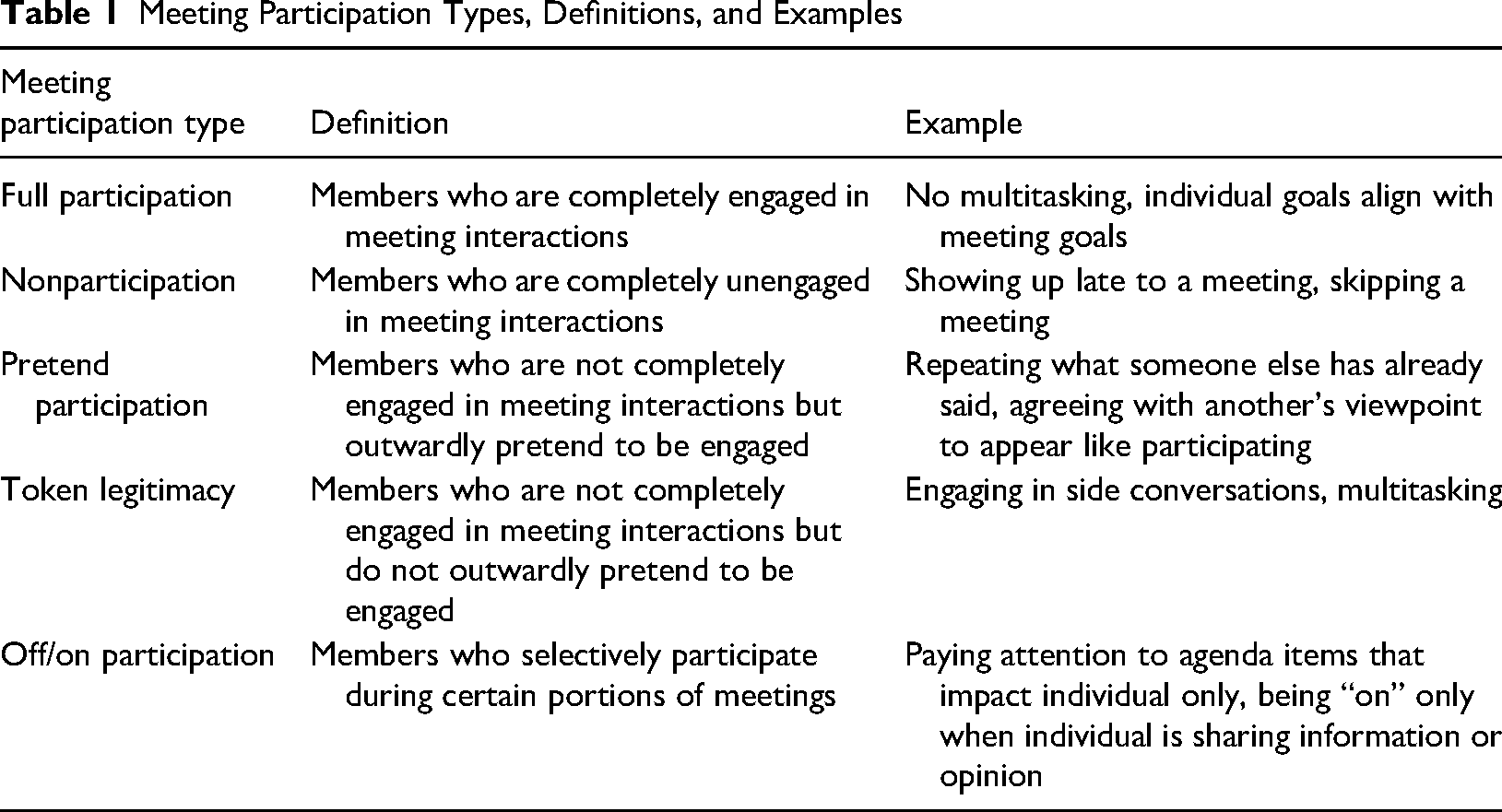
As previously stated, a strategic perspective of meeting participation claims that we adapt our messages to accomplish our goals (Wittenbaum et al., 2004), and oftentimes, we are balancing multiple individual and group-level goals simultaneously (Hollingshead et al., 2007). Balancing our goals, such as impression management and resource management, can be particularly tricky. Meeting characteristics may moderate how these self-interested goals interact, and individuals may experience multiple types of meeting participation across meetings, or even within the same meeting. In categorizing the way individuals participate in meetings from a strategic perspective, we first introduce two polar opposite approaches: full participation and nonparticipation. Then we explore additional categories that fall somewhere between or around these two poles and portray the way individuals balance goals and influence factors when deciding how to communicate in meetings (see Table 1).
Meeting Participation Types, Definitions, and Examples
Full Participation Versus Nonparticipation
Full participation is the idealized type of group participation that many individuals assume is the foundation for successful, functional meeting outcomes. It aligns with labels such as collaboration or the integrating conflict style (Rahim, 1983) in that it portrays an individual's full investment to the group or meeting goal. In this type of participation, the group goal remains the individual's focus. Although there are certainly moments when full participation takes place, it may be difficult to maintain or expect this type of behavior from all group members during an entire meeting. The amount of effort and concentration required may make it difficult for members to remain focused, and cognitive capacity issues may require members to have periods during the meeting where they are less engaged.
In consideration of the influences discussed in this paper, full participation disregards attention to resource conservation needs, with attendees using the required energy and effort to participate in the meeting. As a fully engaged group member, impression management is less of a concern (although this is certainly not eliminated), as individuals generally want to be recognized as someone who is fully committed and engaged. However, members do want to be looked at in a positive light, and communication may be filtered to ensure they do not come across as angry, redundant, or other negative outcomes that may still be in line with fully engaging in the meeting. Full participation members may prefer smaller meetings, which allow them to participate more. These individuals will prefer meetings with high levels of relevance and that involve members who display behaviors and decorum that support and enable participation. However, full participation members may also be fine with meeting characteristics that allow for domination or uneven participation distributions, as long as they are part of the dominant group.
The nonparticipation category is defined as those members who are completely unengaged in the interactions of a meeting. For our purposes, they are individuals who do not even show up to the meeting despite having been clearly invited and expected to attend. Reasons for this type of behavior are varied, from simply not wanting to attend to not feeling the meeting is important or necessary. The absence of nonparticipation members may lead other members to question the commitment and value of the group member. Additionally, it may cause members to reflect on or second guess whether the meeting is illegitimate in some way and whether they should change their opinions or commitment level. Nonparticipation can be frustrating for all attending and participating members.
Nonparticipation members are not trying to convey an impression that they are a committed member of the meeting, and other members are likely aware of this. They are not using any resources, and it could be perceived that they are not willing to use any of their time and effort to further the meeting's purpose. Their absence prevents any meeting characteristics from directly influencing them, although their lack of participation may certainly influence others in the meeting. These behaviors, such as not showing up or showing up late, have shown to be a form of interpersonal transgression that is evaluated by peers (Mroz & Allen, 2017).
Pretend Participation
Members who may not be completely invested in a meeting but want their outward impression to indicate that they are fully engaged may select a pretend participation approach. In pretend participation, individuals are concerned with impression management in that they want to be viewed as fully engaged members of the meeting and receive all the benefits of a fully engaged member. However, they also desire to conserve energy resources. This may be due to lack of interest in the proceedings, not feeling like they are necessary or pertinent to the meeting conversation (i.e., meeting relevance; Allen & Rogelberg, 2013), or they are simply fatigued from workload issues. It also could be because they are not prepared for the meeting but would prefer others to not know this as it would hurt how others view them. With all of these issues, their concern for their public image is still highly valued. One way of considering pretend participation is viewing it as a balancing act. The participant wants to control their image while also reducing exertion, whether out of choice (e.g., conserving energy) or necessity (e.g., lack of meeting preparation).
An awareness of good meeting citizenship behaviors may help members pretend and give off the impression that they are engaged when in fact the opposite is true. Individual members’ naïve theories (e.g., Beck et al., 2012) of good meeting participation will determine how they try to portray an engaged image to others during the meeting while conserving energy. Since members may differ on what good participation looks like (e.g., speaking a lot vs. listening a lot), and since it may be difficult to fake certain behaviors (i.e., be viewed as insincere), accomplishing impression management goals may not be straightforward.
There are certainly many communication behaviors that can fall within pretend participation. Repeating what someone else has already said or agreeing with another's viewpoint may provide the appearance of participation, but not require high levels of effort. Engaging in more relational, support-oriented messages may likewise contribute to positive group process without requiring intense monitoring of the conversation. Of course, any communicative act that mirrors appropriate engagement could potentially work, as long as it is executed and interpreted in the intended way. And there is a risk that overly positive relational or supportive messages can look inauthentic, and the appearance of authenticity is important when pretending. For example, complimenting a speaker could be seen as supportive communication (full participation) or a brown nosing (pretend participation). The goal of these behaviors is to portray full participation while hiding attempts to conserve energy.
Token Legitimacy
Some members may not desire to portray complete engagement during meetings. Their need to portray a certain impression may be quite low, whether that evolves from having a strong reputation or a low need to maintain one. What is clear is these members perceive a need to receive credit for attendance and to do so in a way that minimizes effort and time resources. Token legitimacy generally satisfies the norms of presence while eliminating the need to be fully engaged.
A variety of meeting characteristics may encourage token legitimacy participation. Large meetings may lead members to believe that participation will be difficult and require great effort. It may be intimidating to participate in such meetings and require high meeting preparation and courage to participate. It could also be a result of learned helplessness as well as a perceived lack of relevance. Meeting leaders may do their best to discourage this behavior, such as calling on people to speak or using facilitation techniques. However, certain meetings (e.g., trainings) may make it easy for people to attend with minimal effort.
Of course, in many circumstances, meeting facilitators may be quite satisfied with this level of meeting participation. Meeting leaders who are worried about how meeting discussion will go or are sharing very basic information may prefer individuals pursue token legitimacy. While being involved in a side conversation or surfing the internet on your phone may be considered rude (Paskewitz & Beck, 2019, 2021), there may be meeting contexts or norms that allow for such behavior. Many token legitimacy behaviors are nonverbal in nature, and part of why they are so successful is that there is a vagueness to them that does not alert others to lack of effort.
Communication form or medium will greatly affect how members can participate in a way aligned with token legitimacy. In a virtual format, simply registering with the meeting software and maintaining virtual attendance may be enough, especially if the meeting involves many members. Since members can often select an avatar or image instead of their live video camera, the meeting can be attended primarily through audio, affording members the chance to accomplish other activities while listening. If a portion of the meeting requires higher levels of engagement, they can activate their microphone or video and respond accordingly. But the necessity of visual engagement is eliminated. Of course, doing the bare minimum is possible in face-to-face meetings as well, as people can always work on laptops or phones and appear engaged in the meeting. The ability to hide the exact nature of what a group member is doing can create the illusion of engagement. However, these actions may come at a risk, as Paskewitz and Beck (2019, 2021) found members generally disapprove of individuals working on hidden tasks (i.e., on phone during a meeting), perhaps because they assume the tasks are not for work. Regardless of what else they are doing, the purpose of token legitimacy is to gain credit for attendance while minimizing effort.
Off/On Participation
Another category of participation is off/on participation. Off/on participation refers to members who can selectively participate during certain portions of the meeting but can be quite nonparticipative during other portions. This form of participation is in a way a blend of full participation and token legitimacy. However, group members in these meetings are strategic in their attentiveness and are not trying to fake participation as much as activating energy and effort resources for specific portions of the meeting. For example, during a meeting with a round-robin approach (i.e., each person reports on their project), individuals may choose to be “on” during their report and “off” during everyone else's reports.
In order for members to portray a good impression, the meeting format and culture must allow for Off/On participation. In some circumstances, meeting facilitators may be quite satisfied with off/on participation, especially from members whose expertise is only needed at select times during the meeting. Oftentimes, it is practical to have a meeting that covers a variety of topics, some less relevant to certain individuals than others. Certain agenda items may require everyone's attention, but other agenda items only need select individuals to engage.
Sometimes the medium (e.g., virtual meetings, conference calls) may allow meeting members to control their times of engagement. Other times there may be an acknowledgement that multitasking is appropriate during meetings. For example, a teacher attending a faculty-wide meeting may grade papers while listening to the proceedings. The assumption may be that the papers being graded do not require excessive focus and thus do not prevent the teacher from token legitimacy during certain parts of the meeting while having full participation during other parts. Accomplishing multiple activities at once is a type of time resource conservation. When an important moment arises, the teacher may pause from grading to participate and then return to the task.
Discussion
In sum, participation in meetings is complex. Researchers cannot model every potential interaction process in meetings. However, our analysis of the phenomenon, supported by both theory and previous research, suggests that overlooking participation variability may create a confound in our understanding of meetings across organizations. We now provide a brief discussion of the implications for organizational theory and research, followed by some suggested practical implications for managers in organizations. We conclude with next steps for investigating the legitimacy of the types of participation discussed herein.
Implications for Theory and Research
The strategic view of meeting participation and subsequent participation categories unites several theoretical views on how individuals participate in meetings. Impression management and resource conservation theories portray two different ways individual goals may influence decision-making, and certainly these goals may pull in opposite directions or at least need to be balanced. The desire to portray or create a positive impression may require energy and time resources that are also precious to the individual. If individuals have a clear preference for impression management goals, then they will consume resources to create that impression (full participation). The opposite is likewise true, as resource conservation may lead individuals to devalue the need to create or maintain a good impression (nonparticipation).
The desire to maintain or balance both goals may lead to pretend participation, token legitimacy, or on/off participation. In fact, these three category types may be best represented as an attempt to simultaneously balance both impression management and resource conservation goals. The pretend participation category is aligned with individuals who want to portray full participation but need to reduce resources necessary to truly be a full participant. The token legitimacy approach suggests a need to maintain a baseline level of impression management while withholding a high level of energy resources. The on/off participation approach would make impression management a strategically selective effort and would assume an ability to assess times for meeting engagement and times for resource conservation. The frequency of each of the five participation types, when individuals choose to utilize them, and the communication behaviors associated with each are important avenues for future research.
Of course, the desire to achieve the meeting goal is related to all these influences. Although there are exceptions, most meetings involve individuals who have a general desire to advance the purpose of their affiliation, and meetings are mechanisms for doing so. This meeting purpose, when combined with a host of individual goals, creates a framework for individuals to then make impression management and resource conservation decisions. Sometimes group or meeting goals will be the driver in making decisions to become fully engaged in meeting participation, while other times meeting characteristics and individual goals may hold sway. An important implication of the strategic perspective is that these goals must be considered in conjunction with how meeting members adjust messages to account for impression management and resource conservation needs.
Implications for Managers in Organizations
A strategic perspective of meeting participation suggests meeting members sometimes adjust messages so as to not to be fully engaged. Idealistically, full participation would be the preferred approach by all parties. However, full commitment toward a meeting goal at all times is unrealistic (Bales, 1954). A strategic perspective considers the multiple goals and meeting characteristics that go into member participation choices.
Managers are likely not surprised by members who are not fully engaged, and there may even be circumstances where it is preferred. Creating meeting agendas that highlight times of increased focus by all or certain members may be helpful in establishing focal points for participation. For example, managers sometimes call meetings for various issues, meaning certain members may be needed for particular agenda items. If these are brief, this may not be problematic for the meeting. However, managers could also highlight agenda points requiring participation (e.g., Item #3: Discuss Project Ideas, Everyone Bring One Idea; Jay, 1976). This type of preparatory work can help meeting members appropriately prepare for the meeting, giving them insight into the type of participation required.
Future Research on Strategic Participation in Meetings
Future testing of these meeting participation categories can further enhance our understanding of participation. One important way to do this is through incorporating a temporal perspective to meeting participation. For meeting members, participation likely fluctuates throughout the meeting. Desire to have full participation at the beginning of a meeting may trail off during the later stages if the meeting is lengthy. A meeting of little interest to a participant may evolve into a more meaningful interaction if another group member introduces a pertinent topic. In these cases, future research is needed to explore how participation shifts within a meeting. Utilizing interaction analysis can highlight both the ebb and flow of meeting conversation, as well as shifts in participation within a single meeting. Exploring these fluctuations can highlight meeting characteristics that shift participation and guide managers to better facilitation efforts going forward.
Additionally, individuals may shift their meeting participation across meetings to account for increased participation in one meeting and lower participation in another. To this point, our essay has presented meeting participation categories as choices made by group members for a specific meeting moment. Though that approach is useful in defining these categories, future research could utilize these categories to describe participation across meetings, thereby highlighting individual patterns of participation. For example, Alex may think, “I talked most of the time in the last meeting because no one else seemed prepared. I’ll stay quiet in this one to let everyone else speak up.” In this case, Alex is shifting their participation based on previous meetings to allow others to speak up. This shift would impact how much Alex participates in one meeting but may not lead their manager to perceive them negatively if Alex actively participates in other meetings. Though research often measures participation based on a single meeting, assessments of participation can also happen across meetings, which could yield insights into relational dynamics, such as underlying conflict or groupthink, as well as task dynamics, like roles within the project.
In addition to the temporal perspective, researchers could also learn more about how participation is perceived by all meeting members. Beck and Keyton (2009) highlight how meeting members can accurately perceive strategy of group members after the meeting. Taking this further, exploring other meeting members’ perceptions of meeting participation could be a useful feedback tool. By assessing participation of other members within or across meetings, meeting members can learn how they are being perceived by group members and shift behavior as needed. For example, a meeting member may be taking a full participation approach but tend to listen and be quiet. Where others may think the reserved behavior is due to lack of interest, this meeting member may simply need more time to process information before speaking. By asking other meeting members for perceptions of others’ participation, members can adapt behavior going forward.
Besides meetings, other organizational activities may also be influenced by impression management and resource conservation, and a comparison between meetings and these other activities may be fruitful. For example, impression management is especially salient to job interviews (see Peck & Levashina, 2017 for a meta-analysis on the topic), and for longer interviews, resource conservation may be as well. Comparing the influence of these two theories across work activities may provide additional insight into how organizational context makes certain goals salient.
Finally, future research will want to explore other factors that may influence meeting participation. In this essay, individuals decide on a meeting participation type based on their available resources, the nature of the meeting, and the importance of impression management. Although a helpful framework for studying participation, considering how these factors interact not only with individual and group goals but also other factors would be fruitful.
Conclusion
Participation in meetings is more complicated than simply a dichotomous participate-or-not-participate approach. Even viewing participation on a gradient scale from full participant to nonparticipant lacks the nuances discussed in this review. Our hope is the forgoing arguments will create questions among meeting science and communication researchers, requiring a more complete treatment of participation in group and team meetings. Additionally, we hope that managers in organizations will understand and see through the token participation to the larger issue at hand, which may be the perceived preponderance of terrible, irrelevant meetings that motivate variation in participation that is less desirable.
Footnotes
Funding
The author(s) received no financial support for the research, authorship, and/or publication of this article.
