







Abstract
Numerical simulations have been widely employed to predict the blast loads for confined explosions. Although they can provide accurate predictions, high-level computational resources are usually needed. Furthermore, the numerical simulations are often lengthy. To provide a quick response to emergencies and then a quick assessment of blast risks, a fast-running model is proposed in this study to predict the blast loads in a confined room. It is based on the method of images (MOI) and the low altitude multiple burst (LAMB) addition rules. The fast-running model can predict the multiple pressure pulses, which are caused by the multiple reflections of the shock wave from the surfaces of the confined room. Numerical models are developed to predict the internal blast loads. They are validated against the experimental data. After validation, numerical simulations are conducted to provide a reference for the evaluation of the accuracy of the fast-running model. It is shown that reasonable accuracy can be achieved by the fast-running model concerning the overpressure-time history, the arrival time, the first peak overpressure and the maximum impulse. Furthermore, the fast-running model has a significantly lower requirement of hardware resources and exhibits a much higher computational efficiency than the numerical model. The fast-running model provides a very fast and efficient method to predict the internal blast loads. It can be used to eliminate the need for a user to run a numerical simulation to determine the blast loads generated from confined explosions.
Introduction
According to the confinement, the explosion scenarios can be divided into two categories, that is unconfined and confined explosions. In the past, considerable studies have been carried out on the behaviour of shock wave propagation for unconfined explosions, especially for free field scenarios. However, fewer studies were devoted to the confined explosions. Owing to the multiple reflections and diffractions within the buildings, the pressure pulse duration of the shock wave is significantly extended. This gives rise to a larger maximum impulse (Feldgun et al., 2012). Hence, the blast loads of confined explosions may result in more serious damage to buildings and critical infrastructure (Luccioni et al., 2006).
The blast loads at the point of interest within a room, which is subjected to a fully or partially confined explosion, are significantly more complex than that of an external explosion. This complexity is caused by the multiple shock wave reflections from the surfaces of the confined room (e.g. walls, ceiling, floor etc.) and by the openings that allow pressure relief. In general, the overpressure-time history in confined rooms can be divided into three periods, that is the primary shock period, the shock-reflection period and the pressure oscillation period (Dong et al., 2010). The internal blast loads depend on several factors, that is the charge mass, location, shape, orientation, point of detonation, the confined room geometry (shape and size), the presence, location and size of openings, the relative location of the charge to the target point and the surrounding surfaces. To explore the influence of these factors on the shock wave propagation within the confined room and on the internal blast loads, simplified, experimental and numerical approaches were employed in the previous studies.
Baker et al. proposed a simplified internal blast load model, which contained three pressure pulses of triangular shape (Anderson et al., 1983). The subsequent pressure pulse has half the peak overpressure and maximum impulse of the previous pressure pulse. The pulse durations are constant and equal to twice the arrival time of the shock wave. However, it does not take the quasi-static pressure into account, which can be quite significant in magnitude and duration. UFC 3-340-02 presented a procedure to simplify the overpressure-time history, which takes the quasi-static pressure into account (US Army Corps of Engineers, 2014). However, the highly irregular multiple peaks, which were caused by the multiple shock wave reflections from the surfaces of the confined room, were replaced by an idealized single peak. Needham developed a simplified model to predict the blast loads at any point on the walls of a rectangular building (Needham, 2009a). In addition, the pressure waveform in the shadow region of the building can also be given. Furthermore, the author developed another simplified model to predict the overpressure-time history for the shock wave propagation from room to room through doorways and windows (Needham, 2009b). Note that no image bursts or shock addition rules were required in both models. Dragos et al. developed a procedure to simplify the highly irregular nature of fully confined blast loads (Dragos et al., 2013). It was further incorporated into an analysis tool of structural response.
Experiments of confined explosions were performed at both large- and small-scale. Edri et al. conducted a full-scale experiment to understand the characteristics of an internal explosion (Edri et al., 2011). The TNT charges were detonated at the centre of a cubicle room with rigid walls. A limited size of venting opening was placed at the ceiling. The effect of the charge mass on the blast loads was investigated. Chan and Klein conducted experiments to discuss the blast loads inside an enclosure (Chan and Klein, 1994). A 1 lb C4 charge was detonated at the centre of a rectangular steel bunker. It was shown that the pressure pattern inside an enclosure was much more complex than in the free field due to the multiple reflections and the interactions of the shock waves. Sochet et al. carried out small-scale experiments to verify the similarity law of the blast loads between the large- and small-scale experiments of internal explosions (Sauvan et al., 2012). Kong et al. conducted an experimental study to investigate the characteristics of internal explosions within a cabin structure having a venting hole (Kong et al., 2013). It was indicated that a shock wave, whose magnitude is comparable to the initial shock wave, can result from the merging of several shock waves reflected from the walls due to geometric symmetry. Wu et al. conducted experiments in a blast chamber to analyse the effect of the cylindrical charges on the peak overpressure and maximum impulse on the chamber walls (Wu et al., 2013). It was indicated that the blast loads were significantly amplified. Sochet et al. conducted experiments at a small-scale to analyze the pressure profiles generated from the explosion of a gaseous charge detonated in an enclosure (Sochet et al., 2021). The enclosure can be divided into two rooms by a movable wall at three possible locations. Wu et al. carried out internal blast experiments within fully and partially confined rooms to explore the influence of the venting on the behaviour of shock wave propagation and the failure modes of the rooms (Wu et al., 2020). In addition, a design method was proposed for the chambers subjected to fully and partially confined explosions. Gault et al. conducted small-scale experiments to investigate the influence of the charge location on the shock wave propagation in a confined room (Gault et al., 2020). To investigate the dynamic response and the damage mode of the steel cuboid rooms subjected to confined explosions, Yao et al. conducted small-scale blast experiments within steel cuboid rooms (Yao et al., 2021). Furthermore, strengthening methods were proposed to enhance the blast resistance of the steel cuboid rooms.
The application of numerical simulations can provide a comprehensive analysis of the multiple shock wave reflections inside an enclosure. Zyskowski et al. compared the internal blast loads obtained from a small-scale hydrogen-air explosion and those obtained from a numerical simulation using AUTODYN (Zyskowski et al., 2004). It was pointed out that both predictions agreed well only for the cases of normal incidence. Hu et al. developed a numerical model for the prediction of blast loads inside unvented structures (Hu et al., 2011). The effects of the charge shape and orientation as well as the geometry and volume of chambers on the internal blast loads were discussed. Feldgun et al. followed the experimental study of Edri et al. (2011) by a numerical analysis to understand the blast loads (Feldgun et al., 2012). An insight into the pressure distribution on the walls and the behaviour of the pressure attenuation was gained. To predict the dynamic response of steel cylinders subjected to partially confined explosions, Langdon et al. conducted both experiments and numerical simulations using LS-DYNA (Langdon et al., 2014).
The method of images (MOI) is extremely efficient and can provide detailed tracking of the shock wave reflections. To consider the interaction between the shock waves, low altitude multiple burst (LAMB) addition rules have been employed by many fast-running models (Needham, 2018). Chan and Klein proposed a MOI approach to describe the track of the shock waves and to calculate the blast loads generated from internal explosions (Chan and Klein, 1994). The effect of the order of reflection on the internal blast loads was investigated. Lapébie et al. proposed a fast-running model to describe the shock wave propagation in complex geometries (Lapebie et al., 2017). To consider the wall openings and the oblique reflections, Wu et al. proposed an improved method of images (MOI) to calculate the blast loads on the walls for confined explosions (Wu et al., 2017).
Recently, study of the confined explosions has revived because of interest in the shock wave propagation within the vented and unvented spaces. This demonstrates a need for a fast-running model to predict the internal blast loads within a few seconds. However, little data were available from the open literature and only limited attempts were made to understand the internal blast loads. To consider the multiple reflections and the nonlinear addition of the shock waves within the confined rooms, it is reasonable to combine MOI and LAMB addition rules to predict the internal blast loads. This study presents a fast-running model, which is based on MOI and LAMB addition rules, to predict the blast loads within a confined room. The theoretical background of MOI and LAMB as well as the procedure of the fast-running model are briefly explained in Section Fast-running model. To predict the blast loads for confined explosions, numerical models are developed in Section Numerical simulations. They are validated against the experimental data of Chan and Klein (1994). After validation, numerical simulations are conducted for different explosion scenarios to provide a reference for the evaluation of the accuracy of the fast-running model concerning the overpressure-time history, the arrival time, the first peak overpressure and the maximum impulse (Section Evaluation of fast-running model). Furthermore, the computational efficiency is compared between the fast-running model and the numerical simulations using LS-DYNA.
Fast-running model
The fast-running model presented in this study is based on MOI and LAMB addition rules. They will be explained in the following subsections. After that, the procedure of the fast-running model is illustrated.
Method of images (MOI)
The method of images (MOI) assumes that the reflecting surface is smooth, flat and perfectly rigid. Thus, the blast energy is reflected completely by the reflecting surface due to the neglection of structural deformation (Needham, 2018). For the reflection from a planar surface, the concept of image burst can be used. Figure 1 illustrates the concept of image burst. The image burst (C1) is used to represent the interaction of the shock wave with the reflecting surface. It has the same mass and distance to the reflecting surface as the real burst (C). The image burst is located on the opposite side of the reflecting surface, compared to the real burst. Regarding a gauge point situated in the air, for example point B in Figure 1, the incident wave is considered as the one generated from the real burst along the path of shock wave propagation CB, whereas the reflected wave from the reflecting surface propagates along the path CA-AB. According to the principle of mirror, it can be regarded as the wave generated from the image burst C1 along the path of shock wave propagation C1A-AB. As a result, the blast loads measured at gauge point B can be estimated by the superposition of the shock waves generated from the real burst (C) and image burst (C1). Image burst concept.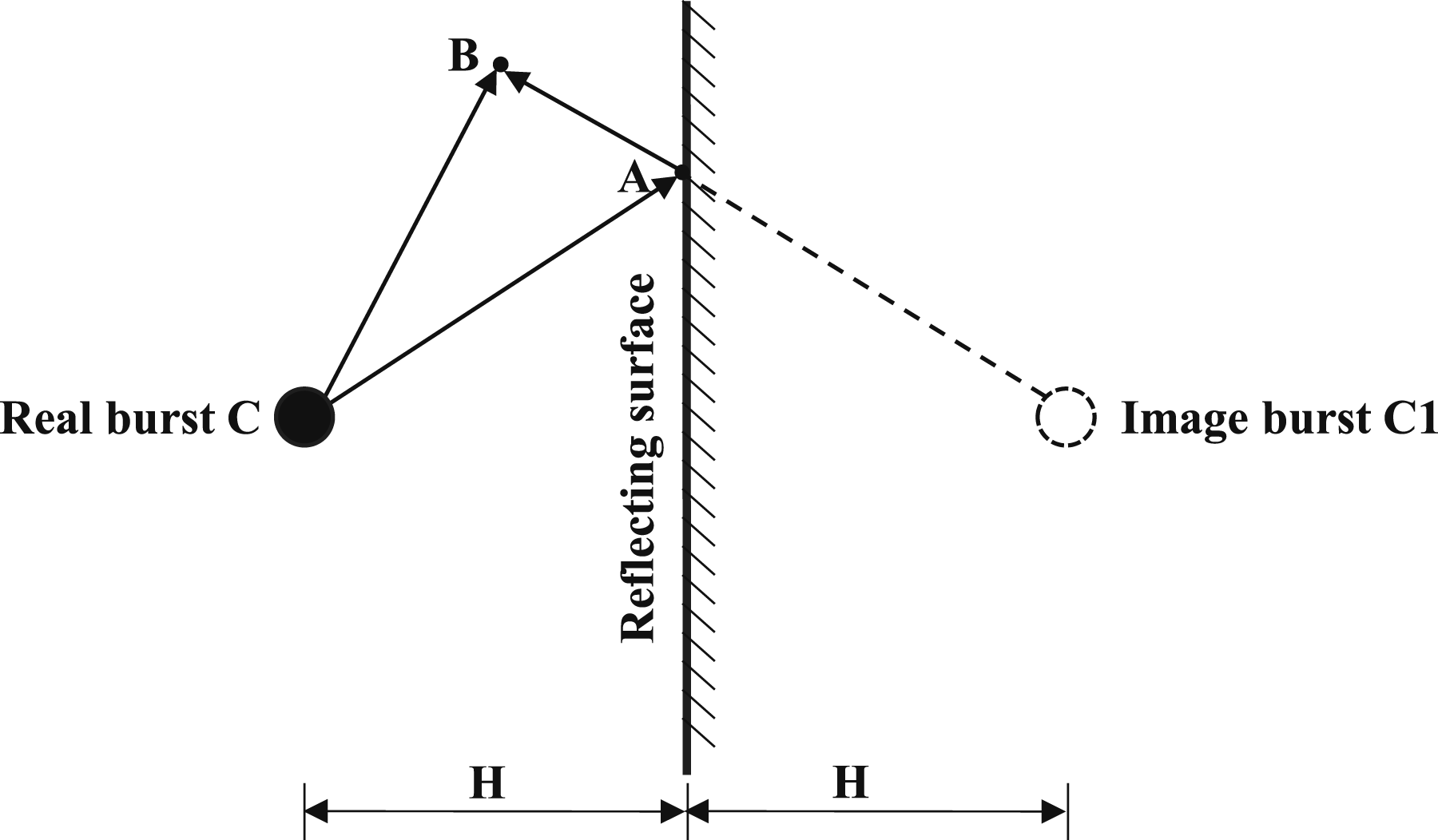
Considering the internal explosions within a confined room, which has more than one reflecting surface, the order of reflection and the associated number of image bursts are important for the estimation of the blast loads. Figure 2 depicts the locations of the first- and second-order image bursts as an illustrative instance. C1 and C2 are the first-order image bursts of the real burst C with respect to the reflecting surfaces of walls 1 and 2, whereas C12 and C21 are the second-order image bursts of first-order image bursts C1 and C2 with respect to the reflecting surfaces of walls 2 and 1. Regarding gauge point B, the shock wave, which originates from real burst C, arrives at the gauge point after reflection from walls 2 and 1 successively. The path of shock wave propagation is CA2-A2A1-A1B, which can be equivalent to the propagation path of the shock wave generated from second-order image burst C21, that is C21A1B, according to the principle of mirror. Illustration of first- and second-order images.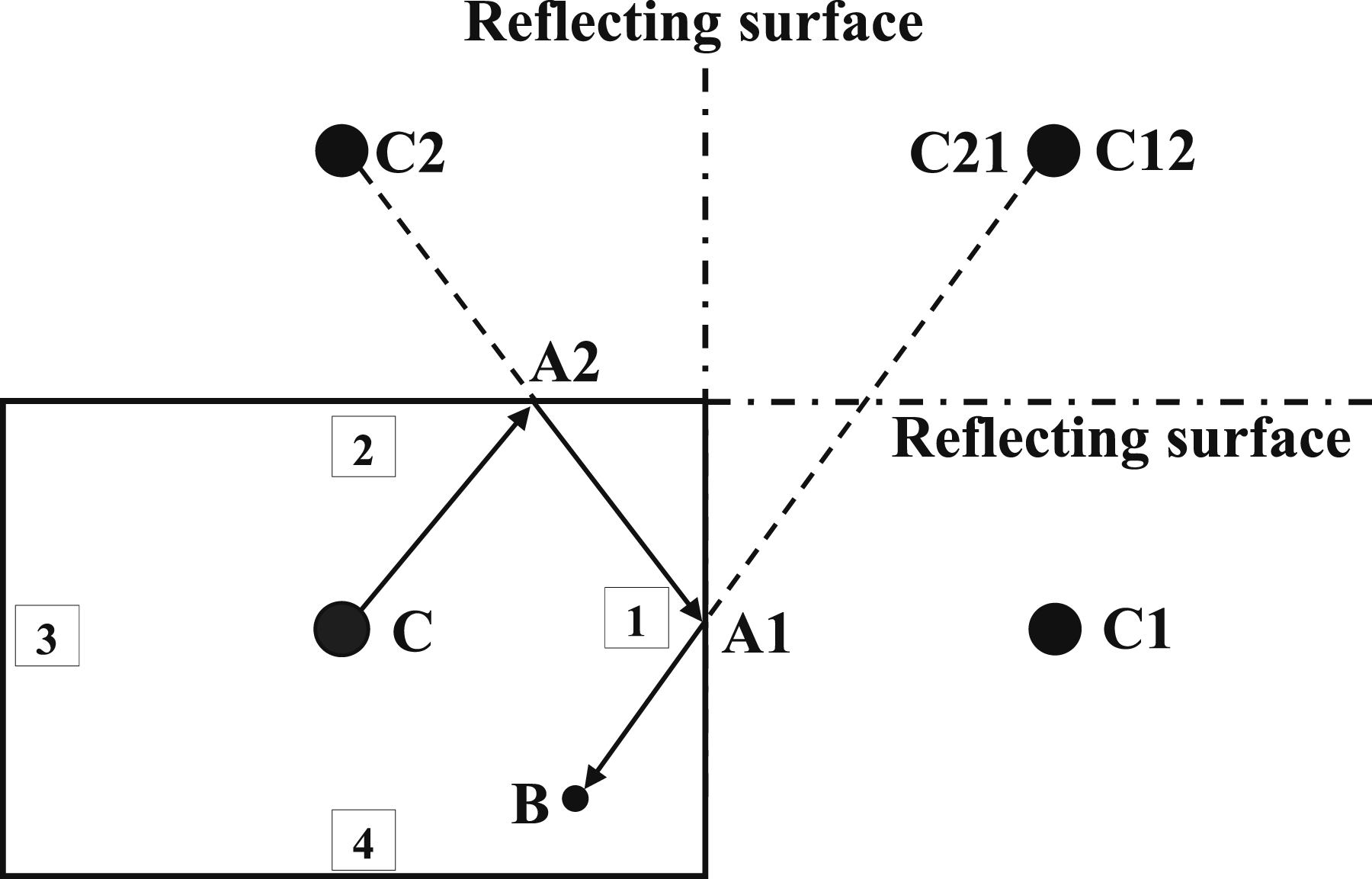
It is noticeable that the shock wave generated from internal explosions has multiple peaks in the overpressure-time history due to the multiple reflections from the walls of the confined room. Using MOI, the internal blast loads can be estimated by the superposition of the shock waves generated from the real and image bursts. Note that the distance between the image burst and the point of interest increases significantly with the order of reflection. Hence, the overpressure decays noticeably with the order of reflection. Taking the real burst, the first- and second-order image bursts into account, the total number of bursts is 37, which includes one real burst, 6 first-order image bursts and 30 second-order image bursts. It is worth mentioning that the real burst and first-order image bursts have an influence region, which occupies the entire room (Figure 3). Influence region of first-order image burst.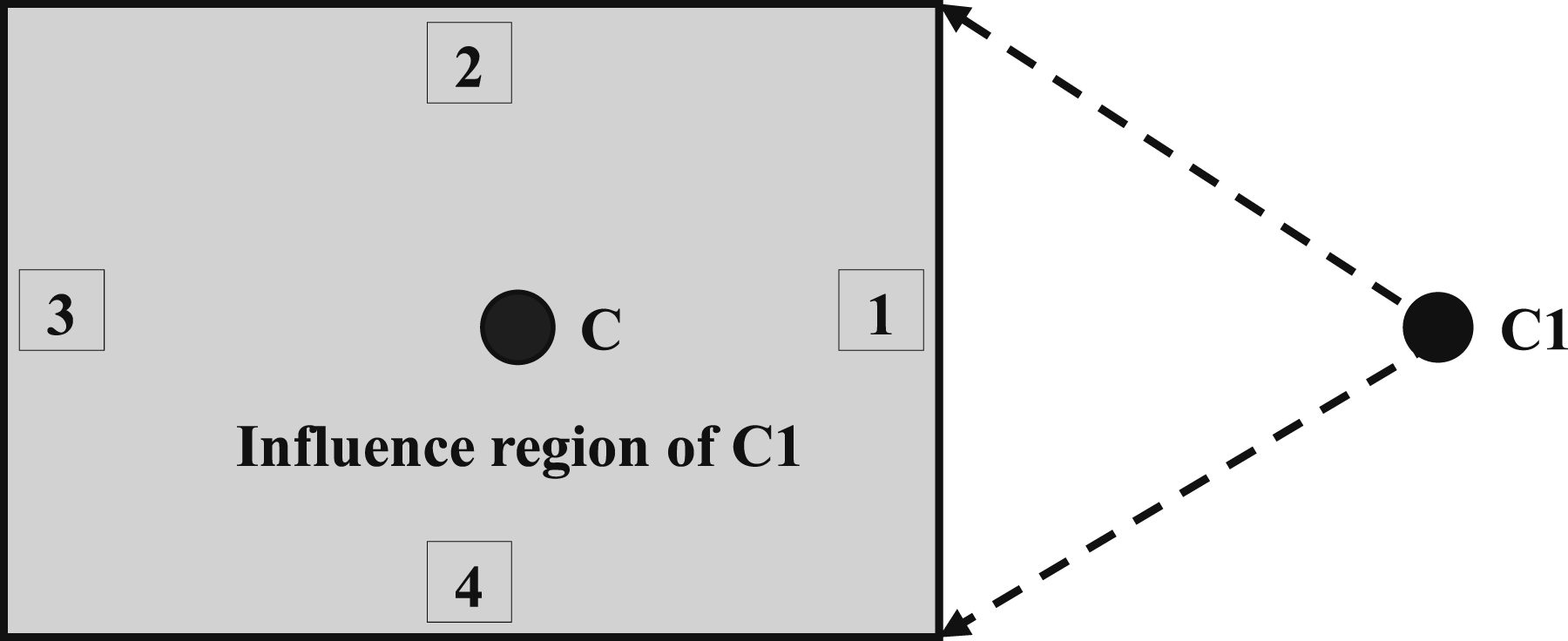
However, this is not the case for the second-order image bursts, whose influence region may cover only partial space of the room. The region of influence of the second-order image burst is limited by the solid angle of the shock front intercepted by the reflecting surface. Figure 4(a) and (b) illustrate the influence regions of image bursts C12 and C21, which are marked as the blue and grey areas. Hence, it is necessary to verify whether the point of interest is located within the influence region of such second-order image bursts or not. Note that image bursts C12 and C21 have the identical location. Furthermore, it is worth pointing out that their influence regions are complementary to each other. This means that the sum of the influence regions for such pairs of second-order image bursts (e.g. C12 and C21), which have identical locations, cover the entire room (Figure 4(c)). Under such circumstances, the complementary pairs of second-order image bursts (e.g. C12 and C21, C14 and C41 etc.) can be regarded as an image burst, whose influence region occupies the entire room. Thus, the total number of bursts is reduced to 25, taking 12 complementary pairs of second-order image bursts into account. Owing to the introduction of the complementary pairs of second-order image bursts, it avoids judging that if the point of interest is located within the influence region of the second-order image bursts or not. Influence region of complementary pair of second-order image bursts: (a) image burst C12; (b) image burst C21; (c) complementary pair C12 and C21.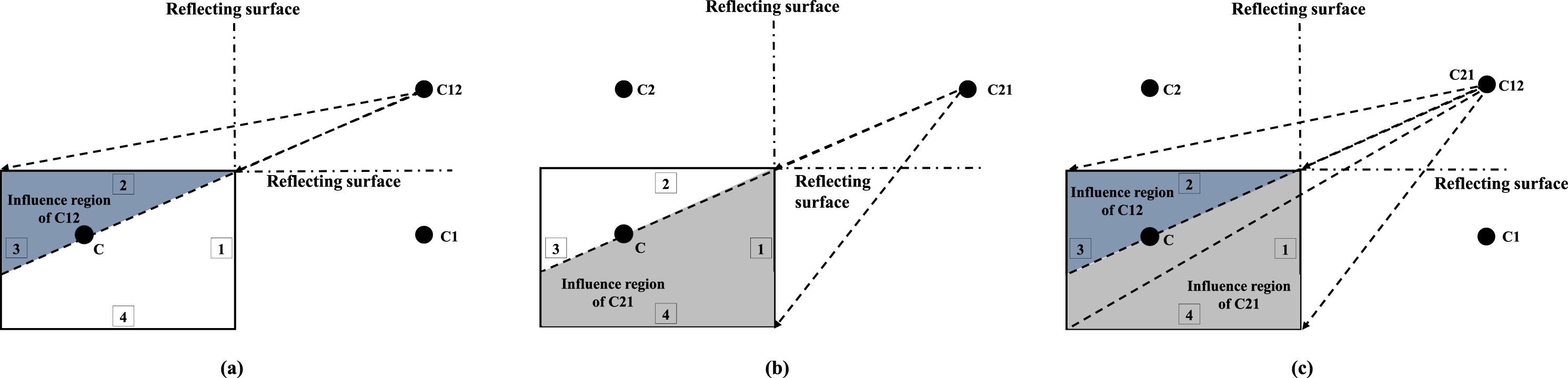
The overpressure-time history is computed as the sum of all the shock waves, which can be viewed by the point of interest. The total number of shock waves is controlled by the order of reflection desired for the calculation. This study considers the real burst and the image bursts up to second-order reflection for the blast load estimation.
Low altitude multiple burst (LAMB) addition rules
The internal blast loads within a confined room can be estimated by the superposition of the shock waves generated from the real and image bursts. The superposition can be considered by the LAMB addition rules (Needham, 2018), which are given in eqs. (1) – (3) and based on the conservation laws of mass, momentum and energy, respectively.





The density, particle velocity and peak overpressure at the point of interest, which are caused by the shock waves generated from the real and image bursts, are calculated individually. Then, the overpressure-time history at the point of interest can be estimated by using the LAMB rules. Note that the superposition of overpressure contains a linear and nonlinear part, which refers to the first and second terms on the right-hand side of eq. (3).
Eq. (1) states that the density at the point of interest after superposition is equal to the ambient air density (ρ0) plus the sum of the over-densities (



Eq. (3) means that the overpressure at the point of interest after superposition is the sum of the overpressures, which are induced by the shock waves generated from the real and image bursts, plus 1.2 times of the difference between the sum of specific dynamic pressures of the individual shock waves and the dynamic pressure of the shock wave after superposition.
To consider the energy dissipation during the process of the shock wave reflection from the walls, a wall surface reflectivity factor of 0.8 is assumed (Chan and Klein, 1994).
It is well-known that the peak overpressure of the shock wave varies significantly with the distance. Hence, the distance from the burst to the point of interest has a profound influence on the overpressure-time history. Three different shapes of the overpressure-time history exist after the superposition of the shock waves generated from two bursts. Shape I has only a single peak (Figure 5(a)), whereas shapes II and III have double peaks (Figure 5(b) and (c)). Note that the charge masses of the real and image bursts are identical. Hence, the shock wave generated from the burst, which arrives earlier at the gauge point, has a higher value of peak overpressure. Overpressure-time histories after the superposition of two shock waves (a) shape I, single peak; (b) shape II, two peaks, the second peak is larger; (c) shape III, two peaks, the first peak is larger.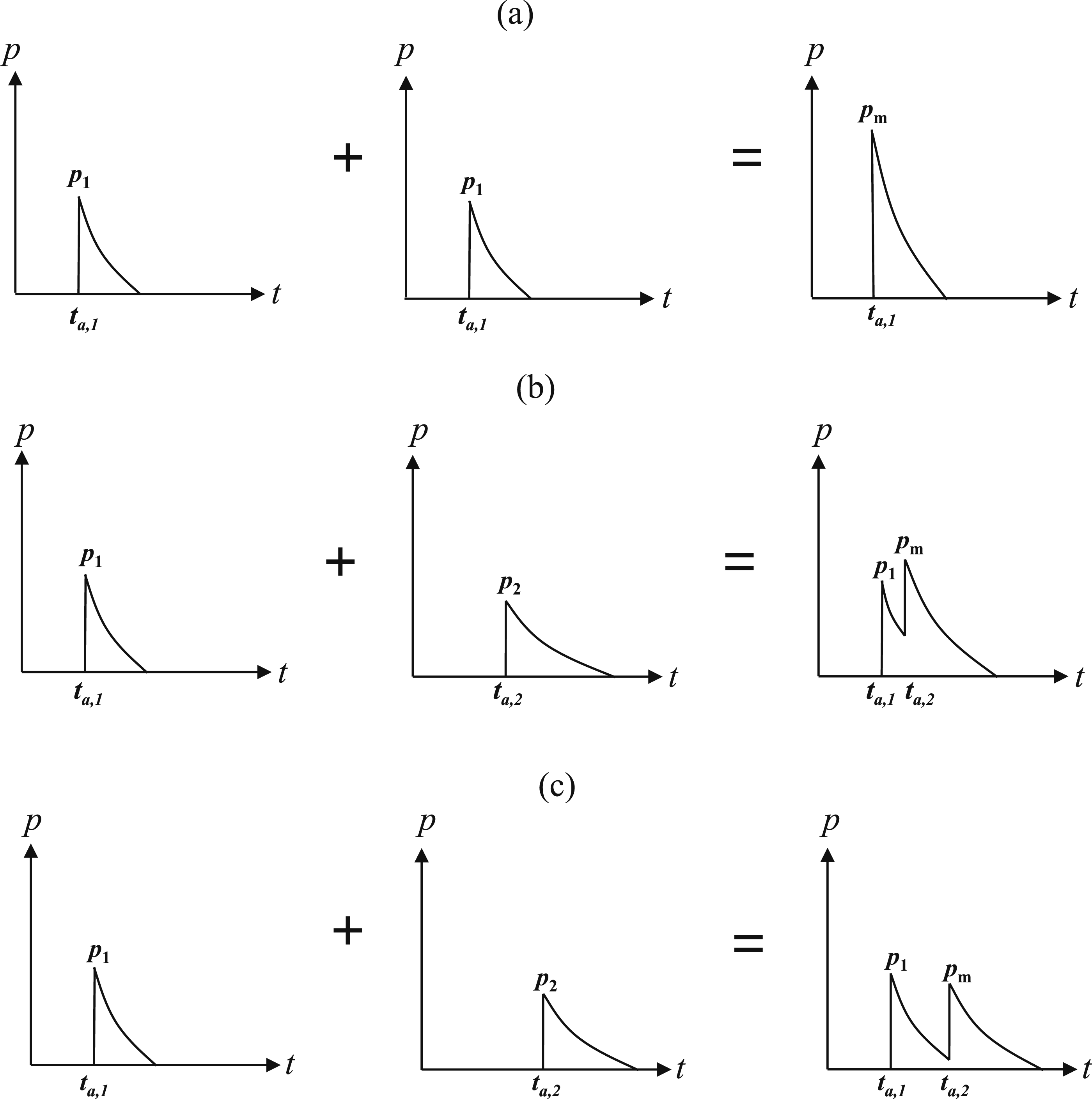
Shape I (Figure 5(a)) illustrates two shock waves, which have the same magnitude of peak overpressures (
Procedure of fast-running model
The fast-running model contains three main components, that is pre-processor, blast load solver and post-processor. Figure 6 depicts the flow chart of the fast-running model. The fundamental parameters, for example room dimensions, charge mass and location, gauge locations, termination time and interval of time, are given in the pre-processor. Flow chart of the fast-running model.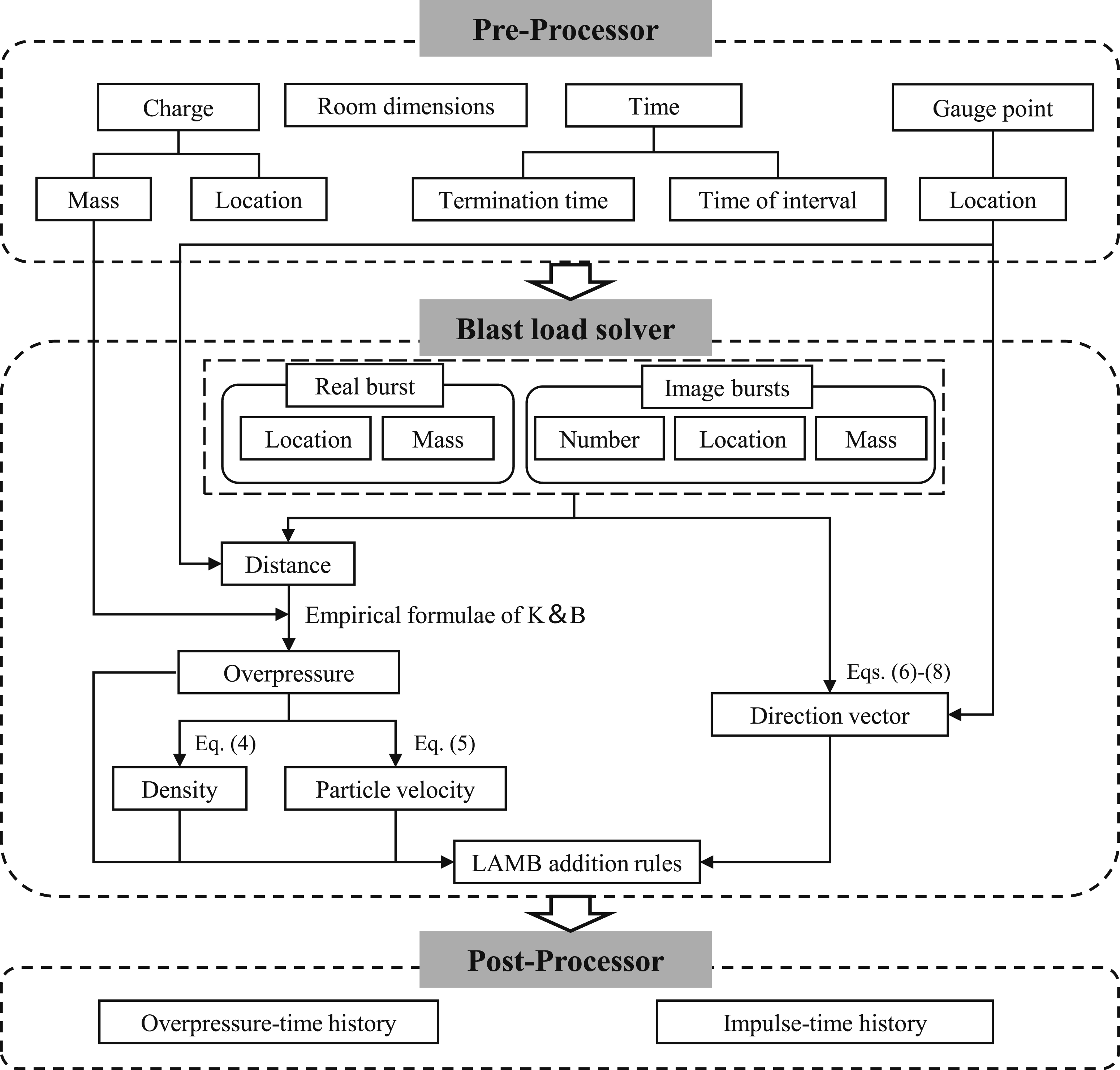
Then, the locations of the image bursts are determined automatically in the blast load solver by using the charge location, the room dimensions and the presence of the reflecting surfaces. After that, the distance between the real/image burst and the gauge point is estimated. Subsequently, the blast parameters, for example peak overpressure, arrival time and positive phase duration, are calculated for the real and image bursts by using the empirical formulae of K&B. Using the interval of time specified in the pre-processor, the blast load calculations are conducted at each time steps until the termination time is reached. Accordingly, the density and particle velocity of the shock waves, which are generated from the real and image bursts, are estimated by eqs. (4) and (5). Furthermore, the direction vector is calculated by eqs. (6) – (8) for the vectorial calculation of the particle velocity after superposition. After that, the density, particle velocity and overpressure of the shock wave after superposition are determined by the LAMB addition rules (eqs. (1) – (3)). Lastly, the overpressure- and impulse-time histories at the points of interest can be outputted in the post-processor. Note that the negative phase is not addressed in this study due to the assumption that the walls of the room are rigid.
The overpressure-time history is expressed by the Friedlander equation (eq. (9)).


Numerical simulations
To provide a reference to verify the applicability of the fast-running model, numerical simulations are conducted by using LS-DYNA. At first, a numerical model is developed to predict the internal blast loads within a fully confined room. Then, the numerical model is validated against the experimental data of Chan and Klein (Chan and Klein, 1994).
Numerical model
To gain an insight into the blast test in the rectangular bunker, which was carried out by Chan and Klein (Chan and Klein, 1994), a numerical model is established by using the 1/8th symmetry. The dimensions of the numerical model are 152.5 cm × 122 cm × 122 cm (length × width × height, Figure 7(a)), which represent a 1/8th section (light green colour) of the rectangular bunker used in the blast test. Figure 7(b) is the plan view across the mid-horizontal plane of the bunker, which shows the configuration of the three side-on gauges, that is the front, left and corner gauges. They were pointed vertically upwards and located at the mid-horizontal plane of the bunker as the charge. Their coordinates are given in Table 1. High explosive C4 was employed in the blast test. The charge mass of C4 is 453.6 g (1 lb). The charge was located at the centre of the rectangular bunker. It had a spherical shape and was ignited at its centre. Using a TNT equivalent factor of 1.35 for the high explosive C4 (Wharton et al., 2000), the equivalent charge mass of TNT is 612.4 g. Sketch of the numerical model (a) and gauge configuration (b). Location of the side-on gauges.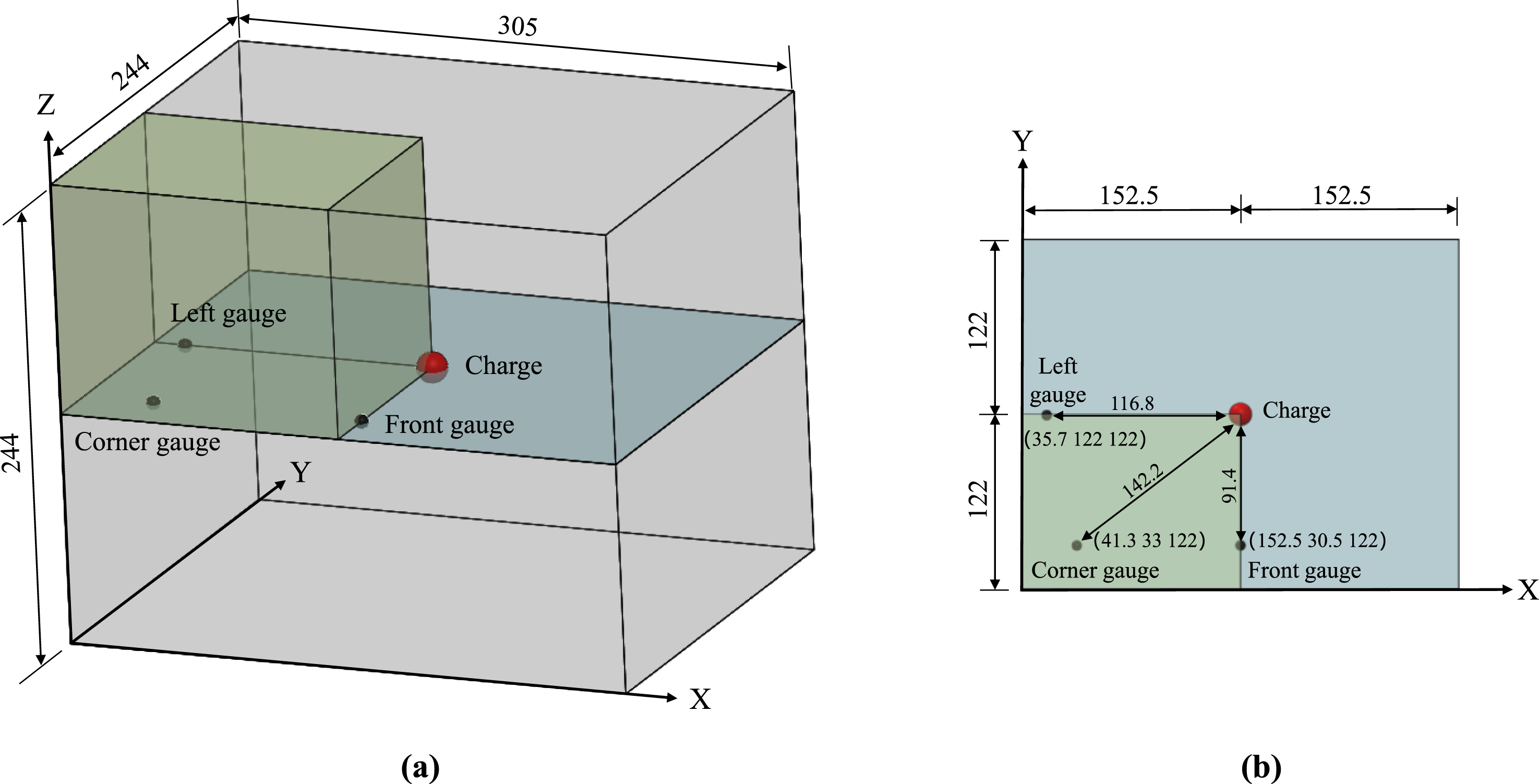

Parameters of material models for high explosives.

The Jones-Wilkins-Lee (JWL) equation of state (EoS, eq. (11)) is used for the high explosives C4 and TNT.
Parameters of the equation of state for high explosives.

The air is modelled via *MAT_NULL and regarded as an ideal gas using a linear polynomial equation of state (eq. (12)).
The exterior walls of the bunker are considered rigid since no cracks or obvious deformation appeared during the experiment (Chan and Klein, 1994). This means that the exterior walls can be considered as ideal reflecting surfaces (Gebbeken, 2017). Therefore, rigid boundary conditions are applied to the exterior surfaces of the air domain, that is the nodes on the exterior surfaces are constrained in the normal direction (Xiao et al., 2020).
Mesh convergence study
Number of elements and computational time versus the element size.

Figure 8 compares the numerical results of the overpressure-time histories at the three side-on gauges, that is left, front and corner gauges, using the six different element sizes. Numerical results of overpressure-time histories at the side-on gauges using different element sizes: (a) left gauge; (b) front gauge; (c) corner gauge.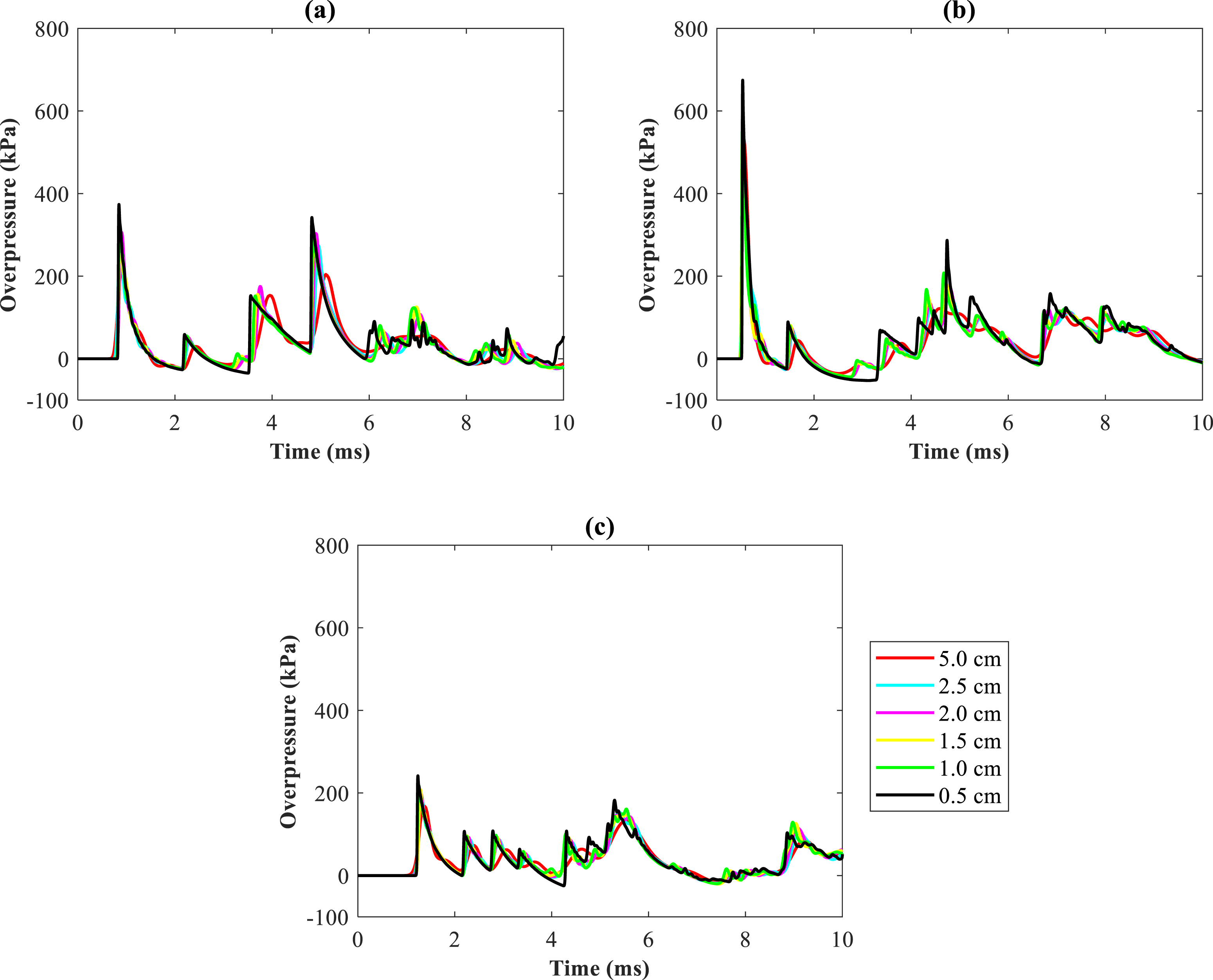
The time axis is limited to the range from 0 ms to 10 ms. It is observed that no obvious discrepancy exists in the overpressure-time histories, which are obtained from the numerical models using the element sizes of 1 cm and 0.5 cm.
To further explore the effect of the element size on the numerical results, Figure 9 compares the first peak overpressure and the maximum impulse in the time range from 0 ms to 20 ms at the gauges. Generally speaking, both the first peak overpressure and the maximum impulse increase as the element size decreases from 5 cm to 0.5 cm. This effect is more pronounced for the first peak overpressures than the maximum impulses. The smallest element size of 0.5 cm is employed for further analyses to provide the numerical results as accurately as possible to evaluate the accuracy of the fast-running model. First peak overpressures and maximum impulses at the gauges versus the element size: (a) first peak overpressure; (b) maximum impulse.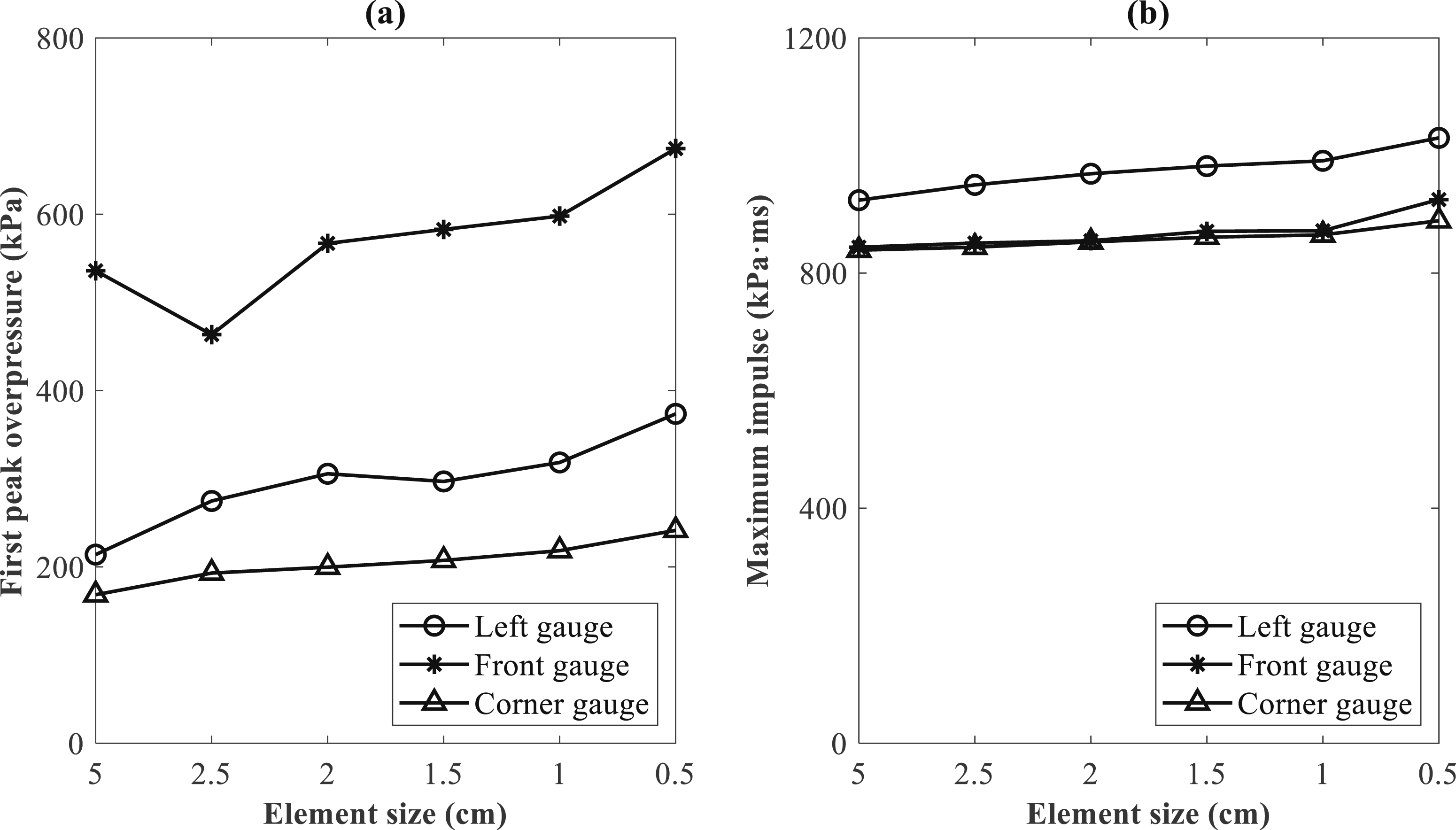
Validation of numerical models
Two types of high explosives are employed in the numerical simulations using LS-DYNA. The one is the explosive material C4 used in the blast test, which is denoted as ‘LS-DYNA (C4).’ The other uses TNT for the charge, which is labelled as ‘LS-DYNA (TNT).’ The charge mass of TNT is converted by using an equivalent factor of 1.35 (Wharton et al., 2000). Figure 10 compares the experimental and numerical results of overpressure-time histories measured at left, front and corner gauges. In general, both numerical results of side-on overpressure-time histories measured at the gauges agree reasonably with the experimental data. Comparison of the experimental and numerical results of the overpressure-time histories at the gauges: (a) left gauge; (b) front gauge; (c) corner gauge.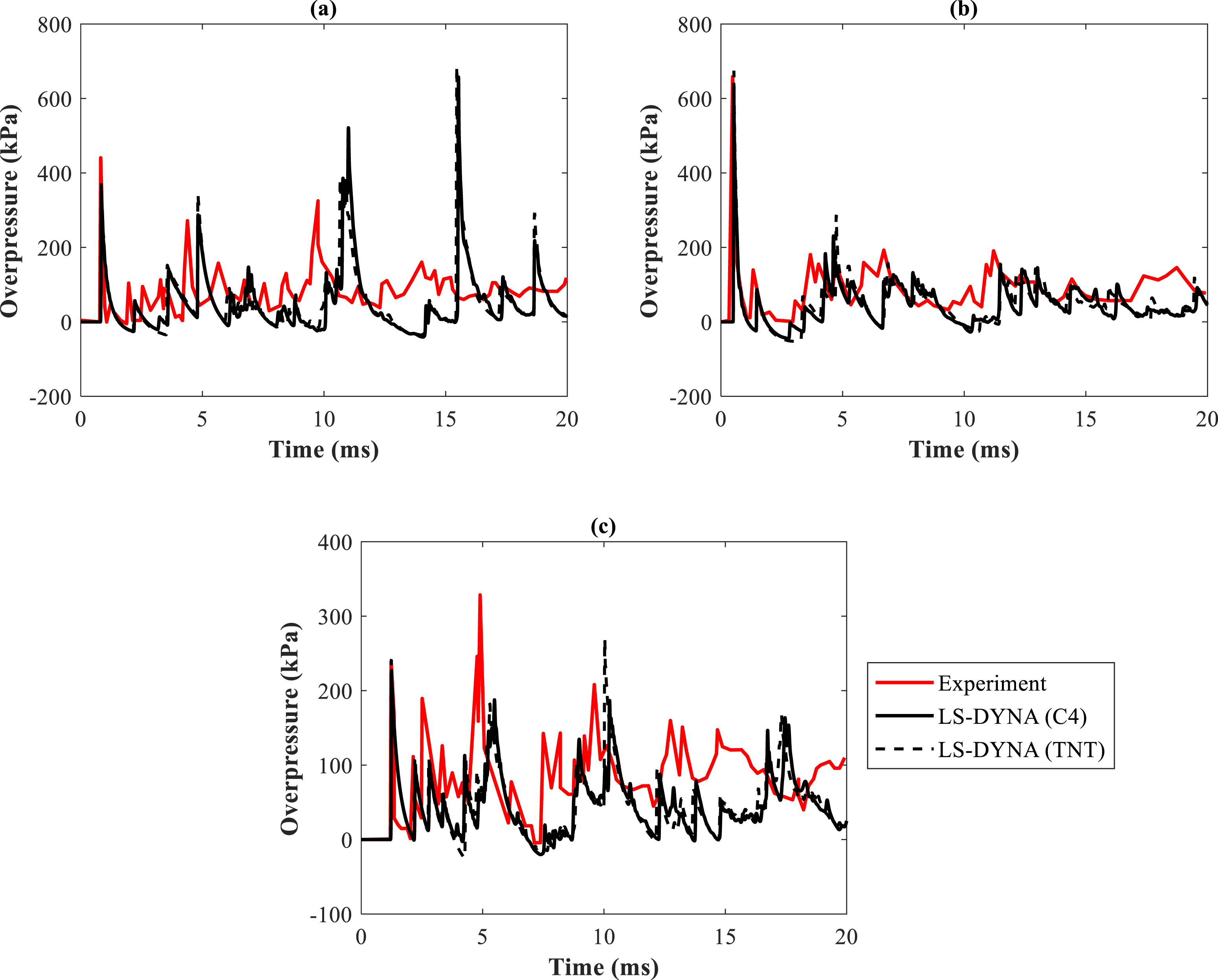
To make a better comparison, Figure 11 depicts the arrival times and the first peak overpressures, which are obtained from the experiment and both numerical simulations. According to the experiment, the shock wave arrived at left, front and corner gauges at 0.820 ms, 0.479 ms, and 1.229 ms, respectively. The arrival times of the shock wave at the three gauges are accurately predicted by both numerical models (Figure 11(a)). Compared to the experiment, the shock wave arrives slightly later at the gauges in the numerical simulation using C4 and TNT. The difference varies from 0.01 ms to 0.05 ms. Figure 11(b) shows that the first peak overpressures can be reasonably predicted by the numerical models. For LS-DYNA (C4), the numerical results of the first peak overpressures are smaller than the experimental results, that is −20.4%, −3.1% and −5.1% for left, front and corner gauges, respectively. For LS-DYNA (TNT), the differences in the first peak overpressure between the numerical simulation and the experiment are −15.2%, 2.4% and 1.0% for left, front and corner gauges, respectively. Comparison of the experimental and numerical results at the three side-on gauges: (a) arrival time; (b) first peak overpressure.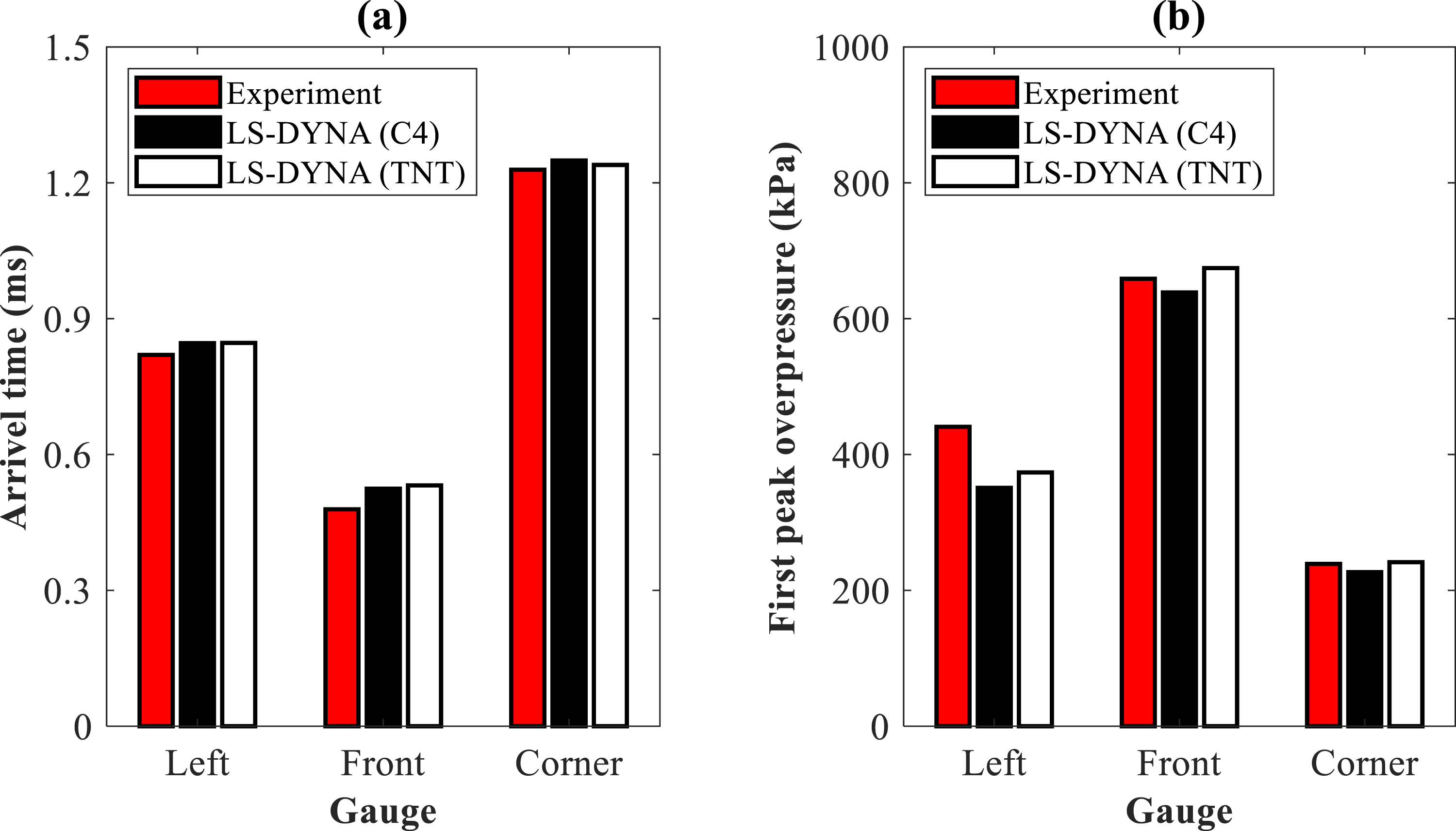
In general, the side-on overpressure-time histories, the arrival time and the first peak overpressures can be reasonably predicted by the numerical models. According to the data analyses, Chan and Klein stated that the error margin of the pressure measurements is ±20% (Chan and Klein, 1994). In this sense, the numerical models are validated against the experimental data. Therefore, they can be used further to investigate the blast loads within the confined rooms.
Evaluation of fast-running model
Scenarios of internal explosions.
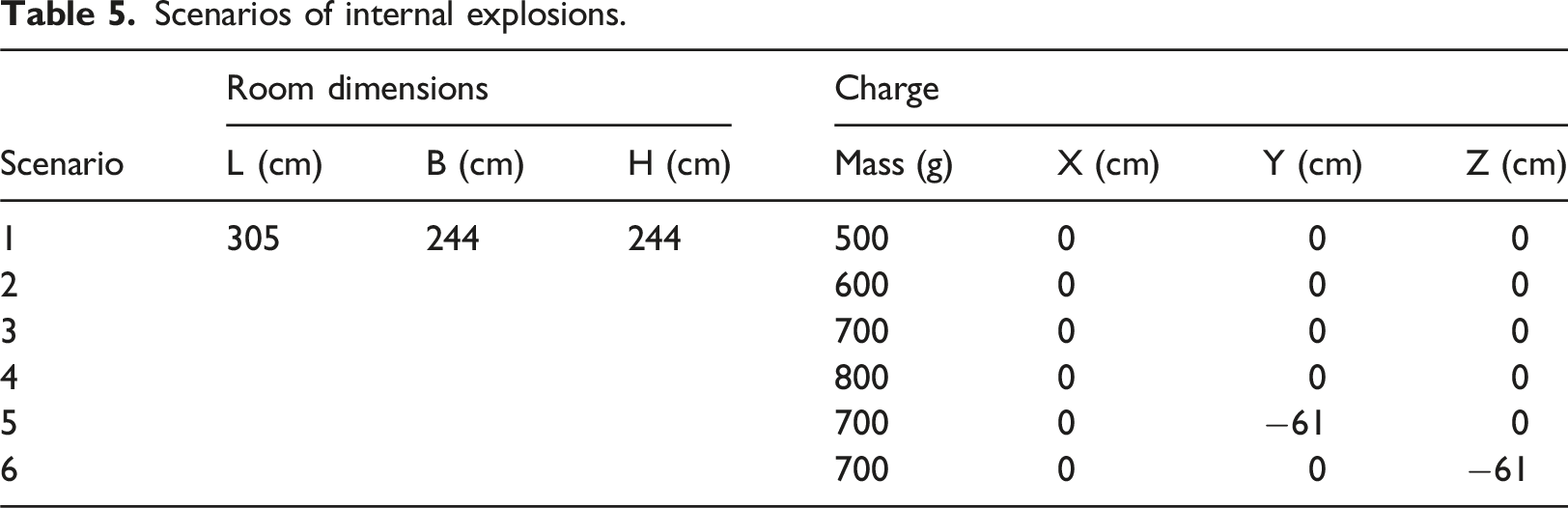
According to the explosion scenarios, three numerical models are established by using the symmetry conditions. For explosion scenarios 1 – 4, 1/8th symmetry is used, that is XOY, YOZ and XOZ are the planes of symmetry (Figure 12(a)). For explosion scenarios 5 – 6, 1/4th symmetry is used. XOY and YOZ are the planes of symmetry for explosion scenario 5 (Figure 12(b)), whereas XOZ and YOZ are the planes of symmetry for explosion scenario 6 (Figure 12(c)). Sketch of the numerical models: (a) explosion scenarios 1 – 4; (b) explosion scenario 5; (c) explosion scenario 6; (d) and (e) gauge configurations.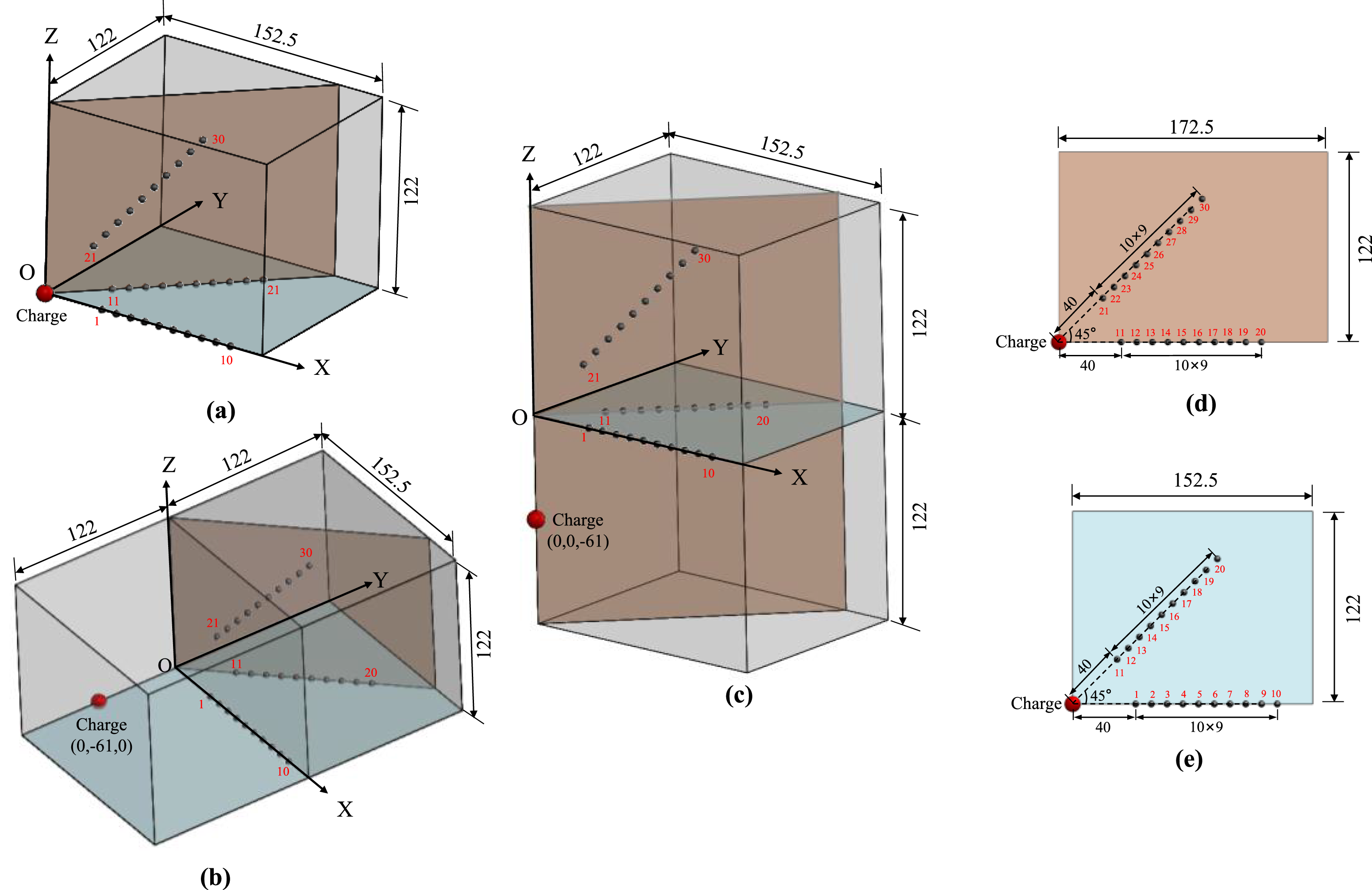
Coordinates of the gauge points used for the numerical simulations.
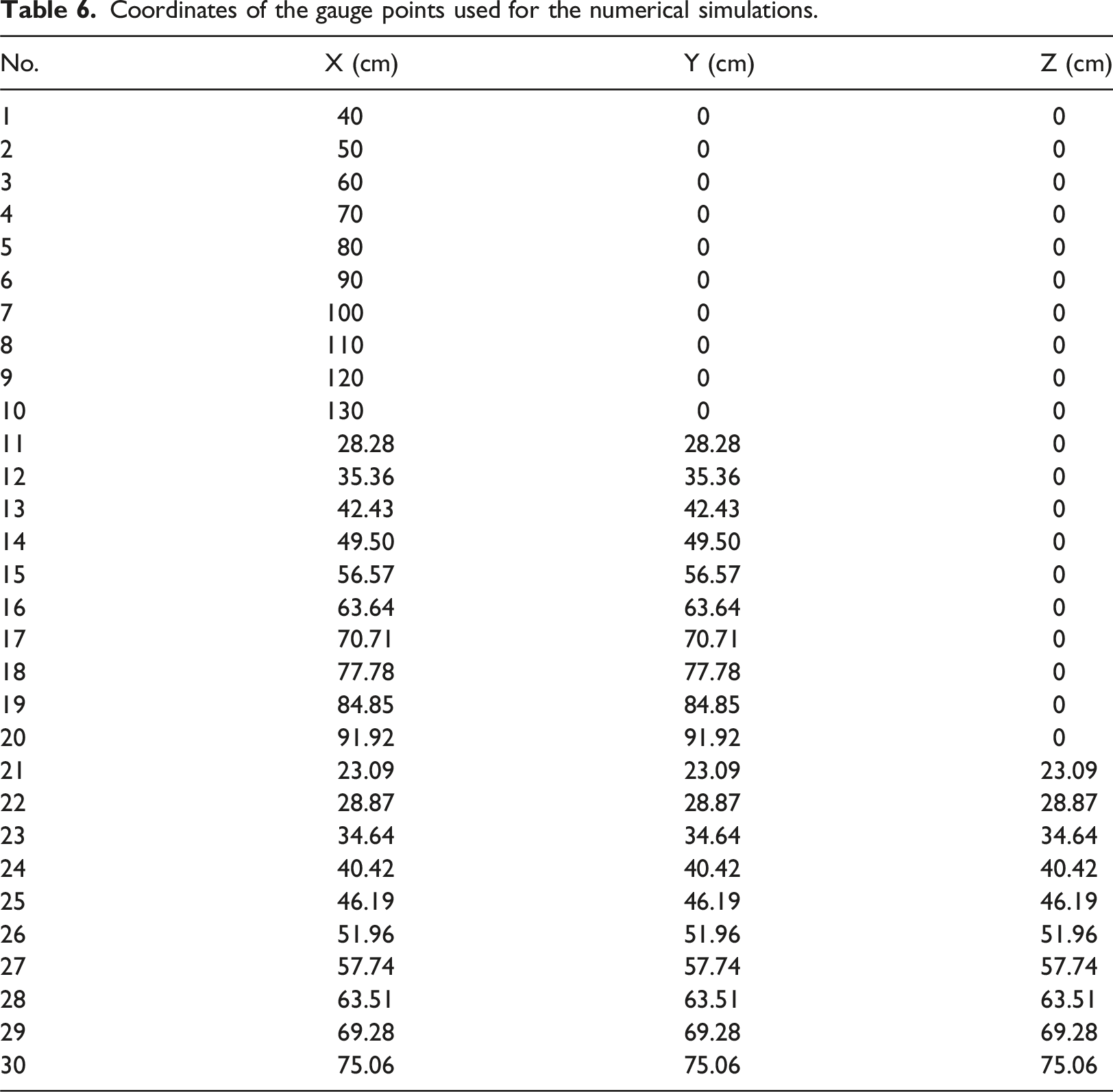
For comparison of the results obtained from the fast-running model and the numerical simulations, the overpressure-time history, the arrival time, the first peak overpressure and maximum impulse are adopted. Furthermore, the computational efficiency and the requirement of hardware resources are also compared.
Overpressure-time history
The effect of the multiple reflections for confined explosions can be elucidated by a wave-tracking analysis of the MOI results. Figure 13(a)–(c) depict the MOI results of overpressure-time histories measured at gauge point 25 (X = Y = Z = 46.19 cm) for explosion scenario 1 (Table 5) for increasing order of reflection. The results are generated from the free field calculation (Figure 13(a)), first- and second-order calculation (Figure 13(b) and (c)) using the fast-running model, respectively. Overpressure-time histories measured at gauge point 25 for explosion scenario 1: (a) free-field calculation; (b) first-order calculation; (c) second-order calculation; (d) LS-DYNA.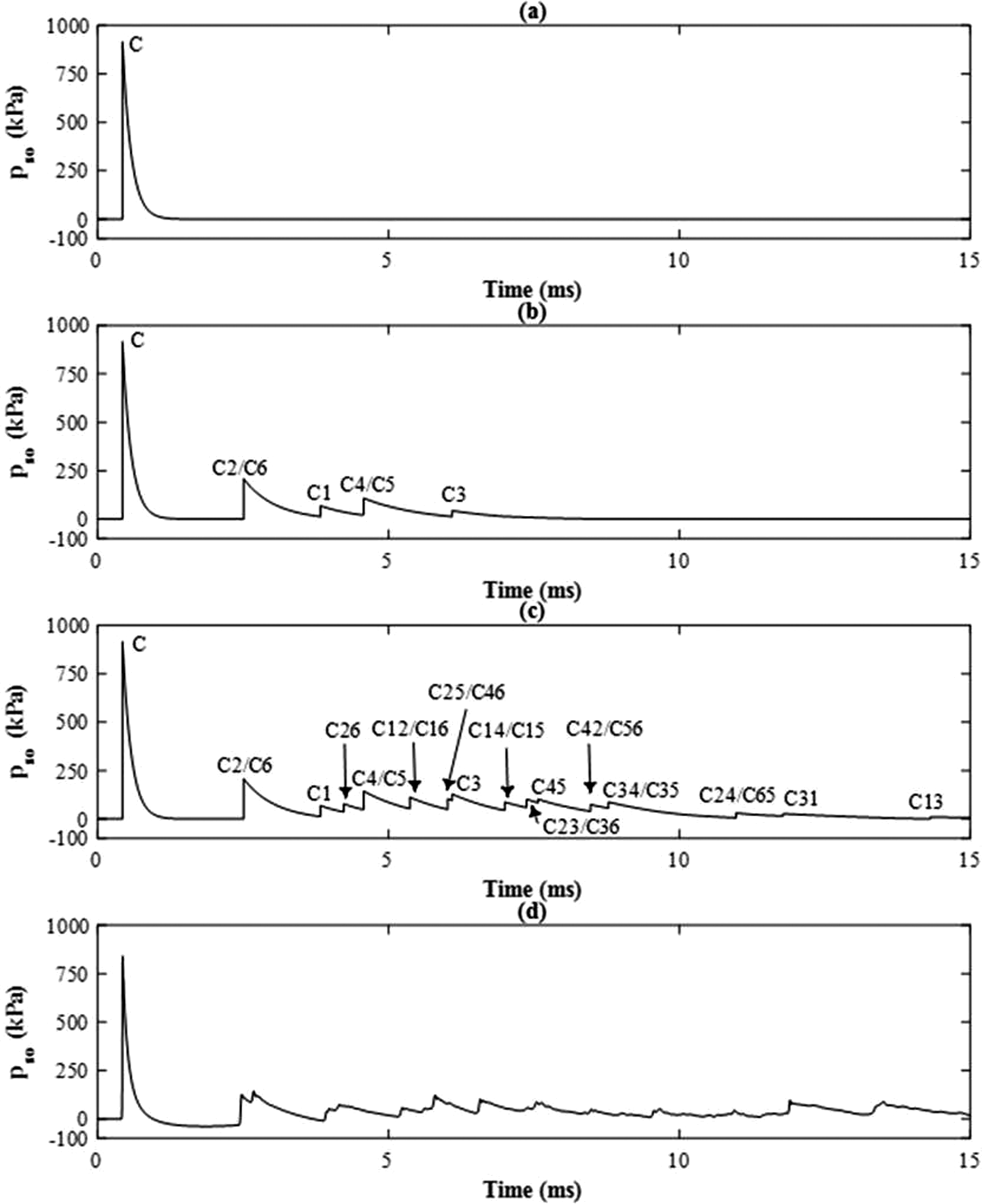
Arrival time and positive phase duration of the shock waves generated from real burst, first- and second-order image bursts.
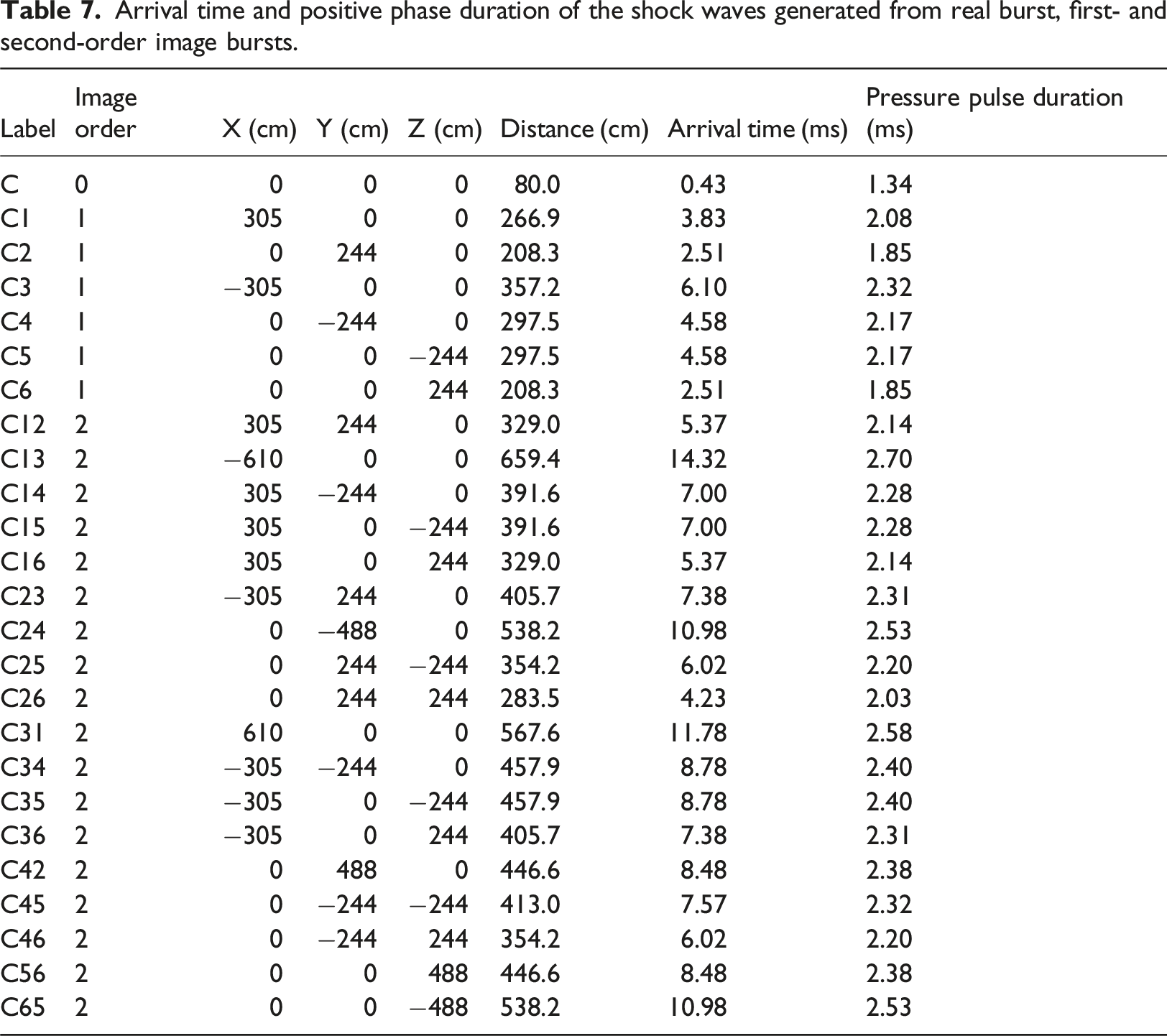
Figure 13(a) shows the results without any reflection, which is equivalent to the free field scenario without the bunker walls. It contains a single pressure pulse, which originates from the real burst C and arrives at gauge point 25 at
It is found that four additional pressure pulses are caused by the first-order image bursts in addition to the first pressure pulse generated from the free field scenario. Taking the second-order image bursts into account, 11 pressure pulses are added to the curve. This tends to be in accordance with the numerical result predicted by the numerical model using LS-DYNA. Comparing the curve of second-order calculation with the curve of the numerical simulation using LS-DYNA, it is indicated that the side-on overpressure-time histories within a confined room can be reasonably predicted by taking the real burst, the first- and second-order image bursts into account.
To provide an in-depth understanding of the confined blast loads, Figure 14 compares the overpressure-time histories at gauge points 3, 8, 13, 18, 23 and 28 for explosion scenario 5 (Table 5), which are obtained from the fast-running model and the numerical simulation using LS-DYNA. In general, the overpressure-time histories predicted by the fast-running model have a similar overall tendency as the ones predicted by the numerical model. However, it should be pointed out that the numerical results are more accurate than MOI results since the nonlinear shock reflections and the shock-shock interaction are self-consistently modelled by the numerical model. Overpressure-time histories measured at the gauge points for explosion scenario 5: (a) gauge point 3; (b) gauge point 8; (c) gauge point 13; (d) gauge point 18; (e) gauge point 23; (f) gauge point 28.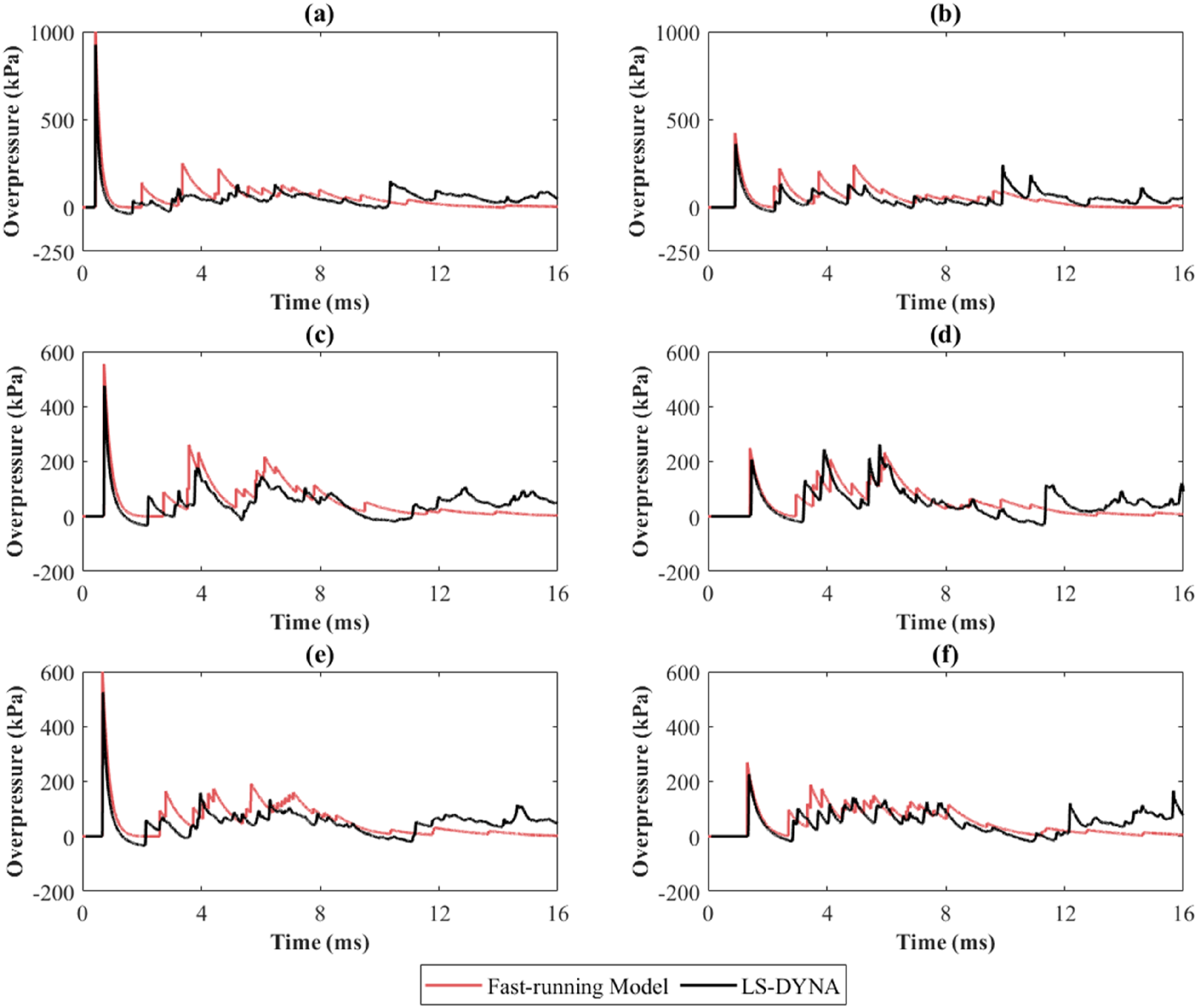
To assess the accuracy of the fast-running model quantitatively, the arrival time, the first peak overpressure and the maximum impulse of the shock wave are employed for comparison in the next sections.
Arrival time
Figure 15 compares the arrival times at gauge points 21–30 of the shock wave for the six explosion scenarios, which are obtained from the fast-running model and the numerical simulations using LS-DYNA. Comparison of the arrival time at gauge points 21 – 30 obtained from the fast-running model and the numerical model: (a) – (f) explosion scenario 1 – 6.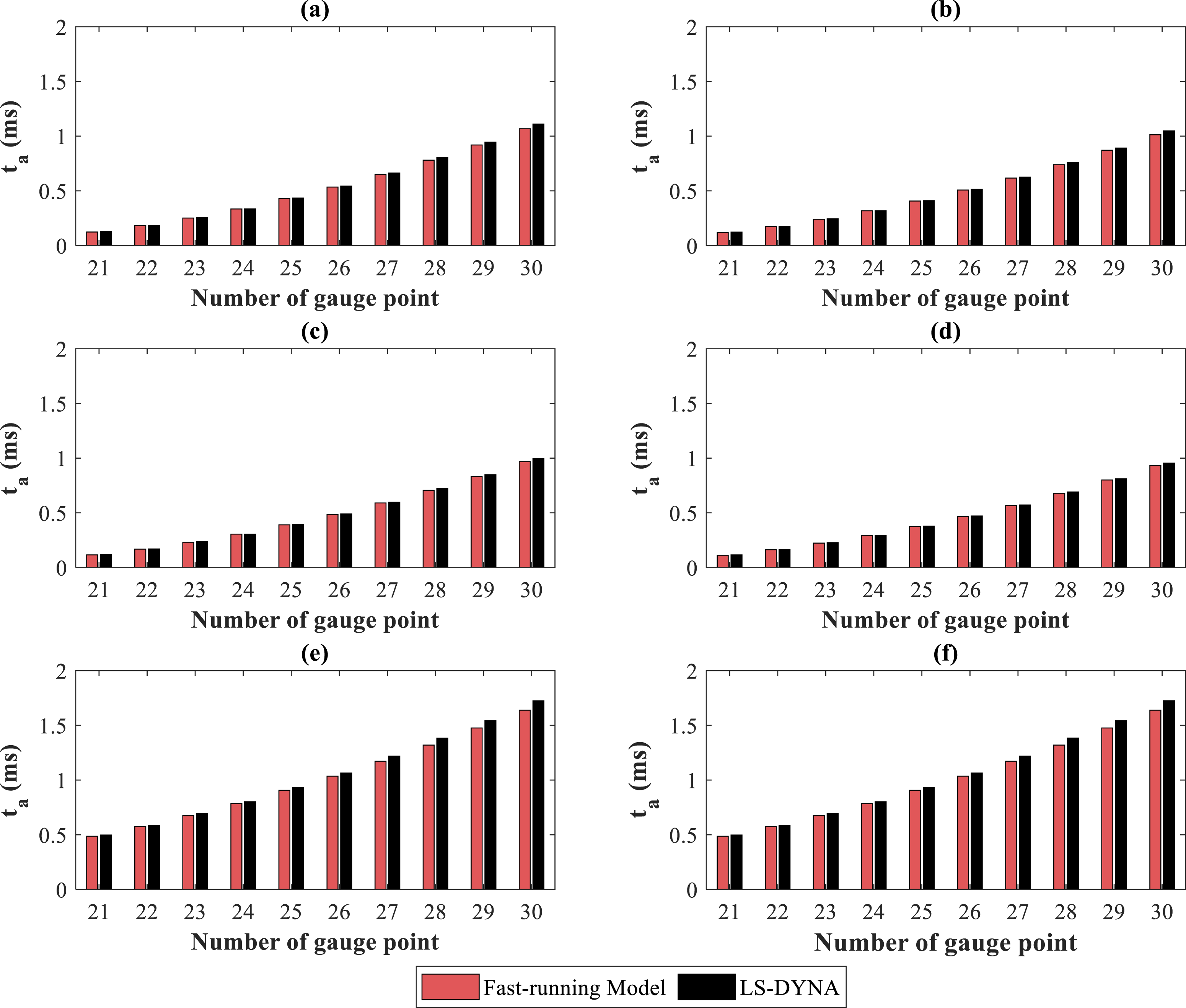
In general, the fast-running model predicts accurately the arrival time of the shock wave. It predicts a slightly earlier arrival of the shock wave than the numerical model. The average difference in the arrival time between both models varies from −1.5% (explosion scenario 4) to −3.2% (explosion scenarios 5 and 6).
First peak overpressure
Figure 16 compares the first peak overpressures at gauge points 21 – 30 for explosion scenarios 1 – 6, which are obtained from the fast-running model and the numerical simulations using LS-DYNA. In general, the results predicted by the fast-running model are up to 20% larger than the numerical results. Comparison of the first peak overpressures at gauge points 21 – 30 between the fast-running model and the numerical model: (a) – (f) explosion scenario 1 – 6.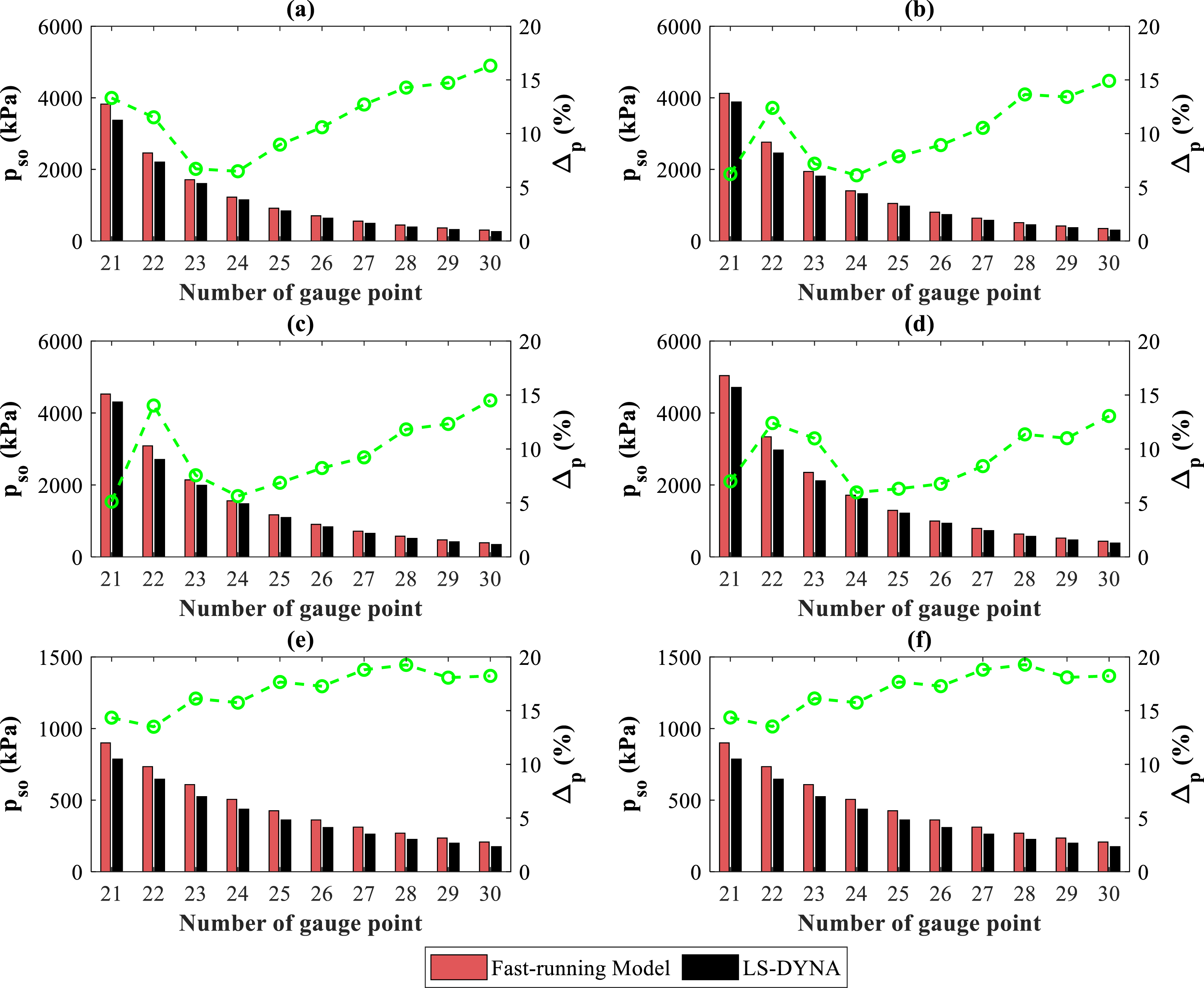
Figure 17 illustrates the average differences ( Average difference in the first peak overpressure at gauge points 21 – 30 obtained from the fast-running model in comparison with the numerical results.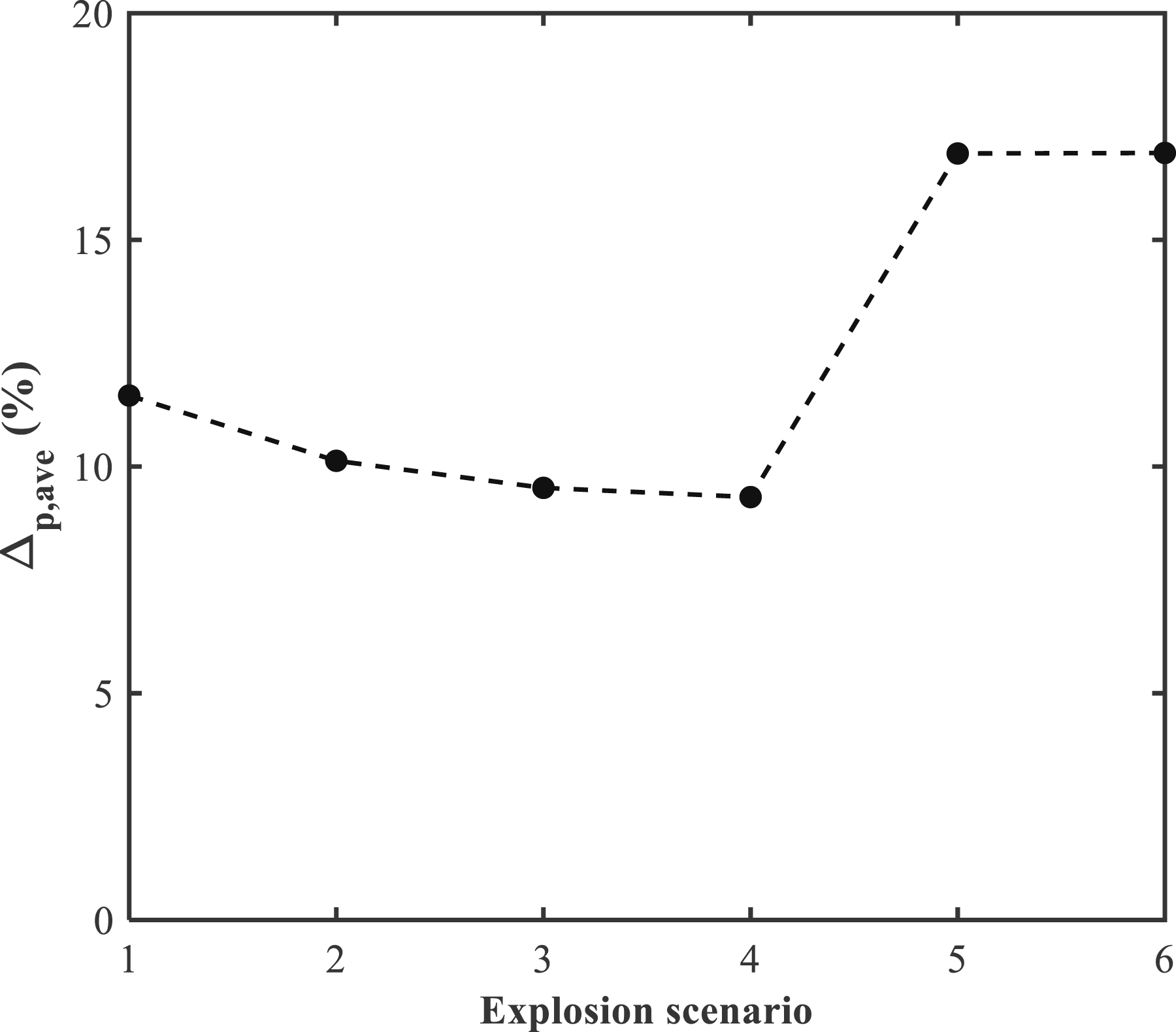
Maximum impulse
Figures 18–20 present a comparison of the maximum impulses at gauge points 1 – 10, 11 – 20 and 21 – 30 during the time range of Comparison of the maximum impulses at gauge points 1 – 10 between the fast-running model and the numerical model: (a) – (f) explosion scenario 1 – 6. Comparison of the maximum impulses at gauge points 11 – 20 between the fast-running model and the numerical model: (a) – (f) explosion scenario 1 – 6. Comparison of the maximum impulses at gauge points 21 – 30 between the fast-running model and the numerical model: (a) – (f) explosion scenario 1 – 6.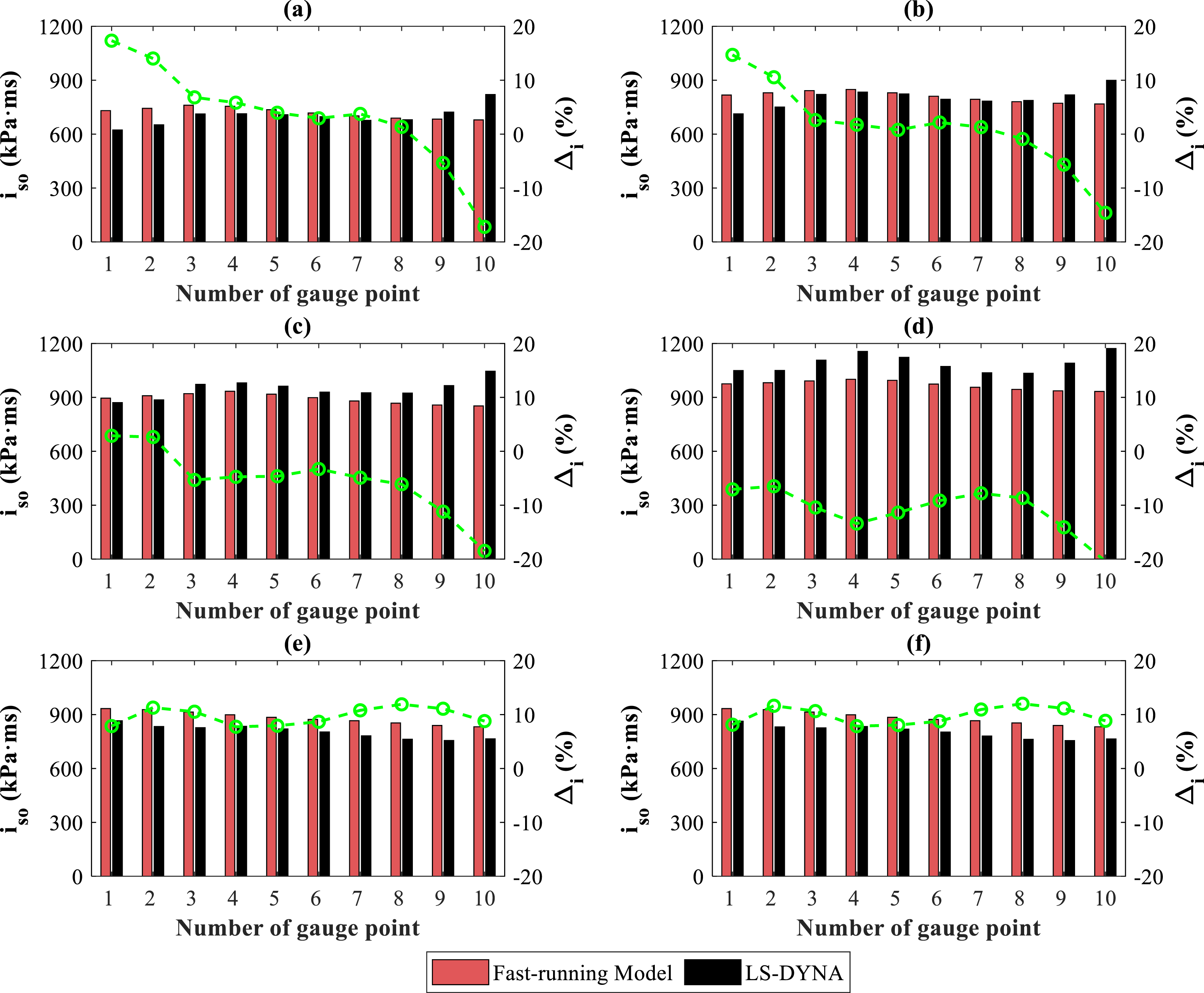
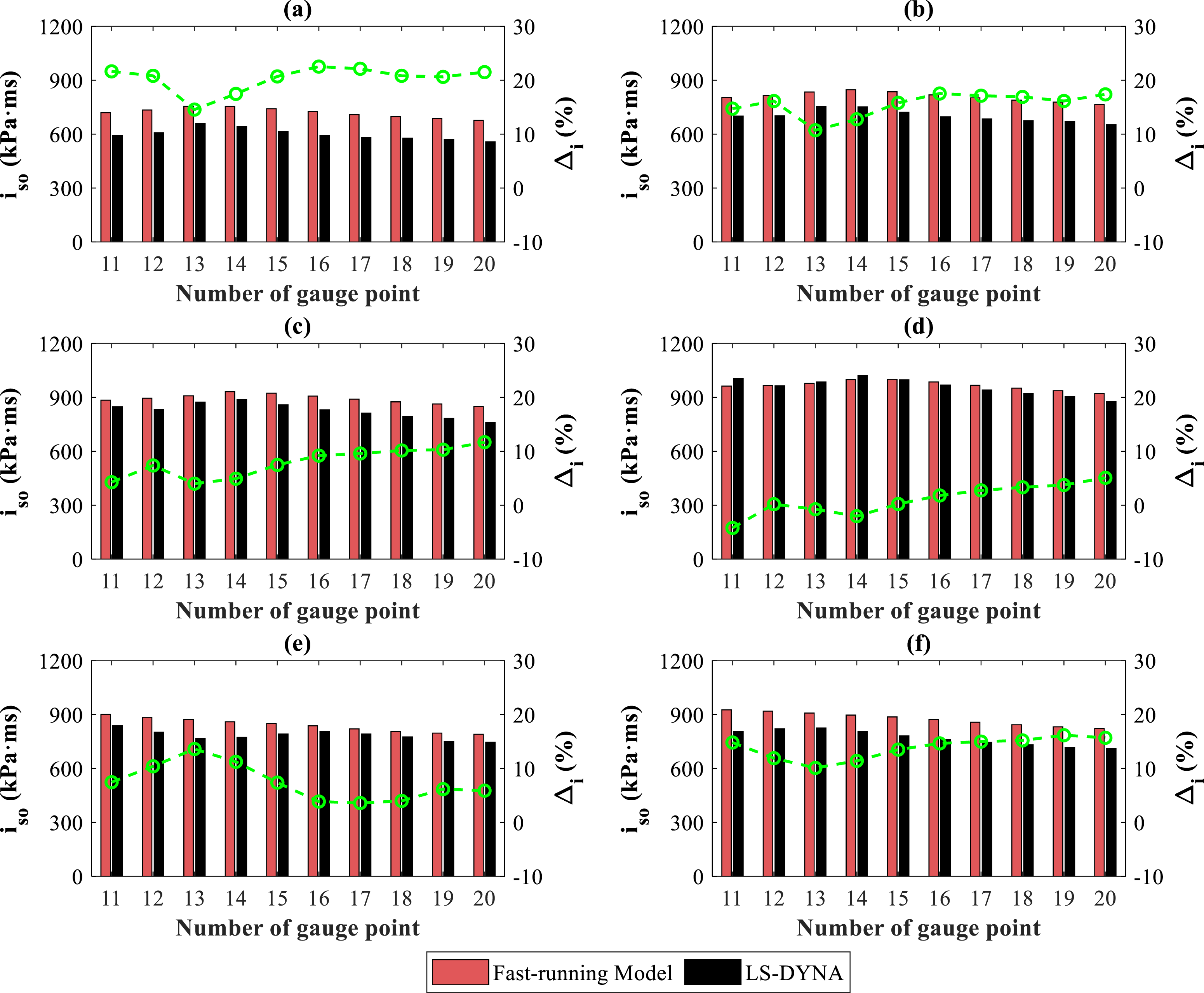
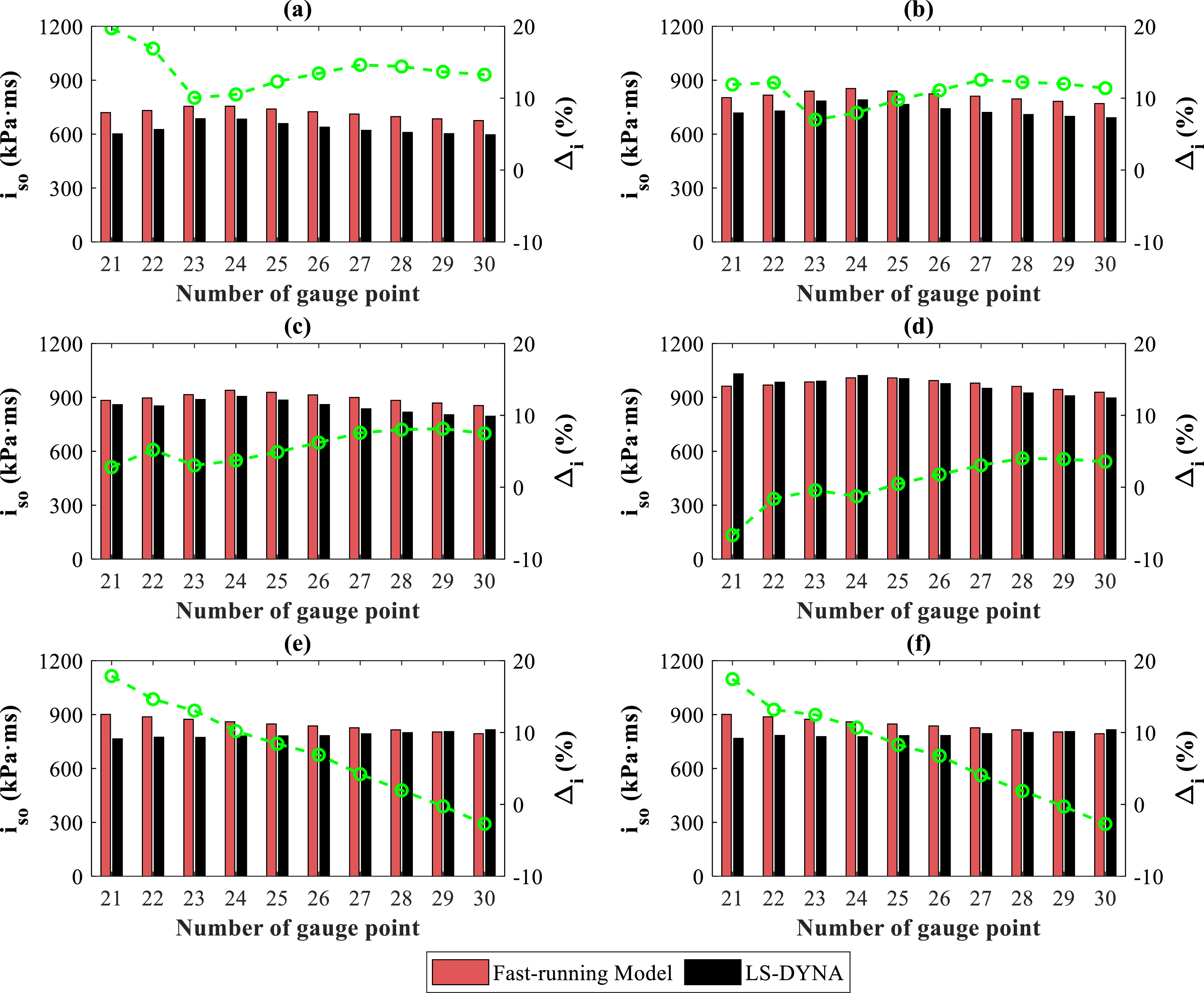
Figure 21 shows the average differences ( Average differences in the maximum impulses obtained from the fast-running model in comparison with the numerical model.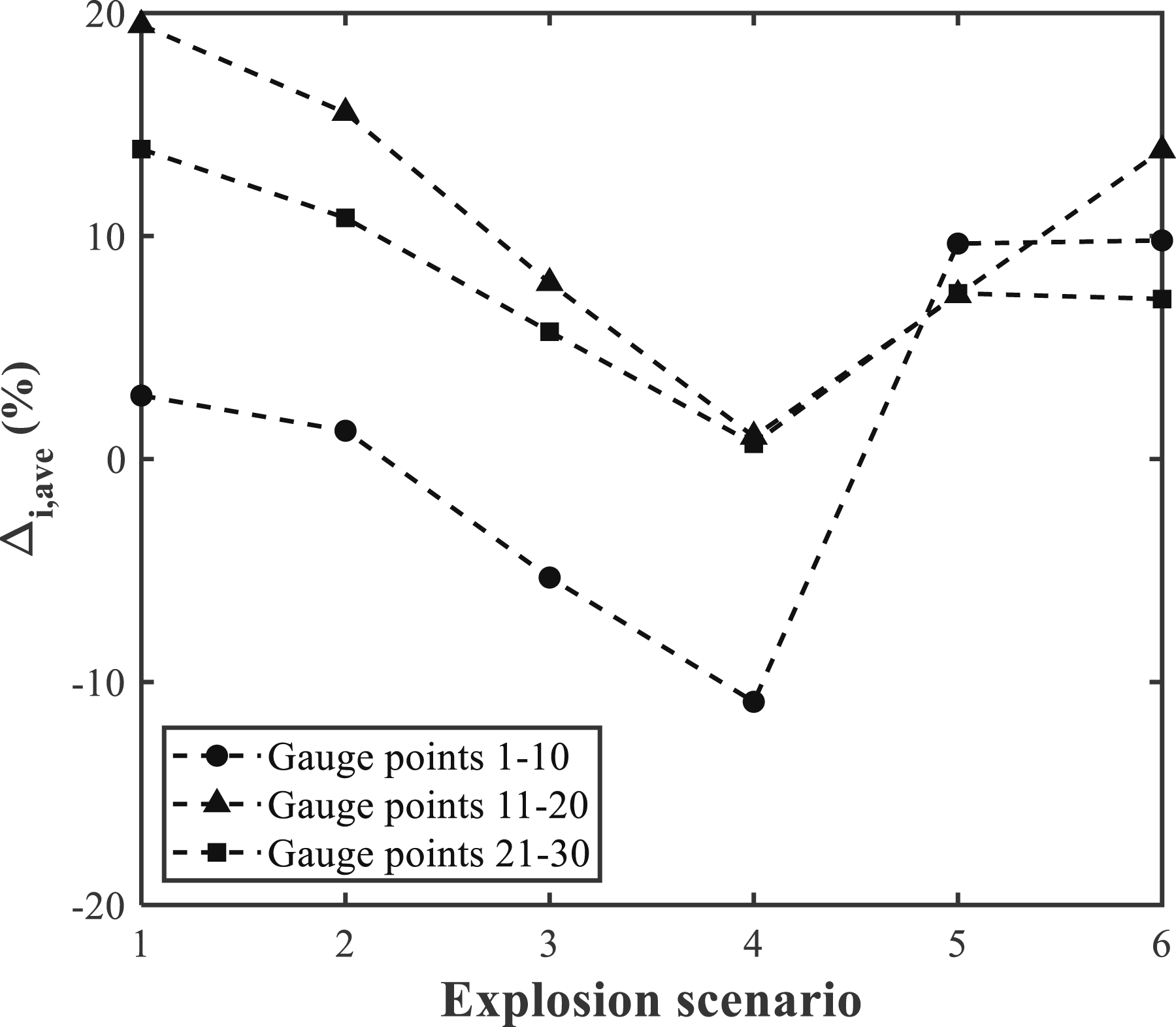
In summary, certain differences exist in the results of the internal blast loads obtained from the fast-running model and the numerical simulations. The underlying reasons are fourfold. First, the negative phase of the shock wave is neglected in the fast-running model, whereas it is considered in the numerical simulations. This leads to an overestimation of the overpressures at later times by the fast-running model to a certain degree. As a result, the maximum impulses are also overestimated by the fast-running model to a certain extent. Second, the surface reflectivity factor has an influence on the blast loads within the confined room. This study adopts a constant value of 0.8 (Chan and Klein, 1994), which means that 20% of the energy is dissipated during the process of the shock wave reflection from the walls. However, the surface reflectivity factor depends on several parameters, e.g. the scaled distance and the angle of incidence. This may lead to a different value of the surface reflectivity factor, which matches better for the explosion scenarios discussed in this study. Third, the interaction between the shock waves is considered by the LAMB addition rules in the fast-running model. This is also different to the interaction mode of the shock waves considered in the numerical simulations to a certain extent. Fourth, the differences in the results partly originate from the empirical formulae, which are employed in the fast-running model to predict the respective pressure pulses generated from the real burst and image bursts. It is well-known that an overestimation of the overpressures is usually expected for the empirical formulae of Kingery and Bulmash due to the safety considerations in the blast-resistant design.
Computational efficiency
Computational resources used for the numerical simulations and the fast-running model.

Explosion scenario 5 (Table 5) is selected as the benchmark. The termination time is 20 ms for the benchmark calculations. In total, 30 gauge points are used to record the overpressure-time histories. The interval of time is specified as 1 μs in the fast-running model. The computational time required by the fast-running model is only 5 s, which is about 1/6500 of the one required by the numerical simulation (9.05 h).
Conclusions
This study presents a fast-running model for the prediction of the blast loads within a confined room. The development of the fast-running model is based on the method of images (MOI) and the low altitude multiple burst (LAMB) addition rules. A numerical model is established to predict the blast loads within a confined room. It is validated against the experimental data of Chan and Klein concerning the overpressure-time history, the arrival time, the first peak overpressure and the maximum impulse of the shock wave. After validation, numerical simulations are conducted by using the validated numerical models to investigate the influence of the charge mass and location on the accuracy of the fast-running model. Several conclusions are drawn from this study. • It is indicated that the second-order calculation in the fast-running model, which takes the real burst, the first- and second-order image bursts into account, can be used for the prediction of the blast loads within a confined room. • The fast-running model predicts reasonably the blast loads at the gauges. Compared with the numerical results, the average difference in the arrival time of the shock wave is within 4%, whereas the average differences in the first peak overpressure and the maximum impulse of the shock wave are within 20%. • The computational time and the requirement of hardware resources are significantly reduced by using the fast-running model in comparison with the numerical model. The fast-running model is about 6900 times faster than the numerical model.
Footnotes
Declaration of conflicting interests
The author(s) declared no potential conflicts of interest with respect to the research, authorship, and/or publication of this article.
Funding
The author(s) disclosed receipt of the following financial support for the research, authorship, and/or publication of this article: Major Research Plan; 52278521.
