






Abstract
The escalating complexity of maritime security has driven the demand for high-performance protective structures capable of withstanding underwater impulsive loads. Sandwich structures have attracted considerable attention in blast-resistant buildings, naval vessels, and military protective systems because of their high specific strength, lightweight characteristics, and superior energy-absorption capabilities under extreme dynamic loading conditions. Sandwich systems comprising fiber-reinforced polymer (FRP) face-sheets and polymer foam cores exhibit exceptional specific strength and broadband energy dissipation capabilities. As a result, they have emerged as a pivotal solution for deep-sea protective applications. However, a systematic review of the dynamic response mechanisms and failure modes of these structures under extreme underwater impact is still lacking. This research systematically reviews the dynamic response behaviors and recent advances of foam core sandwich structures subjected to underwater impulsive loading. Initially, the response principles of these materials in impact environments are elucidated, focusing on the propagation characteristics, loading modes, and dynamic damage mechanisms associated with three distinct types of underwater impulsive loads. Subsequently, the key factors governing the impact resistance of the structures are systematically analyzed from two primary dimensions: loading conditions and structural parameters. Furthermore, a comparative analysis is conducted on the impact characteristics of typical core materials, including polymethacrylimide (PMI), polyvinyl chloride (PVC), styrene-acrylonitrile (SAN), and aluminum foams, and the current application status of impact-resistant foam sandwich materials is outlined. Finally, the limitations of existing research are summarized. It is proposed that future efforts should focus on developing multi-field coupled numerical simulation methods. Such advancements aim to further enhance the impact resistance and service life of these materials in complex marine environments. This review serves as a critical theoretical benchmark for the optimized design and standardized evaluation of future underwater protective structures.
Keywords
Introduction
Escalating geopolitical tensions and the expanding scope of marine resource exploitation have propelled the advancement of maritime technologies. However, during service, high-performance submersibles such as unmanned underwater vehicles (UUVs) and deep-sea robots are increasingly subjected to severe underwater impact loads. Compared to airborne shock waves, underwater impacts are characterized by higher particle momentum and substantially more complex fluid-structure interactions (FSI). Furthermore, the acoustic impedance of structural materials is relatively close to that of water. This proximity leads to enhanced energy transmission across the interface. When combined with complex FSI effects, this mechanism intensifies structural loading under underwater impact conditions (Avachat and Zhou, 2012). Consequently, the deployment of advanced energy-absorbing materials is essential for fortifying the impact resistance of underwater structures.
Owing to their lightweight nature, superior energy absorption, and exceptional capacity to attenuate impact and blast loads, foam materials have been extensively investigated for underwater shock wave protection (Feng et al., 2022; Hoo Fatt et al., 2017; Lu et al., 2013). Building upon this, sandwich structures comprising composite face sheets and high-performance polymer foam cores have emerged as the preferred configuration for deep-sea protective applications. This prominence is driven by their high specific strength, tailored acoustic impedance matching, and highly efficient energy dissipation mechanisms (Siivola et al., 2015; Zhou et al., 2022).Recent studies have further shown that the impact performance of sandwich structures is governed by complex deformation and failure mechanisms, including face-sheet bending, core crushing, shear failure, interfacial interactions, and topology-dependent load transfer, which collectively contribute to their energy absorption and structural integrity under dynamic loading conditions (Guo et al., 2024; Guo and Zhang, 2023, 2025; Wu et al., 2025; Yuan et al., 2024). Currently, foam materials for impact protection are primarily categorized into metal and polymer foams. Metal foams mainly consist of nickel and aluminum variants, with the latter being more widely utilized (Liang et al., 2017). In contrast to traditional monolithic metal shells, polymer foams offer distinct advantages in marine applications, particularly in terms of lightweight design, corrosion resistance, and tunable mechanical properties (Huo et al., 2022; Jeffrey and Brooking, 1998; Song et al., 2024; Wanchoo et al., 2021; Xing et al., 2024; Zhang et al., 2024). Extensive research has investigated various polymeric foams, such as polycarbonate, polyurethane (PU), PVC, PMI, and SAN. Among these options, PVC foam is the most widely used for underwater impact resistance. For blast-mitigation applications, SAN foam offers superior performance, exhibiting minimal out-of-plane displacement and structural damage under explosive loading (Wanchoo et al., 2021). PMI foam has attracted increasing research attention due to its high stiffness-to-weight ratio and superior mechanical performance Furthermore, PMI sandwich structures demonstrate outstanding fatigue and impact tolerance in both laboratory and field tests, constituting a proven system compliant with the IMO HSC Code (Qu et al., 2018; Roosen, 2002; Xing et al., 2024).
Despite the growing body of research on the impact resistance of foam sandwich materials, systematic investigations into their response mechanisms and application modes in complex underwater environments remain scarce. Furthermore, the inconsistency in testing standards severely restricts the comparability of existing findings. Accordingly, this research focuses on the underwater impact response mechanisms and application paradigms of foam sandwich structures. It provides a systematic analysis of impact response, energy absorption, and deformation-failure mechanisms while further exploring the current engineering landscape of these materials in underwater protective structures. This work effectively bridges the knowledge gap regarding the interaction mechanisms of such structures in underwater environments. Furthermore, this review systematically elucidates the damage evolution, energy absorption, and impact-resistance mechanisms of foam sandwich structures under underwater loading. By summarizing the effects of face-sheet, core, and reinforcement design on structural performance, it provides a comprehensive understanding of current research progress and remaining challenges. The findings offer valuable guidance for material selection, structural optimization, and reliability assessment of lightweight underwater protective systems, thereby supporting the broader application of high-performance sandwich structures in marine engineering.
Response of foam sandwich materials to underwater shock loading
Characteristics of underwater shock loading
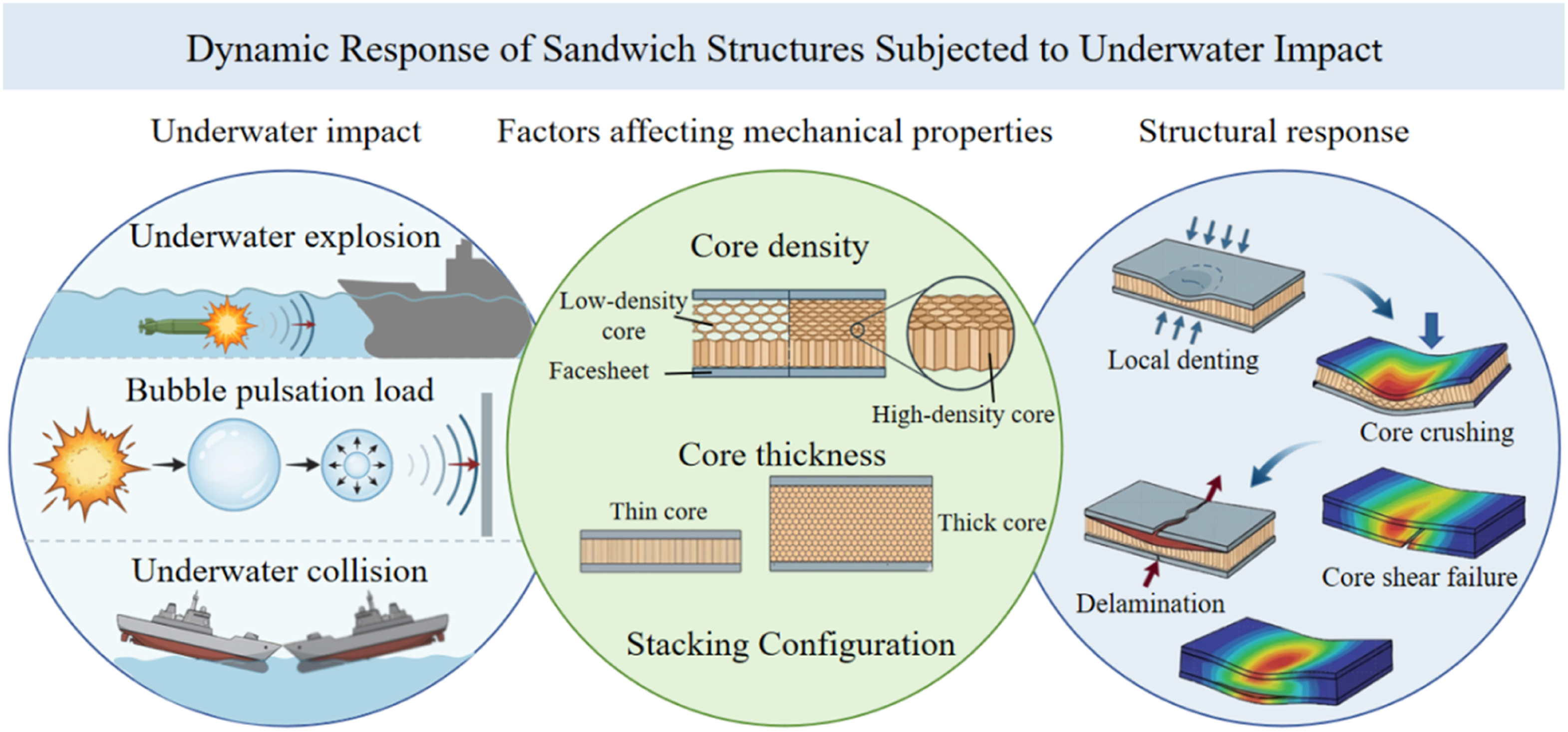
Underwater impact loads primarily originate from underwater explosions such as torpedo attacks, bubble pulsations, and ship collisions, with each scenario exhibiting distinct impact characteristics. During an underwater explosion, the rapid release of energy generates a high-intensity shock wave that propagates through the water. Superimposed on the ambient hydrostatic pressure, this wave expands spherically outward, initiating a complex FSI driven by transient pressure pulses (Matos et al., 2024; Yin et al., 2016; Zhang et al., 2023). Bubble pulsation, a core phenomenon unique to underwater explosions, occurs when explosive gases form a cavity that undergoes periodic expansion and contraction. While generating lower peak pressures than the initial shock wave, these pulsation loads exert a substantially longer duration and greater total impulse (Zhang et al., 2025a, 2025b). Conversely, vessel collisions transmit loads via direct solid-to-solid contact. Dominated by localized deformation and kinetic energy transfer, this process aligns more closely with classical impact mechanics within structural dynamics (Tabri et al., 2009).
Underwater explosion (UNDEX) shock waves
As the primary source of impact loading in marine engineering, underwater explosions exhibit physical mechanisms that differ fundamentally from their in-air counterparts due to the distinct properties of the fluid medium (Zhang et al., 2025b). Governed by the relative incompressibility, high density, and viscosity of water, these explosions exhibit complex and unique dynamic behaviors. Notably, in the near-field regime, underwater blast loads can reach the gigapascal level (Zhang et al., 2023). Shock wave propagation exhibits a pronounced spatial evolution. Initially, the velocity of an underwater shock wave is marginally lower than its in-air counterpart. However, owing to a slower rate of energy attenuation in water, its velocity eventually surpasses that of an air blast over distance (Zhang et al., 2014). Zhang et al. (Zhang et al., 2017) revealed the complex wave propagation and energy distribution mechanisms in underwater contact explosions. They showed that underwater shock waves, as the primary damaging factor, not only induce severe structural damage through vibration and rapid pressure transients, but also exhibit a pronounced global diffraction effect. This enables the waves to bend around the structure and reach the rear side, resulting in overall plastic indentation of the innermost protective plate in a direction opposite to the initial loading.
Driven by the combined effects of parameters such as hydrostatic pressure, medium properties, and boundary conditions, underwater shock waves exhibit substantially greater load magnitudes and peak pressures than those of air blasts (Cheng et al., 2024; Rajasekar et al., 2025). Xu et al. (Xu et al., 2025) demonstrated that both peak overpressure and shock wave propagation velocity scale linearly with hydrostatic pressure. However, the rate of increase in peak overpressure gradually diminishes as the standoff distance increases. Furthermore, experimental work by Rolfe et al. (Rolfe et al., 2017) revealed that sandwich panels under underwater explosions endure pressure loads over 100 times greater than those in air blasts. However, the duration of the underwater pressure pulse is merely one-tenth of its in-air counterpart. Li et al. (Li et al., 2004) reported that at standoff distances of 5–17.5 m, the average peak pressure and impulse generated by 500 g and 1000 g TNT underwater explosions are significantly higher than those of air explosions, by approximately two orders of magnitude and about one order of magnitude, respectively. Concurrently, the propagation velocity of underwater shock waves is approximately 3–4 times that in air, expanding the lethal range by a factor of 9. Furthermore, for 1 kg of TNT at a 5 m standoff distance, the damage severity can escalate by 3–4 levels compared to an equivalent air explosion. Consequently, underwater explosions inflict substantially more severe damage over a broader area compared to surface blasts. Furthermore, Fan et al. (Fan et al., 2025) demonstrated that the attenuation of these shock waves is primarily governed by standoff distance, with detonation depth exerting no discernible effect.
Gas bubble pulsation loading
In addition to the energy dissipated by the initial shock wave, a comparable amount of energy is released into the surrounding fluid through subsequent bubble pulsations (Aman et al., 2019). Experimental studies by Wanchoo demonstrated that the after-flow energy increased significantly during the bubble collapse and loading stages, indicating that the bubble collapse process exhibits greater damage potential than the initial shock-wave stage (Wanchoo et al., 2024). Although the peak pressure of bubble pulsation is only one-fifth that of the shock wave, its impulse is approximately three times greater (Hu et al., 2022). Consequently, bubble pulsations constitute a primary driver of cumulative structural damage. In underwater scenarios, the superposition of the initial shock wave and subsequent pulsation loads inflicts secondary damage, leading to severe failure modes such as structural collapse and rupture. In stark contrast, equivalent air blasts typically induce only minor plastic deformation (Cheng et al., 2024; Feng et al., 2022; Li et al., 2024; Zhang et al., 2025a).
The damage mechanisms induced by bubble pulsation depend heavily on the standoff distance between the detonation source and the target. In far-field explosions, bubble pulsation functions primarily as a pressure wave, requiring synergy with hydrostatic pressure to initiate shell buckling (Fan et al., 2025). Conversely, in near-field scenarios, bubble dynamics undergo a profound transformation. Pandey et al. (Pandey et al., 2025) demonstrated that reducing the standoff distance to the composite sandwich panel correspondingly prolongs the bubble duration. In near-field explosions, the collapsing bubble is drawn toward the shell wall by the Bjerknes force, generating a high-velocity water jet directed at the surface. Carrying immense localized kinetic energy, this jet directly impacts the structure and couples intensely with the ambient hydrostatic pressure, serving as the primary catalyst for rapid shell collapse (Fan et al., 2025).
Ambient parameters and initial bubble conditions fundamentally dictate the evolution of pulsation loads and the corresponding dynamic structural response. On one hand, increasing detonation depth elevates hydrostatic pressure, which shortens the bubble pulsation period and reduces its maximum radius, thereby accelerating the onset of pulsation loads on the shell. Concurrently, high hydrostatic pressure suppresses the elastic restorative capacity of the structure and exacerbates the damage inflicted by these loads. When the hydrostatic pressure approaches the critical buckling pressure of the shell, even minor pulsation increments can catalyze a rapid, global collapse (Fan et al., 2025). On the other hand, near-field pulsation loads are intrinsically linked to the initial pressure state of the bubble. The process begins with the release of a potent incident shock wave against the shell, followed by a series of expansion-contraction cycles. Notably, the secondary pressure pulses generated during the contraction phase act as the critical trigger for structural instability. At low initial pressures, bubble pulsation primarily couples with shell vibrations without inducing discernible macroscopic collapse. At moderate initial pressures, however, the secondary pressure pulse during the contraction phase synchronizes with the shell’s vibrational phase, often triggering symmetric compressive collapse in either horizontal or vertical orientations. In extreme cases of high initial pressure, the immense kinetic energy of the primary shock wave triggers immediate asymmetric collapse, effectively overshadowing the secondary damage effects of subsequent bubble pulsations (Wentao et al., 2022).
Underwater collision and impact loading
Unlike the fluid shock loads induced by underwater explosions, vessel collisions constitute solid-contact impacts; loads are transmitted via direct structural contact rather than the propagation of fluid pressure waves. Zhang et al. (Zhang et al., 2019) investigated ship collision damage and identified two primary energy absorption mechanisms governing the internal structural response: (1) plastic tensile deformation, characterized by indentation and tearing of the outer hull plating; and (2) crushing and folding modes, typically occurring in web, deck, and bottom structures. Conversely, solid impact damage is highly localized at the contact interface and characterized by significant plastic deformation, with kinetic energy converting primarily into plastic strain energy. As the critical parameter governing structural response, impact velocity largely dictates the extent of energy absorption, displacement, and overall damage severity (Prabowo et al., 2020).
In summary, underwater impact loads can be classified into three distinct mechanisms: shock waves, gas bubble pulsations, and solid-contact collisions. The first two are non-contact fluid loads that transmit energy via transient pressure waves and bubble dynamics, whereas the third involves direct structural interaction. Each loading scenario poses severe threats to marine structures, but they differ in magnitude, duration, energy-transfer pathways, and damage mechanisms. These fundamentally different characteristics lead to distinct failure modes and collectively present significant challenges to structural integrity in complex marine environments.
Fundamental principles of material response to underwater shock loading
The response of foam sandwich structures to underwater impact is governed by FSI, exhibiting a multi-stage, synergistic evolution. Under UNDEX loading, the structural mechanical behavior relies on FSI-driven load transfer combined with the energy dissipation mechanisms of the face sheets and the foam core. This complex process depends not only on hydrodynamic effects, such as shock wave propagation and local cavitation, but also on the dynamic constitutive behavior and internal damage mechanisms of the polymer foam (Huang et al., 2016; Prabowo et al., 2020). As shown in Figure 1, the schematic diagram illustrates the shock wave attenuation mechanism within the material (Guo et al., 2024; Huang et al., 2016; Xu et al., 2025; Zhang et al., 2014). Schematic diagram of the shock wave attenuation mechanism in the material.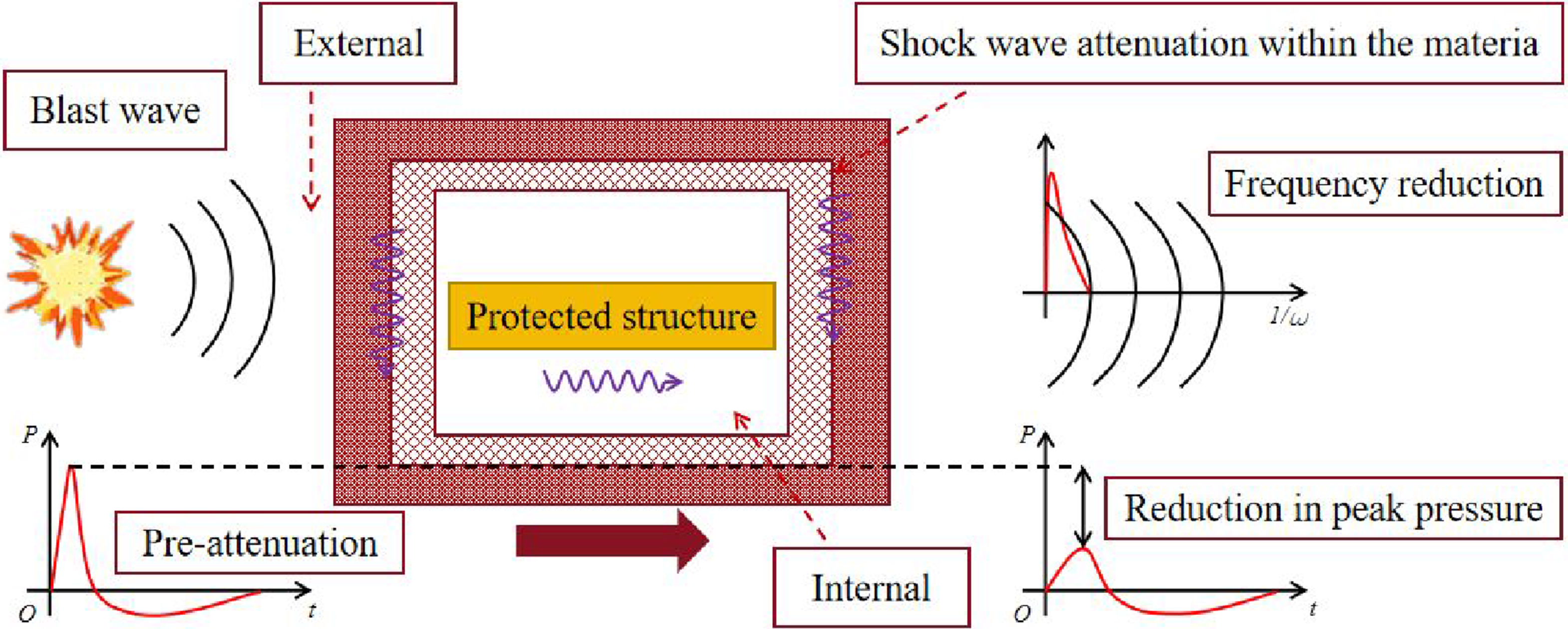
FSI effects and cavitation dynamics
During the load transfer and fluid interaction phase, the underwater shock wave acts instantaneously on the wetted face sheet due to the incompressibility of water. The superposition of incident and reflected waves rapidly imparts immense initial kinetic energy to the face sheet. Concurrently, the shock wave attenuates within the fluid medium due to rarefaction and viscous damping (Guo et al., 2024). Dynamic fluctuations in interfacial pressure readily induce cavitation at the fluid-structure interface. While this cavitation zone initially provides a buffering effect, its subsequent collapse, together with the implosion of the explosion bubble, generates a high-intensity secondary shock wave directed toward the structure. This secondary loading induces abrupt, stepwise changes in the face sheet velocity, thereby aggravating localized structural damage (Guo et al., 2024; Hao et al., 2022; Huang et al., 2016; Pandey et al., 2025).
Dynamic response and energy dissipation mechanisms of the core
During the structural deformation and core energy absorption phase, the dynamic response of the sandwich panel undergoes a four-stage evolution: (1) acceleration of the front face sheet induces initial densification of the proximal core; (2) the core progressively crushes from the center outward to dissipate energy, initiating deflection of the back face sheet; (3) as the velocities of both face sheets converge, the core achieves maximum densification alongside peak transverse stretching in the back face sheet; and (4) upon full dissipation of the kinetic energy, the back face sheet undergoes gradual elastic recovery (Hao et al., 2022). During impact loading, the front face sheet transfers momentum to the foam core, which serves as the primary energy-absorbing component of the sandwich structure. At relatively low impact energies, the core can undergo elastic deformation and partial recovery, thereby reducing the amount of energy transmitted to the back face sheet. As the impact energy increases beyond the elastic deformation limit of the core, progressive cell-wall buckling, fracture, and permanent densification occur, resulting in irreversible damage and substantial energy dissipation within the core. Consequently, significant rearward displacement of the back face sheet generally occurs only after the energy absorption capacity of the core has been partially exhausted and the remaining impact energy is transmitted through the thickness of the structure.
Throughout this process, the foam core dissipates a substantial amount of the shock wave energy through irreversible plastic deformations of the internal cell walls, including rupture, buckling collapse, and friction. This energy conversion mechanism is governed by the three constitutive stages of its stress–strain response, namely linear elasticity, plastic yielding, and densification, as shown in Figure 2 (Zhu et al., 2025b). In sandwich structures with gradient foam cores, damage evolution follows a strict sequential pattern: initial core indentation failure is followed by compression of the low-density layer and cracking of the high-density layer, culminating in interfacial delamination. Notably, while core thickness and mass distribution dictate the overall severity of damage, they do not alter the damage initiation time or the underlying evolutionary mechanisms (Gardner and Shukla, 2011). Deformation process of foam sandwich materials under impact loading.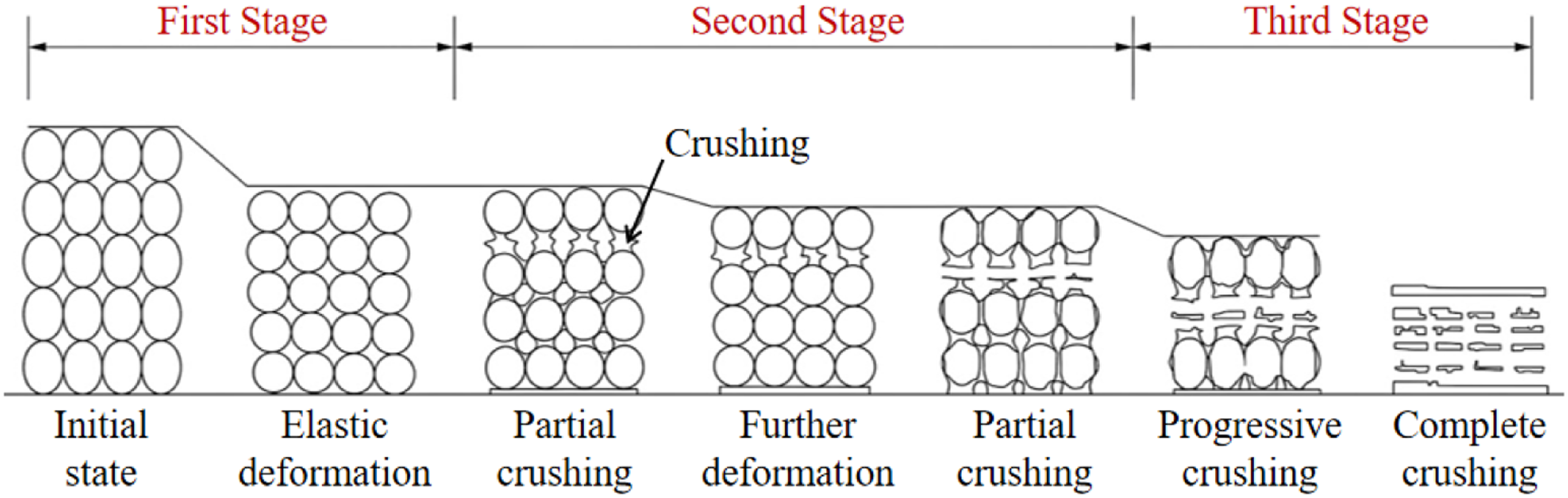
Currently, researchers primarily employ methods such as shock tube experiments, water tank tests, and numerical modeling to simulate underwater impact environments. These approaches are used to elucidate the response mechanisms of structures subjected to blast loading. For instance, based on Abaqus numerical analysis, Yin et al. (Yin et al., 2016) demonstrated that cellular foam coatings can effectively mitigate the dynamic response of structures under deep-water explosions. However, their protective performance depends on an optimal balance between stiffness and densification resistance. Through large-scale water tank contact explosion experiments, Zhang et al. (Zhang et al., 2017) demonstrated that air–water–air multilayer structures can significantly attenuate shock waves and fragment loads via the synergistic effect of the media. Furthermore, full-scale blast experiments by Rolfe et al. (Rolfe et al., 2017) proved that gradient-density foam cores can effectively reduce the out-of-plane deformation of sandwich structures. Meanwhile, combining shock tube experiments with numerical simulations, Feng et al. (Feng et al., 2022) found that the cavitation behavior of graded foam sandwich panels is governed by the weakest core layer, and that optimizing the gradient design can suppress the secondary impact induced by bubble collapse. In a related study, Li et al. (Li et al., 2024) utilized numerical modeling to reveal a non-linear relationship between explosive yield and bubble pulsation. They pointed out that an excessive charge may paradoxically mitigate the destructive effect of late-stage water jetting on the structure. Despite these advances, most existing research has been conducted under terrestrial conditions or in simplified laboratory setups, with systematic investigations under coupled multi-physical-field underwater environments remaining limited. Therefore, future studies should focus on examining the energy absorption and failure mechanisms of foam sandwich materials under realistically simulated or fully submerged underwater service conditions.
Introducing internal deformation constraint mechanisms is particularly crucial in the in-depth analysis of core layers. This approach addresses the localized shear and crushing failure that monolithic foams are prone to during the large underwater deformation stage. As revealed by micro-topological mechanics research, internal mutual constraints can effectively suppress transverse expansion and buckling. This strategy transforms localized buckling failure into global synergistic tensile deformation (Siivola et al., 2015). This transition in deformation mode significantly enhances the material’s vertical load-carrying capacity and specific energy absorption. In the impact-resistant design of sandwich structures, this constraint effect can be realized by embedding three-dimensional (3D) reinforcements into the foam matrix. Examples include carbon fiber skeletons or lattice scaffolds. This approach aims to restrict the lateral expansion of cells and delay the premature densification of the structure, thereby further optimizing the overall dynamic energy dissipation efficiency of the sandwich.
Overall, the underwater impact resistance of sandwich structures relies on a global synergy between the face sheets and the core. This process involves the deformation-induced buffering of the face sheets and the progressive failure of the core. Ultimately, the failure mode is strictly governed by impact intensity. Furthermore, the structural damage characteristics undergo a fundamental transition as impact intensity escalates. Under low-intensity impacts, the central region of the face sheet experiences extensive bending deformation prior to rupture. At medium intensities, the structure exhibits a combination of bending and shear deformations. Under high-intensity blast loading, the localized force on the central area generates severe shear stresses, predisposing the front face sheet to pure shear failure (Gardner and Shukla, 2011). Ultimately, these response mechanisms provide the essential theoretical framework for optimizing core density, thickness, and layering configurations to maximize structural impact resistance.
Key parameters influencing the impact response of foam materials
The impact resistance of foam sandwich structures is governed by the complex coupling of multiple factors. Specifically, the type of impact loading dictates the initial energy input. Meanwhile, material and structural parameters modulate impedance matching and failure modes. These factors collectively determine the energy dissipation mechanisms and global structural integrity.
Impact loading regimes
Strain rate critically governs the impact load capacity and deformation modes of foams, which dissipate impact energy primarily through structural deformation (Senol and Shukla, 2019). Notably, polymer foams exhibit pronounced strain-rate hardening, wherein both compressive strength and energy absorption efficiency increase under dynamic loading (Sasso et al., 2023). The dynamic mechanical properties of the core exhibit significant enhancement at elevated strain rates. For instance, Yao et al. (Luong et al., 2013; Yao et al., 2022) demonstrated that under high dynamic strain rates of 1700 s-1 or 2000 s-1, the compressive and ultimate tensile strengths of PVC foam increase by 107% to 200% compared to quasi-static loading at 10-4 s-1. Both SAN and PMI foams exhibit pronounced dynamic strain-rate hardening. As the strain rate increases, both materials demonstrate improvements in compressive yield stress, collapse stress, and overall energy absorption capacity (Arezoo et al., 2013; Gardner and Shukla, 2011). Notably, the yield stress of PMI foam increases continuously within the 10-4 to 102 s-1 range, plateauing only when subjected to higher dynamic strain rates exceeding 102 s-1 (Li et al., 2000). Furthermore, the deformation response of the foam is highly strain-rate dependent. The core transitions from a relatively uniform, macroscopically intact compression state under quasi-static loading. Under dynamic loading, it is dominated by cell wall buckling, rupture, and closed-cell gas compression. This ultimately leads to pronounced localized failure and macroscopic fracture (Huo et al., 2024; Qu et al., 2018).
Localized loading conditions also directly dictate the impact response and failure modes of foam cores. As Flores-Johnson et al. (Flores-Johnson and Li, 2011) demonstrated, indenter geometry governs the energy absorption efficiency, indentation depth, and overall damage area of sandwich panels. Furthermore, Rizov et al. (Rizov et al., 2004) revealed that localized loads concentrate the structural response severely within the contact zone. During the initial loading phase, the plastic zone within the core first expands radially; however, once the face sheet’s in-plane load distribution capacity is exhausted, this plastic zone propagates longitudinally into the core’s depth. Zhu et al. (Shipsha and Zenkert, 2005; ZHU et al., 2024) demonstrated that compression after impact (CAI) strength is highly dependent on the distance between impact points (DBIP). Under multi-point impact conditions, while a larger DBIP marginally enhances the global load-bearing capacity and stiffness of the structure, it simultaneously exacerbates localized damage severity, resulting in a significant degradation of CAI strength. Additionally, Baran et al. (Baran and Weijermars, 2020) experimentally demonstrated that under pristine pure bending conditions, the SAN foam core undergoes sudden, single-shear failure. Conversely, during post-impact bending, the core exhibits a progressive failure mode characterized by multiple shear cracks and interfacial debonding. As a result, energy dissipation in the damaged structure is dominated by plastic deformation and crack propagation within the core, rather than severe fracture of the face sheets.
In summary, the influence of impact loading on the mechanical response of foams is characterized by the coupling of strain-rate hardening and localized stress concentration. Specifically, high strain rates govern the enhancement of the dynamic yield limit and the transition in macroscopic failure modes. In contrast, localized loading dictates the spatial evolution of plastic damage and the degradation of residual load-bearing capacity.
Structural parameters
Core density
The mechanical properties of foam core materials are highly density-dependent. Qu et al. (Qu et al., 2018) experimentally demonstrated that reducing the core density of a PMI foam sandwich structure from 71 to 51 kg/m3 decreased its compressive strength from 2.00 to 1.10 MPa at a strain rate of 150 s-1, and from 2.28 to 1.32 MPa at 310 s-1. Concurrently, the elastic modulus declined markedly. For PVC foams, Colloca et al. (Colloca et al., 2012) and Luong et al. (Luong et al., 2013) confirmed that the elastic modulus, tensile properties, and overall strength all increase with density, with impact resistance exhibiting a linear dependence on foam density. Furthermore, Yao et al. (Yao et al., 2022) demonstrated that higher PVC foam density enhances both compressive strength and plateau stress. Furthermore, Hosseinkhani et al. (Hosseinkhani et al., 2025) demonstrated that increasing PU foam density results in a denser and more uniform cellular architecture. This microstructural refinement minimizes internal porosity and enhances overall mechanical strength, thereby increasing both the elastic modulus and plateau stress.
Variations in core density fundamentally alter the microscopic failure and deformation mechanisms of the foam. Zenkert et al. (Zenkert and Burman, 2008) observed that cell wall and edge buckling dominates the deformation in low-density PMI foams. In contrast, the thicker cell walls of high-density foams mitigate buckling effects, rendering them more susceptible to failure via plastic hinge formation. Investigating deformation mechanisms across varying densities, Arezoo et al. (Arezoo et al., 2011) concluded that macroscopic plastic collapse in low-density PMI foams is co-driven by elastic buckling and plastic cell wall bending, whereas in high-density variants, it is governed primarily by plastic bending. These density-induced mechanistic differences directly translate to the structural impact response, becoming particularly pronounced in underwater impact scenarios. Zhu et al. (Zhu et al., 2025a, 2025b) demonstrated that under identical impact conditions, a higher core density leads to reduced peak deformation in the back face sheet. High-density cores not only enhance the overall plastic energy absorption of the structure but also suppress water cavitation, thereby mitigating secondary loading effects. Furthermore, for an equivalent increase in impact intensity, the energy absorption capacity of high-density cores improves by 31.7% compared to their low-density counterparts. Senol et al. (Senol and Shukla, 2019) experimentally demonstrated a positive correlation between the density of closed-cell PVC foams and the input impulse. Additionally, high-density foams exhibited a slightly lower volume recovery rate compared to their low-density counterparts. These findings provide a quantitative basis for density optimization in underwater impact scenarios.
Based on these characteristics, optimizing foam core density is critical for enhancing structural performance in UNDEX scenarios. Investigating near-field UNDEX, Pandey et al. (Pandey et al., 2025) showed that low-density PVC foam sandwich panels exhibit larger maximum deflection during the initial impact due to their lower stiffness. This pronounced deflection generates larger surface cavitation bubbles with extended lifespans. The synchronous collapse of these cavitation bubbles with the main explosion bubble exacerbates structural damage. Conversely, the superior stiffness of high-density cores constrains cavitation bubble size and accelerates their collapse. This early collapse prevents load superposition, thereby mitigating the amplified deformation of the sandwich panel. Underwater explosion simulations by Huang et al. (Huang et al., 2016) further established that thick, low-density cores are optimal for low-intensity far-field blasts, whereas high-density cores are better suited for high-intensity near-field events. Introducing a spatial arrangement strategy, Arora et al. (Arora et al., 2017) proposed that positioning lower-density SAN foams on the blast-facing side effectively absorbs energy during the early stages of deformation. However, they highlighted a critical trade-off: increasing foam density results in a significant reduction in tensile fracture strain.
In summary, core density emerges as the primary parameter governing the mechanical properties, failure modes, and impact response characteristics of foam cores. Variations in density fundamentally control the microstructural deformation mechanisms, transitioning from cell wall buckling in low-density foams to plastic bending and hinge formation in high-density foams, which in turn dictate macroscopic stiffness, strength, and energy absorption behavior. Consequently, core density plays a decisive role in tailoring the impact resistance of sandwich structures, ultimately determining their adaptability to different loading intensities and service scenarios in marine environments.
Core thickness
Beyond core density, core thickness serves as another critical parameter dictating the impact resistance of sandwich structures (Guo and Zhang, 2023). Zhu et al. (Zhu et al., 2025b) and Zhou et al. (Zhou et al., 2020) demonstrated that increasing the core thickness enhances the overall bending stiffness by elevating the cross-sectional moment of inertia. This effectively maximizes the core’s energy absorption fraction. It thereby suppresses the peak deformation velocity of the back face sheet. As a result, severe damage modes are mitigated, such as face sheet fracture and rear petaling. The underlying mechanical mechanism is twofold: first, a thicker core extends the shock wave propagation path, facilitating more extensive core crushing to dissipate impact kinetic energy. Second, it effectively attenuates the velocity of the front face sheet, thereby mitigating and delaying momentum transfer to the back face sheet. As the foam core thickness increases, the failure mode of the sandwich panels transitions from an asymmetric pattern to a symmetric one. This symmetric failure mode not only enhances the predictability of structural deformation but also substantially improves the energy absorption efficiency under ultimate loads (Yuan et al., 2024).
Furthermore, core thickness directly influences the stiffness and deformation resistance of sandwich panels. A thicker core can generally increase the load-carrying capacity of the structure by enlarging the separation distance between the face sheets, which tends to enhance bending resistance and reduce structural compliance. Arora et al. (Arora et al., 2012) demonstrated that under air-backed conditions, thicker cores may withstand higher peak impact pressures but also tend to experience more pronounced core crushing and face sheet damage. Conversely, thinner core structures, when combined with the fluid damping effects of a water backing, may limit face sheet failure under relatively low impact loads, with energy primarily absorbed through core crushing. These observations indicate that the effective core thickness is likely to depend on both the loading environment and impact intensity, suggesting a need to balance energy absorption, structural stiffness, and damage tolerance rather than assuming a single optimal value.
Consequently, the impact-resistant design of sandwich structures requires carefully balancing the coupling effects between core thickness and the backing medium. This balance is essential to achieve global optimization of structural stiffness, energy absorption, and protective performance.
Stacking configuration
Rationally designing sandwich architectures and employing multi-material hybridization strategies enhance the impact resistance of polymer foams. The high strain rates, substantial energy, and severe dynamic tension of underwater impact loads frequently induce extensive structural delamination and tearing. To effectively withstand these extreme conditions, polymer foams can be synergistically integrated with other materials or utilized in customized foam-filled configurations. Within hybrid configurations, polymer foams exhibit distinct impact resistance mechanisms when combined with metallic versus non-metallic face sheets. Studies indicate that non-metallic face sheets possess limited intrinsic energy absorption capacity, dissipating energy primarily through localized damage modes such as fiber breakage and matrix cracking. Consequently, their effectiveness in these hybrid schemes relies heavily on the synergistic structural support provided by the polymer foam core. The crucial function of the foam core lies in preventing severe deformation and delamination of the intermediate face sheets induced by non-uniform stress distribution. Furthermore, it curtails debris fragmentation under compression while enhancing the overall load-bearing capacity and structural integrity (Arora et al., 2012; Huang et al., 2016). In contrast, metallic face sheets dissipate energy primarily through plastic yielding and large-deflection tensile-bending deformation, functioning synergistically with the extensive plastic compression of the polymer foam (Sun et al., 2024; Zhu et al., 2025a). The inherent ductility of metallic materials mitigates brittle fragmentation under extreme impact, enabling them to provide continuous and uniform dynamic support. This effectively channels the kinetic energy into the plastic compression of the core. However, employing core materials characterized by a low elastic modulus and relatively high strength can promote an elastic core response and significant springback. Counterintuitively, this can result in a transmitted impulse that exceeds that of an equivalent monolithic structure (Schiffer and Tagarielli, 2014). However, under blast loads severe enough to induce back face sheet rupture, Chen et al. (Chen et al., 2020) demonstrated that an asymmetric face sheet configuration with a thinner front and a thicker rear plate maximizes overall energy absorption efficiency. Furthermore, this design effectively mitigates potential damage to the witness plate caused by secondary debris.
In multi-layer foam core designs, replacing thick monolithic cores with graded-density configurations can optimize blast resistance while simultaneously saving space and reducing weight (Arezoo et al., 2011; Guo and Zhang, 2023). Mahgoub et al. (Mahgoub et al., 2024) revealed that the impact response mechanism of graded cores centers on manipulating load propagation paths through density gradient design. Specifically, the high-density layer sustains the initial impact and disperses the load, while the low-density layer dissipates energy through shear failure, ultimately achieving layer-by-layer load transmission and stepwise energy dissipation. Moreover, Arora et al. (Arora et al., 2017) demonstrated that a stepwise density gradient stacking configuration leverages interlayer interfaces to suppress through-thickness crack propagation within the core. This confines most fractures to the low-density layer, effectively reducing the out-of-plane displacement of the face sheets.
In the context of UNDEX and associated cavitation effects, the stacking sequence of graded cores dictates the protective performance of the structure. Experimental work by Feng et al. (Feng et al., 2022) demonstrated that an optimized gradient design effectively mitigates the impulse transfer induced by underwater shock waves and cavitation oscillation pressures. Furthermore, several studies have corroborated that a negative density gradient configuration, in which the core density progressively decreases from the blast-facing sheet to the distal sheet, delivers optimal overall protective performance. For instance, Mahgoub et al. (Mahgoub et al., 2024) investigated the stacking sequences of PMI foams with densities of 52, 110, and 200 kg/m3. They demonstrated that a negative gradient configuration (200/110/52) yields the highest energy absorption efficiency because the high-density impact layer provides load-bearing capacity and expands the load transfer area, while the low-density distal layer enhances specific energy absorption. Similarly, Jin et al. (Jin et al., 2016) investigated sandwich spherical shells under internal UNDEX loading. They found that a graded foam core with decreasing relative density from the inner to the outer face improves structural stability. This is achieved by combining high energy absorption efficiency with reduced transmitted stress.
In summary, the stacking configuration fundamentally dictates the dynamic response mechanisms of the structure. Graded designs enable the precise tailoring of load paths to achieve stepwise energy dissipation and crack suppression. Regarding failure modes, metal configurations should primarily guard against interfacial debonding induced by multiple coupled mechanisms. In contrast, non-metallic configurations are more susceptible to delamination under severe dynamic tensile loading. These contrasting behaviors, rooted in inherent material properties and interfacial strength, necessitate distinct design strategies to optimize energy absorption, structural integrity, and reliability under extreme dynamic conditions.
Application of foam sandwich materials in underwater shock-resistant structures
The application of sandwich structures has progressively expanded from terrestrial civil engineering to marine and naval sectors, including naval vessels, submarines, and offshore oil platforms (Phuong et al., 2021; Ren et al., 2019). Driven by this trend, composite sandwich panels have been widely investigated in recent years as lightweight structural concepts for underwater shock resistance (Hu et al., 2022). Furthermore, several review articles have summarized the damage tolerance modeling and experimental evaluation of these naval sandwich panel systems. Sandwich structures were originally developed for underwater protection in mine countermeasures vessels (Zenkert, 2009). However, due to the high susceptibility of naval hulls to underwater shock loading, these structures require tailored design considerations to resist blast-induced deformation and structural failure (Gargano et al., 2022). Compared with conventional monolithic steel or single-skin hulls, composite sandwich structures typically consist of high-strength face sheets and a polymer foam core. They are characterized by low radar signature, reduced structural weight, and improved corrosion resistance. In addition, they may exhibit enhanced durability under marine service environments. Consequently, their adoption may contribute to improved vessel maneuverability and potential reductions in fuel consumption and maintenance requirements (Dear et al., 2017; Hoo Fatt and Vedire, 2022).
Classification of core materials for underwater protection structures
Materials designed for underwater protection need to withstand a complex interplay of hydrostatic pressure, impact loading, and prolonged stress. Specifically, the buffer layers of submarines and other underwater vehicles are subjected to long-term service in extreme deep-sea environments characterized by low temperatures and immense pressure. Consequently, these structures are required to absorb collision-induced shocks while simultaneously resisting environmental degradation caused by seawater corrosion and marine biofouling, thereby maintaining their long-term mechanical stability and structural integrity. To address these demanding requirements, composite sandwich structures comprising high-strength face sheets and polymer foam cores are widely recognized for their exceptional efficiency in mitigating UNDEX shocks (Matos et al., 2024). Among impact-resistant core materials, high-performance polymer foams such as PMI, PVC, and SAN, as well as lightweight porous metals including aluminum foam, are commonly employed for underwater protection applications. These materials are noted for their relatively high specific energy absorption and favorable damage tolerance characteristics.
According to the studies by Zhu et al. (Rajaneesh et al., 2014; Zhu et al., 2025b; Rolfe et al., 2017), the typical application density of polymer foams generally ranges from 50 to 200 kg/m3, which is lower than that of metal foams, particularly aluminum foams. Polymer foams can exhibit high specific stiffness and specific strength even at low densities. For instance, PMI foam with a density of 52 kg/m3 shows a specific stiffness of 1355 kN·m/kg and a specific strength of 27 kN·m/kg. SAN foam with a density of 100 kg/m3 achieves a specific stiffness and specific strength of 955 kN·m/kg and 26 kN·m/kg, respectively. In comparison, aluminum foam with a density of 250 kg/m3 exhibits a specific stiffness of 720 kN·m/kg and a specific strength of 6 kN·m/kg. These results indicate that low-density polymer foams generally show higher load-bearing capacity per unit mass than high-density metal foams.
From a material perspective, although polymer foams have relatively low matrix elastic moduli, they are characterized by very low density, high porosity, and good compressibility, which enable sustained energy dissipation through large deformation. In contrast, metal foams such as closed-cell aluminum foams exhibit higher stiffness and strength, but their relatively high density limits their specific performance advantages. Since specific stiffness, specific strength, and specific energy absorption are governed not only by the properties of the matrix material but also by cell structure, pore distribution, and collapse mechanisms, polymer foams can often achieve higher energy absorption efficiency per unit mass under lightweight conditions. Impact experiments by Rajaneesh et al. (Rajaneesh et al., 2014) further confirm this trend. At the same yield strength level, replacing 250 kg/m3 aluminum foam with 80 kg/m3 PVC foam increases the specific energy absorption from 0.278 kJ/kg to 0.463 kJ/kg. At the same density of 250 kg/m3, PVC foam further increases the specific energy absorption to 0.725 kJ/kg, which is about 160% higher than that of aluminum foam. These results indicate that, at the same mass, polymer foams can sustain higher loads and absorb more energy. Overall, under the requirement of sufficient load-bearing capacity, polymer foams can achieve superior impact load transmission behavior and higher energy absorption efficiency per unit mass at lower weight, highlighting their higher specific energy absorption capability compared with metal foams.
Polymer foam
PMI foam
PMI foams demonstrate distinct advantages in underwater shock mitigation due to their exceptional specific modulus, specific strength, and energy absorption capacities. Compared to traditional polymer foams such as PU, PVC, and polypropylene (PP), PMI foams of equivalent density exhibit the highest strength and stiffness among all existing copolymer foams (Huo et al., 2024; Liu et al., 2009; Zhu et al., 2025b). The protective efficacy of PMI foams can be more significant under high-impulse loading. Specifically, the compressive strength of a 75 kg/m3 PMI foam is 1.3 times that of an equivalent-density PVC foam, and the impact resistance of PMI-cored sandwich structures becomes increasingly superior as the applied impulse rises (Zhu et al., 2025b). Furthermore, PMI foams demonstrate good thermo-mechanical and dimensional stability. They sustain robust mechanical performance at temperatures of 80°C and above, whereas equivalent PVC foams suffer significant degradation under these same conditions (Roosen, 2002). Additionally, the creep resistance of PMI foams under long-term fatigue loading is generally higher than that of their PVC counterparts (Zenkert and Burman, 2011). Compared to aluminum foam, the relatively lower elastic modulus of PMI foam renders it susceptible to secondary loading, which can exacerbate structural stress (Schiffer and Tagarielli, 2014). Nevertheless, its combination of load-bearing capacity under severe impacts and resistance to corrosion and hydrostatic pressure makes it a widely considered core material for long-term underwater applications.
PVC foam
Owing to their lightweight nature, good moisture resistance, and relatively high specific strength, PVC foams are extensively utilized as core materials in composite sandwich structures (Yao et al., 2022). Compared to PU and aluminum foams, PVC foams exhibit superior dynamic plateau strength. Furthermore, as the strain rate increases, its yield strength, compressive strength, and plateau stress all increase significantly, following an approximately log-linear relationship (Tang et al., 2025). Under low-velocity impacts and moderate blast loads, at an equivalent density of 250 kg/m3, the maximum dynamic penetration force and energy absorption of PVC foam surpass those of aluminum foam by 225% and 173%, respectively (Rajaneesh et al., 2014).By combining relatively high dynamic strength with considerable ductility, PVC foams may help mitigate severe bending deformation of the face sheets and delay petaling failure in the distal plate (Chen et al., 2020). Particularly in high-density configurations, these properties can reduce overall structural deformation and lower the likelihood of catastrophic failure. Furthermore, the damage tolerance of PVC foams allows them to retain a relatively high residual load-bearing capacity, even in the event of extensive interfacial debonding (Jin et al., 2016).
SAN foam
SAN foams have been investigated for their potential in both aerial and underwater blast mitigation, and have been reported to perform comparatively well with respect to out-of-plane displacement and core damage (Kumar et al., 2026). Under air blast loading, SAN-cored panels suffer less deflection and damage than traditional PVC and PMI equivalents. Under UNDEX conditions, a density-graded SAN core restricts face-sheet displacement (Gargano et al., 2022). Furthermore, SAN foams demonstrate exceptional residual load-bearing capacity following low-velocity impacts. When subjected to a 34.7 J impact, SAN-cored sandwich panels sustain initial core damage that reduces their post-impact bending stiffness by 35.2%. However, their collapse load decreases by a mere 4.9%, a structural retention rate that vastly outperforms traditional balsa wood and polyethylene terephthalate (PET) foams (Baran and Weijermars, 2020). This combination of localized damage tolerance and retained load-bearing capacity suggests that SAN foams may be a suitable core material for extending the operational lifespan of underwater equipment.
Metal foam
Within metallic foam systems, nickel and aluminum foams serve as quintessential representatives. However, owing to its relatively high penetration resistance, aluminum foam can perform well under high-intensity impact conditions. It effectively attenuates the impact energy and pulverizes debris originating from the front face sheet, making it the premier core material for preventing catastrophic fragmentation failure in the distal plate (Chen et al., 2020). Furthermore, high-strength aluminum foam delays the onset of initial underwater cavitation and extends the cavitation distance. Concurrently, its high elastic stiffness can reduce elastic springback within the core, thereby helping to limit the total impulse transmitted to the structure (Schiffer and Tagarielli, 2014). The impact resistance of aluminum foam is strongly influenced by its relative density. Higher-density aluminum foams can enhance structural resistance to blast loading, and their external application may improve blast energy mitigation performance. Furthermore, aluminum foams with a relative density ranging from 0.16 to 0.35 are reported to provide a balance between energy absorption capacity and structural protection (Kumar et al., 2026). Xuan et al. (Xuan et al., 2017) combined experiments and simulations and found that, regardless of whether the aluminum foam sandwich panels failed by boundary shear fracture or central fracture, the maximum deformation in the central region prior to damage was identical. Moreover, the energy absorption under the two failure modes was the same. Conversely, at equivalent densities, aluminum foam exhibits a lower dynamic plateau stress and densification strain than polymer foams such as PVC. This elongates the core’s compression phase and renders the distal plate more susceptible to debris-induced tearing under low-to-moderate impulses. Under these specific loading conditions, its overall protective performance may be lower than that of high-strength PVC foam (Chen et al., 2020).
Current applications of impact- and shock-resistant foam sandwich materials
Summary of relevant research on the application paradigms of underwater foam sandwich materials.
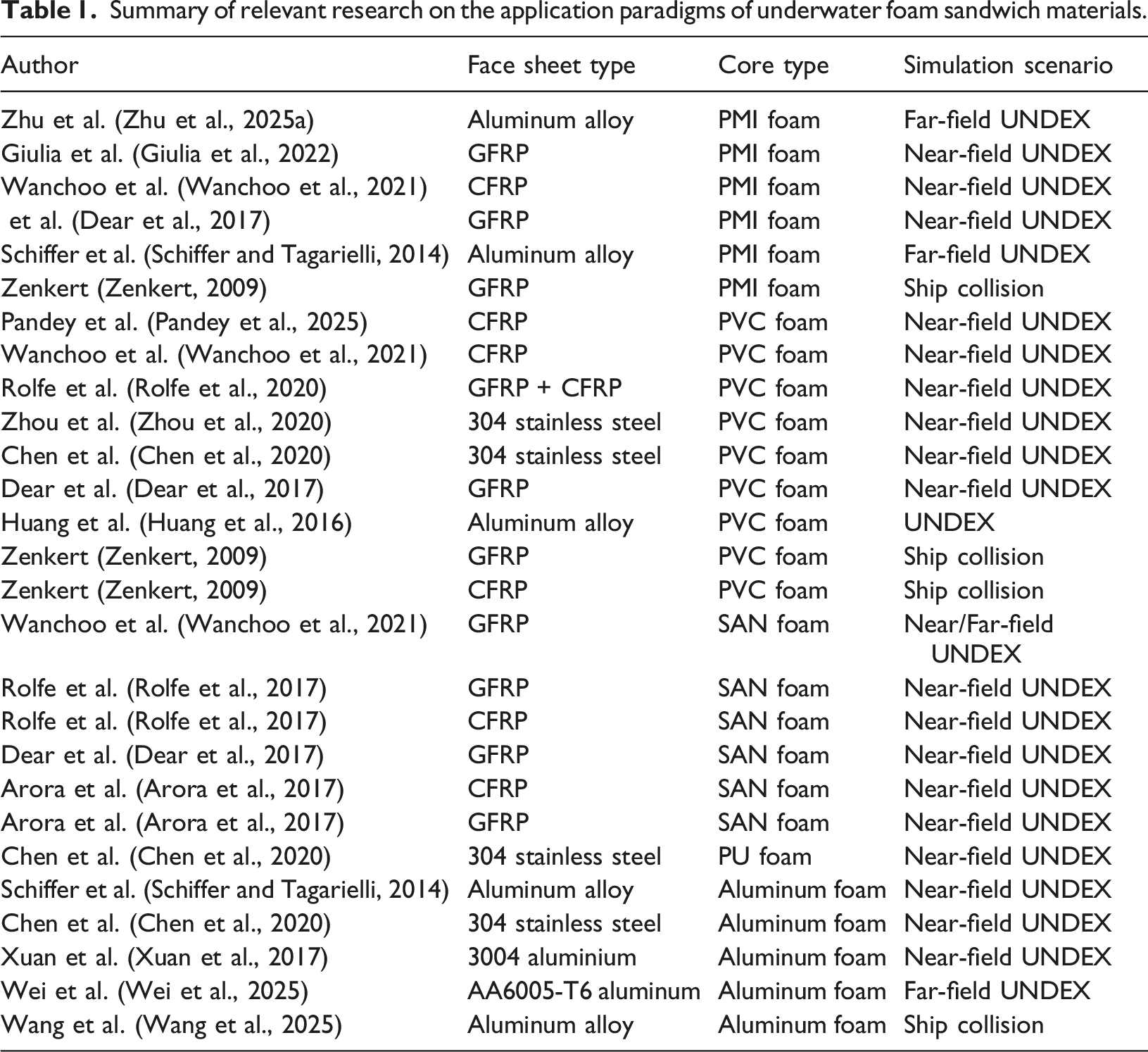
As summarized in Table 1, polymer foam sandwich structures have been widely investigated for underwater impact and blast protection over the past two decades. Among the various configurations, sandwich structures composed of FRP face sheets and PVC foam cores have been extensively studied, particularly in naval and marine engineering applications. This widespread adoption is primarily attributed to their favorable balance among lightweight characteristics, impact resistance, manufacturing maturity, and cost-effectiveness. Compared with conventional metallic sandwich structures, CFRP- and GFRP-based sandwich panels exhibit relatively high specific strength, high specific stiffness, and good corrosion resistance, suggesting their potential for marine protective structures. In contrast, although PMI and SAN foams can provide enhanced stiffness or improved fracture toughness, their engineering applications remain constrained by higher manufacturing costs and increased processing complexity. Metallic foam sandwich structures generally offer greater structural rigidity and interfacial stability; however, their broader implementation is limited by relatively high weight, corrosion susceptibility, and complex manufacturing processes.
Existing studies suggest that the long-term service reliability of polymer foam sandwich structures largely depends on the integrity of the face sheet–core interface. At present, sandwich panels are commonly fabricated through adhesive bonding, resin infusion, and prepreg hot-pressing processes, among which interfacial debonding has been identified as one of the predominant failure modes under underwater impact loading (Phuong et al., 2021). To improve interfacial bonding performance, increasing attention has been devoted to through-thickness reinforcement strategies, including Z-pin reinforcement (Mouritz, 2020), stitching/tufting (Chen et al., 2023; Mohammadi and Sosa, 2024; Sun et al., 2023), and three-dimensional weaving techniques (Yanneck et al., 2022; Zhao et al., 2026), which can effectively enhance interlaminar shear strength and suppress crack propagation. However, these reinforcement approaches may also introduce local stress concentrations and increased manufacturing complexity. Therefore, despite the superior lightweight characteristics and energy absorption capability of polymer foam sandwich panels, their long-term application in harsh marine environments remains constrained by interfacial degradation, moisture absorption, and fatigue-induced delamination. In comparison, metallic foam sandwich structures, although associated with higher structural weight, generally exhibit greater structural robustness and more stable load-transfer capability.
Furthermore, considerable discrepancies still exist among current underwater impact and blast studies due to the lack of unified international testing standards. Variations in explosive charge equivalence, stand-off distance, boundary constraints, scaling laws, and shock tube equivalence models often lead to substantial differences in the reported deformation and failure responses, thereby limiting direct quantitative comparison between studies. For instance, Zenkert (Zenkert, 2009) and Pandey et al. (Pandey et al., 2025) both investigated the dynamic response of CFRP/PVC foam sandwich structures, yet under fundamentally different loading scenarios. Zenkert focused on damage tolerance in naval collision conditions through compression-after-impact experiments, whereas Pandey examined fluid–structure interaction under near-field underwater explosion loading. Despite the distinct loading modes, both studies consistently demonstrated that the ultimate deformation of sandwich structures is primarily governed by the global bending stiffness and foam core crushing characteristics rather than the specific failure morphology. Zenkert observed similar central local buckling behavior under different impact damage modes, while Pandey reported that increasing foam core density reduced the maximum panel deflection by approximately 40%. These findings mutually verify that enhancing core density and interfacial stability can significantly improve the blast and impact resistance of sandwich structures. Therefore, future research should focus on establishing standardized underwater impact evaluation protocols and conducting full-scale, multi-field coupled experiments to bridge the gap between laboratory-scale investigations and practical marine engineering applications.
Conclusion and future direction
This review systematically elucidates the characteristics of underwater shock loading and the corresponding material response mechanisms. By examining both intrinsic material parameters and extrinsic loading conditions, we comprehensively analyze the key factors governing the impact resistance of foam sandwich structures. Review analysis indicates that composite sandwich systems comprising FRP face sheets and polymer foam cores exhibit promising application prospects in current research on underwater impact protection. This structural configuration capitalizes on the high specific strength of the FRP face sheets alongside the broadband energy dissipation capabilities of the foam core, establishing vital theoretical design principles for achieving both lightweighting and extreme protective performance in deep-sea equipment. Synthesizing these findings with prevailing limitations, future research on underwater impact mitigation necessitates targeted breakthroughs in the following critical directions: (1) Future studies should place greater emphasis on modeling and experimentally investigating the effects of hydrostatic pressure on foam-core sandwich structures. Hydrostatic pressure not only alters the yielding, stiffness, and compressive behavior of foam cores, but also profoundly affects fluid–structure interactions, cavitation dynamics, and shock-wave propagation. Existing research remains largely limited to shallow-water or ambient-pressure conditions, leaving the behavior of deep-sea structures under extreme multi-physics coupling insufficiently understood. Therefore, future work should focus on multi-physics coupling under high hydrostatic pressure to enhance the impact resistance of deep-sea structures. (2) To mitigate long-term degradation and extend service life, greater attention should be devoted to the aging behavior and durability of sandwich structures in marine environments. Under coupled effects of hydrostatic pressure, moisture, and cyclic loading, microcracks and interfacial damage progressively accumulate, accelerating structural deterioration. To address this issue, self-healing strategies such as embedded microcapsules and biomimetic vascular networks, can harness deep-sea hydrostatic pressure to accelerate the permeation and mixing of healing agents. This autonomous healing process effectively inhibits water ingress, suppresses damage propagation, and restores the mechanical integrity of the structure. (3) While practical marine applications frequently involve repeated impact loading, current research remains largely confined to single-strike responses. Future research should therefore investigate progressive damage mechanisms in foam cores, including cell wall fatigue buckling, cumulative plastic deformation, and stiffness degradation under successive impacts. It is also essential to quantify how residual stresses, stress concentrations, and microstructural damage compromise the load-bearing capacity and energy absorption over multiple impact cycles. Such studies will provide critical guidance for designing durable, high-performance sandwich structures for marine applications. (4) To mitigate interfacial debonding and core shear failure induced by high-intensity impulsive loading, the incorporation of 3D through-thickness reinforcements has emerged as an effective strategy for enhancing damage tolerance in sandwich structures. This approach effectively suppresses macroscopic delamination and significantly improves the impact resistance of the structure under extreme environmental conditions, including sub-zero temperatures.
Footnotes

Author contributions
Conceptualization, S.Y.; Investigation; Methodology S.Y.; Roles/Writing - original draft S.Y., X.Z; Writing - review & editing X.C., J.L.
Funding
The authors disclosed receipt of the following financial support for the research, authorship, and/or publication of this article: This work was financially supported by the Science and Technology Planning Project of Tangshan City, China (No. 25130214B), the Undergraduate Innovation and Entrepreneurship Training Program of North China University of Science and Technology, China (No. S202510081117), and the Fundamental Research Funds for the Central Universities (No. CUSF-DH-T-2023017).
Declaration of conflicting interests
The author(s) declared no potential conflicts of interest with respect to the research, authorship, and/or publication of this article.