







Abstract
Everyday materials such as honey, shampoo, and oil are often described not only in terms of their viscosity but also by the sense of stickiness they evoke during contact and separation. Although previous studies have identified visual cues that support the perception of viscosity, the visual basis of stickiness perception, particularly in interactive contexts, remains poorly understood. Here, we introduce a novel phenomenon, termed pseudo-slimy, in which participants experience a sense of stickiness toward a visually deforming object that stretches and eventually breaks in response to their own finger movements. In Experiments 1 and 2, we systematically manipulated the distance at which the object visually broke (break distance) and found that larger break distances elicited significantly stronger impressions of stickiness. In Experiment 3, we demonstrated that the perceived strength of this phenomenon could be quantitatively mapped onto a psychological stickiness scale derived from common viscoelastic materials, showing a significant correlation between adjusted break distances and scale values. Together, these results suggest that the spatial extent of visually induced resistance to separation serves as a powerful cue for stickiness perception. The present findings provide new insights into how humans visually infer material stickiness in interactive situations and offer a potential framework for pseudo-haptic applications that evoke tactile qualities through visual feedback alone.
How to Cite this Article
Kawabe, T., Morisaki, T., & Ujitoko, Y. (2026). Pseudo-slimy: A novel phenomenon to evoke stickiness perception. i-Perception, 17(3), 1–15. https://doi.org/10.1177/20416695261458511
Introduction
We encounter a wide variety of everyday substances—such as honey, condensed milk, shampoo, and salad oil—that differ not only in their perceived viscous properties but also in the sensation of “stickiness” they convey when touched or deformed. Several previous studies have shown promising cues to the visual perception of the viscosity of such materials. For example, the deformation of overall shapes (Assen et al., 2018; Paulun et al., 2015) and the speed of image motion (Kawabe et al., 2015) are effective cues for visually judging viscosity. When an observer's finger interacts with such materials, the detachment of the finger from the material surface causes a sensation known as stickiness (Kim et al., 2020; Lee et al., 2019; Zigler, 1923). Importantly, stickiness is not reducible to viscosity alone but reflects a distinct perceptual experience that arises from interactions between the material surface and the finger during contact and separation. Although it is known that visual presentations of scenes in which a finger detaches from the surface of viscoelastic materials effectively evoke an impression of material stickiness (Lee et al., 2019), it has not been well established which visual cues human participants use to judge material stickiness, especially in scenes involving interaction with materials.
To address this unresolved issue, the present study introduces a novel augmented reality phenomenon, termed “pseudo-slimy,” in which participants experience a sense of stickiness toward a visually stretching object. In this phenomenon, the stretching of the object is visually induced by the observer's finger movement, and the object eventually breaks after sufficient extension. The inclusion of this breaking event was motivated by prior findings suggesting that visual information available at the moment of finger detachment provides critical cues for judging stickiness (Lee et al., 2019). We controlled the finger distance at which the break event occurred as the break distance. A larger break distance implies that the object visually resists separation for a longer spatial extent, which may be interpreted as stronger adhesion between the finger and the object. Therefore, we hypothesized that larger break distances would evoke stronger impressions of stickiness. In the next section, we review prior studies that provide the theoretical background for investigating stickiness perception in an augmented reality setting. Sections “Experiment 1” to “Experiment 3” report experiments designed to quantify the strength of the pseudo-slimy phenomenon. Section “General Discussion” discusses limitations and future directions.
Related Work and Novelty of the Present Study
The phenomenon reported in the present study is closely related to pseudo-haptic techniques. In this section, we review prior studies relevant to the background of the present work.
Pseudo-Haptic Technique
Pseudo-haptic techniques are perceptual approaches that allow users to experience haptic sensations through visual feedback that is systematically modulated in response to user actions (Lécuyer et al., 2000; Ujitoko & Ban, 2021; Xavier et al., 2024). For example, visual feedback can be modulated through temporal delay (Takamuku & Gomi, 2015), spatial displacement (Dominjon et al., 2005), and object deformation (Argelaguet et al., 2013). Pseudo-haptic techniques can convey diverse haptic properties, including weight (Samad et al., 2009), compliance or elasticity (Argelaguet et al., 2013; Punpongsanon et al., 2015), friction or resistance (Lécuyer et al., 2000; Kawabe et al., 2021; Narumi et al., 2017; Ujitoko et al., 2019), viscosity (Costes et al., 2019; Fukushima et al., 2013; Watanabe & Yasumura, 2008 ), roughness (Ujitoko et al., 2019), object shape (Ban et al., 2012; Lécuyer et al., 2008), and material category (Hachisu et al., 2011). These capabilities are particularly valuable for enhancing the realism of digital experiences where physical touch is limited, and they are widely applied in virtual and augmented reality, gaming, and mobile user interfaces as a bridge between the physical and virtual worlds.
Pseudo-Haptic Sensations With Bare Hand
In the present study, we focus on pseudo-haptic sliminess sensations that arise when users manipulate virtual objects with their bare hands, without the use of physical devices. Thus, it is useful to review previous studies investigating pseudo-haptic sensations with the bare hand. Prior research (Ban et al., 2015) has proposed methods that exploit self-touch sensations between the thumb and index finger, combined with visual deformation of the user's hand, to induce the illusion of contacting virtual objects in augmented reality environments. Another study (Sato et al., 2019) has demonstrated techniques that dynamically adjust the deformation of virtual objects in synchrony with pinching gestures to convey elasticity. Several variations of this approach, in which virtual objects deform in response to users’ gestures, have been explored in the literature (Kawabe, 2020; Kawabe & Ujitoko, 2024). Additionally, researchers have developed methods to elicit illusory perceptions of weight by modulating the rate of size change of a virtual object as it is lifted (Kawabe et al., 2022). Such pseudo-haptic techniques, which do not rely on direct physical contact with devices, can be applied to interactive kiosks to showcase virtual products effectively. For example, presenting a sense of weight or resistance for specific items in a gesture-controlled carousel can draw greater attention to important items, such as promotional products (Gaucher et al., 2017).
Perceptual Stickiness in Virtual Reality
Recently, Hirao et al. (2025) have investigated to what extent the perception of surface stickiness could be pseudo-haptically reproduced using visual information alone, without the use of physical haptic devices in a virtual reality (VR) environment. Specifically, they designed pseudo-haptic techniques such as manipulating the visual gain of hand movements and altering the appearance of surface deformation. They experimentally evaluated how strongly each technique, as well as their combinations, enhanced the perceived sense of stickiness, and how precisely participants could discriminate subtle differences in stickiness, as measured by the just noticeable difference (JND). The results showed that conditions combining multiple pseudo-haptic cues (e.g., changes in hand motion together with surface deformation) enabled finer discrimination of stickiness than conditions relying on a single cue, reducing the JND by 44%.
Novelty of the Present Study
The present study examines the pseudo-slimy phenomenon, which is novel in several respects. First, to our knowledge, this is the first study to investigate the perception of stickiness in an augmented reality context. Second, this is also the first attempt to examine stickiness perception using bare-hand interaction; in contrast, Hirao et al. employed a VR controller to manipulate the deformation of a virtual surface. Finally, our study examines whether changes in break distance systematically alter the subjective level of perceived stickiness. By using break height as a parameter, Hirao et al. examined how pseudo-haptic cue combinations improve discrimination of surface stickiness, whereas the present study identifies break distance as a parameter that quantitatively controls the perceived magnitude of stickiness. To provide empirical evidence for these contributions, we conducted the experiments described in the following sections.
Experiment 1
The purpose of this experiment was to examine whether the distance at which the deformable region presented between the thumb and index finger breaks serves as a cue for perceived stickiness in an augmented reality context. We hypothesized that perceived stickiness would increase as the break distance becomes larger.
Method
Participants
A priori power analysis using G*Power (Faul et al., 2007) indicated that a minimum of 25 participants was required (assuming an effect size of f = 0.25, α = 0.05, and β = 0.95). Therefore, data were collected from 31 participants (17 females and 14 males; mean age = 29.25, SD = 9.70). Ethical approval for this and the subsequent studies was obtained from the research ethics committee of NTT Communication Science Laboratories (R07-010). All experiments were conducted in accordance with the principles of the 2013 Declaration of Helsinki. Written informed consent was obtained from all participants prior to participation.
Apparatus
In the experiment, participants placed their right hand on the desk surface, positioned 30 cm below a camera (C1000e, Logicool Co., Ltd.) directed toward the desk. At this camera distance, the physical size of the hand as displayed on the screen was approximately the same as the actual physical size of the observer's hand. Participants viewed a live video stream of their right hand on a 32-inch LCD monitor (Display++, Cambridge Research Systems Ltd.) with Full HD resolution and a refresh rate of 120 Hz, positioned 57.3 cm from the observer (Figure 1a). A Mac Pro (Apple Inc.) was used to control the experimental procedures. Participants rested their chin on a chinrest to stabilize their field of view while observing the display.
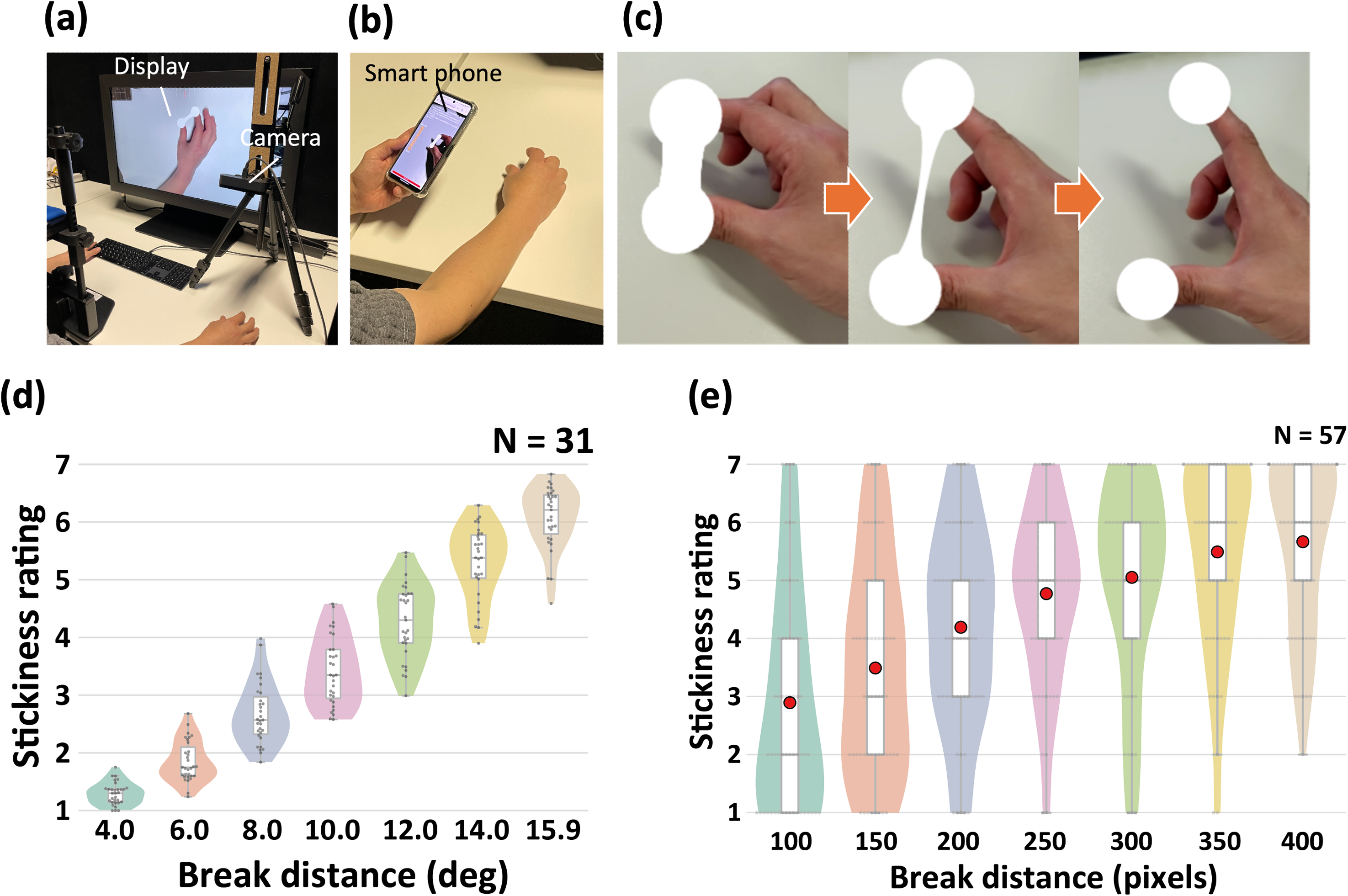
Experimental setup, stimuli, and results in Experiments 1 and 2. (a) In Experiment 1, participants placed their right hand 30 cm below the camera and observed the stimuli on the display. (b) In Experiment 2, participants were instructed to hold their own smartphone vertically with either their right or left hand and, while viewing either their right or left hand captured by the smartphone's rear camera, observe the stimuli. (c) When the participants separated the thumb and index fingertips, a deformable region was visually extended. When the region extended to the predefined break distance, the region disappeared. (d) Results in Experiment 1. (e) Results in Experiment 2.
Hand tracking
Fingertip positions were obtained in real time using MediaPipe Hands (https://github.com/google-ai-edge/mediapipe). We tracked a single hand (maxNumHands = 1) with modelComplexity = 0, minDetectionConfidence = 0.5, and minTrackingConfidence = 0.5. The tip of the thumb and index finger corresponded to landmarks 4 and 8, respectively. MediaPipe outputs landmark coordinates normalized to the range [0, 1]. These normalized coordinates were converted into pixel coordinates on the display canvas. The distance between the thumb and index fingertips was computed as the Euclidean distance and used to control the deformation and breakage of the deformable region (see next section). Hand tracking and stimulus updates were performed at approximately 30 Hz. No explicit latency compensation or delay measurement was implemented; instead, the most recent tracking results were used for immediate rendering on each frame. No additional temporal filtering (e.g., moving average or Kalman filtering) was applied. The raw tracking output from MediaPipe Hands was used directly. If hand landmarks were not detected (i.e., multiHandLandmarks was unavailable), fingertip detection was considered unsuccessful (fingersDetected = false), the rating functions were disabled, and the stimulus was not updated for that frame.
Deformation model and procedure
Participants were instructed to repeatedly open and close their thumb and index finger while viewing the monitor (Supplemental Movie 1). White disks with a radius of 2.4° (32 pixels) were superimposed on the display at the positions corresponding to the two fingertips, representing a virtual material (Figure 1c).
A deformable white region was rendered between the two disks. However, this region was displayed only when the distance between the fingertips, denoted as dt, was smaller than a predefined threshold D (hereinafter referred to as the “break distance”). When dt was smaller than D, the deformable region was rendered between the two discs; when dt is equal to or greater than D, the region was not displayed. That is, the deformable region disappeared when dt ≥ D.
The white deformable region was composed of a sequence of white circles whose centers lay along the straight line connecting the two discs. The radius of each circle was adjusted so that its outer edge lies exactly on a quadratic Bézier curve defined by the endpoints (x1, y2) and (x2, y2), which corresponded to the centers of the outermost white circles. The control point (xm, ym) was set as the midpoint between (x1, y1) and (x2, y2). In other words, although the centers of the circles followed a linear path, their sizes were modulated such that the upper boundary formed by their outer edges traces the shape of the Bézier curve.
A point on the quadratic Bézier curve at parameter t (where t ranges from 0 to 1) was defined as follows. The x-coordinate was given by:


The control point was defined as the midpoint of the two endpoints:


The radius (i.e., thickness) of the drawn circles, denoted as w(t), was modulated based on a tear coefficient C, which was defined as:

This coefficient controlled the tapering of the shape, making it narrower in the middle and thicker toward the ends. The modulation is implemented using the following nonlinear exponential function:

Here, wmid was defined as c multiplied by wmax. The parameters wmin (minimum width), wmax (maximum width), and k (a sharpness coefficient) were constants, with k set to 4 in the present implementation. As the fingertip distance dt approached the threshold D, the mid-region thickness wmid decreased, producing a stretched and tearing-like appearance in the rendered image.
Furthermore, the system incorporates a state-transition mechanism that governs the appearance and disappearance of the deformable region. Specifically, when dt is equal to or greater than D, the deformable region abruptly disappears (i.e., breaks) without a smooth fade-out and does not immediately reappear. The region reappears when the fingertip distance, after falling below a secondary threshold denoted as Drebind, exceeds Drebind again. In the present implementation, Drebind was set to 40 pixels. The primary threshold D is always greater than Drebind. Once the condition dt < Drebind is satisfied, the system transitions to a rebind-ready state. When dt subsequently becomes greater than Drebind, the system returns to the normal drawable state. The state-transition mechanism can be summarized as follows:
- When dt < D, the deformable region is rendered and deforms as a function of the distance between the thumb and index fingertips. - When dt ≥ D, the deformable region disappears immediately (i.e., breaks) without a smooth fade-out, and the system enters a non-rendering state. - The region does not immediately reappear after the break. Instead, the system transitions to a rebind-ready state when dt < Drebind. - Once in this state, the deformable region is rendered again when dt increases above Drebind, and deformation resumes.
This region was displayed only when the distance between the thumb and index fingertips was smaller than a predefined threshold (hereinafter referred to as the break distance). Seven levels of break distance were tested (100, 150, 200, 250, 300, 350, and 400 pixels), corresponding to physical distances of 4.0, 6.0, 8.0, 10.0, 12.0, 14.0, and 16.0 cm and visual angles of 4.0°, 6.0°, 8.0°, 10.0°, 12.0°, 14.0°, and 15.9°, respectively.
Participants were allowed to stretch and break the deformable region freely. After each trial, they rated the perceived stickiness on a 61-point scale ranging from 1 to 7 in increments of 0.1. Participants reported their stickiness impressions by moving a marker (a red line) along a white number line displayed at the top of the screen, which ranged from 1 to 7 in increments of 1, using the arrow keys. On each trial, the marker initially appeared at position 4. Each break distance condition was repeated 10 times in a randomized order.
The demo code is available at https://osf.io/bn4j7/files/98zmn.
Results and Discussion
The obtained ratings were averaged for each participant and each condition, and these averages, shown in Figure 1d, were used for subsequent analyses. Since the rating values are not normally distributed, after applying the aligned rank transformation (ART: Elkin et al., 2021; Wobbrock et al., 2012) to the ratings, a one-way repeated-measures ANOVA with break distance as a within-participant factor was performed. The analysis revealed a significant main effect of break distance [F(6, 180) = 664.10, p < .0001, η2
p
= .956]. Multiple comparisons (t-tests with Bonferroni correction) showed that all pairwise comparisons between break distance conditions were statistically significant (p < .05). A linear mixed-effects model revealed a strong positive effect of distance on stickiness ratings (b = 0.0163, 95% CI [0.0160, 0.0166], t(2138) = 100.84, p < .001), indicating a robust linear increase in perceived stickiness as break distance increased. The random intercept variance for participants was 0.136. The intraclass correlation coefficient (ICC ≈ 0.19) indicated that approximately 19% of the variance was attributable to between-participant differences, with the remaining variance arising from within-participant variability. As a first-order approximation under the present laboratory conditions, the relationship can be expressed as:

Consistent with our hypothesis, perceived stickiness increased systematically as the break distance increased. Importantly, the linear mixed-effects model revealed an approximately linear relationship between break distance and perceived stickiness, suggesting that observers treat break distance as a continuous cue rather than a categorical threshold. This approximately linear mapping between break distance and perceived stickiness also has practical implications for system design. Specifically, it suggests that perceived stickiness can be predictably controlled by parametrically adjusting break distance, enabling straightforward calibration of visual feedback in augmented reality systems.
One plausible interpretation is that break distance serves as a critical visual cue linked to the moment of detachment. In the present paradigm, the disappearance of the deformable region at a specific fingertip separation provides a discrete event that signals the limit of material cohesion. A larger break distance implies that the material visually maintains its connection over a greater spatial extent before rupture, which may be interpreted as stronger adhesion or resistance to separation. This interpretation is consistent with previous findings suggesting that visual information available at the moment of detachment plays a key role in stickiness perception (Lee et al., 2019).
Although interindividual variability was present, as indicated by the ICC, the effect of distance remained highly consistent across participants, suggesting that the mapping between break distance and perceived stickiness is largely shared across observers.
Experiment 2
The aim of Experiment 2 was to examine the cross-device robustness of the pseudo-slimy phenomenon. Investigating whether this phenomenon is limited to the specific conditions of Experiment 1 is important for identifying the general conditions under which it occurs, as well as for determining whether it depends on the particular device used. If the pseudo-slimy phenomenon relies on the relative relationship between hand size and break distance on the display, similar results to those of Experiment 1 should be obtained regardless of the display size. In this experiment, we tested this prediction using an online experiment conducted on smartphones with smaller displays than those used in Experiment 1.
Method
Participants
A power analysis using G*Power indicated that, assuming an effect size of f = 0.20, alpha = 0.05, and beta = 0.95, a minimum of 39 participants would be required for each psychological factor, wherein we assumed a smaller effect size than in Experiment 1 due to the online nature of the experiment (Chandler & Shapiro, 2015; Crump et al., 2013). As a result, 57 participants (20 females and 37 males; mean age = 45.91 years, SD = 9.82) participated in the experiment. The participants were recruited via the Yahoo! crowdsourcing service and received 50 yen for their participation. Ethical approval for this and the subsequent studies was obtained from the research ethics committee of NTT Communication Science Laboratories (R06-009). All experiments were conducted in accordance with the principles of the 2013 Declaration of Helsinki. Written informed consent was obtained from all participants prior to participation.
Stimuli and Procedure
Stimuli and procedure were identical to those used in Experiment 1, except for the following. The disks presented at the positions of the thumb and index finger had a diameter of 40 pixels. On each trial, one of seven break distances (100, 150, 200, 250, 300, 350, and 400 pixels) was randomly selected and presented to the participant. Participants were instructed to hold their own smartphone vertically with either their right or left hand and, while viewing either their right or left hand captured by the smartphone's rear camera, break the deformable region presented between their fingertips on the display by increasing the distance between the thumb and index finger (Figure 1b). Participants rated perceived stickiness on a 7-point scale by tapping the number corresponding to their perceived level of stickiness. Each break distance was evaluated once per participant.
Results and Discussion
The obtained ratings were averaged for each participant and each condition, and these averages, shown in Figure 1e, were used for subsequent analyses. As in Experiment 1, we conducted ART-ANOVA with break distance as a within-participant factor. The main effect of break distance was significant [F(6, 336) = 27.68, p < .0001, η2 p = .330]. Multiple comparisons (t-tests with Bonferroni correction) revealed significant differences between all break distance pairs (p < .05) except for 200–250, 250–300, 300–350, and 350–400 pixel pairs (p > .05).
A linear mixed-effects model further revealed a significant positive effect of distance on stickiness ratings (b = 0.0094, 95% CI [0.0080, 0.0108], t(341) = 12.91, p < .001), indicating that perceived stickiness increased as break distance increased even under smartphone-based viewing conditions. The random intercept variance for participants was 0.679, and the intraclass correlation coefficient (ICC ≈ 0.24) indicated that approximately 24% of the variance was attributable to between-participant differences. Under the present smartphone-based conditions, the relationship can be approximated as:

These results indicate that the positive relationship between break distance and perceived stickiness observed in Experiment 1 is preserved in an online smartphone environment. However, the absence of significant differences among larger break distance pairs, together with the smaller regression coefficient compared to Experiment 1, suggests a partial saturation effect under these conditions, whereby increases in break distance beyond a certain range produce diminished perceptual changes. The differences in slope and intercept between Experiments 1 and 2 may also reflect a general response tendency specific to online rating tasks. In online surveys, participants may be more likely to adopt satisficing strategies or prefer middle response categories, which could have biased responses toward the midpoint of the 7-point scale (Gao et al., 2016). Such a tendency would be consistent with the relatively higher intercept and shallower slope observed in Experiment 2, because compression of responses toward the center of the scale would reduce apparent sensitivity to changes in break distance while increasing baseline ratings.
Importantly, despite increased variability across participants, as reflected in the higher random-effect variance and ICC, the effect of break distance remained consistent, suggesting that the underlying perceptual mapping is robust across devices and viewing conditions. This pattern supports the hypothesis that the pseudo-slimy phenomenon depends on the relative relationship between hand configuration and visual deformation rather than absolute display size.
Taken together, Experiment 2 demonstrates that the pseudo-slimy phenomenon generalizes to everyday smartphone usage. The consistency of the distance–stickiness relationship across laboratory and online environments suggests that this phenomenon reflects a stable perceptual process rather than an artifact specific to controlled experimental settings.
Experiment 3
The aim of Experiment 3 was to examine whether the strength of pseudo-slimy could be assessed in an alternative manner. Specifically, we tested how well the stickiness evoked by the phenomenon corresponded to the perceived stickiness of everyday materials. To this end, in Experiment 3a, we first constructed a stickiness scale for common viscoelastic materials. In Experiment 3b, participants were then asked to express the stickiness of these materials on that scale by adjusting the break distance in the stimuli. We subsequently analyzed the correlation between the adjusted break distances and the stickiness scale obtained in Experiment 3a.
Experiment 3a
Method
A total of 151 participants (36 females and 115 males; mean age = 45.88 years, SD = 9.43) were recruited online and took part in the experiment. The participants were recruited via the Yahoo! crowdsourcing service and received 50 yen for their participation. All participants completed the task using their own smartphones. On each trial, a pair of names referring to everyday viscoelastic materials was presented on the smartphone display. The ten materials used were water, orange juice, dish soap, salad oil, shampoo, ketchup, condensed milk, liquid glue, honey, and mochi. These materials were selected because they were sufficiently familiar for participants to readily imagine their stickiness and sufficiently diverse to span a wide range of perceived stickiness. On each trial, two materials were randomly selected from this list and presented simultaneously, one at the top and the other at the bottom of the display. Participants were instructed to indicate which of the two materials they perceived as having stronger stickiness. In total, 45 unique material pairs were presented in a randomized order.
Data from two participants were excluded from subsequent analyses because they consistently selected the same display position as being stickier, irrespective of the material pair. Based on the remaining data, a unidimensional stickiness scale was constructed using Thurstone's method. (Gescheider, 2013; Thurstone, 1927).
Results and Discussion
The resulting scale is shown in Figure 2a, with each material positioned along a unidimensional axis. Assuming that this psychological axis reflects subjective stickiness, we next examined whether the stickiness elicited by pseudo-slimy could be quantified by its position on this scale.
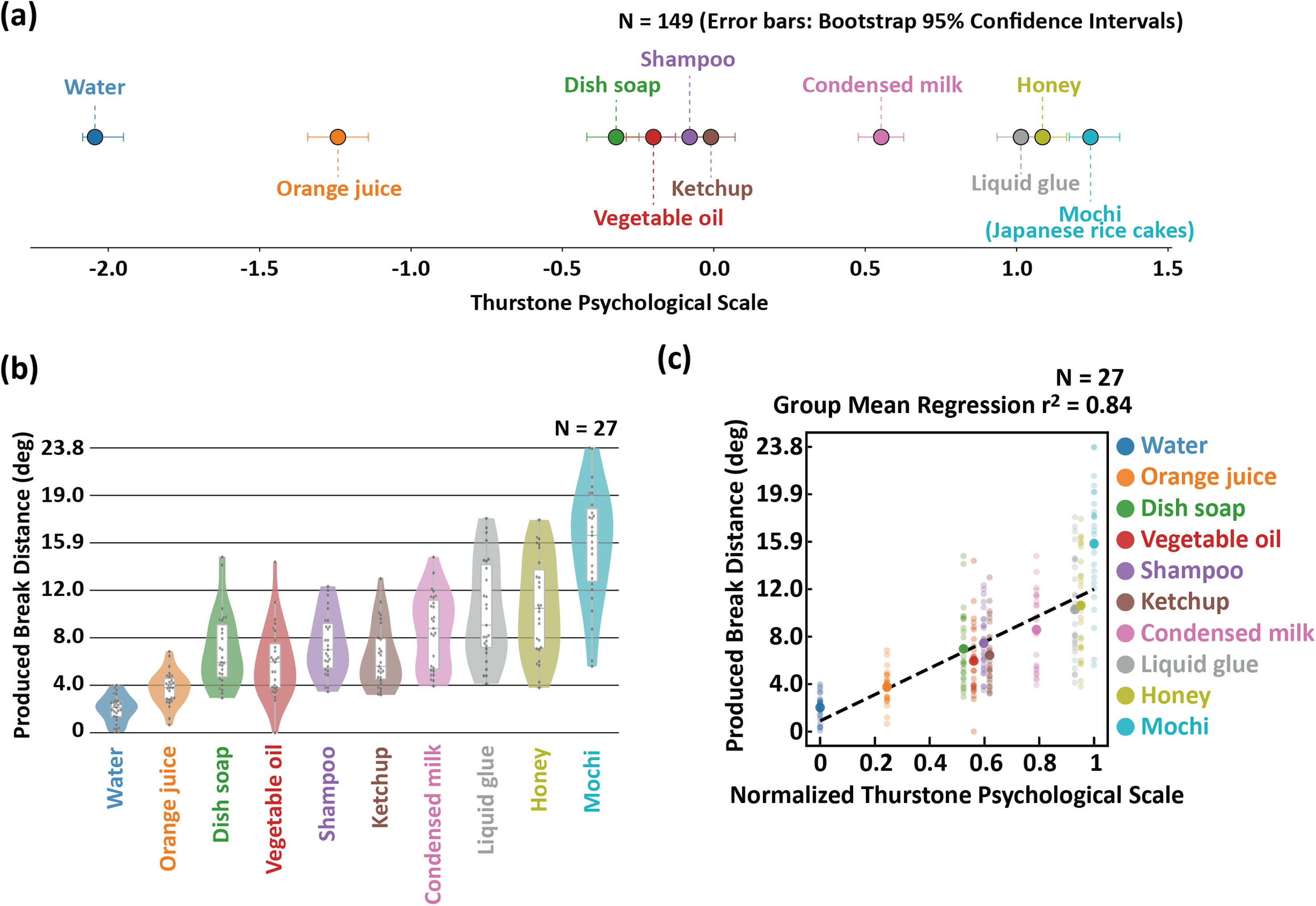
Experiment 3 results. (a) Thurstone psychological scale of the stickiness of viscoelastic materials, constructed in Experiment 3a. (b) Results from Experiment 3b, in which participants produced break distances to represent the perceived stickiness of each viscoelastic material. (c) Correlation between the normalized psychological scale (0–1) and the break distances produced for each material. Large and small markers indicate group-level and individual-level data, respectively.
Experiment 3b
Method
In Experiment 3b, according to G*Power, a minimum of 20 participants was required (assuming an effect size of f = 0.25, α = 0.05, and β = 0.95). Data were collected from 27 participants (14 females and 13 males; mean age = 29.25, SD = 10.00). Each observer entered the laboratory and completed the task individually. The apparatus was identical to the one that was used in Experiment 1. On each trial, the name of a material was presented at the top of the screen, and the participants adjusted the break distance using the assigned keys so that the perceived stickiness would match that of the indicated material. The break distance (D) was initialized to 100 pixels at the beginning of each trial. Participants adjusted D using the arrow keys, with each key press changing the value in steps of 10 pixels (left arrow: −10, right arrow: +10), within a bounded range of 0–600 pixels. Each material condition was repeated six times in randomized order.
Results and Discussion
Figure 2b summarizes the variation in produced break distances for each material. A one-way repeated-measures ANOVA with material as the within-participant factor revealed a significant main effect of material [F(9, 234) = 79.27, p < .0001, η2 p = .753]. Multiple comparisons (t-tests with Bonferroni correction) showed that all pairwise comparisons revealed statistically significant differences (p < .05) except for the following material pairs: Dish Soap vs. Vegetable Oil, Dish Soap vs. Shampoo, Dish Soap vs. Ketchup, Vegetable Oil vs. Ketchup, Shampoo vs. Ketchup, Shampoo vs. Condensed Milk, and Liquid Glue vs. Honey. Figure 2c also presents a correlation plot between the mean produced break distances and the stickiness scale values calculated by Thurstone's method, standardized to range from 0 to 1. The Spearman correlation between the mean produced break distances and the normalized scale values was significant [ρ = 0.92, p < .001].
A linear mixed-effects model further revealed a significant positive relationship between the produced break distances and the psychological stickiness scale derived from everyday materials (b = 0.0127, 95% CI [0.0114, 0.0139], p < .001). This result indicates that break distance not only modulates subjective ratings (Experiments 1 and 2) but also corresponds closely to an externally derived perceptual scale of material stickiness. The random-effects structure further revealed substantial interindividual variability in baseline responses (random intercept SD = 0.65). The intraclass correlation coefficient (ICC ≈ 0.24) indicated that approximately 24% of the variance was attributable to between-participant differences, with the remaining variance arising from within-participant variability. Despite this variability, the relationship between produced break distance and perceived stickiness remained highly consistent across participants, suggesting that this mapping reflects a shared perceptual mechanism rather than idiosyncratic judgment strategies. For the material-matching task, the relationship between adjusted break distance and the psychological stickiness scale can be approximated as:

These results indicate that the pseudo-slimy phenomenon can be quantitatively assessed by mapping perceived stickiness onto a psychological scale derived from common materials. Importantly, this finding demonstrates that the pseudo-slimy phenomenon provides a quantitatively valid mapping between a controllable visual parameter and perceived material properties grounded in real-world experience. In other words, break distance can function as a perceptual proxy for stickiness that generalizes beyond the experimental context. From an engineering perspective, this approximately linear mapping implies that perceived stickiness can be systematically calibrated by adjusting break distance. This provides a simple and effective mechanism for rendering graded material impressions in augmented reality without requiring physical haptic feedback.
General Discussion
The present study demonstrated that a strong impression of stickiness can be elicited by purely visual deformation cues that are tightly coupled to an observer's own finger movements. By introducing a controllable breaking event into a visually stretching object, we showed that the distance over which the object appeared to resist separation, which is operationalized as break distance, systematically modulated perceived stickiness. Importantly, this phenomenon was robust across participants and was not limited to relative judgments: the illusion-based stickiness could be quantitatively aligned with a psychological scale derived from everyday materials. These findings suggest that stickiness perception relies, at least in part, on visual information specifying resistance to detachment, extending previous work on visual viscosity perception to a qualitatively distinct material dimension associated with adhesion and separation dynamics.
In the present study, we demonstrated that break distance serves as an effective cue for judgments of stickiness. What kind of mechanism might underlie this effect? Upon similar results between Experiments 1 and 2, one possibility is that observers scale the break distance relative to the size of their own hand when evaluating stickiness. That is, information about how widely their fingers are separated in visual display may be used to interpret the break distance and to map it onto a stickiness judgment. The results suggest that stickiness judgments are unlikely to rely on the absolute physical size of the hand itself, but rather on the relative scale between the hand and the break distance.
In the present study, we position the phenomenon as originating from visual processes. Even when observing the display during which another person is experiencing the phenomenon, we ourselves can feel a sense of stickiness, suggesting that vision contributes to the phenomenon. On the other hand, we cannot rule out the possibility that this phenomenon is cross-modal in nature. When the phenomenon elicits strong stickiness, one may feel a sense of weight in the hand or experience the sensation that the fingers must be spread more widely. This suggests that contributions from the kinesthetic or sensorimotor system may also be involved. Although more refined experiments will be required to resolve this issue, the present study is limited to reporting the phenomenological aspects of pseudo-slimy.
The results suggest that the relationship between break distance and perceived stickiness can be modeled, to a first approximation, as a monotonic, approximately linear function. Although the precise intercept and slope varied across tasks and devices, break distance consistently served as a controllable parameter for predicting perceived stickiness. From an engineering perspective, this suggests a simple design guideline: larger break distances should be used to evoke stronger stickiness, and the exact mapping should be calibrated for the target display environment and application context.
Finally, several limitations and future directions should be acknowledged. In the present study, stickiness was evoked using a highly simplified visual representation that abstracted away many physical properties of real materials, such as texture, surface irregularity, and true mechanical resistance. This simplification allowed us to specifically examine how visual resistance to finger separation contributes to the perception of stickiness. Future work should examine how pseudo-slimy interacts with richer visual cues and with actual haptic feedback. In addition, the moderate interindividual variability observed in the material-matching task suggests that prior experience and expectation may play an important role in stickiness perception. Another limitation concerns the construction of the psychological stickiness scale in Experiment 3a. The scale was derived from participants’ judgments based on their mental images of everyday materials, rather than direct physical interaction with those materials. As such, the scale may reflect subjective expectations and prior experience rather than the physical stickiness of the materials themselves. This reliance on memory-based evaluation introduces potential variability and may limit the extent to which the scale corresponds to actual material properties. An important direction for future research is to examine the correspondence between pseudo-slimy and physically experienced stickiness using real materials. For example, providing participants with reference substances of known adhesive properties and systematically relating these to break distance would allow a more direct validation of the perceptual mapping identified in the present study. Despite these limitations, the present findings establish a simple yet powerful framework for investigating how humans visually infer adhesive material properties through interaction.
Supplemental Material
Footnotes
Author Contribution(s)
Code Availability
The demo code to experience our phenomenon is attached to the manuscript. The code for analyzing the data is available from the corresponding author upon reasonable request.
Data Availability
The datasets generated and/or analyzed during the current study are available from the corresponding author on reasonable request.
Declaration of Conflicting Interests
The authors declared no potential conflicts of interest with respect to the research, authorship, and/or publication of this article.
Funding
The authors received no financial support for the research, authorship, and/or publication of this article.

Supplemental Material
Supplemental material for this article is available online.
References
Supplementary Material
Please find the following supplemental material available below.
For Open Access articles published under a Creative Commons License, all supplemental material carries the same license as the article it is associated with.
For non-Open Access articles published, all supplemental material carries a non-exclusive license, and permission requests for re-use of supplemental material or any part of supplemental material shall be sent directly to the copyright owner as specified in the copyright notice associated with the article.
