






Abstract

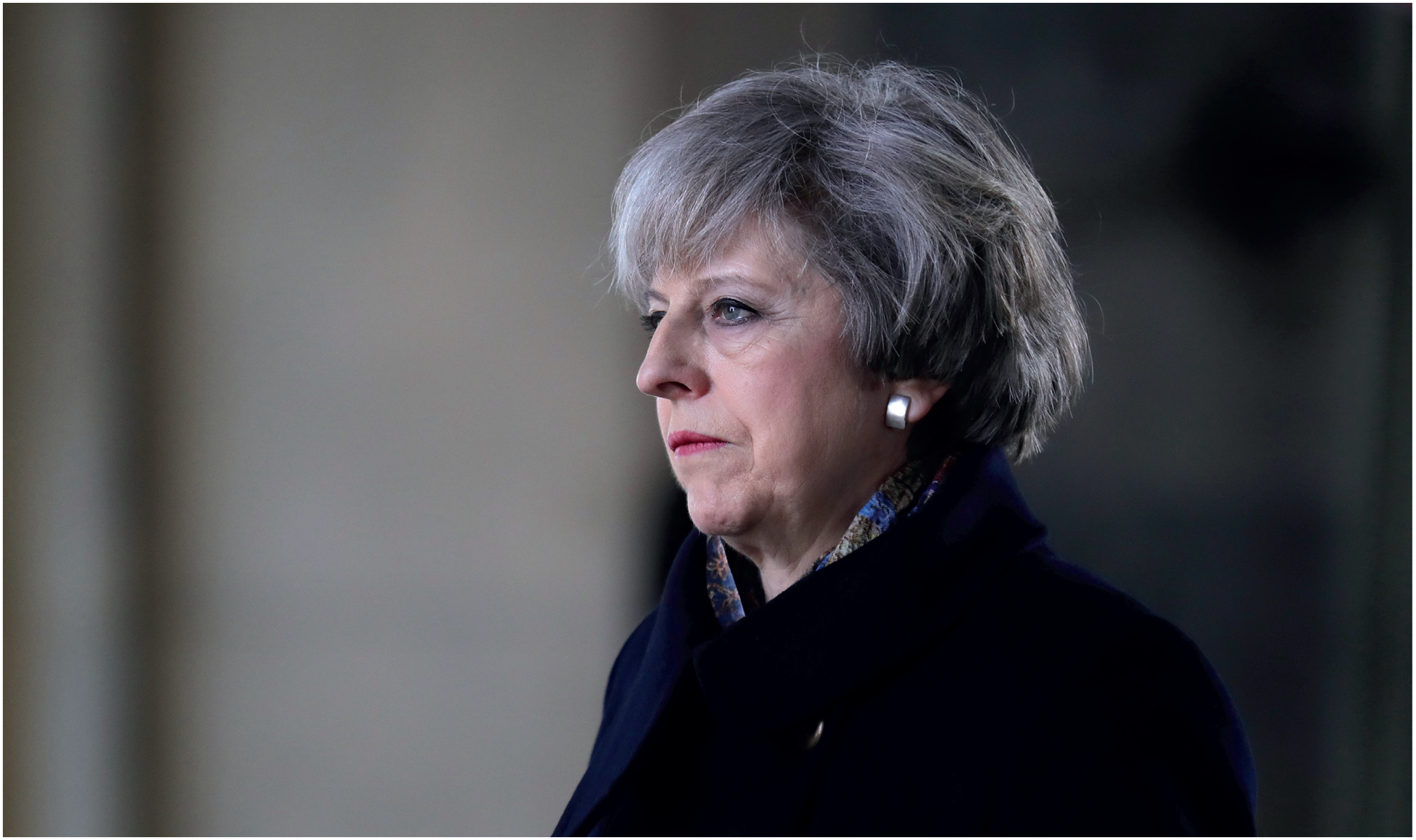
Theresa May promised a fresh approach to government but how distinctive is she from her predecessors?
The Conservative Party has undergone significant ‘modernisation’ over recent years, particularly under David Cameron’s leadership. The extent of ‘change’ has been questionable, with critics claiming the indecisive 2010 General Election result confirmed that the party had not been revitalised sufficiently. However, the narrow General Election victory of 2015 indicated some degree of Conservative re-alignment with mainstream British opinion following multiple electoral defeats. Nevertheless, levels of Conservative electoral support have remained historically low, and following Theresa May’s accession as Prime Minister in mid-2016, it is worth assessing both the party’s contemporary image, its popular appeal, and whether the incoming Prime Minister offers continuity or change compared to previous Conservative administrations.
Modernisation
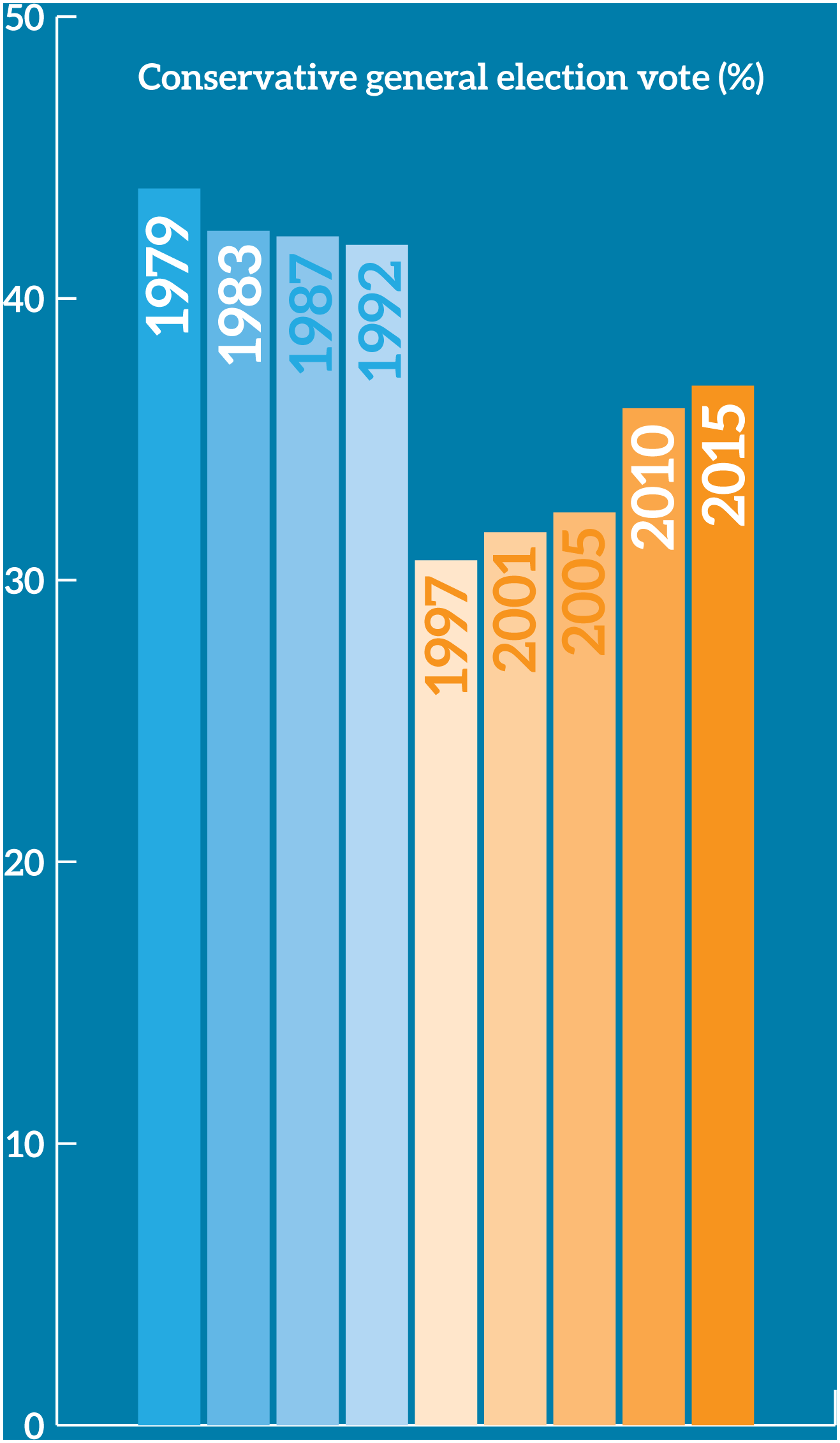
Under the Cameron leadership (2005-16), the Conservative Party made concerted efforts to revise and rebrand its image and identity. This ostensibly ‘modernising’ political strategy derived from three successive General Election defeats between 1997 and 2005, when the party’s national vote share ranged between a meagre 30.7 per cent and 32.4 per cent. Such sustained political opposition contradicted the conventional historical mantra that the Conservatives were the ‘natural party of government’ (as it had been for approximately two-thirds of the 20th century) and specifically adept at governing and ‘statecraft’. During David Cameron’s tenure, the Tories’ level of support was considerably below the support consistently achieved by Margaret Thatcher’s ideological and assertive variant of Conservatism between the late 1970s and 1990 (see graph), and indeed for much of the post-war era.
In the aftermath of a catastrophic 1997 General Election defeat, the Conservative Party appeared notably detached from public opinion on issues such as investment in public services, growing inequality and increased social liberalism. Further electoral defeats provided momentum for pragmatic ‘modernisers’ to convince mainstream party opinion that the Conservatives had to compete with political opponents in embracing more inclusive, unifying and socially-oriented concepts, of the type that would largely not have been countenanced or emphasised during the Thatcherite ascendancy. However, the leaderships of both William Hague (1997-2001) and Iain Duncan Smith (2001-3) featured some significant resistance to ‘modernise’. Nevertheless, first Michael Howard (2003-5), and then David Cameron more explicitly acknowledged the need to address some negative Conservative legacies, specifically a somewhat ‘toxic’ image.
At the 2002 annual party conference then party Chairman Theresa May publicly described the Conservatives as ‘the nasty party’ with a narrow base and sympathies’, in what was a fairly brutal assessment.
In making this speech, May burnished her credentials as a pragmatic figure not wedded to Thatcherite ideology, who acknowledged the need for evident evolution from past policy agendas. Consequently in 2005, by persisting with this approach Cameron rejected Thatcher’s often misquoted dismissal of ‘society’ and asserted that ‘We do think there’s such thing as society, we just don’t think it’s the same as the state’. This ‘social’ emphasis was ultimately attempting to transcend the previous ‘nasty’ and uncaring image that May had highlighted, as well as trying to revive a more socially liberal, reformist and compassionate Conservative policy tradition.
‘Big Society’ and ‘Shared Society’ Conservatism
The Conservatives’ weak electoral support since 1997 appeared to confirm that the party’s message was relatively narrow in its appeal, and the party’s ‘modernising’ politicians acknowledged the need for a more inclusive agenda that attracted a broader cross-section of British society. Cameron’s ‘social’ strategy suggested that in order to extend popular support, the dominant ‘economic’ and neo-liberal emphasis of post-1975 Conservatism required moderating and reviewing, although it was by no means abandoned. Indeed, the party’s attachment to free-market principles became evident in the fiscal conservatism, the ‘shrinking state’ narrative, and ‘austerity’ agenda after 2010, which Theresa May and other prominent Cabinet Ministers explicitly signed up to. Nevertheless, an enhanced attention to social policy, social inclusion and a more limited, ‘re-imagined state’ saw the incorporation of ideas connected to social justice (traditionally a left-wing concept), the advocacy of ‘social capital’, the evoking of a nebulous ‘Big Society’, as well as bold claims by various prominent Conservatives (including May) to be ‘the workers’ party’ and ‘the party of the poor’.
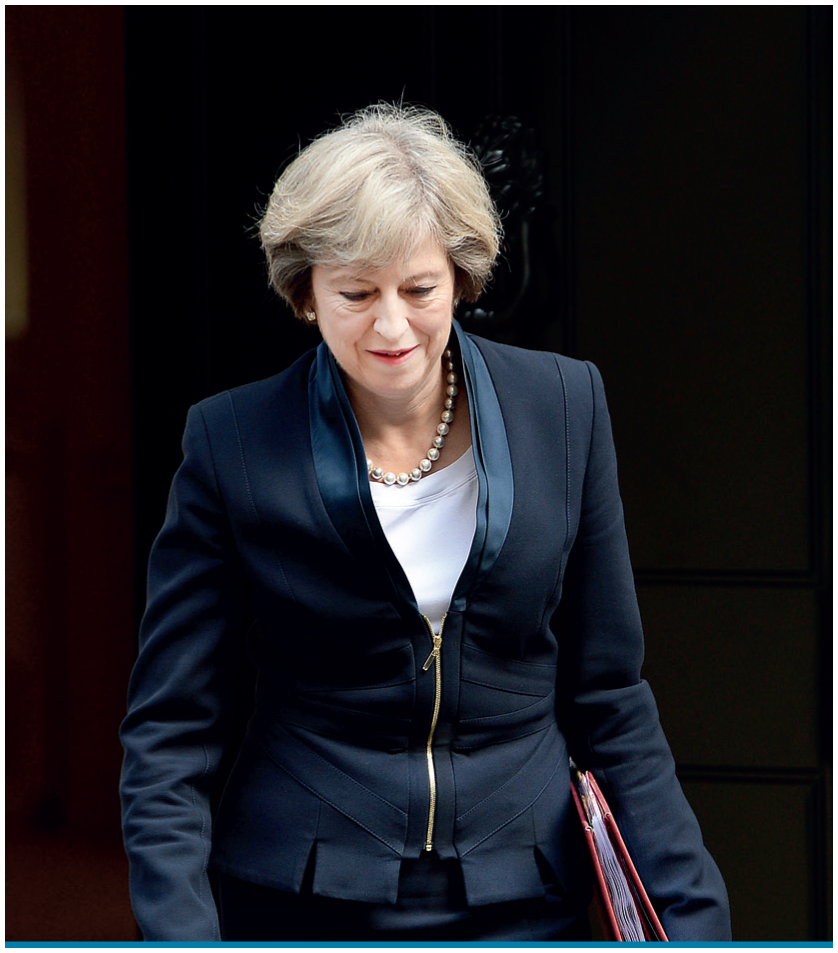
Theresa May profile:
Theresa May became Britain’s second female Prime Minister in mid-2016 when she succeeded David Cameron in the wake of the EU referendum result, whereby Britain narrowly voted to leave the European Union.
With a professional background in banking, and after several unsuccessful runs for Parliament in the early to mid 1990s, Mrs May was elected as MP for the safe Conservative seat of Maidenhead in Berkshire in the 1997 General Election. Yet 1997 was one of her party’s worst electoral results of the 20th century, and she joined what were depleted and demoralised parliamentary ranks.
However, she quickly entered the Shadow Cabinet in 1999, and went on to hold various shadow portfolios ranging from Education & Employment, Transport, Party Chairman, Family, Culture, Media & Sport, Leader of the House, and Work & Pensions. She was reward for such loyal service in opposition when the Conservatives returned to power in coalition with the Liberal Democrats in 2010, and Prime Minister Cameron appointed her to the prized post of Home Secretary.
Mrs May went on to become the longest-serving Home Secretary since the 1890s, being in the role for over six years until her elevation to the premiership in summer 2016. During her time at the Home Office she faced various challenges including rising immigration and ongoing terrorist threats. On the whole, she gained the reputation as being a ‘safe pair of hands’, and this competent image saw her potential challengers for party leader fade away, enabling her to ascend to Number 10 without a formal contest.
In conjunction with Cameron’s bold and high-profile (yet contentious) advocacy of same-sex marriage (which became law in 2013), a broader Conservative policy framework subsequently evolved with a far more social edge. This appeared once again, aspire to represent the moderate, socially liberal and inclusive ‘centre ground’ of British politics, where elections are won and lost. Cameron even aligned himself with Tony Blair’s ‘moderniser’ image by audaciously referring to himself as the ‘heir to Blair’.
In seeking to restore some social equilibrium to the Conservatives’ policy agenda, there was also some re-engagement with the traditions of Benjamin Disraeli, whose 19th century ‘One Nation’ Conservative narrative argued for improved social cohesion between the wealthiest and poorest classes. Parallels were highlighted between the social dislocations of the Victorian-era with similar patterns within contemporary globalised Britain. Ultimately, the Conservative Party of the first decade of the 21st century persistently focused on a revived social policy agenda, contemplated ‘paternalistic’ initiatives to ‘cure’ a ‘broken’ and fragmented society, and consequently rejected wholly free-market solutions. Yet moulding this into a coherent, popular and convincing agenda was far from easy, failed to sufficiently convince up to 2010, and the core narrative was further complicated by coalition government dynamics between 2010-15. Since 2010, the Conservatives in national office have been keen to hold the ruling Labour Party with responsibility for many such socio-economic problems and divisions, primarily due the alleged centralising and bureaucratic ‘big government’ tendencies of the Blair and Brown regimes.
Such practical policy-making difficulties were epitomised in ‘The Big Society’ agenda before, during and after the 2010 general election campaign, although less so in the run-up to 2015 when the term was barely mentioned at all. ‘Big Society’ vocabulary was progressively disregarded the longer the Conservatives occupied national office, with it being effectively eclipsed by more urgent socio-economic priorities. Despite her apparent lack of enthusiasm for Cameron’s ‘Big Society’ while serving under him, Theresa May appeared to revise and revamp this policy message with her much-publicised ‘Shared Society’ agenda launched in early 2017, which similarly advocated a reduced central state, greater social cooperation alongside heightened mutual responsibilities; all of which sounded uncannily similar to Cameron’s previous narrative. As a distinct element however, May emphasised a ‘social mobility’ for all, and its aspirational potential over the narrower concept of social justice which primarily focused on the most vulnerable. This is consistent with her expressed desire for an expansion of grammar schools, a policy which notably contrasts with her various Conservative leadership predecessors dating back to the 1970s. May also sought to use this social policy initiative to affirm her faith in the significance of family, the value of both public and private institutions, as well as a thriving civil society (all arguably influenced by her background as a vicar’s daughter). The ‘Shared Society’ argues that such mechanisms detached from a bureaucratic state are more effective in delivering ‘fairness’ and tackling social problems. Yet whether this agenda is yet another gimmick, a previous policy revamp under a different name, or distinctly different and more practical and viable, remains to be seen. Within this context, the need to broaden Conservatism’s popular support remains a major motivating factor for Theresa May from mid-2016 onwards.
Leadership and party image
Despite extensive attempts to broaden the Conservatives’ appeal, Thatcherism’s legacy prevails unfavourably among significant numbers of urban (and particularly northern) voters, many of whom recall the 1980s as a destabilising socio-economic period, linked to unemployment and social unrest. Consequently, despite such extensive ‘detoxification’ attempts, in 2015 Ukip replaced the Liberal Democrats as the main rival to Labour in the majority of its inner-city urban strongholds. Disillusionment among traditional Labour voters no longer automatically translates into Conservative electoral support (as was more likely the case during the ‘years of consensus’ between 1945-75, when a more stable two-party system existed). This specific development is a symptom of the fragmentation of the British party system, and is a further challenging scenario for Theresa May’s ostensibly ‘unifying’ leadership.
While there has been some success to the ‘detoxification’ strategy as evident in relatively improved Conservative electoral performances in 2010 and 2015, this does not eclipse the fact that (as Conservative donor Lord Ashcroft highlights in various polls), the party remains hampered by an image of being detached from economically disadvantaged communities and ‘ordinary’ elements of British society. Within this context, the distinctly upper-class heritage of David Cameron, and the equally clipped tones and upper middle-class background of Theresa May, have continued to create difficulties of perception for modern Conservatism within less affluent areas. Nevertheless, Mrs May’s aspirational and meritocratic grammar school background has potentially more popular resonance than Cameron’s public school image, while Jeremy Corbyn’s emergence as Labour leader has provided further opportunity for the new Conservative leadership to appeal to undecided, moderate voters who feel disenfranchised by Labour’s leftward shift.
May’s challenges
Having governed between 2010-15 as majority coalition partners with the Liberal Democrats, before winning a small parliamentary majority in 2015, the Conservatives have prospered from various beneficial circumstances. Firstly, the post-2008 economic slump which Labour was disproportionately blamed for, then by a collapse in support for its former coalition partners between 2010-15, and also by notably fierce Labour internal divisions since 2015. The Conservatives then engineered a relatively smooth leadership transition in 2016, despite the tumultuous circumstances which created such a scenario, although the absence of a general election to endorse the new Prime Minister is viewed by some as a weakness. Yet while significant political capital was made from the failings and misfortune of other political actors, between 2010-15 Conservative electoral support increased by less than 1 per cent. This seems a relatively poor return, and of further concern is that such political capital has been countered by less propitious factors; namely the rise of Scottish nationalism and the threat of a further independence referendum, alongside the unerring presence of UKIP and Brexit’s destabilisng impact following David Cameron’s high-risk referendum strategy.
Consequently, in the aftermath of the Brexit referendum result, which led to Cameron’s dramatic resignation and Theresa May’s swift accession, the condition of both the governing party and the country is under significant pressure. Constitutional disunity could be further exacerbated if political ‘modernisation’ under May’s stewardship sees enhanced devolution granted to various English regions (alongside initiatives such as the continuation of Cameron’s ‘northern powerhouse’ agenda). Just as Brexit and the close nature of the referendum result exposed simmering tensions within British society, this de-centralised, ‘localist’ agenda (inherited from Cameron) could potentially further divide rather than unify the nation, with various regional resentments consequently heightened. The fact that the Conservatives won a slender parliamentary majority in 2015 is clouded by the fact that they have no MPs within the boundaries of any major northern city, a minority of MPs in Greater London, and a solitary Scottish MP; all of which potentially undermines how ‘unifying’ Theresa May’s premiership can potentially be. While in power since 2010, recurring Conservative themes such as ‘deficit reduction’ and ‘streamlining the state’ have ostensibly appealed to prosperous, ‘striving’ and aspirational elements of ‘Middle England’, yet this is only a minority (if significant) public viewpoint. Indeed, in 2015 the party received its lowest-ever national percentage of any majority Conservative government, and even during its improved electoral performances of 2010 and 2015, the Conservative share of the national vote failed to reach anywhere near the levels of the Thatcher heyday.
Post-2010 ‘austerity’ policies have adversely impacted within the poorest sections of British society, which continue to lack significant C onservative representation, and the impact of such policies can be aligned with social unrest in summer 2011 and ‘anti-austerity’ protests at recent Conservative Party Conferences, which some political commentators have likened to the social disunity of the early 1980s. This specific disconnection with government has polarised existing social tensions, which have been exacerbated further by aspects of globalisation. Such lingering discontent threatens Mrs May’s affirmation that her administration can instil greater unity across British society. Nevertheless, she has expressed an explicit desire to address disharmony while improving political support across the social spectrum, and this is reflected in her advocacy of strategic industrial intervention and a relaxation of elements of the austerity agenda.
A fractured society?
2015 saw the first majority Conservative administration elected since 1992, creating circumstances under initially David Cameron and then Theresa May for ‘the natural party of government’ to consolidate its political revival freed from coalition shackles, and fused with ‘modernised’ and ‘compassionate’ themes. Yet despite extensive efforts at ‘detoxification’, underlying intra-party and public tensions have returned, and far from delivering more cohesive social unity, Cameron’s departure in 2016 occurred amidst a fractious and chaotic public mood, fuelled by Brexit. In inheriting her position within such a challenging socio-political environment, Theresa May embodies broader continuity as a ‘moderniser’, while also offering elements of specific policy and image change. She notably represents a more cautious and less patrician persona than her predecessor, yet her desire for an innovative and cohesive domestic policy agenda alongside the all-consuming, unprecedented and divisive implementation of Brexit presents clear risks to her credibility. She is also weakened by a limited personal mandate, and if May fails to deliver on core political priorities, then her authority will be further eroded. Consequently, a fractured society could potentially be the most distinctive legacy of post-2010 Conservative statecraft, despite determined efforts for an opposite outcome.
Footnotes
Dr Ben Williams is a politics tutor at the University of Salford. His most recent publications are ‘The Evolution of Conservative Party Social Policy’ (2015) and ‘John Major: An Unsuccessful Prime Minister?’ (co-edited with Kevin Hickson, 2017).