






Abstract

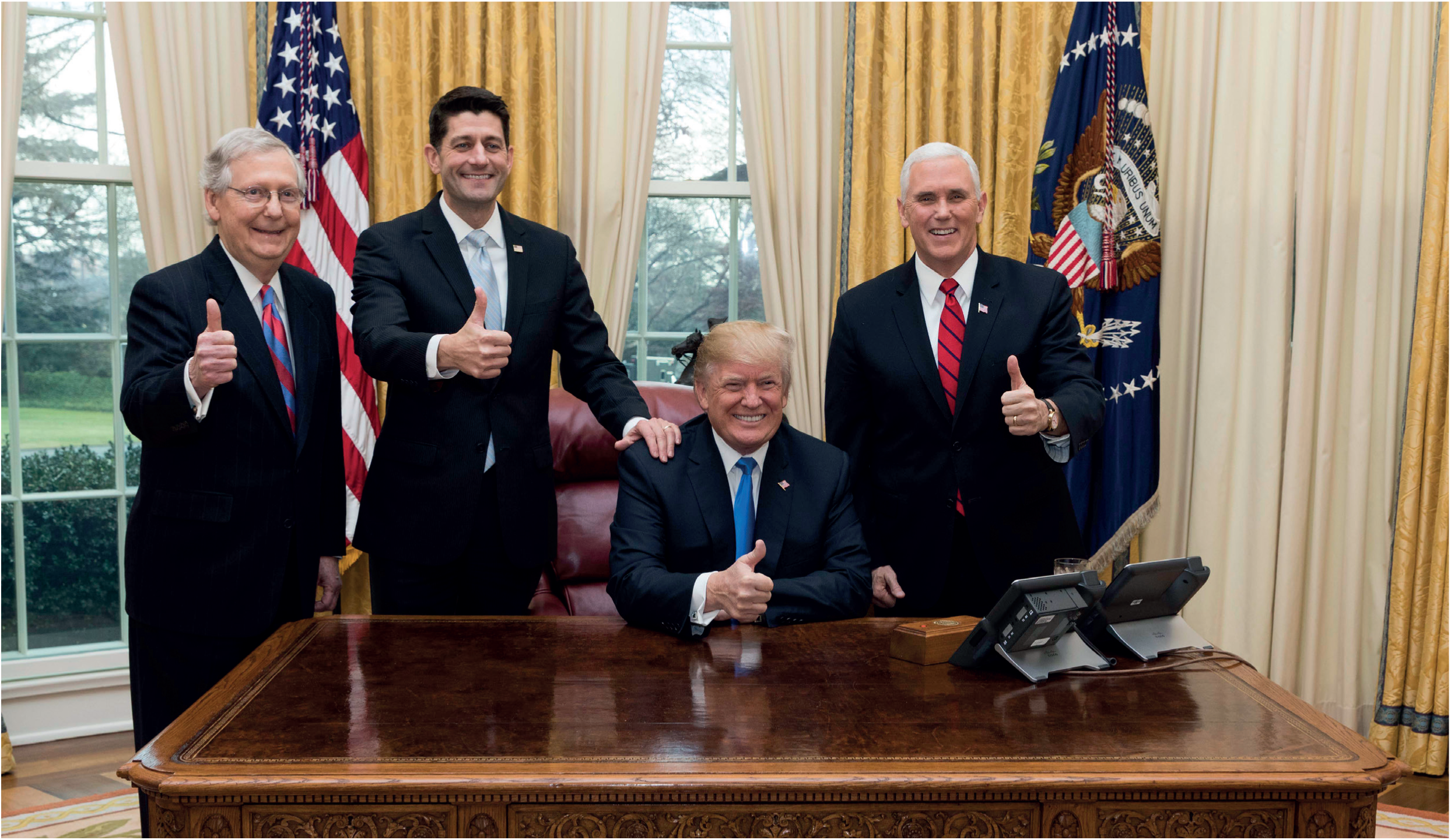
President Trump celebrates the passage of the Tax Cuts Act with Vice President Mike Pence, Senate Majority Leader Mitch McConnell, and Speaker of the House Paul Ryan | 20 December 2017 (Official White House Photo by Joyce N. Boghosian)
Source: By The White House from Washington, DC – Photo of the Day: 21 December 2017, Public Domain, https://commons.wikimedia.org/w/index.php?curid=64969915
Donald Trump was far from a universally popular presidential choice among the Republican Party. But though the President is not a conventional Republican, Trump is part of an ongoing evolution of American conservatism, as
Donald Trump has, at times, appeared an unlikely stand bearer for the Grand Old Party (GOP). The 45th President of the United States of America has often seemed at odds with the traditions of the Republican Party. But upon careful consideration, it is clear the Trump presidency is part of the increasingly conservative evolution of the Republican Party, a movement that started out as a reaction to the New Deal policies of President Franklin Roosevelt and continues growing today.
Moreover, whilst it can be argued that President Trump is not a conservative in the conventional sense, his presidency has presented Republicans in the Senate and the House of Representatives with a once in a lifetime opportunity – the chance to grasp political power and wield it. Before the 2018 midterm elections, the GOP found itself in control of both the White House and Congress. Republicans who were ardent supporters or opponents of Trump for party presidential nominee in 2016 were willing to work with the president in order to achieve results that the GOP would naturally tend to support. As Trump showed over the controversial nomination of Brett Kavanaugh to the Supreme Court and the introduction of tax cuts, big ticket Republican policy wins are possible when a party has a majority status over its opposition.
The evolution of GOP conservatism
The Trump presidency has challenged traditional GOP views on issues like free trade and America’s global role in foreign policy and international relations. But Trump has not completely taken over the Republican Party. The ongoing political evolution of conservative Republicanism will continue to shape the party in a way that Trump cannot. As President, Trump has significant power, but his influence is limited compared to the long-term outlook and trajectory of conservatism in general.
The white working-class support, that was so important to Trump’s rise to the White House, had already become a key area of support for the GOP before the 2016 presidential election. This cohort will become increasingly important as the American electorate continues to become more diverse. Many Trump supporters fit the description of what has been called ‘white rage’ – white working-class Americans who believe that their concerns are being ignored in favour of wealthy elites and ethnic and racial minorities. A similar sentiment was also influential in the rise of the Tea Party during the 2010 congressional midterm elections.
Unless he wins re-election in 2020, Trump is unlikely to leave a lasting legacy in a similar fashion to that other former Democrat turned Republican, Ronald Reagan. On the other hand, Trump’s success in crashing the Democratic blue wall in midwestern states such as Michigan was in some ways due to a second wave of Reagan Democrats (Democratic supporters who voted for Reagan) – these could be considered Trump Republicans if he wins a second term due to their support.
Trump – an ally to the GOP
Trump and congressional Republicans have a good working partnership in three key areas: increased military spending, supporting and passing large tax cuts, and appointing and confirming conservative justices to the federal courts. For all these reasons, the GOP will continue to support Trump.
Since the Cold War era, the GOP has supported a large and robust military, even in peace time. Being tough on national defence and supporting the military is still important to conservatism and the Republican Party. Although Trump does not toe the traditional party line on issues of foreign relations and diplomacy, he will support congressional Republicans increasing government spending for the military.
Trump and the GOP also align on tax cuts. Cutting taxes epitomises the desire of conservative Republicans to decrease the size of government in the domestic sphere. The goal is to undo as much of the legacy of the New Deal as possible, a legacy that gave birth to an expansive government that was more involved in the daily lives of Americans. Reducing government revenues is another way, as Republicans see it, to starve the beast – government. Reducing a future deficit could require significant cutbacks or privatisation of domestic programs – even Social Security and Medicare.
Conservative Republicans also covet the presidential appointment of sympathetic justices to the federal courts, especially the Supreme Court. On this issue, Trump made it perfectly clear during his 2016 presidential election campaign that he would appoint conservative judges. In the eyes of many of his voters, Trump has fulfilled his promise to deliver a conservative-leaning Supreme Court following the successful confirmation of Brett Kavanaugh, despite serious concerns about his past sexual behaviour. Kavanaugh’s predecessor Justice Anthony Kennedy was known to be a libertarian swing vote, but in Kavanaugh Trump has appointed another very conservative justice to a conservative leaning Supreme Court.
For as long as Trump can help the GOP achieve results that are important to the party, they will continue to overlook his shortcomings, such as his loose grasp of ethics (the financial gains of family members whilst working for the administration, like his son-in-law Jared Kushner) and compulsive lying (Mexico will pay for the border wall). The allure of power and the president’s willingness to support key conservative issues maintain the working relationship between Trump and congressional Republicans.
Difficulties in the Trump-GOP partnership
The partnership between Trump and congressional Republicans has been rocky at times and by no means is it a stable working relationship. Although this relationship may boast significant achievements, there has also been plenty of squandered opportunity. At this point in the Trump presidency, more should have been accomplished; the lack of reliable partner in the president has hindered the unity of the party, and the fault lies entirely with the President.
Without coherent or consistent leadership in the White House, policy making has become difficult for the congressional Republican majority, restrained and sometimes undermined by their unpredictable party leader. The most significant example is the failure to repeal the Affordable Care Act (ACA), better known as Obamacare. Although the repeal was nearly successful, Trump hindered its chance of passage by calling the May 2018 House repeal bill ‘mean’ – this only a month after its passage in the House, which Trump celebrated in the Rose Garden with House Republicans and Vice President Mike Pence. The lack of presidential leadership put Senate Republicans in a bind, which was not helped by the late Senator John McCain. Both McCain’s disdain for the president and his disillusionment with the party Senate leadership for crafting a bill in private, proved to be a final coffin nail in the latest attempt to repeal the ACA with McCain casting the key vote against repeal. Thus ironically, a vocal critic of Obamacare was its de facto saviour.
Donald Trump Rally Evansville, IN, 30 August 2018
Source: By raschau – https://www.flickr.com/photos/raschau/44376877781/, CC BY 2.0, https://commons.wikimedia.org/w/index.php?curid=72759900

In this case, instead of using the power of the presidency to unite congressional Republicans, Trump undermined and divided his party – although Republicans have been able to weaken the ACA by executive orders and by the removal of the individual mandate (starting in 2019) as part of a tax cut bill that the president signed into law in December 2017. But repealing and reforming the ACA was the largest legislative priority for the GOP, and since the party was unable to do so with a congressional majority, it was a missed opportunity. This highlights a dilemma for the GOP: how to govern with conservative principles.
Republican dilemma
For all their ideological fervour, Republicans seem at a loss as to how to govern as conservatives. Their agenda is clear, but, as Obamacare illustrated, carrying it out via legislation that can be signed into law has consistently proven difficult. How do they turn principles like support for limited government into a governing philosophy?
It is one thing to campaign as a conservative, and it is another thing entirely to be able to govern as one. For all their success in taking control of the GOP and in winning the presidency with the likes of Ronald Reagan and George W. Bush, the party has generally failed to simultaneously control both the executive and legislative branches. The current GOP dominance is only the second time this has occurred since the Eisenhower presidency: the first time was a four-and-a-half-year span during the George W. Bush presidency.
The key tenets of conservative Republicanism include support for limited government, low taxation, free-market economics and personal responsibility/ morality. But, Republicans have frequently struggled to transform their campaign rhetoric into bills signed into law. This has been extremely difficult for Trump, as well as Republicans who adhere to the staunch anti-government rhetoric of the Tea Party. The fact that Trump offers no historical consistency and frequently changes his stance on policy preferences makes it more difficult for congressional Republicans to predict his reaction to proposed legislation.
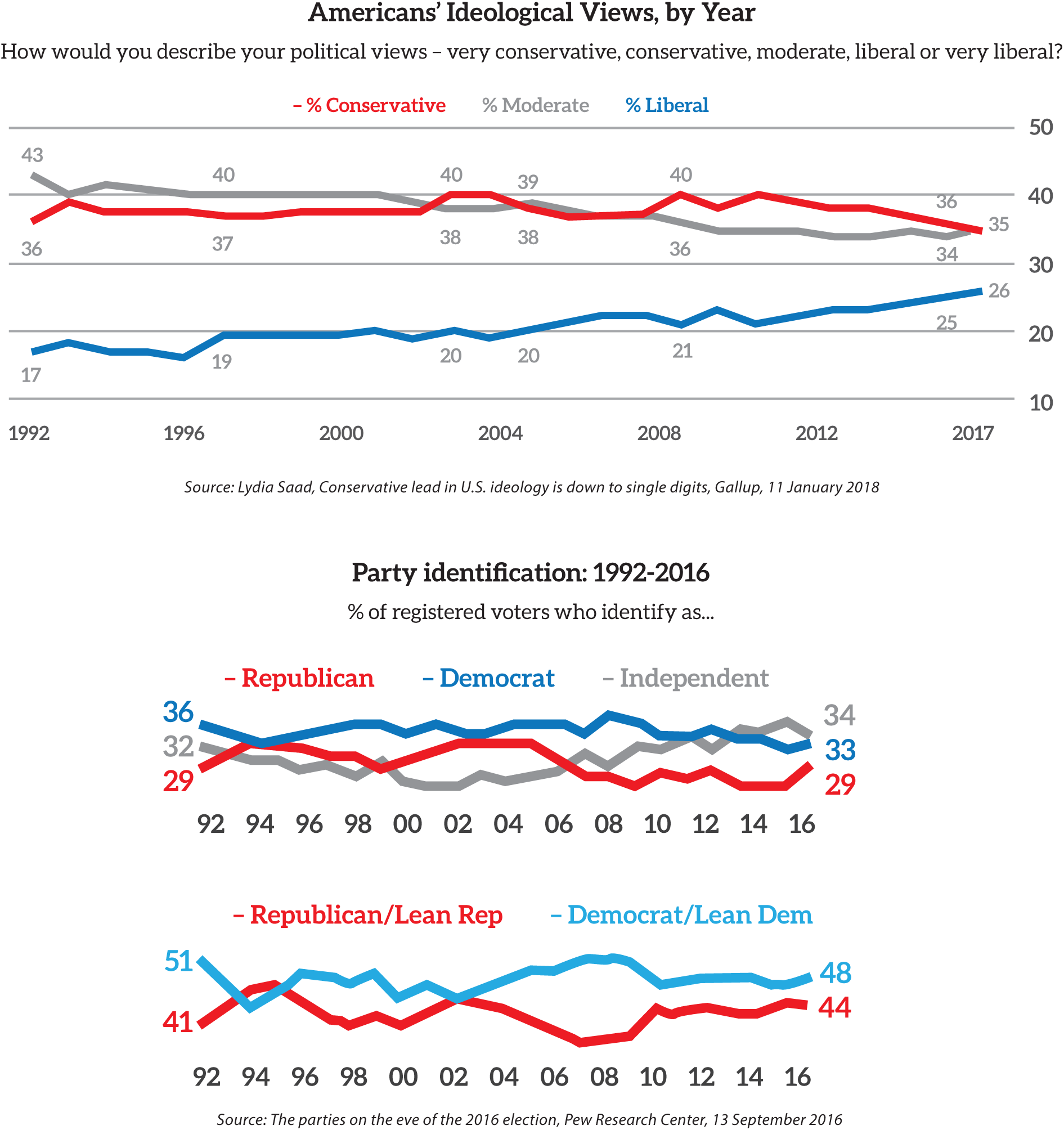
Governing also becomes difficult when faced with an electorate that does not seem to know what it wants. Americans tend to believe that they are conservative, but they are also highly in favour of government programmes. This inconsistency has been labelled by political scientists such as Christopher Ellis and James Stimson as ‘symbolic conservativism’ and ‘operational liberalism’. Any Republican attempt to reform a popular government programme is unlikely to be supported by the majority of the American public – even amongst a portion who identify as conservative and tend to support the GOP. Furthermore, although conservatism has the upper hand in popularity over liberalism, the Republican Party is usually second choice to the Democratic Party when polling party preference. Due to these inconsistencies, conservatives rely heavily on rhetoric and polarisation in order to win elections and attempt to sway public opinion in support of Republican policy legislation. Democrats, of course, also try to sway public opinion, but whereas polarisation certainly exists on both sides, political scientists such as Thomas Mann and Norman Ornstein argue that GOP polarisation is more extreme and can be referred to as asymmetrical polarisation – meaning that whilst the Democrats have moved leftward, the Republicans have moved much further to the right.
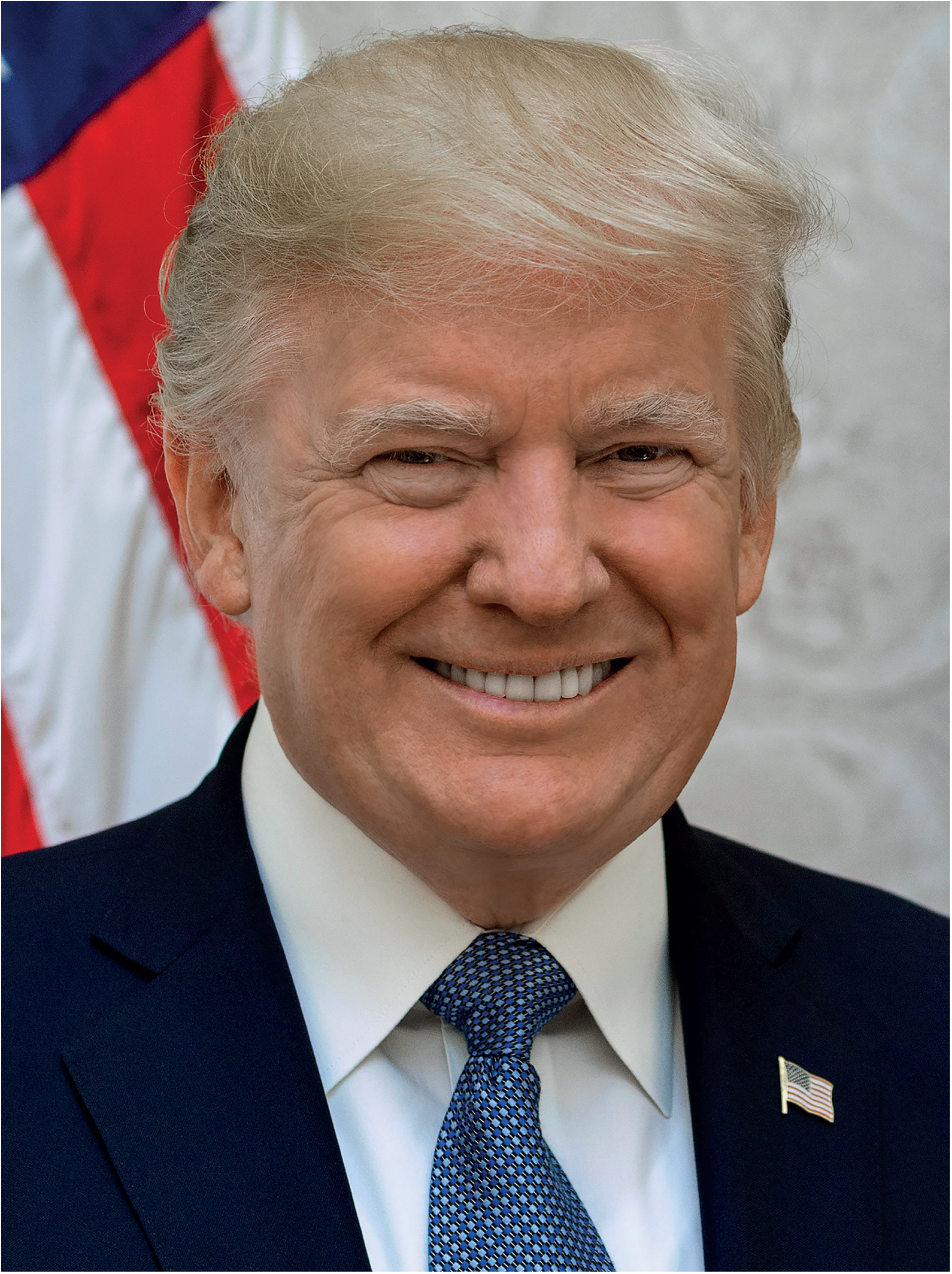
President Donald Trump poses for his official portrait at The White House, in Washington, D.C., on Friday, 6 October 2017. (Official White House Photo by Shealah Craighead)
Source: By Shealah Craighead – White House, Public Domain, https://commons.wikimedia.org/w/index.php?curid=63769676
Looking ahead to 2020
Trump’s rise to the presidency is part of the evolution of GOP conservatism, but now the GOP must pause to consider whether to move forward with the relationship or if the party wants to dissolve the marriage and chart a different course. Maintaining a working relationship with Trump will not be easy for congressional Republicans. Trump is unorthodox in his disregard for facts that challenge his narrative and has no qualms undermining congressional Republicans as he did in the latest attempt to repeal Obamacare.
Although the midterm elections are the first true test of the Trump-GOP relationship, the big question is whether or not both parties are willing to commit to another four years. The 2020 presidential election will have important consequences for the GOP. Trump reflects the core views of the conservative electorate. (Whether he believes them himself is unclear.) When it comes to what the base wants, Trump is willing to deliver results no matter the consequences, as he has shown with tax cuts and his Supreme Court appointments. If Trump wants to run for re-election in 2020, the party is powerless to stop him, and whilst he could face a challenger in a Republican primary, any damage to his candidacy will also diminish the chances of the GOP winning the 2020 presidential general election.
This marriage of convenience may lack two loving partners, but on the level of elite power politics it certainly works for now. Though it normally takes both partners to maintain a relationship and only one partner to dissolve it, this does not hold true for the GOP and Trump. The Republicans may eventually want out, but Trump’s current success means the GOP is stuck with him, at least for now.
Footnotes
Dr Michael Espinoza is a lecturer at the University of Texas (Rio Grande Valley)