






Abstract

Parliamentary democracies have very different rules and procedures for questioning their political leaders.
Prime Minister’s Questions is a staple of British political life. When the UK parliament is in session, at noon every Wednesday the Prime Minister spends around half an hour facing questions from members of the House. The often-bruising encounters at PMQs regularly lead news bulletins.
Parliamentary democracies around the world all have mechanisms for questioning their leaders, yet there is little understanding of what these procedures are and how they vary across different countries. An ongoing project is examining the rules of engagement for questioning prime ministers in 31 parliaments. This draws on a systematic examination of procedural rules, as well as on consultation with parliamentary officials.
How does questioning take place?
The nature of government in parliamentary democracies is collective. Prime ministers lead the government and are collectively responsible together with their cabinets; but in most countries they are not responsible for specific policy portfolios. Prime ministers are expected to account for their own actions and also to speak for the government. Consequently, whether or not they are questioned individually or together with ministers, is likely to have an important effect on the types of questions they are asked.
The setting of the procedure may create different types of questioning environments, too. Plenary situations create a visible, public forum for questioning and potentially allow a wider participation from parliamentarians, while committees involve a select participation and a more closed setting.
The distribution of settings in Figure 1 suggests a tendency for questioning prime ministers in the plenary. Out of the 41 plenary mechanisms included in the sample, 24 are collective: prime ministers are questioned in the plenary together with ministers in most of the countries included in the study. Individualised plenary mechanisms are less frequent: 13 countries have a distinct mechanism for questioning the prime minister individually.
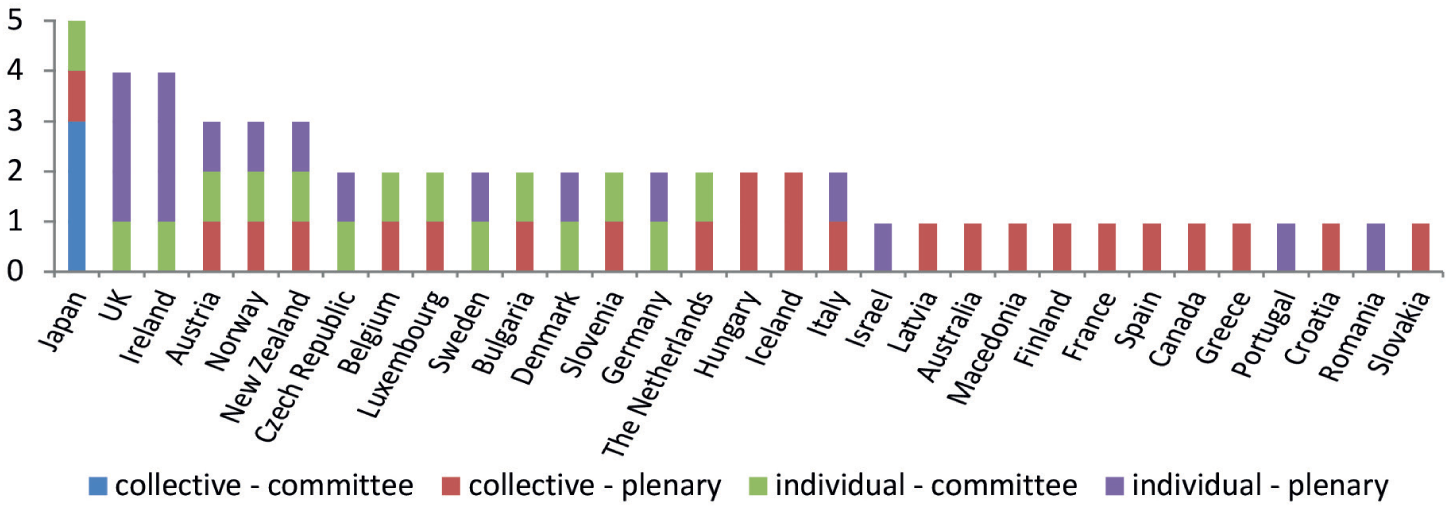
Setting and focus of mechanisms for questioning prime ministers (N = 59).
Some countries present an exceptional variety of questioning mechanisms. In the UK and Ireland, MPs may question prime ministers through multiple plenary mechanisms: aside from Oral Questions to the Taoiseach, the Irish Dáil allows party leaders to question the prime minister at Leaders’ Questions, and to inquire about the legislative agenda at Business Questions. Aside from the weekly PMQs, the UK Prime Minister may also be questioned after giving statements in the House of Commons, and may be addressed urgent questions.
Regularity of questioning
An important variable for understanding how questioning is configured is the regularity with which each mechanism is convened: some allow regular, routine questioning of the prime minister, such as PMQs, whilst others allow occasional, exceptional questioning.
Routine questioning of prime ministers takes place mostly in the plenary: 26 procedures are convened at least once a week or at least once a month, and 23 of these are plenary procedures. In the case of individualised procedures, the presence of the prime minister is required by definition, although in some cases other ministers may occasionally deputise. In the case of collective procedures, the prime minister attends together with ministers, and may not attend on every occasion. Australia, Canada and New Zealand are the only three cases where prime ministers are expected to attend every daily session of Question Time unless they have other engagements. In Norway and Sweden the mechanism is mixed: a few government ministers attend Question Time every week, and there is a special monthly individualised session where only the prime minister is questioned.
Routine committee questioning is exceptional. The only two countries in the sample that hold routine committee sessions with prime ministers are Japan and the UK. The UK Liaison Committee comprises the chairs of House of Commons select committees, and has held hearings with the prime minister two or three times a year since 2002. In Japan, the prime minister is regularly questioned by the Budget Committee, but also by the Joint Meeting of the Committees on Fundamental National Policies, which is the only mechanism in this set of countries that comprises members from both houses of parliament.
Procedural variation suggests that there are different ways to configure the relationship between the prime minister and parliament through questioning mechanisms. Investigating the rules that govern these mechanisms and building classifications based on key variables represents a first step towards understanding their functioning, and prompts further research into the practice of questioning prime ministers. Studying the practice of questioning in different countries may offer insights into how these mechanisms contribute to accountability as a crucial component of democratic politics, and whether they also perform other functions, such as representation, leadership testing, or political conflict and support.
Footnotes
Ruxandra Serban is a PhD student in political science at University College London.