






Abstract


May’s European Parliament elections did not see the predicted surge for anti-EU parties, but the vote has ushered in a more fragmented – and uncertain – political landscape in Europe.
After several tumultuous years in European politics –with the Eurozone and refugee crises and the surprise outcome of the Brexit referendum – the 2019 European Parliament elections brought some good news for the European Union. Turnout increased for the first time since 1979 and anti-EU parties failed to become the dominant force that many observers had expected. But while populist parties may not have done as well as some had feared, the elections nonetheless delivered a blow to the two major party groups – the centre-right European People’s Party (EPP) and the centre-left Progressive Alliance of Socialists and Democrats (S&D) – that lost their overall majority for the first time in four decades. The key outcome of these elections is one of greater fragmentation. This could weaken the Parliament vis-à-vis other EU institutions and make decision-making in the EU more cumbersome.
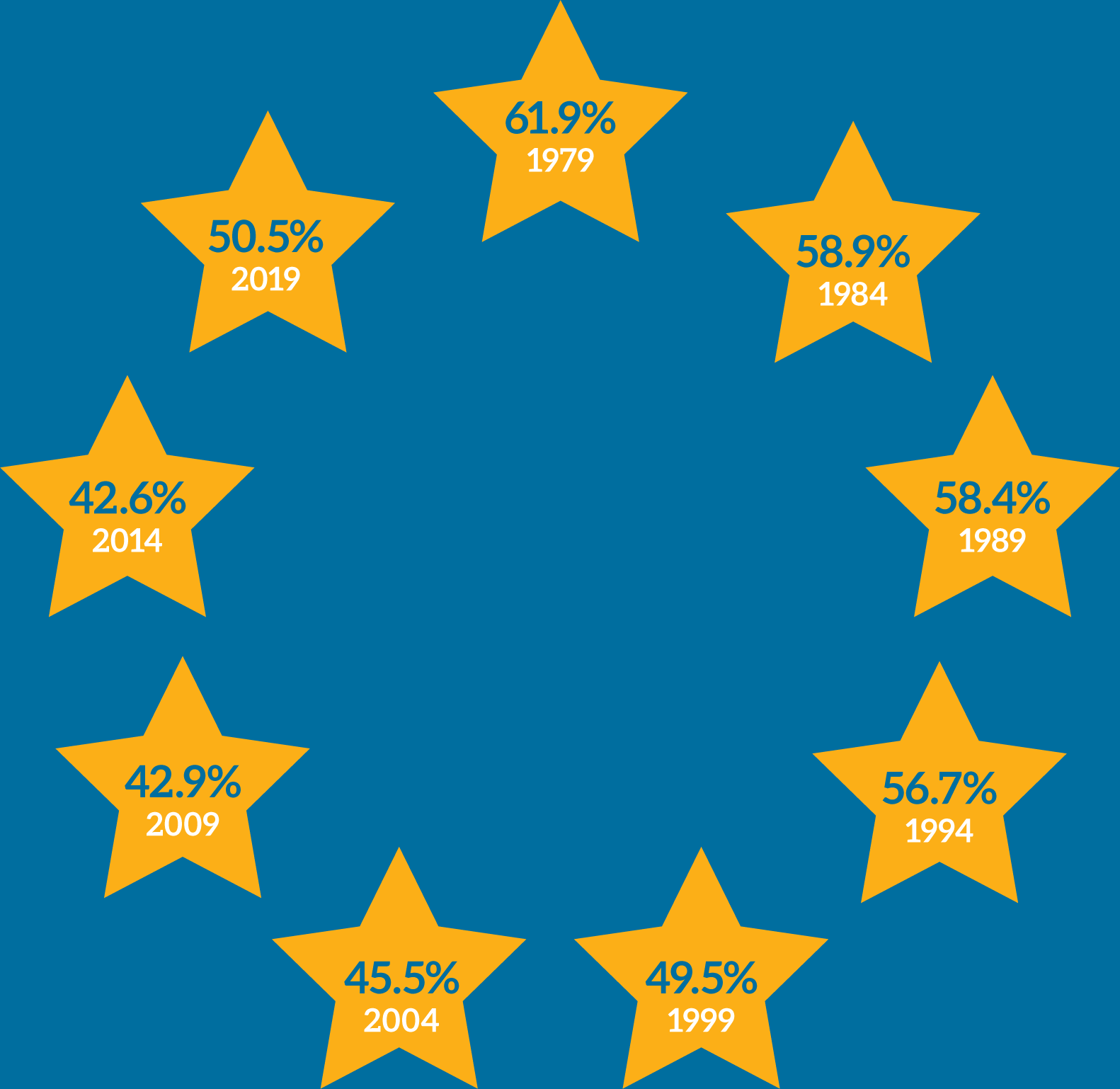
Turnout in European Parliament elections
Still second-order elections?
Closer European integration has been accompanied by a steady increase in the European Parliament’s legislative power. Once merely a consultative second chamber, the European Parliament (EP) is today a co-legislature on par with the Council of the EU. The aim of these institutional reforms has been to strengthen democracy and accountability in the European Union. Yet, researchers have cast doubt on quality of democratic representation in the European Parliament. A key problem is the ‘second-order’ nature of European Parliament elections.
After the very first direct elections in 1979, Karlheinz Reif and Hermann Schmitt dubbed EP elections ‘second order national elections’, i.e. they are low-key affairs with campaigns that focus more on national than on European policy issues, turnout is low and parties that are in national government tend to perform worse. This argument has roots in theories of mid-term elections in the US, where the President’s party tends to enjoy a comparative disadvantage and suffer mid-term losses. Since the European Parliament elections are considered similarly low-salience, people tend to either stay at home or use them as opportunities to express their dissatisfaction with their national governments and opt instead for smaller parties. However, as the EU itself has become more politicised domestically, European issues have also started to play a much bigger role in European elections. This has, however, often been to the detriment of pro-European mainstream parties, as Eurosceptic parties on both the left and the right have performed increasingly well.
The 2019 elections were heralded as the most important European Parliament elections yet. Not only because they were fought in the shadow of Brexit, but also because populist and Eurosceptic parties were widely expected to perform well, and possibly win over a third of the seats. During the campaign, French President Emmanuel Macron described the elections as a crucial battle of pro-European forces against the populists. Hence, the fight over ‘Europe’s future’ was a central theme in a number of EU countries, and perhaps in part this contributed to rising turnout. After suffering declining turnout in each consecutive election since 1979, turnout was up to 50.5 per cent in these elections.
Greater fragmentation
While turnout was higher than in recent elections, many voters still turned their backs on the traditional centre-left and centre-right mainstream parties, and opted instead for the smaller right-wing populist, liberal and green parties. The elections produced the most fragmented European Parliament to date. Importantly, this meant the informal pro-EU ‘grand coalition’ of EPP and S&D lost the majority they have held since the first elections to the European Parliament in 1979.
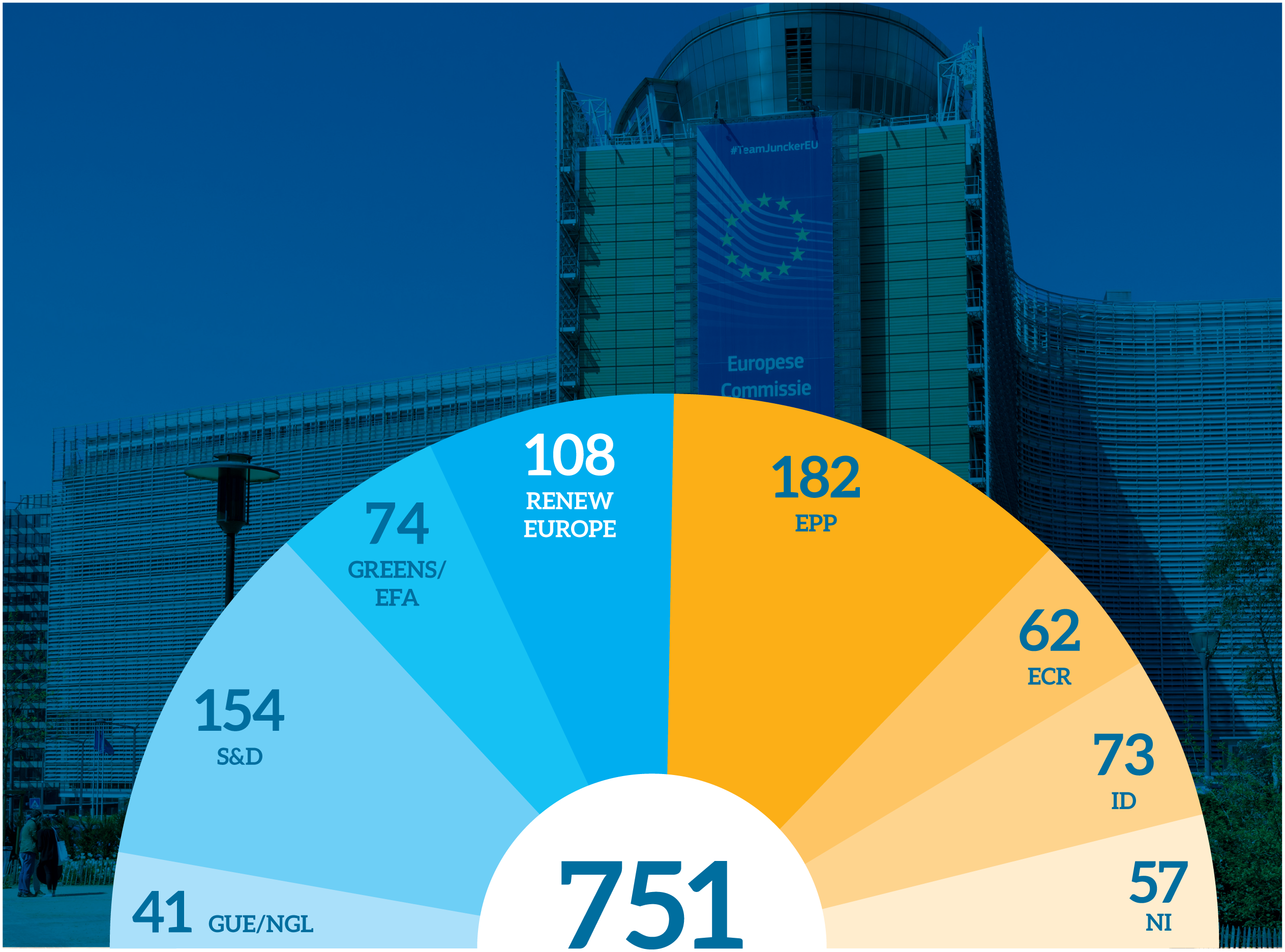
Composition of the European Parliament, 2019
The centre-right EPP remained the largest party group, but won just 182 MEPs (24 per cent) of the total 751 MEPs, down from 217 seats in 2014. The centre-left S&D came second place in the Parliament with 150 MEPs (20.5%). In Germany, France and the UK, this was a particularly disappointing election for the social democrats. But socialists did well in Spain, where Prime Minister Sanchez’s PSOE topped the polls and in Malta, where Prime Minister Muscat’s Labour Party won 55 per cent of the votes.
In the run-up to these elections, much of the focus had been on the rise of Eurosceptic populists across Europe. The elections did not bring the expected populist surge, but the radical right did well in a number of countries. The greatest gains were made by Matteo Salvini’s – Italy’s Deputy Prime Minister – populist anti-immigrant party Lega, which stormed into first place ahead of its populist coalition partner the Five Star Movement and pro-EU centrists.
In Spain, the nationalist Vox gained representation in the European Parliament for the first time, but with fewer seats than expected. In Belgium the anti-immigration Vlaams Belang made a strong electoral comeback. Marine Le Pen’s far-right National Rally beat Macron’s En Marche at the finish line in France, but with a lower vote share than in 2014. The most successful anti-EU party was Britain’s six-week-old Brexit Party, which forms the biggest party delegation in the new Parliament. Members of Nigel Farage’s pro-Brexit group caused an early stir by turning their backs to the performance of the European anthem during the Parliament’s opening ceremony.
A more surprising result was the rise of the Greens. Across Western Europe, Green parties did better than expected. In Germany, the Greens came far ahead of the social democrats, in second place behind Chancellor Merkel’s Christian Democrats. The Greens also did well in Ireland, France and the UK.
As the EPP and S&D no longer controls a parliamentary majority, they will have to work together with other party groups. The strengthened liberal group Renew Europe (108 seats/14 per cent), that has joined forces with Macron’s En Marche, could be the king makers in the new parliament. Combined, these three pro-EU centrist party groups control 444 seats (59 per cent). Yet, this is only sufficient to dominate policymaking if they can agree, not only among themselves, but also internally within the party groups, which is a collection of national party delegations. According to data from the think-tank VoteWatch Europe from the last session of the Parliament, cohesion within European Parliament political groups is relatively high at above 85%. Cohesion is highest for Greens/EFA at 95%, and also high for EPP and S&D, but far lower for the Eurosceptic groups on the right. The higher levels of internal cohesion within, and coordination among, the pro-EU groups in the Parliament make them a more powerful and effective force. However, that does not mean that the greater parliamentary fragmentation will not cause difficulties.
The end of the Spitzenkandidaten?
One of the first tests was the vote on the next President of the European Commission. The battle over who succeeded Jean Claude Juncker illustrated the difficulties in transforming the EU into a more conventional parliamentary system where parliament has greater influence over the election of the executive. Since the introduction of the Lisbon Treaty in December 2009, the European Parliament has been given greater powers over the election of president of the EU’s executive body, the European Commission. Whereas the president was previously chosen by a consensus of European leaders in the European Council which was then approved by the European Parliament, the Lisbon Treaty stipulates that the European Council shall nominate a candidate ‘taking into account the elections to the European Parliament’ by qualified majority, and the parliament in turn must ‘elect’ the nominee with an absolute majority.
In the 2014 and 2019 elections, the European Parliament took advantage of this constitutional change by proposing rival candidates, the so-called Spitzenkandidaten (lead candidates), for the most powerful executive office in the EU – the Commission President – prior to the elections. In conjunction with the introduction of Spitzenkandidaten by the political groups in the European Parliament, this modified procedure for choosing the Commission president should ostensibly make European elections similar to parliamentary elections in national democracies, where voters cast for a ballot for a party (or candidate) in the knowledge that this is also a vote for a specific prime ministerial candidate and government. Thus, in theory at least, the European Parliament elections now allow voters to give a mandate to specific political platform for the EU’s executive body, the Commission. In response to decades of falling turnout and decline of trust in EU-level institutions, the hope was that the introduction of Spitzenkandidaten would strengthen the European element in the campaigns, personalise the distant Brussels bureaucracy, and thereby increase interest and participation in European democracy. Importantly for representation, it would create a direct link between the vote for parties as representatives and the vote for parties as governors.
Following the 2014 European Parliament elections, the European Council reluctantly agreed to nominate the Spitzenkandidat of the largest political group, the EPP, Jean Claude Juncker as Commission President (only Hungary and the UK opposed this). However, this time the Spitzenkandidat of the largest group (EPP) Manfred Weber was neither a popular choice in the European Council, nor did the Brussels-insider attract much attention from voters during the campaign. The EPP thus faced a dilemma: either to rescue the Spitzenkandidaten model it has long championed by backing one of the other lead candidates (e.g. S&D’s Frans Timmermans or Renew Europe’s Margrethe Vestager) or back one of its own from outside. It chose the latter, and the Christian Democratic German Defence Minister, Ursula von der Leyen, emerged as the European Council’s nominee for Commission President.
The choice of von der Leyen was also a setback for those who hoped that the Spitzenkandidaten would be the start of a process where voters were in the driving seat of electing the Commission. Following the introduction of the Spitzenkandidaten process in 2014, many thought this would take off in 2019 and generate genuine interest among voters. However, research suggests that outside member states with their ‘own’ lead candidates, notably Germany and the Netherlands, there was very little awareness of these politicians and the link between their vote and the election of the Commission President. Not surprisingly, we have therefore witnessed a familiar closed-door compromise among European leaders in which they also agreed on Belgian Prime Minister Charles Michel to lead the European Council, Spanish Foreign Minister Josep Borrell as high representative for foreign policy and the French chief of the International Monetary Fund Christine Lagarde as European Central Bank chief.
Overall, the EU is becoming more politicised domestically across Europe, and the 2019 elections suggest a greater interest among citizens in taking part in European Parliament elections. European political groups play a crucial role in EU policymaking, but when it comes to forming a ‘European government’, this is still largely in the hands of European governments rather than European voters.
Footnotes
Sara Hobolt is the Sutherland Chair in European Institutions at the London School of Economics.