






Abstract

The UK is often depicted as being in the midst of a US-style ‘culture war’ between liberals and conservatives. But is this really the case?
It‘s difficult to escape the sense that Britain is a divided nation. It seems intuitive that we would be when you look at the political events in our recent history. In six short years, our divisions have been revealed and reinforced by two acrimonious referendums and three bitter general elections.
The 2016 EU referendum, in particular, split the country down the middle, and the following general election shattered the House of Commons, leaving a hung parliament and faction-riven parties. In her resignation speech in July 2019, Prime Minister Theresa May reflected on this entrenched division and how ‘when opinions have become polarised – and driven by ideology – it becomes incredibly hard for a compromise to become a rallying point’.
The December 2019 General Election, with its comfortable majority for the Conservative government and the final commitment to ‘get Brexit done’ may have seemed like a route to a kind of resolution. Boris Johnson’s victory speech emphasised the ‘One Nation’ ambitions of his government, reflecting their electoral success in previously staunch Labour constituencies.
However, far from heralding a new-found spirit of national unity, Britain has often been characterised as even more divided in recent months. Even in the middle of the COVID-19 global pandemic, a new front has emerged. Indeed, the fact that the UK is in the middle of a ‘culture war’ is increasingly asserted as an unquestionable reality. And while the terminology may already feel familiar, it is actually very new ground for us.
When you look back at news coverage from June 2015, there were barely any mentions of ‘culture wars’ in the UK media, and what there were mostly referred to the US. By the summer of 2020, there were countless news pieces and comment pieces arguing over the source and shape of the UK’s culture war. But are we really in the grip of a cultural conflagration? Despite the headlines, the data suggests we’re not nearly as far apart as the rhetoric would lead us to believe.
Polarisation
At the end of 2019, we produced a report with the charity Engage Britain that revisited the concepts and history of polarisation, and tested the evidence from the UK against these more precise definitions. This review highlighted how we were quickly and uncritically importing US discussions of polarisation, even though the ideas often don’t fit the UK’s very different context. We highlighted the risk of this slipping into a full-blown culture wars framing, which does now seem to be where we’re heading.
Encouraging more precision in our definitions and the evidence supporting claimed trends, is not an exercise in academic pedantry. It is vital in revealing the risks we face from deliberately or accidentally embedding division.
First, there is a crucial distinction between what are known as ‘issue polarisation’ and ‘affective polarisation’. The former refers to divides in attitudes towards specific issues or policies, while the latter refers to identity and emotional divisions. The two are often related, but not always. We can distrust and dislike people from the opposing side, regardless of whether we disagree with them on matters of policy or priorities.
There is strong evidence that Britain has become affectively polarised – particularly in terms of people’s Brexit affiliations and identities. The proportion of people who say they have a ‘very strong’ Brexit identity (44 per cent) is almost five times higher than those who hold a traditional party identity (nine per cent). And these identities colour social interactions. Even now, four years on from the referendum vote, you don’t have to look far to find stories of Brexit splitting families, causing relationships to break up or ending friendships. This marks a break from our recent history, where our attachment to political parties had been weakening for decades: very rapidly, the UK had a new badge to put on diverging group identities.
A 2018 review found that the majority of both Leavers and Remainers describe the other side as ‘hypocritical’, ‘selfish’ and ‘closed-minded’. And this also translates to social interactions: just half of the population are now willing to talk politics with supporters of the opposite side of the Brexit vote, and roughly one in three would be happy with their child marrying someone who voted differently.
Consensus
But the extent to which we have become polarised on concrete issues is far less clear than the prevalence of the ‘divided Britain’ narrative suggests. It is evident, however, that the electorate aren’t split into simple, coherent, opposing blocs.
Even Leave and Remain identities represent coalitions of people with highly diverse views. Our research has shown how Leave supporters are split roughly into thirds, between those who believe the UK should ‘open itself up’ to the rest of the world post-Brexit, those who think we should ‘protect ourselves’ from the rest of the world, and those in the middle. These are very distinct views of what Brexit is for and what it will achieve. Similarly, on the Remain side, only half say they actively identify with Europe, with the other half more pragmatic and instrumental in their reasons for supporting Remain. (Figures 1 and 2.)

Strength of Brexit and Party Identity
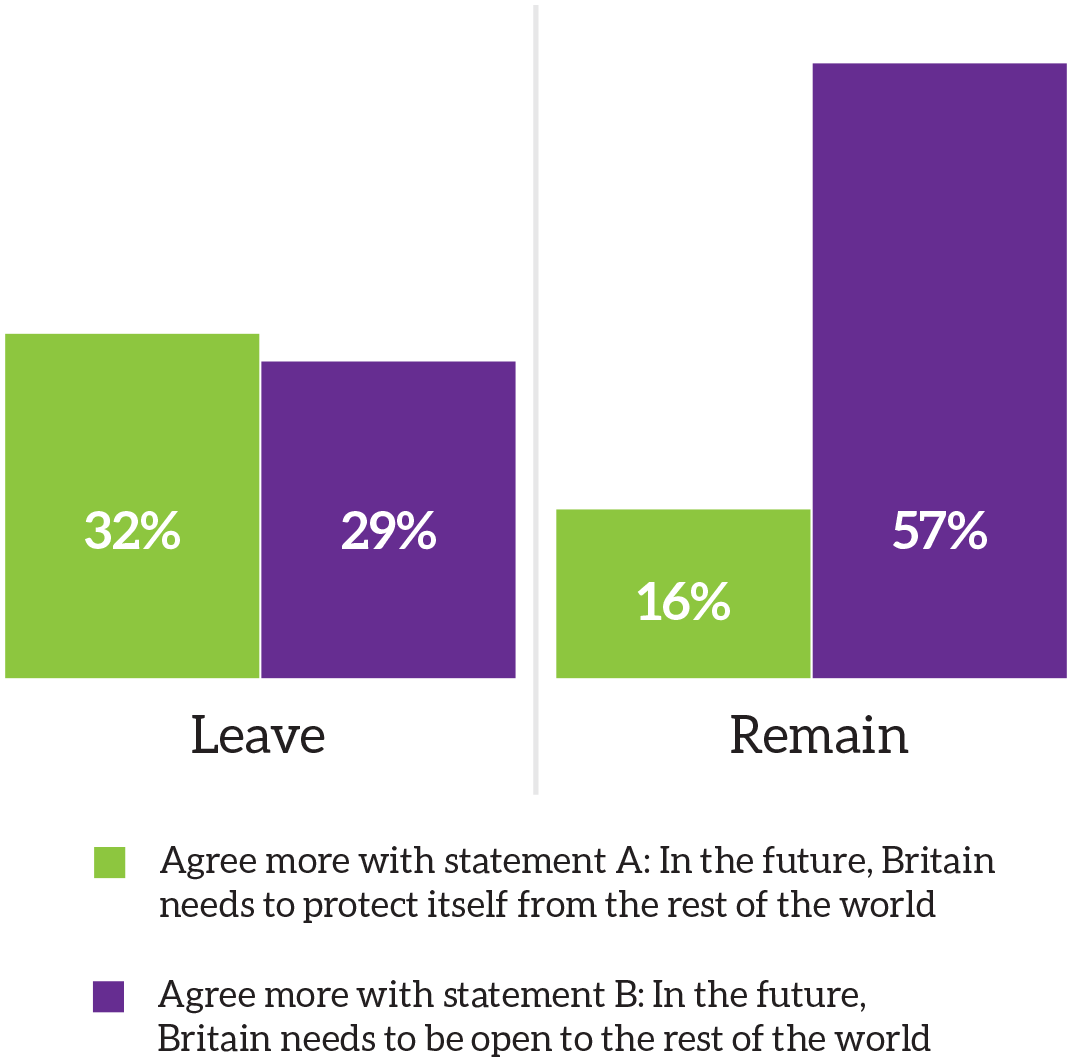
Support for the UK ‘Opening Itself Up’ or ‘Protecting Itself’ From the Rest of the World
There are many aspects of attitudes and identity in the UK that are converging rather than polarising, such as views on gender equality, same-sex relationships and racial prejudice. It is easy to forget just how divided we were on what seem like uncontentious issues now, such as gender roles. Less than 30 years ago, we were split down the middle on whether or not it was a man’s job to earn money and a woman’s to look after the home and family, while now that is a very niche belief. (Figure 3.)
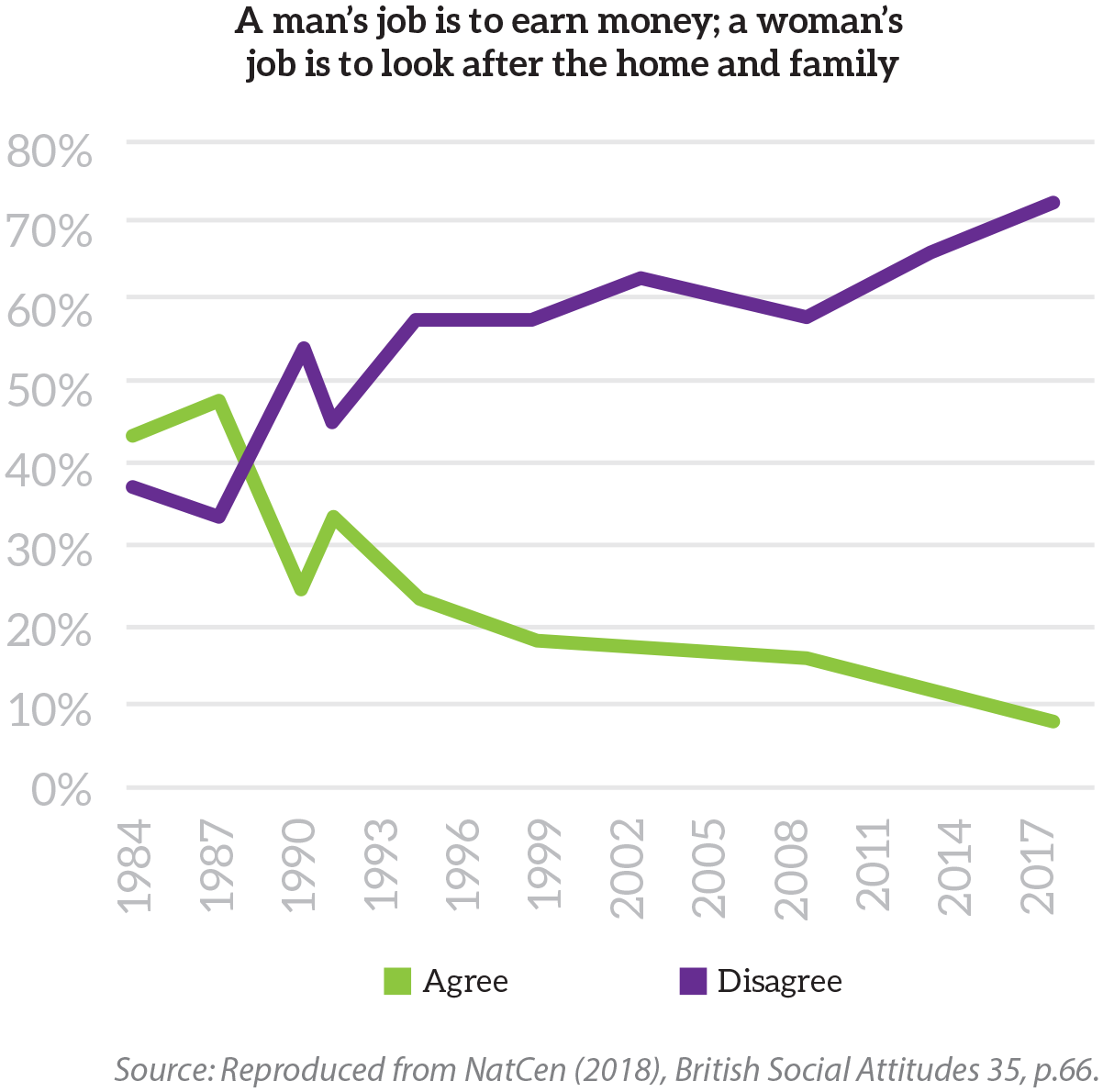
Views on Traditional Gender Roles, 1984-2017
There is also significant consensus on what government should be focusing on, with funding for health and social care and lifting families out of poverty seen as key priorities for the public – each demonstrating a central focus on fairness, regardless of party allegiances or Brexit preferences. Even on contentious issues, such as immigration, the majority of the population are ‘balancers’, who agree it needs to be controlled and back a points-based system, according to recent research. Even in the US, it’s not at all clear that the divisions on individual issues are as wide as often portrayed, with strong evidence that when it comes to many policy choices, the bulk of the population are in an ‘exhausted majority’ in the middle of a spectrum, where the attention is drawn to the noisier extremes.
Divisions ahead?
While the nature and extent of the ‘culture war’ in the UK might be overblown, the risks of such divisions are not. A recent report by UK in a Changing Europe explored the gaps between Conservative and Labour MPs and voters on economic and cultural issues, and it points to how logical it is for the Conservative party to emphasise cultural divisions.
When you compare the economic values of MPs with voters’ economic values, Labour MPs are much closer to the average voter than Conservative MPs. However, it is the opposite with cultural values. Labour MPs, and party members are significantly more socially liberal than the average voter, and even their own supporters. It makes perfect sense then that some in and around No. 10 are reportedly in favour of a ‘war on woke’.
This may seem counter-intuitive, given the liberalisation of attitudes in recent decades, the lack of distance between the bulk of the country on these cultural issues, and their low salience for most people. As former Downing Street pollster James Johnson rightly points out, his regular programme of focus groups shows that ‘statues, transgender toilets and no-platforming barely register. Most people do not know what ‘woke’ even means.’ Johnson is also correct that ‘Britain is not the US, where polarisation among politicians has translated into polarisation among the public.’
But this also points to the potential dangers ahead. Back in 1991, sociologist James Davison Hunter popularised the idea that American politics had experienced prolonged and intense polarisation in his book Culture Wars: The Struggle To Define America. The culture wars thesis observed the growing separation between orthodox, conservative values and progressive, liberal values. The gulf between these two ideological worldviews, Davison Hunter argued, had eventually created bitter conflict, leading to two irreconcilable tribes, deeply divided on salient and morally charged issues such as abortion, gun control, homosexuality, censorship, privacy and recreational drug use.
Polarisation should not be viewed as a steady, all-or-nothing state. Instead, as James Campbell argues in Polarized: Making Sense of a Divided America, polarisation should be understood as a matter of degree. The question is not ‘Are we polarised or not?’; rather, to understand trends and implications, we should be asking to what extent we are ‘highly polarised’ or ‘relatively unpolarised’.
It is, then, a process, and countries shift over time, particularly where there are concerted attempts to encourage it. In the US, there is strong evidence that polarisation among the electorate grew through a cascading effect from political leaders and elites down to the population, over a long period of time.
The more precisely defined elements of polarisation provide a vital framework to understand the mechanisms of change. In particular, issue polarisation can take a number of different forms. (Figure 4.)
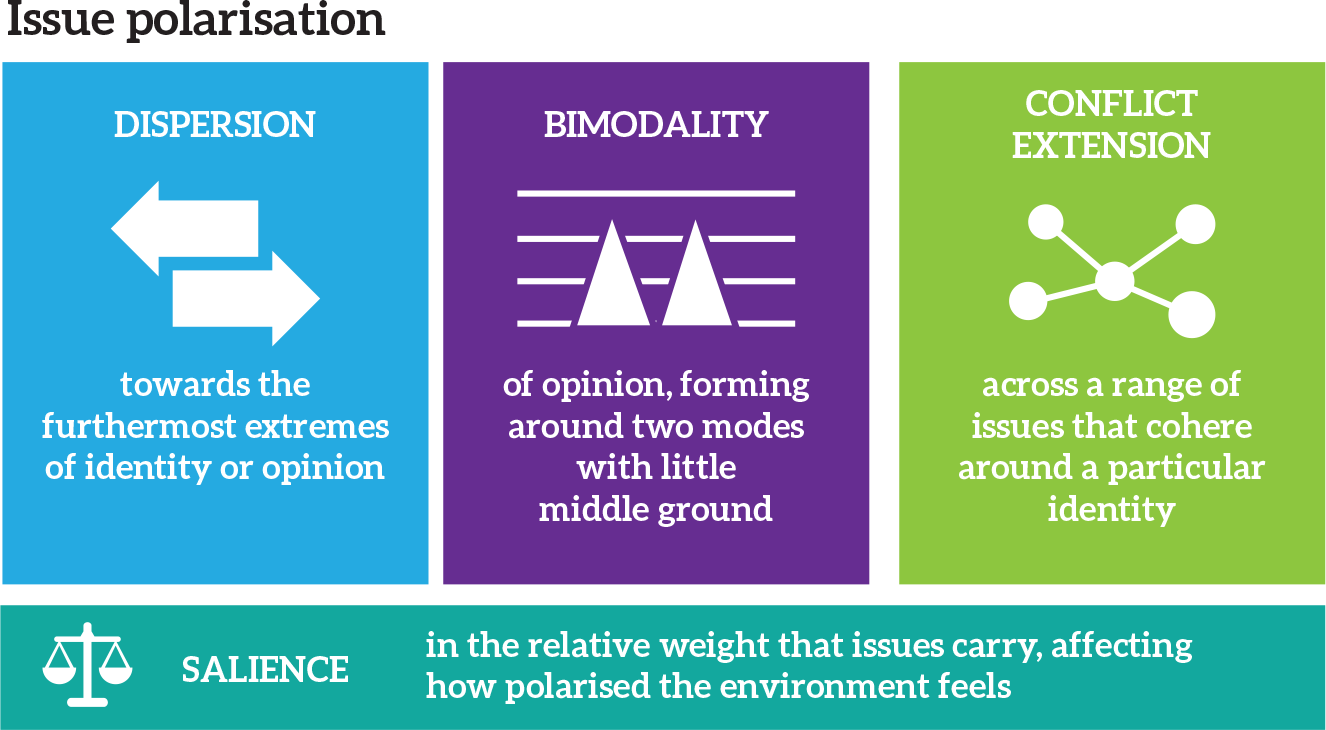
Elements of Ideological Polarisation
First, there can be dispersion of views, where the spectrum of opinion just increases, and the extremes on either side pull further apart. Aggregate opinion on issues can also become bimodal, where two blocs form and move apart, leaving very few in the middle group. This is how we often think of the US, and there is strong evidence of how this has developed over time from the Pew Research Center. The median Republican is now more conservative on a range of attitudes than 97 per cent of Democrats; in 1994 just 64 per cent of Republicans were more conservative than the median Democrat.
Uncertain future
A further element of polarisation – conflict extension – is perhaps more important at this stage in the UK. This theory suggests that polarisation can start with one or a small number of issues that create a strong identity, which then build out to cover an increasing range of issues. It is argued that this is different from the past, where political division formed around one policy area at a time, which was then displaced by new sources of conflict, rather than rolled together. It meant that even if parties were polarised on one issue, they could cooperate on others, and were not locked into a constant battle. Where conflict is extended rather than displaced, we can get stuck, and over time, it becomes possible to predict the views of an individual on more and more issues knowing only this underlying identity. The Brexit identity revealed and reinforced by the EU referendum may not end with ‘getting Brexit done’, but could provide a base for other conflicts to be rolled in.
Finally, and vitally, the polarisation models emphasise that salience matters. The issues in conflict need to be important to divide people. This partly explains the power of Brexit identities, as they were linked to a key binary decision about the future of the country. It also explains why the Conservatives are focused on raising the salience of cultural issues, while Labour would like to downplay them.
The UK then, is currently not nearly as polarised on key issues of substantive policy as we’d think from the culture war discussion – but we could be. Directly importing models from the US of today is a lazy rhetoric, because of the vast differences in our political structures and history. But this does not mean we won’t follow the US down a similar road, just some decades later. The core building block of cultural polarisation – strong affective group identities – is already well established, before the increased strain that the aftermath of the pandemic will bring. The US path has shown how much political agency matters, and how crucial the actions and focus of political parties and leaders can be. A divided Britain is not a current reality or an inevitable outcome, it’s a choice.
Footnotes
Bobby Duffy is Director of the Policy Institute at King’s College London.