






Abstract

© Press Association
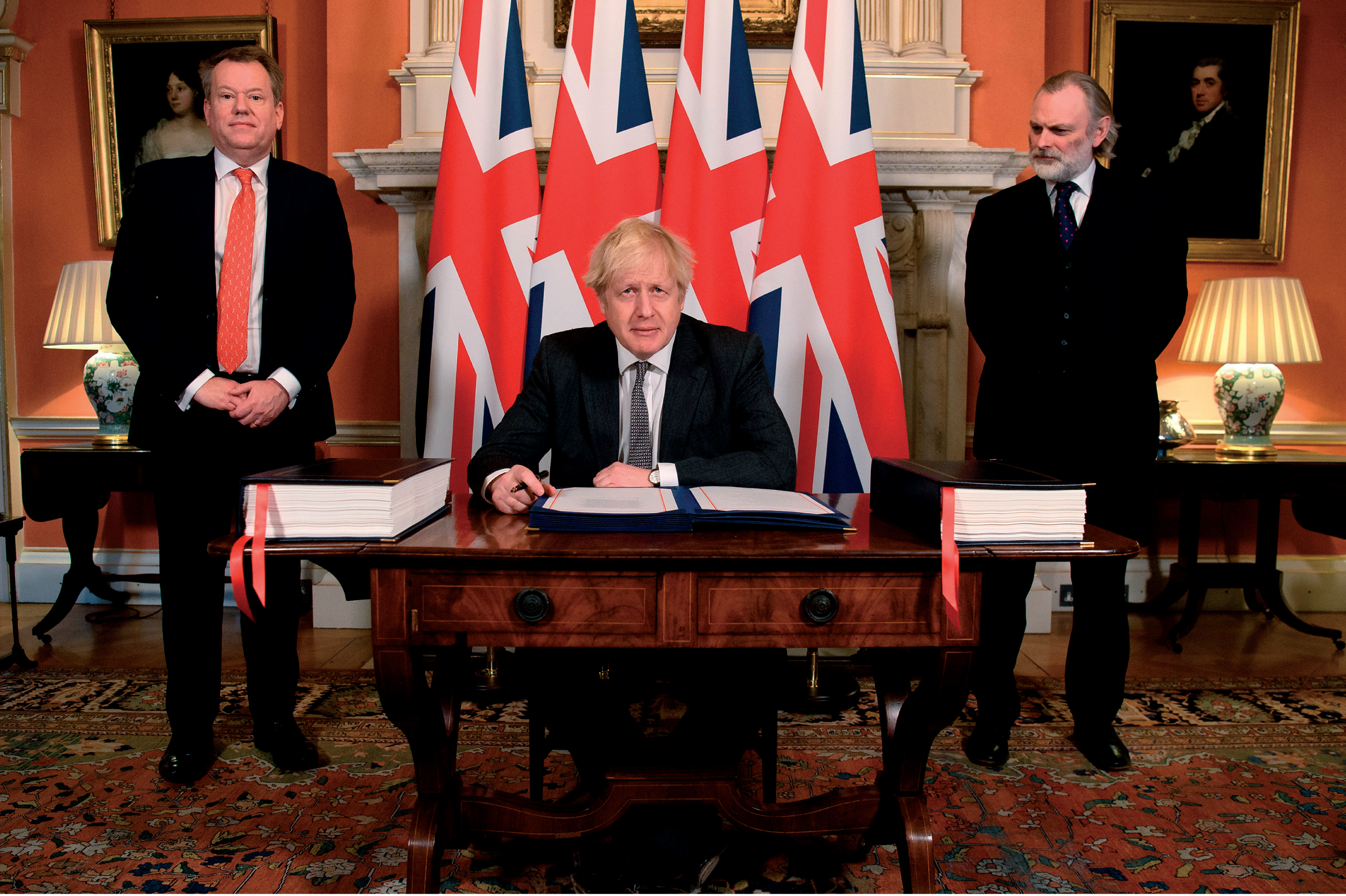
On Christmas Eve, Boris Johnson concluded a Brexit agreement with his EU counterparts. But what did the Prime Minister agree to? Simon Usherwood examines the Brexit deal and finds that many questions about Britain’s future remain unresolved.
Even before COVID, it was evident that 2020 was going to be a difficult one for British politics. The December 2019 General Election might have given Boris Johnson the majority he needed to push through the Withdrawal Agreement with the European Union that had bedevilled the previous three years, but that merely opened the door to the next phase of Brexit - working out what a new relationship with the EU might look like.
The Withdrawal Agreement was focused on ending the old relationships: finding arrangements to tie up financial liabilities, securing commitments on citizens’ rights and the Irish border. But it was never meant to be the be-all and end-all of the process. Alongside it, a Political Declaration announced the intention of both sides to pursue a new set of negotiations on an ‘ambitious, broad, deep and flexible partnership’, that would reflect the proximity and importance of each to the other.
The obvious fly in the ointment was that the repeated extensions of the Article 50 process to produce the Withdrawal Agreement, had not been matched by extensions of the planned period in which to conclude this new partnership. The date of 31 December 2020 for the new treaty’s operation had been set in the version that Theresa May failed to get through Parliament for the original March 2019 deadline.
Despite May’s deadline being pushed back by ten months - and the Prime Minister being replaced by Boris Johnson - neither side seemed keen to shift their timing. For the EU, a delay would have both run into a new financial planning period and dragged out a process that was distracting attention away from the other, more pressing items on the to-do list. For Number 10 under Johnson, asking for more time after making so much of the previous delays was simply not an option, especially given the belief that some time pressure could help make the Commission more flexible.
The Trade and Cooperation Agreement
The upshot was that the early spring of 2020 found the two sides preparing to conclude another agreement with each other. A deal of a scale and nature that would more usually take several years of negotiation, needed to be hammered out in a matter of months. The situation became even more daunting by the time the talks formally began in March, as the scale of the COVID pandemic was becoming all too clear.
With this in mind, it is still rather easy to overlook that the conclusion at all of the Trade and Cooperation Agreement (TCA) on Christmas Eve, just nine months later, is a significant achievement that has no real parallels elsewhere. The reasons for that successful conclusion are worth examining, because they also help to explain the contents of the TCA.
Most obviously, and distinctively, this was a negotiation about divergence, rather than convergence. Almost all trade deals have sought to reduce barriers between the parties; an often-difficult process of trying to agree on joint standards or processes, or which side’s version might be acceptable to both. By contrast, the UK and EU had shared a vast array of common laws, regulations and procedures, and so it was a matter of what they might want to stop doing in alignment with each other, at least in formal terms.
Secondly, the UK made very clear from the start of this phase, that it intended things to be kept to a very limited scope. Notwithstanding the rhetoric of the Political Declaration, the formal opening position that was presented in March 2020 indicated that this was to be a modest Free Trade Agreement, with minimal diversions into other areas. Less on the table meant less to be got through.
Lastly, the consequences of not agreeing a deal hung all too clearly over both sides’ heads. While the experience of the Article 50 process had been a difficult one, it did underline the importance of having some functional relationship for both.
The prospect of entering 2021 with a collapse of all prior arrangements - with all the attendant uncertainty and disruption - was one that did not ever really seem to be acceptable, even to those in the UK who talked of ‘prospering mightily’ in such a situation. The huge disruptive effects of COVID lockdowns only furthered the arguments of those who said that a second level of disturbance was not desirable. And yet, for all this, the process ended up being a lot more finely-balanced than it could have been.
Fraught negotiations
The key stumbling block in the negotiations was a very familiar one: the UK seemed unable to identify clearly what it wanted to achieve. As with Article 50, much of the official position was about ending particular aspects of cooperation and avoiding others, rather than about articulating a more constructive model of what it hoped for and how that fitted with its wider plans. Thus a key issue throughout, was the removal of any role for the EU’s Court of Justice after many decades of support by the UK while a member state for the need of an independent arbiter in disputes. Likewise, the unwillingness to maintain any future alignment on regulations, even in areas where the UK has consistently had more stringent requirements than the EU.
The successful segmentation of the process by the EU also meant that it had already secured its fundamental red lines in the Withdrawal Agreement, and so seemed more willing to let the UK choose to walk away. This was grounded in an analysis that the latter stood to lose very much more than the EU did by having a no-deal, and by an understanding that in trade talks the larger party usually gets what they want. But the EU’s relatively relaxed position still assumed a degree of coherent strategising from the UK side that was not always apparent.
Boris Johnson’s decision in the autumn of 2020, to introduce the Internal Market Bill, is a case in point. The legislation included provisions to disapply parts of the Withdrawal Agreement in order to facilitate intra-UK trade, in a way that ministers admitted would break the law, albeit it ‘in a very limited and specific way’. Not only did this endanger the parallel process of implementing the Northern Irish Protocol, but it also called into question the entire architecture of international treaty-making, something that is existential to the EU’s being. While gradually walked back by the UK, with no obvious concession by the EU, it did highlight the dangers for the latter, of making further commitments that might be disregarded in short order.
Agreement
Agreement was finally reached in December 2020, after weeks of seeming brinksmanship from both sides. In content, the TCA is a relatively modest free trade agreement, with some relationship-specific elements added in. Certainly, if benchmarked against bloc membership, it represents a severe weakening of the EU-UK relationship, even if it does contain some eye-catching provisions.
Most noted at the point of its rapid signature and entry into provisional force, was the ‘zero-zero’ aspect of trade in goods: no tariffs and no quotas between the two. Most free trade agreements fail to hit this, as specific sectors lobby hard to retain protection from competition: in this case, the status quo ante was one of no such barriers.
Both sides ended up putting a lot of symbolic weight on fishing, far out of proportion to its economic value, mainly because it had much potential for demonstrating the success of each side’s negotiating.
However, this does not mean that trade in goods has not been constrained. Both sides now have to impose checks for health and sanitary standards, as well as requiring paperwork to prove goods have sufficient local content to meet the rule of origin requirements. This multiplication of steps for importers and exporters not only contributed to short-run disruption in the first weeks of the TCA’s operation, but will continue to add cost to cross-border trade, which should be expected to lessen as a result.
Goods are only a part of all economic activity and it is in services that the effects will be more evident. The UK pulled back from trying to keep the (somewhat patchy) provision for selling services: this includes recognition of professional qualifications or guarantees about British financial providers being able to supply within the EU, potentially of major consequence for the City of London’s financial sector. In addition, there seems to be little prospect of developing this area, despite it being one that modern free trade agreements increasingly recognise as important for securing economic gains.
Aside from this trade package, it was fisheries that captured much of the attention during the negotiations. The EU sought to keep its historic access to UK waters, while the UK tried to escape the failures of the Common Fisheries Policy.
Both sides ended up putting a lot of symbolic weight on fishing, far out of proportion to its economic value, mainly because it had much potential for demonstrating the success of each side’s negotiating. The result was, perhaps inevitably, something of a fudge. While the EU quota will be cut back during an adjustment period of five and a half years, and the UK becomes an ‘independent coastal state’ at that time, the TCA does allow the EU to impose tariffs on the UK if its quota is reduced any further. Put differently, the nominal independence does comes with some effective strings attached.
Elsewhere, it is the absences that have been more striking. Cooperation on security was largely put on hold, as the UK falls outside of most of the police and judicial cooperation systems and intelligence sharing. While work-arounds can be found for things like arrest warrants, these will be both slower and more cumbersome than what came before.
Similarly, the continuation of participation in EU research programmes was more than out-shadowed by the decision to stop being part of the Erasmus+ student exchange scheme. As critics rightly pointed out, this has been a key means of introducing young, skilled people to the UK. Making that more difficult will have a negative impact on the kind of economic migration the government says it wants to encourage, while also weakening the soft power that the UK carries in the world. A hurried announcement of a replacement ‘Turing scheme’ by the government, merely emphasised the cost and confusion of replacing things that had already been demonstrated to work, while exposing the lack of comprehensive preparation undertaken.
And this will be the leitmotif of the next years; a deal agreed at speed, and with minimal discussion with economic and social actors, is likely to run through more extensive ‘teething difficulties’ than needed to be the case. That phrase, uttered by ministers in the first weeks of the TCA, is likely to seem less and less credible as an explanation as time goes by. As much as hauliers and firms will get to grips with the new border processes, and the regulatory gaps get closed over time, this will not be able to distract from the wider impacts that are going to be felt through the economy and society.
A hard deal
To use the language of what might now be termed ‘early Brexit’, this deal represents the ‘hard’ end of the spectrum. Certainly, it stands well beyond the vision of future cooperation painted by the Leave campaign during the 2016 referendum, where participation in the single market and customs union were portrayed as a good balance of being out, but still close.
The dynamics of the subsequent years has been for an ever-harder, ever-purer form of Brexit; as if any institutionalised cooperation is necessarily and fundamentally suspect. As noted already, the shape of debate has been about escaping the clutches of the EU, a position made easier by appeals back to the ‘will of the people’ to leave: would that not be betrayed by trying to keep by other means those links that were rejected back then?
But to what end? This is now, as it has always been, the central question of Brexit: what is it for? Even now, after two treaties and seemingly endless discussion, it is impossible to pin down what vision the UK has for itself as a society or as a member of the international community. It is just as hard to see a concrete project emerging from Number 10 or the government more generally.
‘Get Brexit done’ was an effective slogan in 2019 because so many people were tired of hearing about the subject. While the TCA does provide a first step towards achieving that, the public is likely to discover that there’s still a long way to go and many difficult choices to be made: taking back control requires control to now be exercised.
Footnotes
Simon Usherwood is Professor of Politics at the University of Surrey.