






Abstract

© Guy Bell / Alamy Stock Photo
COVID has unleashed an ‘infodemic’ of conspiracy theories. But, as
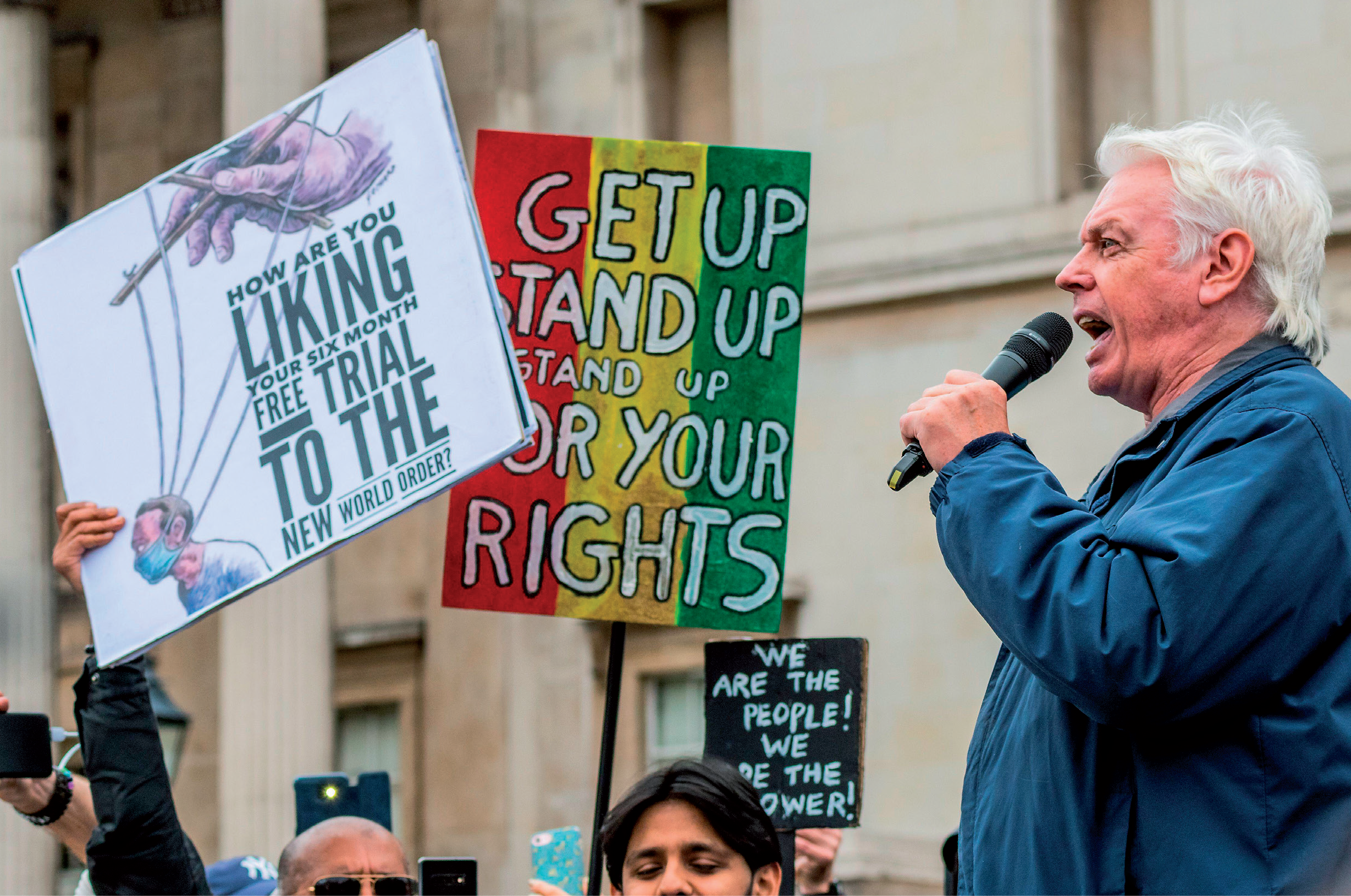
Ever since White House aide Kellyanne Conway defended Donald Trump’s false claim that his inauguration attracted a record crowd as ‘an alternative fact’, media disinformation has become an almost daily visitation. The Coronavirus pandemic has ushered in what the World Health Organization has called an ‘infodemic’ of conspiracy theories, from the notion that Bill Gates is using vaccinations to implant digital microchips to track and control the world’s population, to the idea that the virus was manufactured deliberately as a biological weapon by China. Arguably, the ultimate pandemic ‘alternative fact’ is that COVID doesn’t actually exist: David Icke and Alex Jones of Infowars have both drawn plenty of attention – and donations – by arguing that the pandemic is merely an invention by the global elite to steal our freedoms.
Do all these frothy effusions matter? Yes, they really do. Democracy rests on a sure foundation of fact: if we cannot trust the veracity of what we are told through official sources, effective government is impossible. Conspiracy theories replace the trusted information which democracy requires, with wild imaginings worthy of sci-fi writers or strident bar room philosophers. The result can have real world consequences: countless numbers have refused COVID vaccinations as a result of anti-vax conspiracy theories.
Why are conspiracy theories so popular?
How have such ideas progressed from the mutterings of cranks to almost the mainstream of political discourse? In his Voodoo Histories, David Aaronovitch suggests that the provenance of conspiracy theories can be found in anti-Semitic tropes like The Elders of Zion, an early 20th century publication claiming a Jewish plot to destroy all existing governments and replace them with ‘a new world empire ruled by a supreme Jewish autocrat from the House of David’. This extraordinary publication was widely believed to be true and became the most important foundation reference point for a tsunami of anti-Semitism, cited by fascists and Nazis, as well as the car maker Henry Ford, who funded the distribution of half a million copies throughout the USA. It was later exposed as a clever forgery, based on a number of sources, including a 19th century novel, and was probably composed by Tsarist police to justify contemporary Russian anti-Semitic pogroms.
Aaronovitch points out that so many of these conspiracy theories – from the notion that President Roosevelt was complicit in the Japanese attack on Pearl Harbour in order to justify America’s entry into the second World War, to the idea that the moon landings were staged – would require thousands, possibly millions of people to sustain total silence about these fabrications. That’s a big ask, not least when leaks are common from any activity which governments wish to remain totally confidential. The logistics of such falsifications are just impossible to believe – yet, of course, millions do believe.
Why are conspiracy theories so popular? Charlotte Gregg suggests the fading away of old certainties under the Enlightenment’s forensic rationality, led to a yearning for easily understood non-rational explanations for humankind’s unanswerable questions. The worldwide need for religions, also founded on unprovable, non-scientific assumptions, has also been posited as another explanation. Take Scientology. Followers of L. Ron Hubbard believe that billions of souls (Thetans) from the overpopulated Galactic Confederacy were transported and then dumped, by its leader, Xenu, at the base of earth’s volcanoes and subsequently destroyed in a series of nuclear explosions.
Technological change has super-charged the spread of conspiracy thinking. Previously, oddballs and cranks could share their views only within small groups, but the advent of the internet has made it possible for such ideas to be disseminated to millions. Silicon Valley – Facebook, Google and others – has created an online world in which falsity travels faster than truth, and garners far more ‘likes’ and engagement.
America’s ‘paranoid style’
The United States is very much the global epicentre of conspiratorial thinking. In many respects this isn’t novel. After the Second World War, the German social theorist Theodor Adorno and colleagues produced a study called The Authoritarian Personality which investigated the susceptibility of Americans to a fascistic form of government. Based on extensive surveys, they characterised those subscribing to ‘conventionalism’ (i.e. ‘lax morals are ruining our country’) and ‘authoritarian submission’ (i.e. ‘we need a leader who will destroy the things perceived as ruining our country’).
This authoritarian curiosity has, if anything, become a more visual feature in American politics. During President Trump’s term in office, a popular internet meme featured a photograph of Trump, gurning above a box of text that declared: ‘Maybe the reason grown adults are acting like children about President Trump is because he’s stepped up and has acted like the “strict parent” to a group of spoiled, ignorant and entitled “teenagers” in a government that has been in need of a true father figure for a long time!!’
Writing in The Guardian shortly after Trump’s presidential election loss, American Studies scholar, Sarah Churchwell, cited historian Richard Hofstadter’s shrewd analysis of ‘the paranoid style in American politics’. Paranoia offers a master trope for interpreting ‘the sense of heated exaggeration, suspiciousness, and conspiratorial fantasy’ in American political narratives, from 18th century Illuminati paranoia to the Papist conspiracies of 19th century nativism, to the enduring anti-communist hysterias of the 20th century. Hofstadter predicted that paranoid energies would periodically be released in America when ‘historical catastrophes or frustrations’ exacerbated the religious traditions and social structures that fostered those energies, catalysing them into ‘mass movements or political parties’.
Political conspiracies
Hofstadter’s hopes have, so far, not come to pass. If anything, US politics often appears more ‘paranoid’ – and conspiratorial – than ever. A number of conspiracy theories remain powerful mobilising forces in US political discourse, particularly on the right.
Birtherism: This was the false claim that Obama’s presidency was illegitimate because he was not born in the USA but in Kenya. As Daviid Aaronovitch noted, this idea emerged from a ‘crank’ section of the Republican right, but Trump claimed it as his own and became ‘birther in chief. When it came to the primaries in 2016 however, the false claim proved helpful: this was when conspiracism moved from the fringe to the mainstream. Having pushed the Birther myth, Trump emerged as the Grand Old Party (GOP) candidate for president.
© EFE/ Alamy Stock Photo
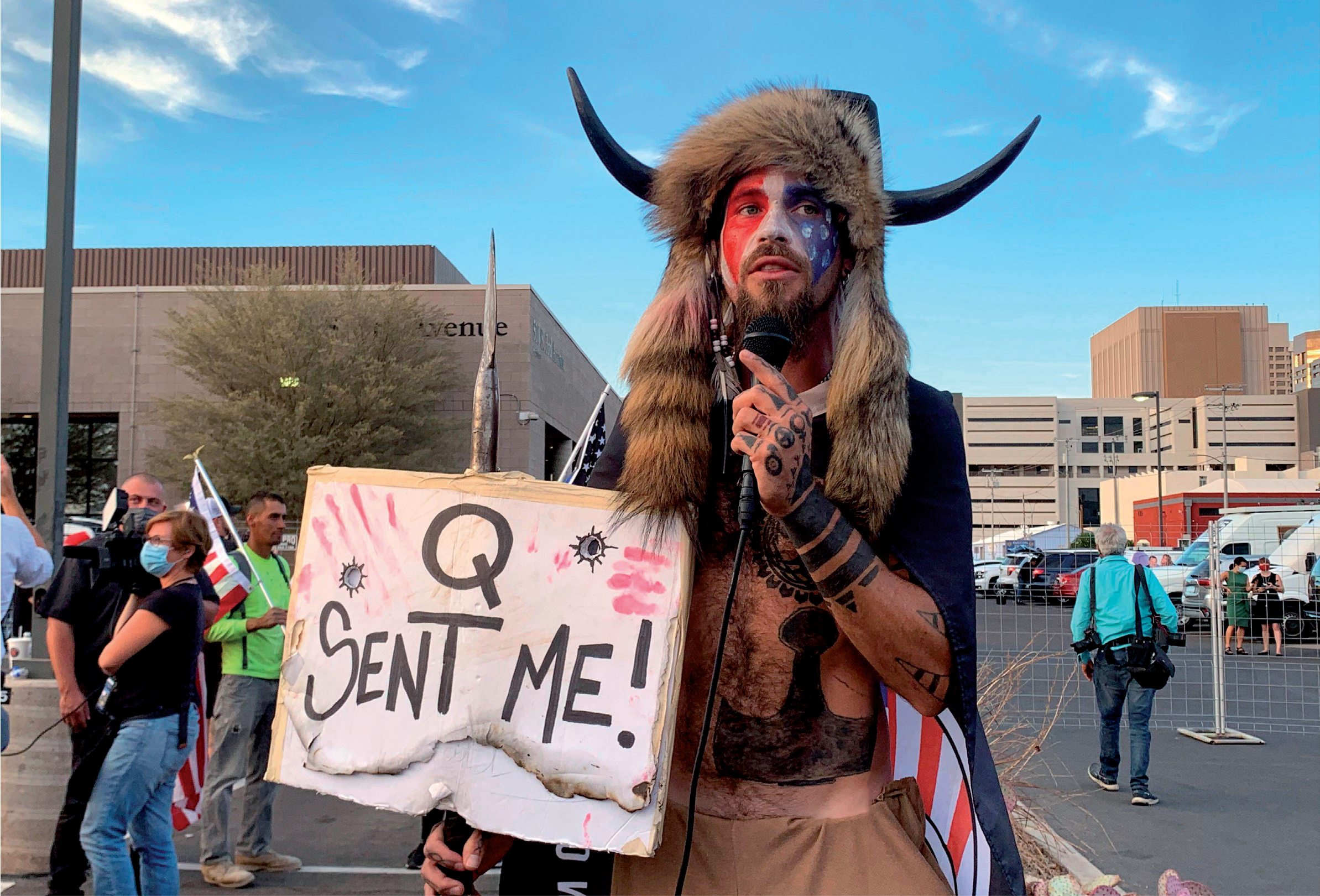
QAnon: Today, QAnon is the pre-eminent conspiracy theory animating US politics. Followers of QAnon believe that former President Trump is waging a secret war against an elite of Satan-worshipping paedophiles in government, business and the media. QAnon devotees held that this struggle would climax in an event when prominent people, for example former presidential candidate Hillary Clinton, would be arrested and executed in August 2019. These events, of course, did not occur but that has not stopped the spread of QAnon.
The movement started in October 2017 when a series of posts appeared on the website 4chan (later to become 8kun), signed off by a ‘Q’, who claimed he had clearance from US security. These became known as ‘Qdrops’ often featuring pro Trump slogans and themes. The movement then spread like wildfire on social media. A number of Republican politicians, such as Congresswoman Marjorie Taylor Greene, have voiced support for QAnon theories. Travis View of the QAnon Anonymous podcast has suggested that ‘even if…. Q stopped posting, the community of true believers would remain. And so would their inclination towards building and promoting conspiratorial fantasies.’
Trump’s election ‘victory’ claim: Before the 2020 Election, Trump carefully seeded the idea, as he did in 2016, that if he lost it could only be because the vote was ‘rigged’, adding that the precise method used would be postal voting. So royally did his writ run that, despite the clear evidence to the contrary, provided by all the news agencies and even some Republican Congressmen, some 70 per cent of Republican voters genuinely believed – and still do – that a successful conspiracy to ‘steal’ the vote had occurred despite no evidence to back up the claims.
Pandemic conspiracies
One of the most striking features of the past year and a half has been the mainstreaming of conspiracy theories around the pandemic. The US military imported the virus while competing in Wuhan’s 2019 Military World Games; the Coronavirus vaccines cause male infertility; Dr Anthony Fauci is a secret member of the ‘deep state’ which was plotting to dethrone the President. The pandemic has also spawned a host of anti-vaccination conspiracy theories.
David Aaronovitch traced the Twitter hashtag ‘#wedonotconsent’ and found a world in which Bill Gates seeks to rule the planet via vaccines and Piers Corbyn sides with posts from Breitbart, Steve Bannon’s website, which disseminated such choice false stories as Hillary Clinton organising a high-level Democrat paedophile ring out of a pizzeria in Washington (conspiracy theorists seem to enjoy adding paedophilia to the supposed crimes of their invented enemies).
Andrew Wakefield, the doctor who claimed MMR vaccines caused autism in children back in 1998, was proved many times to be woefully wrong and was struck off the UK’s medical register. However, he has managed to carry on selling his anti MMR claims in the USA. As Aaronovitch notes, ‘Wakefield’s discredited work has led to a drop in vaccination rates in several affluent parts of the world. The scientific truth has had its work cut out combating a social media-fuelled world of fear and disinformation’ Wakefield has since emerged for those opposed to COVID vaccinations.
Combating conspiracies
All this is not to say that conspiracies do not ever happen: for example, the suspicion that the UK and France secretly conspired with Israel to invade Egypt was eventually proved to be founded in truth. The same applied to the suggestion that Nixon had been involved in the early 1970s conspiracy to break into the Watergate Democratic headquarters.
However absurd they might be, we should certainly treat these ideas seriously because they gravely weaken the sinews of democracy, not to mention public health. Sarah Churchwell’s quotation from Hannah Arendt provides a further insight, ‘It is not ideological “indoctrination” that defines totalitarian lies, but rather the incapacity or unwillingness to distinguish altogether between fact and opinion.
Churchwell offers a suitable conclusion to this analysis: ‘The same night that Trump tweeted he had won the election, Fox News host Jesse Watters told a guest he believed “that Joe Biden was installed … I can’t prove this allegation. It’s a gut feeling”. The Big Lie provides a substitute for unsatisfactory reality, a collective delusion that fills in the gaps between power and comprehension. It is not content with attacking individual facts but seeks to create an alternative social fantasy that placates its believers while empowering the liars.’
Footnotes
Bill Jones is Co-Author of Politics UK, 10th edition, Routledge, (July 2021).