






Abstract


Media stories about a ‘culture war’ between ‘woke’ young people and older generations abound. But, argues
‘Not cool, University of Manchester. Not cool.’ This was how Jeb Bush, former Governor of Florida, responded to a 2018 story about Manchester University Student Union ‘banning’ applause at its events. Students had argued that clapping might trigger anxiety among some audience members, and that there were quieter ways for people to show appreciation. Students were encouraged to instead use ‘jazz hands’ – the British Sign Language gesture for applause, where you lift both hands up and wave them.
It may seem odd that such an eminent American politician felt compelled to comment on a minor decision by a handful of students thousands of miles away in Britain. In fact, former Governor Bush was making a self-deprecating reference to his own excruciating experience of ‘silent applause’, when he had to ask his audience to clap after a flat speech during his unsuccessful campaign for the 2016 Republican presidential nomination.
But the joke was missed in the international media storm that blew up around the story. Overnight, the University of Manchester’s jazz hands became a cri de coeur among those who despaired at the character of today’s youth (‘What A Load Of Clap’ was a popular headline), without any hint of Bush’s irony (Piers Morgan tweeted ‘Britain’s losing its mind’). One professor opined that ‘it symbolises our culture’s slide into infantilised decadence, where enfeeblement is celebrated and learned helplessness indulged’.
It’s not just students in Manchester who have been the subject of such attention: whenever similar incidents crop up, whether at US political conferences or Australian schools, there is some furore. And it’s not just silent applause that causes despair; the fate of historical statues and portraits of the Queen draw similar attention.
Culture wars?
The reason for the furore is that these incidents provide simple but vivid examples of complicated issues that are seen entirely differently by different groups. On one side, the use of jazz hands, for example, is just a sensible attempt at the inclusion, in this case, of autistic people for whom applause, as the University of Manchester disability officer said, can feel like a bomb going off. On the other side, it’s a sign of a generation that is coddled in a way that will cause them to be utterly unprepared for the real world.
The clapping controversy is one, admittedly slightly ludicrous, example of the ‘culture wars, which are most often presented as being waged between the ‘snowflake’ or ‘social justice warrior’ young and the ‘out-of-touch’ or ‘ok, boomer’ old. The culture wars are increasingly the prism through which we see generational differences, so it’s important to figure out whether we are experiencing any real sea change in the attitudes and beliefs of today’s youth.
The first point to recognise is that there is always tension between generations on cultural change, and this is a good thing. We can think of it as a type of ‘demographic metabolism, as outlined by the Canadian demographer Norman B. Ryder in the 1960s. Ryder regarded society as an organism where this metabolism makes change inevitable. As both the Hungarian sociologist Karl Mannheim and the French philosopher Auguste Comte conclude, social, political or technological innovation would likely stall if we lived forever, as individuals get stuck in their ways.
As Ryder says, ‘The continual emergence of new participants in the social process and the continual withdrawal of their predecessors compensate society for limited individual flexibility. The society whose members are immortal would resemble a stagnant pond.’ Despite the benefits of generational change, it is a constant challenge for society to cope with this unending churn of membership, and, as Ryder puts it, ‘the incessant “invasion of barbarians”.
While this may seem like a harsh description of our offspring, Ryder means that each new entrant is, by definition, not ‘configured’ to the attitudes and behaviours of their parents’ society. Traumatic shocks, like wars, economic crises or pandemics, may utterly change the direction of new generations in their formative years, but there is always cultural tension between generations. As Ryder says, we are ‘pulled apart gradually by the slow grind of evolutionary change.
This is also the impression we get when we look at the actual data: there have been some incredible changes in our cultural attitudes over the last few decades – but this did not start with the arrival of Millennials or Gen Z.
We can see this in Figures 1, 2 and 3, which track the attitudes to race, gender roles and homosexuality between generations over time. There are two similar trends across the issues. First, the extraordinary change in our overall societal attitudes over a relatively short period of time has been driven by all generations, except the oldest. But second, there remain significant minorities even among the youngest generations who are holding on to ‘older’ attitudes.
Our focus purely on generational differences and stereotypes distracts us from a much richer interpretation of how individual and societal attitudes, beliefs and behaviours actually shift: that they are always a blend of lifecycle, period and cohort effects.
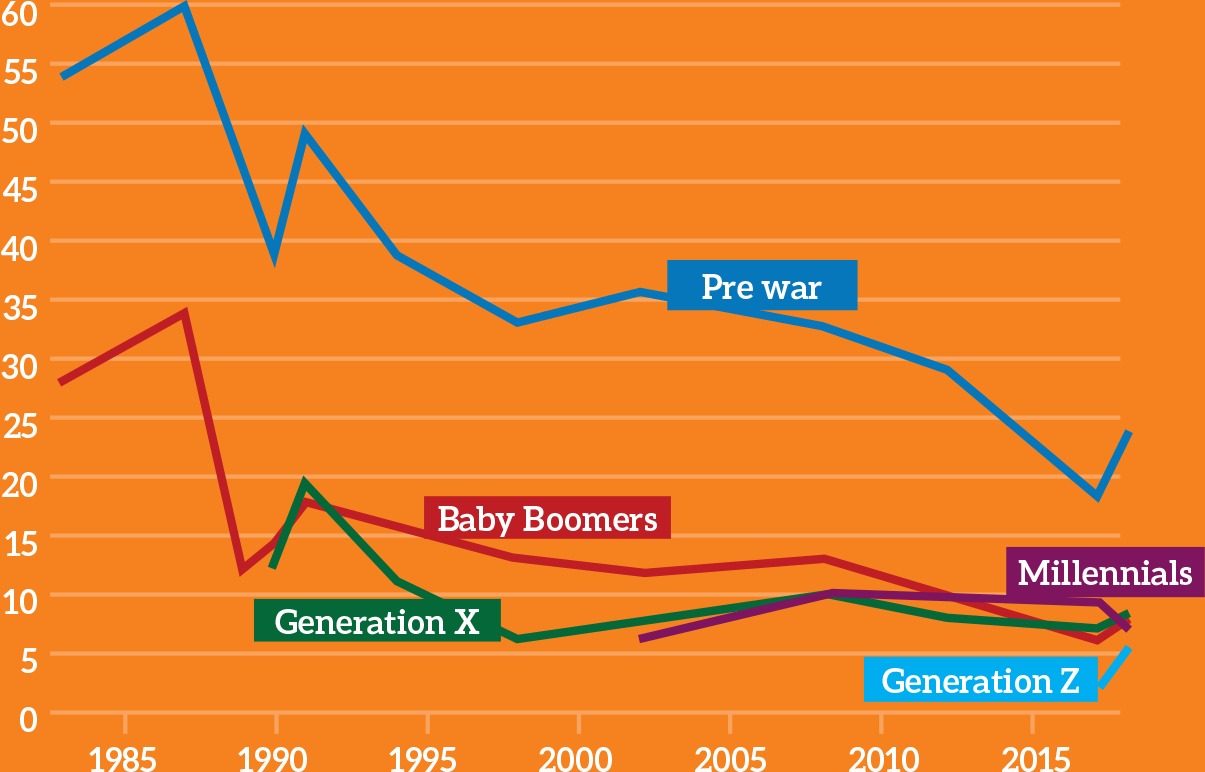
% of British adults agreeing the job of the man is to earn money and the job of the woman is to look after the home and family
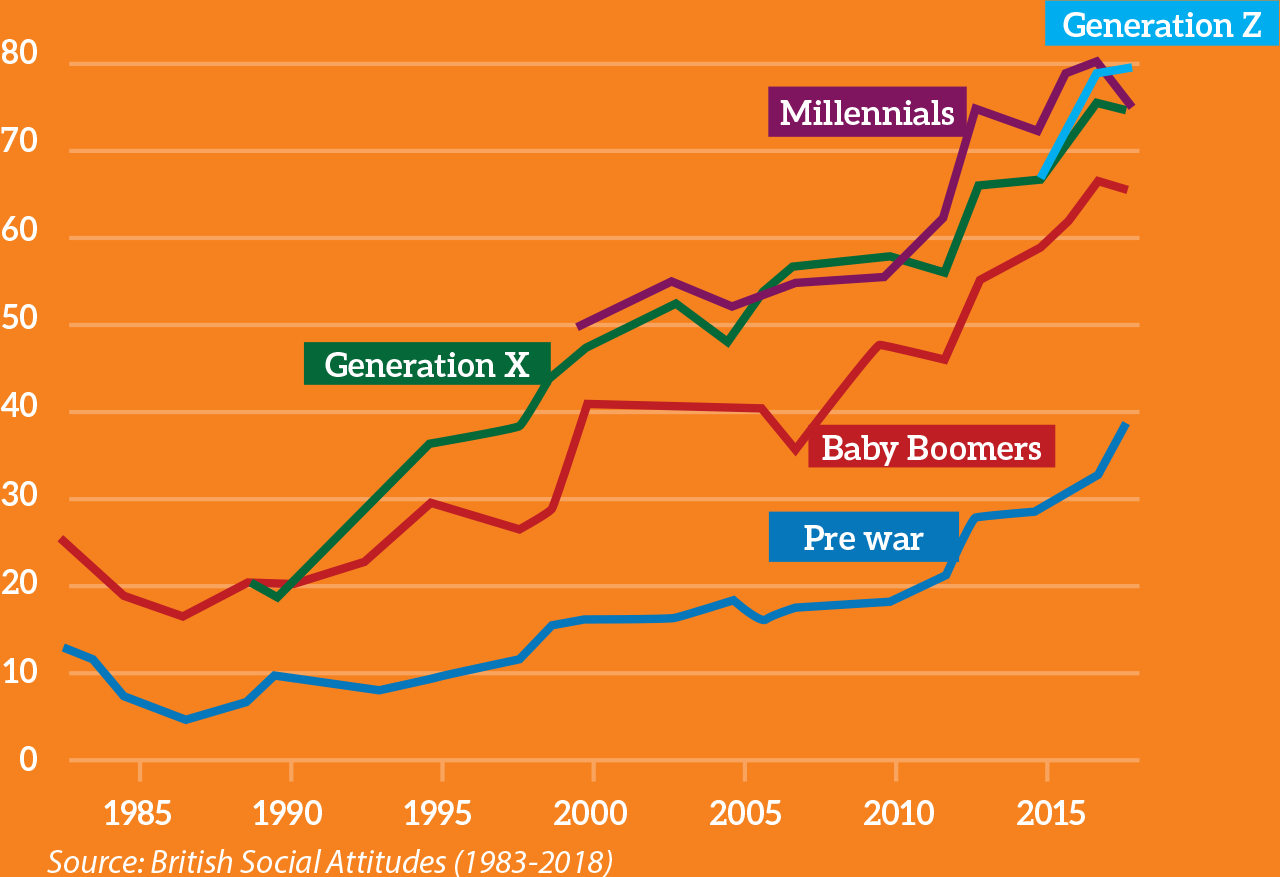
% of British adults viewing same-sex sexual relations as “not wrong at all”
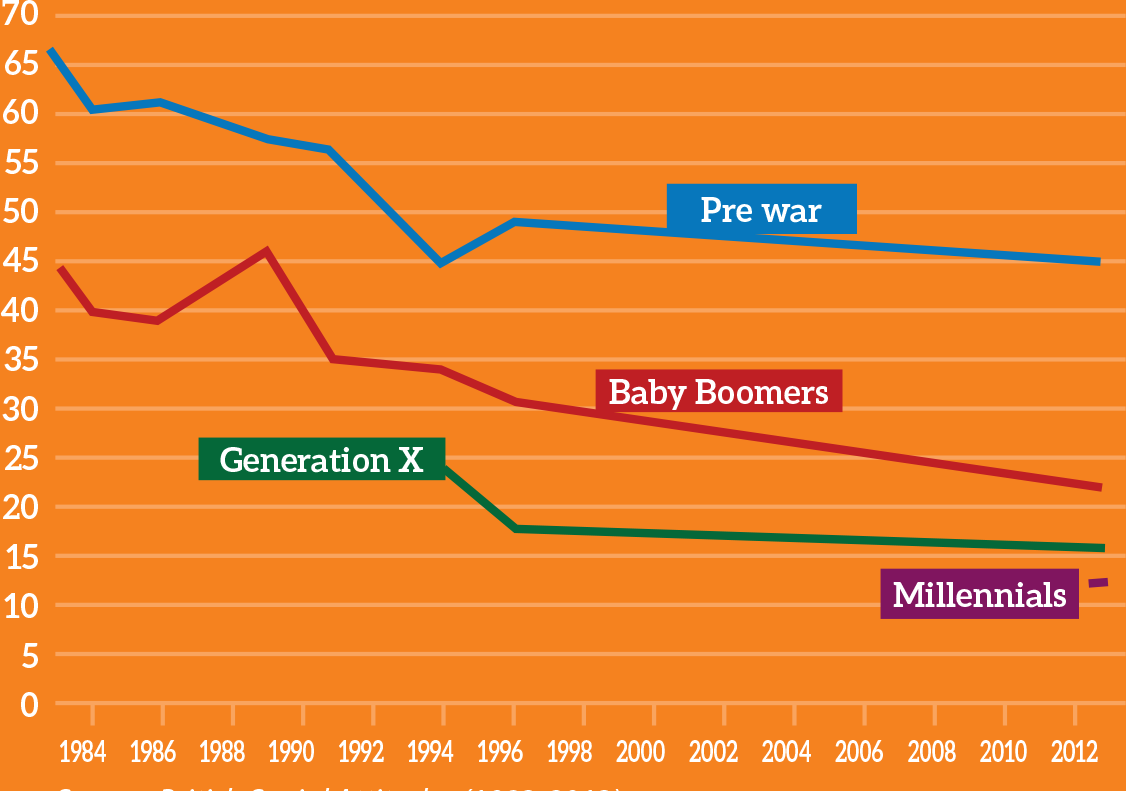
% of white British adults saying they would mind if one of their close relatives were to marry a person of black or West Indian origins
Three effects, not one
Lifecycle effects are when we change as we age, and go through different lifestages, from leaving education, getting a job, having children to retiring. Period effects are where attitudes or behaviours change across society as a whole, either spurred by a particular event that touches us all (like a pandemic or a financial crisis) or through the slower evolution of cultural change. And cohort effects are where a generation is different, and stays different, from other generations, often because of the different context in which they were brought up in their crucial formative years.
Each of these effects can be seen in our shifting attitudes to immigration in the UK. Figures 4 and 5 trace the proportion of people in each generation for whom immigration is one of the top issues facing the country, and shows how generationally divisive it became in a short period of time. In the late 1990s, hardly anyone saw immigration as a top concern in Britain – but it shot up as European immigration increased in the early 2000s. It was then often the top issue for the country, peaking just before the European Union (EU) referendum in 2016 before falling away again. While the flow of changes during this period was similar across the generations, the levels of concern were utterly different. At the peak of this gap, the Pre-War generation was twice as likely to identify immigration as a top concern than Gen Z.
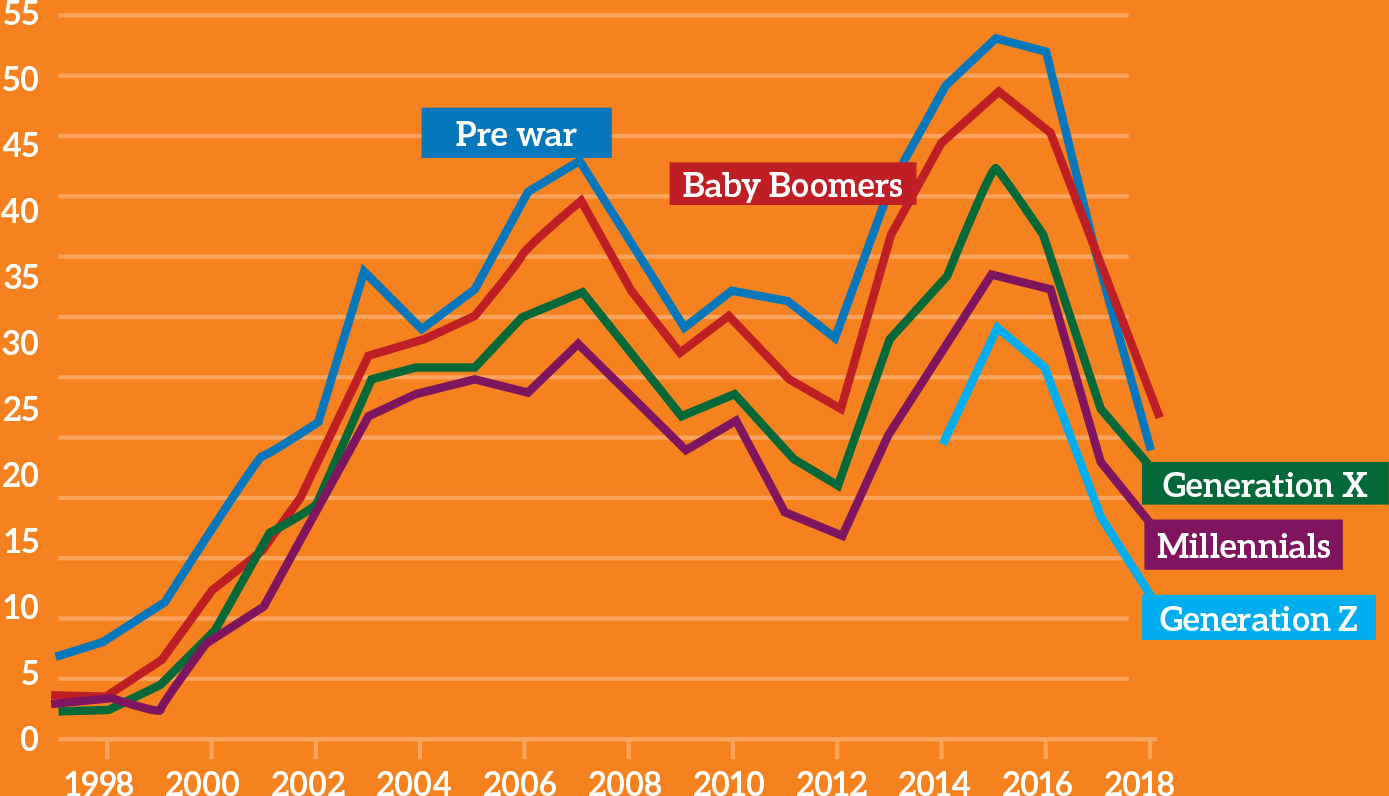
% of adults saying that immigration is among the most important issues facing the country
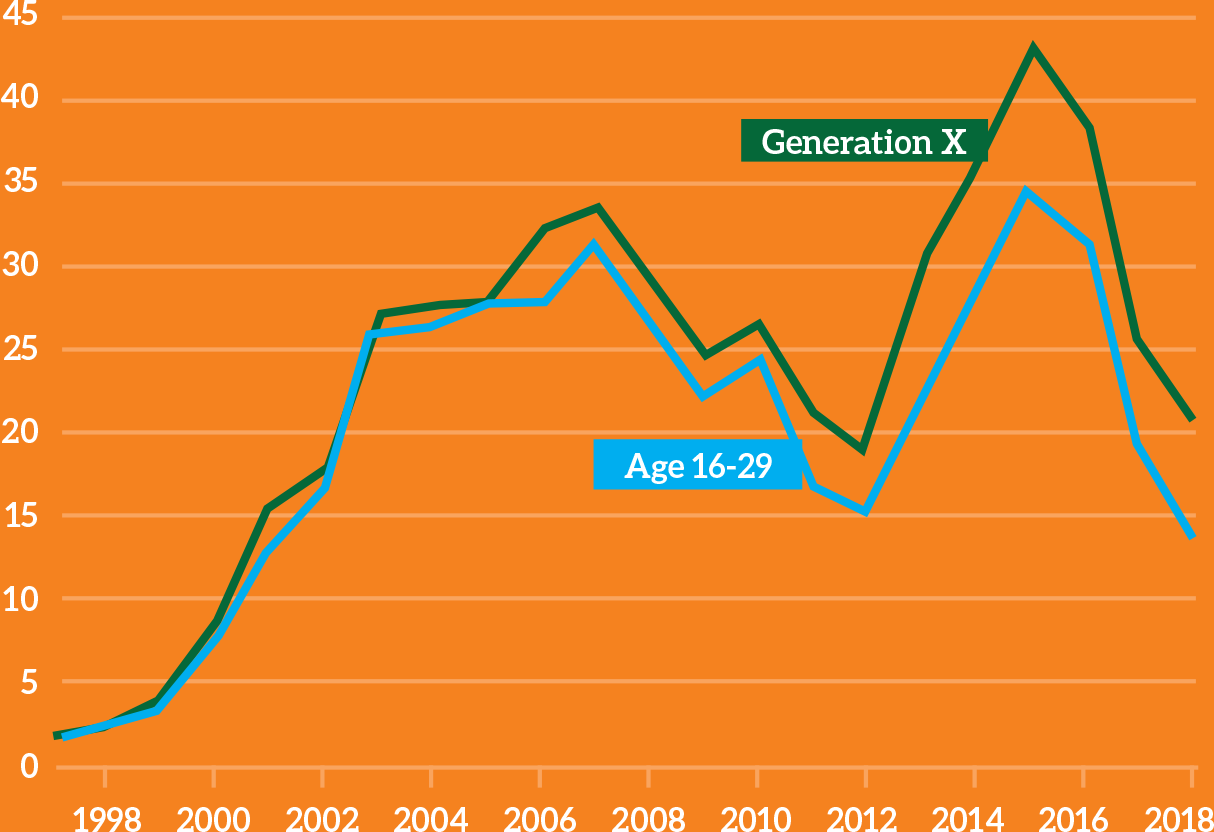
% of adults saying they see immigration as the main important issue facing the country
But, of course, period and lifecycle effects still matter in this pattern. The surge in immigration in the UK, and the huge growth in media and political attention on the issue, increased all generations’ levels of concern about it. And we still change as we age, which dampens generational effects. Figure 5 traces concern about immigration among Generation X compared with the 16 to 29 age group in each year of the study. In the late 1990s, these groups were exactly the same, but as Gen Xers have aged, their concern about immigration has gradually increased compared with people in that age group today.
Generational change
The overall impression we get from looking across a wide range of cultural issues is not of a sudden shift with the latest generation of young people, but rather a remarkable change among most generations over the last three or four decades, and a complex interplay between different lifecycle, period and cohort effects. Generational differences are essential to understanding culture change, but the gaps between today’s young and most other generations are not as large or unusual as they are often portrayed.
Of course, there are important generational differences, and these show up most on emergent issues, as we would expect from generational theory. For example, support for the Black Lives Matter (BLM) protests is roughly twice as high among the youngest compared with the oldest age groups, and in the UK, the young are roughly twice as likely to be ‘ashamed’ of our imperial past than older groups. But these gaps are no different in scale from those seen between the Pre-War generation and Baby Boomers on other racial attitudes.
Even on gender identity, perhaps the clearest example of a leading-edge culture change issue today, the ‘culture warrior’ label is a poor fit for large sections of the young, and the gaps between young and old are not unusual for emergent cultural issues. For example, roughly twice as many young people as older people in Britain think that ‘a person should be able to identify as a different gender to the one they were born in’, and there’s a similar split on whether passports should include a category for people who do not identify as male or female. The issues have changed, but the gaps between old and young are similar to those seen in the past.
Why, then, are generationally driven culture wars so much more prominent today? Rather than being a ‘cohort effect, I believe the main explanation is a ‘period effect; where the greater division across society as a whole, driven by polarising politics and our fractious media and social media environments, has sensitised us to high-profile but unrepresentative examples of ‘woke’ and ‘unwoke’ behaviour. People of all generations are identifying more with their own group and differentiating themselves more from the ‘other’ group, which leads us to focus on behaviours that would have attracted less attention in the past. The ‘war on woke’ seems to be more a result of this change in the general environment than a distinct break in the attitudes of our current generation of young people.
Overly simplistic generational analysis that relies on stereotyping vast swathes of the population is to some extent part of the problem. In reality, cultural change is neither smooth nor unidirectional. Social values change as a result of a constant and messy struggle both between and within generations, and a fuller understanding of cohort, lifecycle and period effects is vital. We need to remember the power of shocks that can change our trajectory, and lifecycle effects that return younger generations to well-worn paths as they age.
These simplistic generational trends are also sometimes wrongly translated as ‘job done, which skirts over the fact that less liberal attitudes persist in significant minorities of younger generations, and that inequalities continue to exist. For example, the writer Douglas Murray shows a palpable frustration about new expressions of inequality, such as a focus on ‘toxic masculinity’: ‘Why would the... rhetoric become so heated when the standards of equality have so much improved? Is it because the stakes are so low? Because people are bored and want to assume the heroic posture amid a life of relative safety and comfort?’ It is perfectly reasonable to question the usefulness of emergent concepts, but doing so should not lead to a dismissal of continuing injustice. The persistence of discriminatory attitudes and the gaps in outcomes on the basis of gender, race and sexuality, deserve more attention than that.
There is a further risk with emphasising this generational framing, and in particular ascribing so much responsibility to emerging generations of young people. Barack Obama, for example, has repeatedly outlined his particularly strong faith in the ‘next generation’ whose ‘conviction in the equal worth of all people seems to come as second nature’, while implying that their parents and teachers never truly believed the same. This is no doubt intended to be positive encouragement, but it brings its own risks. The trends in our attitudes don’t suggest that current generations represent a real break with the recent past on issues including gender, race and sexuality. Lionising coming generations not only misrepresents reality but also encourages a false sense of separation.
It is startling to observe how far our attitudes to race, gender and sexuality have shifted in the last few decades. That they have moved so much so quickly should be celebrated, particularly as it is not something we would have foreseen 30 or 40 years ago. That these issues remain a source of conflict is entirely predictable, however. Such conflict is built-in, through the constant arrival of new participants in society. We will always fear the young barbarians and feel that things are changing too fast for us to keep up – but we need to remember that it’s a natural part of our societal metabolism, and better than becoming a stagnant pond.
Footnotes
Bobby Duffy is Professor of Public Policy at King’s College, London and author of The Generation Myth: Why When You’re Born Matters Less than You Think.