






Abstract

© ZUMA Press / Alamy Stock Photo
Boris Johnson was widely seen as the leader who could transform the Conservatives’ electoral appeal. Instead, writes
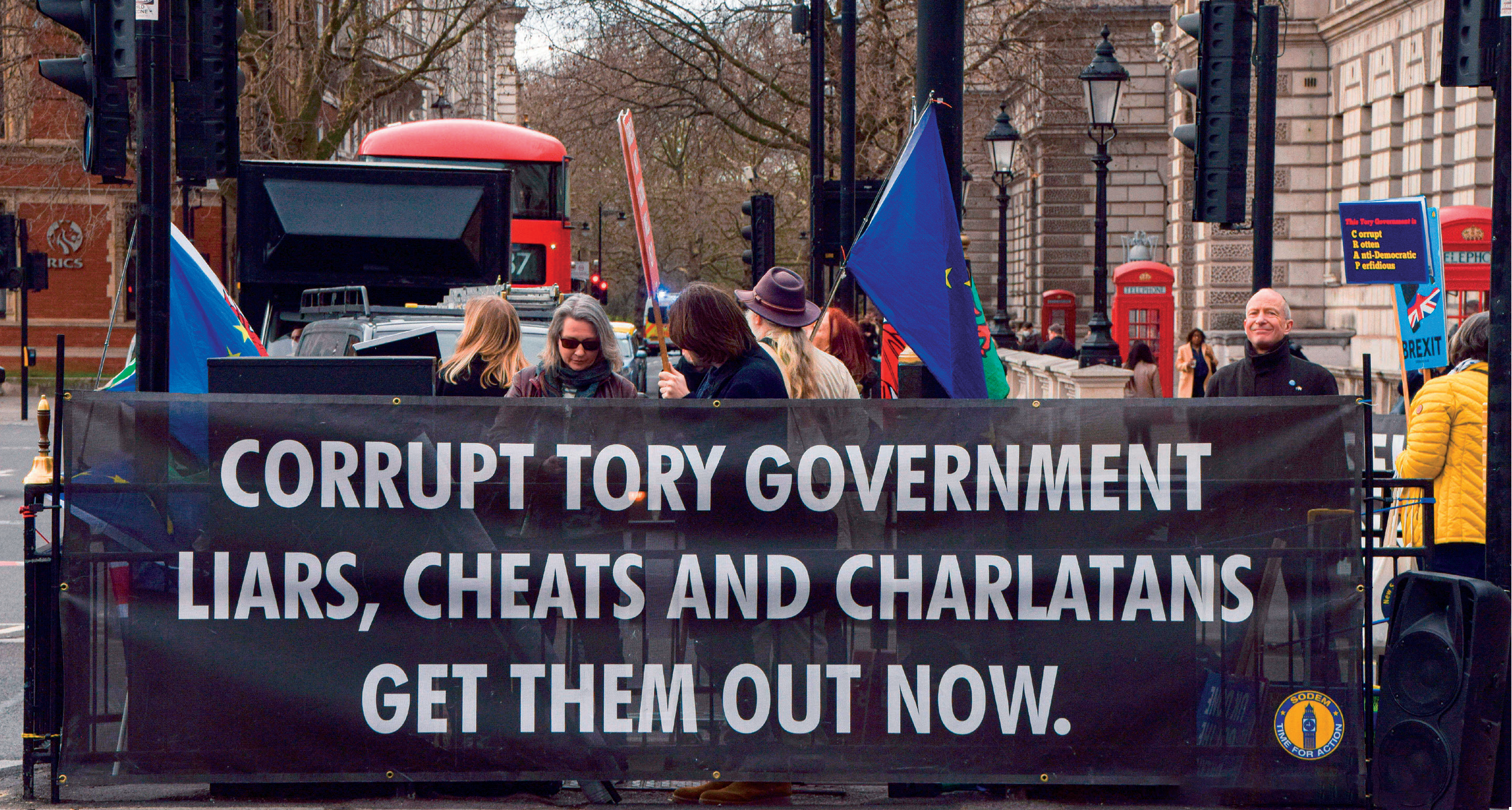
By the time you read this Boris Johnson may no longer be Prime Minister. The ‘partygate’ scandal that has engulfed his premiership and led to a police investigation into a series of alleged breaches of COVID lockdown rules, has already led to multiple departures from Downing Street. Press Secretary Allegra Stratton resigned in December, when a video emerged of a mock press conference at which she was asked to respond to reports of a Christmas party in Number 10 and joked that ‘this fictional party was a business meeting, and it was not socially distanced’. A further five civil servants, including Johnson’s Chief of Staff, Principal Private Secretary, and Head of Policy resigned in February. More than a dozen Conservative MPs publicly called for the Prime Minister to resign, including the leader of the Scottish Conservative Party, Douglas Ross. With others reported to have submitted letters of no confidence to the Chairman of the 1922 Committee, the year began with building speculation that Johnson could soon face a ballot on the future of his leadership of the party.
Should Johnson lose a vote of no confidence, or be forced to resign by some other means, it would be an extraordinary and humiliating end for a leader who less than three years ago delivered the Conservatives their largest majority since Thatcher’s third General Election victory in 1987. Even if he manages to cling on to power, Johnson has suffered such reputational damage that the possibility of him being able to fully recover his authority either with his party or with the country seems remote. On one level this prompts the question: how were things allowed to go so badly wrong at the heart of government in the midst of the pandemic? On another, it also leads us to ask to what extent is the current Conservative crisis one merely of leadership, or a more far-reaching crisis of conservatism as it seeks to define itself for the post-Brexit era? Can the Conservatives resolve their current difficulties by ejecting their leader and replacing him with a new figure untainted by the partygate scandal? And what might the end of Johnson’s premiership mean for the future of Conservative politics?
Existential crisis
The fact that Johnson was chosen by the Conservatives as their leader at all was symptomatic of the existential crisis facing the party at the time. In 2019, desperate to find a way through the impasse over Brexit, Conservative MPs – some against their own better judgement – put aside concerns over Johnson’s personality to lend their support to the candidate who appeared best able to ‘get Brexit done’. Failure to do so threatened the destruction of the party and raised the real prospect of Jeremy Corbyn becoming Prime Minister. His defeated rival, Rory Stewart, described Johnson as ‘the most accomplished liar in public life’. After the partygate scandal broke, the former International Development Secretary told Sky News that Johnson was ‘manifestly unsuited to be Prime Minister from the beginning’ and the fact that he was chosen at all was ‘very disturbing’ and an indictment of a political system that values power over integrity.
Partygate, characterised by moral malaise and a cavalier disregard for the rules, is a political scandal reflective of Johnson himself, and largely of his own making. It is almost impossible to imagine a similar series of events occurring under, say, his predecessor Theresa May. In that sense, it is very much a personal crisis of his leadership. As the anti-Brexit commentator Alex Andreou acerbically noted on Twitter, ‘Interestingly, Boris Johnson will be the third Prime Minister in a row brought down by Boris Johnson’. Fascinated as he is by Greek tragedy, Johnson might one day come to appreciate the classical nature of his downfall. Undone by his own hubris and the burning desire for revenge of his former closest advisor, Dominic Cummings, Johnson has, to the frustration of his sympathisers, tossed away the chance to embed a realignment of British politics to Conservative electoral advantage. This failure is most obviously manifest in his much-trumpeted levelling up agenda, which remains beset with inconsistencies and has yet to evolve from an effective political slogan into a coherent policy programme (Jennings et al. 2021; Newman, 2021).
Conservative statecraft
Conservative statecraft under Johnson was crafted in large part by Cummings. At its heart was Brexit, which created a new electoral cleavage which Johnson was able to successfully exploit at the 2019 General Election by transforming the Conservatives unambiguously into the party of Brexit. This represents more than the single issue of leaving the European Union. Johnson and Cummings exploited a deeper conflict over identity and values – with particular effect in so-called ‘Red Wall’ seats – by mobilising ethnocentric and culturally conservative voters who rallied to ‘back Boris’. The rhetoric of levelling up provided the reassurance to cross-pressured voters that their concerns over social and economic disparities would not be ignored. The ‘culture wars’ the Conservatives under Johnson have engaged in are another part of the strategy for sustaining the ‘identity conservative’ coalition post-Brexit (Sobolewska and Ford, 2020). The idea of ‘Global Britain’ offers an international dimension to the Anglo-British Conservative Nation for which the party presents itself as the patriotic voice.
This statecraft project has been the most far-reaching attempt to re-establish Conservative hegemony since Thatcher. However, sustaining a reputation for governing competence in office is an essential component of an effective statecraft strategy. In this respect the Johnson administration is failing gravely. Recent YouGov poll data finds that seven out of ten voters now regard Johnson as performing badly as Prime Minister, and just a quarter think he is doing well. Clear majorities think the government is handling the most salient issues of crime, the economy, education, health and immigration badly. Two-thirds of voters also regard the Conservative Party as untrustworthy and serving its own interests over those of the country. For Johnson to turn these figures around will take a Herculean effort. But would an alternative leader serve the Conservatives any better? The risk for Johnson is that a majority of his MPs will conclude that an alternative could fare no worse and opt to jettison the incumbent in the hope of preserving their seats at the next general election.
Significant chapter
Even if Johnson’s tenure as party leader and Prime Minister proves to be relatively short, it will still be a significant chapter in this history of Conservative politics. By pushing through a hard Brexit and building an electoral coalition that reached deep into traditional Labour territory in the Midlands and North of England, Johnson has reset the parameters of Conservative statecraft within which his successor will have to try and operate. Yet, he has also left a number of key issues unresolved. In the aftermath of the unprecedented state support for the economy during COVID, the future direction of Conservative political economy is unclear. Both Johnson and most of his likely successors have indicated that they want to reduce taxes and the size of the state but have not set out how such an aim can be reconciled with the desire to level up the country, and the reluctance to return to the austerity of the Cameron-Osborne era.
The future of the Union also remains in a state of flux. The current phoney war, in which Johnson loudly refuses to grant a referendum on Scottish independence that Nicola Sturgeon almost certainly doesn’t presently want, suits both sides but is not a sustainable state of affairs in the long-term. It is notable that a majority of Conservative Members of the Scottish Parliament have called for Johnson to resign. Reinvigorating the Conservatives’ status as the self-professed party of the Union, and diffusing the threat of Scottish independence, will be one of the biggest challenges to face Johnson’s successor.
Despite their recent travails, the Conservative Party will go into the next general election with some electoral strengths. The 2019 election saw Labour reduced to its lowest seat tally (202) since 1935, leaving the main opposition party with a mountain to climb to return a majority government. Post-Corbyn, Labour remains a divided party. The prospect of a minority Labour government, dependent on support from the Scottish nationalists, was something that helped the Conservatives win seats in the south of England from their former coalition partners in 2015. It might similarly help them hold off the threat of Liberal Democrat incursions into the ‘Blue Wall’ signalled by the Chesham and Amersham by-election. Ultimately however, it is likely to be the electorate’s assessment of the ability of the respective parties (and their leaders) to address the core concerns of living standards and the state of the public services that determines the outcome of the next election. Whether Johnson or his successor can recharge Conservative statecraft with the requisite reputation for governing competence remains to be seen.
Footnotes
Richard Hayton is Associate Professor of Politics at the University of Leeds, and Editor of The British Journal of Politics and International Relations.