






Abstract

© Frank Augstein / Alamy Stock Photo
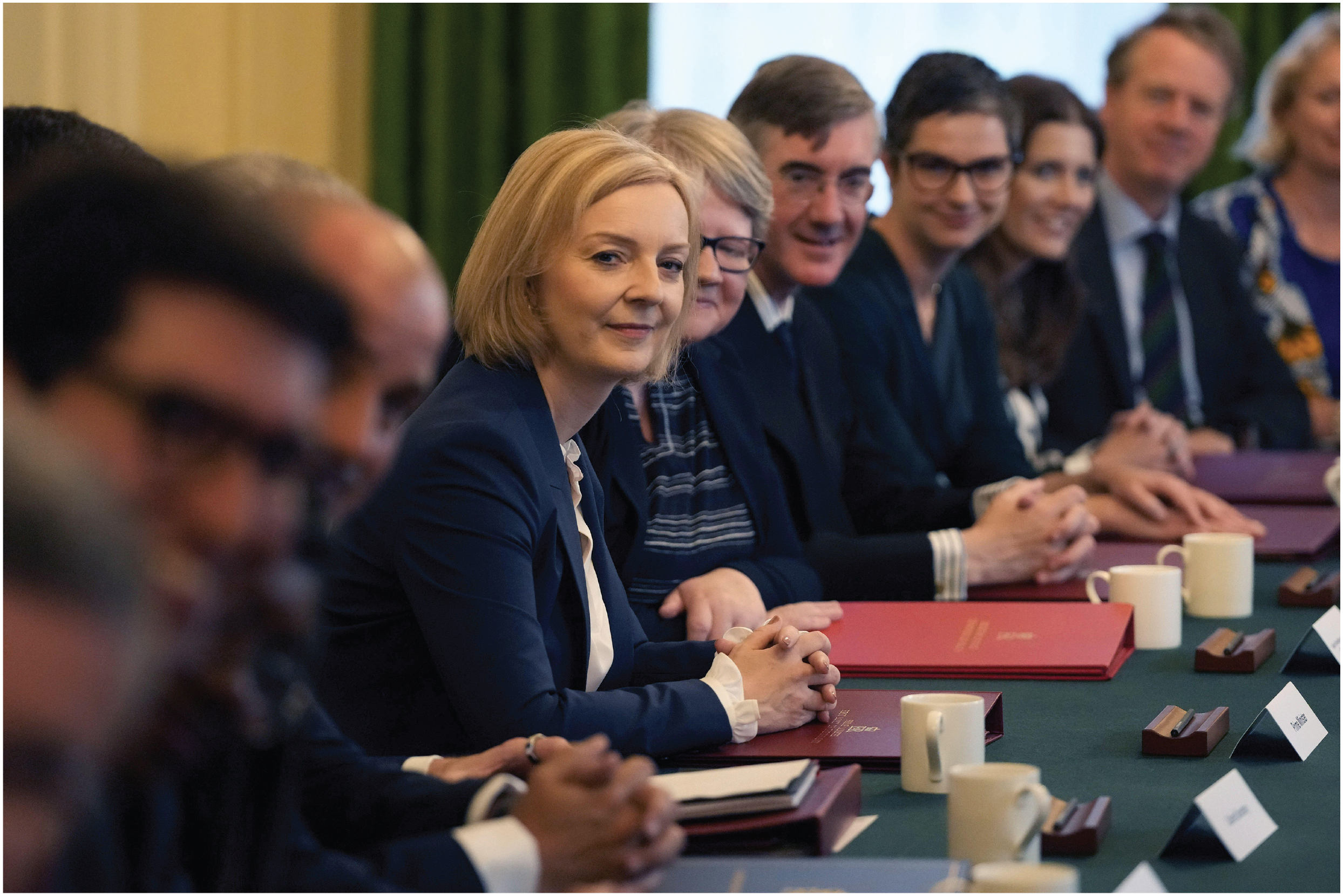
As Britain welcomes its fourth prime minister in six years, Max Stafford explores the ongoing changes and reforms to the running of Downing Street’s political operation over the past 25 years.
The most important word in the title is staff, not chief (Gavin Barwell, Chief of Staff to Theresa May, speaking in 2021)
Running Downing Street is not easy. This probably ranks as one of the most obvious statements in British politics. However, just how hard it is to run Downing Street – and how a prime minister’s Downing Street operation can shape a premiership – is often under-appreciated. Different prime ministers have taken different approaches to running Number 10. Tony Blair, for example, clashed with the Civil Service over wanting to have a more politicised operation supporting his office.
Liz Truss came to power, at least in part, due to a series of scandals and doubts about how Downing Street functioned under her predecessor, Boris Johnson, who fell foul of ethical standards and Partygate investigations. Her premiership could have been the moment to reset how Downing Street functions. Instead, the same questions that arose of Johnson’s operation soon emerged for Truss.
Within days of taking office in September, Truss’s relatively inexperienced backroom team was also embroiled in its own scandals. Truss’s Chief of Staff Mark Fullbrook, was caught up in several lobbying scandals, while her heavy focus on right-wing and free-market think-tanks for recruitment to the policy and communications teams drew significant comment, especially in the wake of her failed ‘Trussonomics’. However, while Truss – and her economic agenda – might be gone, the question of how Downing Street is run remains very much a live issue in British politics.
The Downing Street operation
The concern with who is employed within the Downing Street political staff – as opposed to the Civil Service contingent – matters. Since its inception in 1997, holders of the role of Chief of Staff have had a significant influence on government policy. Jonathan Powell, who served under Blair for a decade to 2007, was closely involved in the Northern Ireland Peace Process. Nick Timothy and Fiona Hill were widely blamed for overseeing Theresa May’s disastrous 2017 General Election manifesto. Their successor Gavin Barwell brought his prior interest in housing with him to serve May until 2019. Dominic Cummings, a de facto chief under Johnson until 2020, was central to the government’s response to everything from Brexit to the COVID pandemic.
But it is not just who occupies roles in Downing Street that matters. It is essential to understand the very way in which the Downing Street building is run if we want to understand the wider issue of how a British prime minister carries out their task. The ‘geography’ of how physically close you are to the prime minister matters deeply. As previous Chiefs of Staff have acknowledged, Downing Street itself is not ideally suited to the running of government, given the building’s chaotic layout and lack of sufficient office space. But the issues are secondary to a different, more abstract, structure. This is the structure of the prime minister’s office and how it functions. As Jack Brown notes in his stellar book on the subject, the closer your office is to the PM, the more likely you are to be able to exert influence.
There are ‘Four P’s’ at the heart of the Downing Street operation: the political office (concerning relations with a PM’s party and campaigning); the press office (dealing with communications); the Policy Unit (which generates policy proposals covering the full range of the government’s responsibilities); and the Private Office (which is the administrative and political operation most closely associated with servicing the PM’s daily requirements).
The Private Office and SpAds
The Civil Service has, historically, most closely guarded the realm of the Private Office. Prior to Tony Blair’s premiership, the Private Office was almost entirely staffed by non-partisan officials. As Caroline Slocock (2019) set out in her account of her time in Thatcher’s Private Office, this is traditionally staffed by five private secretaries (one as Principal), each covering a key area of government policy (home affairs, foreign policy, the economy and so on). The Principal Private Secretary (PPS) is, therefore, the civil servant closest to the PM’s daily professional life. Blair’s arrival brought with it a dispute over institutional territory. He proposed that his Chief of Staff (Powell, whose role was already an innovation within Downing Street history) should assume the role of PPS, too. This was strongly resisted by Sir Robin Butler (then Cabinet Secretary, the Civil Service’s most senior official), precisely because the PPS role was the Civil Service’s closest link to a PM and their intentions. Powell, Anthony Seldon, Peter Hennessy and others, have all given accounts of the Civil Service’s resistance to this innovation and how, subsequently, the concern about having non-partisan functions (including relations with the monarchy and the nominations of honours) meant that the position was safeguarded from becoming a role for a Special Advisor (SpAd – the term used for political advisors who act in a partisan fashion).
The role – and number – of SpAds has long been a cause for concern. Before her brief reign, Liz Truss had expressed a desire to reduce the number of SpAds working in Downing Street. This was nothing new. Historically, incoming prime ministers have often been critical of the number of SpAds working in government. Equally, this desire to reduce their number often runs into the reality of prime ministers wanting to see more delivery of policy and reform once they get into Downing Street. This frequently translates into an expansion of the political functions at the centre, primarily exemplified by increasing the number of SpAds and units.
Blair, in his second term, introduced the Delivery Unit, designed to drive and measure the delivery of core manifesto pledges. Cameron gradually increased the number of SpAds during his time in office. His predecessor, Gordon Brown, began by signalling a desire to reduce their number, which included making the Chief of Staff role a Civil Service one, joint with the PPS post. However, he ended up revisiting the structure less than a year into power, bringing both more civil servants and more political appointees into his operation. In his memoir, Ed Balls recounts how this stemmed from Brown telling him that he felt as if he was not making sufficient progress (even, albeit unsuccessfully, offering Balls the position of Chief of Staff). Prime ministers often make much of their desire to almost ‘de-Whitehall’ their operations. However, the longer they stay in power the more they then seem to find that the machinery of government feels easier to operate if they can have more of their own people doing it. In essence, the growth in the number of SpAds is not an end in itself – it is how a prime minister may seek to ‘hug’ control of their agenda closer to Number 10.
Overall, the challenges of leading and staffing Downing Street are myriad. They range from debates about structure and working relationships through to discussions regarding the tone a PM wants his or her team to set. A lot of these issues are not new – debates have raged since at least the creation of the Chief of Staff post, 25 years ago.
However, we should not too readily dismiss a PM’s occasional desire to slim down Downing Street. Truss reduced the Policy Unit from 21 staff to 12, with the majority covering economic portfolios. This was a sizeable reduction in both number and scope. Drawn largely from centre-right think tanks and campaign groups (such as Policy Exchange and the Taxpayer’s Alliance), the new intake of policy advisors mirrored her intention to seek economic reform and lower taxes. We cannot know if it would have subsequently grown, but given the economic difficulties that Truss’s short premiership experienced, we might be tempted to declare that such a change in Downing Street was more hindrance than help. However, it is too simplistic to reach such a conclusion, as the extremely short timeframe concerned means that we cannot know how the slimmed down Policy Unit would have fared in the long run.
One recent proposal that does seem to have been forgotten, is the Johnson-era move to establish an Office of the Prime Minister as a formal government department, with its own Permanent Secretary and a Chief Operating Officer. The idea of a ‘Prime Minister’s Department’ continually resurfaces, with comparisons made between the rather haphazard and semi-structured constitution of Downing Street and the formal offices found elsewhere, such as the German Chancellery and the US President’s West Wing. Some of these comparisons are asymmetric (such as comparing the office of a prime minister with that of a president), but the general point about the omission in the British system is notable. Others, such as Patrick Diamond at the Mile End Institute and Cath Haddon at the Institute for Government have explored the arguments for and against establishing such a structure. Jonathan Powell has outlined how the idea was given considerable thought during Blair’s second term. As an idea that periodically re-emerges within Whitehall, it does seem very possible that one of these days Rishi Sunak or one of his immediate successors may yet find themselves implementing it.
Sunak’s Downing Street
At the time of writing, in the opening weeks of Rishi Sunak’s tenure, it seems that the latest resident of Downing Street is likely to stick with what has now become what we might term the ‘traditional’ set-up. In other words, he will have a Chief of Staff (Liam Booth-Smith) who is very politically close to the PM and has a long-established working relationship with him. This will be accompanied by a return to a political head of communications (Truss split this between a SpAd and a civil servant) and a refreshed Policy Unit. Beyond this, it is too early to speculate about how Downing Street will be run. One point of interest will be the ongoing calls for an independent ethics advisor (the role has been vacant since Lord Geidt resigned under Boris Johnson). This role examines potential breaches of the codes that govern the executive office and operations, often coming to public attention at times when PMs are trying to move on from public scandals (such as Partygate or alleged breaches of the Ministerial Code). Given that Sunak was one of those fined for breaching lockdown rules, he may be keen to appoint a new ethics advisor quickly to put some substance behind his pledge, made in his first speech as PM, to restore ‘integrity, professionalism and accountability at every level’.
Overall, the challenges of leading and staffing Downing Street are myriad. They range from debates about structure and working relationships, through to discussions regarding the tone a PM wants his or her team to set. A lot of these issues are not new – debates have raged since at least the creation of the Chief of Staff post, 25 years ago. However, the changes in the personalities involved and the priorities they have, means that whilst PM’s may come-and-go, concern over the issue of how Downing Street is run will be with us long into the future.
Footnotes
Dr. Max Stafford is a specialist in political leadership studies. Having previously advised former Cabinet ministers, he now spends his time lecturing at a number of universities. He has taught at British, European and American universities and earned a PhD in April 2020.