






Abstract

© Justin Tallis / Alamy Stock Photo

Labour leader Keir Starmer has pledged to abolish the House of Lords.
In December 2022, Sir Keir Starmer declared that the House of Lords is ‘not capable of being defended’. The Labour leader’s intervention thrust the chamber firmly into the political spotlight ahead of the next general election. Proposals to reform this archaic institution are regular occurrences in the political cycle, and Starmer’s plans provoked an unsurprising Conservative reaction. But what is the current status of the House of Lords, and how likely is reform?
As the unelected upper chamber of the British Parliament, the House of Lords has traditionally been pivotal to the country’s constitutional structure. Dating back to medieval times and first formally noted in the late 13th century, the Lords has had an eventful and often controversial history. In wholly functional terms, its ‘revising’ legislative role within a bicameral system is viewed by its advocates as enhancing the smooth legislative workings of Parliament. Since 1911 its undemocratic nature - members are not directly elected by popular franchise - has made it formally inferior in terms of power compared to the House of Commons, but constitutional conservatives ardently hold that it continues to play a vital parliamentary role, albeit within the context of a widely accepted Commons ascendancy.
Others however, have been more critical about the purpose that the Lords serves. For example, in 1962 Tony Benn, while campaigning to disown his own hereditary peerage, alluded to what he perceived as its obscurity and irrelevance, referring to it as ‘the British Outer Mongolia for retired politicians’, while previous Labour Prime Minister Clement Attlee likened it to ‘a glass of champagne that has stood for five days’. Such unflattering comments belie the fact that the Lords has been central to some major and often exciting political dramas of the 20th century, while at the same time fulfilling its fundamental purpose of checking and passing laws.
Abolition or reform?
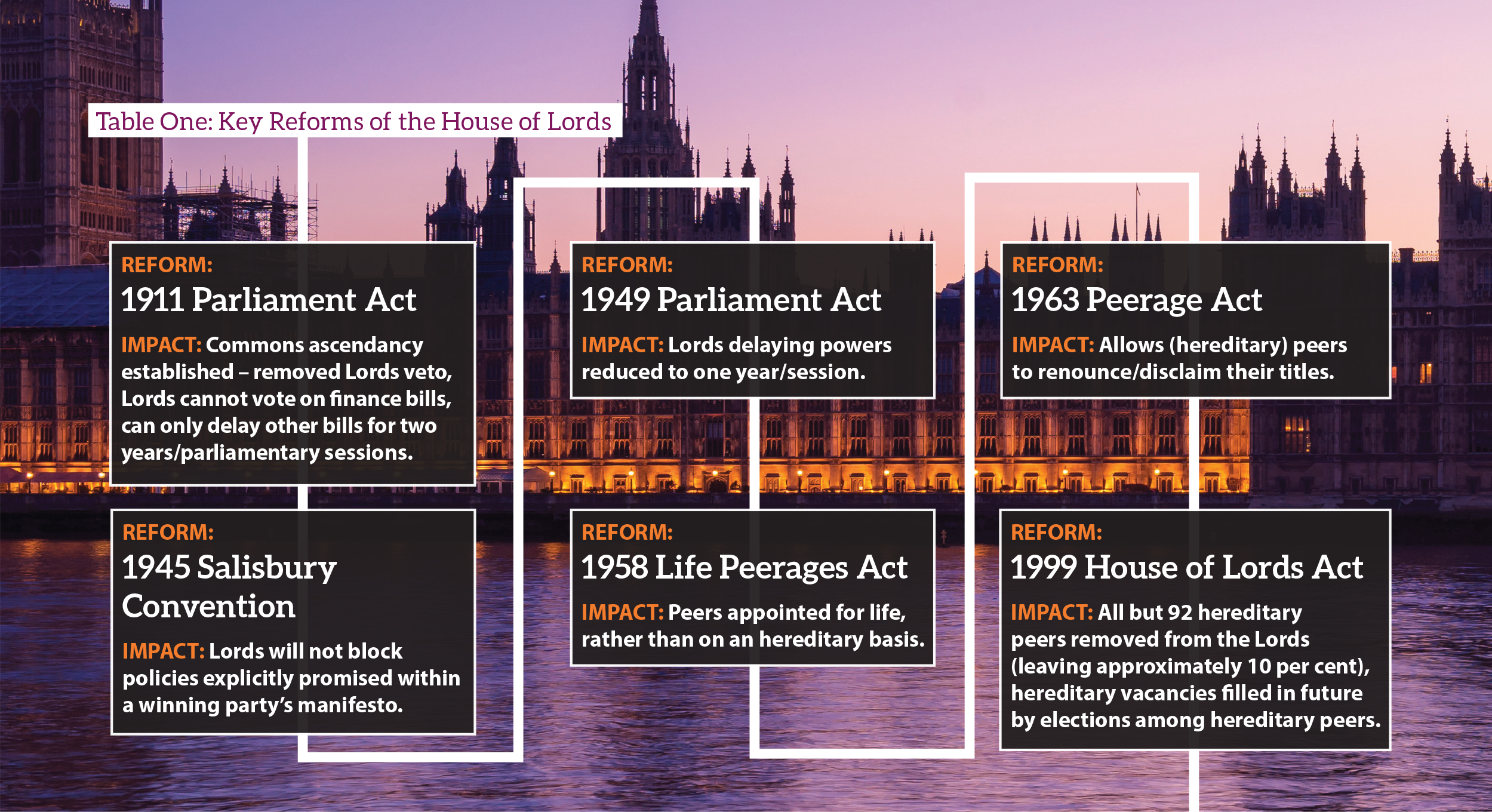
The House of Lords has appeared to effectively evolve and adapt to changing times and circumstances. The 1911 Parliament Act removed the Lords’ power to veto a Bill. The Salisbury Convention of 1945 further acknowledged the Commons’ democratic supremacy, while the Life Peerages Act (1958) could be said to have revitalised a formerly stagnant chamber, with an influx of new blood and more socially ‘representative’ peers with a much wider range of life experiences. Tony Benn’s successful renouncement of his peerage in 1963 (to allow him to become an MP rather than a Lord) also indicated a gradual willingness of the parliamentary authorities to move with the times. Then, in 1999, all but 92 hereditary peers were abolished by Tony Blair’s New Labour government. However, democracy has remained persistently absent from the chamber, with both life peers and the longer established hereditary members still unelected by the wider public: the 2000 Wakeham Report which recommended a streamlined, partly-elected chamber with independent appointments was never wholly implemented.
Starmer’s proposals
Keir Starmer’s proposal to abolish the House of Lords (at least in its current guise) is perhaps the boldest and most ambitious policy pledge from the Labour leader. Nevertheless, such a policy can be seen to align with Labour’s more reformist heritage of pursuing relatively radical constitutional reform, most notably between 1997 and 2010, and particularly during the Blair government’s first term in office from 1997-2001. Indeed, the inconclusive Lords reforms of the Blair era (removing 90 per cent of hereditary peers) can be seen as ‘unfinished business’ for a future Labour administration to complete, with Starmer recently commenting that the ‘sooner hereditary peers are abolished the better’. But this would be a bold move, possibly stirring up a hornet’s nest of both political and constitutional instability, with the potential to undermine and derail the broader policy agenda and priorities of an incoming Labour government (a scenario that influential Labour figures such as Lord Mandelson have already warned about).
Yet at various times in its history, Labour has been openly in favour of abolishing what has traditionally been a pro-Conservative body that has often clashed with Labour governments. Indeed, abolition was in evidence in two of its most left-wing (and electorally unsuccessful) manifestos, 1983 and 2019. In 2019 the party’s manifesto pledged to:
‘act immediately to end the hereditary principle in the House of Lords, and work to abolish the House of Lords in favour of Labour’s preferred option of an elected Senate of the Nations and Regions’.
The post-2022 incarnation of this policy adheres broadly to the narrative of the 2019 Labour manifesto, proposing to remove the lingering hereditary intake and maintain Parliament’s bicameral status with a ‘new, reformed upper chamber’ (democratically elected) should Labour win the next general election. This is not a conventional abolition in the purest sense (which has traditionally entailed no more second chamber and a shift to unicameralism), as under Starmer’s proposals a second chamber would still exist, albeit in a significantly reformed and more democratic state. There does indeed seem to be growing consensus (even among reformers) that a second chamber has value in terms of parliamentary workload and is required in some form, as opposed to abolishing it entirely.
The composition of the Lords
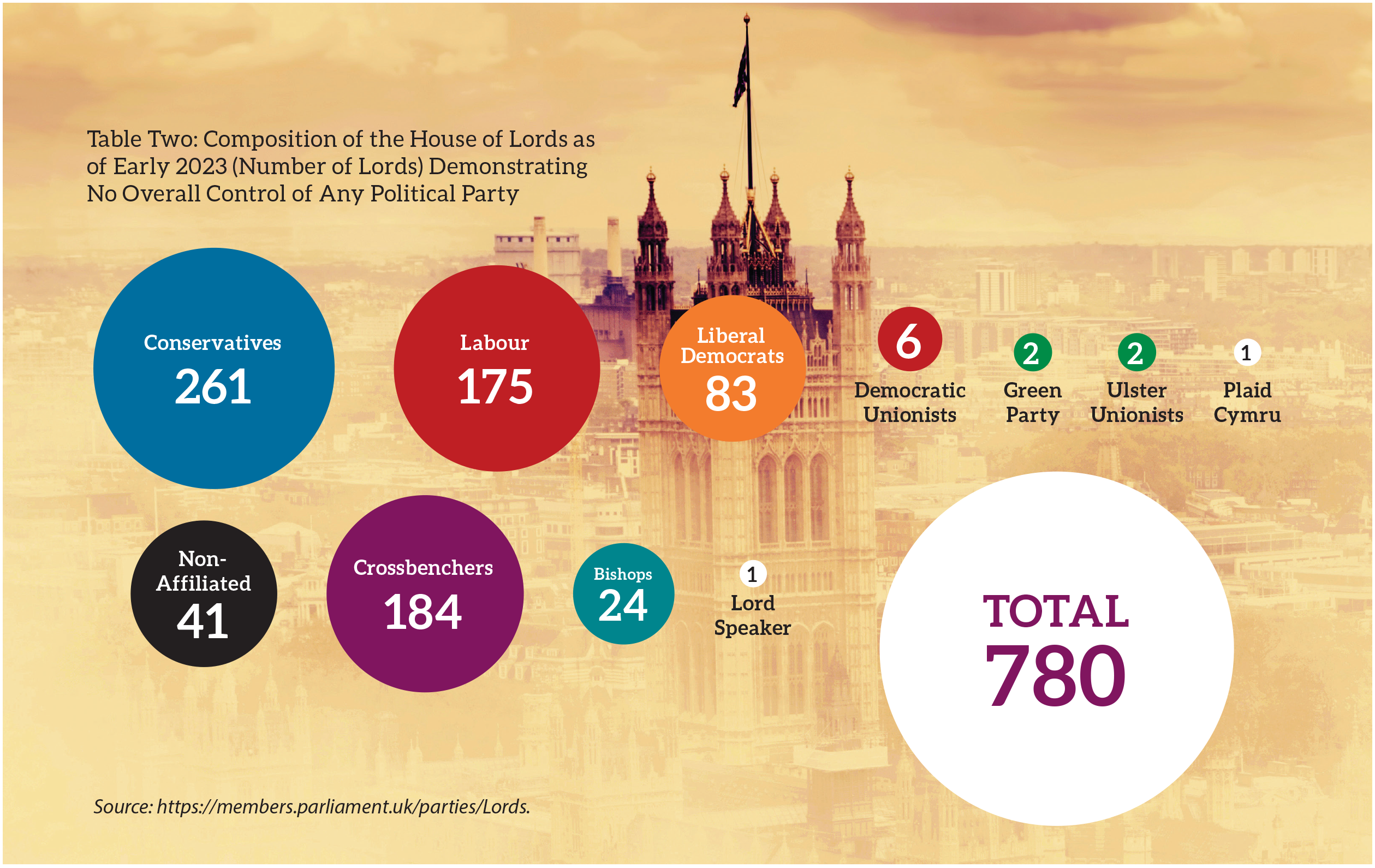
In arguing for the necessity of reform, a key element is the demand to trim and curtail some of the outdated practices and excesses of the Lords, in particular arising from its varied, imprecise and seemingly limitless membership, which currently stands at approximately 780 peers (as of early 2023), but has been over 800 in recent years, and was as high as 1330 in 1999 prior to the removal of most hereditary peers. While many peers rarely attend and overall numbers can be fluid due to an ongoing cycle of deaths, resignations and appointments, it is still said to be the second biggest legislative body in world after the Chinese National People’s Congress. This very flexible membership capacity has seen it often filled with appointees who have sometimes been referred to as ‘cronies’ and dubious figures associated with the patronage of senior politicians, specifically linked to the power of Prime Ministers to make appointments to peerages (life peers), disproportionately to their own party, and on a fairly arbitrary basis.
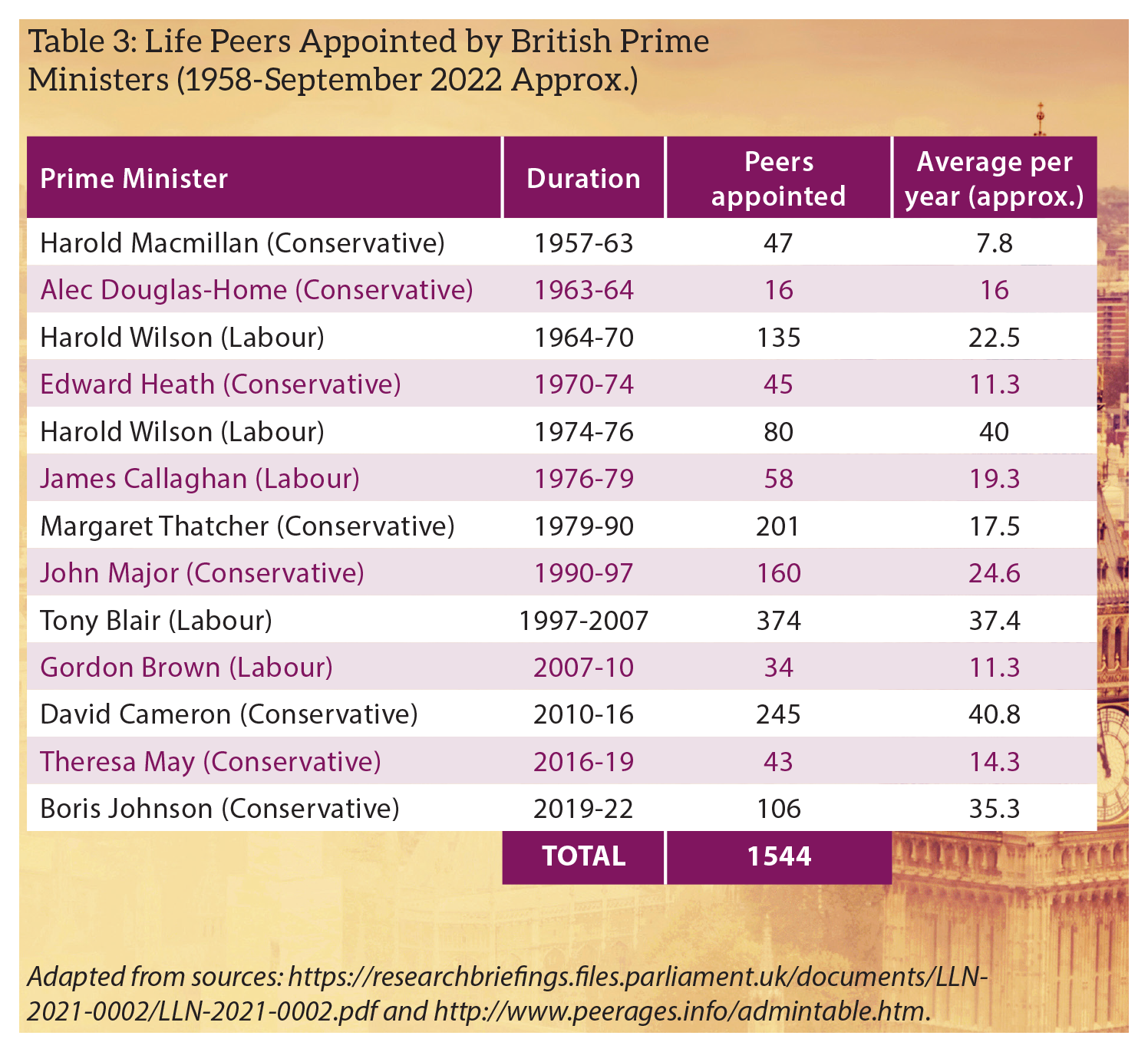
An example of this apparent misuse of appointments was when former Prime Minister Boris Johnson nominated Lord Lebedev for a life peerage in 2020. As the son of an ex-KGB agent and of Russian origin, Lebedev’s suitability for the role was questioned. National security concerns were said to have been raised by the British intelligence services. Subsequently, ‘the Baron of Hampton and Siberia’ has barely attended or spoken in a Lords debate since his appointment, raising questions of whether such appointments enhance the Lords’ intake and functions, while also raising the spectre of ongoing allegations of ‘political cronyism’ and even corruption. Accusations of cronyism are not, however, necessarily a new thing; Tony Blair faced allegations of ‘cash for honours’ in 2006-7, which resulted in a police investigation based on claims that political donations were made in return for peerages. While Blair was interviewed over the matter under caution, no charges against him were eventually brought. Yet despite such controversies, there have been just over 1500 life peers created by successive administrations since 1958, with approximately 650 currently eligible to participate in the chamber’s affairs as of early 2023 (out of the 780 total); making up the vast majority of its membership. Some Prime Ministers (notably Blair, Cameron and Johnson in recent years) have appointed life peers at a markedly higher rate than others (see Table 3), which has raised concerns among some political commentators about the nature and consistency of prime ministerial patronage.
Life Peers Appointed by British Prime Ministers (1958-September 2022 Approx.)
Problems of reform
In advocating Lords reform, Starmer has proclaimed that the policy will be a ‘driving mission of a Labour government’ and will seek to ‘restore trust in politics’. It can therefore be justified as a means of removing the risks of such dubious patronage, alleged corruption and perceived cronyism. The Labour leadership can further validate it in the context of revisiting and completing the legacy of the reforms of the Blair government of two decades ago, as well as transcending the indecision over the Lords that characterised the Conservative-Liberal Democrat coalition government of 2010-15 (when various proposed reforms were abandoned). There is certainly a valid case to be made that the Lords’ current balance of mainly appointed life peers and a lingering smattering of the hereditary variant is an anachronism with little logical justification. Yet a major and obvious problem of abolishing the Lords and replacing it with a reformed and modernised chamber is that the current equilibrium and balance of power will be thrown into confusion and uncertainty. This is because an elected upper chamber will be able to claim a democratic mandate of its own, thus removing the Commons’ claims of ascendancy.
Critics of such reforms fear that this will create a recurring scenario similar to that in the USA, whereby the two elected chambers of the House of Representatives and the Senate (each often controlled by rival parties) frequently reach a frustrating gridlock when failing to agree over policy, creating a constitutional impasse in the process. The second chamber would also see a shift from its present culture whereby crossbenchers and independents are significant groups who often prevail, and instead evolve into a more explicitly partisan body, with the likelihood of it being under one party’s control as opposed to its permanent ‘hung’ status of recent times. Variables such as the electoral system used to elect it, constituency boundaries and the electoral cycle of the reformed chamber, would all be key considerations in devising how things would practically function in a revamped Lords.
Another aspect of possible concern arising from such reform is that while an elected second chamber would clearly have more democratic legitimacy, there is no guarantee that its composition would be as knowledgeable and experienced as the current membership, which benefits from a raft of ex-diplomats, civil servants, politicians, business figures, academics and military, among others. Indeed, despite all of the previously highlighted concerns about a lack of democracy, dubious executive patronage and alleged cronyism, the knowledge and real-life experience of many current Lords can be seen as a vital enhancement of the legislative revision process, and comparatively inexperienced politicians will not provide the same degree of expertise and rigour when dealing with often very specialist aspects of law-making. There is consequently a ‘Burkean’ argument that the Lords (as it stands) provides wisdom, historical value and continuity, and that changes of this nature should be gradual and evolutionary, not sudden and abrupt. Many Conservative critics of the Lords reforms of the Blair government accused his administration of ‘constitutional vandalism’ for the upheaval created (along with other reforms), and there is certainly the potential for that line of criticism to be resurrected in the context of these proposals (which would see most if not all current Lords being removed).
Will Lords reforms succeed?
The House of Lords has evolved and adapted over many years, but in the early 21st century it remains a curious combination of appointed and hereditary members. The African nation of Lesotho is said to be the only other country in the world to have legislators based on hereditary principles. There does appear to be some dissatisfaction with the status quo, and reformers broadly agree that this rather arbitrary and random settlement cannot be sustained indefinitely; even some Conservative MPs acknowledge demands for change, with recent suggestions to relocate the chamber to other parts of the country. However, as many Conservative-minded politicians will also observe, while it is often easy to highlight a political problem, devising an appropriate practical remedy is not always that straightforward.
For all of its desire to change what can appear to be a somewhat archaic system, if Labour wins the next general election, will it be able to precisely do what it wants to the House of Lords? It will evidently have a wide range of policy priorities to address after approximately 15 years in opposition, and within this context, there will indeed be questions as to whether constitutional reform is something of a diversion, and not a high enough priority. The challenge will be whether an incoming Labour administration is willing or able to exert the required time and energy to finally complete Lords reform (dating back several decades). The devil will therefore be in the detail, with much depending on the size of its parliamentary majority and whether the unreformed Lords (without a Labour majority) is particularly resistant to any new government’s legislative programme, including attempts to radically alter its own composition.
Footnotes
Ben Williams teaches politics at the University of Salford.