






Abstract


The High Seas take up much of the Earth’s surface but sit beyond the control of any nation-state. In the face of climate change - and overfishing -
The ocean plays a crucial role in sustaining life on Earth. The sea’s plankton absorbs carbon and churns out oxygen on a truly massive scale. The ocean’s great currents regulate temperatures and weather patterns, making our world much more hospitable to life. Hundreds of millions of people worldwide are nutritionally reliant on fish.
Unfortunately, our economies are steadily undermining the environmental health of the ocean. Climate change is wreaking havoc in two ways. First, it is spurring the warming of the ocean, leading to a flight of fish populations away from the equator, as well as the melting of ice sheets. Second, it is slowly acidifying the ocean. This is disrupting marine food webs, since zooplankton - small crustaceans which are key to marine ecosystems - are less able to grow or heal in more acidic water. That could also have major knock-on effects for fish, and for people who rely on the ocean for sustenance.
Further threats include harmful fishing practices such as bottom trawling, as well as plastic pollution, and pollution from agriculture (which has caused the emergence of multiple ‘dead zones’ in the ocean, that are largely devoid of life). Seabed mining, which appears to be moving closer to reality, could also cause untold damage to seabed ecosystems, by creating sediment plumes which smother creatures living on the sea floor.
Alongside this multifaceted environmental crisis, the ocean faces another. This is a crisis of inequality. The ocean is big business: under what economists call the ‘Blue Acceleration’, ocean industries are growing at a faster rate than the overall global economy. But there are winners and losers, because the ocean economy is even more unequal than land-based economies.
Some countries lack access to the sea in the first place (because they are landlocked). Others are locked out by the high costs of entering technologically complex industries. Not all countries have the technology to engage in offshore fossil extraction, for example, or the mining of the seabed. Meanwhile, fishing is dominated by just a few countries which can afford to subsidise large fishing fleets. It is little surprise, then, that in each of the major sectors of the ocean economy, ten or fewer companies account for almost half of all global revenues.
The High Seas
These challenges are perhaps most evident on what international lawyers call ‘the High Seas’. This refers to all parts of the ocean which are beyond 200 nautical miles of any country’s coast, which collectively represent around 60 per cent of the ocean’s surface, and 95 per cent of its volume. Traditionally, these areas have been loosely regulated at best. The default principle has been the ‘freedom of the seas,’ which means everyone has the right to exploit High Seas resources to their heart’s content, even when their activities are environmentally destructive.
(Source: National Geographic)
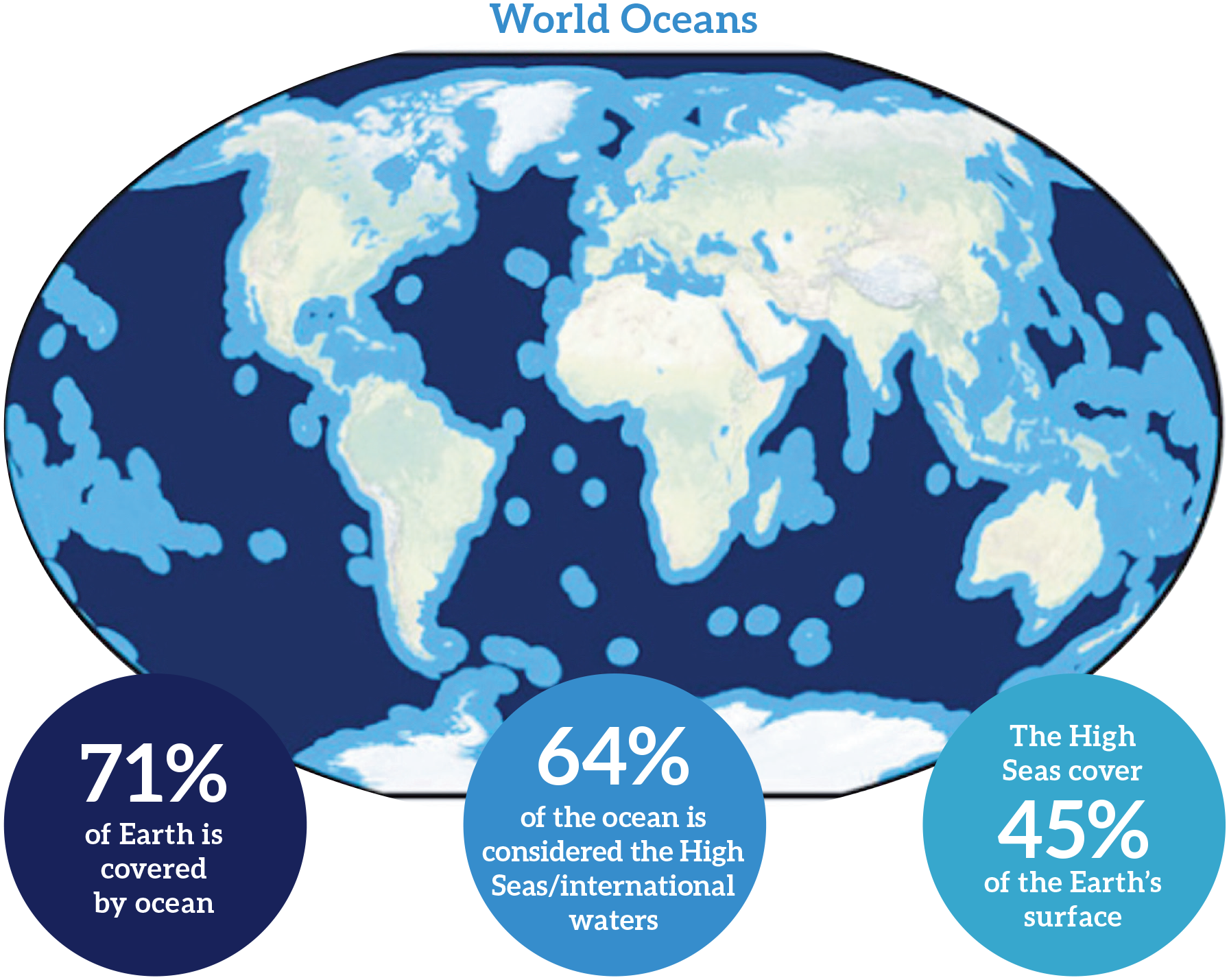
The ideal of the freedom of the seas is closely associated with the 17th century Dutch thinker Hugo Grotius, whose famous essay The Free Sea defended an unconstrained right of all countries to fish (and to navigate) the ocean as they saw fit. In Grotius’s vision, there was simply no reason to restrict anyone’s freedom to fish, because the quantity of fish in the ocean was essentially limitless. As such, no country’s fishing activities would ever have an impact on anyone else’s. It is now abundantly clear that this was an unfounded belief. The 20th century, for example, witnessed serious collapses of many fish populations, including North Atlantic cod, and North Sea herring. Nevertheless, the doctrine of the freedom of the seas has reigned supreme until our own time.
Weakness of High Seas governance
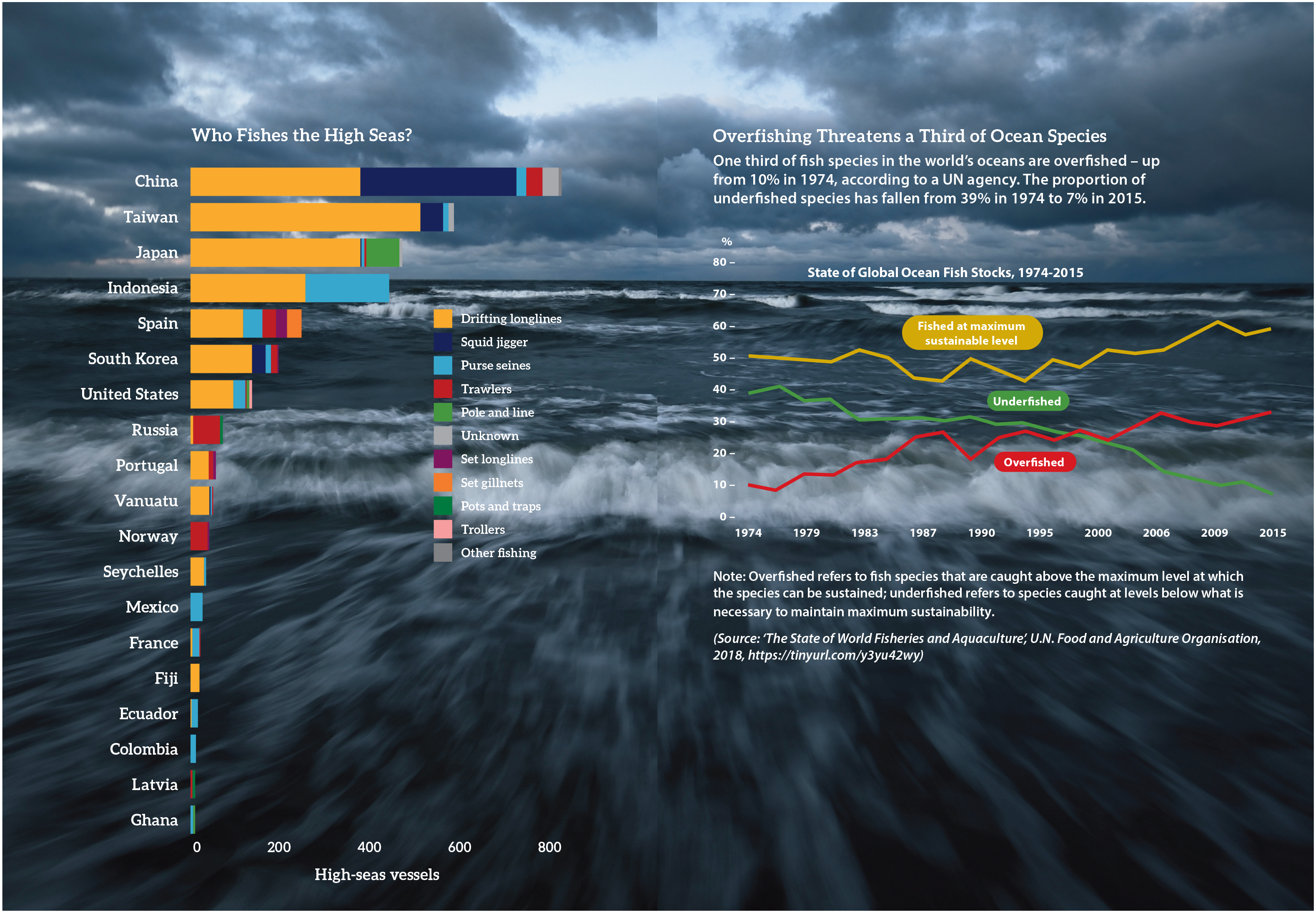
Fishing on the High Seas is an economic oddity. Because there are comparatively few fish to be found there, and because it takes a lot of fuel to motor 200 nautical miles or more in search of them, High Seas fishing is not really a profitable activity. Nevertheless, High Seas fishing persists, because a few countries - chief among them China, Japan, Spain, and the Republic of Korea - continue to subsidise fuel for long-distance fishing fleets.
Unfortunately, the governance structure for High Seas fishing is very permissive. If countries want to protect a given fish population - tuna in the Atlantic, say - they can band together to form a Regional Fisheries Management Organisation. Such an organisation can then negotiate catch limits, giving fish populations the chance to recover. The trouble is, fishing vessels can choose which country’s rules they will be governed by. Under the ‘flag state’ system, it is relatively easy for a fishing boat sailing under the flag of the United Kingdom, for example, to ‘switch flag’ and sail under the auspices of a country which does not belong to the relevant organisation. The crew can then fish to their heart’s content.
A related problem is the failure of Marine Protected Areas on the High Seas. These are areas of sea set aside with high levels of protection, where fishing activities are limited, to make fish populations more resilient. Some experts see such areas as key to conserving marine ecosystems. To date, however, Marine Protected Areas on the High Seas have barely taken off. The recent Kunming-Montreal Global Biodiversity Framework aims to protect biodiversity within 30 per cent of the planet’s water habitats. It is hard to see how that goal can be met when Marine Protected Areas today cover just 1 per cent of the High Seas. Even if more are created, their effectiveness will be an open question if boats sailing under the flag of less scrupulous countries can refuse to recognise them.
Consider one final issue on the High Seas. These areas - which are beyond the jurisdiction of any nation-state - contain a significant amount of biodiversity. The genetic codes of some of the unusual creatures that live there might contain the key to medicines or chemicals of the future. To date, it has been open to any company to collect genetic information from High Seas biodiversity, and patent it. Those companies can then charge for the privilege of using that information. For many, however, this is unjust. Countries in the Global South have argued that this biodiversity should be seen as the ‘common heritage’ of all of humankind. As a result, any financial proceeds from these ‘marine genetic resources’ should be shared between all countries, rich and poor.
A new High Seas Treaty to the rescue?
These are exactly the issues a new High Seas Treaty (technically called an Agreement on Biodiversity Beyond National Jurisdiction) is intended to address. After years of negotiations, a new Treaty was finally agreed in New York, in March of this year. If and when 60 countries ratify the new Treaty, it will come into legal force. But how much will the Treaty achieve? How successful is it likely to be in tackling environmental destruction and economic inequality at sea?
One important development is that the Treaty provides a new mechanism for creating Marine Protected Areas on the High Seas (MPA). But whether they eventually come to cover 30 per cent of the ocean - or even more - remains to be seen. The fine print of the Treaty text gives cause for concern. It outlines a process through which any country can object to a particular MPA. If it is successful in its objection, that country (and therefore vessels sailing under its flag) will not be bound to respect its provisions. At first glance, the grounds on which a country can object appear to be very wide-ranging. For instance, states can complain that the MPA infringes their rights under the existing Law of the Sea - but the existing Law of the Sea, as we have seen, gives countries essentially unlimited freedom to fish on the High Seas. The worry is that less scrupulous countries could issue a whole series of objections to new Protected Areas. It will be important to watch how such objections are dealt with in practice.
What about marine genetic resources? Here the Treaty envisages a benefit-sharing mechanism that would share the proceeds of exploitation with all countries, rich and poor. But what exactly will that mechanism look like? Will companies patenting genetic codes have to pay to do so, or will it be enough to share ‘non-monetary’ benefits like information and data? Will any benefit-sharing be compulsory, or purely optional? Disappointingly, the new Treaty doesn’t seem to resolve these questions. The Treaty text suggests a global fund will be set up, to hold contributions from those who patent marine genetic resources. But the issue of who will be required to pay into it, and when, appears to have been kicked down the road. The desire to secure an agreement has led negotiators, it seems, to defer these vitally important questions to some later date.
Workers’ rights at sea
It is important to recognise that the new High Seas Treaty does not seek to resolve all governance issues on the High Seas. There are some important problems that are left to one side. One of them is the rights of people who actually work in fishing on the High Seas. Unfortunately, these workers are among the world’s most vulnerable. They may spend weeks or months at sea, with no means of contacting family or friends. In cases where employers are unscrupulous or even abusive, this makes it very hard to achieve legal remedy. In the most extreme cases, employers have been known to kill fishing workers, and throw their bodies overboard.
This is partly explained by the distinctive legal position of fishing workers. As we have seen, each boat on the High Seas sails under the flag of one country or another. It is that flag state that is responsible for protecting workers’ rights. Unfortunately, some flag states have shown themselves to be uninterested in carrying out their duties. Instead, so-called ‘Flag of Convenience’ countries are content to sell their flag while providing little or no protection to workers.
Thinking bigger
Weak governance on the High Seas is a complex problem, and no one policy reform will provide a magic bullet. But a number of proposals are worth investigating. One priority should be to cut fishing subsidies for High Seas fishing - which is, as we have seen, environmentally destructive but fundamentally uneconomic. In June 2022, the World Trade Organization (WTO) adopted a much-awaited agreement to end destructive fishing subsidies. This could make an important contribution - but it will need to be ratified by two-thirds of WTO members before it can come into force. Pressure must be put on countries to sign up.
More broadly, some economists have suggested that we end High Seas fishing entirely. To put it negatively, High Seas fishing is environmentally destructive and economically irrational. To put it more positively, if the whole of the High Seas were protected from fishing, they would serve as an enormous Marine Protected Area within which the world’s fish populations could begin to recover from the pummelling they have taken from industrial fishing. According to some calculations, closing the High Seas to fishing would not even cost the fishing industry any revenues overall - although any losers in the short-term might need to be compensated. Ending High Seas fishing would also reduce the human rights abuses workers in fishing can face.
Closing the High Seas to fishing would not tackle all the environmental challenges it faces, however. Climate change will still be a major threat, and in that sense the future of the ocean will still depend on rapid emissions cuts in the world’s economies. The dangers of seabed mining still loom. Since it would take place on the seabed rather than the water of the High Seas itself, it would be governed separately, by the International Seabed Authority - an example of the way in which oceanic governance is unhelpfully fragmented. But since seabed mining could have such dramatic effects on the ocean’s ecosystems, serious attention should be given to a moratorium on seabed mining, at least until its environmental consequences are much better understood. Only then can we really give the High Seas a chance.
Footnotes
Chris Armstrong is Professor of Political Theory at the University of Southampton and author of A Blue New Deal: Why We Need a New Politics for the Ocean.