






Abstract

© IMAGO/Revierfoto / Alamy Stock Photo
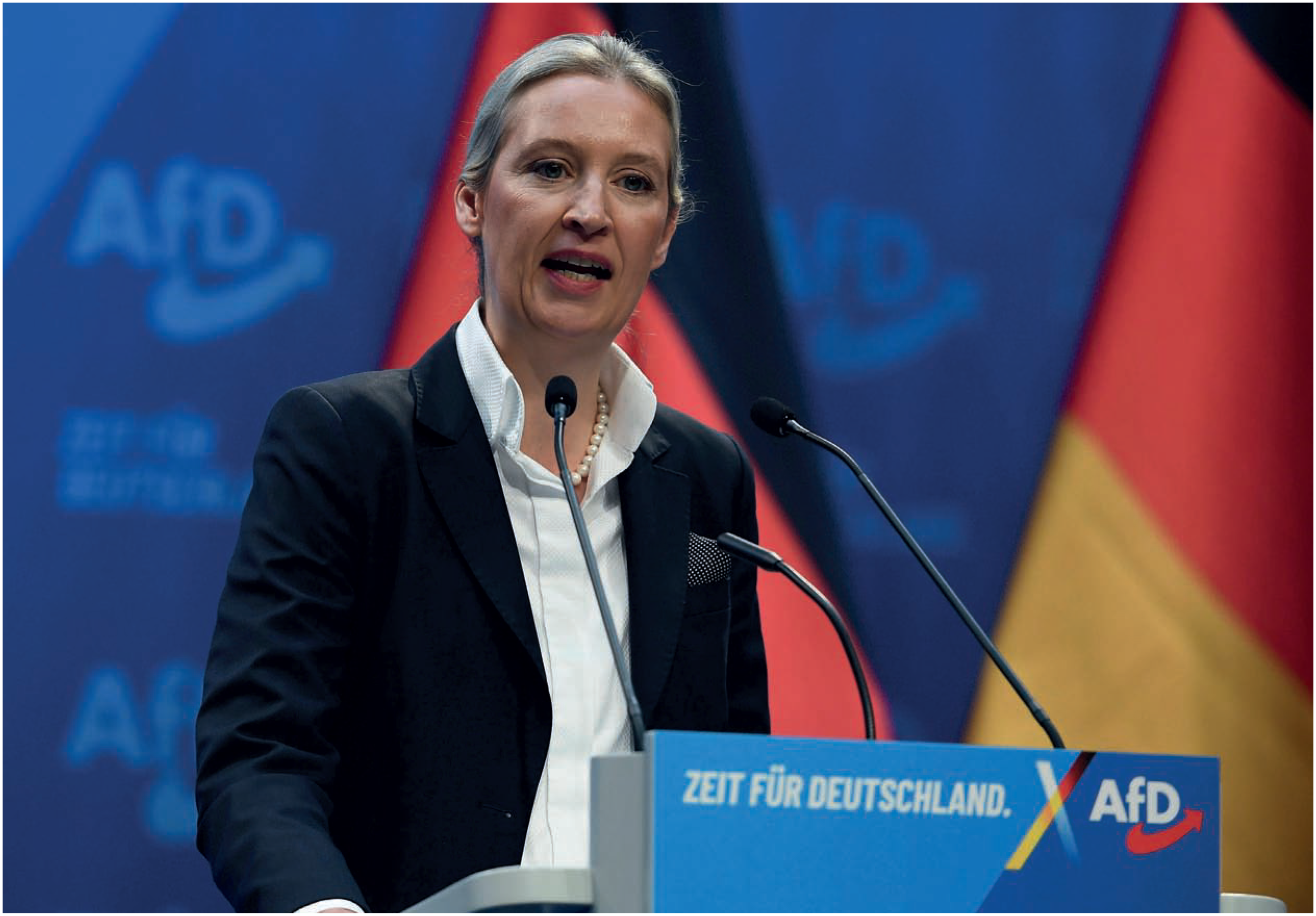
The AfD’s success underlined that adopting an anti-migration agenda is not a winning strategy for mainstream parties in the face of a rising far-right. But the German election also showed that clarity and authenticity can go a long way in mobilising support for protecting democracy, write
‘In the end, people will always choose the original,’ Heidi Reichinnek warned in a speech in the German Bundestag in January 2025. The Left Party co-leader’s words, which quickly went viral on social media, proved prophetic. Reichinnek was speaking after the Christian Democrats under Friedrich Merz had just gained enough parliamentary support to pass a motion for tougher migration policies following a fatal knife attack by an asylum seeker the previous week. The motion was highly controversial because it required support by the far-right (Alternative for Germany) AfD to pass, breaching a long-standing taboo in Germany to not collaborate with the far-right in federal politics.
The German Parliament ultimately rejected Merz’s immigration bill but the motion was part of a wider move by his Christian Democrat Union and its Bavarian sister party (known as the CDU/CSU) to try to stop AfD’s rise by adopting tougher positions on migration. The results of Germany’s federal election on 23 February 2025 show that this strategy has failed (see Figure 1). So what drove the success of the AfD? And what can centrist parties and politicians across Europe learn from the German experience?
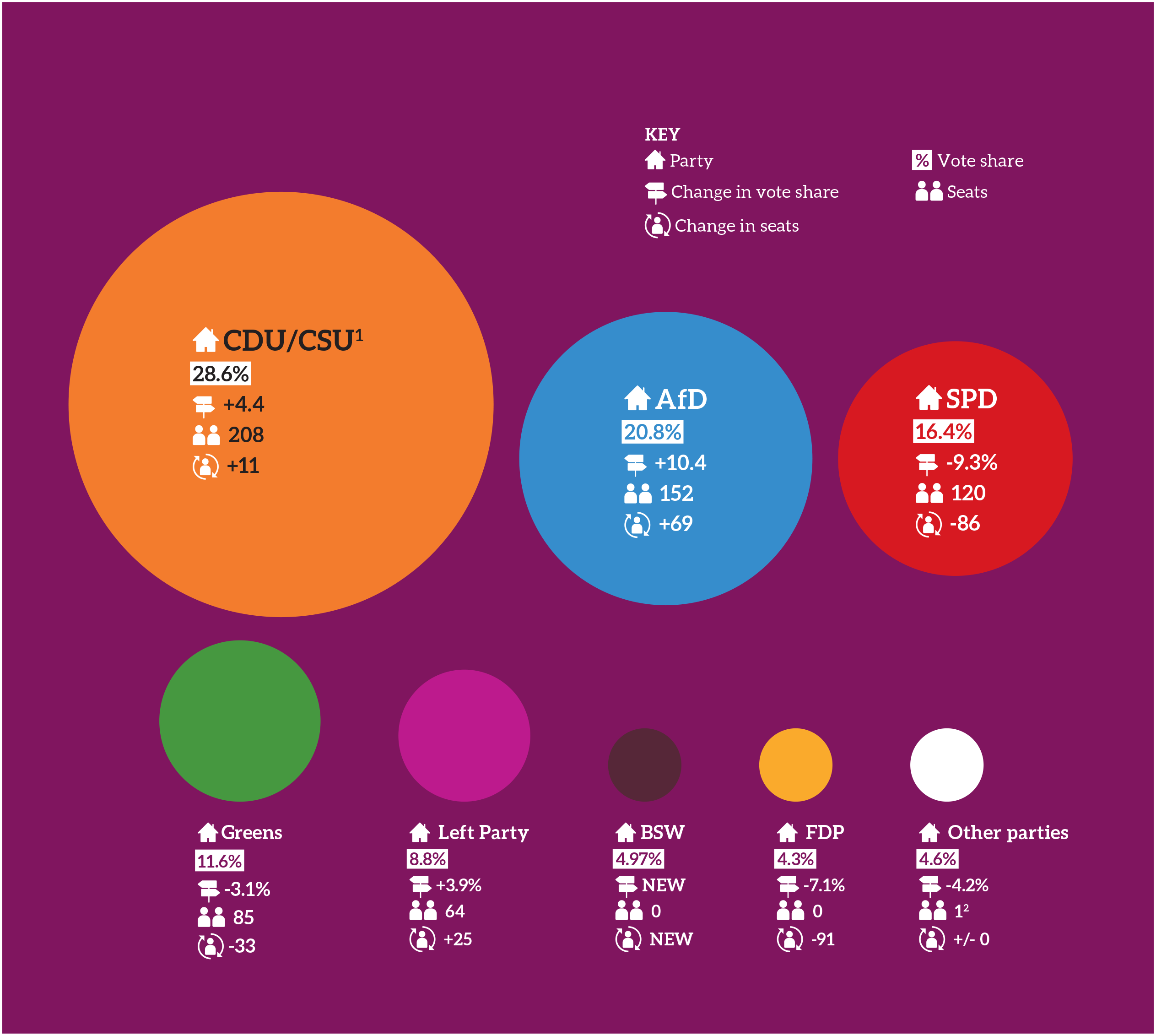
Results of Bundestag Election, 23 February 2025
Understanding the election
Never since the foundation of the Federal Republic after the Second World War has a far-right party held more seats in the Bundestag. The AfD doubled its 2021 result to just under 21 percent, making it the second-strongest party in Parliament. With 152 seats, the AfD will now receive more significant public funding, have more parliamentary speaking time, and will be entitled to hold important positions in the Bundestag. Many AfD MPs are new to the Federal Parliament, but their political careers to date suggest that they are likely to upset parliamentary rules and provoke and mock Germany’s mainstream parties and parliamentary democracy.
The recent elections at both state (Land) and federal level also showed that most AfD voters do not support the party merely out of dissatisfaction with the other options but because they agree with the AfD’s key policy positions (e.g. opposition to climate and migration policies) and its way of ‘doing politics’. Indeed, there is growing evidence of the emergence of a substantive share of AfD loyalists, characterised by a relatively coherent set of attitudes supportive of nativism and authoritarianism (Hansen and Olsen, 2024).
The AfD has consolidated its position in Germany’s party system and public discourse. This is particularly the case for Germany’s five eastern states, where the AfD became the largest party overall and also won 45 out of 48 first-past-the-post constituency seats. Thirty-five years after German reunification, the AfD has entrenched itself as the major regional party in the post-Communist East, where it has claimed for some time to be the ‘people’s party’.
The new government’s job will not be made easier by the increased polarisation in German politics. In addition to the AfD’s substantive gains on the far-right, the election has also resulted in a strengthened far-left.
The situation could not be more different for Germany’s mainstream parties. Despite improving on their disastrous 2021 result and in all likelihood returning to government in Berlin, the CDU/CSU’s 28.6 per cent marks the second-worst result in the Christian Democrats’ history. Election night was even worse for the Social Democrats (SPD). The party of Chancellor Olaf Scholz lost more than 9 per cent compared to its result in 2021. With a mere 16 per cent, it fell to third place, behind CDU/CSU and AfD. This is the SPD’s worst result since the introduction of universal suffrage in Germany in 1919. Continuing a trend, the SPD particularly lost support from its core base, with many blue-collar workers and unemployed now voting AfD. The SPD’s former coalition partners, the Green Party and Free Liberal Party (FDP), did not fare much better. While the Greens only suffered relatively modest losses, dropping to 11.6 percent, the FDP’s vote share was more than halved. With only 4.3 per cent, the party failed to clear the 5 per cent threshold and did not gain any seats in Parliament for the second time since 2013.
A wake-up call
One silver lining from these election results is that Germany is likely to avoid what could have been the most complicated government formation process in postwar history. The real nail biter on election night was not whether the AfD would do better than polls suggested, but how many of the smaller parties would enter Parliament. Because both the FDP and the new Sahra Wagenknecht Alliance (Bündnis Sahra Wagenknecht, BSW), which split from the Left Party just over a year ago, failed to clear the 5 per cent threshold, Germany avoided new record levels of parliamentary fragmentation. As a result, the country will very likely have a stable government with the return of a CDU/ CSU-SPD coalition, albeit weakened due to its relatively small majority. However, given the ‘cost of governing’, both CDU/CSU and SPD may have reason to worry about the next elections. ‘Grand coalitions’ between these two parties have often strengthened the political margins, whereas the parties in government risk losing many of their ‘unique selling points’ because of the constraints of governing together. While Germany may well have a stable government, it may see the AfD make further gains in four years’ time.
The new government’s job will not be made easier by the increased polarisation in German politics. In addition to the AfD’s substantive gains on the far-right, the election has also resulted in a strengthened far-left. The Left Party, written off by pollsters ahead of the election, celebrated a surprise electoral comeback, largely driven by its high support among younger voters. Winning a quarter of the vote among 18- to 24-year-olds, the Left Party rose from 3 per cent in the polls in late 2024 to nearly 9 per cent on election night. Its positions on public finances, welfare policies, and, even more importantly, defence and foreign policy, are often at odds with the positions of SPD, Greens, and especially CDU/CSU. For this reason, the new governing coalition will benefit from the BSW having missed the threshold by less than 14,000 votes (it won 4.97 per cent). The BSW’s stark opposition to military support for Ukraine and demands for ‘peace’ in the face of Russia’s war of aggression would have further strengthened the polarised parliamentary opposition in their rejection of boosting Germany’s defence capabilities and supporting Ukraine.
Nevertheless, the election is a serious wake-up call for Germany’s mainstream parties. Together, the CDU/CSU, SPD, and Greens hold fewer than two-thirds of the seats in the Bundestag. That means that these centrist parties no longer hold enough seats to change Germany’s constitution. The incoming CDU/CSU and SPD government faces huge challenges both at home and abroad. The Trump administration’s U-turn on support for Ukraine and the threat to impose tariffs on EU goods have dramatically increased the urgency for Germany and Europe to strengthen their independence from the United States. Merz himself acknowledged on election night that the US can no longer be seen as a reliable partner.
Early signs from the coalition talks between CDU/CSU and SPD indicate that the parties plan to act quickly and decisively; in addition to a special fund of 500 billion Euro to invest in Germany’s ailing infrastructure, the parties agreed to a reform that would exempt any defence spending above 1 per cent of GDP from the ‘debt brake’. Since the AfD and Left Party have enough seats in the new Bundestag to block such a reform, the CDU/CSU and SPD signalled its intention to push these measures through in special parliamentary sessions before the new government comes into office. While this plan is fully in line with constitutional law, it is unusual for an outgoing Parliament to make such far-reaching decisions after an election. It underlines that these are extraordinary times.
Responding to the far-right
How can Germany’s mainstream parties respond to the rise of the extremes? The political but also democratic pressure to engage with the AfD and the more than ten million voters who cast their ballot for the far-right is severe. Upon assuming the CDU leadership in 2022, Friedrich Merz adopted an anti-migration strategy as a response to the far-right. This was a stark departure from the more centrist course the CDU had pursued under Angela Merkel and her successors. Even before breaking the parliamentary ‘fire wall’ by accepting AfD support for his motion in January, Merz’s anti-migration stance repeatedly made headlines. The language that Merz has used to describe both refugees and political opponents also reflects a serious departure from his party’s pluralist and consociational approach to politics (Dilling, 2024). CDU and CSU were not the only parties to adopt more anti-migration positions. The coalition government of SPD, Greens, and FDP also introduced tougher migration legislation in the autumn of 2024.
While accommodating the far-right’s demands for anti-migration policies may seem sensible from a democratic-theory perspective by responding to the demand of a growing share of voters, it has not helped mainstream parties to maintain their vote share or reduce the AfD’s appeal. Rather than winning back voters from the AfD, CDU/ CSU suffered a net loss of over one million voters to the far-right. Similarly, while having initially been relatively immune against losing support to the far-right, the SPD lost over 700,000 voters to the AfD in this election. The FDP lost 900,000 voters to the AfD. These losses echo the larger comparative literature in political science, which has evidenced that accommodating far-right positions on migration is not a vote-maximising strategy (Krause et al., 2023). While it can, under certain circumstances, attract some anti-migration voters, such gains are typically outweighed by losing more moderate voters (Chou et al., 2021; Hjorth and Larsen, 2022). Instead, accommodation has shown to strengthen the far-right by legitimising and normalising its views (Krause et al., 2023).
Instead, the Left Party’s strategy behind its surprise comeback may provide more promising inspiration for Germany’s mainstream parties. Following years of internal turmoil and the eventual departure of Wagenknecht and her supporters, the party began its gradual rise in the polls by focusing on its core issues of social equality, fair rents, and opposition to racism and discrimination. It combined this renewed policy focus with a sophisticated use of modern technology. Its ‘exorbitant rents calculator’ app helped not only to collect data on almost 50,000 cases of ‘exorbitant’ rents but also to connect with voters. Its recovery in the polls gained further momentum when Reichinnek’s speech condemning Merz for breaking the parliamentary ‘fire wall’ by accepting AfD support for his anti-migration motion went viral on TikTok and Instagram. The Left Party’s focus on social justice, economic equality, and pro-migration views can certainly not serve as a blueprint for other parties. Such positions would, for instance, hardly be credible for the CDU/CSU. However, it underlines the importance of authenticity when parties try to respond to the far-right. The Left’s comeback adds to evidence from other countries that has shown mainstream parties to fare better in maintaining levels of support and containing the far-right if they address concerns over migration in a way that is consistent with their traditional ‘brand’ (de Jonge, 2021). At a time when Germany and Europe seem to be at a crossroads, mainstream parties would be well advised to remember that clarity and authenticity can go a long way in mobilising support and protecting democracy.