






Abstract

© Justin Ng / Alamy Stock Photo

Fragmentation and coalition politics are set to define the next UK election. Richard Rose outlines the possible scenarios for the next general election.
By-election results in recent months have confirmed what opinion polls and electoral trends have been suggesting for some time: Britain’s general elections are no longer truly general. Across much of the United Kingdom’s 650 constituencies, the traditional contest between Labour and Conservative candidates is no longer the defining political competition. In Gorton and Denton in February, the Green Party came first, Reform UK second, and the Conservative candidate of the official Opposition finished fourth and lost their deposit. In Runcorn last year, Reform captured one of Labour’s safest seats.
These outcomes illustrate a fundamental change in British politics. The two-party system that structured elections for most of the 20th century has fragmented into a patchwork of local contests involving multiple competitors. Instead of a uniform national swing determining who governs, different parties now dominate different political terrains.
Depending on the constituency, one of several parties offers voters dissatisfied with Labour a credible alternative. Reform UK campaigns most effectively in areas where immigration and cultural change are salient concerns. The Green Party has moved decisively leftwards in university towns and metropolitan constituencies with large student populations. The Scottish National Party and Plaid Cymru compete by emphasising national autonomy and independence. Liberal Democrats appeal to voters seeking closer relations with the European Union. Independents have succeeded in constituencies with large Muslim electorates by foregrounding support for Palestinians.
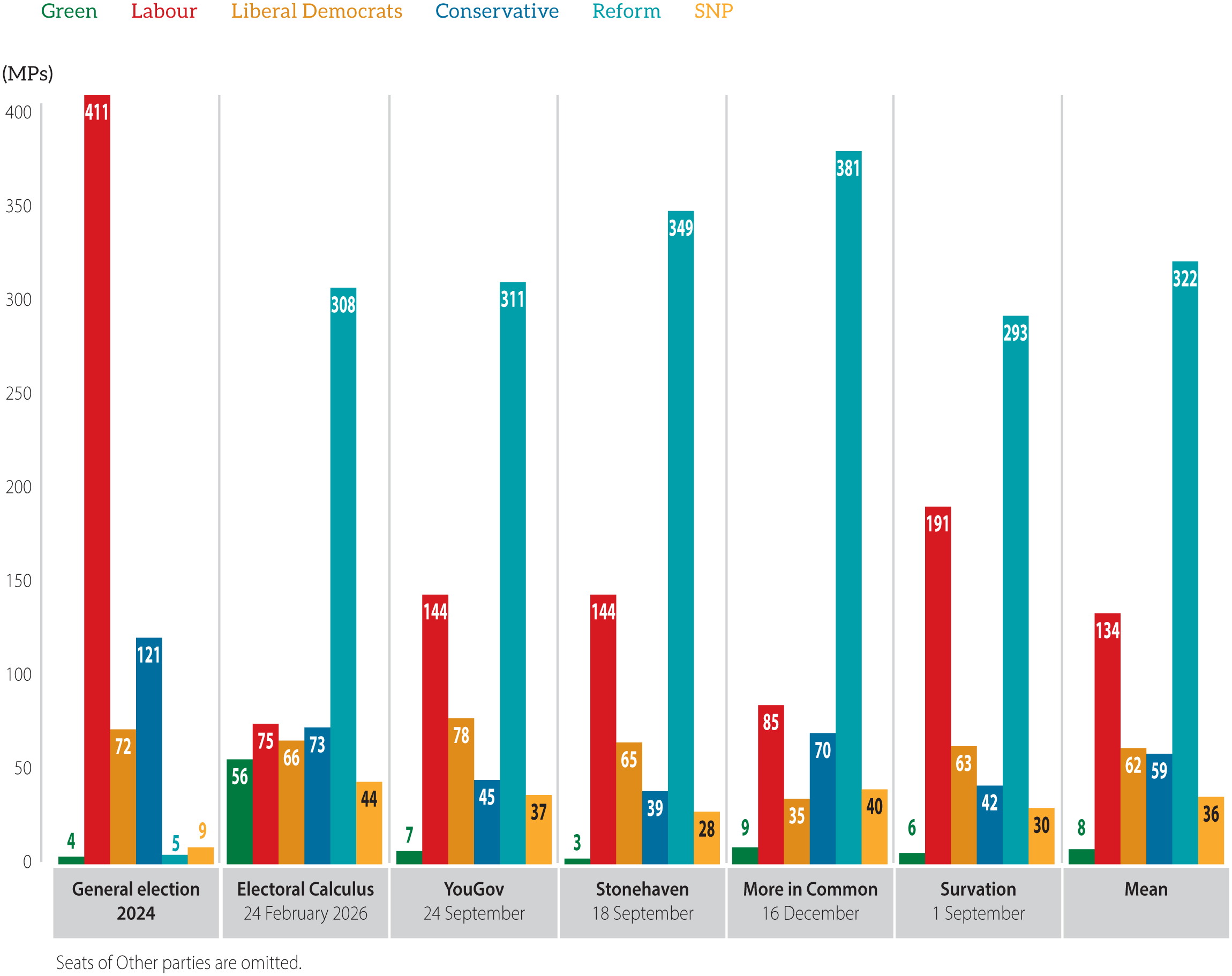
MRP Predictions of a General Election
Seats of Other parties are omitted.
Meanwhile, the Conservative Party remains strategically divided: it must decide whether to compete with Labour on economic competence or challenge Reform UK on immigration and cultural issues. The result is a political landscape defined less by a single national contest than by multiple localised struggles.
Why national polls no longer suffice
In such circumstances, national opinion polls alone provide an increasingly misleading guide to electoral outcomes. A general election result is no longer the straightforward aggregation of national vote shares but the cumulative effect of hundreds of distinct constituency battles.
To address this complexity, analysts now rely heavily on multi-level regression and post-stratification modelling, which estimates outcomes seat by seat before aggregating them into a projected House of Commons. These projections remain hypothetical – snapshots of what might happen if an election were held immediately – yet they capture the consequences of party fragmentation far better than the now outdated results of the 2024 General Election.
Recent modelling exercises suggest a striking possibility: Reform UK could emerge as the largest parliamentary party if an election were held today. Labour and the Conservatives appear increasingly likely to compete for second place rather than government, each potentially holding fewer than 100 MPs. Liberal Democrats hope to consolidate their parliamentary presence, while the Greens seek to translate rising vote shares into significant representation. Labour’s erosion in Scotland gives the Scottish National Party a realistic prospect of winning most of the country’s 57 seats.
However, projecting seat totals answers only part of the political question. In a fragmented party system, election results no longer automatically determine governments. Parliamentary arithmetic must now be combined with ideological compatibility, leadership ambitions and strategic calculations about legitimacy. The next election therefore invites consideration not of one likely outcome but of several plausible governing scenarios.
Can the traditional parties still govern alone?
The most familiar outcome would remain a single-party majority government manufactured by the first-past-the-post electoral system. Historically, this system converted pluralities of votes into decisive parliamentary authority. Keir Starmer benefited from precisely such an effect when Labour secured a commanding Commons majority despite opposition parties collectively winning 66 per cent of the vote.
Today, however, that electoral bonus appears to have disappeared. For Labour to regain an outright majority it would need to increase its electoral support by more than half. For the Conservatives, the required recovery would be even greater – larger than the surge achieved by Margaret Thatcher when she defeated a Labour government in 1979. While electoral politics always allows for surprises, neither outcome appears likely under current conditions.
A more realistic possibility is a single-party minority government. A party winning a substantial plurality of seats might remain in office through confidence-and-supply arrangements. Theresa May’s Conservative government survived in this manner after the 2017 election by securing support from Northern Ireland’s Democratic Unionist Party.
The Scottish National Party could play a comparable role in future. Because it does not seek participation in UK-wide government, it could sustain a minority administration in exchange for legislation granting the Scottish Parliament authority to call an independence referendum. Such an arrangement would allow a governing party to retain authority while depending on nationalist leverage.
Another possibility is what might be termed a ‘penny-farthing’ coalition – a two-party government dominated by one large partner supported by a much smaller one. If the Liberal Democrats retained roughly their present strength, they could provide a governing majority to a party holding approximately 250 MPs.
For Liberal Democrat leaders, this would revive a familiar dilemma. Coalition participation offers Cabinet influence and legislative power but carries electoral risks. The party’s experience after joining the Conservative-led coalition in 2010 demonstrated how junior partners can suffer severe punishment at subsequent elections. Cooperation with Labour would pose fewer ideological difficulties, yet such an opportunity would arise only if Labour experienced significant seat losses, weakening its authority as senior partner.
Governing through cooperation
Fragmentation makes broader coalitions increasingly conceivable. A three-party ‘tricycle’ coalition involving Labour, Liberal Democrats and Greens could emerge if Green representation expanded significantly. These parties share enough policy overlap to cooperate, particularly on environmental and constitutional reform, though Labour would require a substantial electoral recovery to lead such an alliance.
Even more flexible arrangements are possible. A minority government might survive through shifting parliamentary alliances – a ‘pogo-stick’ strategy in which ministers assemble different voting majorities depending on the issue. Green MPs might support climate legislation, Liberal Democrats could back increased funding for local government, while other parties abstain rather than trigger an election.
Comparable arrangements already operate elsewhere in Europe. Norway’s Labour Party governs despite holding only 31 per cent of parliamentary seats, relying on ad hoc support from allied parties. As Britain’s party system fragments, such fluid governing practices may become less exceptional and more routine.
Up to this point, these scenarios assume that either Labour or the Conservatives remains central to government formation. The political calculus changes dramatically if Reform UK becomes indispensable to building a majority.
Reform UK and the politics of disruption
An outright Reform UK parliamentary majority would represent the most dramatic break in post-war British politics. Constitutionally, the monarch would invite Nigel Farage to form a government. Yet electoral success would immediately confront Reform with organisational challenges. The party lacks a large pool of experienced MPs capable of filling ministerial offices required to run government departments.
External appointments to the House of Lords could supplement ministerial ranks, but Commons ministers would still be required to answer to Parliament. Governing capacity, rather than electoral legitimacy, would become Reform’s first test.
A more probable outcome would be a Reform–Conservative coalition if Reform emerged as the largest party without securing a majority. Electoral arithmetic might encourage cooperation: many Reform voters are former Conservatives, and ideological differences between the two parties are smaller than those separating either from Labour.
Political incentives, however, complicate such an alliance. Serving as junior partner to Reform could threaten the Conservative Party’s long-term independence, recalling how the National Liberals disappeared after aligning permanently with Conservative leadership between the wars. Moreover, Farage has repeatedly stated that his aim is to replace rather than collaborate with the Conservatives. Conversely, a Conservative-led coalition including Reform would risk internal instability, as a media-savvy deputy prime minister could overshadow the prime minister.
A defensive alternative would be a Labour–Conservative coalition designed explicitly to exclude Reform from office. Both Keir Starmer and Conservative leader Kemi Badenoch have characterised Reform as beyond acceptable democratic norms. A grand coalition could therefore emerge as the only parliamentary majority capable of preventing Reform from governing.
Such an arrangement would resemble Britain’s wartime coalition governments but would carry significant political risks in peacetime. It would reinforce populist claims that Labour and Conservatives constitute a single establishment determined to preserve power regardless of the desire of voters.
The strain on first-past-the-post
These scenarios collectively test the resilience of Britain’s electoral system. The traditional justification for first-past-the-post has never been fairness but governability. By exaggerating parliamentary majorities, it concentrates responsibility for government and allows voters to reward or punish incumbents easily.
Since 2010, however, the system has twice failed to produce a majority government. Increasing party fragmentation raises the possibility that it may fail again - not once but repeatedly.
If a future election produced a House of Commons incapable of sustaining either a minority or coalition government, a caretaker administration might remain in office while a second election was held within months. Repeated inconclusive elections would fundamentally challenge assumptions underpinning Britain’s constitutional arrangements.
At that point, electoral reform could move from academic debate to political necessity. Liberal Democrats, Greens, nationalist parties and Reform UK all favour proportional representation. Labour and Conservative MPs, faced with recurring instability, might conclude that preserving first-past-the-post risks endless disruption. Abstaining on electoral reform could become preferable to governing amid chronic parliamentary deadlock.
From two-party politics to systemic uncertainty
The significance of the Gorton and Denton and Runcorn by-election results therefore extends beyond individual constituencies. They signal the maturation of a process that began long before the 2024 General Election: the disruption of Britain’s party system.
The next general election may not simply determine which party governs. It may determine whether Britain continues to operate under political assumptions shaped by 20th century two-party competition or adapts to a new era defined by fragmentation, negotiation and coalition-building.
General elections once produced decisive answers to a single national question. The next one is far more likely to produce multiple plausible governments, each dependent on fragile parliamentary arithmetic. Britain is entering an era in which the outcome of elections will no longer be obvious on election night – and where governing may prove more difficult than winning.
Footnotes