






Abstract
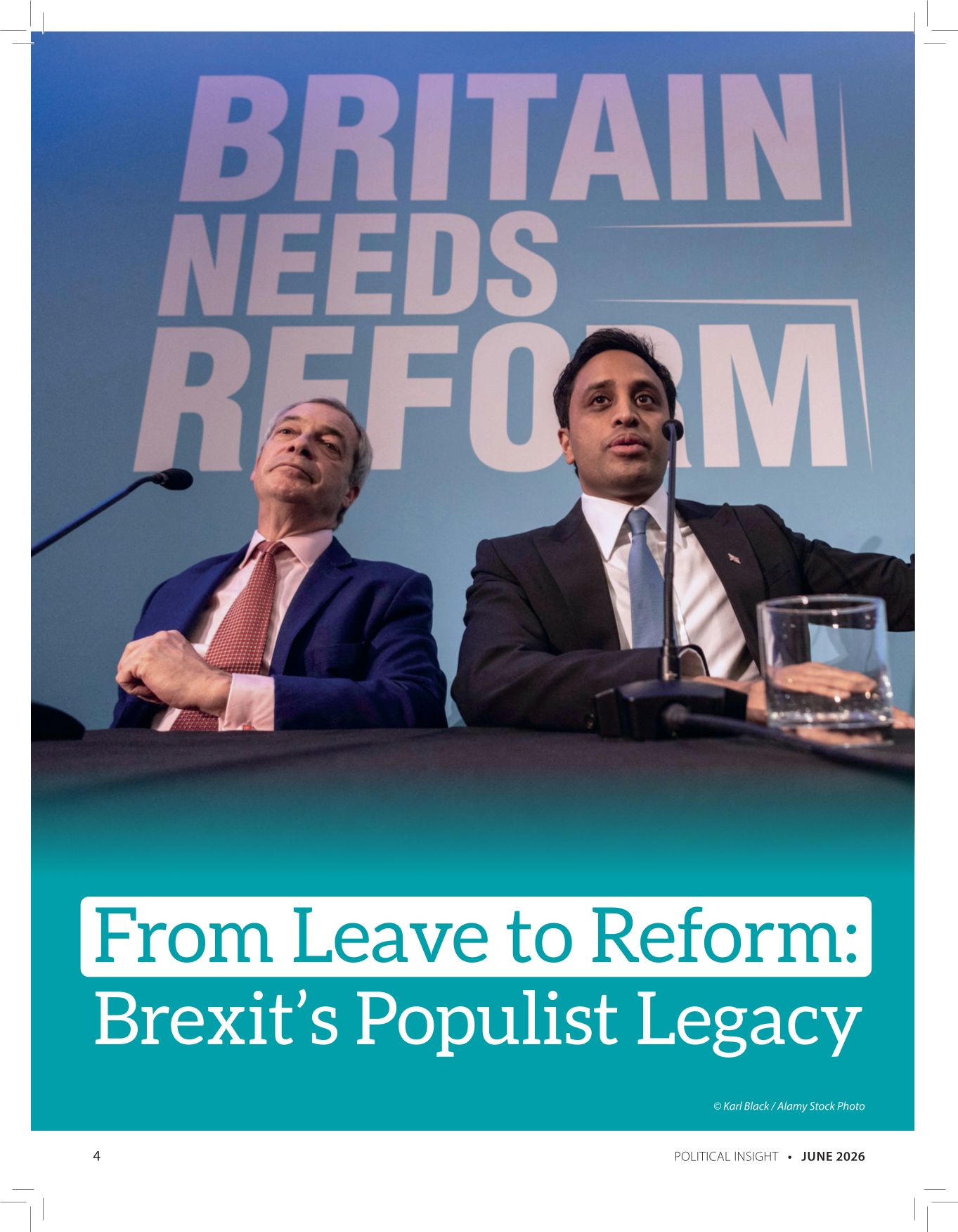
© Karl Black / Alamy Stock Photo

Something broke in British politics long before 2016, and Brexit accelerated the collapse. Anand Menon charts the spiral of unmet expectations and eroded trust that has carried Reform UK from the fringes to the threshold of power.
Here’s a curious thing. Some ten years after the EU referendum, support for Brexit has declined significantly. Fifty six per cent of the public now believe it was the wrong decision, compared with 31 per cent who say it was the right one. Evidence of the negative economic impact of leaving the EU is piling up. Yet Nigel Farage, the man synonymous with the project, is the bookies’ favourite to be the next prime minister
Paradoxical? Only superficially. There is a reason why British politics is in turmoil. Why populist parties are flourishing. Why there is the real prospect of Reform UK forming the next government.
And that reason is intrinsically linked to Brexit. The referendum of 2016 was partly a protest against a fundamentally flawed political and economic status quo. A subsequent failure to respond effectively to that discontent further strengthened the anti-politics sentiments that helped fuel it in the first place. Subsequently, the process of exiting the EU merely provided grist to the populist mill. Farage, in other words, both exploited popular dissatisfaction at the referendum of 2016 and has benefited from the failure of mainstream politics to address it subsequently.
Which leaves us where we are today. With a government elected on a manifesto promising ‘change’ languishing in the polls because of its failure to deliver. With the two traditional parties of government securing their lowest ever combined vote share in recent local elections. With populist challengers threatening to upend the old political order. Brexit has played a key role in helping this come about.
Brexit has been portrayed as the revenge of the ‘left behind.’ There is far more to it than that. Only 21 per cent of Leave voters could be described as working class while 59 per cent were middle class. Yet there was more than a hint of truth to the claim that Brexit represented the ‘Revenge of the Places that don’t Matter.’ Poorer areas were disproportionately likely to back Leave. And on an individual level, the referendum did mobilise significant numbers who were economically insecure and had given up with mainstream politics. Some three million people who had not voted in the 2015 General Election turned out to vote on 23 June 2016. This increase was most marked amongst social groups with a preference for leaving the EU.
The popular dissatisfaction that found its outlet in that vote had been brewing for some time. In the years prior to the referendum, with the Great Financial Crisis beginning to bite, scandal and crisis in the form of the MPs expenses debacle and the economic aftershocks of the crash combined to drain faith from politics. Meanwhile, as New Labour embraced the free market, and both major parties promoted liberal social policies, voters increasingly felt they were being denied any real choice. The liberal governing cartel labelled ‘Remainia’ by Rafael Behr bestrode British politics. By 2015, the percentage of voters who saw a ‘great difference’ between the two big parties was a mere 27 per cent. The British Social Attitudes Report found in 2015 that around one quarter of the British population believed that ‘it’s not really worth voting’.
This was the frustration that the Leave campaign capitalised on. To take a couple of examples: in Hartlepool, Leave gained 70 per cent of the vote on a 73 per cent turnout (as compared to a 61 per cent in 2015). Boston in Lincolnshire was the site of the Leave campaign’s biggest victory (76 per cent voted for Brexit). Median household income in the town in 2016 was less than £17,000, as compared with £27,000 across the 20 local authorities where support for EU membership was strongest. The Leave vote in other words represented, amongst other things, a howl of protest from people who turned out to demand that they should no longer be overlooked.
And to be fair to the Conservative Party, it seemed to understand this. In July 2016, Theresa May stood outside Downing Street and spoke of the ‘burning injustices’ in British society and emphasised the priority her government intended to give to those ‘just about managing’. A year later, the Conservative manifesto was arguably the most statist and interventionist produced by a governing party in living memory. Conservatives, it declared, ‘do not believe in untrammelled free markets. We reject the cult of selfish individualism. We abhor social division, injustice, unfairness and inequality.’
Boris Johnson continued in the same vein. The day after his general election triumph, he called in senior civil servants and announced that the whole government had to shift its focus to improving the lives of the working-class voters in the North of England who backed Brexit and switched to the Tories.
However, rhetoric was accompanied by precious little in the way of delivery. Theresa May barely made an impression on those ‘burning injustices’, several of which were exacerbated on her watch. Nor did things improve under her successors.
And so, a gulf emerged between what politicians were saying about responding to the referendum, and what they did. Unsurprisingly, the public reacted. The number of people who almost never trust the British government to place the needs of the nation above those of their own party nearly doubled from 26 per cent in 2019 to 49 per cent in 2024. Distrust increased most among those who voted to Leave in 2016. Forty two per cent of Leave voters – as opposed to 24 per cent of Remainers – believed politicians don’t care ‘at all’ about their region. This was particularly striking because trust and confidence had increased significantly among Leave voters in the immediate aftermath of the UK’s departure from the EU. Hopes raised, then dashed.
And frustration with politics saw us return to the anti-politics mood that had characterised the pre-referendum period. While in 2019, 47 per cent had said there was a great deal of difference between the parties, by 2024 just 12 per cent believed this. Successive governments had missed a chance to respond to a clearly stated public desire for change, and the public reacted accordingly.
All of which has continued to this day. A Labour government elected on a manifesto entitled simply ‘Change’ has failed to deliver. Consequently, it has seen its support decimated. The massive majority secured by Keir Starmer flattered to deceive. Behind the headlines lay the lowest ever combined vote share for Labour and the Conservatives. Reform UK, the Greens and Plaid Cymru all saw their highest ever general election vote shares. Labour’s electoral ‘Jenga tower’ is built on under 34 per cent of the vote. And its wobbliness has been underlined subsequently, culminating (for the moment) in the local elections a few weeks ago in which the governing party was hammered, while Reform UK and the Green secured significant gains.
A failure to deliver change led to increasing public disillusionment in the years following the referendum (as indeed it has done in the months following the 2024 election). The conditions were – and are – thus propitious for the rise of populist alternatives. All the more so because the post-referendum years helped normalise the populist playbook.
This began with the referendum itself. Populism is generally defined as a political ideology pitting a supposedly out of touch elite against a unified ‘people’. And a popular vote that had to be implemented by a Parliament with a Remain backing majority provided an ideal context for populist rhetoric to flourish. As early as the 2016 Conservative Party Conference, Theresa May was arguing that those who claimed Article 50 could only be triggered following agreement in both Houses of Parliament were ‘trying to subvert’ democracy.
A failure to deliver change led to increasing public disillusionment in the years following the referendum (as indeed it has done in the months following the 2024 election). The conditions were – and are – thus propitious for the rise of populist alternatives. All the more so because the post-referendum years helped normalise the populist playbook.
The November 2016 High Court judgment, which saw the government defeated on this question led to the infamous ‘Enemies of the People’ headline in the Daily Mail and ‘The judges versus the people’ in The Telegraph. During the course of the parliamentary battles over Brexit, the media was to variously refer to Members of Parliament as ‘saboteurs’, ‘wreckers’, ‘mutineers’, and ‘traitors’.
The theme of the people versus Parliament was to become a staple of Mrs May’s rhetoric. Calling the 2017 election, she declared that ‘the country is coming together, but Westminster is not’. Having finally negotiated a Brexit deal, she conducted a two-week campaign appealing directly to the public over the heads of MPs – even though it was the latter who would ultimately decide her fate.
When MPs rejected the agreement for a second time, the Prime Minister ramped the rhetoric up a notch. In a TV address to the nation on 20 March 2019, she declared that voters were ‘tired of the infighting, tired of the political games and the arcane procedural rows, tired of MPs talking about nothing else but Brexit’. She claimed Parliament had done ‘everything possible to avoid making a choice,’ while ‘I am one your side.’
And there was a receptive audience for such rhetoric. The 2019 edition of the Audit of Political Engagement found that 54 per cent of respondents felt ‘Britain needs a strong leader willing to break the rules’. 43 per cent expressed a preference for political parties and leaders ‘with radical ideas for change who haven’t been in power before’. The findings prompted The Times newspaper to devote its main leader to the danger of populism.
Following Boris Johnson’s election as Tory leader and Prime Minister, the battle between Parliament and the executive intensified. The new Prime Minister lost six votes in six days following the summer recess. At one point the government hinted that it might not comply with a law passed by Parliament to prevent a no deal Brexit.
Before his election to the Tory leadership, Johnson had argued that it was ‘wrong in every sense to blame MPs for blocking Brexit. It is both shameful, and inaccurate’. By the time of the 2019 election, his manifesto described a UK ‘paralysed by a broken Parliament that simply refuses to deliver Brexit’ and criticised MPs who have ‘devoted themselves to thwarting the democratic decision of the British people’ thereby opening a ‘destabilising and potentially extremely damaging rift between politicians and people.’
And the disregard for the rules continued. The government tried to circumvent its own Northern Ireland Protocol via an Internal Market Bill, which, in the words of the Northern Ireland Secretary, meant it could breach international law in ‘a specific and limited way.’ Even as he was about to be pushed from power, Johnson insisted to the House of Commons that the ‘deep state’ was plotting to take the UK back into the EU.
We were thus confronted with a potent combination. High levels of public frustration – not least with the stagnation of real wages since 2008 – created fertile soil for populism, while the actions of successive governments reinforced the key populism narrative of the people versus the elite.
And Brexit itself has had another role to play here. Leaving the European Union has had precisely the impact that all serious economists forecast, in reducing the UK’s trade intensity and weighing significantly on its growth prospects. Addressing economic inequality becomes far more difficult when the economy as a whole is flatlining. Yes, the referendum was a wakeup call. But its outcome has also been a contributory factor to the economic insecurity that has helped drive populism in its wake.
For some observers at the time, Brexit showcased the functionality of the British political system. The referendum, Fraser Nelson argued, provided a ‘safety valve,’ allowing voters to vent their frustration without doing something more drastic, such as electing their own version of a President Trump.
As it turns out, these analyses were founded on two elections that were outliers from the broader secular trends that had been shaping British politics. The fragmentation and polarisation that were hinted at in the General Election of 2015, were held in abeyance in those of 2017 as the figures of Corbyn and then Johnson and the issue of Brexit dominated. But they reasserted themselves with a vengeance in 2024 and subsequently.
Brexit figures as both cause and consequence when it comes to the rise of populism. Consequence, in that the outcome in 2016 reflected increasing discontent with the political and economic status quo. Cause, not only in the way the methods deployed to implement it showcased the populist playbook but also in the failure to address the obvious popular desire for things to be done differently, which sapped faith in politics and in its economic impact which ultimately made failure more likely.
The success of populism has been rooted in the failure of mainstream politics to deliver. The sad fact about contemporary Britain is that the populist diagnosis of a political elite that seems more concerned with squabbling among themselves than delivering economic security is a superficially compelling one. Brexit was the first clear signal of this discontent. The subsequent decade has merely intensified this sentiment. Practical improvements to the lives of those who, nearly a decade ago, protested about being ‘forgotten’ is the only effective means of combating the threat.
Which brings us back to Nigel Farage. An unrivalled exploiter of grievance, his championing of the Leave cause underlines the degree to which populist ‘solutions’ merely exacerbate the frustrations from which populism draws its support.
In the aftermath of Brexit, mainstream politicians had a unique opportunity to react to this dissatisfaction. It was an opportunity they squandered. At the time of writing, another Labour politician, Andy Burnham, is running based on a promise to bring about ‘change’. Should he win he now has a small window in – and a sizeable majority with – which to deliver the change people have long clamoured for or face the electoral consequences.
Footnotes
Anand Menon is Professor of European Politics and Foreign Affairs at King’s College London, and Director, UK in a Changing Europe.