






Abstract
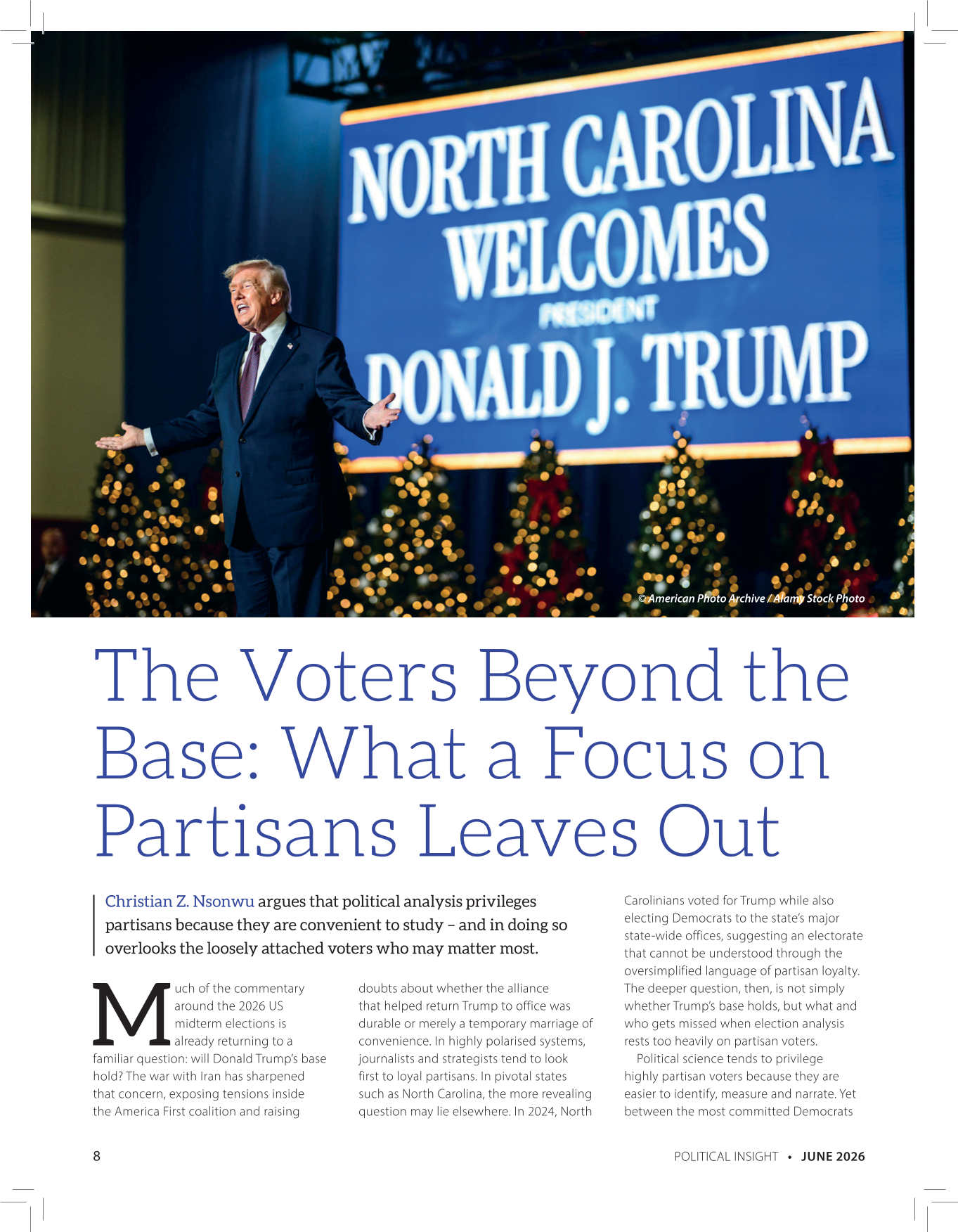
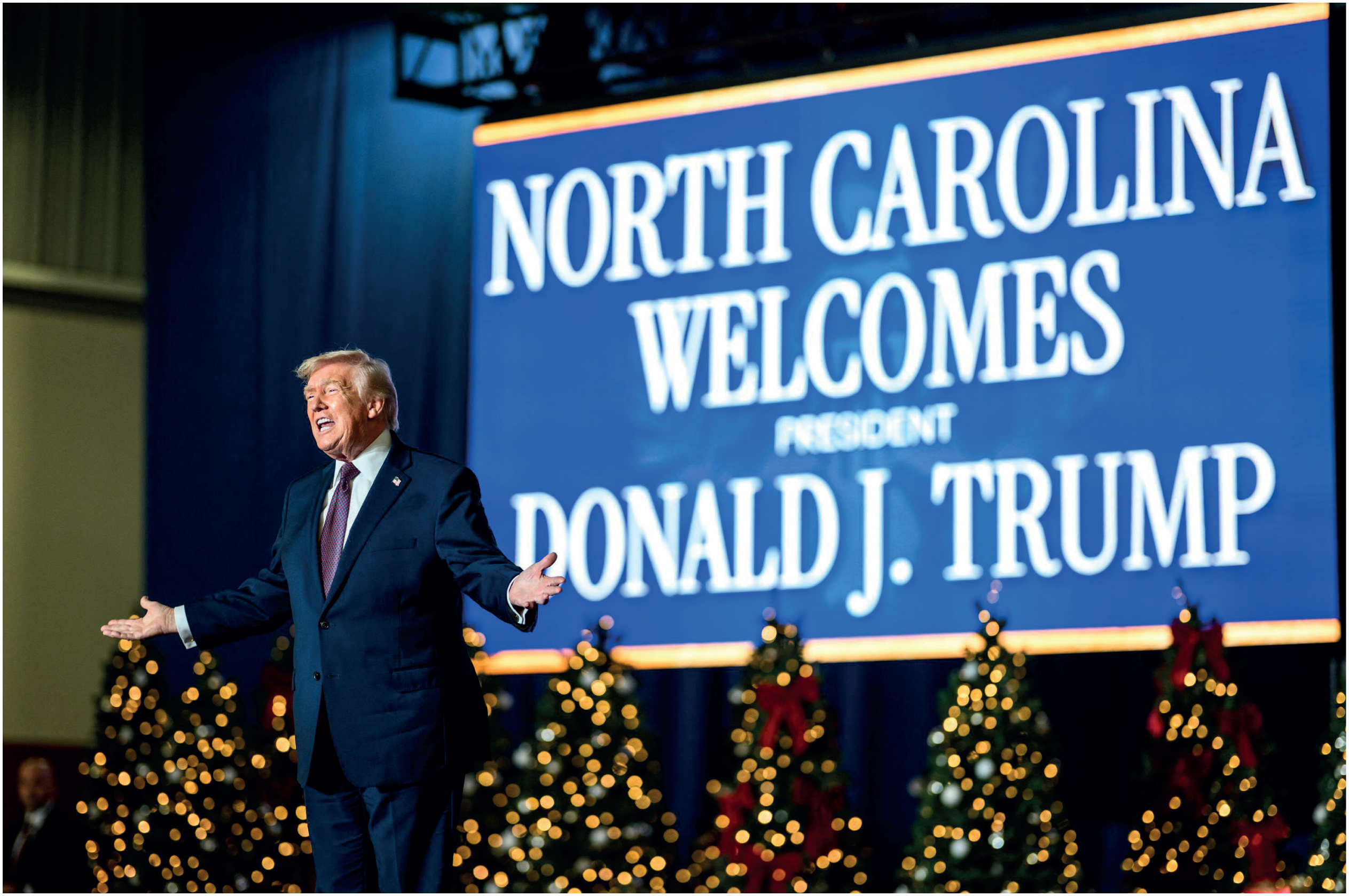
© American Photo Archive / Alamy Stock Photo
Christian Z. Nsonwu argues that political analysis privileges partisans because they are convenient to study – and in doing so overlooks the loosely attached voters who may matter most.
Much of the commentary around the 2026 US midterm elections is already returning to a familiar question: will Donald Trump’s base hold? The war with Iran has sharpened that concern, exposing tensions inside the America First coalition and raising doubts about whether the alliance that helped return Trump to office was durable or merely a temporary marriage of convenience. In highly polarised systems, journalists and strategists tend to look first to loyal partisans. In pivotal states such as North Carolina, the more revealing question may lie elsewhere. In 2024, North Carolinians voted for Trump while also electing Democrats to the state’s major state-wide offices, suggesting an electorate that cannot be understood through the oversimplified language of partisan loyalty. The deeper question, then, is not simply whether Trump’s base holds, but what and who gets missed when election analysis rests too heavily on partisan voters.
Political science tends to privilege highly partisan voters because they are easier to identify, measure and narrate. Yet between the most committed Democrats and Republicans sits a less settled but still consequential group of voters who do not fully fit in either camp – and it is this group, more than the loyalists, that tells us whether parties are commanding durable allegiance or merely assembling fragile coalitions.
Across many Western democracies, party scepticism is increasing, while party membership remains at a low point. This can be seen across the United States as voters are increasingly opting to identify as unaffiliated/independent.
Looking at the base
Across many Western democracies, party scepticism is increasing, while party membership remains at a low point. This can be seen across the United States as voters are increasingly opting to identify as unaffiliated/independent. And though Trump and the Republicans are struggling in the polls, recording meagre approval ratings, Democrats have not automatically benefited, as they have experienced a steady decline in party affiliation over the past decade. The 2026 midterms may therefore hinge not within the partisan bases themselves, but among voters whose attachments are weaker, conditional and much harder to predict.
These voters are not necessarily moderates or apathetic. They may split their tickets, sway from one election to the next, or lean one way without firmly committing; their values, priorities and support are provisional rather than fixed by party identity. They are often less visible than committed loyalists, but in an age of hardening identities and weakening formal attachment, they may give a better indication of where electoral politics is heading.
Taking a closer look at these voters does more than correct an imbalance in campaign coverage. It helps distinguish between partisan stability and coalition fragility. Loyal partisans tell us which side is sorted and settled. Unaligned voters tell us how far that settlement extends beyond the core – and how shallow or durable party attachment has become beneath it.
A state beyond simple partisan voting
This November’s midterm election will feature several key races that may determine whether Trump can continue his legislative agenda. North Carolina, a consistent battleground, has repeatedly resisted simple partisan sorting, and in 2026 it will host one of the most important US Senate campaigns of the cycle. It offers a useful window into what politics looks like beyond the base.
The US Senate is currently divided 53-47 in the Republicans’ favour. North Carolina is one of a handful of seats that will decide whether Democrats can win back a majority or whether Trump retains his margin in the Upper Chamber. It is also poised to be one of the most expensive state-wide campaigns in US history and will likely become ground zero for campaigners and elites from both parties trying to drum up support among their core supporters.
If we adopt the same partisan approach that hyper-focuses on party loyalists, we risk misunderstanding North Carolina’s political identity and unaligned voters. Part of what makes North Carolina so enticing to both parties, is its diverse demographics and long history of split-ticket voting. In this state, the politically unaligned show their strength and their consistent rejection of simple partisan voting patterns. Since 1992, North Carolinians have elected eight Democrats as Governor and only one Republican. For Presidential elections since 1992, North Carolinians have selected a Republican nominee eight times and a single Democratic nominee. The significance of North Carolina’s long pattern of selectivity lies in its repeated, predictable nature, suggesting that large parts of the electorate do not move through politics as straightforward partisan loyalists.
In the 2024 election, North Carolina voters continued this trend. Donald Trump carried the state for a third time, by 183,048 votes (3.2 per cent), a competitive but clear victory. However, in the state’s Gubernatorial election, Democrat Josh Stein won the state’s highest office by 828,187 votes (14.8 per cent). The Republican candidate for governor ran a campaign mired in scandal, which explains part of the landslide victory, yet when put in the context of the last 30 years, it fits a fairly consistent pattern. And it represents another instance of North Carolina voters separating national and state-level judgments. Further, downballot, North Carolina’s unaligned voters continued their selective support as they elected a Democrat to fill four of the major state-wide offices: Governor, Lieutenant Governor, Attorney General and Secretary of State.
To add to North Carolina’s unique political identity, both parties have sizable and nearly identical bases: 29.8 per cent of registered voters are Democrats, 30 per cent are Republicans. Additionally, they have a substantial ‘unaffiliated’ identity, with 39.5 per cent of the electorate registering as independent from either party. The largest bloc in the state does not belong to either major party, which immediately complicates any attempt to read North Carolina simply as a contest between two partisan camps.
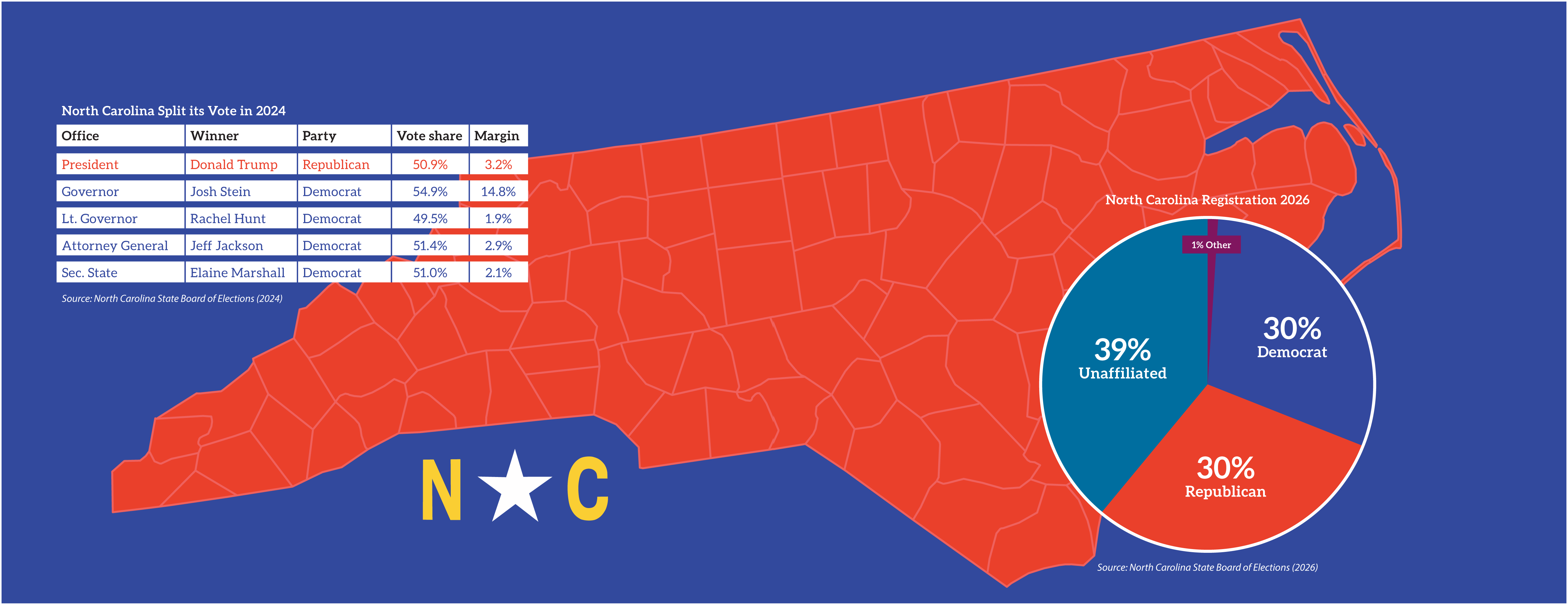
This demographic and electoral puzzle is what makes North Carolina more than just another battleground state. It is not simply competitive; it is difficult to reduce to a straightforward story of partisan alignment. The case for North Carolina is not centred on the idea that its residents are wholly unique in their political identities; rather, it highlights how voters across much of the populace can be selective in their support at different levels of government. Further, North Carolina shows how voters can behave in ways that are not reducible to strong party attachment.
Partisan stability, electoral uncertainty
High-stakes elections like North Carolina’s Senate campaign push us to frame politics far too often through the lens of partisans and bases. But the state also suggests that this frame is incomplete. A January 2026 Catawba-YouGov survey found that most North Carolina voters sit firmly in one partisan camp, with little wavering between the parties. But not everyone who registers as unaffiliated is a partisan in disguise: of those who call themselves independents, around 40 per cent told the survey they do not lean towards either party at all. It is this genuinely unattached bloc – rather than the larger group of covert partisans – that tends to act as a political bellwether and to hold real sway over the balance of power.
North Carolina is useful not because it is a competitive state, but because it helps distinguish between partisan stability and electoral uncertainty. Early 2026 polling suggests Democratic and Republican identifiers are already largely settled in their respective camps, while the real movement potential lies among voters outside those firm party identities. Even there, the story is not one of straightforward conversion from one side to the other. Late-2025 shifts in party identification pointed more to a softening of Republican attachment and a move toward independence than to a clear Democratic gain. In that sense, North Carolina suggests that weakening party attachment may matter less because it enlarges one side’s base rather than because it creates a larger electorate whose support is looser, more selective, and more difficult to predict.
Earlier this year, North Carolina legislators were among the first in the country to join the gerrymandering arms race. There is a bitter irony here as North Carolina’s electorate often behaves in ways that are not easily reduced to stable party blocs, yet much of its politics has been marked by intense partisan gerrymandering. It suggests that even in a state where voters remain cross-pressured, selective and loosely attached, party elites still respond by trying to harden competition into a durable partisan advantage.
The lesson missed in focusing too much on partisan allegiance is that the importance of these voters lies not in the notion that they are all waiting to defect from one party to the other. North Carolina suggests something more subtle. Party attachment can weaken without producing a clean partisan flip. Voters may move away from a label, become more hesitant, split their tickets, or remain genuinely undecided. That makes them harder to place within standard campaign narratives, but is also more revealing of how fragile party coalitions may be beneath the surface.
North Carolina is not an isolated case. Across Western democracies, the same loosening of partisan ties is visible: in Britain, Reform UK’s breakthrough in the May 2025 local elections showed how quickly support can drain away from the established parties when voter attachment is shallow. The pattern points to a wider condition of dealignment and political scepticism – and suggests that looking closely at loosely attached voters may tell us more about the health of democratic politics than continued fixation on loyal partisans alone.
The most revealing question in 2026 may not be whether Trump’s base holds, or whether Democrats fully mobilise theirs. It may be what happens among voters beyond the base; those who remain politically engaged without fully belonging to either camp. If politics is becoming more polarised while many voters still resist stable partisan identity, then these lesssettled voters may become more, not less, politically significant. They are harder to predict, more difficult to classify, and often less visible in campaign coverage. Yet that is precisely what makes them so revealing. In the upcoming midterm elections, the most important faction may not be those who hold the base together, but those who were never fully inside it to begin with.
Footnotes
Christian Z. Nsonwu is a Doctoral Researcher at Queen’s University Belfast whose work examines political behaviour and association in deeply polarised contexts.