






Abstract
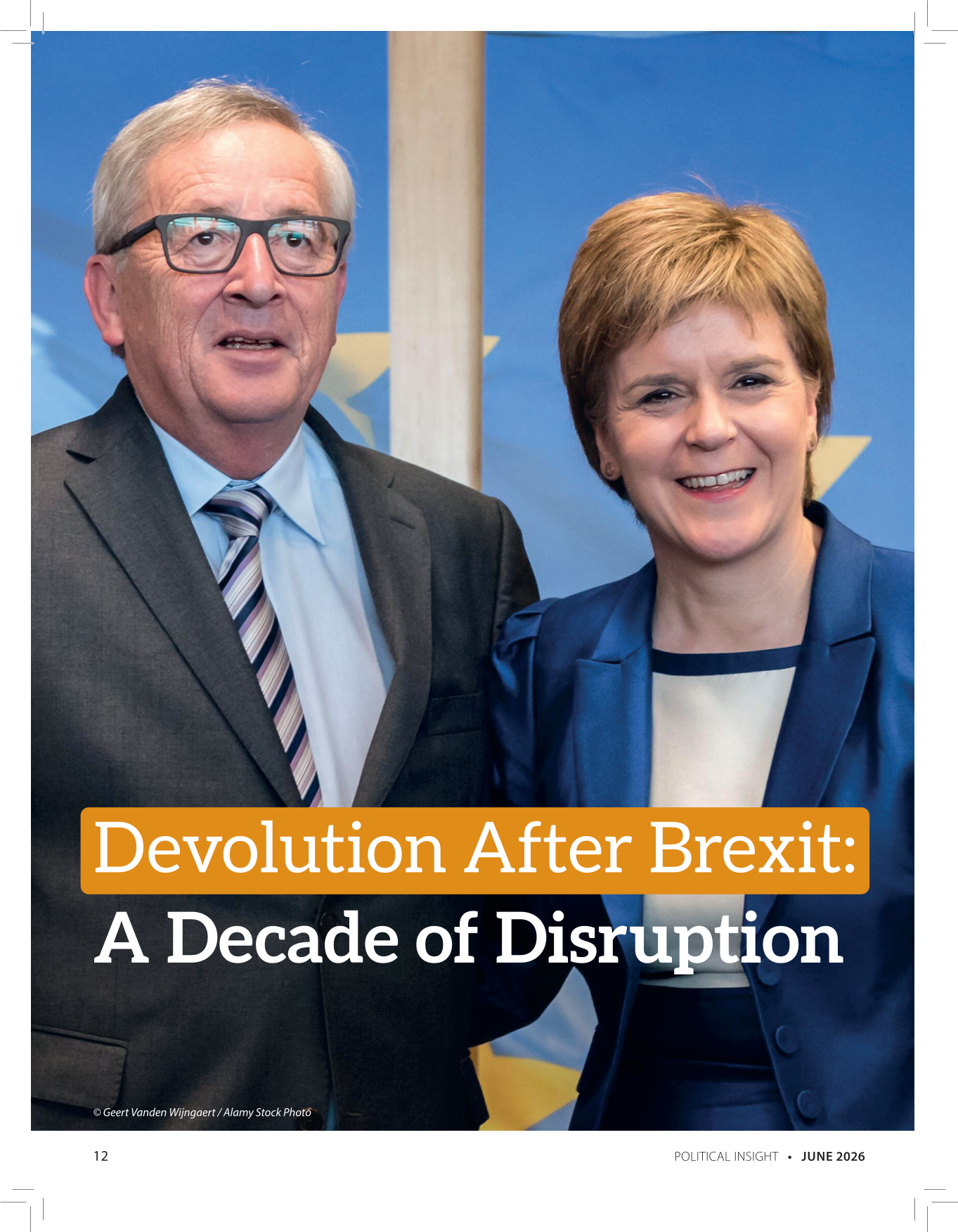
© Geert Vanden Wijngaert / Alamy Stock Photo

The Brexit vote exposed deep territorial fissures across the UK. Nicola McEwen assesses the constitutional damage – and asks whether closer alignment with the EU could paradoxically ease the path to Scottish or Welsh independence.
On the morning of 24 June 2016, when the UK woke to news that it had voted to leave the European Union, Scotland’s First Minister Nicola Sturgeon defiantly told the world’s media that Scotland had ‘voted overwhelmingly to remain’. Scotland faced the prospect of ‘being taken out of the EU against our will’. Scotland’s 62% Remain vote had come less than two years after the independence referendum. For the First Minister, it represented a ‘significant and material change of the circumstances in which Scotland voted against independence in 2014’. A second independence referendum, she said, was now ‘highly likely’.
A decade on, there seems little prospect of that referendum in the foreseeable future. The Scottish Parliament does not have the authority to legislate for one – as the UK Supreme Court confirmed – and successive UK prime ministers have refused to transfer that authority, as David Cameron did ahead of the 2014 vote. Brexit also, paradoxically, made the SNP’s commitment to ‘independence in Europe’ a more challenging prospect: it would mean turning the Anglo-Scottish border into a new external border of the EU, with all the trade barriers that implied.
But the Brexit vote and the process that followed exposed deep territorial fissures between the UK’s constituent parts. The competing sovereignty claims it generated have produced constitutional reverberations that are still being felt today.
Devolution after Brexit
EU membership had provided the regulatory scaffolding that supported the transition to devolution in Scotland and Wales, and its reintroduction in Northern Ireland. EU rules and regulations, especially those relating to the internal market, did not prevent policy divergence between the UK and devolved governments. But the fact that all governments and legislatures within the UK had to operate within the framework of EU law minimised the adverse market impacts of any divergence. Membership of a plurinational European community in which nations shared and pooled their sovereignty also made it easier to reconcile Westminster parliamentary sovereignty with the sharing of political authority across the UK’s constituent nations.
Perhaps it was inevitable, then, that the 2016 referendum and the British/ English nationalism that drove Brexit would have a disruptive effect. Brexit may not have thrown a grenade at the devolved institutions, but it landed blows that have dented their authority and sparked new questions about the constitutional future of these islands.
These effects have been most keenly felt in Northern Ireland, as the only part of the UK that has a land border with the European Union and a close and complex relationship with Ireland – as Katy Hayward explains on page 35. But the drive to ‘take back control’, voiced by the Leave campaign and adopted by successive Conservative governments, sat uneasily alongside the shared sovereignty norms and self-government claims that underpinned devolution in Scotland and Wales too.
The Sewel Convention
The founding statutes of the devolved institutions made clear that devolution did ‘not affect the power of the Parliament of the United Kingdom to make laws’ for Scotland or Wales, including in devolved matters. But a key foundational principle of devolution was the convention that the UK Parliament would ‘not normally’ do so without securing the consent of the devolved legislatures. This convention – more commonly known as the Sewel Convention – became a widely-used procedural process: when Westminster introduces legislation touching on devolved matters, the UK and devolved governments negotiate the content, and the devolved legislatures express or withhold consent via legislative consent memorandums (LCMs). The convention also had symbolic weight, representing the principle of self-government in matters of devolved authority.
Despite being written into the Scotland Act (2016) and the Wales Act (2017), however, the Convention carries no legal weight. This was confirmed in the first legal case brought by Gina Miller on whether Parliament needed to give its consent before the government could invoke Article 50. The Lord Advocate and the Counsel General for Wales intervened to argue that the consent of the devolved legislatures should also be sought. The Supreme Court unanimously concluded that the scope of political conventions is ‘determined within the political world’ – not the courts.
In the political world, the consequences were significant. The first major disregard of the Sewel Convention came when the EU (Withdrawal) Act 2018, which included changes to devolved matters, was passed without the consent of the Scottish Parliament. It would not be the last. The Institute for Government’s tracker shows that, of the around 220 Acts of Parliament requiring legislative consent from one or more devolved legislatures in the first 25 years of devolution, consent was withheld from just 28 – 19 of which were during the 2019-2024 parliament.
The Labour government entered office in 2024 promising to strengthen the Sewel Convention through a new memorandum of understanding ‘outlining how the nations will work together for the common good’. This was a considerably weaker commitment than the one in the party’s Commission on the UK’s Future, chaired by Gordon Brown, which had called for a new statutory formulation that would be ‘legally binding… in all circumstances’. That gap matters: the existing ‘not normally’ qualification had allowed Michael Gove, when in government, to claim that proceeding without devolved consent was still within the Convention, since preparing for Brexit was not part of the ‘normal’ legislative process. Under Labour, the Convention has continued to be used as originally intended, and discussions on a new MoU are ongoing, but without agreement so far.
Common frameworks
Withholding consent can be a useful lever. The original EU (Withdrawal) Bill created a bitter intergovernmental dispute over the threat it posed to devolved law-making authority. After both the Scottish and Welsh legislatures withheld consent, intense negotiations followed, opposition was mobilised in the House of Lords, a new agreement was reached with the Welsh government, and amendments were made that diminished the Bill’s constraining effects on devolution.
The EU (Withdrawal) Act 2018 also initiated a joint programme of work across the UK’s four administrations. Officials conducted ‘deep dives’ into areas of EU law that intersected with devolved competence, exploring where UK-wide or GB-wide approaches – ‘common frameworks’ – were necessary. Of 152 areas identified, a framework was judged necessary in just 30 cases, almost half relating to environment, food and rural affairs.
The common frameworks process has been widely praised as an encouraging example of intergovernmental cooperation against a backdrop of otherwise tense relations. But frameworks have given the UK government a voice in areas of devolved competence, without giving devolved governments greater influence over repatriated EU law reserved to Westminster in those areas that intersect with devolved matters. It was a missed opportunity to increase ‘shared rule’ in the UK’s territorial constitution.
The UK Internal Market Act
The UK government regarded common frameworks as offering insufficient protection for the domestic market and embarked on a more hierarchical and unilateral process, culminating in the United Kingdom Internal Market Act 2020 (UKIM Act). It was the most controversial of the Brexit-related legislation for its effects on the devolved institutions and generated a serious breakdown in relations between the UK government and its Scottish and Welsh counterparts.
The political impacts of Brexit continue to reverberate. The rise of Reform UK has brought renewed fragmentation in voting behaviour and political representation to a Westminster system illequipped to accommodate it.
Two Market Access Principles (MAPs) lie at its core. Mutual recognition ensures that goods legally sold or services legally provided in one part of the UK can be sold anywhere, without meeting further requirements. Non-discrimination ensures that goods and most services entering local markets from another part of the UK are not treated differently from local suppliers. Although these principles are familiar features of internal markets and constrain all UK administrations in principle, their effects have been most keenly felt in the devolved nations – which are more dependent on cross-border trade within the UK than England, and which lack the legal authority of the UK Parliament.
The UKIM Act does not explicitly curb the competence of devolved legislatures to regulate their markets in distinctive ways – to promote public health or environmental sustainability, for instance. But the MAPs mean that any such laws would only apply to goods and services originating in local markets. That limitation renders them essentially unworkable: they risk creating competitive disadvantages for local producers, and their narrow reach undermines the very policy goals they are designed to achieve.
Devolved governments have negotiated exclusions from the MAPs – successfully, for example, in relation to single-use plastics. But this process delays legislation, creates uncertainty, blurs accountability and has effectively given the UK government a veto in some areas of devolved competence. The starkest example of where this process disrupted policy making was the controversy over the Scottish Government’s deposit return scheme (DRS). All UK governments had plans to introduce a DRS – refundable charges on single-use drinks containers to encourage recycling – but were proceeding at different speeds and with different scope. Scotland moved first, planning to include glass bottles. When an exclusion was eventually offered by the UK government, glass was excluded, citing ‘the powerful representations made by a broad range of businesses across the UK that interoperability of schemes is critical to avoiding unnecessary barriers to trade’. Scotland subsequently put its scheme on hold. The company set up to administer it collapsed, and the waste firm Biffa sued the Scottish government – unsuccessfully – for £50 million in damages.
© Peter Byrne / Alamy Stock Photo

The UK government also used the UKIM Act to give itself powers to spend directly in broad areas of devolved competence, bypassing the established system of territorial finance. These spending powers are widely seen as a means of strengthening its profile and influence in policy areas otherwise controlled by the devolved governments.
As with other Brexit legislation, the UKIM Act was passed despite the withholding of consent under the Sewel Convention. Unlike the others, however, its primary purpose was to set limits on the regulatory reach of the devolved institutions in favour of unfettered intra-UK trade. The Welsh government took the unusual step of challenging the Act in the courts. The Labour government subsequently brought forward the Act’s statutory review and softened some of its harder edges – committing more fully to the common frameworks process for considering exclusions and giving greater weight to environmental protection and public health alongside economic impacts. The Act itself, however, seems here to stay.
Political futures
The political impacts of Brexit continue to reverberate. The rise of Reform UK has brought renewed fragmentation in voting behaviour and political representation to a Westminster system ill-equipped to accommodate it. The recent devolved elections in Scotland and Wales – each using systems of proportional representation – saw Reform break into the devolved institutions too, with effects that remain to be seen. Its electoral threat may also have bolstered the Scottish National Party, which reaffirmed its dominance of Scottish politics, and Plaid Cymru, which emerged as the leading force in Welsh politics for the first time. That intergovernmental relations will now involve parties with sharply different visions for the constitutional future of these islands means those questions are unlikely to fade.
The UK government’s reset with the European Union – especially if it leads to greater regulatory alignment or a Sanitary and Phytosanitary (SPS) agreement – could also reshape the terrain. In a context of greater UK-EU regulatory alignment applying to all of the UK’s governments, what would be the rationale for continuing to discourage regulatory divergence in the UK in ways that diminish the law-making authority of the devolved institutions?
In considering that question, it may be worth reflecting on the fact that closer UK-EU regulatory alignment would also remove some of the Brexitrelated complexities of independence for Scotland and, indeed, for Wales. Two reports I co-authored with Katy Hayward explored the border implications of an independent Scotland, or an independent Wales, inside the EU while England remained outside. We concluded that those effects, while navigable, could be considerable – and make it harder to build a persuasive case for independence. Easing the UK-EU border through closer regulatory alignment could, paradoxically, smooth the path towards new sovereign states on these islands, by diminishing the significance of the borders between them.
Footnotes
Nicola McEwen is Professor of Public Policy and Governance at the University of Glasgow.