






Abstract
© Will Colebourne / Alamy Stock Photo
John Curtice maps the results of local elections in England and devolved contests in Scotland and Wales — and finds a Britain more electorally fragmented than ever.
The message from the opinion polls has been insistent. The Conservative-Labour duopoly that has dominated British politics since 1945 is facing its most severe challenge yet. Instead of looking like a two-party system, Britain’s electoral politics appears to have fragmented into a multi-party kaleidoscope. The key question hanging over the local and devolved elections on May 7 – the largest set of elections scheduled to take place during the current Westminster Parliament – was therefore whether they would confirm this picture that Britain’s electoral landscape has undergone an unprecedented transformation.
England: A tale of two contests
The local elections in England took place primarily in the more urban half of the country, including not least in all of London. This meant they were being fought primarily in places where Labour usually performs relatively well – in sharp contrast to last year’s local elections when rural shire – and thus predominantly Tory – county contests had predominated. Two-thirds of the seats at stake (again, including all those in London) were last contested in 2022, when Labour enjoyed a narrow lead over the Conservatives in the polls, a position that was largely reflected in the outcome of that year’s elections. The remaining seats were either last contested in 2021 (when the Conservatives were most popular) or 2023 or 2024 (when Labour were well ahead).
The falls in Conservative and Labour support outside London were precipitate. In Labour’s case we can compare the party’s share of the vote in 40 districts with what the party achieved locally in 2008 – hitherto the party’s worst performance in an annual round of English district council elections.
Table 1 shows the outcome in councillors elected, separately for London and the rest of England. The result was very different in the two parts of the country. In London, Labour, despite losing 40 per cent of the seats they were defending, came first in councillors elected, while the Conservatives were second and emerged unscathed in terms of their total seat tally. Although the Greens made notable gains (including overall control of three boroughs) Reform made little impression. The traditional twoparty dominance of London’s politics was seemingly largely undisturbed.
Outcome in Seats for London and the Rest of England
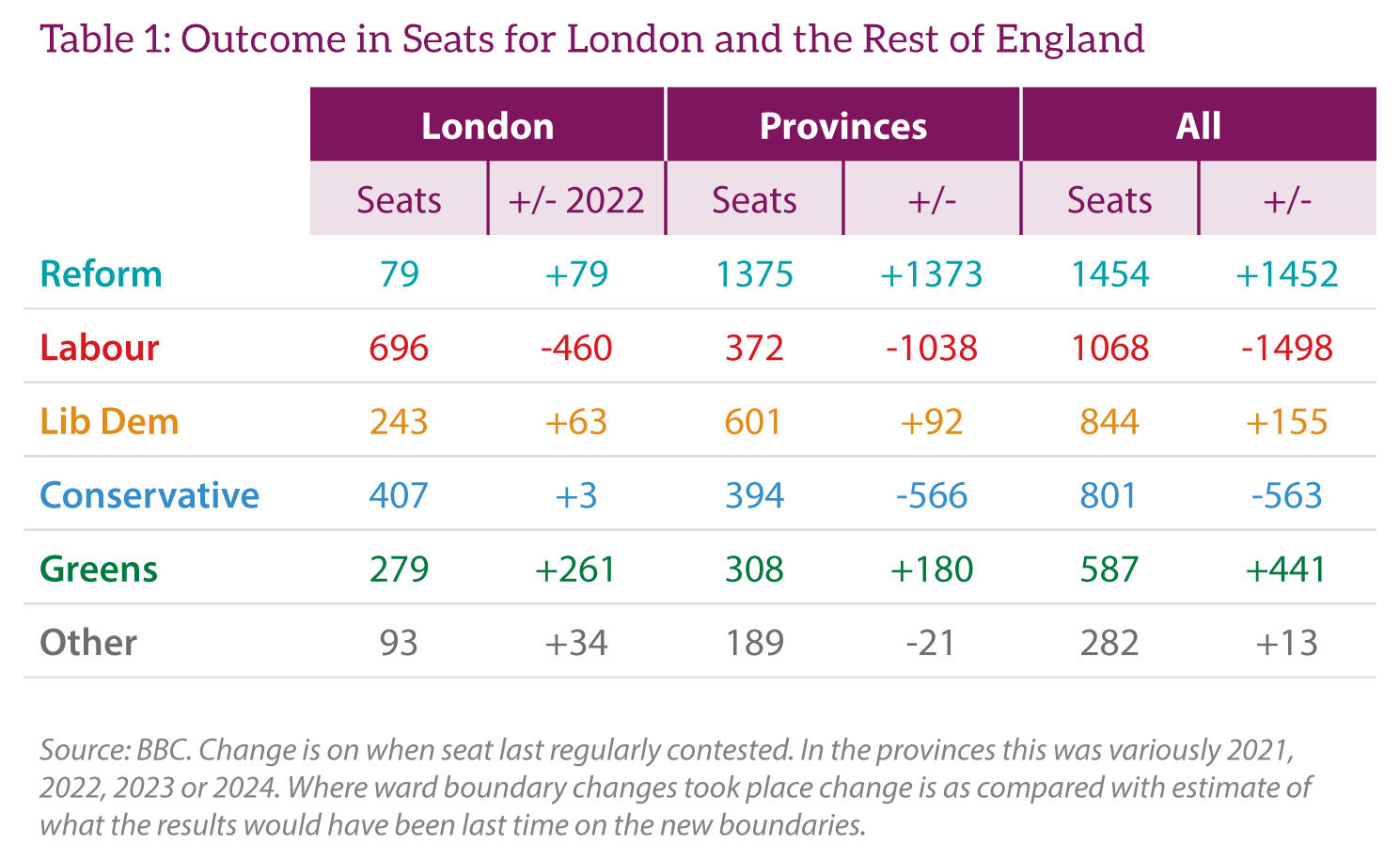
Source: BBC. Change is on when seat last regularly contested. In the provinces this was variously 2021, 2022, 2023 or 2024. Where ward boundary changes took place change is as compared with estimate of what the results would have been last time on the new boundaries.
Outside London, the picture was very different. Reform made large gains and came first. Labour lost nearly three-quarters of the seats it was trying to defend, the Conservatives nearly three-fifths. The Liberal Democrats overtook the Conservatives while the Greens made notable gains. Here, the Conservative and Labour duopoly appears to have been seriously challenged.
Indeed, these differences are reflected in the change since 2022 in the parties’ share of the vote. As Table 2 shows, in a sample of the detailed voting figures in 57 councils collected by the BBC (in 46 of which the boundaries were the same as in 2022, including 14 in London), the fall in both Labour and Conservative support was less in the capital than elsewhere. Meanwhile, Reform advanced much more strongly outside the capital than inside. In contrast the change in support for the Greens and the Liberal Democrats – who despite their net gain of seats (mostly at the expense of the declining Conservatives) suffered a loss of support – was much the same outside the capital as inside.
Mean Change in Party Support since 2022 London and Rest of UK
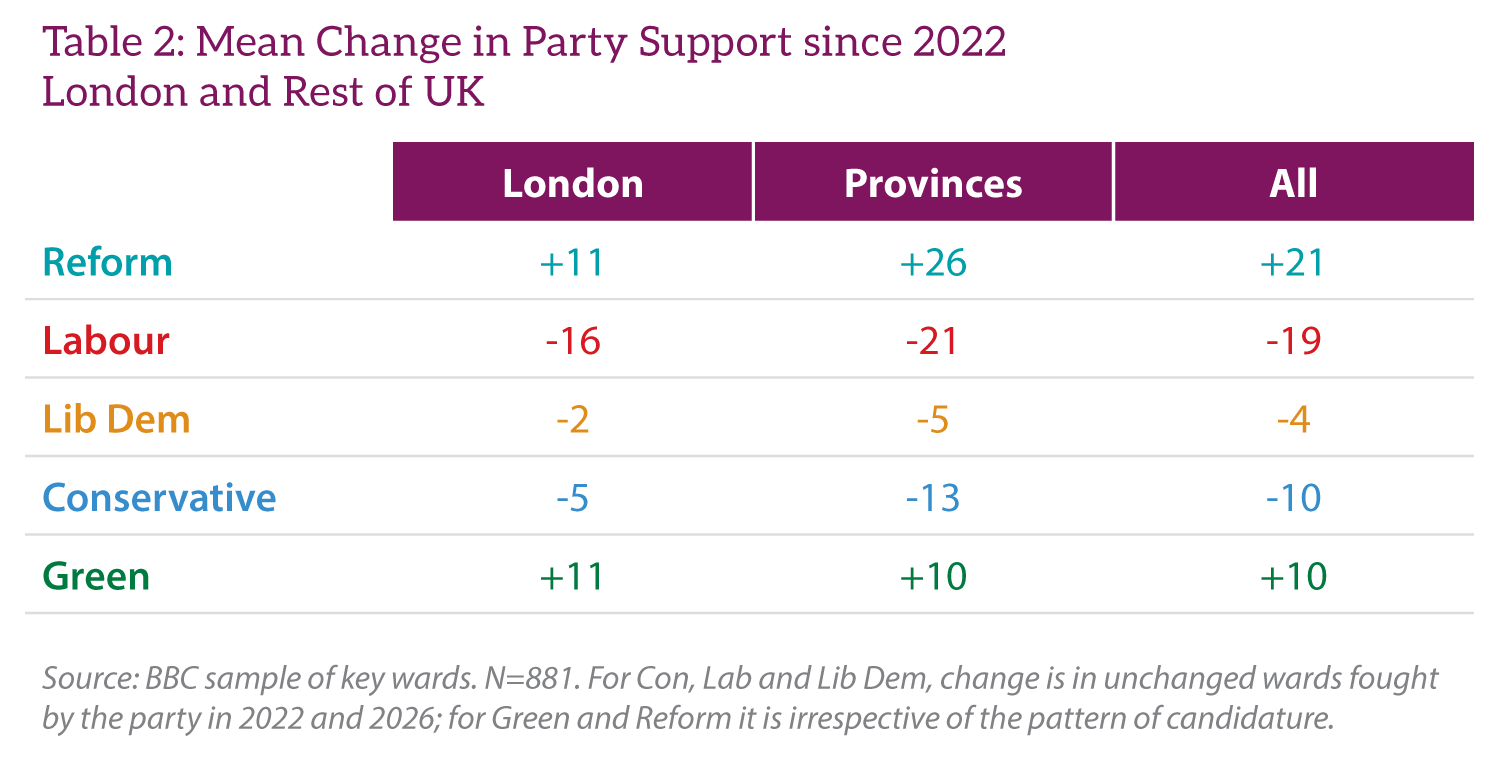
Source: BBC sample of key wards. N=881. For Con, Lab and Lib Dem, change is in unchanged wards fought by the party in 2022 and 2026; for Green and Reform it is irrespective of the pattern of candidature.
The falls in Conservative and Labour support outside London were precipitate. In Labour’s case we can compare the party’s share of the vote in 40 districts with what the party achieved locally in 2008 – hitherto the party’s worst performance in an annual round of English district council elections. Labour’s share was on average eight points lower than in 2008 in 12 metropolitan councils, by four points in eight unitaries, and by three points in 20 lower-tier district councils. In the case of the Conservatives, their previous worst round of district council elections was in 2024, shortly before that year’s General Election. On average, the party’s support in the BBC’s sample was down by eight points on that year. This evidence strongly suggests that, outside London at least, both the Conservatives’ and Labour’s vote share fell to record-breaking lows.
But what of the capital? Support for the Conservatives has been in long-term decline in London, and the previous round of borough council elections in 2022 saw the party’s share of the vote fall to a record low (25.9%). So, any drop in support – as Table 2 indicates that is what happened despite the party maintaining its tally of seats – would mean its tally falling to a new all-time low. In Labour’s case, the party’s previous record lows in terms of its share of the vote were 27.9 per cent in 1968 and 28.0 per cent in 2006. In the 14 London boroughs in the BBC’s sample, Labour’s support was on average two points higher than in 1968 but one point lower than in 2006, suggesting that its performance this time was on a par with those two years. However, the first published collation of all the voting figures puts Labour’s share of the vote across the capital at just 25.6%, a figure which, if confirmed, would be a new record low.
Rather than reflecting a markedly better performance, the lower loss of seats suffered by Labour and the Conservatives in London reflected the fact that the challenge posed by the Greens within the capital was less substantial than that presented by Reform elsewhere. In the BBC’s sample of key wards outside London, Reform won on average 28 per cent of the vote (a tally similar to its current standing in the opinion polls). That was enough to put the party ten points ahead of everyone else (with all of the other four parties all clustered between 16-18 per cent of the vote, much as they are in the polls). Such a lead was bound to see the party benefit from the tendency of the first-past-the-post electoral system to advantage winners in terms of seats. In the BBC’s sample in London, in contrast, the Greens averaged a somewhat more modest 23 per cent of the vote. Although this was six points higher than the party’s tally outside London, it was crucially still four points below the equivalent figure for Labour – while the first published tally for all of London puts Labour three points ahead. The Greens therefore, were not advantaged by the electoral system in London to the extent that Reform were elsewhere. Instead, the system helped insulate Labour from the full consequences of its poor performance in the capital, unlike what happened elsewhere.
The Brexit divide
But why were Reform stronger outside London and the Greens stronger in the capital? One key difference between the two parts of England is that while the rest of England voted in favour of Brexit, London did not. And indeed, as Table 3 shows, estimates of how wards outside London voted in 2016 are strongly correlated with the performance of both challenger parties. Reform’s share of the vote was on average nearly thirty points higher (39%) in wards where more than 60 per cent backed Brexit in 2016 than it was in places where more than 60 per cent voted Remain (10%). The latter, in contrast, often proved the most fertile ground for the Greens.
Performance of the Parties by Leave Share of the EU Referendum Vote in 2016
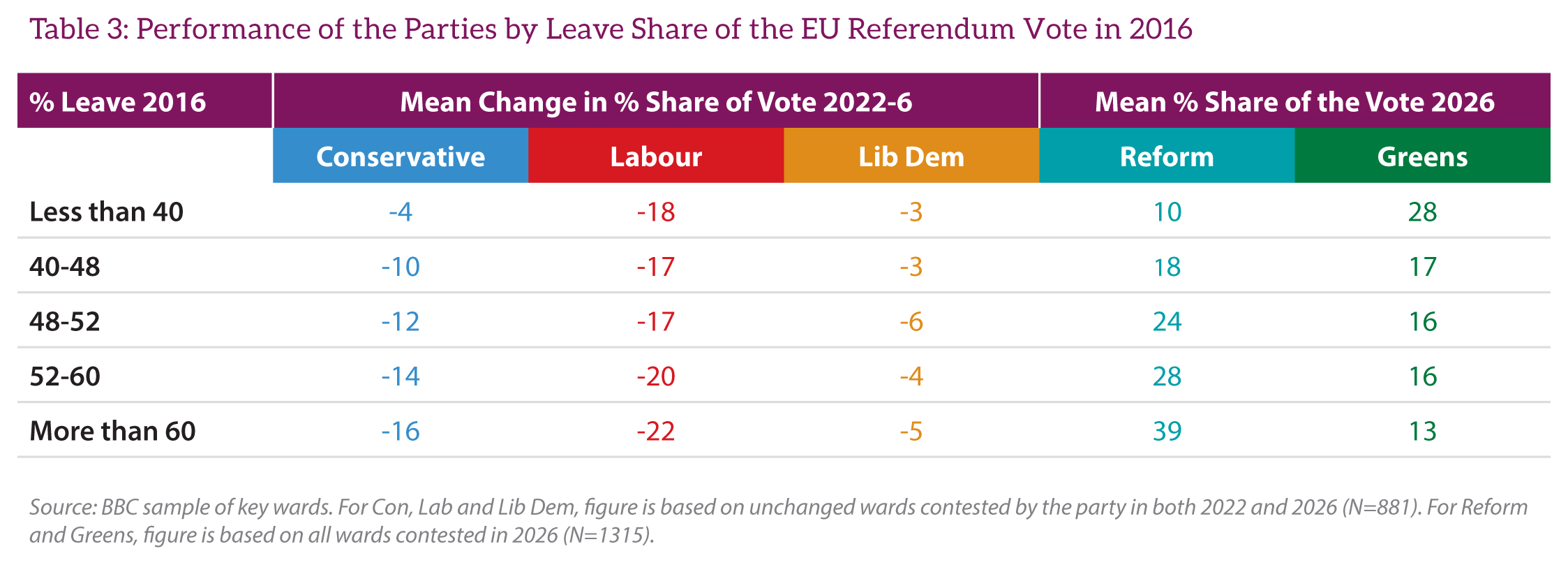
Source: BBC sample of key wards. For Con, Lab and Lib Dem, figure is based on unchanged wards contested by the party in both 2022 and 2026 (N=881). For Reform and Greens, figure is based on all wards contested in 2026 (N=1315).
Labour, meanwhile, saw their vote fall a little more heavily in places that voted heavily for Leave – though, in truth, the party was losing a great deal of ground everywhere. The Conservatives, in contrast, saw their vote fall most heavily in places that backed Brexit (albeit their absolute loss of support in such places was still a little lower than Labour’s). Indeed, this pattern was sufficient to ensure that the party’s average share of the vote was no higher in places that voted heavily for Leave (16%) than it was in those where support for Remain was at its highest (17%). Remarkably, the party that delivered the UK’s withdrawal from the EU has now lost any semblance of relative strength in pro-Brexit England. That status is now exclusively a feature of support for Reform.
Indeed, a strong Reform performance in terms of votes primarily occurred at the expense of the Conservatives – just as it did in the 2024 General Election. In wards where Reform’s share of the vote was 30 points or more higher than in 2022, the Conservative vote fell on average by 17 points. Meanwhile, the fall in Tory support averaged just four points where Reform’s share of the vote was less than 10 points above whatever it achieved in 2022. In contrast, the equivalent figures for the fall in Labour support were -21 and -20 points respectively. Although Labour lost many seats (and control of nine councils) to Reform, the scale of Reform’s advance made relatively little difference to how badly Labour’s vote fell away.
The same cannot be said of the Greens. Labour’s share of the vote fell on average by 37 points in wards where support for the Greens was 30 points up on whatever the party achieved in 2022. In sharp contrast, Labour’s vote dropped by just 11 points in wards where the Greens did less well than in 2022. These patterns are consistent with the evidence of the opinion polls that Labour is losing support most heavily to the Greens (and doing so primarily among Remain supporters) while the Conservatives are losing ground above all to Reform. The Conservative-Labour duopoly is being challenged from both ends of the Brexit spectrum – a spectrum that, apart from the issue of Brexit itself captures the division between, on the one hand socially conservative, immigration sceptic England and, on the other, its more socially liberal, diversity embracing population.
The local elections in England clearly then confirmed the message of the opinion polls. Conservative and Labour support was at an all-time low. Both saw their vote eaten away by a challenger party that seemed better able than the duopoly to appeal to the divergent values of Remainers and Leavers. Both challenger parties enjoyed unprecedented levels of success both in terms of votes and seats. With the Liberal Democrats also losing some of their support while still managing to make a net gain of seats, politics in England emerged from the local elections looking more fragmented than ever.
Scotland and Wales
But what of the devolved elections in Scotland and Wales? Here the previous elections were held in 2021 rather than in 2022. That was a time when Boris Johnson’s Conservative government was still relatively popular. Indeed, the party was able to claim second place in both countries. However, in Scotland that was second place to the SNP, which in coming first or second in votes at every Westminster and Holyrood election since 1992, had long since disrupted the Conservative/Labour duopoly north of the border. Indeed, Labour’s vote in 2021(17.9 per cent of the list vote) was the party’s lowest ever in a Holyrood or Westminster election. However, Wales was still very much a Labour fiefdom. The party had been running the devolved government ever since the advent of devolution in 1999 and had won the largest share of the vote at every Westminster election since 1931.
Yet, as Table 4 shows, Labour’s grip on Wales was broken, while its support in Scotland fell yet again to a new record low. At the same time, the Conservatives lost half of their former support in Scotland and more than half in Wales. In both countries, Reform claimed second place (albeit only narrowly on Scotland’s list vote) to a victorious nationalist party (even though the SNP’s share of the list vote fell to its lowest level since 2003). In Scotland, the joint Conservative and Labour tally represented only just over a quarter of the list vote (27.8%), down from just over two-fifths (41.4%) in 2021. In Wales, it slumped spectacularly from 61.3 per cent in 2021 to just 21.8 per cent now. Both figures are all-time record lows for a Holyrood or Westminster election. Indeed, in Wales, the result could even be portrayed as signalling the emergence of an alternative two-party duopoly of Plaid Cymru vs. Reform.
Results of Devolved Elections in Scotland and Wales, 2026
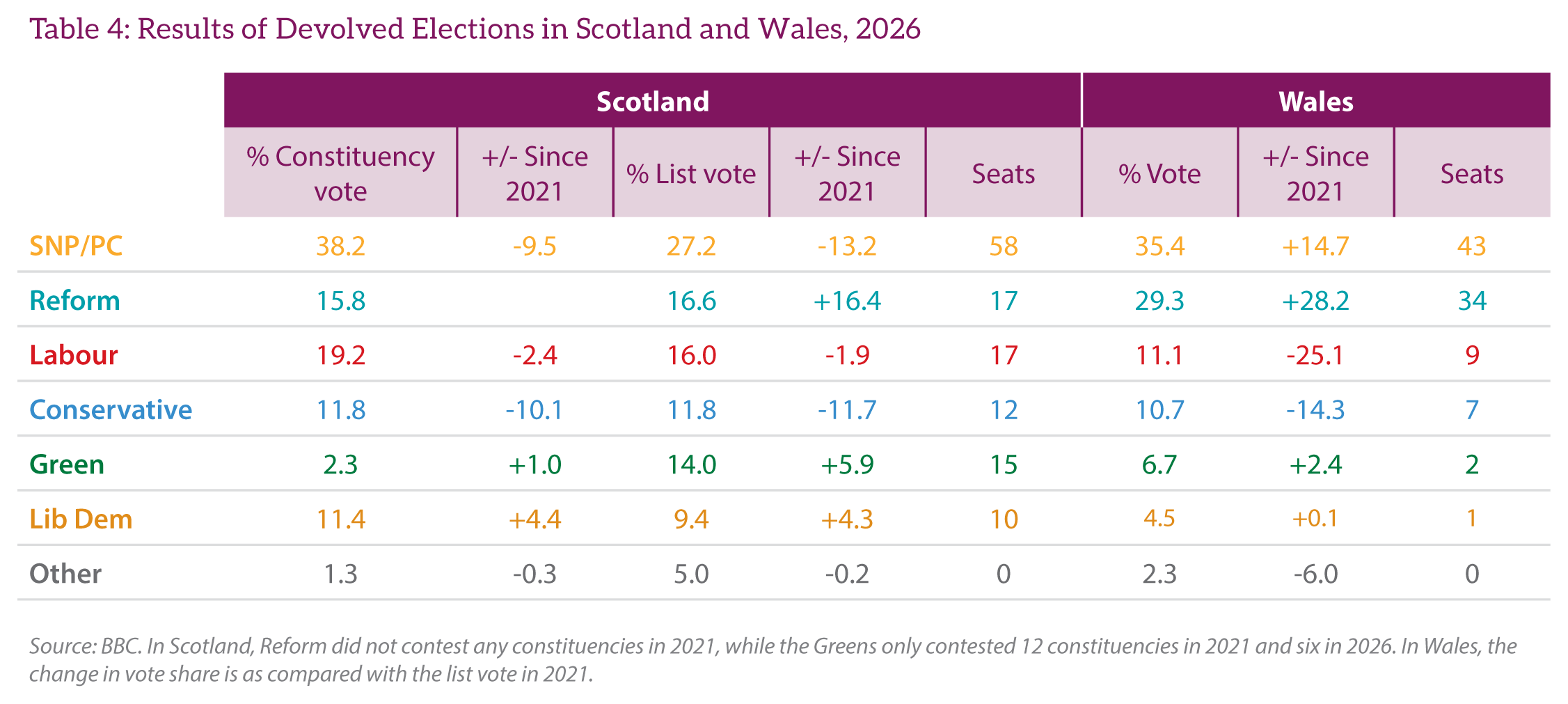
Source: BBC. In Scotland, Reform did not contest any constituencies in 2021, while the Greens only contested 12 constituencies in 2021 and six in 2026. In Wales, the change in vote share is as compared with the list vote in 2021.
Conclusion
Throughout Britain, one clear message emerged from the local and devolved elections on 7 May – the Conservative/ Labour domination of British politics is facing its most severe challenge since 1945. In Wales the collapse in their joint support was spectacular. In London it was mitigated somewhat by the more limited character of the challenge from the Greens as compared with that provided elsewhere by Reform. But everywhere, both parties were finding their appeals to the electorate falling on very stony ground. Both now have but three years to turn things around.
Footnotes
John Curtice is Professor of Politics, Strathclyde University, and Senior Fellow, National Centre for Social Research and ‘The UK in a Changing Europe’.
Analysis for this piece was by Patrick English, Stephen Fisher, Robert Ford, Lotte Hargrave and Stuart Perrett.