






Abstract
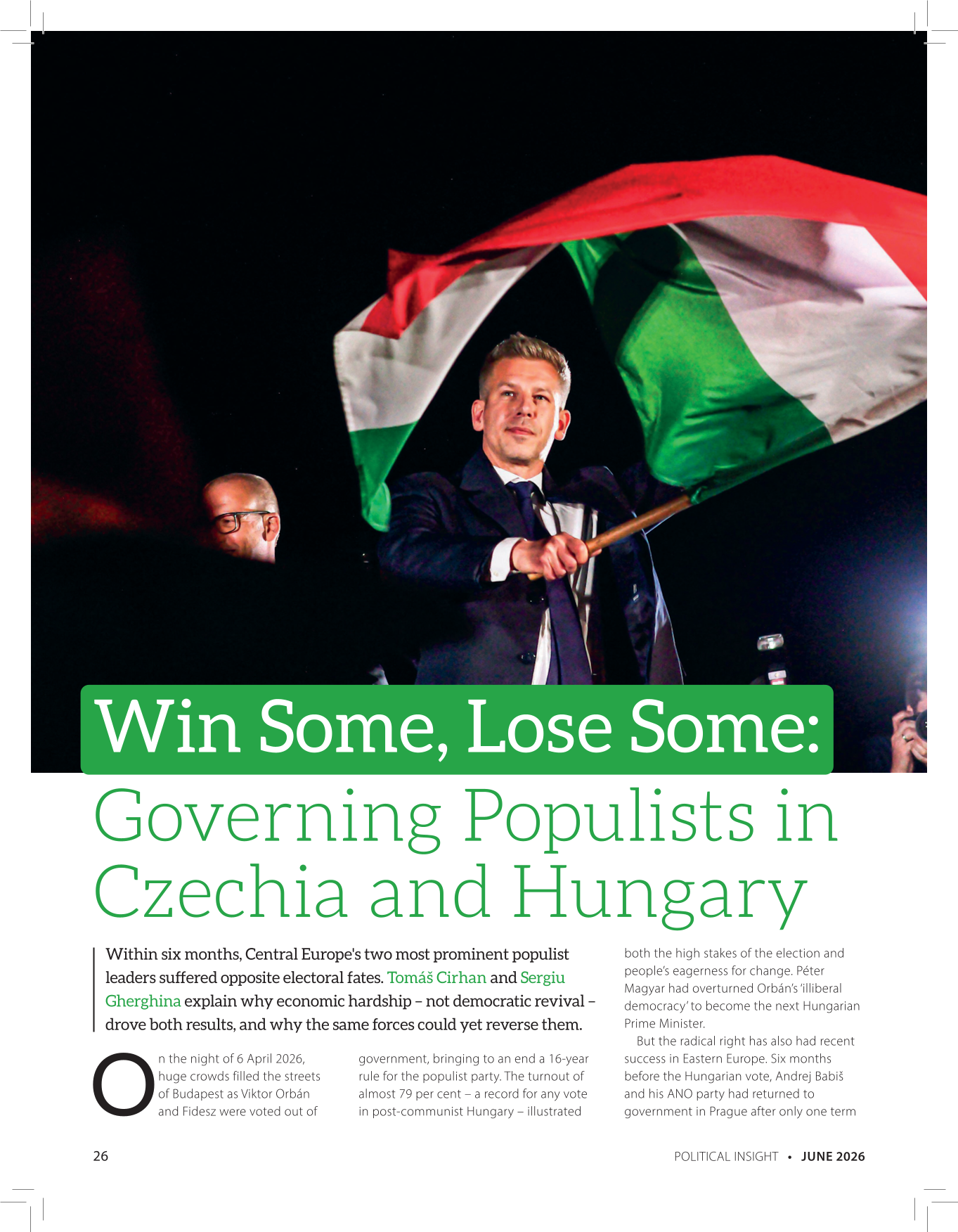
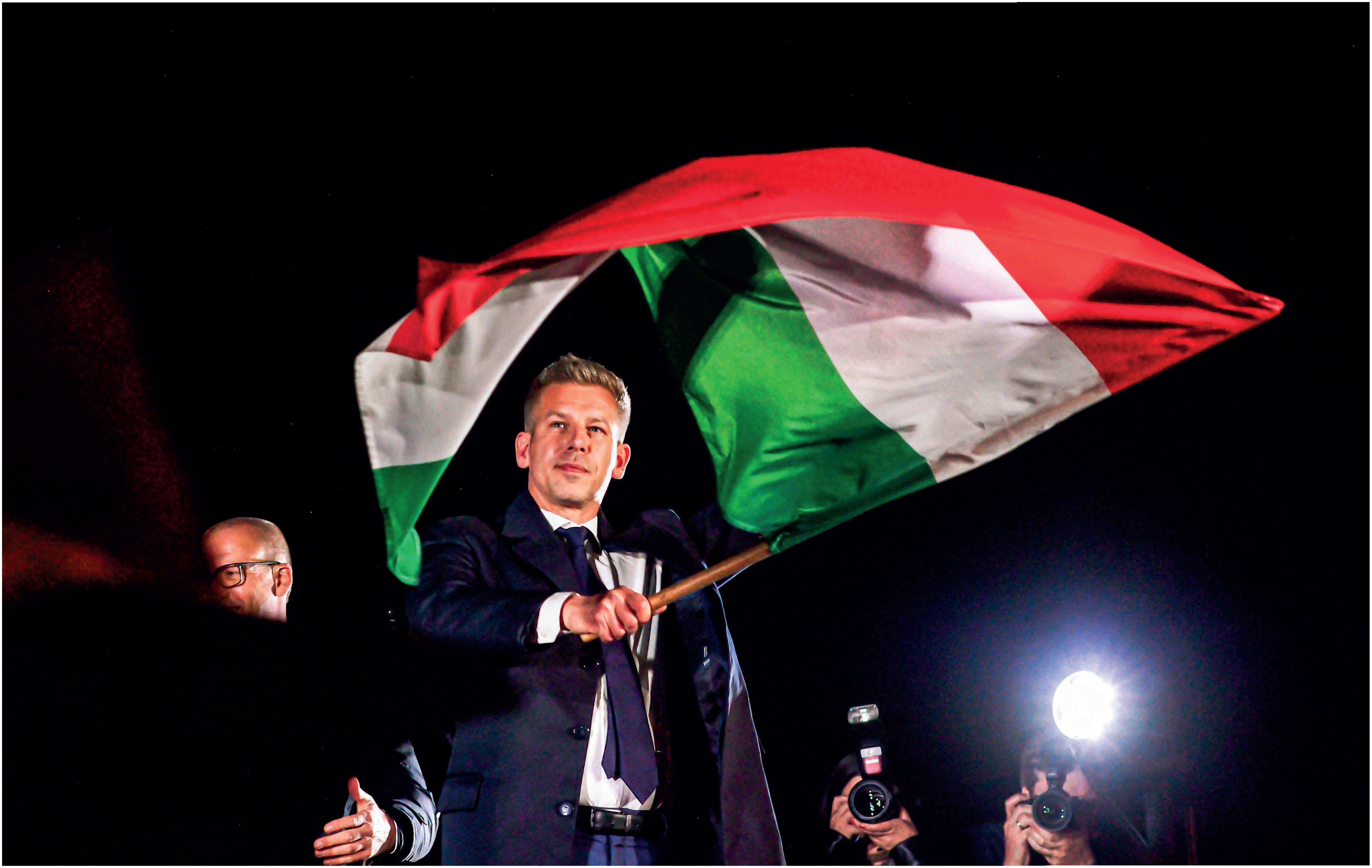
© SOPA Images / Alamy Stock Photo
Within six months, Central Europe’s two most prominent populist leaders suffered opposite electoral fates. Tomáš Cirhan and Sergiu Gherghina explain why economic hardship – not democratic revival – drove both results, and why the same forces could yet reverse them.
On the night of 6 April 2026, huge crowds filled the streets of Budapest as Viktor Orbán and Fidesz were voted out of government, bringing to an end a 16-year rule for the populist party. The turnout of almost 79 per cent – a record for any vote in post-communist Hungary – illustrated both the high stakes of the election and people’s eagerness for change. Péter Magyar had overturned Orbán’s ‘illiberal democracy’ to become the next Hungarian Prime Minister.
But the radical right has also had recent success in Eastern Europe. Six months before the Hungarian vote, Andrej Babiš and his ANO party had returned to government in Prague after only one term in opposition, joining forces with two radical-right populist parties and signalling a major illiberal turn in both domestic and foreign policy. Central and Eastern Europe, long in the spotlight for the persistent presence of populists in government and the democratic backsliding and illiberal tendencies visible in several countries, appeared to be moving in opposite directions at once. These divergent outcomes are best explained by economic hardship and who voters blamed for it, rather than by the health of democracy as such.
Czechia: Populists strike back harder
The populist party ANO (‘Yes’ in Czech) led by billionaire Andrej Babiš has been prominent in Czech politics since gaining its first parliamentary seats in 2013. Fuelled by widespread frustration and mistrust in political parties, Babiš repeatedly attracted support through anti-corruption and anti-establishment campaigns. ANO and Babiš formed the government in 2017, then narrowly lost the elections in 2021. The victor of that election was an electoral alliance that included the conservative Civic Democratic Party, the Christian Democrats, and the liberal-conservative TOP09. This alliance formed a coalition with a second alliance comprising the Pirates and the Mayors and Independents. ANO returned to government in 2025, joining forces with two radical-right populist parties – Freedom and Direct Democracy and the Motorists for Themselves. The latter was a single-issue party built around opposition to environmental regulation and the protection of combustion engine vehicles. The new coalition signalled a major illiberal turn in both domestic and foreign policy.
ANO’s return to government was driven above all by economic grievance. The country suffered high inflation of 10-15 per cent on basic commodities in 2022 and 2023, largely due to heavy dependence on Russian gas, while wages stagnated.
ANO’s return to government was driven above all by economic grievance. The country suffered high inflation of 10-15 per cent on basic commodities in 2022 and 2023, largely due to heavy dependence on Russian gas, while wages stagnated. Both ANO and Freedom and Direct Democracy made this the centre of their campaigns, focusing on energy prices, housing affordability, and wage growth. The outgoing government’s emphasis on foreign policy and support for Ukraine was no match for populist promises to improve living standards.
The outgoing government’s strong pro-Ukrainian stance had mobilised support initially, but its appeal faded as the war continued and economic frustration deepened. Growing discontent gradually produced a rise in anti-Ukrainian sentiment, a trend that Freedom and Direct Democracy actively exploited. Since 2022, Czechia had hosted the largest number of Ukrainian refugees per capita in Europe, and the party pushed a Czechs-first narrative, going so far as to call for the deportation of Ukrainian refugees on the grounds that they received financial support at the expense of Czech citizens. ANO’s engagement with anti-Ukrainian rhetoric was more measured – Babiš’s businesses depended on the Ukrainian workforce – but the party still courted the far right by incorporating anti-immigrant narratives (Naxera, 2024), joining the Patriots for Europe group in the European Parliament, and deepening ties with Fidesz and the French National Rally.
Three early measures marked the start of the illiberal turn: a civil service reform, a foreign-funding NGO database, and the defunding of public media. The civil service reform aimed at politicising the administration: senior civil servants were replaced by people loyal to the cabinet. The government then proposed a bill to create a register of all non-governmental organisations receiving funding from abroad, modelled on similar laws in Russia and Hungary. Given the vagueness of the bill’s provisions, it would likely also cover universities conducting international research, foreign embassies, and the Catholic Church receiving funds from the Vatican. In the media sphere, the government proposed abolishing licencefee funding for the Czech Television and Radio broadcasters and replacing it with direct state-budget funding under government control. These moves prompted civil society to organise the largest mass demonstrations since 2019, both in Prague and across the country.
Most of these changes are framed by the government as efficiency measures and deficit reduction. In practice, cuts fall on the NGO sector, academic research, and culture, while increased funding for sectors such as agriculture – where the majority of Babiš’s companies operate – is planned. The coalition also intends to raise social spending, particularly pensions, which primarily benefits ANO’s core electorate.
On foreign policy, Ukraine is no longer a priority; closer ties with Slovakia are favoured instead. Relations with the European Union have come under strain, mainly due to ANO’s and the Motorists’ resistance to the Green Deal, particularly policies related to the Emissions Trading System. Together, these positions reflect a soft Euroscepticism most visibly embodied in the government’s announcement that it will no longer produce annual Euroreadiness reports and its open declaration that it has no intention of adopting the common currency. Defence spending reveals a similar double standard: the government tells domestic audiences it will cut military spending in favour of social welfare, while in international forums it endorses higher defence budgets.
Tisza’s victory was largely the result of voters rejecting a continuation of Fidesz rather than anything specific to Tisza itself. Voters nationwide had grown frustrated with a sluggish economy, persistently high inflation, a deteriorating healthcare system, and a government increasingly associated with scandal and corruption.
In under half a year in office, the Czech populist government faces several overlapping pressures. Domestically, the cabinet is committed to keeping the budget deficit in check while refusing to raise taxes. Internationally, it must navigate between its Eurosceptic and anti-Ukrainian partners on one hand and its EU and NATO commitments on the other. Fragile economic growth and renewed inflationary pressure from the Middle East conflict add further strain. Whether Babiš can manage these dilemmas with his customary pragmatism remains to be seen.
Hungary: Replacing Fidesz
In the April 2026 elections in Hungary, the pro-European and anti-corruption platform that had lost in Prague won instead – the same broad offer, but opposite results, because the economic context and the incumbent were different. The Respect and Freedom Party (known as Tisza), founded in 2020, secured 69 per cent of the seats in Parliament – the first time Fidesz had been defeated in four consecutive national elections, surpassing the failed attempt by six opposition parties to unite against it in 2022. Led by Péter Magyar, a former Fidesz member, Tisza ran on anti-corruption, judicial independence, and a pro-European foreign policy. It also advocated stronger institutional oversight of the executive, including a shift to direct popular election of the President, and proposed a referendum on capping the Prime Minister’s time in office at two terms, or eight years in total.
Tisza’s victory was largely the result of voters rejecting a continuation of Fidesz rather than anything specific to Tisza itself. Voters nationwide had grown frustrated with a sluggish economy, persistently high inflation, a deteriorating healthcare system, and a government increasingly associated with scandal and corruption. This produced relatively uniform losses for Fidesz across the country, irrespective of local economic conditions (Tóth, 2026).
That said, Tisza earned its victory in several respects. First, it defeated Fidesz on its own terrain: the personalisation of the campaign. Magyar lay at the core of the campaign, positioned as the alternative to Orbán. He gradually shed the image of opposition leader – which had gained momentum after the 2024 European elections – and became the electable statesman who could steer Hungary through difficult waters. He positioned himself as a credible insider witness, drawing on his years inside the Fidesz establishment. His corruption allegations carried weight because they were concrete and first-hand: he published leaked audio recordings directly implicating his former spouse, who had served as Justice Minister. Magyar also cultivated an image of directness and accessibility through social media and extensive personal visits across the country. The personal connection he built with voters was reinforced by the slogan ‘Do not be afraid!’, a direct reference to the climate of fear many associated with years of Fidesz rule.
A second major merit was the strong pro-European emphasis in Tisza’s campaign. Good relations with the EU offered a twofold economic benefit: signalling openness to foreign investors and unlocking the €20 billion frozen under Fidesz. The promise to rebuild EU ties was grounded in concrete domestic issues – restoring the rule of law mechanisms eroded under Orbán and fighting corruption. Anti-corruption messaging, for example, was channelled through the lens of joining the European Public Prosecutor’s Office, which Hungary had declined in 2021, opting out of the enhanced prosecutorial cooperation framework among Member States. Magyar also repeatedly cited adoption of the euro as a path to improving the country’s economic prospects.
After the election, Magyar restructured the Cabinet, replacing the super-ministries created under Orbán with ordinary ministries focused on key policy areas. He assembled a team of ministers widely praised for their expertise – experienced technocrats rather than party loyalists, which had been the norm for most of post-communist Hungary’s governments. Appointing recognised experts also helps pre-empt criticism that Magyar, as a former Fidesz insider, is incapable of bringing genuine change.
Despite a promising start, several question marks remain. One concerns Tisza’s positions on social issues: the party deliberately avoided clear stances on a number of cultural debates in order to maintain broad appeal. Its position on LGBTQ+ rights – which Fidesz systematically undermined – remains undefined. A related uncertainty is how Tisza’s eclectic ideology and broad campaign statements will translate into concrete policy. It is not yet clear when the government plans to reduce Hungary’s dependence on Russian energy, nor how it intends to manage the bilateral relationship with Ukraine given the legacy of the previous government.
The defeat of Fidesz is only the beginning. The years of illiberal decisions, rule-of-law erosion, and flawed checks and balances have left deep structural legacies. Entrenched elites, patronage networks, state control over media and the judiciary, and transactional politics built over 16 years will not be dismantled quickly. The new government is seeking to distance itself from the executive-dominated and politicised governance of the Orbán era, but that inheritance will be difficult to overcome. With Fidesz now in opposition, policy failures or unfulfilled promises from Tisza and Magyar could open the door to a populist return.
The shared lesson is that in both countries, incumbents lost on cost of living and corruption. Czech voters punished a government seen as prioritising Ukraine over inflation and wages; Hungarian voters punished Fidesz for a stalling economy, inflation, and a failing health system. The direction of travel differs, but the mechanism is the same – which is a more compelling argument than the simplifying backsliding-or-recovery framing. Both outcomes are also contingent: if Tisza fails to deliver on its economic and anticorruption promises, the same factors that removed Fidesz could return it to power.
Footnotes
Tomáš Cirhan is an Assistant Professor at the Department of International Relations and European Studies at the Faculty of Social Studies of Masaryk University in Brno. Sergiu Gherghina is Professor of Comparative Politics at the University of Glasgow.