






Abstract
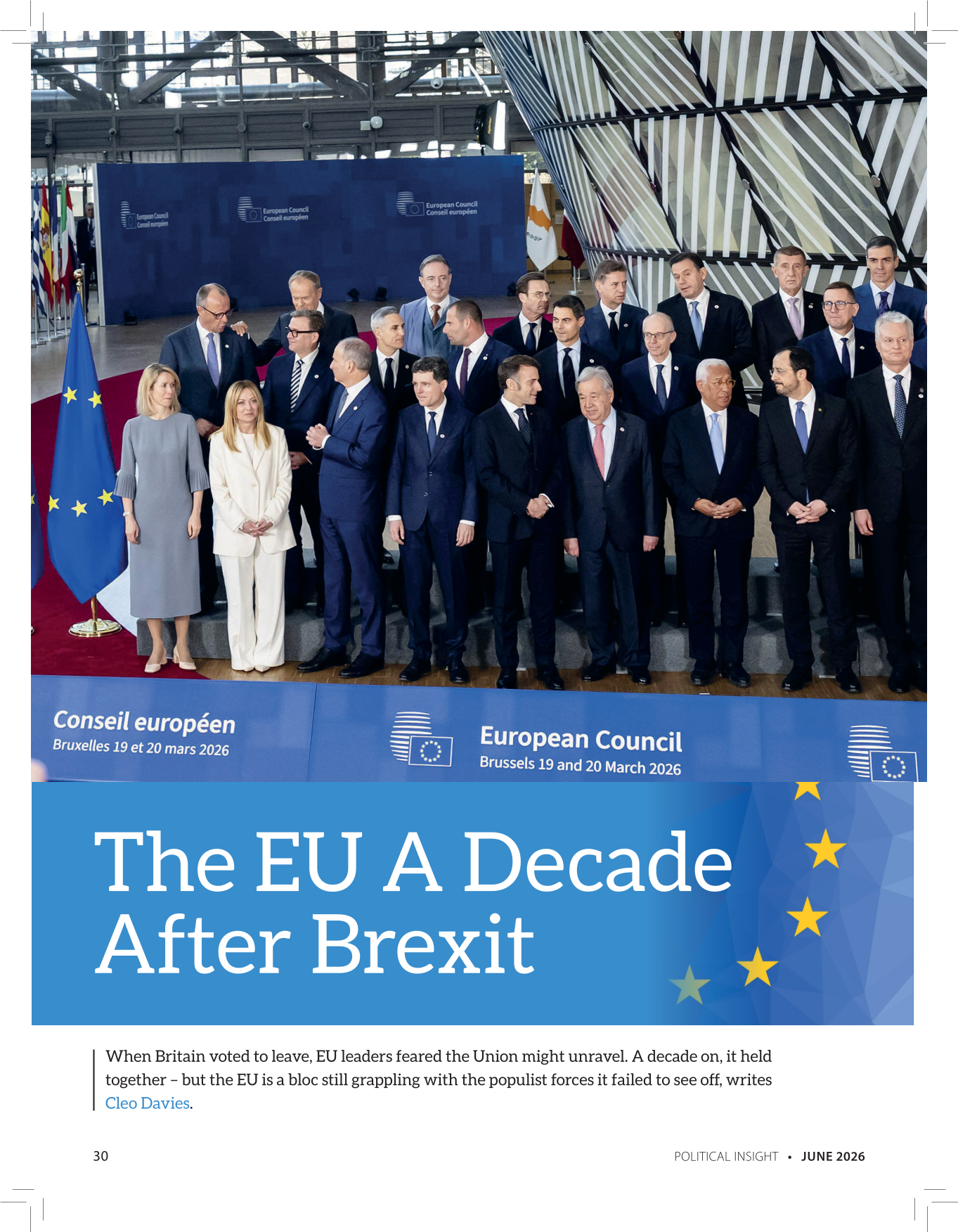
© ANP / Alamy Stock Photo

When Britain voted to leave, EU leaders feared the Union might unravel. A decade on, it held together – but the EU is a bloc still grappling with the populist forces it failed to see off, writes Cleo Davies.
After Britain’s Brexit vote in June 2016, the European Union’s future seemed precarious. Eurosceptic leaders celebrated a great victory with calls for in/out referendums. Marine Le Pen demanded a French vote, Geert Wilders a Dutch one, Matteo Salvini declared it was now Italy’s turn, and the Sweden Democrats called for Swexit. EU leaders fretted about the unravelling of the Union. For many, Brexit looked like the first domino.
A decade on, none of this happened. So what did Brexit do to the EU? Against all expectations, the EU27 maintained unity through years of difficult and highly politicised negotiations.
Brexit, though, did not spur the deep thinking about the European project that some heads of states and governments were calling for a decade ago. Nor did it lead to the federating ‘positive European agenda’ that European Commission President Jean-Claude Junker hoped for. Granted, the political and economic costs to the UK dampened calls by populist Eurosceptics to emulate the UK. But they did not disappear with the UK’s departure. Eurosceptic forces, especially far-right populist ones, now push back against the EU’s liberal order. Ten years after the Brexit referendum, the political centre ground in the EU has shifted to the right, precisely at a point in time when some in the UK call for re-joining the EU to counter the electoral successes of British populist rightwing forces.
After the referendum, heads of states and governments were pessimistic about the EU’s capacity to maintain unity. In 2016, the EU had just come through a particularly bruising period where divisions and dysfunctional responses over the eurozone and the refugee crises had been laid bare.
Brexit’s impact on the EU
It is hard to overstate what a shock the referendum outcome was for the EU. It triggered emotional responses and soul searching with reverberations throughout the entire system. Angela Merkel, in her memoirs published in 2025, writes about how she is still tormented by Brexit and calls it a humiliation for the EU.
In practice, however, Brexit was framed as a UK problem and the UK as a ‘third country in the making’. Emotions notwithstanding, the EU focused entirely on damage limitation and delivering an orderly Brexit from day one. In two European Council statements on 24 and 29 June, EU heads of states and governments committed to unity and outlined the EU27’s red lines – an agreement based on ‘a balance of rights and obligations’ and access to the single market contingent on ‘acceptance of all four freedoms’.
These principles made it clear that the departing state would be supplicant: the UK could not end up enjoying the same benefits as it did as a member but without the constraints of pooled decision-making and financial obligations. They also conveniently reconciled under a single principle – the ‘indivisibility of the four freedoms’ – the very different interests of the EU member states. In a matter of months, the EU clarified its negotiating strategy and put in place a governance architecture that supported unity between member states, the European Commission and the European Parliament. As the negotiations progressed, and the UK descended into political chaos, the EU’s unity was reinforced. So was the commitment to the indivisibility of the four freedoms.
For EU member states, the Brexit negotiations cemented their political understanding of single market ‘club’ membership as the source of the EU’s power, and as a unifying principle. Preserving the single market, including freedom of movement, is still the overarching political construct that drives the actions of the EU27 in relations with the UK. As an organising principle, it transcends the narrower interests of any given EU member state in relations with the UK and third countries. The EU drives a particularly hard bargain for access to the single market.
The adoption of the Withdrawal Agreement – supplemented by the Windsor Framework in 2023 – and the UK-EU Trade and Cooperation Agreement delivered an orderly withdrawal and limited the damage of the UK’s departure. But Brexit still had major consequences for the EU. It redrew the EU’s external border, with serious implications on the island of Ireland. It introduced barriers to trade with one of its major economic partners. The EU is also short of a large financial contributor and one of its most economic and politically liberal voices. Enlargement, for instance, is being planned without the UK, historically one of its most vocal advocates.
Furthermore, the UK left the EU without any provisions for cooperation on defence and security. Despite the adoption of a EU-UK Security and Defence Partnership in May 2025, it is not clear how the UK would feature in any future European security architecture. So far, the UK has not been able to join SAFE (Security Action for Europe), the EU’s €150bn defence fund, over disagreement on the level of the UK’s financial contribution. Participation for the UK, as in all other areas, comes at a price.
Finally, the UK’s departure also led to a transformation in the bilateral relationship between the EU member states and the UK. After the historical lows in bilateral relations under Boris Johnson’s premiership, there has been renewed dynamism in individual bilateral relationships, especially since the Windsor framework agreement in February 2023. But these are constrained by the legal obligations of EU member states (Davies and Kassim 2025).
Unity: the making of the EU27
After the referendum, heads of states and governments were pessimistic about the EU’s capacity to maintain unity. In 2016, the EU had just come through a particularly bruising period where divisions and dysfunctional responses over the eurozone and the refugee crises had been laid bare. David Cameron’s renegotiation had fractured member states, particularly over the concessions made on freedom of movement. Officials in Brussels and in European capitals were also fearful of the UK’s ability to exploit divisions between EU member states during the negotiations.
However, the Union was able to draw on its substantial resources to generate particularly effective collective action and unity (Laffan and Telle 2023). This was in large part due to the exceptional collaborative governance architecture that the EU created for the negotiations. It allowed for mobilising all necessary actors for an effective negotiation, whilst also ringfencing the negotiations with the UK from the rest of the EU political and policy agenda.
In the months after the referendum, the EU’s chief negotiator, Michel Barnier, and his team in the European Commission, worked together with a special internal task force in the Council Secretariat, led by Didier Seeuws. Hundreds of face-to-face meetings and transparency transcended the traditional inter-institutional turf battles. Stefaan de Rynck (2023), in his insider’s account of the negotiations, uses the word ‘symbiotic’ to qualify the relationship between the different institutional bodies in the Commission, the Council and the European Parliament during the negotiations. These were truly exceptional negotiations.
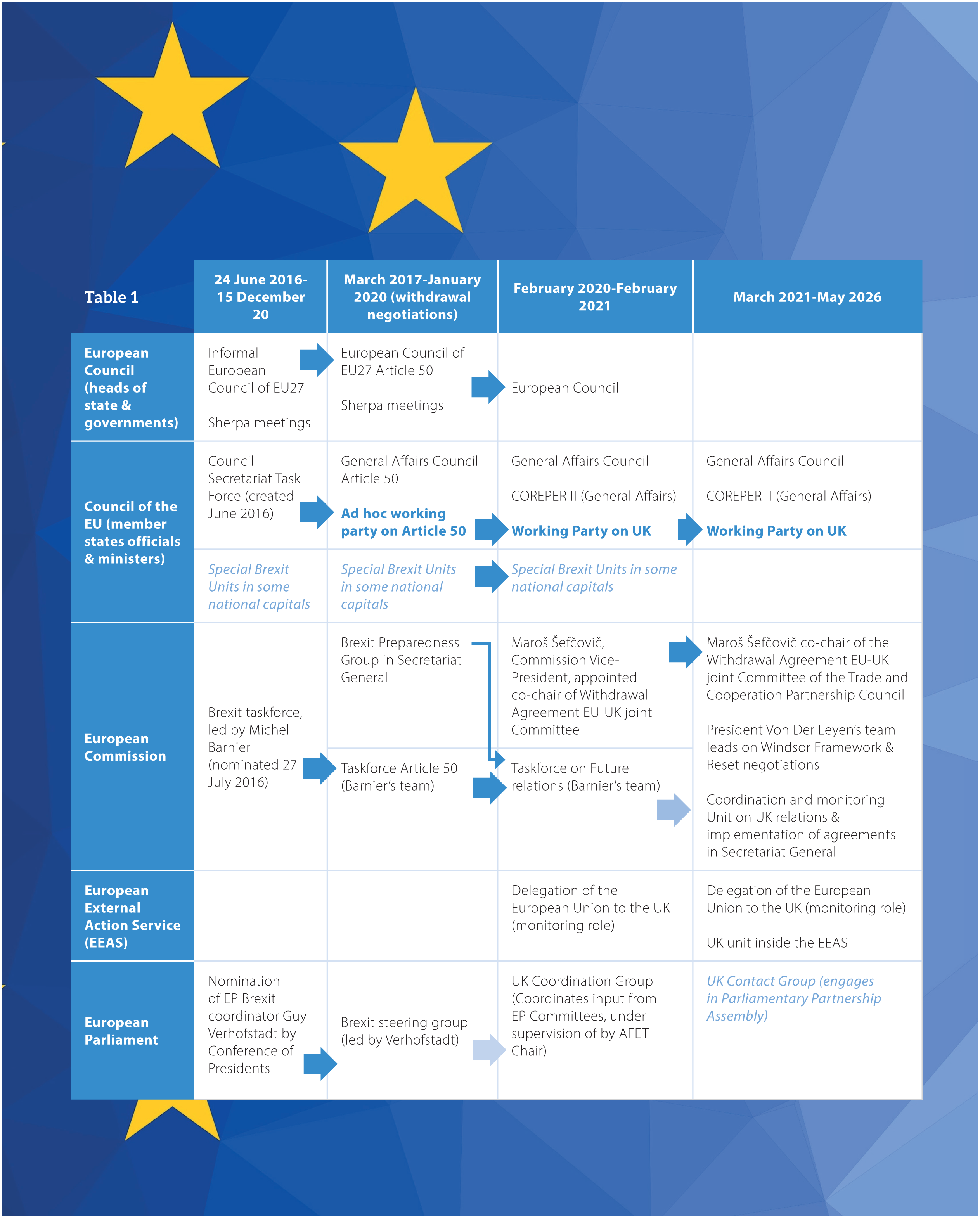
Table 1 presents the EU’s tailor made inter-institutional decision-making bodies for managing negotiations and then relations with the UK. It details how most bodies created for the Brexit negotiations by the European institutions have been wound down or subsumed into existing institutional frameworks of EU decision-making since the end of the negotiations. However, the continued existence of the Council working party on the UK is a legacy of the inter-institutional governance system created for the negotiations.
Since the end of the negotiations, heads of states and governments of EU member states very rarely discuss relations with the UK. The European Commission deals with most of the day-to-day management and implementation of the agreements with the UK.
Engagement and transparency continue to characterise the collaboration between the Commission services and the representatives of member states in the Council working party on the UK. Through the Council working party, member states maintain an overview at all times of the entire relationship with the UK, instead of dealing with the UK sector by sector. Member states also share information in this working party on their country’s bilateral initiatives with the UK.
This system of governance ensures that the EU can manage relations with the UK and develop common positions. But it is not a flexible one. Nor would it allow for making swift and sweeping changes in the relationship.
No domino effect
Virulent Eurosceptics in power in Poland and Hungary never really sought to undermine the Brexit negotiation process because unity and membership was in their interests. Nor did Brexit lead to a domino effect in the net contributing states. Instead of becoming a model to emulate, the UK’s withdrawal dampened ardours to hold referendums on exiting the EU in other member states.
In fact, as Paul Beaumont (2020) has argued, Brexit became a means for the EU to teach a lesson to EU member states on ‘the folly of following Eurosceptic fantasies’. Unwittingly, he goes on to write, Britain helped legitimate the EU ‘by publicly committing economic and political selfharm’. Euroscepticism, though, far from disappeared with the UK’s departure.
Initially, far-right Eurosceptic leaders outside government, notably in the Netherlands, France and Italy, called for holding referendums on membership. However, they moderated their policy stances as the costs and instability of leaving became apparent. As documented in the work of Marco Martini and Stefanie Walter (2023), they ‘took exit referendums off the table and have instead pursued differentiated membership via opt-outs, brakes and selective de-integration’.
Since the departure of the UK, Eurosceptics have shifted their focus to challenging the EU from within. They push back against the EU’s economic and rights-based liberal order, rather than call into question the existence of the Union itself. Their influence is growing. In the 2024 European elections, right wing Eurosceptics made substantial gains, shifting the EU political centre ground towards their illiberal preferences.
Conclusion
A decade after the UK voted to leave, the EU proved a much more resilient organisation than some anticipated. Brexit turned out to be the making of the EU27 instead of the unravelling of the EU28. Brigid Laffan and Stefan Telle (2023), in their account of the negotiations, argue that the EU matured as a polity over the course of the Brexit negotiations. Georg Riekeles, Michel Barnier’s political adviser during the entire negotiations, wrote in 2023 that ‘Brexit has been the EU’s self-discovery and transformation from a system made for dealing with each other to a system made for dealing with difficult others’. The EU still deals with the UK in a united manner, thanks to the institutional legacy of the negotiations. However, it still struggles to replicate similar levels of unity in dealing with other difficulties.
Since the departure of the UK, Eurosceptics have shifted their focus to challenging the EU from within. They push back against the EU’s economic and rights-based liberal order, rather than call into question the existence of the Union itself. Their influence is growing.
Footnotes
Cleo Davies is Assistant Professor in Politics and International Relations at Forward College, Paris.