






Abstract
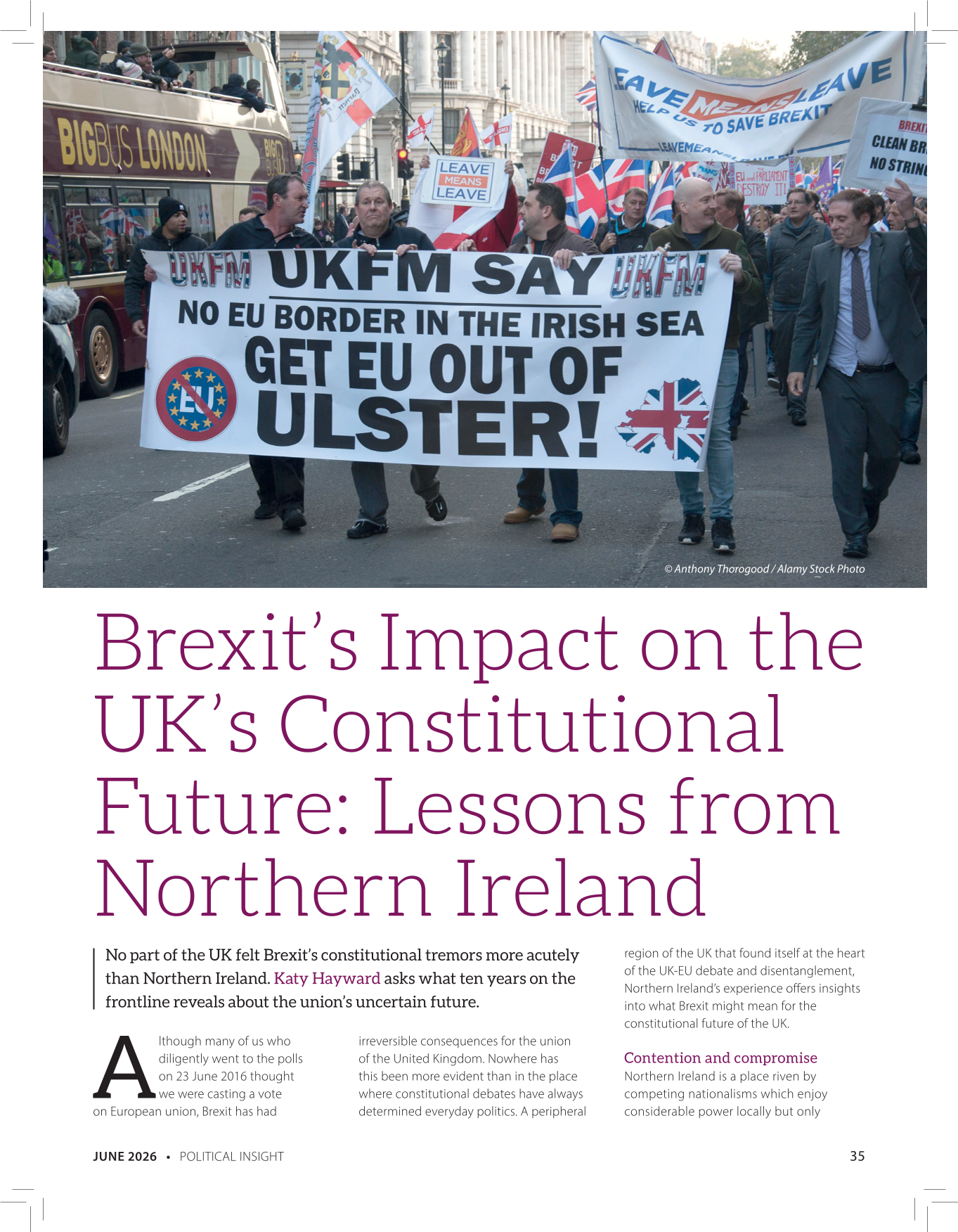
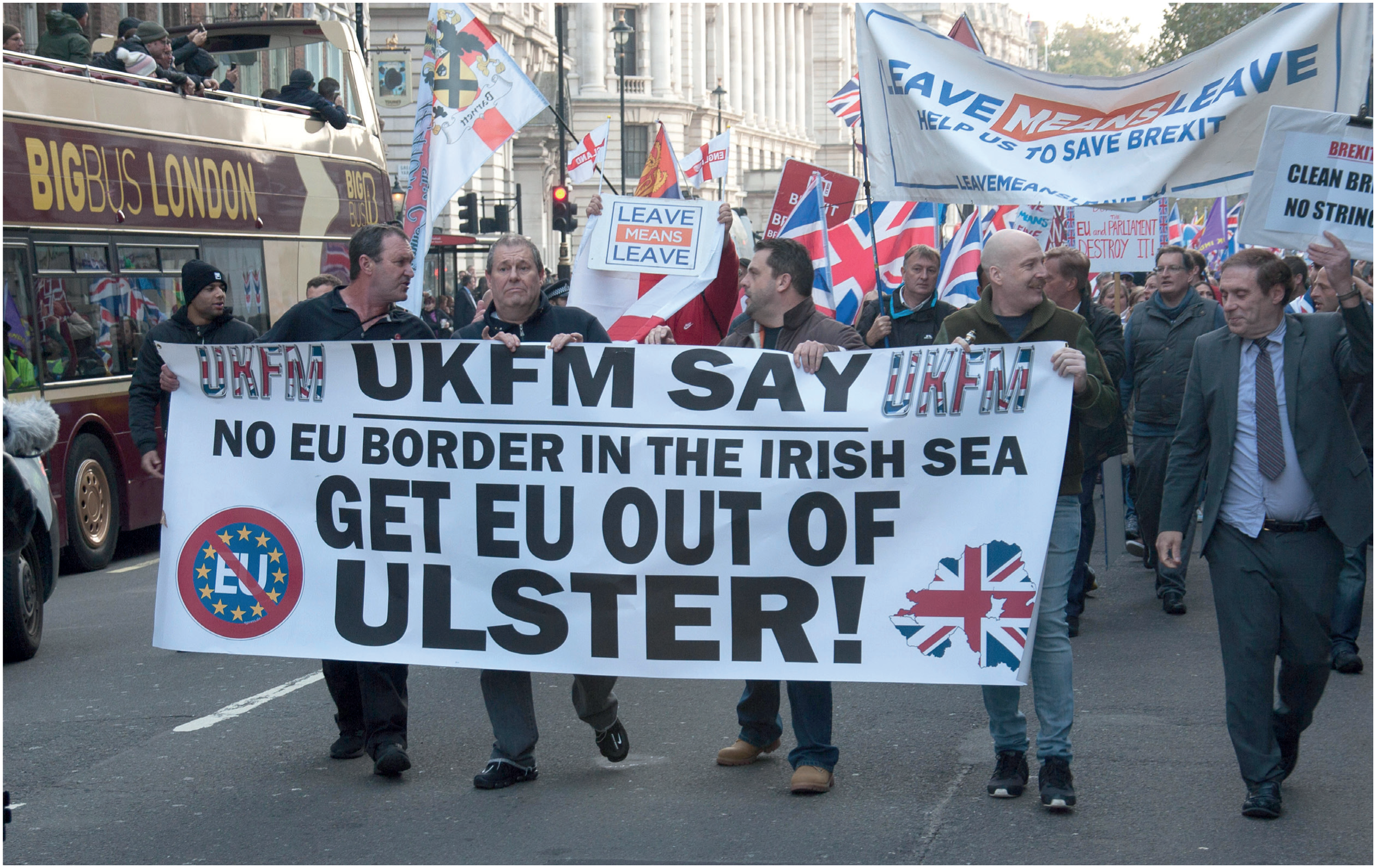
© Anthony Thorogood / Alamy Stock Photo
No part of the UK felt Brexit’s constitutional tremors more acutely than Northern Ireland. Katy Hayward asks what ten years on the frontline reveals about the union’s uncertain future.
Although many of us who diligently went to the polls on 23 June 2016 thought we were casting a vote on European union, Brexit has had irreversible consequences for the union of the United Kingdom. Nowhere has this been more evident than in the place where constitutional debates have always determined everyday politics. A peripheral region of the UK that found itself at the heart of the UK-EU debate and disentanglement, Northern Ireland’s experience offers insights into what Brexit might mean for the constitutional future of the UK.
Contention and compromise
Northern Ireland is a place riven by competing nationalisms which enjoy considerable power locally but only incidentally influence the direction of the UK as a whole. This took on a new significance in the wake of the referendum. Unionism’s support for Leave clashed with the Remain majority formed by nationalists and others. Their Brexit stance centred on the same focal point as their constitutional disagreement: the Irish border.
The land border on the island of Ireland had been transformed by the 1998 Good Friday (Belfast) Agreement and EU membership into a line of connection and cooperation – symbolically contentious, perhaps, but no longer physically so. How could it be transformed into the new UK/ EU external border as leaving the single market and customs union required – with all the associated checks, controls and infrastructure – without causing severe disruption to peace and prosperity on the island?
The compromise came in the form of the Protocol on Ireland/Northern Ireland in the UK-EU Withdrawal Agreement. It allowed a hard Brexit, as desired by Boris Johnson’s government, at the price of special arrangements for Northern Ireland. Predictably, such a compromise raised political ire as well as practical difficulties.
The intensification of nationalist/unionist tensions in Northern Ireland are not a parochial concern. Instead, the post-Brexit experience of the region offers a glimpse into fundamental challenges for the constitutional future of the UK. These can be seen in the democratic problem of the asymmetric union (e.g. Remain majorities overridden by the English Leave vote), the hardening of Leave/Remain from ideologies into identities, and the gap between sovereignty-in-theory and sovereignty-in-practice that nationalism will always, eventually be confronted with.
Post-Brexit nationalism
The post-Brexit environment of the UK has offered clement conditions and plentiful nourishment for a blossoming of nationalism in its various forms. While Brexit in principle may have appealed to a certain sense of British nationalism (parliamentary sovereignty, monetary independence, border controls, etc.), Brexit in fact has seen the flourishing of internal nationalisms that contest the very notion of Britishness.
While Brexit in principle may have appealed to a certain sense of British nationalism (parliamentary sovereignty, monetary independence, border controls, etc.), Brexit in fact has seen the flourishing of internal nationalisms that contest the very notion of Britishness.
Resentment towards those who place constraints on national autonomy and sovereignty has turned inwards: from Brussels to London. Now the indignation of English, Scottish, Welsh and Irish nationalists (of various hues) faces towards Westminster. And if we consider Ulster unionism as a form of nationalism, it seems even that pro-Brexit, pro-British sentiment is despairing of the future of the UK and distrustful of those in charge of making it.
Ten years on from the referendum, Northern Ireland is a region in which all political institutions and parties are distrusted far more than they are trusted. Loyalists – the most hardline of unionists – are the most distrustful and despairing of all. In Queen’s University Belfast, we have been conducting regular polling to ‘test the temperature’ of public opinion in Northern Ireland in relation to its unique post-Brexit circumstances since early 2021. If Great Britain is now riven with ‘Tribal Politics’, Northern Ireland was there long before – and may offer lessons as to what could lie ahead.
Hastening a break-up?
Two-thirds of respondents to our poll in Northern Ireland think that Brexit has made the break-up of the United Kingdom more likely. While the overwhelming majority (86 per cent) of Remain-voters believe this to be the case, Leave voters are evenly split on the matter (41 per cent think it has, 39 per cent think it hasn’t) although nearly a quarter (23 per cent) of them strongly believe that a break-up of the UK is more likely now as a result of Brexit. Looking in more detail at this data, we can see that this is the opinion of those who would self-describe as broadly or moderately unionist, as well as those who are nationalist or ‘neutral’ on the constitutional question (see Figure 1).
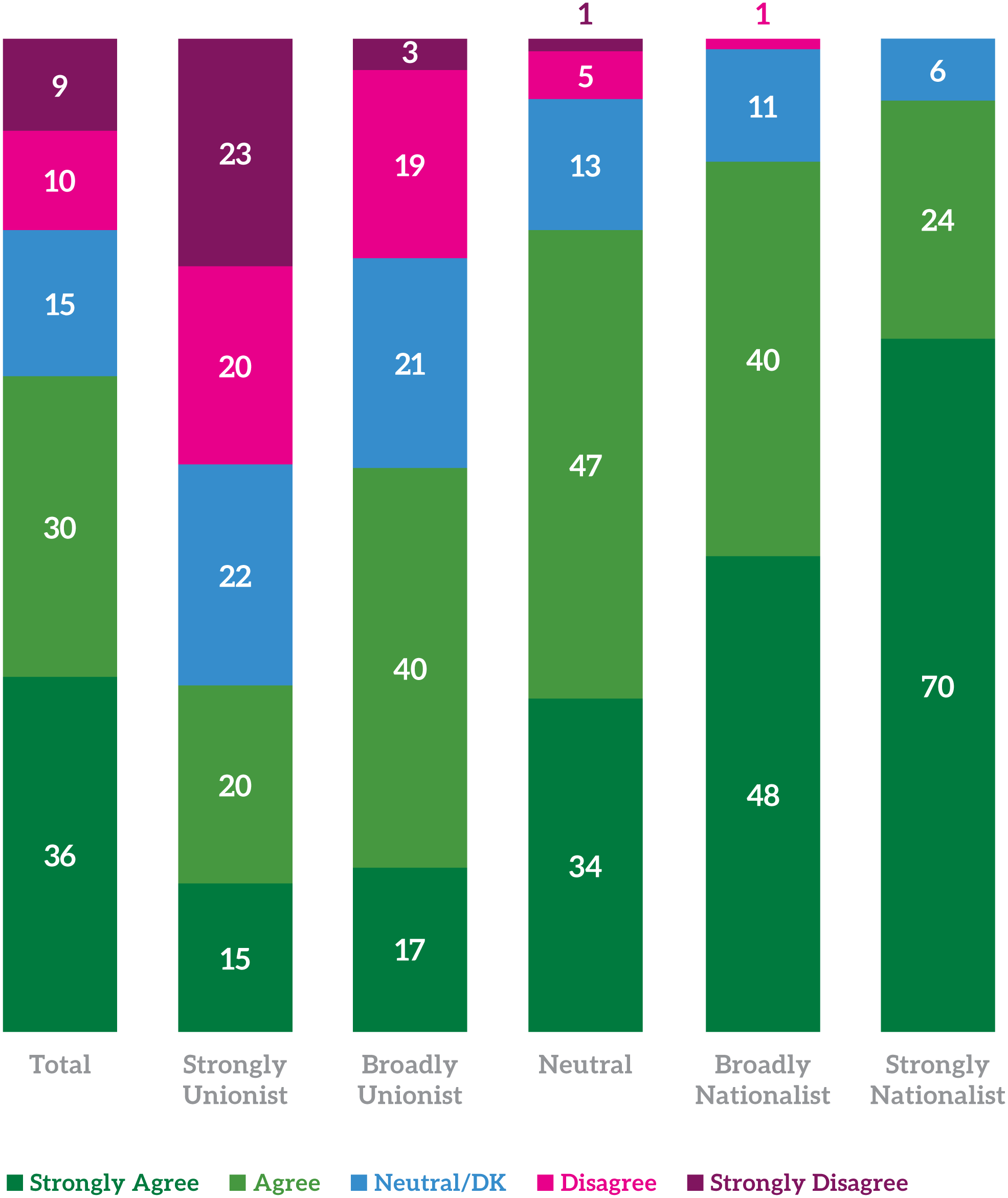
Brexit Makes the Break-up of the UK More Likely (%)
These results are significant for the whole of the UK for several reasons. The most obvious is the fact that Northern Ireland voters do have it in their power to bring about the break-up of the UK. The Secretary of State for Northern Ireland has the means to call a referendum on whether Northern Ireland should leave the UK a become part of a United Ireland (as per the 1998 Good Friday (Belfast) Agreement and subsequent Northern Ireland Act, 1998) – and the duty to do so if he thinks it is likely that a majority in such a ‘border poll’ would vote for unity. While support for staying in the UK has declined in Northern Ireland in the past decade (now consistently some way below the 50 per cent mark in most polls), it remains the preference of the plurality. How unionism is responding to these conditions is as important for the future of the UK as Irish nationalists’ capacity to build momentum.
The first thing to understand about unionism in Northern Ireland is that most unionists voted to Leave the EU – the last thing they wanted or expected was that it might become more difficult to hold the UK together.
The first thing to understand about unionism in Northern Ireland is that most unionists voted to Leave the EU – the last thing they wanted or expected was that it might become more difficult to hold the UK together. Indeed, many Leave voters in Northern Ireland voted in favour of Brexit because they thought it would strengthen the UK. The pro-Brexit arguments and mantras were common across Britain and Northern Ireland. So much so, in fact, that the Democratic Unionist Party (at the time, the largest party in the NI Assembly) paid for Vote Leave advertisements in local newspapers in Britain during the last days of the referendum campaign.
The fact that so many of these Leave voters now expect the break-up of the UK should not be interpreted, however, as leading to any sense of buyers’ remorse. Instead, we have seen a hardening of positions. The same poll shows that Leave/ Remain identities are ‘very important’ to over half of voters in Northern Ireland, including 57 per cent of Leave voters and 53 per cent of Remainers. It also shows that if the referendum were to be held tomorrow, the result in Northern Ireland might not be radically different to that in 2016 when there was a 56 per cent Remain vote: 57 per cent of our respondents say they would like the UK to rejoin the EU. Why is ‘Bregretfulness’ quite so low in Northern Ireland, despite the fact that so many Leave-voting unionists think that Brexit has cast doubt on the future existence of the UK? The key is to understand the reason why they think it has had this effect.
A peculiar precarity
The fact that so many in Northern Ireland think the future of the UK is tenuous relates wholly to Northern Ireland’s experience as part of it over the past ten years. Such experience has been viewed in very different terms by Leavers and Remainers here. First, is the experience shared with Scotland, namely that the Remain-voting majority was overridden by the Leave-voting UK-majority. Such a stark manifestation of the UK’s demographic and political asymmetry merely confirmed nationalist sentiment. Written comments in the Testing the Temperature polls have consistently expressed such views, and the most recent one was no exception:
‘I like Brexit only because I believe it will eventually lead to a United Ireland.’ (44)
‘Brexit has put a Unity poll for uniting our country front and centre!’ (228) ‘UK has become much more insular and weaker on the world stage since Brexit. Big, big mistake. Has upped the ante big time for the unification of Ireland.’ (173)
The constitutional possibility of a ‘border poll’ for Northern Ireland is one way its position differs from Scotland. Another is the fact of it having a land border with the EU and a peace agreement that includes institutionalised strands of cooperation with Ireland. Together these constituted unique circumstances that saw the UK and EU identify ‘avoiding a hard border on the island of Ireland’ as one of the three priority issues in the Brexit negotiations. Finding a solution to the trilemma that arose from the wish to leave the EU’s Customs Union and Single Market whilst meeting that objective was described at the time as ‘hunting for unicorns’. I confess to being one of the experts who went on record in parliamentary committee rooms and broadcasting studios to confirm the nonexistence of such mythical creatures.
The unicorn hunt was not to end until early 2023 with the Windsor Framework – a UK-EU deal that saw conditional modification of the operation of the Protocol on Ireland/ Northern Ireland. The Protocol (part of the UK-EU Withdrawal Agreement) places Northern Ireland de facto and partially in the EU’s Single Market and Customs Union, even while remaining part of the UK and its internal market and customs territory. The Windsor Framework lightened the practical ramifications of this, particularly for trade between Britain and Northern Ireland. It did so in a way that demonstrates an unprecedented level of flexibility and imagination on the part of the UK and EU negotiators. As such, I admit, the beast Northern Ireland has ended up with is as close to a unicorn as we might reasonably expect to see in this world (see Figure 2).

A Pictorial Depiction of the Windsor Framework, Generated by Artificial Intelligence at the Detailed Prompting of the Author.
Better together?
Fake unicorns can be high maintenance, and the Windsor Framework is an extraordinarily complex arrangement – even by EU standards. The institutional mechanisms put in place to manage it, as well as the technical and legal expertise required to keep it functioning, have posed a steep challenge for policymakers, officials and practitioners alike. Some lessons arising from this experience could potentially be shared on a larger scale, if the UK is indeed to enter any similar arrangements for dynamic alignment with some EU rules to reduce trade frictions.
However, the practical difficulties of the post-Brexit arrangements for Northern Ireland have been accompanied, inevitably, by political challenges too. While some remain unconvinced that any unicorn hunt was ever necessary, others resent the very existence of such a peculiar creature. The Testing the Temperature polling has consistently shown a majority thinking that the Protocol/Windsor Framework has a negative impact on Northern Ireland’s constitutional place in the UK and in the UK internal market. This returns us to a core reason for Leave-voters’ and unionists’ doubts about the future of the UK: the Windsor Framework. In their own words:
‘The Protocol / Windsor Framework fundamentally breaks the promises made to the Unionist Community in the Belfast Agreement, e.g. NI will remain an integral part of the UK’ (4) ‘The Windsor Framework is a reprehensible betrayal of Northern Ireland’s status within the UK’ (76) ‘If the Windsor Framework results in the further separation of NI from UK this is a very bad thing. We did not vote to be separated from the rest of the UK.’ (194)
Reacting to the reset
The UK-EU ‘reset’ – if it continues as their Common Understanding (May 2025) indicated – is to be so close as to reduce the ‘separation’ between Northern Ireland and Great Britain in many ways to practical benefit. Politically, however, Leave-voting unionists will face yet another act of Brexit ‘betrayal’. The reaction to UK-EU agreements in which the UK aligns with EU rules will also be a test for various forms of nationalism across the UK itself. The reaction in England will, of course, be the most consequential. If we see a resurgence of English nationalism readying itself for another attempt to take control, centrifugal tensions in the UK may spin the UK in unpredictable directions.
What has happened in Northern Ireland is not peripheral to the UK but indicative of the types of difficult choices and compromises that arise from accommodating different nationalisms. In that sense, the UK’s relationship with Europe is not only foreign policy but a domestic concern of existential significance.
Footnotes
Katy Hayward is Professor of Political Sociology and co-Director of the Centre for International Borders Research at Queen’s University Belfast.