






Abstract
Fast-growing trees have an important role in sustainable forestry. Paulownia species are considered fast-growing trees, although their wood is characterised by low wood density. The object of this study is to produce high-quality sawn timber from young Paulownia species. Ten 5-year-old trees were harvested (stem diameter at 1.3 m above the ground = 21.1 ± 3.3 cm, tree height = 15.0 ± 1.3 m) for producing timber (38 × 89 × 1820 mm, without pith cavity). Before harvesting, the stress-wave velocity of stems was measured to non-destructively estimate the mechanical properties of the timber. A static bending test was conducted on the timber to determine the modulus of elasticity (MOE) and the modulus of rupture (MOR). The mean values of crook, bow and twist were 0.30%, 0.08% and 1.41 degree, respectively. The mechanical properties at 15% moisture content were 4.17 GPa in MOE15 and 19.2 MPa in MOR15. The MOE15 and MOR15 apparently increased compared to timber with a pith cavity in the previous study. The 5% lower tolerance limit with a 75% confidence level (TL75%,95%) of MOR15 was 11.6 MPa. At the standing tree-level (n = 10), stress-wave velocity of stems was correlated with air-dry density of timber (r = 0.644, p = 0.045) and MOE15 (r = 0.768, p = 0.009). Based on these results, high-quality sawn timber can be produced from young Paulownia trees by selecting suitable trees at the standing-tree level using stem stress-wave velocity and eliminating the pith cavity during sawing.
Introduction
Fast-growing trees are crucial for enhancing forestry profitability and ensuring sustainability. Forestry utilising fast-growing trees has been practiced in various locations worldwide, primarily in tropical regions. Cossalter and Pye-Smith 1 reported that ‘fast-wood’ plantations are intensively managed commercial plantations, set in blocks of a single species, which produce industrial round wood at high growth rates (mean annual increment of no less than 15 m3 per hectare) and which are harvested in less than 20 years. Various fast-growing tree species, such as Acacia, Eucalyptus, Pinus, Gmelina and Falcataria in the tropics, and Eucalyptus and Populus in temperate regions, are used to establish the commercial plantations. 1 Wood from these species is primarily used as pulpwood, as fuel for biomass power generation and as raw material for wood-based products. 1 However, to further enhance forestry profitability, it is essential to produce higher value-added products, such as sawn timber, as pulpwood and fuelwood are not necessarily traded at high prices.
Paulownia originates in Asia and is known as one of the fast-growing tree species capable of thriving in temperate to cold climates. It has been introduced in Europe, North America and South America.1–6 While it is characterised by extremely rapid growth, its wood density is known to be low. 6 Consequently, the final products made from wood obtained from this species have traditionally been considered limited. In Japan, it has traditionally been planted, and wood has been used to make chest of drawers, wooden sandals (‘geta’ in Japanese), musical instruments (e.g., the Japanese harp, ‘koto’) and other household items. 7 Recently, we have been establishing Paulownia plantations in Tochigi, Japan, and collecting growth and wood property data to re-examine the potential for producing biomass fuel for power generation.8,9 The results revealed that, while wood density is indeed low as previously known, considering its extremely rapid growth rate, it can supply fuelwood equivalent to or exceeding that of the most popular plantation species, Japanese cedar (Cryptomeria japonica D.Don). 9 However, as mentioned earlier, producing fuelwood does not always show high profitability. Therefore, a portion of the wood produced from the plantation should be used to produce timber products to ensure profitability.8,9 In a previous report, 8 we produced timbers from 4-year-old Paulownia species (mean ± standard deviation of stem diameter at 1.3 m above ground was 17.5 ± 2.8 cm) and investigated its timber qualities. The results revealed significantly lower MOR values in timbers containing the pith cavity than in timbers without it, resulting in a 5% lower tolerance limit with a 75% confidence level (TL75%,95%) of MOR, indicating very low MOR (4.5 MPa). 8 On the other hand, using 26-year-old Paulownia tomentosa planted in Fukushima, Japan, we also investigated the radial variation in bending properties and compressive strength. 6 The results showed that in Paulownia species, compressive strength is slightly weaker around the pith cavity, but then remains nearly constant towards the bark side. Furthermore, it was confirmed that the strength of timbers (n = 15) manufactured from approximately 50-year-old Paulownia tomentosa is sufficient: minimum, mean, standard deviation and maximum values of MOR at 15% moisture content was 12.7, 24.2, 6.1 and 32.9 MPa, respectively. 10 These findings suggest that it is necessary to remove the pith cavity and the surrounding wood when producing timber, and then re-evaluate its bending properties.
To efficiently produce structural timber, strength evaluation at the standing tree level is crucial. It is known that the stress-wave velocity of stems at standing trees can be used to evaluate the strength performance of timbers produced from those trees.11–20 For example, the stress-wave velocity of stems in hinoki cypress (Chamaecyparis obtusa (Siebold et Zucc.) Endl.) were significantly correlated with MOE (r = 0.563, p = 0.015) and MOR (r = 0.531, p = 0.023) of timbers (38 × 89 mm in cross-section). 19 However, available information on the relationships between the stress-wave velocities of standing trees and timber qualities remains limited. 16
The aim of this study is to obtain high-quality timber from young Paulownia trees. To achieve the aim, Paulownia timbers without a pith cavity were produced, and timber qualities were determined. In addition, the relationships between standing-tree characteristics and timber qualities were evaluated to efficiently produce high-quality timber from young Paulownia plantation.
Materials and methods
Materials
Figure 1 shows the experimental scheme of this study. The targeted plantation was located in Mashiko, Tochigi, Japan (36°33′N, 139°54′E, 84 m above sea level). There were 78 five-year-old Paulownia sp. trees in the plantation. The plantation was established with three by 3 m initial spacings by purchasing seedlings (seed source is unknown). After planting, no thinning was conducted but weeding and fertiliser application were done each year.
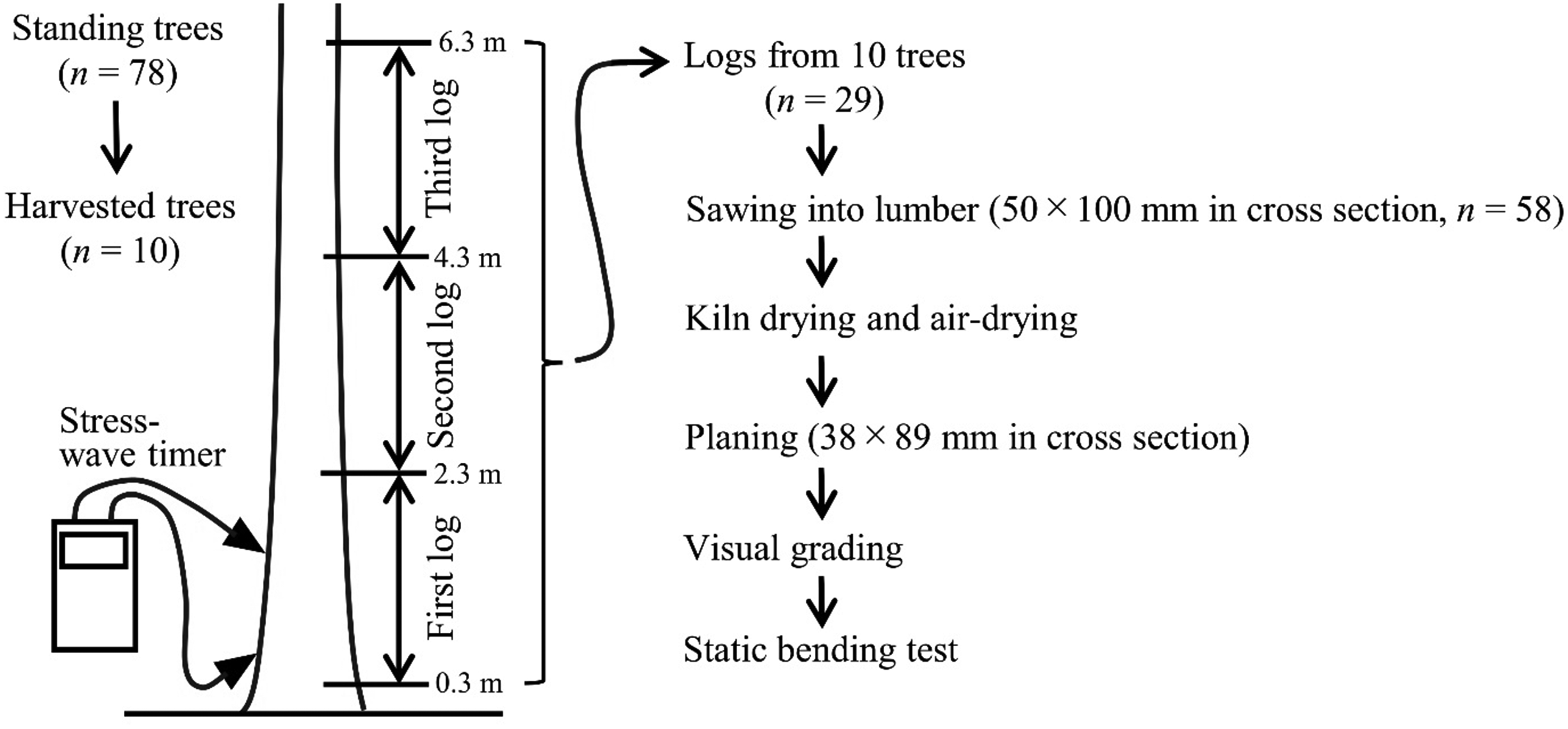
Experimental procedures. Note: n: number of trees, logs or timber.
Standing-tree characteristics
Stem diameter at 1.3 m above ground, tree height and stress-wave velocity of stems were measured for all trees in the plantation as standing-tree characteristics. The stem diameter and tree height were determined using a tape measure (F10-02DM, KDS, Kyoto, Japan) and a height meter (Vertex V, Häglof, Lårgsele, Sweden), respectively. Stem stress-wave velocity was measured using a stress-wave timer (TreeSonic, Fakopp Kft, Sopron, Hungary) according to the methods described by Ishiguri et al.
13
Sensors were set at 0.5 and 1.5 m above the ground to measure the time of stress-wave propagation. The stress-wave velocity (SWV) of stems was calculated by the following formula (Equation [1]):

Timber qualities
After measuring the standing tree characteristics, 10 trees with average-to-large stem diameters and average-to-high stem stress-wave velocity in the plantation were harvested to evaluate timber qualities. After harvesting, logs (2 m in length) were collected from 0.3 m above the ground until the top diameter became less than 14 cm. As a result, a total of 29 logs (almost three logs in a tree) were collected. To identify the sampling height position of the logs, logs collected from 0.3 to 2.3 m, from 2.3 to 4.3 m and from 4.3 to 6.3 m were defined as positions I, II and III, respectively. The logs were sawn into timbers (5 by 10 cm in cross section) as many as possible. A total of 58 pieces were obtained. The timbers were kiln-dried, then kept in air-drying conditions. The dried timbers were planed to 38 by 89 mm in section and cut to 1820 mm in length. After that, crook, bow, twist and density were measured according to Japan Agricultural Standard (JAS) 0600 (visual grading for structural lumber and finger jointed structural lumber for wood frame construction
21
). Crook and bow were determined by the following formula (Equation [2]):

For the twist, timber was placed on a flat steel plate, and the deviation at a single position was measured. The twist was calculated by using the following formula (Equation [3]):

The static bending test was conducted using a full-scale bending test machine (IPA-100R, Maekawa Testing Machine, Tokyo, Japan) according to the methods of strength testing for structural timber described by Japan Housing and Wood Technology Center.
22
The following conditions were applied: lower span = 1602 mm (lower span/depth ratio = 18), upper span = 534 mm (upper span/depth ratio = 6), load speed = 10 mm/min and load direction = edge-wise. The deflection during the test was measured using a displacement transducer (SDP-200D, Tokyo Measuring Instruments Laboratory, Tokyo, Japan) at the midpoint of the span. The timber was randomly set on the lower support, with no consideration of its knot positions. The modulus of elasticity (MOE) and modulus of rupture (MOR) were calculated by the following formulas (Equations [4] and [5])
22
:


After the bending test, a small clear specimen was collected from the timber specimens without any visual defects to measure density and moisture content during testing. The moisture content was determined by the oven drying method. As a result, the mean and standard deviation of the moisture content were 12.1 ± 0.6%. Thus, MOE and MOR values were adjusted to those at 15% moisture content by the following equation (Equation [6])
22
:

Statistical analysis
Statistical analysis was conducted using R software (Version 4.4.2).
23
To obtain the Pearson's correlation coefficient between measured characteristics at different specimen forms, mean values at the tree level (n = 10) and log level (n = 30) were calculated. To evaluate the effect of height positions on measured properties in the timber, the following mixed-effect model (Equation [7]) was developed using lme4 package
24
:

The 5% lower tolerance limit with a 75% confidence level (TL75%,95%) of MOR was calculated by the method described by Japan Housing and Wood Technology.
22
The Shapiro-Wilk test was applied to evaluate the data normality. If the data followed normal distribution, then TL75%,95% of MOR was calculated by the following equation (Equation [8]):

Results
Table 1 shows the mean values of standing-tree characteristics. Stem diameter at 1.3 m above the ground, tree height and stress-wave velocity of stems in all trees (n = 78) in a stand were 21.1 ± 3.3 cm, 15.0 ± 1.3 m and 2.57 ± 0.14 km/s, respectively. Mean values of the sampled 10 trees were almost the same as those of all trees in a stand (Table 1).
Standing-tree characteristics of 5-year-old Paulownia sp. trees.
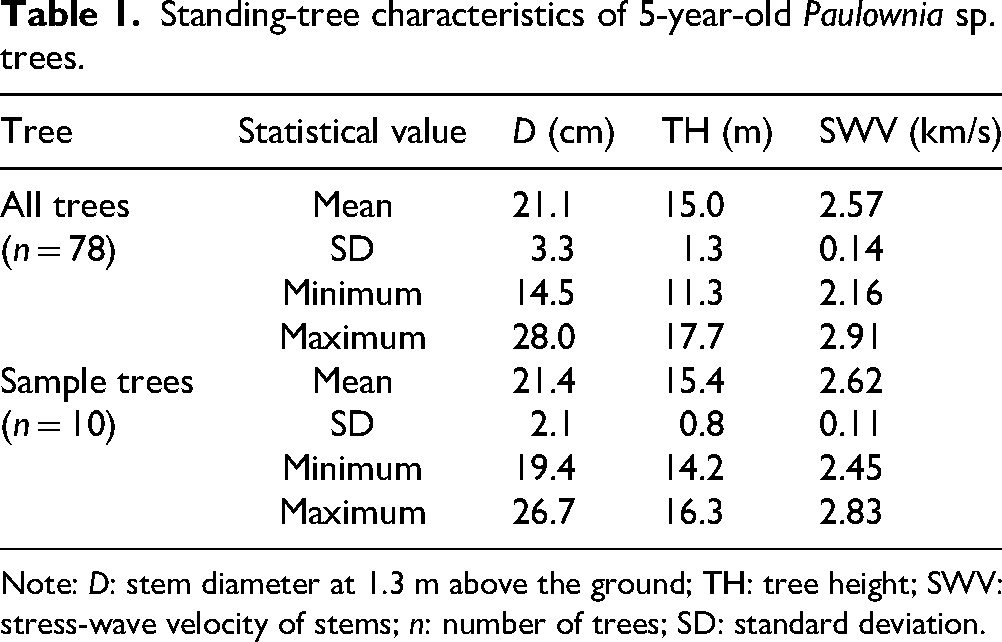
Note: D: stem diameter at 1.3 m above the ground; TH: tree height; SWV: stress-wave velocity of stems; n: number of trees; SD: standard deviation.
Table 2 shows statistical values of timber qualities. Due to issues with the sawing process, timber was not obtained from the log. Thus, 58 timbers were obtained from 29 logs from 10 trees. The air-dry density ranged from 0.15 to 0.25 g/cm3, with a mean value of 0.20 g/cm3. The mean values of crook, bow and twist were 0.30%, 0.08% and 1.41 degree, respectively. The mechanical properties at 15% moisture content were 4.17 GPa in MOE15 and 19.2 MPa in MOR15.
Quality of timber sawn from 29 logs obtained from 10 Paulownia sp. trees.
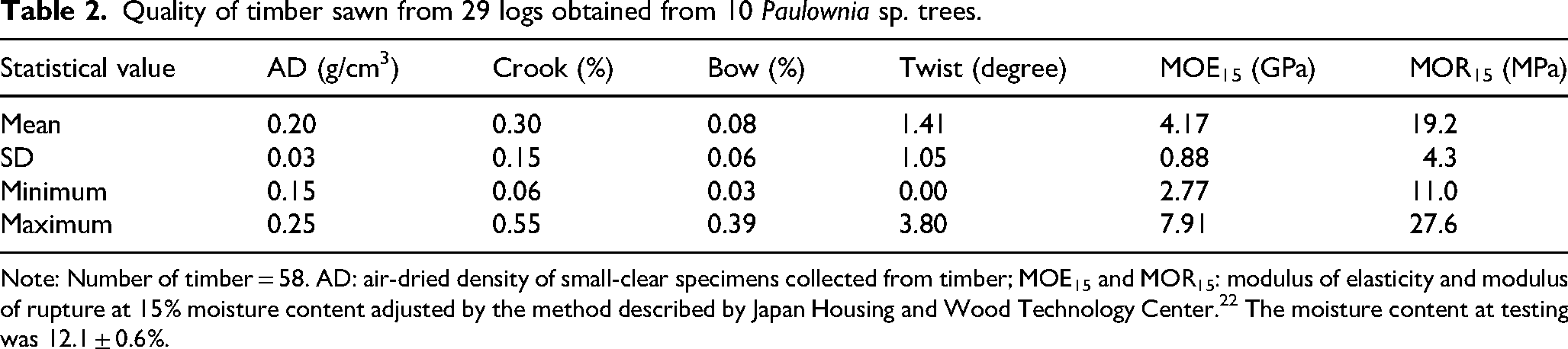
Note: Number of timber = 58. AD: air-dried density of small-clear specimens collected from timber; MOE15 and MOR15: modulus of elasticity and modulus of rupture at 15% moisture content adjusted by the method described by Japan Housing and Wood Technology Center. 22 The moisture content at testing was 12.1 ± 0.6%.
Fixed- and random-effect parameters in the mixed-effect models explaining the effect of sampling height positions on timber quality are shown in Table 3. All models for timber qualities were converged, except for bow. A relatively higher variance component ratio for the random effect of height positions was observed for the air-dry density of timber (53.7%) and MOE15 (20.7%).
Fixed- and random-effect parameters in the mixed-effect models explaining for effect of the sampling height positions on timber qualities.
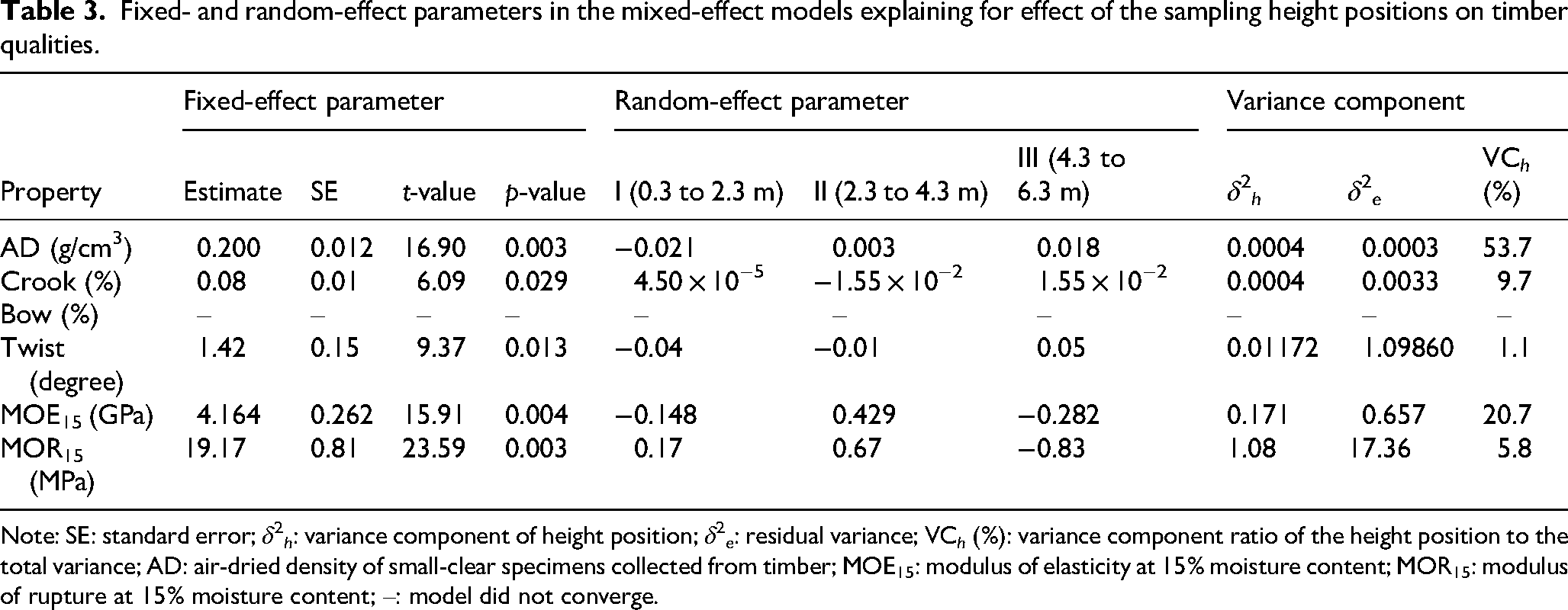
Note: SE: standard error; δ2 h : variance component of height position; δ2 e : residual variance; VC h (%): variance component ratio of the height position to the total variance; AD: air-dried density of small-clear specimens collected from timber; MOE15: modulus of elasticity at 15% moisture content; MOR15: modulus of rupture at 15% moisture content; –: model did not converge.
Relationships between measured properties at different levels are shown in Figure 2 and Tables 4 and 5. Among standing-tree characteristics (n = 78, Figure 2), stem diameter was significantly correlated with tree height (r = 0.415, p < 0.001), but not with stress-wave velocity of stems (r = −0.169, p = 0.139). On the other hand, a weak positive correlation (r = 0.225, p = 0.048) was observed between tree height and stress-wave velocity. At standing tree-level (n = 10), stem stress-wave velocity was correlated with air-dry density of timber and MOE15 (Table 4). In the timber level (Table 5, n = 59), air-dry density of timber positively correlated with bow (r = 0.264, p = 0.046). In addition, MOE15 positively correlated with MOR15 (r = 0.321, p = 0.014).
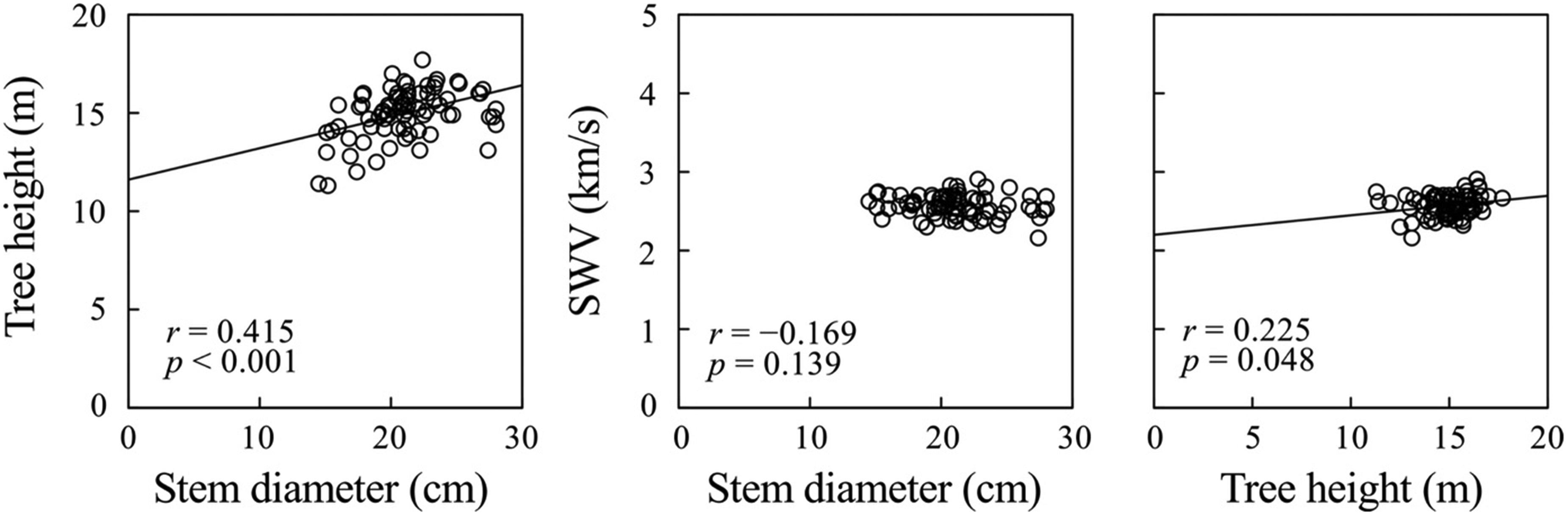
Relationships between standing-tree characteristics. Note: Number of sample trees = 78. SWV: stress-wave velocity of stems; r: correlation coefficient.
Relationships between standing tree characteristics and timber qualities.
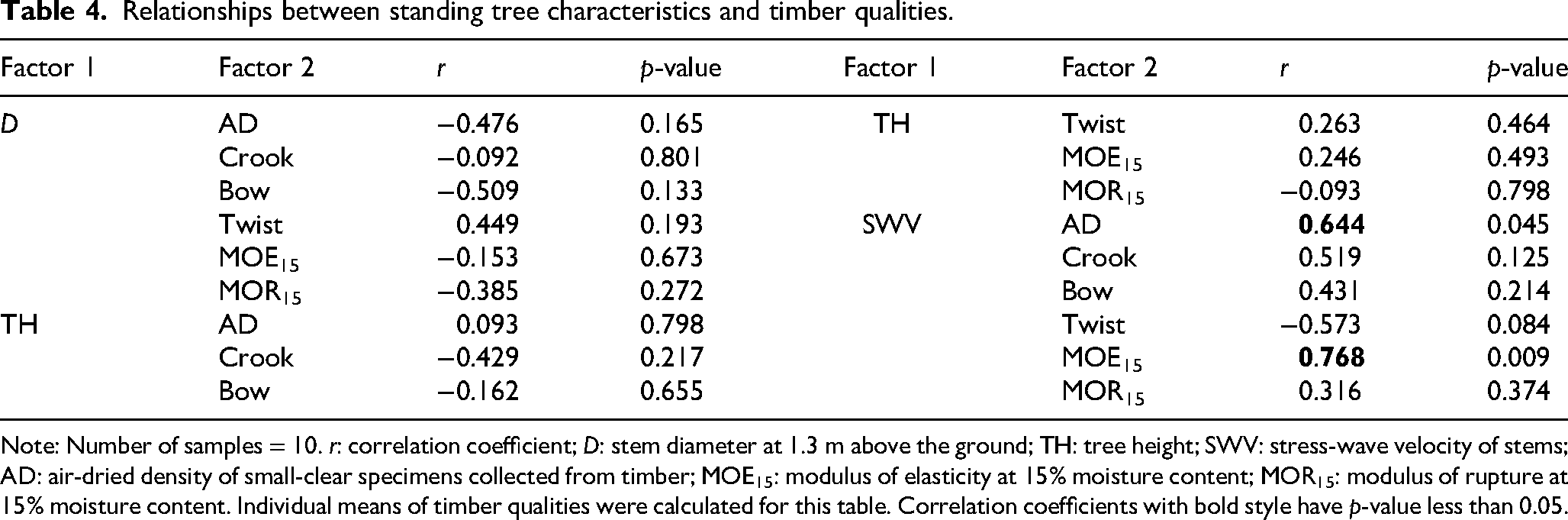
Note: Number of samples = 10. r: correlation coefficient; D: stem diameter at 1.3 m above the ground; TH: tree height; SWV: stress-wave velocity of stems; AD: air-dried density of small-clear specimens collected from timber; MOE15: modulus of elasticity at 15% moisture content; MOR15: modulus of rupture at 15% moisture content. Individual means of timber qualities were calculated for this table. Correlation coefficients with bold style have p-value less than 0.05.
Relationships between timber qualities.
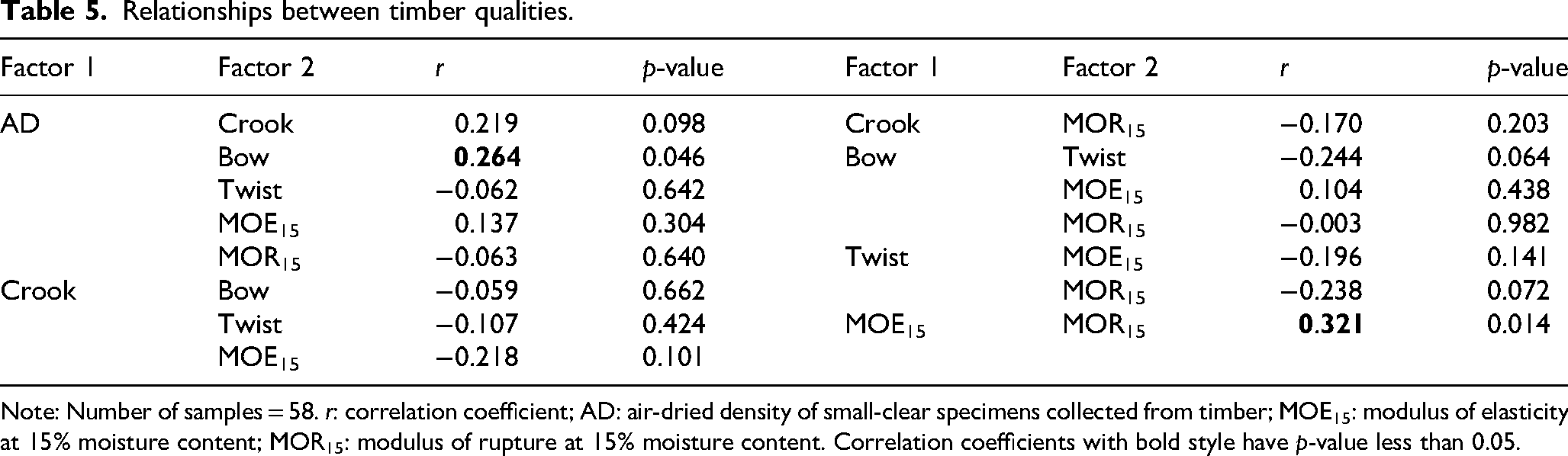
Note: Number of samples = 58. r: correlation coefficient; AD: air-dried density of small-clear specimens collected from timber; MOE15: modulus of elasticity at 15% moisture content; MOR15: modulus of rupture at 15% moisture content. Correlation coefficients with bold style have p-value less than 0.05.
Figure 3 shows the frequency distribution of MOR15. The p-value of the Shapiro–Wilk test exceeded 0.05, suggesting that the distribution was adapted to the normal distribution. The TL75%,95% of MOR15 was 11.6 MPa.
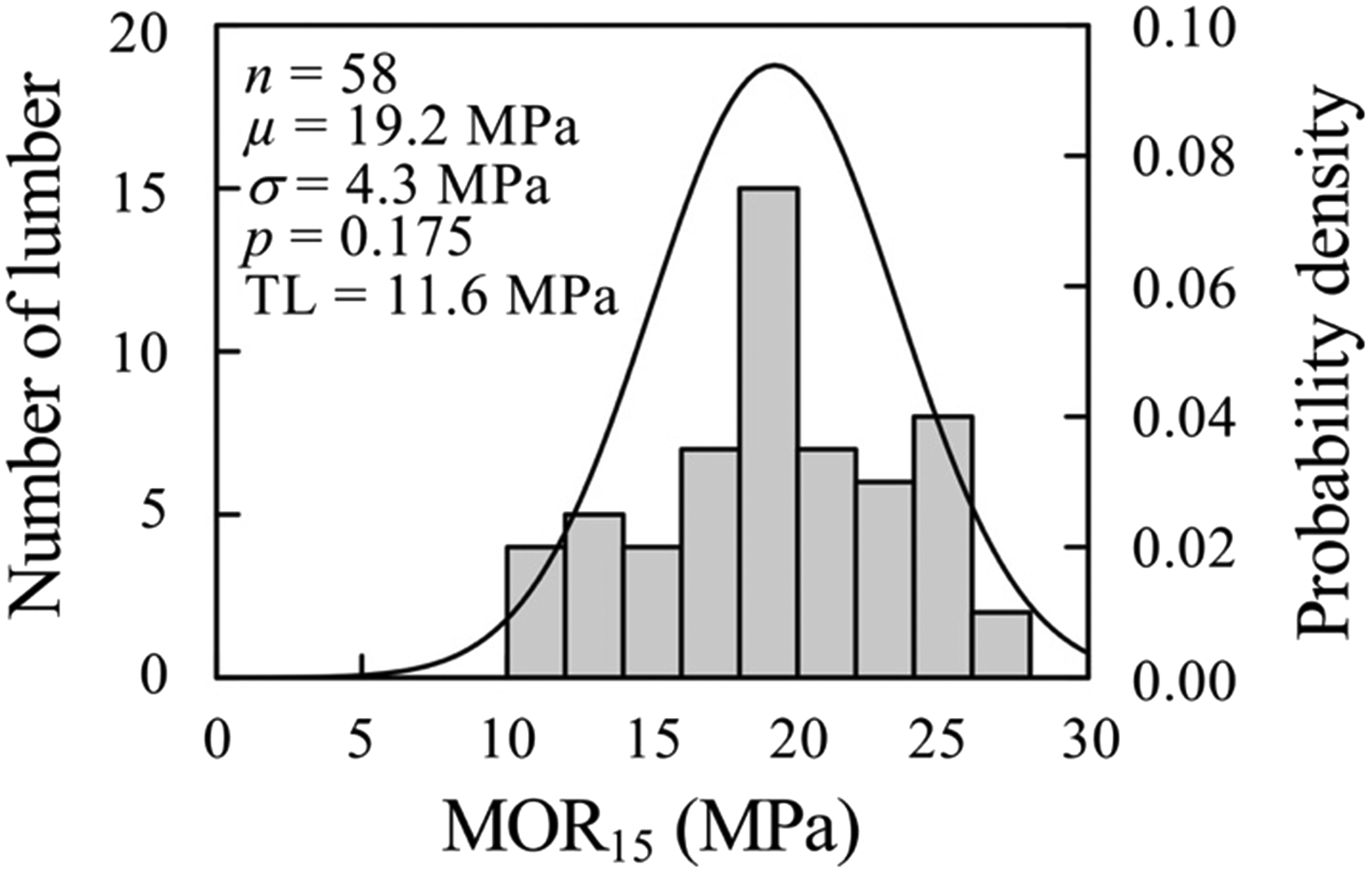
Frequency distribution of MOR of Paulownia timber. Note: n: number of timber; µ: mean value; σ: standard deviation; p: p-value in Shapiro-Wilk test; TL: The 5% lower tolerance limit with a 75% confidence level; MOR15: modulus of rupture at 15% moisture content.
Discussion
Comparing with the timber qualities in the previous study, 8 the values of air-dry density, crook and bow were almost the same, but twist and bending properties were improved: twist was reduced and bending properties increased (Table 2). The minimum values of bending properties in the present study increased by 1.5 times in MOE15 (from 1.86 to 2.77 GPa) and by 3.2 times in MOR15 (from 3.4 to 11.0 MPa) compared to those in the previous study. 8 The higher minimum values in the present study resulted in increased mean values of bending properties (Table 2) and TL75%,95% of MOR15 (Figure 3). In the previous research, 8 TL75%,95% of MOR15 without a pith cavity showed higher values (6.9 MPa) than those with a pith cavity (3.5 MPa), suggesting that the presence of a pith cavity greatly reduced the strength properties of Paulownia timber. In the present study, the pith cavity was eliminated from the timber. Thus, the minimum values of the bending properties increased relative to those in the previous study. 8 In addition, Nezu et al. 6 reported that the compressive strength of 26-year-old P. tomentosa trees was lower near the pith, suggesting that wood in this region may exhibit relatively low strength. In the present study, wood near the pith area was not included because the wood was also removed from timber when the sawing process eliminated the pith cavity. For this reason, the minimum timber value may be increased in the present study. Furthermore, logs collected from higher positions of trees were also used in the present study. As shown in Table 3, values of air-dry density tended to increase from bottom to top along the tree stems, and MOE15 of timber from logs collected from height position II (2.3–4.3 m above the ground) showed higher values. Thus, the minimum values of bending properties might be increased by using logs collected from higher positions.
In general, stem stress-wave velocity has been used as a non-destructive evaluation method for the strength properties of timber.11–20 For example, stress-wave velocity of stems in Siberian larch (Larix sibirica Ledeb.) grown in Mongolia was significantly correlated with MOE (r = 0.776, p < 0.01) and MOR (r = 0.702, p < 0.01). 17 Thus, the stress-wave velocity of stems is closely related to the strength properties of wood obtained from the stem. In the present study, no correlation or weak negative correlation was found between the stress-wave velocity of stems and growth characteristics at the standing tree level (n = 78) (Figure 2), suggesting that fast-growing characteristics in both radial and height directions might not be related to the Young's modulus of wood. Thus, in the tree breeding programme for selecting superior trees with higher wood strength properties, stimulus selection of growth characteristics and wood strength properties can be possible in this species. In addition, the stress-velocity of stems correlated with the MOE15 (r = 0.768, p = 0.009, Table 4), indicating that the stress-wave velocity of stems can be used to efficiently produce structural timber with higher strength in Paulownia wood. However, no significant correlation was found between the stress-wave velocity of the stem and MOR15 (r = 0.316, p = 0.374, Table 4). Furthermore, the correlation coefficient between MOE15 and MOR15 was significant but low (r = 0.321, p = 0.014, Table 5). Ishiguri et al. 10 reported that, in P. tomentosa timber (38 × 89 mm in cross section), no significant correlation was found between MOE and MOR (r = 0.078, p = 0.784), due to the existence of a severe slope of grains. In general, positive, high correlation coefficients were obtained between MOE and MOR in timber of many species.17,19 Thus, the slope of grain and other factors may affect the relationship between MOE and MOR in Paulownia species. Further research is needed to improve the accuracy of MOR estimation using non-destructive testing methods, including stress-wave velocity. On the other hand, positive correlations were generally observed among tree growth characteristics.25–27 For example, Dharmawati et al. 25 reported that a significant positive phenotypic correlation (r = 0.528, p < 0.001) was found in 54 trees of a fast-growing tree species, Neolamarckia macrophylla (Roxb.) Bosser, planted in Indonesia. As shown in Figure 2, a significant positive correlation was found between stem diameter and tree height. Thus, growth characteristics are also interrelated in the Paulownia species. The result of mixed-effect modelling for sampling height positions of logs (Table 3) suggested that air-dry density gradually increased from the base to the tree top. Increasing wood density from the base toward the tree top has also been confirmed in the same species by Nezu et al. 9
Visual grading of JAS 0600 21 has two classes: one is structural timber used for members requiring high bending strength in wood frame construction (here called Class A), and the other is structural timber that is not used for members requiring high bending strength in wood frame construction (here called Class B). Class A has four grades, ‘Select structural’, ‘No. 1’, ‘No. 2’ and ‘No. 3’, and Class B has three grades, ‘Construction’, ‘Standard’ and ‘Utility’. Each visual grade has a characteristic value of MOR for each species group. In the present study, TL75%,95% of MOR15 was 11.6 MPa (Figure 3). The obtained value exceeded the characteristic value of No. 3 grade of Class A in species group W cedar (including Western red cedar [Thuja plicata Donn ex D. Don] and other similar species) and JSII (including Japanese cedar [C. japonica] and similar species), and the Standard grade of Class B in these species groups (Table 6). In addition, MOR15 values of 80% or more of timber exceeded the characteristic value of the Construction grade of Class B in these two species groups. However, no timber exceeded the characteristic value of the Select structural grade in Class A in species group JSII, although the MOR15 value of almost all timber exceeded the characteristic value of the No. 3 grade of Class A of these two species groups. These results indicated that Paulownia timber can be used as structural timber, such as studs, but not as beams. However, only bending properties were tested in this study. Thus, further research is needed to evaluate other strength properties of full-size specimens to support the use of Paulownia wood as structural timber.
Number of Paulownia timbers exceeding the characteristic values of MOR listed in visual grading classes of two species groups in JAS A0600.
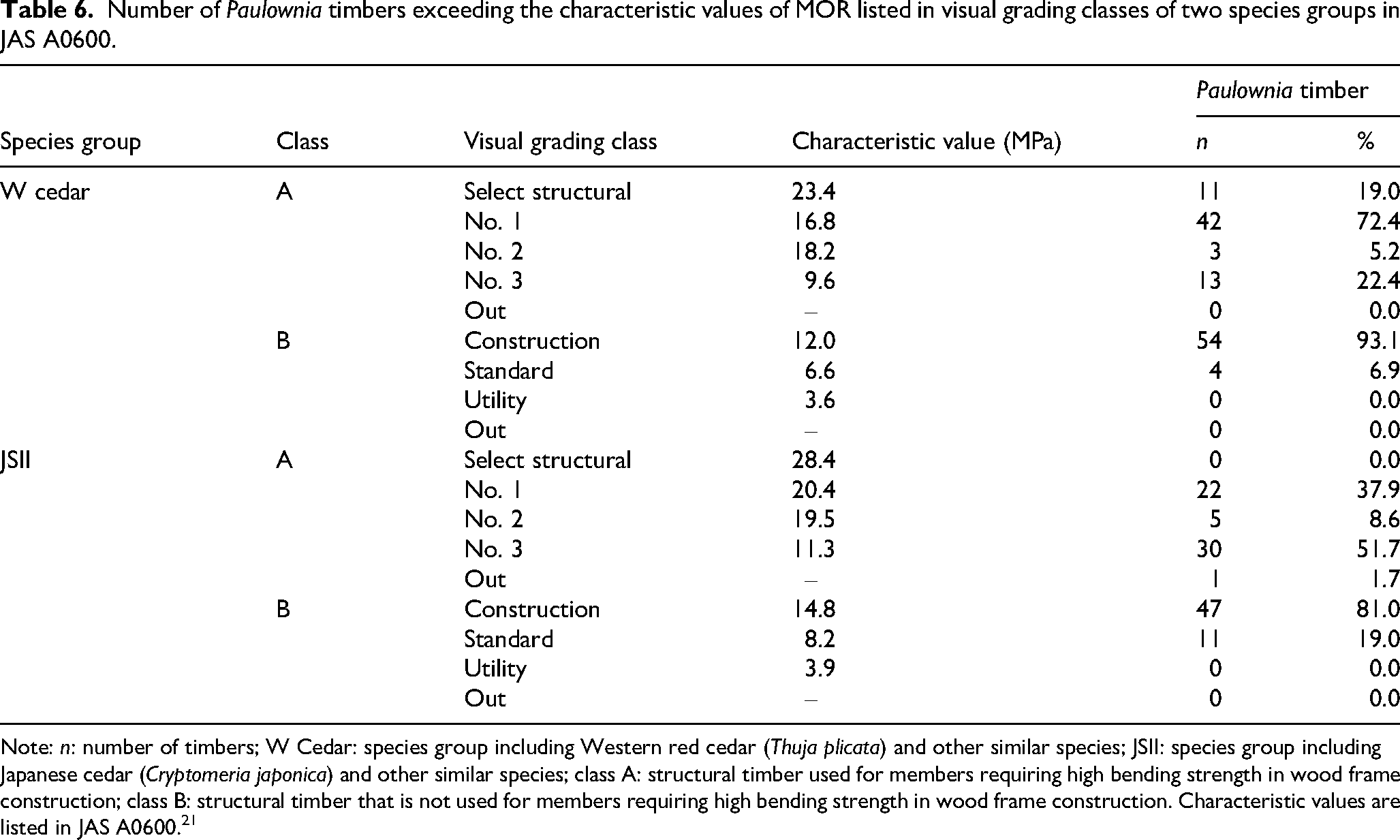
Note: n: number of timbers; W Cedar: species group including Western red cedar (Thuja plicata) and other similar species; JSII: species group including Japanese cedar (Cryptomeria japonica) and other similar species; class A: structural timber used for members requiring high bending strength in wood frame construction; class B: structural timber that is not used for members requiring high bending strength in wood frame construction. Characteristic values are listed in JAS A0600. 21
Footnotes
ORCID iDs

Funding
The authors disclosed receipt of the following financial support for the research, authorship and/or publication of this article: This work was supported by the New Energy and Industrial Technology Development Organisation (NEDO) (Grant Number JPNP21002).
Declaration of conflicting interests
The authors declared no potential conflicts of interest with respect to the research, authorship and/or publication of this article.
Data availability statement
The datasets generated during and/or analysed during the current study are available from the corresponding author upon reasonable request.