







Abstract
Ethiopia has envisioned becoming a middle-income country in the year 2030. To achieve this vision, several initiatives including the ESDP (I-VI), GQIP, and the education development Roadmap have been undertaken to improve the quality of education at all levels. Apart from those initiatives, it is equally important to rethink of a pedagogical approach that suits the contemporary technological advancement and cultural contexts. Currently, our world is experiencing scientific and technological changes, but the customary methods are relatively unable to cope with these changes. It is no longer viable to rely on one-size-fits-all curriculum. So far, the impact of instructional technology on students learning is not consistent and lacks specific context of students’ environment. This indicates that there is a need for intensive investigation to make learning more meaningful and interactive. This study aimed to restructure the existing mathematics course in Ethiopian higher education so as to produce a pedagogically enhanced learning environment. To achieve the goal of the study, a pedagogical intervention with a time series design was made at Wolkite University, Ethiopia. The repeated measures ANOVA show significant difference between students’ mean scores of course achievement measured before, during and after the intervention (F (2.182, 52.358) = 8.354, p < .05, ƞ2 = 0.258). The multiple comparison test further shows a significant improvement of students’ mathematical achievement. It was also found that when technology was used as a tool to enhance students learning, it can overcome the math anxiety caused by the cognitive failure. Therefore, blended learning could be a good approach to enhance students’ mathematics achievement. This might also be extended at lower levels. Additional imperative implications for practice and future research are forwarded.
Keywords
Mathematics education
Students’ knowledge in Mathematics is one of the basic knowledge areas that has a direct relation with success in another subject. Due to this, it is studied at every level of formal education. This interlinkage and having basic knowledge of it has an immense role in the development of individual and society at large (Suratno, 2016). Compared with other subjects and fields of study, mathematics is fundament of all science and technology where its applications spear in different areas (Simamora et al., 2017). However, research show that students’ competence in mathematics is not satisfactory. For instance, there is a concern in students mathematical understanding in western countries (Pohjolainen et al., 2018); in Australia (Plenty and Heubeck, 2013), Uganda (Kiwanuka et al., 2015), in South Africa (Preez, 2018); as well as in Indonesia (Simamora et al., 2017); Ethiopia; and USA (Tokpah, 2008).
Blended learning and mathematics education
The customary methods of teaching and learning practice are relatively unable to cope with recent changes and dynamism (Alotaibi, 2013). This situation gives a clue about the necessity of e-learning practices at schools to produce a positive shift in quality education. It is also important to consider local conditions in which the e-learning is being implemented. As fully e-learning course may be difficult especially in Ethiopia where there is poor infrastructure, weak learners’ technological background and capability, blended learning can be taken as better option.
The emergence of blended learning is based on pragmatic mixing of different method of teaching and learning. It can be seen as the application of two or more methods or solutions to a learning need. Blended learning is therefore the integration of classroom face-to-face learning experiences with online learning experiences. It combines some characteristics of both face-to-face learning and technology-based learning which can overcome the limitations of both kinds of approach to learning. Blended learning is further described by Thorne (2003) as a way of meeting the challenges of tailoring learning and development to the needs of individuals by integrating the innovative and technological advances offered by online learning with the interaction and participation offered in the best of face-to-face learning.
As students of higher education are adults, it is not a matter of choice to make the learning individualized but it is one of the necessary components. To this end, the support of blended learning in realizing this intention is of paramount importance. Research has found that effective combination of face-to-face class time and self-study with an online workbook is a helpful and cost-effective way to enhance learning (Graham, 2006; Zapata and Sagarra, 2007). As a result, blended learning is becoming an increasingly preferred option across the world. The occurrence of COVID-19 has also accelerated the shift towards virtual learning which was a norm especially during the first few months of COVID-19.
Principally, blended learning reduces lecturing while increasing inquiry and discourse (Garrison and Vaughan, 2008). But, for effective course or program design, it is important to examine different scenarios that reflect successful blended learning designs in higher education. According to Garrison and Kanuka (2004) the key assumptions of blended learning design are: considerately integrating face-to-face and online learning, deeply rethinking the course design to optimize student engagement, reorganizing, and replacing traditional class contact hours. It allows students to engage in different activities that help them for a quick retrieval of information, which is associated with a deep understanding of a particular concept. In doing this, students became engaged in the learning process and strengthen their cognition. This situation might bring a double advantage when it comes to the study of mathematics, because there is usually low level of engagement and interest in mathematics.
Research shows that many Ethiopian students have fear of mathematics learning (Melesse, 2014; Shishigu, 2018) claiming that it is one of the hardest subjects to learn. This could be due to the fact that the teaching learning system does not suit or motivate learners to take it at ease (Melesse, 2014) and due the pedagogical approach for being less effective in engaging students in different activities. Such a fear is termed as math anxiety, which is an important concept in learning mathematics. It is one of the affective reactions to learning mathematics.
Blended learning and mathematics anxiety
Research on mathematics anxiety consistently demonstrates that the low-anxious students outperform their highly anxious peers in mathematics (Caviola et al., 2017; Hembree, 1990; Hill et al., 2016; Shishigu, 2013; Wei, 2010; Zakaria et al., 2012). This indicates that math anxiety is a barrier for students learning of mathematics. As evidenced in the above research findings, it is recognized that anxiety states and feelings of helplessness experienced during mathematics classes or related activities are factors with a negative influence on mathematics learning.
Mathematics anxiety refers to unhealthy mood responses which occur when students come upon mathematics problems and manifest themselves as being panicky and losing one’s head, depressed and helpless, nervous, fearful (Adams, 2001). According to Adams, learners who are anxious when confronting mathematics problems are known to experience rapid pulse, nervous stomach, heart palpitations, and upset feelings. The negative effects of mathematics anxiety include disturbance during the process of learning mathematics, department and career selection in higher education. So, mathematics anxiety can be defined as the negative emotions that interfere with learning of mathematics. It leads students to avoid taking math classes and avoid situations in which math become necessary (Ashcraft and Kirk, 2001; Ashkraft and Krause, 2007; Hellum-Alexander, 2010; Sparks, 2011).
Studies also show the direct effect of math anxiety on achievement of students. For instance, a study conducted by Caviola et al., 2017; Khatoon and Mahmood, 2010; Luo et al., 2009; Sheffield and Hunt, 2007; Shishigu, 2013, 2018 show the negative effect of math anxiety on students mathematics achievement. Thus, reducing math anxiety is essential in preparing the future workforce having the required literacy and competency in mathematics.
Generally, Abramovitz et al. (2012), posited that students’ face difficulty in learning mathematics due to the abstractness of mathematical concepts, and as a result, they are afraid of it. Thus, the approach in which courses are presented and the specific level of the language is very important. In the current instructional approach, Ethiopian university students relay on instructors’ lecture note and show poor motivation to study and read textbooks available at a university library and because of that, instructors are forced to roughly handle contents without undergoing the required depth, which resulted in surface learning. Hence, there is a need for a different approach that supplements the face-to-face lectures and tutorials. Among the many such approaches, blended learning is considered in this paper.
Studies shows that technology supported learning (blended learning) is a mediating approach for reducing math anxiety. For instance, a study conducted by (Barry, 2017; Reissman, 2017; Sun and Pyzdrowski, 2009) show that anxious students find learning math by computer as a great solution. But this might not be taken as the only solution to alleviate math anxiety of students. As there are varied causes of math anxiety, it can be noted that there are various ways of overcoming it. For instance, when technology is used as a tool to enhance students learning, it can overcome the math anxiety caused by the cognitive failure on its way (Sun and Pyzdrowski, 2009). Thus, digital technologies have a potential to allow students to a higher engagement in different activities that help them for a quick retrieval of information, which is associated with a deep understanding of a particular concept of a subject. In doing this, students became engaged, motivated, and active in the learning process so as to strengthen their cognition and conceptual understanding.
Problem statement
Though mathematics has been regarded as a fundamental subject for the study of science and technology, it is usually felt by many people that it is impractical. As a result, it is seen as a difficult subject by many students and having poor result in tests and exams is becoming a common problem. For instance, one of the crucial challenges in Ethiopia is the low achievement of students in general and mathematics in particular (MOE, 2017). Large-scale national surveys continue to show unsatisfactory academic achievement of students in mathematics. A study conducted by Shishigu (2013) revealed that students’ achievement in mathematics is below average.
The low achievement of students in mathematics is also observed by (MOE, 2021; Gebremeskel et al., 2017; MOE, 2017). Though there are many factors contributing to this situation, the competence of teachers in mathematics in which case the pedagogy being used (Yeh et al., 2019) might be questionable and needs appropriate reform. Sometimes the low achievement of students is also attributed to the low interest towards the study of mathematics. This situation in turn might also lead students to develop anxiety which is a cause not only for the poor school performance but also for a continued phobia and psychosocial problems. Hence, there is a need to improve the way mathematics is presented to students. To this end, research shows that the usual accustomed methods are ineffective in this technologically changing world (Alotaibi, 2013). Thus, the current technological advancement might force schools to adapt technological innovations to achieve their goals of providing better education for their students.
The unprecedented COVID-19 pandemic has drastically changed the way that peoples around the world lead their lives. The major consequence is that people are forced to stay apart (principle of social distancing). This also affected the way in which teaching, and learning takes place. Specifically, the challenges related to the learning of mathematics in this COVID-19 pandemic era is vast. This is because there is a gap in this subject even at normal situation (pre-COVID) (Tesfamicael and Ayalew, 2021). Hence, the occurrence of COVID-19 necessitates the adaption of technology mediated learning to ensure that learning and communication continues amid the pandemic. During the first occurrence of the pandemic in 2019, the doors of schools globally were closed for the purpose of curbing the spread of the pandemic which force both teachers and students to go into remote teaching and learning mode (Tsolou et al., 2021). But this might not be in place for countries where the infrastructure and readiness is low.
According to Economist Intelligence Unit (EIU) in 2010, some African countries have shown considerable level of e-readiness. On its report of rank of 70 countries, South Africa ranked 40th, Egypt 57th, Nigeria 61st and Algeria ranked 68th. However, Ethiopia is not ranked in this report of e-readiness or digital development in 2010. However, in the report made by EIU in 2017, Ethiopia is ranked 69th out of the 75 surveyed countries. The report shows that poor connectivity, access and high prices as barriers for developing countries including Ethiopia (EIU, 2017). According to this report, Internet access remains unaffordable for many people in the developing world. Developing countries are under challenge of lack of systemic approach to Information Communication Technology (ICT) implementation, awareness, lack of administrative support, and of technical support.
It is true that the emergence of technology has expanded the possibilities for distributed communication and interaction in which case the necessity of technology adaption in to teaching and learning become more pervasive. This is because students get technological tools at their early age, and they trust it as a knowledge base and believe on its ease of communication and as a visual aid. So, it is not a surprise for students to expect schools to be as technology rich as the world around them. In this regard, they also tend to prefer teachers who have digital competence and exposure (Motschnig-Pitrik and Standl, 2012). Thus, it is not an option but decisive to relate the latest thinking and technology to the way mathematics is taught and learned. Because, future fate of education is also becoming unthinkable without the involvement of technology (Osimo, 2002; Spring et al., 2018). This study therefore aimed to investigate the role of blended learning approach in enhancing students’ mathematical learning with respect to their achievement and math anxiety level. Particularly, the following two null hypothesis were tested by introducing a bended learning course: 1. Blended learning does not influence mathematics achievement. 2. There is no relationship between blended learning and mathematics anxiety.
Materials and methods
To achieve the goal of this study, an interrupted time series research approach was used; because, according to (Bogdan and Biklen, 2003; Velicer and Fava, 2003) it is a very useful approach to understand causality within the process of the intervention period. Thus, the design is different from the one sample pretest-posttest design which is highly vulnerable to internal validity threats. In an interrupted time-series design, there is a repeated measurement which is different from the pretest-posttest design. Particularly, in this research, a total of four measurements (tests) were taken throughout the intervention period in order to provide sufficient number of data points to conduct a statistical analysis to evaluate the effects of the intervention. This allows reliable information about the progress of students in the variable being considered.
It is also believed that the time series approach provides a continuous observation of fluctuations in the experimental variable over the entire course of the intervention (Gottmann et al., 1969). Such observation constitutes an integral part of the experimental condition, which help to understand the pattern of change over time. This type of design also helps to examine the progress of students learning throughout the study period which created confidence to discern the effect of the intervention (Blended learning in this case). Interrupted time series design is one of the strongest designs when randomization is not possible. The result of such design is based on comparison made with own progress instead of comparing to other person. To control external factor affecting the design, intact class is used in which withdraw and new addition into the group are totally avoided.
To better examine the role of blended learning, the course level blending model was used. Previously, students were taught by the traditional approach. The course Linear algebra II is one of the compulsory courses given for mathematics major students. It comprises concepts like characteristic equation of a matrix, orthogonality, bilinear forms, quadratic forms, canonical forms, direct sum, and decomposition of vector spaces). Based on the context, the design was set to be supplemental which was implemented at three stages to obtain maximum effect on students learning. The first stage was enabler. At this stage students were given time to be familiar with the online platform and exactly face only things they have already learnt in the class. In this stage, the usual face-to-face hour is not reduced as students are new to the learning environment being introduced.
At the second enhancement stage of the blended learning, they begun to complete some tasks online with the help of additional resources and supplementary materials. The supplementary materials were reference books, previous exam and worksheet collection as well as online interactive lecture notes. On the other hand, the stage of transformational blending as Graham (2009) argued allows a radical transformation of the pedagogy, students were given with all available features of the online platform (Moodle), that includes self-checking mechanism (automated online quiz) which can also be attempted offline through the mobile version, discussion forum, immediate feedback mechanism (with the instructor and with peers) and interactive notes.
Participants of the study
Demographic information of participants.

Data collection instruments
The achievement tests (pretest, test1, test2 and posttest) that were used in this study comprises 10 items each developed by the research team to measures students’ mathematics achievement at three different time intervals (before, during and after the intervention). Different yet similar achievement tests were used at each stage, as it is possible that taking the same test several times has disadvantages such as remembering the test items and memorizing the right answers during the process), which affects the validity of the results.
Based on the goal of the course, all tests focused on three learning categories namely: understanding of algebra concepts, computations, and logical reasoning. All items of pretest, test1, test2 and posttest were multiple choices with four options A-D. All tests were scored manually by the research team. Each correct answer holds one mark while a wrong answer was scored zero and for the purpose of simplicity, the results of students on each test were converted to 100%. All tests were piloted and validated for their similarity before use in the actual study.
The pilot analysis show that all tests were reliable using Kuder Richardson formula KR-20. The internal consistency reliability of pretest, test1, test2, and posttest were 0.58, 0.67, 0.69, and 0.75 respectively. So, the reliability coefficient of all the tests was acceptable based on the threshold of 0.5 suggested by (Andale, 2017; Salvucci et al., 1997)
On the other hand, to access students level of math anxiety, a 14-item Likert scale developed and validated by (Mahmood and Khatoon, 2011) was adapted but latter it was reduced to 11-item based on the reliability analysis of pilot data. This scale is a bi-dimensional and shorter instrument with a five-point Likert scale that assesses positive and negative dimensions of math anxiety. Students choose among the five alternatives namely: strongly agree, agree, neutral, disagree and strongly disagree. The wording of the adapted items has been changed to fit issues of this study. For instance, the item “I would prefer mathematics as one of my subjects in higher studies” was changed to “I would prefer algebra as one of my specializations in further study”. The scale contains five positively worded items mainly dealing with feeling of comfort, interest studying and future engagement, while the negatively worded items dealt with uneasiness, feeling of nervousness and afraid. The positive effect items were reversed for scoring so that a high score indicates high anxiety. The range of scores is from 11 to 55 and high scores will indicate high math anxiety.
Though the initial scale has 14-item, after pilot analysis three items were rejected because of their low inter item correlation with the overall item. Hence, for this study mathematics anxiety was measured using a bi-dimensional 11-item Likert scale. The internal consistency reliability obtained was 0.70 using Chronbach’s apha.
For the purpose of improving the design and to see students’ conception, informal interview was used. This type of interview does not require too much time from the respondents perspectiive. It can be seen by respondents as simple conversation. Hence, it fosters low pressure interactions and allow respondents to speak more freely and openly.
Experimental and data collection procedures
According to corporate and vendor consulting services (Bersin and Associates), blended learning goes through some process. The four processes mentioned by Bersin and Associates (2003), are (1) define learning challenges, (2) develop learning plan and measurement strategy, (3) develop contents, (4) implement and track progress and measure results. Similarly, Alammary et al. (2014) have identified three distinct design approaches of blended learning: 1. Low-impact blend: adding extra activities to an existing course 2. Medium-impact blend: replacing activities in an existing course 3. High-impact blend: building the blended course from scratch
The low-impact approach is associated with providing extra online activities to a traditional face-to-face course. This is done without reducing any of the existing activities and lecture hours. Adding such extra online activities onto an already established course happens when teachers build their first blended learning course. The low impact approach is the easiest approach to producing a blended learning environment. In the medium-impact approach, an existing course is redesigned by replacing some of the face-to-face activities by online components. The assumption behind this approach is that some parts of the course would be more convenient using the web based instructional approach than the face-to-face approach.
In the high-impact approach, the blended learning course is built from scratch. A common way to apply this approach has been described by (Hofmann, 2006). She argues that instead of looking at an entire course, the instructor needs to look at each single course learning outcome, which allows a better integration of online and face-to-face components.
For the purpose of this study, a hybrid approach is used to allow maximum flexibility to deliver the mathematics course selected for the study. This approach contains all the process of Bersin and Associates together with the high impact blending proposed by (Alammary et al., 2014). Thus, a course level blending was used as an intervention for one full semester.
Moodle was used for creating the web-based learning environment which is an interesting learning management system to create a user friendly and interactive learning platform for students to learn and interact. It is also a free ware learning management system available for all.
Ethical considerations
In this study, informed consent and confidentiality was considered as an ethical issue to protect participants’ identity. All participants were briefed on the purpose of the study and gave their consent. Prior to the beginning of the actual study consent was asked and obtained. To make sure that the required information was effectively shared with students and their instructor, they were given time to ask questions about the research or any of the activities described. At the end consensus was reached and appropriate schedule of the face-to-face and the online learning session was made.
Findings and discussion
The blended learning environment served as a content delivery platform and promoting communication and construction of knowledge that allow flexibility and alternative learning solutions for learners. As a follow-up to the suitability of the design, students were interviewed at the middle of the study. This helped to get valuable information to modify the approach for students’ success. The interview took the form of informal conversational interviews where students were selected and interviewed using open-ended questions to evaluate progress of the intervention in addressing their learning needs.
Effect on mathematics achievement
The foremost goal of this study was to investigate the effect of blended learning on mathematics achievement. The progression of students from pretest to posttest have been examined to observe the effect of the intervention. For this type of analysis, a repeated-measures ANOVA was used. This is because, observations are taken from the same or related subjects over time (Elliott and Woodward, 2007).
Descriptive statistics of mathematics achievement.

Mauchly’s test of sphericity for testing equality of variance.

Repeated measures ANOVA for testing within-subjects effects on mathematics achievement.

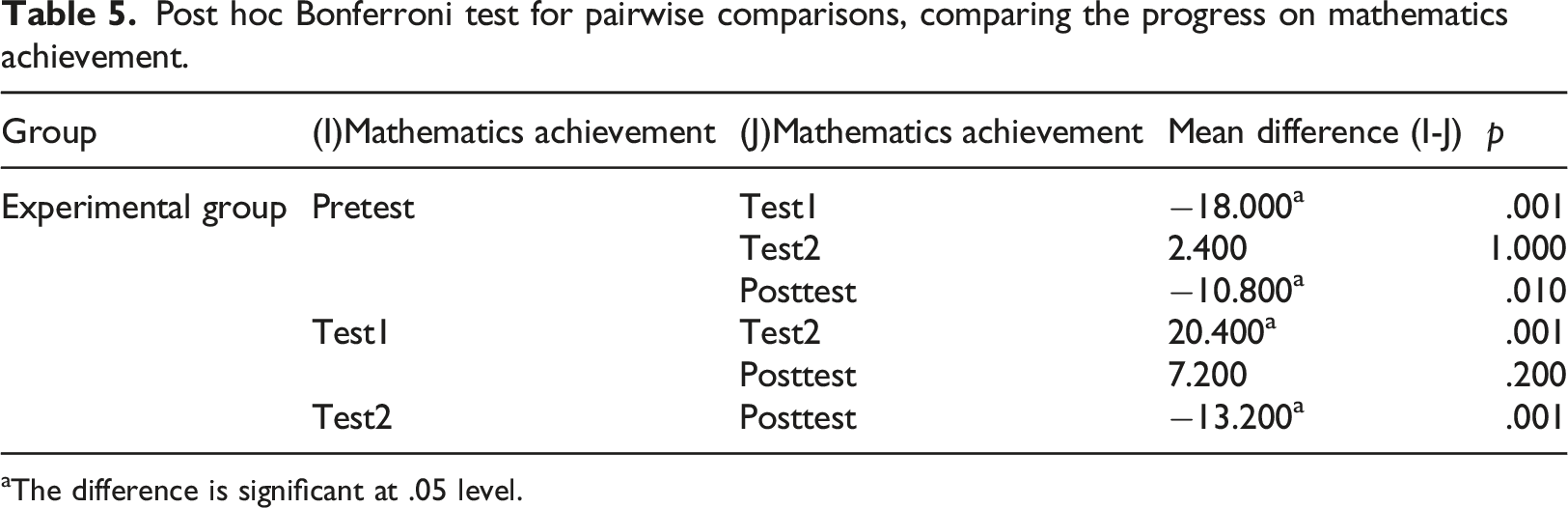
Post hoc Bonferroni test for pairwise comparisons, comparing the progress on mathematics achievement.
aThe difference is significant at .05 level.
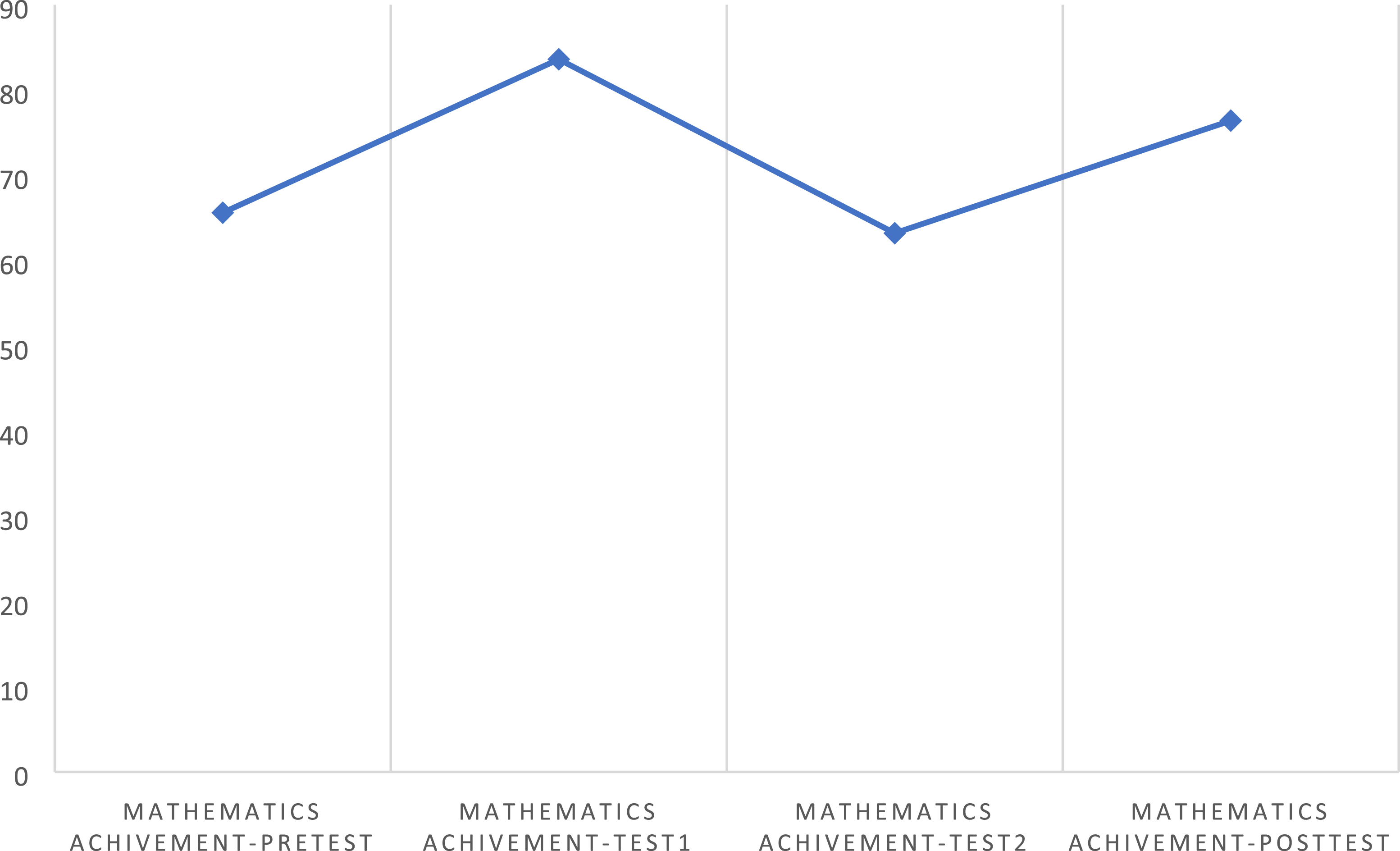
The multiple comparison presented in Table 5 show a significant difference between mathematics achievement pretest and test 1, mathematics achievement pretest and posttest, mathematics achievement test 2 and posttest and also between mathematics achievement test 1 and test 2 (p < .05). The result further shows that students have gained 10.8 points on average from pretest to posttest and 13.2 point from test 2 to posttest. Though the mean gain from test1 to test 2 was statistically significant, it means that students have declined by 20.4 in average. This is ascribed to the fact that students have faced difficulty when various course tasks need to be accomplished and more computer skill is needed. However, this difficulty has been managed by modifying the design and continuously assisting students in their learning. As a result, a significant improvement of 13.2 points on average was obtained, which can be attributed to the design modifications made in stage three of the intervention being used. Though there were fluctuations on the mean scores, the overall result shows that the mathematical achievement of students have been improved.
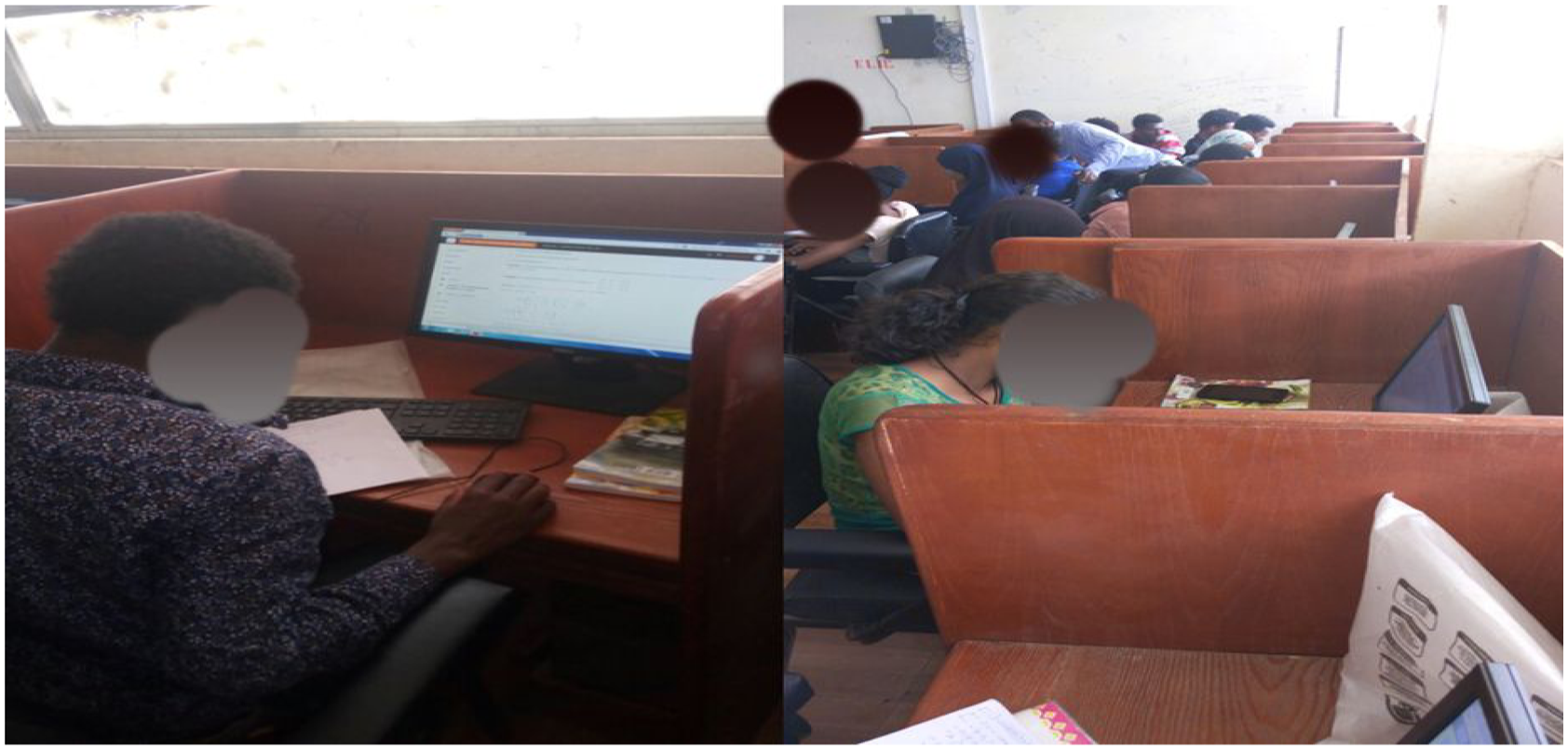
Figures 1–3 shows the mathematics achievement pretest, mathematics achievement test1, mathematics achievement test2 and mathematics achievement posttest mean scores of students. As it can be seen, the increase made from pretest through test1 and test2 to posttest is considerably high which was also significant at 𝛼 = 0.05 level. Students seem comfortable and possess good achievement on test 1, which was attributed to the nature of the blend at this phase which was the enabler blend. Students then show a decline in achievement on test 2 this was because, the nature of the blend was changed to the enhancement stage which require students to complete some tasks by themselves. However, when all the components of the blend are added at the third phase, their achievement was improved which was complemented by motivation which was found considerably high. Design of the study. Students working on the online platform. The effect of blended learning on students’ mathematics achievement.
Therefore, it is evident that the blended learning model used in this study allowed students to control their interaction with additional materials, foster more interaction, prompt feedback and self-assessment. Participants of this study found the blended approach as more engaging and resourceful. As a result, their achievement has been significantly improved.
In line with the findings of this study, previous researchers envisioned that new technology such as computer-assisted instruction should be used in the teaching of abstract concept in mathematics (Ahmad et al., 2008; Bhatti, 2013). The findings of this study is also in agreement with many previous studies such as (Al-Ghassani et al., 2015; Al-Madani, 2015; Awodeyi et al., 2014; Ceylan and Kesici, 2017; Delaney et al., 2010; Fakhir, 2015; Lin et al., 2017; Siew-Eng et al., 2010; Syarif and Sofyan, 2012; Viz and Kaur, 2017; Yilmaz and Oghan, 2010) all of which reported blended learning as a good approach with a potential of improving students achievement and instructional delivery in mathematics courses as well as understanding of concepts in the subject matter (Akgündüz and Akınoğlu, 2017; Awodeyi et al., 2014; Balasubramaniam et al., 2018; Lin et al., 2017; Rozeboom, 2017). It is also in line with the findings of Olelewe and Agomuo (2016), who found an improved achievement in programing language.
Effect on mathematics anxiety
Pretest and posttest comparison within groups on math anxiety.
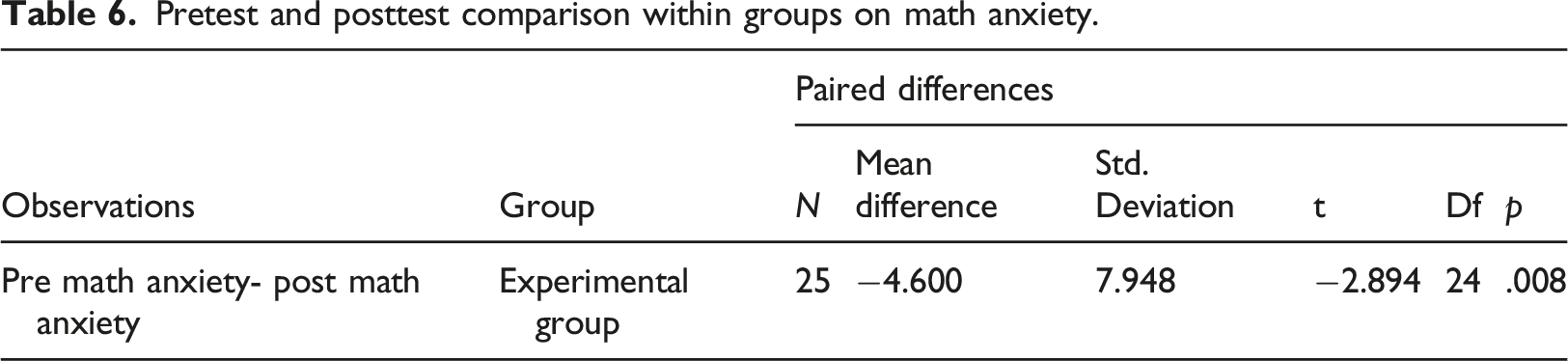
A paired samples t test presented in Table 6 depicted that students’ have made a significant improvement in math anxiety (t (24) = -2.894, p < .05, d = 0.899). Therefore, the null hypothesis “there is no relationship between blended learning and mathematics anxiety’ was reject and the alternative hypothesis “there is a relationship between blended learning and mathematics anxiety” was accepted.
Students have developed some sort of interest with the contents delivered through blended learning approach. This is an interesting result as having relatively low level of math anxiety might trigger students’ energy to work hard which in turn leads them to have good understanding and achievement. This is evidenced by a study conducted by Shishigu, 2018 who found a negative relationship between mathematics anxiety and mathematics achievement.
The finding of this study is also in compliance with previous studies which contend that technology supported learning is a mediating approach for reducing math anxiety. Particularly, it is in line with the findings of (Barry, 2017; Reissman, 2017; Sun and Pyzdrowski, 2009) who found a positive result by introducing computer as one of the learning tools for anxious students. However, it can be noted that there are varied causes of math anxiety, informing the possibility of having various ways of mitigation it. If the cause is the teacher’s and parents’ anxiety, it is necessary to reduce the teachers and parents anxiety (Sun and Pyzdrowski, 2009). On the other hand, if the anxiety is caused by the failure of cognition, then improving the students’ cognition might be a solution. One of the methods used to overcome math anxiety caused by cognitive failure is use of modern technology in the teaching and learning process (Sun and Pyzdrowski, 2009). In either case, blended learning is a good alternatives and yet preferred method in the 21st century generation of digital age.
Therefore, future teacher education program should include blended learning as the imminent promising recent instructional approach. This is also emphasized by Shishigu et al., 2017, that is, the need for a reform of the current teacher education program in Ethiopia so as to equip prospective teachers with the knowledge of technology, pedagogy and content.
Limitations of the study
This study is not without limitations. As the study was conducted in one university, the results cannot be generalized to all universities and contexts. Another limitation that can be pointed in this study is the absence of comparison group. Though it seems difficult to confess the effect of the treatment without a control group, the current study employed an interrupted time series design as a compromise. Thus, it is possible to estimate the effects of a treatment when only a single group is considered using such design and it is also helpful to reveal the pattern of the treatment effect over time.
Conclusion and recommendation
This study shade light to the effectiveness of blended learning approach in improving mathematical achievement and reducing of math anxiety. Blended learning has a pedagogical implication of removing barrier of time and space common in the traditional learning most typically refers to the face-to-face instruction. Online learning allows learning to take place regardless of the student’s physical presence in specific place and time.
The improvement in achievement of students in this study can be attributed to the vast learning opportunity imposed by blended learning approach. It was also found that blended learning as an emerging pedagogical approach has a promise of overcoming some difficulties in mathematics learning such as mathematics anxiety. This indicates that there is an advantage of creating interest towards learning.
It can be said that blended learning had a potential to transform teaching and learning from face-to-face environment towards an increased focus on ICT. It is recommended that the Ministry of education and higher education institutions need to be cognizant of the benefits of a blended approach in the current digital age and particular local contexts.
Additional studies should be conducted in different courses to see the effectiveness of the method in other dimensions of learning and disciplines. It is also recommended to employ a large-scale study comprising different learning characteristics to gain a deeper understanding of how blended learning approach help students learning in general and mathematics learning in particular. Future research is also needed to establish whether prior training can be utilized to encourage students to engage in a blended learning approach.
As generalizability should not be inferred from a single study, it is recommended to engage in systematic replication in order to demonstrate generalizability.
Footnotes
Declaration of conflicting interests
The author(s) declared no potential conflicts of interest with respect to the research, authorship, and/or publication of this article.
Funding
The author(s) received no financial support for the research, authorship, and/or publication of this article.
