






Abstract
This article considers what an a/r/tographic practice of gathering might offer to reconceptualized early childhood teacher training. Drawing on a research project with first-year early childhood education (ECE) students in a university setting, I propose that gathering offers artful ways that go beyond mind/body dualisms to study difficult and complex reconceptualist ECE literature. It allows for material languages and processes that support students in more-than-human learning classrooms.
Introduction
With a black cloth bag clasped in my hand, I slowly meander around my neighbourhood. I am gathering. The sun is bright and the air is dry and salty. As I walk, the ground beneath my feet is constantly changing. The cracked grey cement sidewalk gives way to golden dry grass and flaked red earth. Twigs and dried leaves snap and crunch under my feet as I step onto a brown woodchip path. Many objects cross my path and grab my attention. This time I stop to pick up small, unwanted objects, things that have been discarded, lost, stored, hidden, misplaced by people, trees, and animals. I am gripped by the worlds of these objects—bits of a plastic balloon, a leaf, a used plastic spoon, a half-eaten chestnut. As I walk and gather, I consider what is in my bag and how adding something new might alter these objects. Often I need to stop and analyze things. I might pick up an object and, through touching it (Haraway, 2008) try to figure out what it might be, what it might do or be used for. I think about the implications of picking it up. One time I picked up some slimy thing—it might have been lichen. What is lichen, anyways? What histories might this lichen (?) tell (Anatsui, 2012)? I thought about the discarded (?) or lost (?) bits of paper with writing I had picked up earlier and put in my bag, and how adding the lichen (?) might get white and black slime on everything and wrinkle the papers. I dropped the lichen (?) and continued on with my gathering. 1
Gathering, for me, is a ritual of walking, reading, noticing, picking up and letting go ideas and objects, and documenting by taking pictures and journalling. For over a year before I began teaching future early childhood teachers I sustained a practice where I (re)read texts (e.g. Haraway, 2008; Kimmerer, 2013; Law, 2011; Watts, 2013) and (re)walked, with my cloth bag and a camera, the neighbourhood around my apartment on southern Vancouver Island, British Columbia. After I became a teacher, I continued to gather alongside my students. I gathered as an a/r/tographic inquiry that grew out of and between my roles as an artist, researcher, and early childhood teacher. While I walked and as I read, I attended to how and why animals, I, other artists, other researchers, and later on my students gathered objects and ideas. I attended to the contexts and theoretical orientations of the objects and ideas, and the effects on the objects of weather and the environment. I attended to how I and the students found our way, to what paths we took through texts and on our walks.
The days are colder now. The ground is frozen and the dirt crunches under my feet as I walk. The ice makes it harder to pick up individual objects. Bending, with my arms stretched out, I tug at a leaf and a whole clump comes together. I struggle to tease out the delicate leaf that caught my attention, and it rips apart. The cold is disturbing the specificity of each precise object I gather.
A/r/t/ography is a practice-based and arts-based research methodology (see, e.g. Irwin, 2013; Irwin and de Cosson, 2004; Irwin and Springgay, 2008; Irwin et al., 2009) whereby the roles of artist, researcher, and teacher are entangled to perform theories in practice, relationally and messily. As an arts-based rather than a qualitative methodology, 2 a/r/t/ography gives a push “beyond the use of existing criteria that exist for qualitative research . . . toward an understanding of interdisciplinarity not as a patchwork of different disciplines and methodologies but as a loss, a shift, or a rupture where in absence, new courses of action unfold” (Springgay et al., 2005, p. 898; see also Sullivan, 2005). As a university professor who teaches student early childhood teachers, I have found a/r/tography to be a fruitful methodology.
When I began my teaching practice, I was, at times, puzzled. While I engaged reconceptualist literature with students (e.g. Cannella, 1997; Dahlberg and Moss, 2005; Taylor and Pacini-Ketchabaw, 2015) and expected students to develop practices inspired by this literature with children, I often reproduced developmental assumptions (Bloch, 2014; Cannella, 1997) through my teaching. For example, I lectured to explain course material, as though my students were “vessels” to be filled (Dahlberg et al., 2013). I provided short written vignettes or images so students could “apply” various theoretical lenses, reducing theory to a technical act of application to assess their understanding. I gave discussion questions for students to explore their understandings of the text and found myself “scaffolding” their discussions to help them go deeper. I found myself wondering if my taken-for-granted teaching practices were holding up developmentalism in my classroom rather than supporting a reconceptualist focus. Given that the reconceptualist early childhood movement supports interdisciplinary orientations to teaching (Bloch, 2014), not only did I want my teaching to become a “political and ethical act” (Cannella, 1997), I wanted to explore what a/r/tography might create in my classroom.
I frequently encounter first-year students using quotes from complex reconceptualist 3 texts without understanding the text as a whole. Reconceptualist literature can be challenging to read and typically requires students to learn a new language of terms. Postsecondary students are assigned many readings, and these readings may come from different frameworks, thus students will have multiple languages to learn. When reading for the purpose of writing papers, students new to reconceptualist texts sometimes pull out a quote without understanding how the ideas in the quote connect to and depend on the other ideas in the text for their meaning, much like the frozen leaf I picked up was connected to the leaves around it. Further, students might pull quotes from different texts that draw from different frameworks and then use the quotes together, without understanding that doing so changes their meaning, like the lichen (?) might have changed the other items in my bag. Building on Kummen’s (2014a, 2014b) extension of a reconceptualist focus into university classrooms, I wondered if gathering could offer students in reconceptualist classrooms a way to materially see these changes and shifts. It seemed to me that gathering could offer me and other early childhood university teachers an arts-based practice to engage texts with students by walking through the world. Gathering invites a way of reading reconceptualist theories in and through the surrounding environment—with inspiration from the earth. 4 Thus, gathering could offer students artful ways to engage reconceptualist texts, allowing for discussions and processes that experiment with or assemble and explore ideas and objects. This way of engaging texts extends a developmental understanding of students as vessels to be filled, theories to be technically applied, or discussions to be scaffolded. Gathering could offer artful ways to consider complex problems posed by reconceptualist literature and attune to the ethics of engaging texts in learning. So, I decided to use a first-year inclusive practice course as a site to develop my ongoing research on gathering.
The central question addressed in this article is: What might an a/r/tographic practice of gathering offer to the education of early childhood teachers with a reconceptualist focus in the classroom? I begin by describing my teaching movements in the arts-based practice of gathering with student early childhood teachers. Some student documentation illustrates our movements. I then attend to the students’ gatherings, and end by offering conclusions generated from this research.
Teaching movements
Invitation
I invited the early childhood students to participate in gathering and designed the course as an arts-based inquiry. On the first day of class, students introduced themselves and I briefly introduced gathering. I described the course intentions to them as follows: We are already in the midst of learning (Osberg and Biesta, 2010). We carry things with us into this course (e.g., see Figure 1 for a glimpse of what I carry in my bag). We come with histories, ideas, experiences, cultures, languages, traditions, religions, spiritualities, and so on. Engaging in this course is not about leaving this behind or replacing it. Further, it’s not about simply adding to the existing things, as in accumulating more. It’s about creating openings for learning, rather than moving toward a predefined educated state (Osberg and Biesta, 2010), with what you are willing to pick up and willing to let go. Adding items to your bag has an effect on what is in there, and on what you add. Perhaps things will be reordered or transformed in some way. Perhaps you will need to make room, and let things go. Gathering will give us many openings to ask questions and discuss what we pick up, drop, and why, and how things change.

Inside my bag.
I invited the students to go back and forth with me between gathering outside and gathering inside. Each week we met twice, for 1 hour and 20 minutes each time. The first class of the week we met in the classroom, where students and I took turns sharing what we had gathered from the readings. The second class each week we went outside to gather and to work on our portfolio assignment.
Informed consent
I informed the students that they could participate in the course as usual and that I would ask for their consent to do a secondary analysis of two of their assignments at the end of the course, after their grades had been submitted. All 30 students gave consent for me to use two of their assignments in my research, and most of the 30 gave consent for me to use their real first name.
Portfolio assignment
Our practice of gathering involved a portfolio assignment. La Jevic and Springgay (2008) state that the portfolio “is expected to be a work in progress comprising classroom explorations, research materials, handouts, class notes, reflections, homework assignments, and in class activities and investigations” (p. 74). In this sense, students were invited to use their portfolio as a work in process to investigate reconceptualist literature through research materials, reflection, homework assignments, and so forth. They were encouraged to create a portfolio (i.e. something to hold their written stories, drawings, haiku, poems, paintings, collages) and to use the following materials and methods for their explorations: a bag to gather objects; different texts to read; and a camera to document images.
To demonstrate to the students that a portfolio could have many layers, I designed a new layer for each concern we explored. Portfolio layers were opened up each week after we read and discussed the readings. Following La Jevic and Springgay (2008), students were given class time each week to engage with their portfolio layers.
Meeting places
Each week we met conceptually and physically to explore different concerns (e.g. neoliberalism, the Anthropocene, multiculturalism) related to inclusion through reading selected articles by authors who have been reconceptualizing inclusion in the 21st century and through meeting in different places connected to the readings on and around campus. The readings consisted of a few selected reconceptualist articles/chapters, including Dahlberg and Moss (2005), Taylor and Pacini-Ketchabaw (2015), Shakespeare and Watson (2001), Pacini-Ketchabaw (2007), and Pacini-Ketchabaw and Nxumalo (2012). I would share through lectures what I had gathered from the readings. Students discussed the readings/gatherings in groups, and then members of each group shared with the class what the students had gathered. Sharing our gatherings provided opportunities to discuss our gathering processes, the qualities of the ideas we gathered, and how the ideas might be changed through our gathering of them.
Throughout the course, the students and I met in various places on and around campus to create the portfolio assignment. Rather than seeking to uncover meaning, a/r/tography, drawing on action research, is interested in “creating the circumstances that produce knowledge and understanding through artistic and educational inquiry-laden processes” (Irwin and Springgay, 2008, p. 113; see also, Irwin, 2013). I attempted to create situations where students were supported to engage in collective inquiry processes to produce understandings. The first meeting place was the Museum of Vancouver, where we went to two exhibits. The first exhibit was 1960s–1970s: You Say You Want A Revolution, which explored the hippy revolution in Vancouver and how this movement exemplified the civil and human rights movements that we were reading about and discussing in class. In the second exhibit, c̓əsnaʔəm, the city before the city, we explored the Musqueam territory before the city existed, as told by the Musqueam people. Figures 2 and 3 are two examples of students’ portfolio engagements with the second exhibit.

Drawing of city.

Portfolio layer.
Mia drew a picture of the city of Vancouver (see Figure 2 above) and Pauline created a portfolio layer from the exhibit c̓əsnaʔəm, the city before the city (see Figure 3 below).
Our meeting places were sometimes decided by me and sometimes by the class, based on our discussions. We met several times at our classroom, and from there we became slow researchers (individuals who deliberately pace their research activities) who walked around the campus. Once, we met at the doors of Waterfront Skytrain station in downtown Vancouver and together decided to walk through Coal Harbour. Another time, we went to the Real Canadian Superstore down the street from Capilano campus and next to the edge of the Squamish Nation reservation, where we met to think about borders, place, and land. The following week we went to grocery stores near where we live. The final meeting place was at our classroom. From there, we walked together to the Kéxwusm-áyakn pavilion, where I asked the students to just be present in the space. I was always curious where students would decide to walk and how they would find their way.
Deciding educational directions
The campus is filled with walkways, stairs, sidewalks, roads, paths, trails, hallways, passages, corridors, entrances, doorways, exits, cul-de-sacs, elevators, ramps, and dead ends. Some ways are travelled far more than others; they are like highways, filled with the constant flow of body traffic. As a new teacher, I found that while walking around campus, whenever I exited to go outside, I always ended up inside again: inside another place, another building. The outside of one place is inside somewhere else.
During the layer on ethics I asked the students to go for a walk around campus in groups. I explained that in their inquiries, if they were willing, we would become “slow teachers” and “slow researchers.” Here is how Stengers (2011) explains the idea of a slow researcher. Slow researchers intend defending and promoting “slow science,” that is, resisting the fast, competitive, benchmarked research, which is, seemingly unavoidably, becoming the norm. Needless to say, “slow” does not mean idle. The choice of the expression “slow science” makes this initiative part of the “slow motions,” the best known of which is “slow food,” resisting fast, bad quality and “ready to eat” food and the system that produces it. Slow science is about the quality of research, that is also its relevance for today’s issues. (Stengers, 2011, p. 2)
I suggested to the students, “We will pay attention, slow down, question, be curious, participate, and so on. We will not rush through the process.” Mia and Valentina took a photograph of a road we walked (see Figure 4).

Sign on cement.
I suggested to the students, “Closely attend to how you find your way together.” Despret and Meuret (2016) provoke us to consider a cosmoecological ethics involving relations of obligation and aesthetics of world making. They write, “The cosmos emerges, again and again, out of diverse ways of composing worlds, of crafting attachments and connections that link soil and earth, compost, humus, mud, grass, dogs, sheep, humans, and more” (p. 35). In other words, such an ethics requires us to experiment and explore our capabilities and affectabilities together—beings, worlds, and landscapes that transform us all together. I asked the students, “Through your walk, explore a cosmoecological ethics (the study of the universe’s ecological aspects and our moral relationship to it).”
Several groups of students decided to go into the forest. One group took the hard way to the river—the steep way down. Melika photographed the image in Figure 5 from their walk.

Sign on fence.
The students attended to the trees—in particular, the fallen trees and stumps—as landmarks. They noticed a rotting tree stump that was becoming a nurse tree to another tree. The students opened up new possibilities for engaging with trees, their decomposition, and their life-giving gestures of nursing.
I asked the students to draw a map of their walk, take a picture of their map, and paste the image into their portfolio. Aubry drew the map in Figure 6 and Melissa and Dalena drew the map in Figure 7.

Map of walk one.

Map of walk two.
On their walk through the forest, the students made several stops. Their final meeting place was a fallen tree, and students climbed and balanced on it. Morgan wrote, As we ventured into the forest, we split up into different groups. Water covered the earth and made the ground slippery. Plants and branches crunch beneath our feet. The canopy provides protection from the rain. Though we took different directions, we ended up in the same place. We help each other balance on the fallen tree.
The students’ walk, what they noticed, and the different relationalities with trees offered ideas and possibilities. Their ideas and possibilities bring to mind the context of learning communities.
Attending to student gatherings
I was curious how the students would gather, and how I would gather with them: What conditions were created that called attention to certain objects and ideas? What ideas and objects were students willing to touch, pick up, eat, and digest, and which would come to matter in their worlds? Where would they walk to gather ideas and objects, and how would they pick them up? What would be dropped and left behind? What and how would students gather together?
Chloe picked out an ethics of vulnerability during the layer on the Anthropocene. She wrote, Taylor and Pacini-Ketchabaw (2015) postulate that ever since the start of the Anthropocene era, humanity has shifted to a more exceptionalist point of view. We view ourselves as “actors on a stage,” not giving credit to the microbes and worms providing a backdrop to our existences, creating conditions compatible with life. “Ethics of vulnerability” was proposed that assigns value to our vulnerability, rather than our size or ability to show empathy.
Chloe picked out and thought through ethics of, and possibilities for, relating differently with other beings. Perhaps relating to the spider in Figures 8 and 9 differently might involve thinking about how vulnerable we are to bites, and how the spider might be part of an ecosystem that makes life possible. Alongside her I gathered rather imperfectly by tearing out a few words from Despret and Meuret (2016) about an ethics of obligation that involves “compromising oneself” (p. 27). Gathering with others might create conditions that compromise oneself without guarantees of outcomes. These gatherings again tie in with what Haraway (2016) says: that “it matters what thoughts think thoughts” (p. 12). Here I notice that it matters what ways of relating we think through relations with others. For example, it matters that we think through the ways of relating based on vulnerability and compromise to think through our relations with other beings.

Spider in web.

Drawing of spider.
The students seem to notice, pull out, and use ideas differently than I do. For example, I am captivated and inspired by the ideas that one group of students used in their inquiry assignment to create a response to multiculturalism. The article we read by Pacini-Ketchabaw (2007) offers a critique of multiculturalism in Canada, drawing on Foucault’s (1978) ideas of normativity, governmentality, and power. The article discusses how the discourses of “sensitivity, tolerance, and acceptance of difference” (p. 227) shape an illusion of multiculturalism while actually reproducing normative practices in early childhood care and education in Victoria, British Columbia. This group touched, pulled out these terms as bits of trash and created something new with them.
Figure 10 shows how students gathered these ideas together with other ideas and objects and recreated these ideas in their presentation. Figure 11 shows the ideas and objects the group presented to the campus community at the centre of the campus.

Group work, gathered objects, 2017.

Group work, public presentation, 2017.
Attending to how students gather, what they pick up and drop, how they compose theoretical assemblages like the one in Figure 11 above, I struggle with the question of how to assemble well. Gathering, as a teacher, I have noticed that picking things up and letting things go depends on what objects and ideas calls to you, their qualities and textures, their identities and histories. It depends on where you are, the particularities and specificities of the texts and contexts, territories, weathers, seasons, terrains, flora, and fauna. It depends on the attentions to, the reaches for ideas and objects, the company with whom one walks and reads, the stomachs for digesting ideas, and the negotiations of the paths, directions, orientations, fences, and boundaries along the way. I notice how students explore other terrains and gather bits of old ideas that were not part of the course readings. Often I wonder how our tastes for certain ideas and objects are formed, and how I negotiate students’ tastes with my own tastes, alongside students as a teacher.
The students show me there are other ways to gather, other attentions to and relations with ideas and objects. For example, Jungsun noticed the “non removable and non separable” objects below while walking on campus (Figures 12 and 13).

Source: Photo by Jungsun (2017).

Source: Photo by Jungsun (2017).
Some of the objects, drawings, and images students gathered on their walks can be seen in Figures 14 through 19.

Hyoin, colour pencils, 2017.
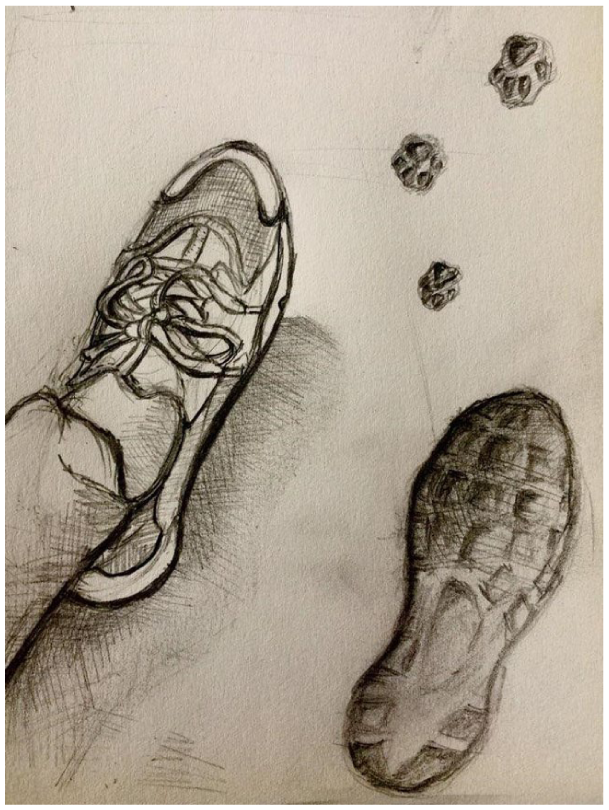
Jamin, charcoal, 2017.

Jungsun, image, 2017.

Mia, ink and watercolour, 2017.

Jungsun, collage, 2017.

Hyoin, image, 2017.
As I attend to student gatherings, a quote from Despret and Meuret (2016) is called to mind that leads me to wonder who bears the consequences of our attentions and relations with ideas and objects. These authors say, “We may never know, safely and reliably, either ahead of time or a posteriori, which beings will bear the consequences, or will enjoy the consequences, of the concrete attention we give to them” (p. 26). Without knowing the consequences ahead of time, I wonder further about our attentions. Despret and Meuret lead me to consider that our attentions are not easy human-to-object and idea relations that depend on who or what is “able to obligate” (p. 27). Perhaps I might wonder if the forest draws our attention, the decomposing tree stumps and logs, the paths we walked, the painted stones, receipt, dime, and so forth.
The gathering of photographs above by Jungsun, Hyoin, Mia, and Jamin shows their own angles on the ideas and objects. It tells of the positions of their bodies in relation to the ideas and objects. It tells of space/place-times they walked to pick them up. It tells of their compositions in photo or on paper. It tells of their renderings through photography and drawing. The photographs above are partial enactments of worlds. My gatherings of their photos and drawings of ideas and objects are a further partial enactment of a world. Perhaps we are all enacting what Law (2011) describes as power-saturated, modest realities that cannot be included if there is no one world (p. 2). Law (2011) discusses research methodologies in postcolonial conceptions of cosmologies and times. He says, perhaps we might explore plural worlds and “ways of proceeding that acknowledge and respect difference as something that cannot be included” (p. 2, emphasis in original). What does it mean to teach inclusive practice within what Law calls a fractiverse—these plural, power-saturated enactments of worlds? These postcolonial research methodologies sit uneasily with, and are even erosive to, other cosmologies of worlds that call for decolonization. For example, during my walks I came across conceptions of place-thought based on Haudenosaunee and Anishinaabe cosmologies of Sky Woman that Watts (2013) explains as thinking that could never be separated from place. The cosmologies of Sky Woman as told by Kimmerer (2013), who is from the Potawatomi Nation, make me question postcolonial worlds. In this sense, I often wonder about, and feel deep responsibility for, the spiritual, thinking, living, ancestral, relational place on which the university campus sits and our gatherings happen. Inclusive group settings, in the postcolonial sense just discussed, are turned upside down when considering Indigenous cosmologies.
These ideas and objects vibrate and reverberate together, creating and generating unpredictable consequences and effects.
Conclusion
The purpose of this article was to answer what an a/r/tographic practice called gathering might offer to reconceptualist early childhood teacher education. Irwin and O’Donoghue (2012) question how we might also value the process of learning. It is my hope that gathering might be a way to acknowledge the process of engaging the many texts with a reconceptualist focus often demanded of students in university settings as they grapple with multiple complex readings in a short time. Gathering, and attending to the process of gathering, allows us to see materially what might be taking shape on another dimension with ideas. Learning is produced as something more than an occurrence inside an individual student. It allows students to reunite ideas and materials to consider them together, to experiment and see the imperfect material consequences of this assemblage. Gathering is are noninnocent. The process of gathering creates spaces to engage critical questions, such as the questions asked above regarding what we pick up and drop and how we compose theoretical assemblages like the one in Figure 11.
Gathering allows students to consider the ethics of more-than-human learning in the complex terrain of reconceptualist literature: It emphasizes the ethics of sites and contexts of inquiry (e.g. the fences and steep hills). It brings attention to and raises questions about the process of grasping objects and ideas (e.g. the movements, body positions, reaching, and crunching and squishing of objects). It allows consideration of the ethics of picking up and dropping objects (e.g. how much we gather, when it is appropriate, and why we pick up certain objects and not others). It has potential to show the (un)learning and transformations of the gatherer as more than occurrences inside the mind (e.g. the moulding of objects, the cracking of twigs). It stories an imperfect and partial path of (un)learning and study (e.g. missteps and wrong directions).
In conclusion, gathering has allowed me, as an artist/researcher/teacher, to explore teaching in the university setting beyond mind/body dualisms. This article adds this attempt to teach beyond mind/body dualism to the reconceptualist literature. Gathering includes, for example, the intelligence and logics of walking the earth, the curiosity of hands meeting objects, the knowing of feet on the ground, the questioning of reaching, the bending of arms and legs over tree stumps, the holding of matters of concern in the heart, the guts to walk down certain paths, the ethics it takes to decide when and how to pick up certain ideas and when and how to let others drop, the importance of feeding the spirit. The pedagogical practice of gathering allows for attunement to the relational processes and embodied situations of engaging theories. It creates small conditions for moments where communities explore the responsibilities and obligations of walking, balancing, and thinking together.
Footnotes

Funding
The author received no financial support for the research, authorship, and/or publication of this article.
Declaration of conflicting interests
The author declared no potential conflicts of interest with respect to the research, authorship, and/or publication of this article.