







Abstract
Children around the world are increasingly left to navigate digital information on their own, yet research on their encounters with online misinformation remains limited. This scoping review identifies existing peer-reviewed literature on children and digital misinformation, analyzes its methodological approaches and key findings, and highlights areas for future studies, such as research in regions of the Global South. After searching four databases (Scopus, Web of Science, ERIC, and PsycINFO) and screening an initial 375 studies based on titles, abstracts, and full-text evaluations, we identify 21 empirical studies that examine children and adolescents’ (aged 5–18) exposure to, experiences with, and strategies for mitigating digital misinformation. All 21 studies characterize children and adolescents as particularly vulnerable due to their developing cognitive abilities, which can limit their capacity to critically assess online information. The dominant approach to addressing this challenge is media literacy and critical thinking education. However, the existing literature is limited in terms of cross-cultural perspectives and quantitative data as well as qualitative insights into children’s subjective experiences. This review underscores the need for future research that expands beyond Euro-American contexts to include more diverse geographic settings, particularly in regions where children may have different levels of access to digital infrastructure, media education, and parental mediation. Additionally, there is a pressing need to explore misinformation across a wider range of digital platforms, examine children’s emotional responses to misleading content, and investigate how misinformation is encountered in everyday digital practices. Future studies should also consider the role of children’s playful engagement with misinformation—both as a challenge and as a potential avenue for developing resilience in diverse media environments.
Introduction
Children under 13 are increasingly using digital platforms to access news and search topics that align with their interests (Notley et al., 2023). These early practices affect their future news habits, political viewpoints, and civic engagement (Valenzuela et al., 2019). In particular, social media permeates children’s daily lives (see, for example, Ofcom, 2024), despite platform age restrictions requiring users to be at least 13 years of age. Consequently, children’s presence on social media is obfuscated due to the fact that they have to lie about their age to create a profile.
Social media use increases the likelihood of encountering digital misinformation (Howard et al., 2021) which, for several reasons, is highly problematic for children. Their emotional regulation and critical evaluation skills are still maturing, which can make it harder to recognize biased or misleading information (Pennycook and Rand, 2021). Their limited experience with online navigation tools, such as URLs, and the prevalence of AI-manipulated content and algorithmic attention-grabbing mechanisms (Vartiainen et al., 2023) further amplifies the issue. Finally, children’s curiosity and play-oriented culture can lead to sharing of misinformation that appeals to entertainment; a phenomenon that also takes place among adults (Melchior and Oliveira, 2024). Consequently, developing children’s awareness of digital misinformation is immediately relevant to safer everyday practices and democratic citizenship.
A few examples may illustrate the complexity of researching children and digital misinformation. Social media practices known as “challenges” involve daring others to perform various activities (“challenges”) filmed and posted online. Risky challenges can be portrayed as harmless to stimulate participation, making them misinformation. For instance, in 2020, a challenge where children tested how long they could endure another person kneeling on their throat went viral. This risky challenge emerged in connection to the death of George Floyd in police custody, highlighting how children engage with serious severe topics through playful activities (see, for example, Hughes, 2001).
Other instances of digital misinformation created by or targeting children are deepfakes generated to misrepresent authentic images, video, or audio (see, for example, Ali et al., 2021). Humorous and entertaining deepfakes, such as videos of well-known, animated characters placed in funny or unexpected situations, are seemingly harmless. However, they will likely be mistaken for actual footage, leading to confusion or trust issues with digital media. Deepfakes are also frequently used to scam users out of money or other profitable resources; in a recent deepfake video, the world’s most prominent YouTuber and influencer, MrBeast (315 million subscribers as of September 2024), appeared to be offering his young viewers new iPhones for free (Gerken, 2023).
Influencers can, knowingly or unknowingly, serve as “super spreaders” of misinformation. In 2023, MrBeast paid for 1000 people’s cataract surgery in a video stating that he “cured a thousand blind people,” thereby extensively pushing the false narrative that blindness is something that can be cured. The widespread trend of children as young as 8 years using anti-wrinkle cream and skin care routines unfit for children provides another example (Rackham, 2024). A final example of digital misinformation is “bad science,” such as stories about electricity-generating pyramids or climate change denialism. False claims like these distort historical and scientific understanding while presenting entertaining visuals that easily captivate young audiences.
So far, research on children’s misinformation experiences is only in its infancy. We lack an overview explaining which aspects of children’s misinformation experience have been studied, how they have been studied, and what evidence has been put forth. This scoping review, therefore, reviews the existing research on children, adolescents, and digital misinformation, focusing on the conduct of research, empirical data, and findings, and identifies critical research gaps and challenges, thereby providing an overview of future research directions.
In the following, we will first describe the two research perspectives central to our scoping review: (1) children’s agency through digital media literacy, underscoring the importance of developing agency when dealing with misinformation, and (2) digital misinformation, including conceptual clarifications and the problems digital misinformation presents for adults. Next, we will discuss the methodology of the scoping review and present our findings. Finally, we will outline research gaps and point out directions for future research in children and digital misinformation.
Children’s agency through digital media literacy
Children are increasingly recognized in research as agentic, social actors (c.f. James et al., 1998). Central concepts from this theorization include the notion of viewing children as beings and becomings, thus accentuating their dual role of contributing to meaning and meaningfulness in society, and as developing subjects of adult power. More recently, the concept of childism (Wall, 2013) problematizes views on children as objects versus subjects (of justice, protection, etc.). A central aspect of childism is to ask “how children’s different and diverse lived experiences call for structurally transformed scholarly and social norms” (Wall, 2013: 69).
When pursuing knowledge on children’s encounters with digital misinformation, we are thus immediately confronted with the issue of orienting our inquiries towards a phenomenon that expresses an adult-centered ontology. Consequently, this review of the literature accentuates the need to further address basic assumptions vis-à-vis children’s lived experiences.
Moreover, with issues as pressing as digital misinformation, we should remain particularly mindful of “safeguarding the rights of children and adolescents to participate without silencing them, [which] requires consideration of both concepts of protecting and respecting the autonomy of C/A (children and adults, ed.) according to the nature of the study and the specific context” (Alves et al., 2022: 129). Furthering children’s agency through different aspects of digital media literacy (DML) is therefore often suggested in research. This approach typically underscores that children are both vulnerable—and thereby in need of protection—but also capable actors with identities reaching beyond their mere belonging to an age-segment-based stage of development.
Traditionally, attaining literacy means being able to read and write, which are complex abilities yet also rather specific and fairly measurable in terms of how well one performs them. Although the concept of DML draws on the nomenclature of traditional literacy, definitions and measurements continue to develop and mutate, forming a host of sub-literacies (Hobbs, 2022). They address more specific aspects of being able to “read and write digital media,” such as dealing with (digital) misinformation, often drawing on critical reading traditions (Buckingham, 2003). However, conceptualizations of DML have also been scrutinized in recent years for these very socio-cultural and humanist perspectives on readerly participation that limit our understanding of the performative, socio-material aspects that often characterize children’s digital practices (Dezuanni, 2015).
Most sources stress the importance of educators’ ability to help students develop apt levels of DML (cf. Erstad and Voogt, 2018). Consequently, educators’ lack of familiarity with core aspects of DML presents itself as a major threat to advancements in children’s democratic agency (Hobbs, 2022). Moreover, children’s prerequisites for developing agency toward misinformation through DML may vary significantly, and therefore, we must attempt to view “the social from the perspective of childhood,” as summarized by Warming (2020).
The many-faceted social media arenas are dominant sites of complex multidirectional communicative practices. These practices encompass production (for example of posts), distribution (allowing the world to see your content and evaluating engagement through likes and other metrics), and consumption (watching other peoples’ content and engaging with it or them) (cf. Bruns, 2008; Jenkins et al., 2016). A recent review of social media literacy finds that the development of socio-emotional competencies stands out in this arena due to the highly interpersonal nature of engagement (Polanco-Levicán and Salvo-Garrido, 2022). However, cognitive competencies of critical thinking and understanding how digital media technologies function are also highlighted (Polanco-Levicán and Salvo-Garrido, 2022). As an excellent example of this, a study of German adolescents’ social media literacy drew on a threefold understanding, consisting of (1) expertise, (2) self-competencies, and (3) social competencies (Festl, 2021). Thereby, the adolescents’ literacies were assessed in relation to their understanding of (1) what they knew about media functions and structures and mediality; (2) their competencies of evaluating things critically, balancing motivation/emotion, and creative (self-)expression; and (3) their competencies of participating constructively, inclusively, and honestly. The study found that high scores in the first two categories positively predicted the third, thus underlining the importance of a holistic approach.
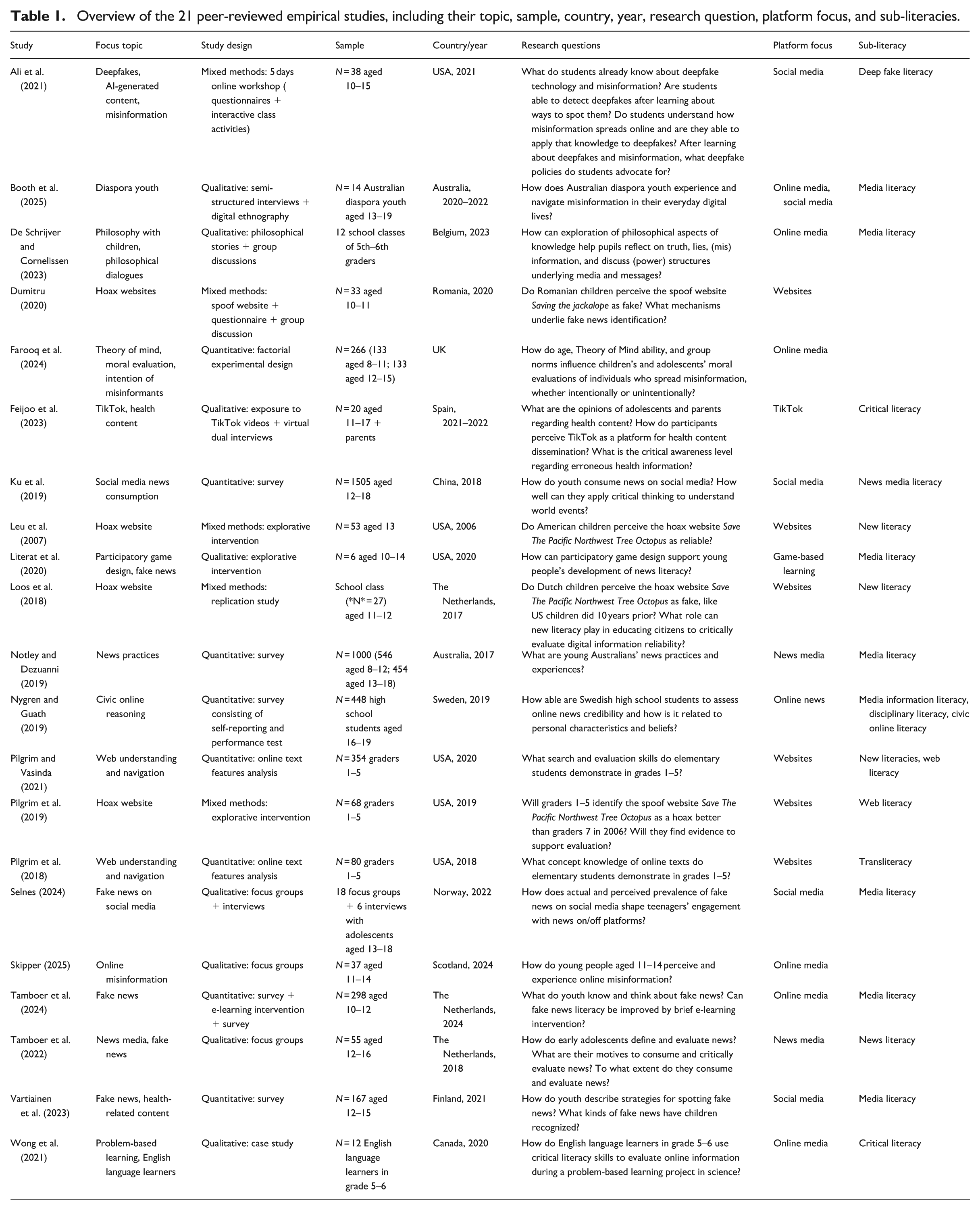
Our review considers the varying role of DML in theoretical framing and assessments in order to provide an overview of how this unfolds in the studies. All except for two studies (Farooq et al., 2024; Skipper, 2025) orient themselves toward more specific sub-literacies as shown in Table 1.
Overview of the 21 peer-reviewed empirical studies, including their topic, sample, country, year, research question, platform focus, and sub-literacies.
Digital misinformation
Defining “misinformation” can be challenging. For this review, we rely on Freiling et al.’s (2023: 3) definition: “claims—well-intentioned or not—that are at odds with the best available empirical evidence”. This definition acknowledges that the classification of something as misinformation can change. Further, the definition is agnostic to the intention of the communicator. The term misinformation is often used to describe content created or shared without deceptive intentions, distinguishing it from intentional disinformation (e.g. Quandt et al., 2019). However, especially in online environments, the purpose of the source of a given content is often complex to determine, and, as the examples in the introduction show, misinformation can be shared with various intentions. Thus, we use the intention-agnostic understanding of misinformation here.
Misinformation can refer to several deviations from factuality: a false core message (i.e. a lie, a deepfake), biased meta-information (e.g. out-of-context and manipulated images), as well as a misleading context (Quandt et al., 2019). Furthermore, misinformation can have different modalities, including image, text, audio, and video. Crucially, for children and adolescents, the borders between misinformation, entertainment, and fiction are blurred, and fiction plays a central role in simulating—and learning—about the social world (Mar and Oatley, 2008).
Misinformation can have several harmful consequences. For example, experimental studies with adults have shown that misinformation can bias the retrieval of correct information from memory (Fazio et al., 2013) and that even implausible misinformation becomes more credible when repeated (Fazio et al., 2019). While not all misinformation is persuasive, misinformation can lead to misperceptions. A meta-analysis on health-related misinformation showed a small but positive relationship between consuming misinformation and believing in false content. The effect is more substantial among younger adults (Li and Yang, 2024). Such misperceptions can then (mis-)guide behavior (Nyhan, 2020). This is often considered especially problematic in democratic societies where governance relies on each person’s opinions and independent decisions (Lewandowsky and van der Linden, 2021). However, misperceptions can also influence well-being outside of politics. For example, people who perceived the COVID-19 pandemic as a hoax were less likely to engage in preventive behaviors (Imhoff and Lamberty, 2020).
While misinformation is not new (e.g. Allport and Postman, 1946), digital media have accelerated the opportunities to produce, spread, and consume misinformation. Following a flash Eurobarometer survey in 2018, two-thirds of EU citizens reported coming across fake news at least once per week (European Commission, 2018). Such self-reports can be biased, and the actual share of misleading content in the overall social media streams tends to be small for most users (Jungherr, 2024). However, as mentioned in the introduction, young media users spend a considerable amount of their time online, increasing their risk of stumbling over misleading content. In 2020, around one-quarter of English videos on COVID-19 found on YouTube contained misinformation (Li et al., 2020); another study showed that algorithmic recommendations could lead to even more misinformation being presented after watching such content (Hussein et al., 2020). Misinformation can also be highly engaging. An analysis of ophthalmology-related content on TikTok showed that only 5.4% of the identified videos on ophthalmology contained misinformation—but these misleading videos were particularly often bookmarked (Sampige et al., 2024).
Research with adults has identified two main factors increasing the risk of believing in misleading content: a lack of cognitive elaboration and motivated information processing. For example, people with a more emotional information processing style (Martel et al., 2020), a lower level of cognitive reflection (Pehlivanoglu et al., 2021), and a tendency to ascribe meaning to meaningless content (Pennycook and Rand, 2019), are more likely to believe in misinformation (for an overview, see Pennycook and Rand, 2021). Furthermore, people are more likely to believe in misinformation that confirms their prior worldviews (Tsang, 2020), lets their social “ingroup” appear in a good light (Faragó et al., 2020), or is otherwise compatible with their pre-existing attitudes (Koch et al., 2023). This might explain why misinformation is particularly powerful without prior knowledge (Rapp, 2016)—and why children could be particularly vulnerable.
Research on combating misinformation has led to the development of interventions that enhance psychological resilience (Ziemer and Rothmund, 2024). Studies show that exposing individuals to misinformation strategies can help them recognize and resist manipulation (Lewandowsky and van der Linden, 2021). Additionally, media literacy initiatives aim to equip individuals—especially young people—with the skills to critically evaluate misleading content. By fostering critical thinking and digital literacy, these efforts enhance users’ ability to navigate misinformation effectively.
Methods and data
A scoping review is a valuable tool for identifying the key topics, conduct of research, findings, and research gaps in an emerging field (Peters et al., 2020; Tricco et al., 2016). First, we systematically searched a reputable database to ensure high reliability and transparency. We used Scopus, the largest abstract and citation database for peer-reviewed literature, including scientific journals, books, and conference proceedings, employing the search string: (children* OR child* OR youth* OR “young adolescent*” OR “primary pupil”) AND (“social media*” OR some* OR platform* OR “online media” OR tiktok* OR instagram* OR youtube* OR snapchat*) AND (disinformation* OR misinformation* OR “fake new*”). We created this search string iteratively, initially using keywords based on known literature (Dumitru, 2020; Loos et al., 2018; Pilgrim et al., 2019). Reading through initial search results, we identified additional keywords and added them to the search string to maximize our chances of obtaining a comprehensive list of publications (Creswell et al., 2003). This process allowed us to continuously expand and refine the search string to determine if added terms yielded more relevant results.
We limited the time range to the past 20 years (2004–2025) and focused on publications in English within the fields of Social Sciences and Arts and Humanities. A search conducted June 18, 2025, yielded 243 results. The same search was repeated the following day, June 19, confirming the initial result count. We then assessed the relevance of these references by reviewing their titles and abstracts. To be included, studies had to mention keywords from the search string in the title, abstract, or keyword fields. Some publications were immediately excluded, while others were marked as “maybe relevant.”
Next, we conducted a full-text review of all publications categorized as “yes” or “maybe” to determine whether they addressed both digital misinformation and the target age group of children and adolescents (ages 5–18). Two exceptions were included despite slightly exceeding the age range—Nygren and Guath (2019) and Booth et al. (2025)—because the majority of participants still are within the relevant age group. As a supplementary search strategy (Peters et al., 2020), we reviewed the reference lists of all selected studies to identify additional relevant literature, which was added iteratively. 20 studies på deemed relevant for inclusion in the review. Given the relatively small number of relevant studies found via Scopus, we expanded our search to additional databases. A search in the interdisciplinary database Web of Science using the same strategy yielded 80 results, and further searches were conducted in ERIC (35 results) and PsycINFO (17 results) from which one more relevant study was added. In total, 21 peer-reviewed empirical studies are included in the review (see Table 1).
Our study has some limitations that should be mentioned. We cannot rule out that we may have missed relevant research published in languages other than English, and we therefore encourage researchers speaking languages other than English to conduct similar review studies of children and misinformation. We included several keywords in the search string and are confident that the terms “misinformation,” “disinformation,” and “fake news” capture the most relevant research. Other related terms, such as “rumors” or “conspiracy theories,” were not included to ensure a focus on the core of the concept of interest. However, some publications may investigate misinformation, disinformation, and fake news more implicitly without using the keyword terms used in our search.
Results
This review begins with five studies (Dumitru, 2020; Feijoo et al., 2023; Leu et al., 2007; Loos et al., 2018; Pilgrim et al., 2019) in which children and adolescents are exposed to specific examples of online misinformation and asked to respond to or evaluate them. The next section presents five studies (Ali et al., 2021; Ku et al., 2019; Nygren and Guath, 2019; Pilgrim and Vasinda, 2021; Pilgrim et al., 2018) that examine how young people assess misinformation in everyday, realistic online environments. This is followed by two studies (Booth et al., 2025; Wong et al., 2021) that focus on how youth from marginalized or minority backgrounds engage with and respond to misinformation. Three further studies (De Schrijver and Cornelissen, 2023; Farooq et al., 2024; Literat et al., 2020) explore how reflective, philosophical, and creative approaches can strengthen young people’s critical engagement with misinformation. Finally, six studies (Notley and Dezuanni, 2019; Selnes, 2024; Skipper, 2025; Tamboer et al., 2022, 2024; Vartiainen et al., 2023) investigate how children and adolescents conceptualize misinformation, how confident they feel in detecting it, and what strategies they employ—or choose not to employ—when evaluating online content. Three studies explore how reflective and creative.
Studies involving exposure to specific misinformation examples online
Feijoo et al. (2023) investigated how 20 adolescents aged 11–17 and their parents responded to misleading health-related content on TikTok. The participants watched two videos: one presenting erroneous information and another debunking it. Follow-up dual interviews revealed that the adolescents showed limited critical engagement with the misinformation. They neither sought information from other sources nor consulted their parents about the content viewed on TikTok. The researchers attributed the lack of critical assessment to the emotionally engaging nature of the platform and the adolescents’ familiarity with it. Meanwhile, parents generally perceived TikTok as mere entertainment and a waste of time, thus making them unaware of the potential risks and the importance of guiding their children to critically evaluate such content.
Earlier, Leu et al. (2007) conducted the first “spoof website intervention,” dedicated to a rare species of octopus living in trees. The website featured pictures of the animal and its environment, historical background information, and links that could be clicked for more specific information. When 53 American 7th-graders (aged 13) were asked to assess the website’s reliability, only six recognized it as unreliable. A decade later, Loos et al. (2018) replicated this study with 27 Dutch children aged 11–12 who had received prior instruction in new literacy, including lessons on fake news and its consequences. Despite this, only two children identified the website as a hoax, and the rest of the children expressed surprise at having trusted the site. The researchers attributed the children’s misjudgment to the school context, trust in their teacher, and emotional involvement with the endangered animal topic.
Pilgrim et al. (2019) further examined this phenomenon by interviewing 68 American children in grades 1–5 to see if younger children would outperform the earlier cohort in detecting the hoax. They found that on average, 65% trusted the website, and only in 5th grade did a majority (58%) begin to question its accuracy.
Finally, Dumitru (2020) conducted a similar spoof website intervention with 33 Romanian children aged 10–11, this time focusing on a fictitious horned rabbit. Participants were told they were part of a study measuring their ability to understand an online text and received no prior digital literacy training to avoid any priming effects. After reviewing the website and searching for additional information online, the children completed a questionnaire similar to Loos et al.’s (2018). While three children refused to sign a petition to save the animal, their reasons revealed they did not perceive the website as fake. Compared to the other studies, the Romanian children’s ability to detect misinformation appeared even weaker.
Across these four spoof website studies, age generally did not predict children’s critical thinking skills, except in Pilgrim et al. (2019), where 5th-graders showed a slightly higher tendency to distrust the website than younger children.
Studies in navigating and assessing online media in everyday contexts
Ali et al. (2021) conducted a study with 38 American participants aged 10–15, involving four interactive online activities designed to assess their knowledge of deepfakes and online misinformation. Initially, participants analyzed 14 AI-generated images, videos, and texts, which they all often mistook for authentic content. The researchers then introduced techniques for detecting deepfakes, after which participants viewed ten videos and attempted again to identify deepfakes. Many admitted finding it difficult to distinguish real from fake, and they often guessed randomly. Next, participants entered a mock news-sharing platform and shared headlines, some factual and others containing misinformation. None questioned the accuracy of the headlines before sharing, and, to their surprise, misinformative headlines therefore spread more widely than factual ones. Finally, when asked about deepfake regulations, participants recognized the need for oversight due to their difficulty in identifying manipulated media, generally favoring policies emphasizing transparency through labeling rather than outright bans.
Relatedly, two studies applied the “Concepts of Online Text” framework (Pilgrim and Vasinda, 2021; Pilgrim et al., 2018) to measure children’s ability to evaluate authentic online sources and resist digital misinformation. Pilgrim et al. (2018) assessed 80 American students in grades 1–5, finding that while children could identify website titles, authors, and headings proficiently, their understanding of URLs and hyperlink navigation was limited but improved with grade level. Building on this, Pilgrim and Vasinda (2021) surveyed 354 American students in the same age range regarding their skills in identifying fake news and misinformation. The children struggled to assess website reliability and trustworthiness—only 18.9% successfully evaluated credibility. Many clicked on images or websites without reviewing search results, with only about half of fifth graders understanding how many results their search generated.
Two survey studies provide further insight into youths’ evaluative skills. Ku et al. (2019) surveyed 1505 adolescents aged 12–18, testing their ability to distinguish facts from claims in a real news article containing both factual statements and subjective opinions supported by varying evidence. While participants generally distinguished facts from opinions well regardless of age, they had difficulty evaluating the quality and sufficiency of evidence. Older adolescents demonstrated a stronger grasp of content and were better at analyzing stakeholders’ positions. Similarly, Nygren (year) surveyed 448 Swedish high school pupils aged 16–19 to evaluate their fact-checking skills and ability to assess online news credibility. Participants rated their own abilities and the importance of credible news, then completed a performance test that included identifying native ads, reader comments, and scientific evidence across topics such as weight loss, hate crimes, and climate change. Results showed generally poor performance, with most students answering fewer than half of the questions correctly. Interestingly, those who valued credible news performed better, while those with high self-rated fact-checking skills performed worse, indicating a misalignment between perceived and actual media literacy. Despite their confidence, 88% struggled to distinguish advertisements from news content in digital newspapers.
Studies focusing on DML practices in marginalized and minority settings
Booth et al. investigate how diaspora youth develop digital and media literacy through their everyday social media practices, and how these skills empower them to respond independently and confidently to problematic information online. Drawing on semi-structured interviews and supported by illustrative digital ethnography, the study focuses on 14 Australian diaspora youth aged 13–19—a group often portrayed as particularly vulnerable to digital risks and harms. The research was conducted during the COVID-19 lockdowns and examines how participants used social media and navigated online misinformation in this period. The digital ethnographic component involved participants completing digital tasks, such as sharing screenshots or producing short videos related to current issues they were engaging with online. The study finds that while these young people are generally aware of misinformation, the strategies they employ to assess credibility often diverge from those traditionally taught in formal education settings.
Wong et al. (2021) examined how English language learners apply critical literacy skills in real time as they research and evaluate online information for a problem-based learning project. This case study followed a group of grade 5–6 students—all recent English language learners—over a 12-week period. Multiple data sources were collected, including: (1) classroom observations via video recordings and mobile phone photographs of group activities and online searches; (2) interviews with students and their teacher; (3) student-produced artifacts such as research notes, emails to experts, presentation materials, reflection journals, and screenshots of online sources; and (4) field notes. Prior to beginning the project, students participated in lessons focused on critically evaluating digital information, including how to identify misinformation and fact-check sources. The study found that students actively engaged in critical literacy practices. They were able to formulate research questions, navigate both online and offline sources, and assess the credibility, relevance, and validity of information. They also used digital tools effectively and integrated scientific knowledge as well as personal experience into their inquiry process. The study concludes that incorporating critical literacy into science education is vital, particularly in linguistically diverse classrooms, to support meaningful and inclusive learning.
Studies using reflective and creative approaches to DML
A Belgian study by De Schrijver and Cornelissen (2023) examines how the Philosophy with Children (PwC) approach can help children explore concepts such as “truth,” “lies,” and “(mis)information.” PwC combines philosophical stories with questions and thought experiments in group settings, encouraging children to reflect on the difference between facts and opinions and whether truth can change. In the study, 12 groups of 5th and 6th graders (10–25 children per group) participated in 2-hour sessions. The authors argue that PwC is a valuable method for engaging children in abstract and complex topics, including the power structures that underpin media and messages. The approach appears especially promising because it appeals to children’s curiosity and may therefore help increase their (often low) motivation to engage critically with news.
Another study focuses on how children and adolescents morally evaluate individuals who spread misinformation, whether deliberately or accidentally (Farooq et al., 2024). Drawing on Theory of Mind (ToM)—the cognitive ability to consider others’ perspectives, intentions, and beliefs—the study explores how age, ToM ability, and group norms shape these evaluations. A total of 266 UK-based children and adolescents (aged 8–15) were divided into groups based on age, the type of norm emphasized (ingroup loyalty or truth-seeking), and the misinformer’s intent. In an experimental scenario, participants observed a fictional case of misinformation within a peer group setting and were then asked to evaluate the misinformer. The results showed that adolescents with higher ToM abilities were less likely to believe misinformation and more likely to judge intentional misinformation harshly. Children, however, were more inclined than adolescents to include the misinformer in the group—regardless of intent—possibly because they viewed the misinformer as part of their own team.
Finally, Literat et al. (2020) investigated how participatory game design can support young people’s development of news literacy. In a 1-day workshop with six U.S.-based participants aged 10–14, the children engaged in group discussions about news, fake news, and online media habits before collaboratively designing their own board games. One of the resulting games, Fakeopoly, was inspired by Monopoly and focused on themes such as manipulation and the spread of misinformation. Guided by researcher-facilitators, participants developed deeper insights into how and why fake news is created and shared, integrating these insights into game mechanics. The process fostered engagement, ownership, and critical reflection, while allowing researchers to observe and clarify misconceptions as they emerged.
Together, these three studies demonstrate how philosophical dialogue, moral perspective-taking, and creative design processes can serve as alternative and engaging pathways for fostering critical reflection on misinformation among children and adolescents.
Studies on children’s and adolescents’ understandings and beliefs about misinformation
Tamboer et al. (2024) conducted a questionnaire study with 298 Dutch children aged 10–12 to explore how they define and evaluate fake news online and to test whether a brief educational intervention could improve their media literacy. The children demonstrated some understanding of fake news, generally describing it as false, fabricated, or deceptive content that mimics real news and spreads through manipulated websites. However, many examples they gave referred to misleading content unrelated to news, such as phishing emails or claims about ghosts and aliens. The children were mostly negative about fake news, emphasizing its intent to mislead, scare, deceive, and influence people for profit or other motives. They considered fake news problematic because it is difficult to distinguish from accurate information and can prompt people to act on harmful or illegal initiatives. To combat fake news, the children suggested using reliable sources, seeking adult advice, avoiding engagement with fake news, fact-checking, imposing fines, and providing media literacy education. Following the initial questionnaire, half of the participants watched a video in which a journalist explained how to recognize fake news, its origins, and ways to prevent its spread. Three weeks later, all children completed the same questionnaire again. Surprisingly, the intervention did not increase the experimental group’s awareness of fake news compared to the control group, although it did boost their confidence in recognizing fake news.
Earlier, Tamboer et al. (2022) had conducted focus groups with 55 Dutch adolescents aged 12–16 to investigate their definitions of news, evaluations of fake news content, and motives behind news consumption and critical evaluation. The adolescents perceived fake news as ubiquitous and acknowledged the importance of checking reliability but often lacked motivation to engage in critical evaluation.
In a related Norwegian focus group study, Selnes (2024) explored how adolescents aged 13–18 perceived fake news and its prevalence on social media, and how this shaped their news engagement both online and offline. Fake news had both positive and negative effects on their engagement: it encouraged some adolescents to search for, investigate, share, and discuss news with parents and friends, often turning them towards established media outlets for fact-checking. At the same time, many were cautious about “liking” or “favoriting” social media posts to avoid contributing to the spread of fake news. Yet, as Selnes noted, avoiding engagement on social media might also limit adolescents’ self-expression. For some, fake news bred skepticism and distrust, leading to reluctance in consuming or engaging with news on these platforms. The adolescents demonstrated awareness of how algorithms shape news selection, expressing particular concern about Facebook’s role in amplifying fake news.
Notley and Dezuanni (2019) surveyed 546 Australian children aged 8–12 about their confidence in distinguishing fake from real news, whom they assess online news with, and whether they had received school education in identifying misinformation. While a third reported confidence in detecting fake news, over half rarely or never assessed the truthfulness of news stories they encountered online. Only 20% said they had been educated by their schools to evaluate news in the context of misinformation.
Similarly, Vartiainen et al. (2023) surveyed 167 Finnish adolescents aged 12–15 about their understanding of fake news, their encounters with it, and their perceived need for further knowledge. Participants demonstrated a broad understanding, recognizing various forms of false information—including ordinary lies, myths, and rumors—often spread for personal, financial, or ideological gain.
Finally, Skipper’s (2025) qualitative study explored how Scottish youth aged 11–14 understand, detect, and respond to misinformation through six focus groups. Participants commonly associated misinformation with scams and financial motives and sometimes accepted misinformation that aligned with their pre-existing beliefs. They typically relied on intuition rather than analytical methods to assess truthfulness, often using comment sections or repeated exposure to judge credibility instead of critically evaluating sources. They acknowledged the diverse forms misinformation can take and noted that AI-generated content makes detection more challenging. Participants also reported barriers to confronting misinformation, including a sense that it was not personally relevant or harmful, willingness to act only when misinformation seemed very serious, fear of becoming targets if they intervened, and a belief that individual actions have limited impact. Instead, they felt platforms and governments should take primary responsibility for addressing misinformation.
The research gaps and avenues for future research
Considering the extensive exposure children and adolescents are likely to have to digital misinformation, the current body of research remains inadequate. While exploratory approaches are valuable in nascent fields, there is a clear gap in robust statistical and cross-national analyses of children’s interactions with digital misinformation. Only five of the 15 studies apply quantitative methods, and none address children’s encounters with digital misinformation across multiple countries and continents, including the Global South.
Conversely, we also see a shortage of semantically rich in situ descriptions of children’s everyday experiences with digital misinformation. Further, none of the 15 reviewed studies provide repeated measurements of variables and the cumulative data collection by applying a longitudinal approach, limiting our knowledge about long-term effects.
More research is also needed to evaluate the effectiveness of digital media literacy training, particularly around generative AI. Only one study (Ali et al., 2021) focuses on this aspect. Given that AI plays an influential role in creating and spreading misinformation (Feuerriegel et al., 2023), fostering children’s awareness and critical thinking skills is imperative. This area represents a pivotal agenda within the field, highlighting the need for targeted research and education to support children’s understanding of AI’s role in digital information landscapes. In this regard, strategies to support children’s digital media literacy should build on promising methods such as cognitive inoculation (c.f. Spampatti et al., 2023), and, furthermore, measure the effectiveness of such strategies in clear terms. Since media literacy interventions can also backfire and lead to unwanted over-skepticism (Hoes et al., 2024), it is particularly important to include assessments of these aspects as well as to secure methods that are conductive of literacy in a precise manner.
Presumably because it is far more feasible to conduct a study on children’s approach to a spoof website than to social media platforms—where children are not allowed—only one study (Feijoo et al., 2023) addresses a social media platform. More research on children’s encounters with misinformation on social media, including cross-platform comparisons, is needed. In continuation of this point, most of the studies are conducted in controlled and therefore artificial settings. They do not paint a complete picture of participants’ real-life or everyday encounters with misinformation online.
Ten studies exclusively address children (aged 5–12) (De Schrijver and Cornelissen, 2023; Dumitru, 2020; Loos et al., 2018; Notley and Dezuanni, 2019; Pilgrim and Vasinda, 2021; Pilgrim et al., 2018, 2019; Tamboer et al., 2024) while the remaining focus on older children and adolescents aged 10 and up. More studies of children are absolutely called for.
We also see several overlapping categories of digital misinformation that speak to various parts of children’s emotional registers. We, therefore, encourage studies of emotionally appealing digital misinformation; studies of humorous and entertaining content (e.g. challenges, deepfakes, bad science, rumors), personally appealing content (e.g. content by influencers, beauty, diet, and exercising tips), and content evoking fear, anger, or curiosity (e.g. scams, radicalizing statements, conspiracy theories). The “spoof website interventions” highlight the value of using emotionally appealing material in interventions. Addressing how digital misinformation integrates with children’s play through different emotional registers presents itself as a complex yet very important future research topic.
Conclusion
Children’s developing self-competences, social competencies, and cognitive competencies impede their ability to critically assess content. This, coupled with their curious and playful dispositions, makes them particularly vulnerable to digital misinformation. The 15 peer-reviewed publications examined speak to various parts of a potential digital misinformation persuasion process—exposure, experience, and prevention—in relation to children and adolescents. According to the studies, children and adolescents are seldom able or aware that they should assess the reliability and trustworthiness of online information, which requires the aforementioned cognitive competencies: a combination of basic knowledge about how to verify information, such as domain-specific knowledge, the reliability of experts, and the credibility of sources, as well as practical exercises in analyzing false information. Conflicting viewpoints, the assumptions behind them, and the extent to which they are supported by evidence need to be carefully considered in online content. Most studies, therefore, highlight that children should receive education in media literacy and critical thinking from an early age. Only two studies point toward other solutions to digital misinformation and children, suggesting legislative initiatives such as labeling deepfakes or being fined for spreading fake news (Ali et al., 2021; Tamboer et al., 2024). None of the reviewed studies point to the relevance of self-competencies or social competencies in relation to children and digital misinformation.
What, then, do we know about the impact of literacy training on children? The two studies that incorporated literacy education (Loos et al., 2018; Tamboer et al., 2024) did not prove that literacy interventions effectively enhance children and adolescents’ ability to deal with online misinformation such as recognizing a website as fake (Loos et al., 2018) or increasing the general awareness of fake news (Tamboer et al., 2024). Yet, the quality and scope of the literacy training in these two studies are unknown, making it challenging to evaluate the effectiveness of digital media literacy as a solution to digital misinformation.
All 21 studies focus on investigating and measuring children and adolescents’ ability to navigate and resist digital misinformation. However, developing these skills must be balanced with strategies that prioritize protecting children from the harms of misinformation, while at the same time recognizing and strengthening their agency in ways that further enable them to participate meaningfully. Thus, future research should not only improve methodological rigor and expand geographically but also address how participation and protection can be balanced. This is essential to foster safe, engaging digital arenas that support children’s safe democratic participation as prescribed in the 25th General Comment to the United Nations Convention on the Rights of the Child (United Nations, 1989).
Footnotes
Acknowledgements
The authors would like to thank TrygFonden for their generous funding.

Ethical considerations
This study is a review of publicly available literature and does not involve human participants, animals, or primary data collection. Therefore, ethical approval was not required.
Consent for publication
Consent was not required, as this study is a review of publicly available literature.
Funding
The authors disclosed receipt of the following financial support for the research, authorship, and/or publication of this article: This research is part of a larger research project supported by funding from TrygFonden. The funder had no role in the study design, data collection, analysis, decision to publish, or manuscript preparation.
Declaration of conflicting interests
The authors declared no potential conflicts of interest with respect to the research, authorship, and/or publication of this article.