







Abstract
Smart cities are now arguably the new urban utopias of the 21st century. Integrating urban and digital planning, smart cities are being marketed across the world as solutions to the challenges of urbanization and sustainable development. In India, in particular, there has been a move towards building 100 new smart cities in the future in order to spur economic growth and urbanization. Using the case of Dholera, the first Indian smart city, I examine how global models of smart cities are provincialized in the regional state of Gujarat through local histories, politics and laws. First, I argue that Dholera smart city is part of a longer genealogy of utopian urban planning that emerged as a response to the challenges of development and modernity in post-independent India. Second, that Dholera highlights a shift towards an ‘entrepreneurial urbanization’ in a regional state interested in scaling up a ‘Gujarat model of development’ for emulation at the scale of the nation. Finally, that in Dholera ‘speed’ is a relative term across its scales of manifestation from the global to local, where short ‘bursts of speed’ in conceptualization and investment is matched by significant ‘bottlenecks’ via local protests. The article concludes that Dholera’s fault lines are built into its utopian imaginings, which prioritizes urbanization as a business model rather than a model of social justice.
Introduction
Existing cities are required to be upgraded in a phased manner, whereas new cities have the luxury to incorporate smart city vision at the conceptual stages of development. The approach towards new city development is quite different. A (new) city can be planned with respect to information and communication technology (ICT) so as to integrate infrastructure components, like smart grid, green buildings, multimodal transport networks and so on, into their master plan. (Pagdadis, 2013)
In a presentation on Dholera smart city in the 2013 Vibrant Gujarat Summit, Pagdadis, an official from Pricewaterhouse Coopers set out the case that the seamless integration of urban planning and digital technologies is the most sustainable solution to rapid urbanization in India. Indeed, Dholera, India’s first new smart city, currently emerging in its western state of Gujarat, is now hailed as the model for 100 new smart cities to be built in India in the next few decades. Master planned by UK-based global consultancy firm Halcrow, and partially paid for by the Indian state and Japanese corporations, it is envisioned that Dholera at 903 km2 area, will be twice the size of present-day Mumbai by 2040. Marketed as the pinnacle of technology-driven urbanism, Dholera smart city turns its back to the challenges of existing Indian cities struggling with pollution, traffic congestion and slums. Dholera promises to be a new city without the ‘annoyances’ of everyday urban life.
Smart cities are now widely accepted as ‘places where information technology is combined with infrastructure, architecture, everyday objects and our own bodies to address social, economic and environmental problems’ (Townsend, 2013: 15). In India, the smart city narrative has been synonymous with new ‘greenfield’ cities, which now arguably form the new urban utopias of the 21st century. At one level, Dholera can be understood as a ‘real-time’ (Kitchin, 2013) socio-technical manifestation of an urban utopia. Seen particularly in the ‘importation of off-the-shelf program techniques’ (Peck, 2002: 344), Dholera’s ‘smart’ credentials are marketed by Cisco (the global information technology (IT) company) as a meshwork of fibre-optic cables, sensors and cameras linked to a central control room to track citywide utility consumption. Dholera also has globally recognizable features of eco-cities (such as renewable energy) and new urbanism (such as walk to work) that proclaim to provide a seamless urban life in the new smart city.
At another level, Dholera is not a ‘new’ city typology per se; rather an extension of a postcolonial modernization project that was earlier vested in the development of ‘new towns’ (Kalia, 1990). As a smart city built from scratch, Dholera can be seen to extend the focus of a neo-liberal state on global cities (such as Mumbai), knowledge cities (such as Ambani City), technology cities (such as HITEC city), IT hubs (such as Bangalore), eco-cities (such as Lavasa) and so on, to a more digitally led city-making initiative in recent years. Following Bunnell’s (2002: 267) observations in Malaysia’s ‘intelligent cities’, the ‘broad ideological underpinning of strategies to realize such aims – liberalization and modernization – show similar continuity’ in Dholera. Crucially, it places regional states such as Gujarat at the nexus of modernization and liberalization through their investment in new cities in order to compete in the global economy.
Using the case of Dholera, I raise three key issues in this article. First, that Dholera smart city is part of a longer genealogy of city making that emerged in post-independence India as a response to the challenges of development and modernity. Following from early planned cities like Chandigarh and Bhubaneshwar to industrial townships like Jamshedpur and more recently to eco-cities, Dholera presents a new trend in city building in India that, instead of addressing existing social exclusions, actually reinforces long-standing social inequalities. Second, the Dholera case highlights a shift towards an ‘entrepreneurial urbanization’ by the regional state of Gujarat interested in enforcing ‘big bold’ policies on city making through a rule of law. In doing so, it underscores how regional economic ‘success’ can become a model for emulation at the scale of the nation. Finally, whilst Dholera exhibits what has been called an ‘instant urbanism’ (Murray, 2013) through ‘fast policy’ (Peck, 2005: 767), it also shows that speed is a relative term across its scales of manifestation from the global to local. The ‘bursts of speed’ in putting together new laws, master plans and global capital investment at the regional scale are matched by significant ‘bottlenecks’ in technological challenges and local protests by farmers living on the land where Dholera will be built.
‘Provincializing’ the smart city in Gujarat, India
In recent years, the rise of gated communities, new towns, satellite cities and other spatial manifestations in the global south has seen a flurry of theorizing around ‘postcolonial urbanism’. Scholars have argued that this reflects different moves towards a ‘Dubaisation of Africa’ (Choplin and Franck, 2010), ‘worlding’ of cities (Roy and Ong, 2011) and ‘assemblage urbanism’ (McFarlane, 2011) among many others. Scholars have also argued that this is largely in a context of a ‘global privatization of urban space’ (Hogan et al., 2012: 59). At face value, Dholera seems to fit these arguments. Dholera is part of a shift in development paradigms circulating in the global south (in China, Malaysia, Korea, Brazil and other countries) towards new city making in partnership with the private sector (Moser, 2010; Percival and Waley, 2012; Watson, 2014). As such, it reflects how technology-led ‘utopian imaginings’ (Bunnell and Das, 2010) have become central to contemporary postcolonial urbanization in India. As a smart city, Dholera will rely almost exclusively on a technocratic mode of urban governance shaped by corporate interests to control and monitor its population. Composed of large-scale privatized residential neighbourhoods, commercial and business districts, Dholera will be a ‘private’ city at a gargantuan scale, producing a ‘new urban colonialism’ (Atkinson and Bridge, 2005) in a city of ‘premium networked spaces’ (Graham, 2000), where urban planning as well as management and control of big data will serve the interests and aspirations of the political elite and middle classes (Choe et al., 2008). Dholera also reflects how the ‘Global Intelligence Corps’ (Olds, 2001) vested in companies like McKinsey, Halcrow and Cisco contribute to ‘policy mobility’ (Peck, 2002) and the ‘mutation of a smart city’ (Rapoport, 2014) model in Gujarat. Finally, Dholera also reflects a new global trend in the large-scale expulsion (Sassen, 2014) of those that cannot fit into its smart city-based ‘high-tech strand of developmental utopianism’ (Bunnell, 2002: 267).
On close inspection, however, these conceptual critiques offer little reflection on the underlying sociopolitical and historical contexts. As Brenner et al. (2011: 234) note, over-reliance on translocal learning to explain urban change does not shed light on the ‘geographies of land ownership, dispossession, deprivation and struggle generated and entrenched in the unequal distribution of resources and the precarious life conditions’ against which smart cities like Dholera are conceptualized and materialized. Dholera is the site of intense local and regional politics around development and urbanization that traces its genealogy back to India’s post-independence city-building projects since 1940s. What is different in Dholera today is that it is driven by a rhetoric of urgency – to respond to challenges of urbanization, sustainable development and rural–urban migration, which justify the speeding up of lawmaking, regulations and policies to enable a new city to quickly materialize. As Watson (2014) notes in the case of ‘African urban fantasies’, the assumption in Dholera is that these new cities are built on ‘empty land’, thereby evading public and democratic debate on mass-scale expulsions of marginalized citizens from their land and livelihoods. Yet as I will argue, Dholera is the site of intense struggles to slow down the development process – local protests and grass-roots political action that question the legitimacy and embedded injustices of new laws brought in to ‘fast-track’ land acquisitions for building the smart city.
If Dholera presents a ‘mutation’ (Rapoport, 2014) of the globally circulating smart city model, its materialization will be shaped by the demands and needs of local contexts. As noted, Indian sociologist Ashis Nandy has argued, ‘our native vernacular genius will corrupt the imported model of the post-industrial city and turn it into an impure, inefficient, but ultimately less malevolent hybrid’ (paraphrased in Chatterjee, 2004: 145). It could be said that this has been the outcome in several state-funded utopian city-building projects in India, such as Chandigarh (Kalia, 1990), Bhubaneshwar (Kalia, 1997) and Gandhinagar (Kalia, 2004). Sassen (2011) would also argue that smart cities will ultimately be corrupted through ‘urban wikileaks’, where grass-roots hacking of digital technologies will democratize and equalize social power. But these arguments gloss over the increasing use of a rule of law by the state in order to maintain and authorize sovereign power over particular populations and territories. In this context, grass-roots struggles to equalize power relationships (social, material and digital) in the smart city will neither be fast nor be straightforward. I am therefore as uncomfortable as Partha Chatterjee (2004) in accepting Nandy’s and Sassen’s optimism about the power of the grass roots to corrupt the smart city model in India.
In provincializing the smart city, I align myself with Chakrabarty’s (2000: 34) suggestion of ‘developing the problematic of non-metropolitan histories’ by unpacking and making visible the ‘repression and violence that are as instrumental in the victory of the modern as is the persuasive power of its rhetorical strategies’ (p. 44). This means not just ‘identifying and empowering a new loci of enunciation’ (Sheppard et al., 2013: 895) for situating the story of smart city making in the regional state of Gujarat but also unpacking the ‘ambivalences, contradictions, the use of force, and the tragedies and ironies’ (Chakrabarty, 2000: 43) associated with its vision to lead urbanization akin to a entrepreneurial model in India. Whilst the rhetorics and representations of smart cities in India have been about the appropriation of the term into a westernized discourse of the ‘modern’, it appears very different if we refocus our attention on ‘local history, and a view of urban change not as imposed from above but rather as an inherently negotiated process’ from below (Shatkin, 2007: 6). Provincializing a smart city in Gujarat means identifying the parochial nature of its claims that are rooted in Gujarat’s postcolonial histories, the national emulation of the ‘Gujarat model of development’, as well as its use of a rule of law to exclude those on the margins. Provincializing the smart city also means locating how alternative knowledges about the smart city are produced not through grand narratives of postcolonial urbanism but from the margins of a region deeply rooted in historic inequalities in India.
Dholera’s provincialization is evident in three related processes. First, Dholera leads a new phase of utopian urbanization in India that whilst embedded in a postcolonial legacy of utopian urban planning also scales up from regional to national scale. In doing so, it bypasses the pressing challenges of existing Indian megacities to create new townships (Bhattacharya and Sanyal, 2011). Thus, Dholera becomes an ‘urban fantasy’ (Watson, 2015: 38) propagating ‘the hope that these new cities and developments will be “self-contained” and able to insulate themselves from the “disorder” and “chaos” of the existing cities’. Second, Dholera is made possible because the regional state in Gujarat has acquired increased powers in controlling and directing urbanization through a rule of law. It highlights the emergence of an ‘entrepreneurial state’ (Mazzucato, 2013) preoccupied with ‘lawfare’ – the increased use of ‘brute power in a wash of legitimacy, ethics, and propriety’ (Comaroff and Comaroff, 2006: 31) to build new cities. Dholera reflects the almost perpetual presence of the entrepreneurial state in city building using what Comaroff and Comaroff call a ‘metaphysics of disorder’ to internalize the logics of capital and extend the rhetorics and practices of ‘new townships’ that shaped Indian urban planning since independence.
Third, despite the rhetorics and practices of ‘speed’ embodied in the rise of Dholera and other smart cities in India, its utopian fault lines begin to unfold in the bottlenecks and ‘slowness’ in its manifestation. As Hsing (2012: 85) observes in the case of Chinese cities, Dholera too is ‘centre stage in the politics of accumulation and dispossession today’. Dholera smart city as a new ‘regime of dispossession’ (Levien, 2013) through ongoing land-grabs makes peasants the final frontier in city-making (Goldman, 2011). This mechanism imposed by a rule of law in the making of Dholera becomes a state-orchestrated exercise in land grabs which has seen protracted protests from farmers.
Dholera as a new utopia?
Dholera is not the first city in India to be conceived at a grand scale. Chandigarh, designed by French architect Le Corbusier, was independent India’s first state-driven large-scale master-planned city that marked India’s route to modernity and development by making a break from tradition and the social injustices of a colonial past (Kalia, 1990). Similarly, Bhubaneshwar, designed by the German architect Otto Koenigsberger in 1948, was also built to make a break from the socio-religious conflicts of the old capital of Cuttack and establish a secular new capital for the regional state of Odisha (Kalia, 1997). The third master-planned city, Gandhinagar, was built in the 1960s to establish a new capital for the regional state of Gujarat. However, in a significant move away from employing well-known American architect Louis Kahn, Gujarat state officials hired a local architect HK Mewada, who had been a follower of the ‘son of Gujarat’ – Mahatma Gandhi. Mewada adopted a form of indigenous modernity in the new city through ‘Gandhian principles’ of self-sufficiency and egalitarianism (Kalia, 2004).
Dholera, however, was planned in the image of a global Gujarat that rejects its local identity rooted in Gandhian principles. It nevertheless draws upon a postcolonial legacy of building new townships as a route to modernity and development. Otto Koenigsberger, who was the director of Housing and New Town Development in India from 1947 to 1951, planned several new townships during this time. These include Jamshedpur, Faridabad, Kalyani and Nilokheri, which were built in the image of ‘modernist aesthetics and social reconstruction’ (Liscombe, 2007: 172). However, as Shaw (2009: 875) notes of Indian town planning in the post-independence era, ‘many of the new towns came to symbolize much more than their functional role because the Indian state…attempted to fashion a new society and economy to reflect its new-found freedom from colonial rule’. This legacy has continued in more recent examples, such as New Bombay (Shaw, 2009), Rajarhat (Chen et al., 2009) and Lavasa (Datta, 2012). To understand why Dholera, although located in Gujarat, makes a break from Gandhinagar, it must be placed in a larger context of a Gujarat reeling after the 2002 communal riots 1 and the breaking down of communities, neighbourhoods and trust. For several years, the legitimacy of its Chief Minister, Narendra Modi, was challenged not only within India but also internationally. Since allegations of his involvement in the riots surfaced, Narendra Modi was not allowed entry into the West – the United States and the United Kingdom steadfastly refused to grant him visas. Instead, he visited countries in South and South East Asia, particularly China where he encountered the economic wealth generated through the building of new cities and rapid industrialization (Pathak, 2014). The ‘Gujarat model of development’ as circulated during his election campaigning in 2014 was built on the replication of a ‘Shanghai model’ (Pathak, 2014). Dholera and the tide of new cities in Gujarat therefore were an opportunity for Narendra Modi (himself from a lower caste) as a heroic subaltern then to make a break from his communal links and association with right-wing Hindu political parties and model himself as a ‘visionary politician’ – as the ‘keeper of the phantasmagoria of postcolonial development’ (Roy, 2011: 264).
India is not the only postcolonial state that embarked upon city building as a route to modernity. In the 19th and 20th centuries, the master plans of a number of new cities (built and unbuilt) planned across Asian, African and Latin American countries suggest that often urban planning was a tool of the postcolonial state to make a break from its colonial past and impose a more universal notion of modernity out of touch from its population. In Plan Obus (unbuilt), Le Corbusier disregarded Algeria’s socio-religious context to design an ambitious modernist new capital city of Algiers, with built forms that violently imposed a romanticized and sexualized ‘other’ on the Algerian landscape. Holston (1989) notes how Brasilia, the new master-planned capital of Brazil, began from a tabula rasa to create a society free from divisions of class and social disparities, yet even after many years, social justice still remains unattainable for a large majority of Brasilia’s population. Chandigarh too emphasized design to bring about social justice and in the end turned out to be a ‘designed city rather than a planned one’ (Kalia, 1990: 5). Similarly, Bhubaneshwar claimed to eliminate social inequalities, such as caste and religion through design, but the civic spaces designed for the interaction of ‘equal citizens’ were appropriated by the middle classes as their private spaces or gave way to informal settlements for the working poor (Liscombe, 2007). Instead of absorbing the rising urban population, these towns were largely bypassed by rural–urban migrants moving to megacities in search of new livelihoods.
Kalia argues that the ‘failure’ of these cities to deliver their promises of modernity ‘show that new designs and planning do not by themselves make the dream of building a modern urban environment come true’ (2004: 5). In their attempts to solve urban and social crises through a radical reconstruction of urban planning and architectural form as well as in their failures of actually coming even close to this ideal, the new postcolonial cities in India and elsewhere reflected the 19th- and 20th-century utopias in the West (Fishman, 1982). They share a few characteristics – a total rethinking of urban planning as a tool to implement social justice, a central role for built environment professionals (architects, town planners and policymakers) and an over-reliance on technological modernism in the ‘ideal city’ of the future. However, as blueprints aiming for social engineering they were almost impossible to implement and enforce in practice (Freestone, 2000).
Dholera too is arguably a ‘blueprint utopia’ (Holston, 1989) that has been designed to bring in a new era of social and economic prosperity in Gujarat and beyond. Reflected in a blog by Amitabh Kant, a state official in charge of the Delhi–Mumbai Industrial Corridor (DMIC) where Dholera is located, Dholera’s utopian vision is a city where knowledge, power and wealth are redistributed through the help of digital technology. He continues…creating the smarter cities of the future is really about empowering the citizens of India with information and connectivity, so they can educate their children, improve their health, manage their lives better and connect to the world. (Kant, 2013)
This narrative, however, shows little reflection on Dholera’s local history or the diversity of its social, cultural, religious or material landscapes. Dholera is idealistic in its imagination of networked spaces as a solution to the challenges of urbanization, climate change and rural–urban migration. Just as in Chandigarh and Brasilia its urban planning is also largely driven by technological privilege and therefore ‘customized precisely to the needs of powerful users and spaces, whilst bypassing less powerful users and spaces’ (Graham, 2000: 185). In overly relying upon ‘information and connectivity’, Dholera fails to reflect upon local history and learn from much of the critiques already forwarded about smart cities in the West (Greenfield, 2013; Hollands, 2008; Kitchin, 2013; Maeng and Nedovic-Budic, 2008). It reinforces state sovereign power (Hollands, 2008; Kitchin, 2013), without challenging the existing power structures embedded in everyday social relations in Gujarat and without considering that its digital technology might become ‘buggy and brittle’ (Townsend, 2013) overtime. In purporting a totalitarian vision of a ‘networked city’ (Graham, 2000), Dholera fails to make connections with the postmodern realities of a plural India struggling to maintain communal relations, to negotiate everyday encounters with the state and to manage their lives and livelihoods in a ‘global’ Gujarat.
Dholera, however, is also distinctly different from earlier utopian experiments in one significant way. As a smart city, it is driven not by visionary architects and planners but rather by the corporate sector seeking to create new global markets in India (Doherty, 2013; Falconer and Mitchell, 2012; IBM, 2010). As Batty et al. (2012: 486) have argued: the term smart city has become shorthand for the way companies that are developing global ICT…such as IBM, CISCO, Microsoft, Oracle, SAP are beginning to generalise their products as they see markets in cities representing the next wave of product development.
It presents a situation that Sassen would call an ‘extreme case of key economic operations’ (2014: 9) of a neo-liberal state, which is playing an ever increasing role in directing and controlling the discourses and practices of urban planning with the active participation of the corporate sector. Dholera shows how a postcolonial developmental logic vested in new towns is now used to drive urbanization and economic growth.
Urbanization as a business model
The regional state of Gujarat for some time has labelled itself as ‘India’s growth engine and economic powerhouse’ and ‘the only state in India to emerge as investor friendly even during the world economic downturn’ (GIDB, 2014). Led since 2001 by its Chief Minister, Narendra Modi, Gujarat was labelled as a state with ‘minimum government and maximum governance’, which led to its development indices rising far higher than the rest of India. For example, in Gujarat recorded over 10% annual growth rate between 2004–05 and 2011–12 (Mishra, 2013) when the overall Indian growth rate remained around 5%. This growth was reliant on three strategies: first, an active lobbying for investment; second, the speed in their issuance of clearances for capital investment projects; and finally, reducing what is seen by the corporate sector as ‘political interference’ (or social resistance) to development projects. Indeed, the ‘Gujarat model of development’ based on a ‘homegrown neo-liberalism’ (Roy, 2011) was the slogan of Narendra Modi’s election campaigning for Prime Minister’s office in spring 2014. Thus, whilst Kundu (2014) claims that India’s census data shows sluggish urbanization and growth despite decades of urban development policies, Gujarat seems to be an anomaly in these statistics.
The Gujarat model of development presents the rise of a regional ‘entrepreneurial state’ (Mazzucato, 2013) that is leading in radical technical change by continually innovating and creating policy for big, bold ideas. This regional entrepreneurial state is an extension of the practices of entrepreneurial city/regions in ways that cities in the global north have creatively reoriented themselves to compete in the global market (Hall and Hubbard, 1996). In the global south, in particular, the repositioning of cities through new development strategies to enhance competitiveness has been emerging in Guanzhou and Hong Kong in China (Xu and Yeh, 2005). As Jessop and Sum (2000: 2287) find in the case of Hong Kong, Gujarat too has a ‘long history of urban entrepreneurship, but its strategies have been adapted to changing circumstances’. Whilst Gujarat had focused so far on industrialization-led urbanization, it has now entered a new phase of entrepreneurial urbanization that (following Jessop and Sum, 2000) pursues innovative strategies to enhance urbanization for economic growth, formulates explicit policies on urbanization and actively pursues these to realization and circulates entrepreneurial discourses through state agents.
This new phase is evident in the determination of Amitabh Kant, the chief executive officer (CEO) of DMIC, to ‘use urbanization as a business model’ (quoted in Borpuzari, 2011: 97) actively creating markets in smart cities through ‘bold “mission-oriented” public investments’ (Mazzucato, 2013). This included the setting up of the Gujarat Infrastructure Development Board (GIDB), a state-level ‘parastatal designed to fast track particular large projects’ (Watson, 2014: 227) through a public–private partnership (PPP) model, the planning of several seaports for increasing trade and the investment in Dholera and six other industrial hubs in Gujarat. Further, this ‘innovation’ was followed through with its publicity and marketing by hosting a biennial trade show called ‘The Vibrant Gujarat Summit’, where Dholera smart city was first publicly unveiled in 2013.
The Gujarat model provincializes global urbanisms by a counter-scaling of policy transfer and mobility from the regional to national. Indeed, within days of Narendra Modi being elected Prime Minister in May 2014, the Planning Commission of India announced that a new mission will be initiated to build 100 smart cities across India. This mission will replace the 7-year Jawaharlal Nehru National Urban Renewal Mission (JNNURM) initiated in 2005, which had focused on the creation of a series of ‘global cities’ across the country. Whilst the JNNURM had attempted to transform the city–state relationship by decentralization and giving power to the city scale, the federal state had continued to exert significant power over its decisions and policy direction. In keeping with the slogan of ‘minimum government maximum governance’, the new policy moves power even further away from the federal state to the local state. It is also a significant shift from the JNNURM policy that focused on modernizing existing cities. The policy on 100 smart cities built on the model of Dholera will include a substantial proportion (not yet revealed) of new cities built from scratch.
The big bold move of the Gujarat state in building Dholera smart city might well have created a new market for smart cities in India. This is seen recently in construction commencing on Smart City Kochi in South India and Wave City near Delhi, as well as the announcement that the city of Surat, in Gujarat, will be retrofitted into a smart city. In December 2013, the US-based Smart City Council (which includes companies such as IBM, Microsoft and Cisco as partners), opened its first regional chapter in South India. The purpose was to set a new agenda for smart cities in India and to ‘accelerate growth in the smart cities sector by lowering barriers to adoption through thought leadership, outreach, tools and advocacy’ (Smart Cities Council, 2013) This new market is seen as essential to economic growth and development in the words of Amitabh Kant: In much of the developed world, innovative new digital technologies are being retrofitted onto aging infrastructure to make cities work better for the 21st century. But here in India we have a tremendous opportunity to build new cities from the ground up with smart technologies. Using technology and planning, we can leapfrog the more mature economies. (Kant, 2013)
Bunnell and Das (2010: 281) argue that the ‘technological utopian language (of “leapfrogging,” of “smart” this, and “intelligent” that) and, perhaps more importantly, the numbers and tables, graphs and charts, glossy pictures, and digital simulations deployed to visualize the “multimedia utopia” have powerful effects’. Kant, as a state official with huge responsibility over the industrialization of the Delhi–Mumbai region, can be seen as an ‘agent of persuasion’ (Peck, 2002) employed by the state to ‘disembed and circulate suggestive and loaded policy signifiers and reform texts, decoupling the moment of reform from the rationalist preoccupation with results’ (p. 349). Crucially the use of terms such as ‘leapfrogging’ and ‘opportunity’ in the above smart city narrative on Dholera presents this as ‘ideologically appropriate’ (McFarlane, 2011) for the current challenges of urbanization. In the words of Amitabh Kant (2013), the building of smart cities such as Dholera ‘will enhance economic growth, global competitiveness, social inclusion, and environmental sustainability’. This presents a message of ‘urgency’ in the thought and innovation that characterizes Dholera.
The adoption of the Gujarat model at national level underscores how an entrepreneurial urbanization can simultaneously scale down from the global scale, bypassing the nation state as well as scale up from the regional state to replicate itself at the national level. This scaling and counter-scaling however involves ‘enormous technical and legal complexities to execute what are ultimately elementary extractions’ (Sassen, 2014: 15). The scale shifts also detracts from Gujarat’s history of communal tensions and the marginalization of socio-religious identities to underline the universality of globally reaching aspirations amongst India’s young electorate.
Bursts of speed and fast policy
In their 2010 report, titled ‘India’s Urban Awakening’, McKinsey estimated that an investment of about US$1.2 trillion is required over the next 20 years in India across areas like transportation, energy and public security to build the ‘cities of tomorrow’. In 2011, McKinsey first floated the idea of a big data revolution taking place across the world, which it claimed can address a number of problems globally – security, health, taxation, food and even environmental pollution. More significantly, they suggested that big data is set to enhance new waves of productivity and growth particularly within certain sectors such as urban development. These sets of top-down policy direction were reinforced recently by the Charter Cities initiative based in NYU Stern Business School, focusing on ‘the potential of start-up cities to fast-track reform’ in rapidly urbanizing countries. Arguing that ‘urbanization is an opportunity’, Charter Cities has published several reports to ‘unlock land values in Indian cities’. This rhetoric that ‘urbanization should not be seen as a challenge, rather as an opportunity’ was also repeatedly used by Modi throughout his 2014 election campaign (Bloomberg, 2014).
However, Gujarat had begun the ‘fast-tracking of reform’ much earlier than the Charter Cities initiative. In 2009, the Gujarat government passed a Special Investment Region (SIR) Act, in order to ‘fast-track’ industrialization of the region. Similar to a Special Economic Zone (SEZ), the SIR Act (with provisions taken from the Gujarat Town Planning and Urban Development Act, 1973) applies specifically to development within Gujarat on any area of more than 100 km2 or industrial area with an area of 50–100 km2. Unlike SEZs, which are largely developed by the private sector through foreign investment, the Gujarat government has a much larger stake in the SIR, being able to set-up government agencies and companies within its area. Further, the area designated under the SIR Act is not controlled by a local authority rather it is under the jurisdiction of the Gujarat state government and denoted as an ‘industrial township’.
In one of his recent speeches on Dholera SIR, Modi admitted that ‘scale and speed is characteristic of my way [of working]’ (Panchal, 2014: author translation). Indeed the speed with which the SIR Act was conceptualized and implemented is evident from this timeline – the SIR Act passed in March 2009, notification of Dholera as SIR received in May 2009, master plans completed by Halcrow, UK, in October 2010, development plan for the SIR approved in December 2011 and finally land allocation started in December 2012. The new SIR law bypasses India’s 1894 Land Acquisition Act, which specifies only certain types of land as ‘land needed for public purpose’ – educational institutions, housing, health or slum clearance as well as for projects concerned with rural planning. This Act also notes that land under multi-crop cultivation will be taken only as a ‘last resort’. In a 2013 revision to the Land Acquisition Act, fair compensation for land acquisition as well as consultation with local self-government institutions was also made mandatory under this Act. The SIR Act, however, falls under the Gujarat Town Planning Scheme (GTPS) 1976, which defines town planning, development plan or an infrastructure project as also deemed to be land needed for public purpose within the meaning of the Land Acquisition Act. Unlike the Land Acquisition Act, the GTPS does not include compensation for land taken for ‘public purpose’. Land can be acquired by the Gujarat state under this scheme who can then notify a number of small towns and villages as part of SIRs, acquiring agricultural land, pooling and readjusting this land and reallocating it to new urban development master plans.
Dholera therefore reflects a radical internalization of a ‘bypass urbanization’ (Bhattacharya and Sanyal, 2011) that not just circumvents the challenges of existing megacities but more crucially also the (Land Acquisition) laws of the federal state. This is in order to create new cities that could be used to establish the global reach of previously ‘parochial’ regions. Indeed, Dholera and other SIR regions in Gujarat were endorsed as the ‘building blocks of global Gujarat’ (Artist2win, 2013) by Narendra Modi in its promotional videos. As Watson (2014: 230) argues: It is access to land by the urban poor (as well as those on the urban periphery and beyond) that is most directly threatened by all these processes, and access to land in turn determines access to urban services, to livelihoods and to citizenship.
Similar to utopian planning ventures of the 20th century seen in Chandigarh or Brasilia, for example (Holston, 1989), this disregard for everyday power relations within and beyond cities extends modernist ideals of earlier urban utopias to the present smart cities.
Dholera, a smart city?
Dholera is the name of a small village located in a vast low-lying ecological area off the Gulf of Khambhat (on the Arabian Sea) in Gujarat (see Figure 1). It is one of the 22 villages that will be pooled together to constitute ‘Dholera smart city’. This region remains submerged under the sea for most part of the year, losing at least 1 cm of its coastline to the sea each day. It also includes a large region that is inhabited by the blackbuck, one of India’s endangered bird species. It is a region of low population density with 6532 households and 37,712 inhabitants in the 2001 Census. The draft Environmental Impact Assessment report (Senes Consultants, 2013) notes that the overall literacy rate in the region is 57%, far lower than the national average of 77% and the Gujarat average of 81%. Over half of the women in Dholera region are illiterate. It is largely inhabited by ‘Koli Patels’ (at 62%), an indigenous fishing community, and a number of other social groups who are listed as ‘Scheduled and Backward Castes’ by the Indian state since 2001. In this region, 47% of land is agricultural, with 62% of residents occupied in agriculture. They show a high reliance on subsistence farming and minimum demands for industrial products. Its farmers were promised water from the controversial Narmada Dam built in 2006, but the state’s unfulfilled promise has seen increased soil salination and consequently a decline in agricultural productivity over the years. Nevertheless, some farmers have made use of state schemes for rain water harvesting by constructing check dams across the region to grow cumin, wheat, cotton and millet.
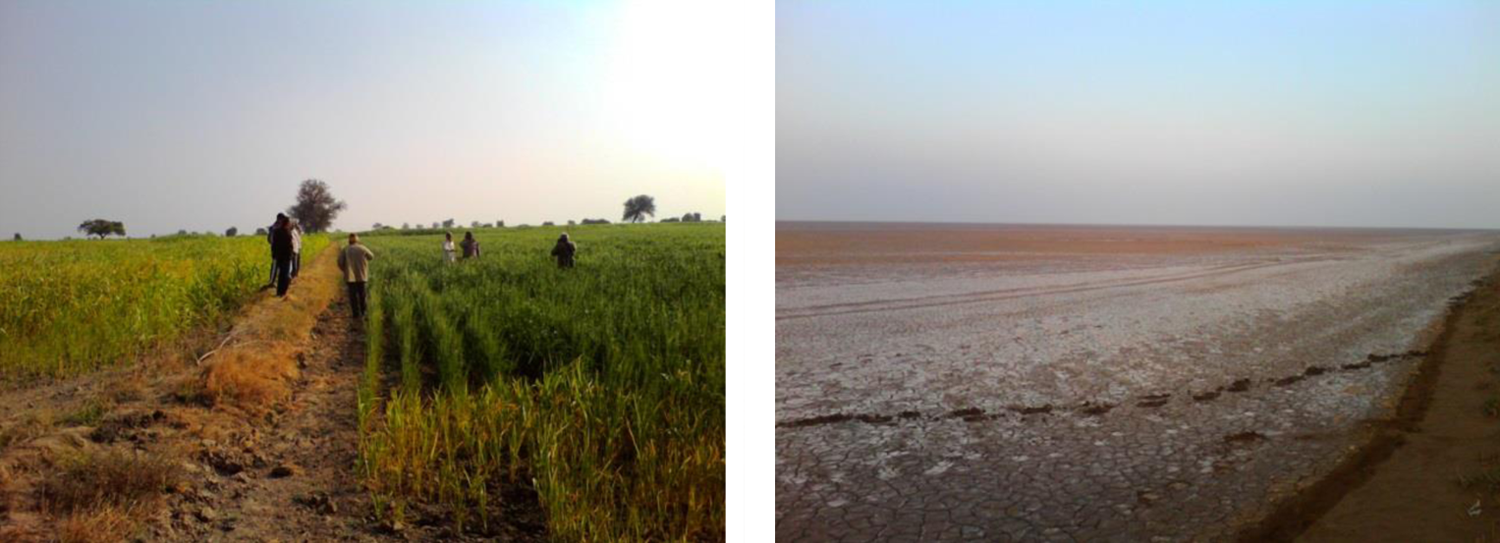
Pictures of actually existing Dholera region. Source: JAAG (personal communication).
Dholera smart city will cost around US$9–10 billion, with the Indian state and Japanese corporations (Hitachi, Mitsubishi Corp, Toshiba, JGC and Tokyo Electric Power Company), contributing up to 10% of this amount – the rest is expected to come from the private sector. The new smart city will include only 12% agricultural land (a reduction from 67%) and will be built in three phases to complete by 2040. Demands for electricity and freshwater will be fulfilled by constructing the nearby Kalpasar mega-dam project, industrial trade will be supported by the development of a seaport and global business will be spurred by the construction of an international airport. Dholera will also be connected by rail link to the nearest city Ahmedabad, which is located about 100 km to its north. The creation of Dholera is supposed to spearhead economic growth in the region, generating 0.8 million jobs and supporting 2 million inhabitants by the year 2040 (Dholera SIR (2014)).
Labelled by noted Indian activist and scholar Arundhati Roy (2012) as one of the smaller ‘matryoshka dolls’ in India’s mega-urbanization, Dholera embodies and scales up an ideology of size matters. Dholera is located in the influence zone of the DMIC, a 1483 km long region of urbanization passing through six regional states including Gujarat. Seduced by the ‘urban pulse’ (Bunnell and Das, 2010) of the Tokyo–Osaka Industrial Corridor, the DMIC will be completed at a cost of US$90 billion with financial and technical aid from Japanese corporations. The DMIC in turn forms the most important section of the Golden Quadrilateral (GQ), the fifth largest highway project in the world linking India’s four megacities – Delhi–Mumbai–Kolkata–Chennai. GQ is expected to consolidate business, economic and industrial potential across the country by connecting not just the megacities but also centres of agriculture, commerce, culture and education along the route.
So far Dholera has materialized only in policies, master plans and drive-/fly-through simulations. These, however, present somewhat ambiguous and sometimes contradictory identities. Dholera has at times been labelled an industrial city, an SIR, a knowledge city, a global city, an eco-city and only recently as a smart city. Therefore, its aims and objectives have remained slippery and changed continuously. This ambiguity is part of an entrepreneurial urbanization model that makes it harder to examine its claims and therefore conduct a systematic examination of its strengths and weaknesses. When Dholera was designed by Halcrow, UK, there were no mentions of a smart city – instead Dholera was labelled and granted planning approval in 2009 as an industrial township. It was only in December 2012 in a TEDx lecture given by Amitabh Kant in Delhi that he presented the idea of ‘smart growth’ for seven new cities, including Dholera. He further elaborated: To my mind, technology holds the key…digital technology has allowed the world to do urbanization, and instead of vertical, do horizontal urbanization. Therefore today’s cities not only have to be interconnected, transit oriented, walkable and cycle-able, they have to be the smart cities of the future.…It means India can make a quantum leap into the future…it means you can drive urbanization through the back of your mobile phone. (TEDx Talks, 2012)
In this TEDx lecture then, Dholera achieved a metamorphosis from an SIR ‘industrial township’ to a ‘smart city’. Its smart labelling was made visible thereafter in all the super-simulated promotional videos. In its discursive and material transformations from an industrial to a smart city through an ambiguous rhetoric of ‘mobile phone-driven urbanization’, Dholera began to articulate the ideologies of entrepreneurial urbanization as a route to economic growth and development. Dholera was thereafter simultaneously labelled as an SIR, eco-city and smart city when it was unveiled in the Vibrant Gujarat Summit in January 2013: Government of Gujarat envisages developing these SIRs and eco-cities in line with the most advanced principles of Smart City development. Being the front-runner in technology adoption, the Government of Gujarat has already planned to develop Dholera SIR based on the Smart City philosophy. It has appointed a consultant to develop the master plan of the project and a global IT powerhouse for integrating core infrastructure components through its Smart + Connected Communities network platform. (Sharma, 2013)
Sharma, CEO of the Gujarat Infrastructure Development Board (GIDB) presented above what Shatkin (2007: 10) calls a ‘privatization of planning’ – ‘the transfer of responsibility for and power over the visioning of urban futures and the exercise of social action for urban change from public to private sector actors’. In this case, GIDB as an arm of Gujarat state, which was awarded the ‘most admired state-level PPP agency in India’ in 2008 by the global auditing firm KPMG, leaves Dholera’s operationalization in the hands of the private sector investors (through Build–Operate–Transfer contracts) and the Global Intelligence Corps, where the skills to do so are presumed to be located. Smart here is a highly subjective parameter to be given meaning through a ‘global IT powerhouse’ – even though it has been operationalized through the discourses of efficiency, organization, intelligence and functionality (Hollands, 2008).
Dholera’s smart credentials, given by Cisco, reflect the fusion of eco-city and networked city ideologies. Its claims to eco-city status include a range of renewable energy initiatives, low-carbon footprints, wildlife sanctuaries and so on. Its ‘smartness’ is presented via features, such as ‘connected homes’, green residential spaces, ‘futuristic’ malls and marketplaces, advanced mass rapid transit system (ARTIST2WIN, 2013). Its smart metering will connect all infrastructure (water, electricity, etc.) facilities to individual homes through an automatic metering system and to all individual homes through a ‘fiber-to-home concept’, which will carry all the signals for telephone (landline), broadband Internet, video-on-demand, entertainment channel and so on. It will tap into India’s first ‘smart grid’ along the DMIC, promoting an increasingly technocratic city with ‘state-of-the-art’ infrastructure that will link and control municipal services across all smart cities in the region. Its claims to Industrial Township are vested in the location of a Gujarat trade centre in the city and its proximity to the airport, seaports and DMIC. Its claims to Knowledge City are vested in its entertainment and knowledge zones, university and training centres, super speciality hospitals and so on. Indeed, Dholera presents such an all-encompassing utopia of a future city that its scaling up to a national level seemed inevitable when it was mentioned in the state of the Union Budget in February 2013. Plans for seven new cities have been finalised and work on two new smart industrial cities at Dholera, Gujarat and Shendra Bidkin, Maharashtra will start during 2013–14. We acknowledge the support of the Government of Japan. In order to dispel any doubt about funding, I wish to make it clear that we shall provide, if required, additional funds during 2013–14 within the share of the Government of India in the overall outlay for the project. (IBNLive, 2014)
This announcement made by the Indian Finance Minister highlighted the significance that two new flagship projects, Dholera and Shendra–Bidkin another industrial township in the neighbouring state of Maharashtra, held for the Indian economy. There are 24 new smart cities proposed by the Indian state along the Delhi–Mumbai mega-region, with the first seven scheduled for completion by 2020. Conceived here as ‘smart industrial cities’ the identity of Dholera relies on a ‘definitional impreciseness’ (Hollands, 2008: 304). ‘Industrial’ and smart as labels are used interchangeably – the former representing economic reasoning and the latter reflecting globally marketable logics for attracting business and investment.
Through a ‘serial seduction’ (Bunnell and Das, 2013: 277) of ‘pulsating, larger than life built forms’, the images and promotional videos of Dholera transform the ambiguous rhetorics of a smart city into an active desire for its materialization among the Indian young upwardly mobile urban population. Its ‘self-congratulatory’ (Hollands, 2008) rhetoric, evident in all the simulations and publicity videos on Dholera smart city, however, hides the ideological forces and politics behind smart city making and the absences and silences that shroud the discourses perpetuated by its most enthusiastic supporters (both public and private sector). Neither the plans nor videos of Dholera, nor the speeches of Narendra Modi, nor the lectures of Amitabh Kant, refer to actually existing Dholera, which remains as an absent presence, giving the impression of an empty backdrop, a tabula rasa – the perfect landscape in waiting for the smart city.
Slowing down and rule of law
Speed is only half the story of Dholera smart city. As Peck (2002: 348) notes, ‘the confident rhetoric of fast-policy solutions and the conviction-speak of neoliberal politicians collide with the prosaic realities of slow (and uncertain) delivery’. Examples of earlier projects in India and elsewhere suggest that most of these city-making projects encounter a number of challenges and bottlenecks that slow down construction. Apart from the well-known cases of Dongtan, Masdar and Songdo, where construction stalled or residents did not move in, a recent and well publicized case in India is that of privately funded ‘eco-city’, Lavasa, which faced several Supreme Court injunction orders, ironically for violating environmental laws and bureaucratic procedures (Datta, 2012). Similar bottlenecks were evident in Kochi smart city in Kerala, Rajarhat new town in Kolkata (Kundu forthcoming), Rawabi in Palestine, Dompak in Malaysia and Eko Atlantic in Nigeria. These cities face the primary challenge of transforming agricultural lands to urban real estate. This was acknowledged in the India Infrastructure Report (2009), which noted: Without major urban land reforms, our cities will not be able to support the inevitable urbanization in a planned way. The urban land market is plagued by numerous regulations.…A number of innovative solutions have been attempted in India and abroad to leverage land for development. (India Infrastructure Report, 2009: 2)
Acquiring land for large infrastructure or urban development projects in India has consistently faced local protests and judicial challenges. Goldman (2011: 555) notes that since ‘70% of India’s population thrives on rural economic relations, this roadblock to the globalization dream seems fairly substantial’. This was also acknowledged by Amitabh Kant (2013), who noted that the ‘the key challenge [to making smart cities work] will be to monetise land values’. But agricultural land particularly in regions of declining agricultural productivity with lower population density (and hence presumed as decreased potential for local resistance) makes land acquisition relatively straightforward. This has been the case in almost all new cities currently being built in India.
Whilst the 2009 SIR Act was brought in precisely to address what the India Infrastructure Report (2009) called ‘land challenge’, farmers in Dholera region did not realize that this law superseded the Land Acquisition Act, which meant that their land could be acquired far quicker and without compensation by the state for ‘public purpose’. Levien (2013) describes this process as a ‘regime of dispossession’, where socially and historically specific constellations of state structures of bureaucracy and governance produce particular patterns of dispossession of peasants and landless farmers. I suggest that these initiate a new ‘regime of urbanization’ whereby land is acquired for a ‘public good’ and ‘delinked from capitalist production, by making it available for capitalist space of any kind’ (Levien, 2013). In Dholera, this constitutes a shift from ‘land for the market’ (Levien, 2013), seen in earlier models of dispossessions, to a new model of land for urbanization through the ‘active dispossession of those working and living in the rural periphery’ (Goldman, 2011: 555). Violently imposed upon landscapes and populations who were presented as ‘lacking’ in development and therefore ideal for a ‘makeover’, smart city Dholera thus produced a protracted struggle for land rights and social justice even before it was built.
JAAG land rights movement
Chen et al. (2009: 463) note in their comparison of Chinese and Indian new towns that there is a ‘lack of organized protest in general from those who are displaced by the rapid transformation of agricultural land to urban land’. In Gujarat, however, from the early 2000s, farmers’ cooperatives began to organize under a coalition called Jameen Adhikar Andolan Gujarat (JAAG) or Land Rights Movement Gujarat to claim their rights to the commons – agricultural land, common property, fishing areas and pasture land, among many others. Most of these farmers are from the lower castes or agricultural castes and are listed as ‘Scheduled Castes or Tribes’ under the Indian Constitution. JAAG social action has included public protests, marches, putting up notices outside the villages barring state officials from entering their land and several other peaceful demonstrations. JAAG achieved some success in a neighbouring region when 44 villages therein were notified as an ‘auto and knowledge hub’ under the SIR Act (ET Bureau, 2013). In 2013, as a result of JAAG protests (see Figure 2), the Gujarat government was forced to withdraw 36 of the total 44 villages from the SIR notification (Counterview, 2013). In April 2014, another nearby SIR was withdrawn after several protests. This gave faith to the JAAG campaigning against the Dholera SIR notification, resisting the release of their land holdings to the Gujarat state government without any real compensation (JAAG activist, personal communication).
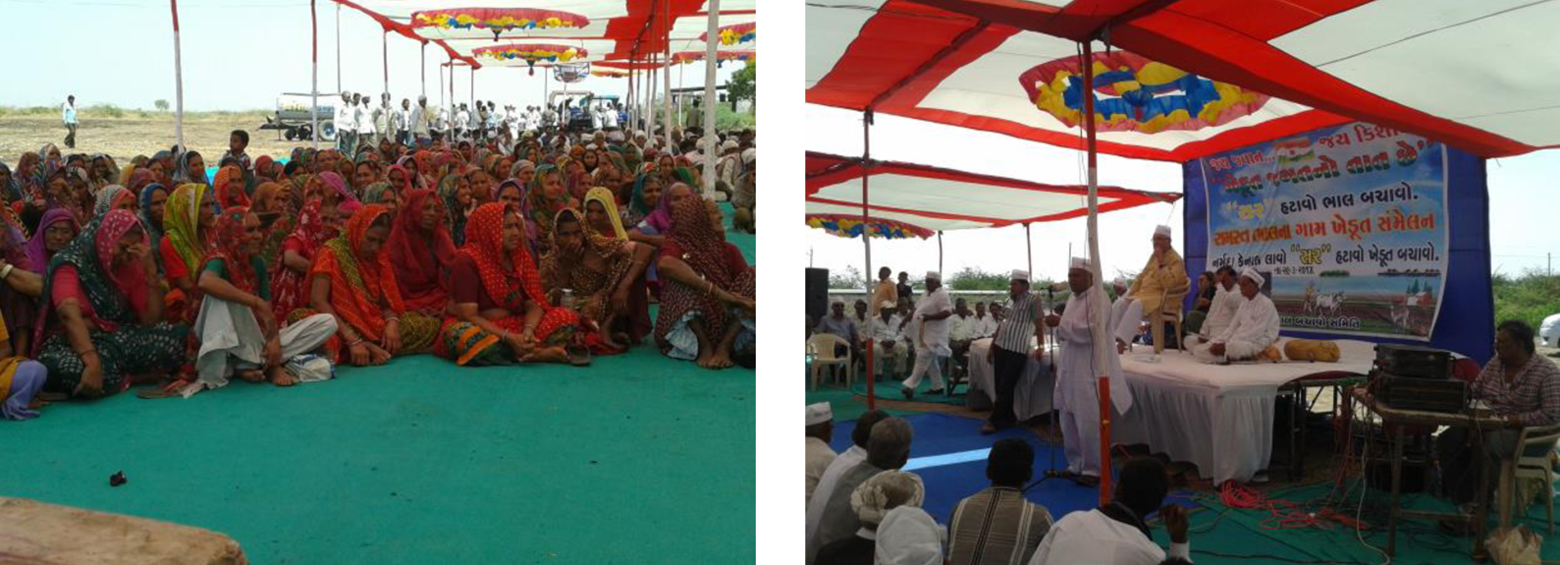
Protesters campaigning against Dholera SIR. Source: JAAG (personal communication). SIR: Special Investment Region.
However, the police in retaliation issued warrants against several activists and arrested them (Telegraph India 2013), denied them license to stage peaceful protests, and engaged in several instances of harassment and bullying with farmers and activists. More recently a leaked Indian Intelligence Bureau report named JAAG as one of the organizations ‘under watch’ for engaging in ‘anti-development activities’ (Pathak, 2014). The state has also begun to issue notices to several farmers to either hand over the land and take whatever compensatory land is offered or prepared to be evicted by the state officials. As Goldman (2011) found in the case of the Mysore–Bangalore project, here too minimal compensation was offered for what has been called ‘unproductive farmland’. Farmers claim that most of the compensatory land is infertile, or disconnected from irrigation canals that are essential for agriculture, and that it would take years of work to make these cultivable. Indeed, in several cases, the compensatory land allocated to farmers was based on 100-year-old maps and has already been claimed by the sea (JAAG, personal communication). JAAG activists argue that Dholera SIR will lead to large-scale transformations in livelihoods of farmers, partially benefitting those with larger parcels of land and dispossessing small-scale subsistence farmers. JAAG claims that farmers do not want compensation; rather they want state investment in improving agricultural productivity and soil fertility in order to secure their precarious livelihoods.
The practice of eviction and dispossession of farmers and marginalized citizens from their land in order to facilitate urbanization and urban renewal is not unique for smart cities nor is it new in the postcolonial era. The Land Acquisition Act was established in 1894 by the colonial state to speed up the process of procuring private land to build state-funded projects for capital accumulation. More recently, Narain (2009) shows how building the satellite city of Gurgaon near Delhi has meant extensive land acquisition from farmers who have lost their land due to the real estate boom. To that extent ‘accumulation by dispossession’ (Harvey, 2009) has remained a persistent theme in the loss of Indian agricultural landscapes to new infrastructure projects and townships. In these instances as Goldman (2010) notes, civil and human rights are suspended through the enactment and enforcement of laws that empower the state to establish a ‘state of exception’ justifying land acquisition. This produces new models of power and dispossession that are directly linked to the historical geographies of marginalization in the region but also leads to new experiments in the control and shaping of identity, citizenship and rights.
Participation in state consultation processes
Whilst the state is increasingly asserting its sovereignty through a rule of law and has criminalized several aspects of JAAG’s social action and protest, much of JAAG’s efforts have been to slow down the process of building Dholera by direct participation in state prescribed processes of bureaucracy. On their part, JAAG has provided challenges to the instrumental and technocratic tools embodied in the environmental impact assessments (EIAs) notifications that require mandatory public consultations for large-scale township projects. This has meant that JAAG members have had to acquire a new set of knowledge and practice in order to formally challenge state practices during the processes of ‘democratic decision-making’ embedded in environmental public hearings.
EIA public hearings mark the only space in India where subaltern actors have a ‘voice’ in formal deliberative processes of governance. However, state control over and undermining of this process is perhaps most apparent in the recent revisions (2006 and 2009) to the national EIA notification in 1994, which has gradually reduced the threshold levels of public participation and consultations in the case of township projects and delegated environmental decisions to regional authorities, such as Gujarat state in case of Dholera (Jha-Thakur, 2011; Paliwal, 2006; Rajvanshi, 2003). The EIA public hearing for Dholera, which was fixed for early January 2014, was heavily policed and videotaped as per the provisions of the EIA notification. Over 500 members of the public, which included JAAG activists, farmers and several other members, exercised their right to democratic participation by attending the public hearing and raising their objections about the project with the Gujarat state authorities.
JAAG noted that the draft EIA prepared by Senes Consultants (2013), the state-appointed EIA consultants, had several instances of misinformation and misrepresentation of facts associated with the use of outdated maps. This made it more of a ‘bureaucratic arrangement’ (Narain, 2009 and Paliwal, 2006) rather than as a participatory tool through which states listen to local communities and respond to environmental contingencies. Indeed, whilst these important issues were raised by historically and socially marginalized communities in the public hearing, their ultimate disregard in the final approval for Dholera highlighted how farmers and indigenous populations have now become the ‘weakest links’ in smart city making.
Dholera, however, faces other roadblocks identified in several official reports attached to the EIA report (such as flood assessment and biodiversity) that are potentially more concerning for the state. First, the EIA report underlined the high risk of flooding in Dholera, which means that it would cost over INR700 crore to do the necessarily engineering works for flood mitigation. Second, Dholera SIR will be built close to the blackbuck habitat and would therefore lead to irreversible loss of biodiversity. These challenges although glossed over by the state officials in the public hearing have provided key grounds for the withdrawal of several investors from Dholera. The flood assessment report has also led to the abandonment of plans to build an international airport in Dholera. Plans for the international seaport have also been abandoned as well as the Kalpasar dam project.
Dholera smart city is behind schedule. Its first phase was due to be completed in 2016, but JAAG activism has delayed land acquisition and technical challenges have delayed investors. However, unlike other SIRs that were withdrawn, JAAG activists note that Dholera has been the prime public relations tool for Narendra Modi during the elections and therefore has much higher stakes than other SIRs which were not marketed as smart cities. This makes Dholera smart city an intensely politicized terrain of simultaneous social activism and political ambitions. Dholera then is the new urban utopia, whose fault lines are drawn in its very conceptualization, whose bottlenecks are written into the speed of its delivery and whose materialization as smart city requires the active dispossession of marginalised citizens.
Conclusions: Entrepreneurial urbanization and the smart city
This article has presented an in-depth critical geographical analysis on Dholera smart city to suggest how the process of building new cities in India is bifurcated by conflicting demands of economic growth and social justice. On one hand, Dholera shows how a neo-liberal state attempts to attract global capital and enhance economic growth through the construction of new townships, satellite cities, eco-cities and so on. It shows how different forms of translocal learning and practice shape its future and politics – during sanctions imposed on the international mobility of political leaders, through global branding via master plans and smart credentials, during TEDx lectures where ostentatious proclamations about the future of Indian cities are made and during trade shows to attract investors. It shows how fast policy allows states to create new laws in order to direct planning and policy in favour of new townships.
On the other hand, Dholera smart city can be placed within a longer genealogy of utopian urban planning in postcolonial Gujarat and India. I have argued that the postcolonial state has now internalized the national developmental legacy of utopian urban planning and extended this to a new phase of smart city planning across the country. By looking below the scale of the nation at how regional states such as Gujarat have used a model of entrepreneurial urbanization to increase economic growth and development, I have suggested that Dholera smart city is key to scaling up the Gujarat model of development to India.
Dholera is yet to be built, but the twists and turns in its identity and politicization as a smart city provide us an insight into the future of 100 new Indian smart cities proposed by the newly elected central government. On one level, Dholera can be critiqued as reinforcing India’s ‘digital divide’ and promoting a panoptic urbanism. On another level, counterarguments can be provided by suggesting that the ‘menacing’ smart city might be transformed by new horizontal forms of networked citizenships bypassing neo-liberal governmentality (Townsend, 2013). Although this article has focused on examining the politics of building Dholera rather than new forms of digital citizenships, the article shows through Dholera’s bottlenecks that the process of city building will be far slower than that claimed by glossy videos, compelling interviews and the political promises.
This connects to a wider issue that I have raised in this article. I have suggested that it is no longer just city regions, but rather regional states such as Gujarat that are now emerging as global competitors, bypassing the national scale. In order to do this they have begun to exercise an increased role and interest in a form of entrepreneurial urbanization that is reinforced by state level laws out of synch with the federal state. The ‘lawfare’ (Comaroff and Comaroff, 2006) of the state put in place solely for the purpose of fast-tracking growth underline the ‘projects of ideological legitimation towards which they are mobilized’ (Brenner et al., 2011: 234). I have shown through the case of Dholera that this rule of law is now the prime tool of the regional state through which big bold ideas in urban planning are taking shape and being scaled upwards.
The ideology of smart cities circulating with amazing speed via rhetorics, laws, policies and practices in India illustrates how ‘nation states have the capacity to enforce their truth games’ via ‘self-justificatory narratives of citizenship and modernity’ (Chakrabarty, 2000: 41). This means enforcing through a rule of law, a self-sustaining myth of urbanization as a ‘good business model’, which increasingly represses the articulation of resistance and social action among marginalized groups. Reflection, learning and innovation through knowledge and awareness about laws and its practices, about bureaucratic processes and state-mediated deliberative democratic encounters are becoming rapidly familiar to the farmers in Dholera. It seems, however, that whilst there is emerging scholarship around fast policy we still know little about grass-roots forms of transformative learning, knowledge and action that can provide substantial challenges and slow down the building of new cities in India. Here, the available tools of analysis using political economy, policy mobility and postcolonial urbanism need to be complemented by ethnographic details on the everyday struggles faced by those at risk of being excluded from India’s urban future. We need to understand how those at risk perceive their role in the smart city and how they use the bureaucracies of the state to challenge the state against dispossession. It means examining how the ‘population’ referred to in the EIA reports become ‘citizens’, claiming their rights to livelihoods and landscapes as they encounter the smart city. It means examining how the smart city will be built not by digital citizenships but by ‘insurgent citizens’ (Holston, 2008) living on its margins – socially, geographically, legally and economically. Crucially, it means understanding how a right to the city is inherently connected to a right to commons as political and social action gather momentum against the smart city.
These are big issues which have been impossible to fully address within the scope of this article. However, as the Indian government’s plans to build 100 new smart cities take shape, and new laws and policies are being put together overnight to make this process seamless, scholars might want to pay attention to the ethnographic realities of those encountering smart cities in policy and practice. The 100 smart cities of the future might well be those that do not ever materialize in India, but encounters with smart cities for marginalized social groups will continue to slow down and challenge India’s new phase of entrepreneurial urbanization.
Footnotes
Acknowledgements
I would like to express my heartfelt gratitude to JAAG members for their kindness in answering my questions via phone and email conversations, discussing the issues around land acquisitions for Dholera and for informing me about the various aspects of their movement. I am also grateful to JAAG for supplying me with their photos for inclusion in this article. I would like to thank the three anonymous reviewers for their constructive and insightful feedback that have vastly improved the arguments I make in this article. Thanks also to the editor Rob Kitchin for inviting me to write this piece. All other omissions and mistakes are my responsibility.