







Abstract
The teaching case is based on two teams that were tasked with the design of two different digital products: a planned five-month project (known internally as Seasonal Sales Team; SST), in view of the forthcoming sales season; and an impromptu 24-hour project (known as Elec24) in response to unexpected national elections. Despite their similarities, the two projects differ in terms of their degree of virtuality (hybrid vs virtual) and temporality (long vs short lifespan). By focussing on Lorena, an experienced product designer who has taken on the responsibility for the two projects, the case explores how virtuality and temporality influence the teams’ coordination plan and creative process.
Keywords
Learning objectives
• Evaluate how contextual characteristics of hybrid and virtual teams may impact their coordination and creativity. • Understand creativity as a process – rather than as an ability or output – within a temporally condensed project lifespan. • Explore suitable coordination practices for temporally diverse virtual teams.
The protagonist: A product designer with expertise in adapting digital products and working virtually
As a digital product designer, Lorena is responsible for all aspects of product design, including tabs, filters, and content. Lorena is well-aware of the challenges of working in short-term virtual projects; but is she prepared to work in a virtual project that will only last for 24 h? Lorena had just finished a meeting with her manager who identified her as the best-placed person due to her expertise in product design and her widespread experience in virtual work to collaborate with a sibling organisation on an impromptu project (introduced with the name of Elec24). The new project will start tomorrow with a final product design to be delivered the day after tomorrow! Elec24 is about incorporating new digital content about the forthcoming elections (e.g. candidates, polls, interviews) into the existing news portal, in light of the unexpected national elections that the government has just announced. Lorena is still expected to work for a recurring (yearly) product design virtual project (known in the company as Seasonal Sales Team [SST]), scheduled to start in the middle of the month with a planned duration of 5 months. SST is an established project that runs every year before the sales season. Although still a temporary project with a specific lifespan, SST is not a challenge for Lorena as she has, by now, developed well-established practices in managing the project effectively. But a 24-h project! Is there room for creativity (a paramount expectation in the digital product design industry) in such a short lifespan? And how does Lorena deal with the fact that she will be an ‘external’ member from a different organisation? How should virtual team members – who, in the most part, do not know one another – coordinate their activities and produce creative digital products when everybody needs to work around the clock non-stop? And finally, what are the best coordination practices for virtual teams with short lifespans to achieve their creative potential?
Case introduction
Creativity is generally seen as the generation of ideas that are novel and useful (Amabile et al., 1996). Existing relevant literature confirms that virtual teams can be creative despite their unique challenges (e.g. geographical dispersion), and it has identified specific factors that influence creativity within the virtual context (Chamakiotis et al., 2013; Ocker, 2005). However, these studies were based on planned virtual team projects which had the required material resources at hand, and whose members had the time to make the necessary preparations. But what happens to virtual teams that emerge on the spot and which may lack the luxury of time? This was the case in the Covid-19 pandemic, whereby we saw traditional teams transition to virtual ones overnight, for instance. Another example are teams set up for time-sensitive tasks (Driskell et al., 2023), whose lifespan may be unusually short. Due to such challenges, therefore, members of those teams may not have the luxury of time to develop strong interpersonal relationships and, ultimately, trust. Therefore, it is essential to understand what leaders and members of these teams can do to ensure they can produce creative solutions, despite their unique challenges.
In this teaching case, we explore this issue by focussing on a case of a virtual team with an extremely short lifespan (Elec24) our protagonist has been instructed to join, and comparing it with another project of hers (SST), which, although still temporary, is hybrid (i.e. involving face-to-face communication too) and of a much longer duration.
In what follows, we discuss existing literature on creativity in virtual teams and continue by introducing the two contrasting virtual projects (SST and Elec24). While the two projects we use in the teaching case are real and formed part of a larger empirical research project, they have been partially modified by adding some fictional characteristics to protect the anonymity of the organisations involved. Their contextual characteristics, however, remain intact.
Literature on creativity in virtual teams
Over the last 30 years, scholars across numerous fields – such as Information Systems (IS) and Human Resource Management (HRM) – have written papers that deal with the management of virtual teams. When virtual teams emerged in the mid-1990s, they were seen as an innovative way of working that broke traditional boundaries (e.g. Gilson et al., 2021). For example, workers could be part of global virtual teams dispersed across countries, continents, languages, cultures, and time zones. Clearly, despite the evident benefits of virtual work, such as being able to work ‘round the clock’ and to access global talent and foreign markets, virtual teams came with unprecedented challenges (e.g. Kimura, 2024). For example, how could employees trust their virtual teammates when they never met them in person? How could leadership be exercised at a distance? And how could creativity emerge when virtual workers were not able to sit down and generate ideas together?
So, what do we know about creativity in virtual teams? The existing literature in this area focuses primarily on the factors that influence creativity (Chamakiotis et al., 2013; Chamakiotis and Panteli, 2023; Ocker, 2005) and on the stages of the creative process in this context (Chamakiotis and Panteli, 2017; Nemiro, 2002). These studies show clearly that achieving creativity in virtual teams is possible, but they also reveal factors that can inhibit creativity, as well as factors that can have either an enabling or an inhibiting role depending on leadership style. For example, the issue of cultural (and often linguistic) diversity in global virtual teams is one such factor; on one hand, it may lead to language misunderstandings and slower communication, but on the other hand it may bring more ideas to the table (Chamakiotis et al., 2013). In a review paper, Abi Saad and Agogué (2023) group the factors that influence creativity in virtual teams into five categories: individual, team, leadership, technology, and climate-related.
There are also studies that focus on the creative process in virtual teams. For example, Nemiro (2002) identifies the four stages of the creative process – that is, idea generation, development, finalisation/closure, and evaluation – and identifies different digital technologies that are found to work well for each stage. In another study, Chamakiotis and Panteli (2017) show how different leadership styles can help to boost creativity at different stages of the creative process. For example, they find that having a formal (centred) leader is important at the start of the process when team members get to know one another, while shared and emergent leadership styles work better later in the process. Shared leadership, in particular, is found to be beneficial for creativity as it allows different subgroups of experts to take on leadership positions for tasks that match their expertise.
Still, although there is evidence that creativity is present throughout the virtual team lifecycle (Chamakiotis and Panteli, 2017, 2023), Reiter-Palmon et al. (2021) argue that most literature in this area focuses on the idea generation stage and that less is known about the other stages of the creative process (e.g. idea evaluation). Additionally, given that not all virtual teams are the same, researchers have highlighted the importance of understanding how virtuality (e.g. Reiter-Palmon et al., 2021) and temporality (e.g. Abi Saad and Agogué, 2023) influence creativity in virtual teams. Given the growing (digital) transformation of the workplace, virtual teams have become much more widespread; hybrid teams, in particular, whose members work partly virtually (from home or other locations, such as cafés and working spaces) and partly in the office have become even more popular. However, despite their increasing popularity and the availability of more sophisticated technologies that could help, creativity in hybrid and virtual teams is not a given.
With the presentation of our comparative teaching case, we explain what coordination practices may help teams with different degrees of virtuality and temporality (lifespans) to maximise their creative potential.
The two projects
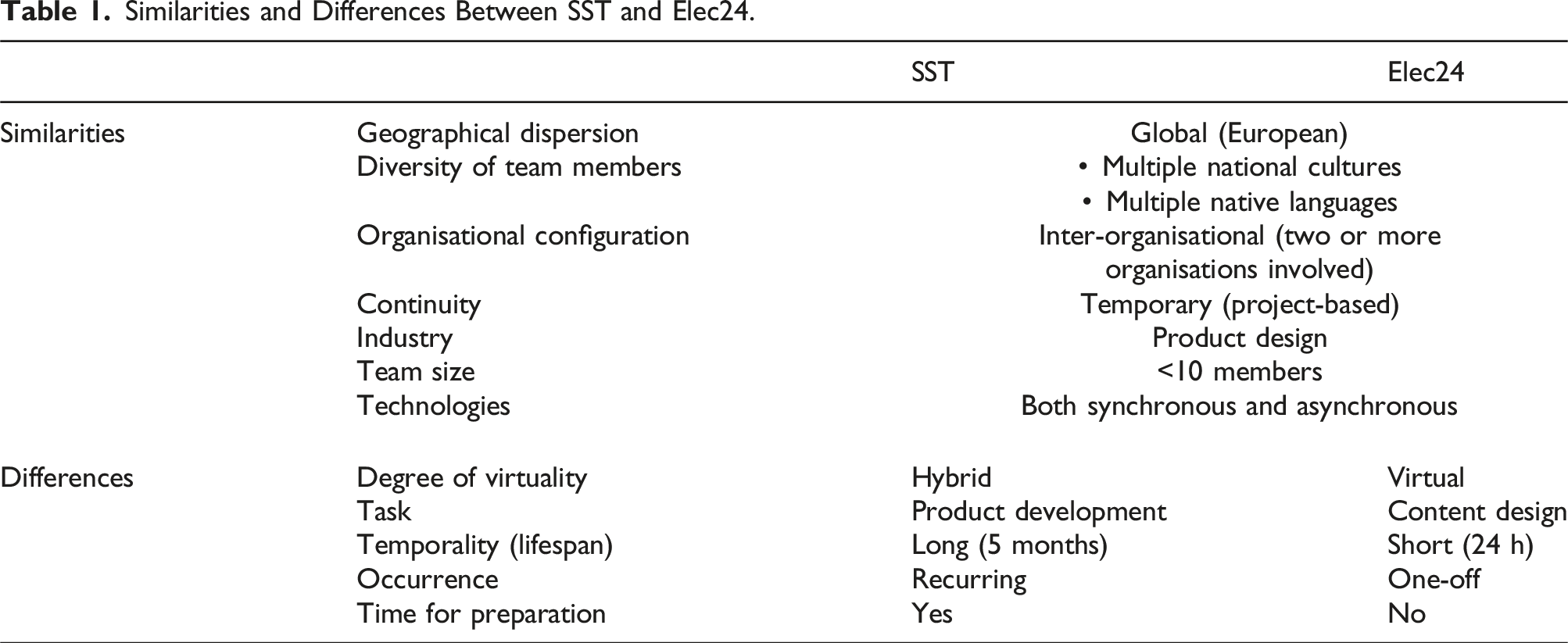
Seasonal Sales Team (SST) and Elec24 (both fictional names) are two virtual project teams in the digital product design industry. However, the two projects are not identical: SST is about product development, a homepage (including, e.g. tabs, filters, content), in view of the sales season, whereas Elec24 is about content design in the light of national elections that the government has just announced. Evidently, content design forms part of product development, but it does not include any type of product implementation. Let us have a closer look at the two projects in order to understand the teams’ characteristics and the two tasks in question.
SST: A virtual project with a five-month lifespan
We begin with the presentation of the project team and the tools that will be available to them. SST has been set up to comprise eight members dispersed across Greece, Spain, and the UK (i.e. one digital product designer [Lorena], five software engineers, one product manager, and one User Experience [UX] designer who is external to the organisation). The participants include females and males of a total of four different nationalities (and four different mother tongues), as these are the members with the required experience and skills for this type of work. English, a second language for all, will be used as the formal language for communication and collaboration.
The available tools for the team are as follows: • Slack, a common instant messaging application for business, for everyday chat communication between the team members; • Jira, a ticketing system which allows features to be described by the product manager and for the team to pick them up and implement them; • Figma, a UX design tool, for designs; and • Zoom, a popular tool for team meetings, for videocalls.
We now continue with the project itself. The team will be tasked with the redesign of the product’s homepage in view of the upcoming seasonal campaign, and will have five months, with incremental deliveries (‘product increments’) and reviews every two weeks. ‘Product increments’ refer to adding new features to the product in question. In the case of SST, new design of product description, search capabilities, Frequently Asked Questions (FAQs), and campaign banners could be possible product increments.
The project involves two phases: product discovery and product delivery. The product discovery phase typically starts with a meeting with all key team members who explore product ideas, and possible alternatives. This phase typically involves research, interviews with customers, and low-resolution design, with the aim (or desired output) being coming up with some ideas that the team considers suitable for implementation. This process is ongoing, resulting in feature selection and feasibility checking with the engineers in the team. This phase will be executed in parallel with the implementation, which makes communication crucial for a successful delivery. In the digital product manager’s own words, ‘The general idea of the Discovery Phase is to research current tendencies in the digital market realm, getting feedback and relevant information from our customers; and to basically create the general idea of the product. This will allow us to draft the low-fidelity designs and product requirements that can be handed over to the engineers for implementation’.
Moving on, according to the digital product manager, the team is supposed to start generating product increments in the Delivery Phase: ‘The team should discuss the outputs generated in the Discovery Phase, define the upcoming increment to be delivered based on the final high-fidelity design product requirements and acceptance criteria, and the engineers will implement the agreed features to include on the Homepage for the upcoming two weeks’.
The features will then be split into smaller tasks by the product manager who will be assigning them to different team members. After each product increment has been completed, the UX designer and the product manager will approve the implementation, and it will be presented to the stakeholders and taken to a new round of interviews with clients. Their feedback will be incorporated into the upcoming Discovery cycle.
Elec24: A virtual project with a 24-hour lifespan
Like before, we start with the presentation of the project team. The team that has been put together involves two subgroups from the organisation’s offices in Spain and France, who are now expected to work on the project 24 h non-stop in order to meet the organisation’s deadline. In this newly composed virtual team, the members of each subgroup are highly homogeneous in terms of educational, national, cultural background, and mother tongue spoken (the participants from Spain are all Spanish, whereas the French participants are all French). Lorena will be joining the Spanish subgroup. English is used as the official language for communication and collaboration at the team level. Although the members of each subgroup know each other well and have worked together on other projects in the past (with the exception of Lorena who will be meeting everyone for the first time), the two subgroups will come together for the first time; they have no working history and are not expected to work together again in the foreseeable future. The virtual team has been given complete freedom to organise and coordinate themselves as they see fit throughout the 24 h.
The technologies available to the team are as follows: • MS Teams, MS Office’s messaging application for business for communication; • Trello, a tool that organises tasks into boards for visualisation, organisation, coordination and record-keeping; and • Google Workspace, Google’s suit of tools for synchronous documentation.
Given the extremely short lifespan of this this project, the team have been given the freedom to make their own decisions as to how they use the tools available to them.
So, what is Elec24 tasked with? Elec24 is a virtual project that has emerged unexpectedly due to the national elections that have just been announced by the government. The task here is to design digital content that will be inserted into an existing homepage (i.e. news portal). According to the instructions given by the digital product manager, ‘Define the content related to the upcoming elections that we want to provide for our customers, such as candidates’ profile, electoral programme, polls or interviews’.
A videocall has been organised with the digital product manager where the organisation’s top management will also be virtually present at the start of the 24 h so that the team has an opportunity to go through the brief and ask questions. The team will have to communicate with related departments (e.g. Information Technology [IT] department to explore available capabilities and limitations of the existing news portal; news/journalism department to explore what type of content they have access to).
Comparison of the two projects
Similarities and Differences Between SST and Elec24.
Discussion questions
• What is the impact of a hybrid/virtual team’s lifespan on team creativity? • What actions can help to enhance creativity in the two projects? • What is the impact of the degree of virtuality on team creativity? • How could the prescribed digital technologies be used by the two teams and why? • Can you develop a coordination plan to help Lorena with the management of each project?
Footnotes
Declaration of conflicting interests
The author(s) declared no potential conflicts of interest with respect to the research, authorship, and/or publication of this article.
Funding
The author(s) received no financial support for the research, authorship, and/or publication of this article.
