







Abstract
La French Tech is a program and an ecosystem that aims to accelerate the rise of unicorns in France. The mission’s creation and success materialized in the goal of 25 unicorns reached in 2022 ahead of the scheduled time (2025). This achievement attracts attention to the Unicorn phenomenon in France and how it can be encouraged in a country initially lagging behind and where the national context was not considered favorable. Unicorns are startups that achieve a $1 billion valuation milestone. They epitomize economic dynamism and contribute to a country’s image of business talent. The skills of attracting foreign equity investment, boosting employment, and creating value explain the political and media attention that startups receive as they strive to become unicorns. This case study examines the impact of La French Tech Mission and highlights factors facilitating startups to unicorn status. Students will be able to analyze ecosystems’ roles, analyze challenges and opportunities confronting unicorns, analyze the prevalent organizational structures of unicorns, and propose actionable recommendations for the program. The Teaching Case fosters a comprehensive understanding of the dynamic landscape of high-value startups applicable to real-world or hypothetical scenarios.
Understand the influence of La French Tech Mission and identify the key factors that contribute to the rapid growth of a startup to unicorn status. Assess the challenges and opportunities faced by unicorns. Analyze the typical organizational forms of unicorns and discuss their underlying rationale. Evaluate the impact of La French Tech on unicorn development and assess its potential for international expansion. Recommend the next actions for the program. These learning outcomes provide a progressive framework for understanding the rise of unicorns in France, their organizational specificities, and the importance of the ecosystem in fostering innovation and scaling entrepreneurial success at both national and international levels.Key learning outcomes
Introduction
“I want France to be the country where tech entrepreneurs can succeed. We're going to simplify administrative procedures, reduce taxes and facilitate access to capital, French President Emmanuel Macron said concerning La French Tech program.”
1
La French Tech program, initiated during François Hollande’s government in 2013, underwent significant expansion under Emmanuel Macron’s presidency from 2017 on. Originally conceived to reshape France’s entrepreneurial image globally through advocacy, La French Tech rapidly evolved into a bridge connecting government entities, intricate administrative operations, and startups. La French Tech nurtured a service-oriented ecosystem, thereby creating a more conducive atmosphere for initiating startups in France. It also aimed to foster a more hospitable environment for launching companies in France.
The philosophy underlying La French Tech recognizes the inherent involvement of the government in startups, whether during their establishment, visa acquisition, or funding processes through the public body for investment (Banque Publique d’Investissement—BPI) until 2023. From 2023 on, French Tech Finance Partners took over, gathering investors in the tech sector, along with organizations and associations advocating for the sector’s interests. 2 Rather than urging startups to approach the government, the approach shifted to bringing government support directly to startups.
Emmanuel Macron asserted: “La French Tech embodies our bold vision of the economic future, based on innovation and creativity.”
3
President Macron has also been a vocal advocate for La French Tech on the international stage. He has spoken at conferences such as Viva Technology and has met with tech leaders from around the world. President Macron firmly believes organizations need to be leveraged more to curb unemployment, and it is no surprise that he mentions it while pushing for La French Tech. A strong supporter of innovation and state modernization, his support to the program is adamant. “French Tech is an opportunity for France. It is a source of innovation, growth and jobs. We must support and accompany it so that it can continue to develop.”
4
What is La French Tech?
La French Tech represents both the French startup ecosystem and the government’s initiative to bolster it. This term includes a network of startups, entrepreneurs, investors, and other key players within the tech industry, operating within France and internationally. The overarching goal of the French Tech initiative is to establish France as a forefront innovator and technological leader globally, by equipping startups with essential resources, support, and networking opportunities for their growth and success. Emmanuel Macron supported the program and its development. The French Tech initiative has several goals, encompassing promoting French startups and entrepreneurs on the international stage, helping French startups access the funding and resources they need to succeed and creating an environment that is conducive to innovation and entrepreneurship in France. Indeed, La French Tech has helped to raise the profile of French startups on the global stage and has made it easier for them to connect with investors and customers worldwide. La French Tech has also created a number of programs and initiatives to help French startups access the funding and resources they need to grow, including the French Tech Accélérateurs program, which provides funding and mentorship to high-potential startups. La French Tech has worked to create an environment that is conducive to innovation and entrepreneurship in France, by simplifying regulations, providing access to talent, and creating a supportive community for startups.
La French Tech has experienced a significant journey since its inception, marked by several key milestones that we materialize in Figure 1. Launched on November 27, 2013, by Fleur Pellerin, then Minister Delegate for Small and Medium-sized Enterprises, Innovation, and the Digital Economy, La French Tech was initiated to support the growth of French startups both domestically and internationally.
5
La French Tech major milestones.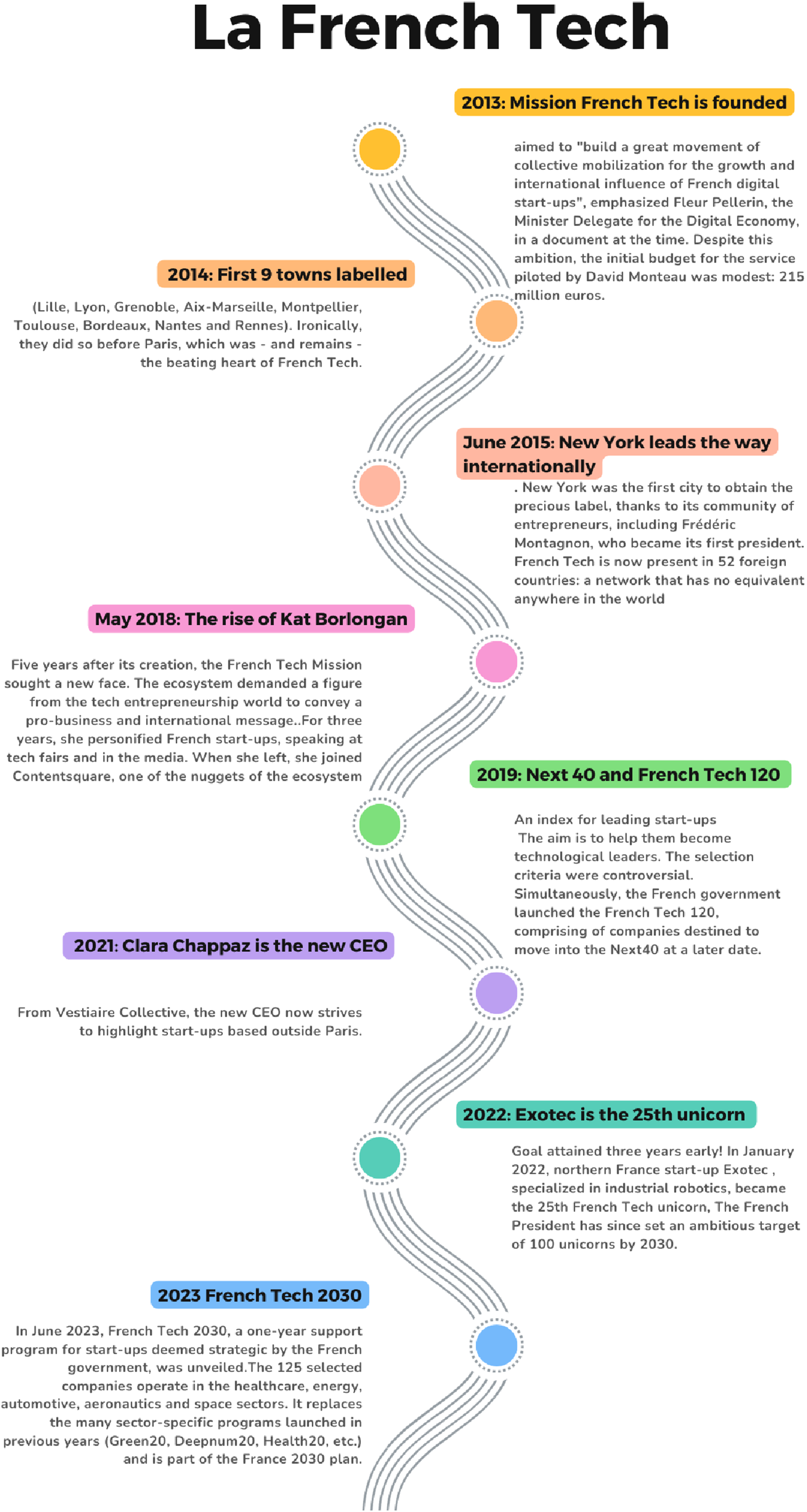
Over the years, La French Tech has expanded its international presence, showcasing successful entrepreneurial stories and driving the global recognition of French innovation.
6
“The metropolises are called upon to form a national network, open to new entrants, ready to share in France the imperative of innovation [...], to set out to conquer international markets, to attract foreign investors and talent,”
explained Axelle Lemaire, the Secretary of State for Digital, at the time of the announcement.
Global expansion
La French Tech has established a network of 67 communities in 52 countries, providing support and resources to French startups abroad. Their main missions are talent attraction and development, investment and funding, knowledge sharing, networking collaboration and partnerships, market expansion, brand recognition, fostering innovation and growth, event organization, and funding access. 7 La French Tech organizes several international events, such as the La French Tech Summit, which brings together French startups, investors, and partners worldwide. 8 These events provide a platform for French startups to showcase their innovations and connect with potential partners and investors. In 2015, the French Tech Ticket program was initiated, inviting international entrepreneurs to establish startups in France, contributing to diversifying the country’s innovation landscape. The year 2016 saw the introduction of the French Tech Visa, strategically designed to attract global talent by simplifying the entry process for foreign startup founders and employees. This visa program aimed to enhance France’s position as a hub for international tech expertise. Moving forward to 2019, significant initiatives such as the Next40 and French Tech 120 programs were launched. These programs helped identify and support promising startups, fostering their growth trajectory and elevating their international visibility. Implementing these programs showcased France’s commitment to nurturing a dynamic and competitive ecosystem for innovative ventures. In 2019, La French Tech and Enterprise Singapore launched the Global Innovation Alliance, a program that supports French startups that want to establish themselves in Singapore.
Initiatives like French Tech Agri20 have been created to support technological innovations in specific sectors such as food and agriculture, demonstrating La French Tech’s commitment to addressing diverse challenges and fostering sector-specific growth. 9
Celebrating its 10th anniversary in 2023, La French Tech reflected on a decade of achievements and growth, highlighting its impact on the French startup ecosystem.
Figure 1 synthesizes the different important milestones for La French Tech.
Kat Borlongan was appointed to head La French Tech on May 24, 2018. 10 Arrived from the Philippines at 20, Borlongan had established herself as a significant figure in the technology and innovation sector, which made her a fitting choice to lead La French Tech. 11 Her appointment marked a key moment in the French tech scene, underlining the government’s commitment to innovation and digital transformation.
She asserted both: “France has all the ingredients to be a global leader in tech innovation. We have a talented pool of entrepreneurs, a supportive government, and a vibrant startup ecosystem.”
And: “My goal as Director of La French Tech is to help French startups scale and become global leaders. I want to make France the most attractive place in the world for startups to launch and grow.”
Under the leadership of Kat Borlongan, the focus transitioned from startups to scaleups and subsequently to unicorns. “when I first started in 2017, there was one number in particular that really broke my heart. And that number was the Series C, which way back then was like 1%,” she said. “And now, every couple of weeks or so we're announcing different mega rounds. And I think a lot of it is also due to the fact that it's an ecosystem that really pulled together during the crisis. The government did not let anybody down. 24 hours after the lockdown was announced, Cedric O, our minister took the mic and said, we're putting €4.3 billion on the table to make sure that we preserve the French tech ecosystem.”
12
The government, aligning with this shift, implemented various programs to assist French startups in becoming international leaders, exemplified by the ambitious goal of creating 25 unicorns.
In 2023, previous goals were actualized. President Macron’s ambitious goal for France is to achieve 100 unicorns by 2030, specifically focusing on nurturing 25 green unicorns—companies dedicated to developing environmentally sustainable technologies. This initiative aligns with broader concerns about biodiversity and environmental sustainability in France and Europe, leading to the emergence of a new species on the business landscape: green unicorns. The French GreenTech ecosystem is thriving, with the country witnessing a record-breaking fundraising surge in the GreenTech sector, indicating significant growth and support for environmentally conscious startups in France. Also, French Tech Finance Partners was established in January 2023. French Tech Finance Partners brings together tech investment funds such as Partech, private equity and corporate venture funds (led by large companies), banks, and organizations and associations such as France Invest and France Digitale. It is a strategic initiative aimed at addressing challenges in funding for businesses in France. Comprising 16 members representing diverse stages of financing and industries, the organization focuses on identifying obstacles to financing startups. Its triple objectives include contributing to the growth of entrepreneurship, improving access to funding, and fostering innovation within the French tech ecosystem. First of all, it aims at solving the problem of a financing fabric that is (too) concentrated in the capital. “It's an observation we've made for a long time, which led us to create the France Digitale Tour six years ago: we travel with investors to different regions of France,” explains Maya Noël, General Manager of France Digitale, an association of startups and investors that is part of the FTFP (French Tech Finance Partners).
13
The second issue that the FTFP will address is deeptech, a sector with fewer financiers because it requires significant capital at the start, particularly due to the long research and development times that need funding. Also, FTFP will lead a reflection on how France can make itself even more attractive to foreign investors.
Following Kat Borlongan’s term of office, which ended in 2021, Clara Chappaz took over as head of Mission French Tech in October 2021. In July 2023, she was again replaced by Marina Ferrari, who was appointed Secretary of State for Digital Affairs and now oversees La French Tech. In October 2024, Antoine Armand was appointed as the new director of Mission French Tech, bringing his experience in industrial policy and ecological transition to the helm of the initiative. Under his leadership, the mission is focusing more on developing green unicorns and deepening the links between technological innovation and French industrial sovereignty. With a valuation of around $5.8 billion, The top three unicorns in the French ecosystem
The latest initiatives
La French Tech Next40 is a program to support 40 of the most promising French startups, composed of representatives from the French startup ecosystem, including entrepreneurs, investors, and experts.
La French Tech 120 highlights the most mature and hyper-growth startups, to help them become European champions and contribute to the job dynamic in France. French Tech is seen as creating thousands of jobs yearly.
The French Tech Community Fund, initiated by Mission French Tech in 2019, is a government-funded initiative amounting to €1.5 million. This fund supports the growth and collaboration within the French Tech community.
The French Tech mission has launched a new accelerator program in collaboration with SLUSH, a major Nordic tech event. The program will support 34 French startups in their international expansion efforts.
The French Tech ecosystem aims to have 25 green unicorns by 2030, focusing on environmentally conscious startups and a program to support the goal “French Tech Green20” to nurture 20 environmentally friendly startups.
What are unicorns?
Aileen Lee invented the term in 2013, highlighting the rarity of these organizations. An American venture capitalist, she showed that only 0.07% of venture capital funds invested in companies achieved a valuation of $1 billion or more. Only a few super unicorns emerged each decade, with a higher concentration in consumer-oriented startups. Even excluding Facebook, considered a super unicorn, consumer-oriented unicorns generated more value collectively. However, enterprise-oriented unicorns had a higher average worth and raised significantly less private capital, resulting in a higher return on investment. On average, it took around seven-plus years for these companies to experience a liquidity event, excluding those that remained private (Lee, 2013).
Some have added additional criteria later, such as the valuation of more than 1 billion must be done within 10 years after the company’s creation. If the company goes public or is acquired, it is no longer considered a unicorn. In 2013, 39 unicorns were born, and Lee (2013) considered only US-based software companies.
Unicorns’ success contributes significantly to the economy by creating jobs and generating substantial revenue (Venâncio et al., 2023). Unicorns often bring disruptive innovations to the market, driving technological advancements and pushing other businesses to innovate to stay competitive.
What is the role of digital technologies in the rise of unicorns?
Unicorns benefitted from digital technology breakthroughs that created new opportunities to interact with customers and respond to their needs, edging a competitive advantage to disrupt existing markets, attract users, and quickly increase their valuation. Disrupting markets, they often create new ecosystems and value propositions for frustrated customers (Bower and Christensen, 1995; Christensen, 2015; Christensen and Overdorf, 2000). Modern technologies, such as cloud computing, allow companies to scale up more rapidly and adapt to demand. Unicorns can thus manage rapid growth without having to invest heavily in infrastructure. Online platforms, mobile applications, and the internet have enabled unicorns to reach a global audience. This significantly expands their potential market, which can result in exponential growth. New technologies have also made fundraising and investment easier. Unicorns can quickly raise substantial amounts of money, enabling them to finance their growth and operations. Advanced data analysis technologies help unicorns make informed decisions and optimize their operations. This allows them to gain efficiency and improve their business model. New technologies enable unicorns to iterate rapidly on their business model, add new features, and adapt to changing user needs. They often adopt a platform-based organizational structure, fully leveraging the disruptive possibilities of technology (Gawer, 2009; Gawer and Cusumano, 2014). These technological specificities led to a historically long period of low-interest rates, high fundraising times, and IPOs.
Suggested questions that can be asked in class or as a final examination are as follows. 1. Identify the key factors that have contributed to the growth and success of unicorns in France. Explain what the technological conditions for the rise of unicorns are. 2. Estimate the economic and financial implications of the presence of unicorns in an entrepreneurial ecosystem. 3. From the top three examples, can you identify and explain the common organizational or business model aspects for these unicorns. Discuss the reason behind this organizational form. 4. Using what you know about ecosystems, analyze the role La French Tech played for the rise of unicorns and explain to what extant exportation of the program would work. 5. Recommend actions to La French Tech for the years to come.
Footnotes
Declaration of conflicting interests
The author(s) declared no potential conflicts of interest with respect to the research, authorship, and/or publication of this article.
Funding
The author(s) received no financial support for the research, authorship, and/or publication of this article.
