







Abstract
This case study illustrates the process of implementing a customer relationship management (CRM) solution and introduces students to various concepts related to enterprise software project management and change management. The main aim of this study is to explain the importance of strategic change management initiatives in driving the success of technology implementation projects. To achieve this aim, the current study uses a composite case study that outlines the CRM implementation by ChatterSphere Private Limited (CSPL), a provider of Artificial Intelligence-powered chatbot solutions. Despite the CRM solution being feature-rich and well-engineered into CSPL’s technology stack, CSPL cannot unleash the CRM’s intended impact due to employee engagement challenges and a lack of on-the-job training support. Students will take on the role of Diya, the Chief Marketing Officer of CSPL, who also played an important role in CRM implementation, and develop the change management plan to maximize the potential of the CRM solution and embed it into the end-to-end business processes of CSPL.
Keywords
Introduction
“Implementing CRM isn’t a one-time event; it’s a journey where you continually refine your customer strategies, always seeking to enhance the customer experience.” - ChatterSphere Management
Understanding customer relationship management
Customer Relationship Management (CRM) refers to strategies and tools used by businesses to effectively manage customer relationships and streamline marketing workflows (Winer, 2001). The strategic aspect of CRM focuses on the “what and why” of enhancing customer relationships by aligning the 3Ps (people, processes, and planning) of the organization. Similarly, CRM tools build on the existing CRM strategy to address the “how” aspect of CRM strategy execution. For example, consider a restaurant where the employees develop personal relationships with the customers based on their past interactions, and the restaurant does not collect any information about the customers’ purchases or ask for feedback regarding their dining experience. Realizing the importance of managing customer relationships for improving sales, the restaurant owner develops a CRM strategy that requires the employees to collect customer feedback using feedback forms and offer a discount of one percent to customers who spend more than ₹300.
The restaurant witnessed increased sales and better customer retention after consistently implementing the above steps. With the increase in customer footfall, the owner also realizes that manually implementing the above approach is time-consuming and prone to errors. To improve the execution of the CRM strategy, the owner purchases a cloud-based CRM subscription and equips the employees with tablets. Using these tablets, the employees enter the order details in the CRM cloud along with the customer’s mobile number, and the CRM cloud stores all these details in a secure centralized database repository. The cashier at the billing counter will also be able to calculate the bill using the order details recorded in the CRM, and the CRM automatically applies a discount of one percent to the final bill. Further, the CRM will send an electronic copy of the bill to the customer’s mobile device along with a link to the feedback form. Since the CRM keeps track of every transaction and customer feedback, the owner can also use this data in the future to develop a loyalty program, improve the service quality, or create a customized promotional plan.
The above restaurant use case briefly explains how CRM strategies and tools help organizations optimize their marketing efforts and service interactions. Given their utility, CRM systems are widely used in businesses to provide a personalized customer experience and achieve hyper-personalization (Pukas, 2022). Some of the best-known providers of CRM tools include Salesforce, HubSpot, Microsoft, Oracle, SAP, and Zoho. These enterprise-level CRM tools go beyond centralizing customer data, automating marketing workflows, and enabling real-time analytics to help organizations achieve better coordination and craft tailored experiences that reflect the needs of the target customer segment (Marsh, 2023). Since enterprise-level CRM touches nearly every customer-facing function and organizational unit, implementing the CRM solution requires a company-level transformation (Mishra and Mishra, 2009). Further, to fully embrace the CRM solution, employees should collectively follow the recommended operating procedure, use real-time data to make better decisions, and act collaboratively to improve the customer journey.
The current case study aims to develop students’ understanding of the CRM implementation process and the organizational enablers that maximize the strategic value of CRM. To achieve this aim, the author creates a composite case study involving a scenario that requires students to prepare a change management initiative for ChatterSphere Private Limited (CSPL), an Artificial Intelligence (AI) powered chatbot solution provider. Before working on the recommendations for the current dilemma, students are also requested to conduct a thorough situational analysis using the provided information to understand the contextual factors and explore various enterprise software project management methods (Despa, 2014) and change management frameworks (Errida and Lotfi, 2021) to improve the quality and relevance of the case discussion. The objectives of the case study are: (1) To assess the need for a comprehensive CRM solution for CSPL. (2) To compare the suitability of CSPL’s CRM implementation process with other software project management approaches. (3) To examine the organizational and employee-specific barriers that limit CSPL from maximizing the value of its CRM investment. (4) To develop a change management plan that mitigates the above-identified barriers and outlines the steps for its implementation.
In addition to the above objectives, students can also focus their discussion on the recent trends in project and change management, including the rising popularity of hybrid project management (Reiff and Schlegel, 2022), data-driven change management approaches (Nwokeji et al., 2015), AI-assisted continuous learning initiatives (Sundaresan and Zhang, 2022), and program evaluation methods (Jain, 2014). Based on a blend of various real-life CRM implementations, the case provides a comprehensive picture of the critical success factors influencing technology adoption and illustrates the strategic choices that organizations face over their CRM journey. Students should contemplate their own technology deployment experiences and how the case insights might have helped them improve their project.
Case overview
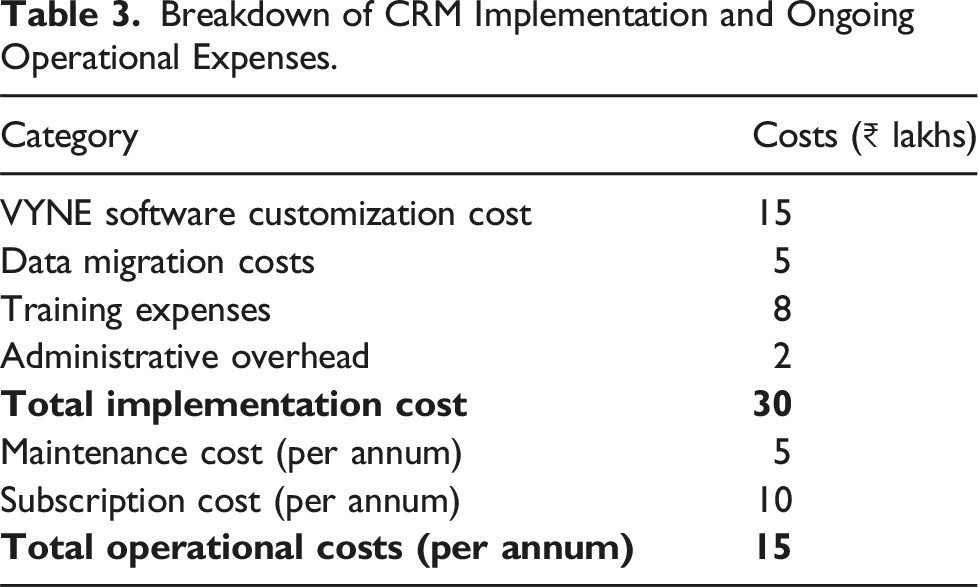
In autumn 2022, Aarav Mehta, director of ChatterSphere Private Limited (CSPL), faced challenges following the implementation of a CRM system. CSPL, a growing player in Conversational AI, aimed for ₹50 crore sales by 2023 after reaching ₹30 crore in 2022. As the customer base expanded, reliance on traditional methods like Excel and personal data systems to manage customer data became inefficient. To streamline operations and enhance customer relationships, Aarav invested ₹30 lakh in a CRM system.
While the implementation was successful, employee resistance to fully integrating the CRM in sales processes posed a problem. Despite CRM’s potential, many employees continue using traditional methods, as inputting data into cloud-based CRM is consuming more time and requires additional effort. Aarav realized that fully integrating the CRM into business processes requires more than developing new modules or customizing the CRM to CSPL’s specifications. Aarav met with senior managers and Diya Sharma, the Chief Marketing Officer of CSPL, to identify the future course of action aimed at promoting employee engagement with the CRM tool. The management team concluded that CSPL needed an ongoing training program to train new recruits about the CRM system and also to update the technical skills of the existing employees.
Given Diya’s familiarity with the CSPL’s CRM system and her contribution to its development, Aarav identified Diya as the ideal candidate to lead the change management initiative. Compared to CRM deployment, the current project is more complex as it requires creating a program to reform the company’s culture and its employees to be in line with CSPL’s broader strategic goals. Diya also acknowledged that the program’s success depends on overcoming staff resistance to using CRM by tailoring individualized rewards, fostering a sense of ownership, and creating training programs that address individual training needs. Given these challenges, Diya finds herself at a crossroads and is reviewing change management practices from other organizations to assist in creating an effective program for CSPL.
CSPL at a glance
CSPL was founded by Aarav in 2016 to revolutionize automated customer service interactions. CSPL solutions empower businesses to deliver chatbot experiences that are comparable to interacting with service executives and work with communication channels like SMS, WhatsApp, Telegram, iMessage, and Facebook Messenger. To help businesses strengthen customer relationships, CSPL solutions integrate with the client’s existing technology stack and provide a unified experience regardless of the touchpoint customers use to engage with the business. This omni-channel approach increases consumer engagement, making CSPL a reliable collaborator for businesses seeking an exhaustive digital solution.
The structure of CSPL’s sales and marketing department is shown in Figure 1. CSPL’s marketing functions, which include running digital marketing campaigns and social media outreach activities, are outsourced to a third party, and Diya is responsible for managing these initiatives. The sales director reports to Diya and is responsible for setting the goals of the sales teams and ensuring their peak performance. CSPL follows a multi-stage, iterative sales process consisting of lead qualification, prospecting, opportunity exploration, needs analysis, solution presentation, client onboarding, solution development, and customer success assistance. While long-term support, needs analysis, and client engagement fall under the purview of the customer success team, the sales development team is responsible for prospecting, lead qualification, and initial client outreach. Structure of CSPL’s sales and marketing team.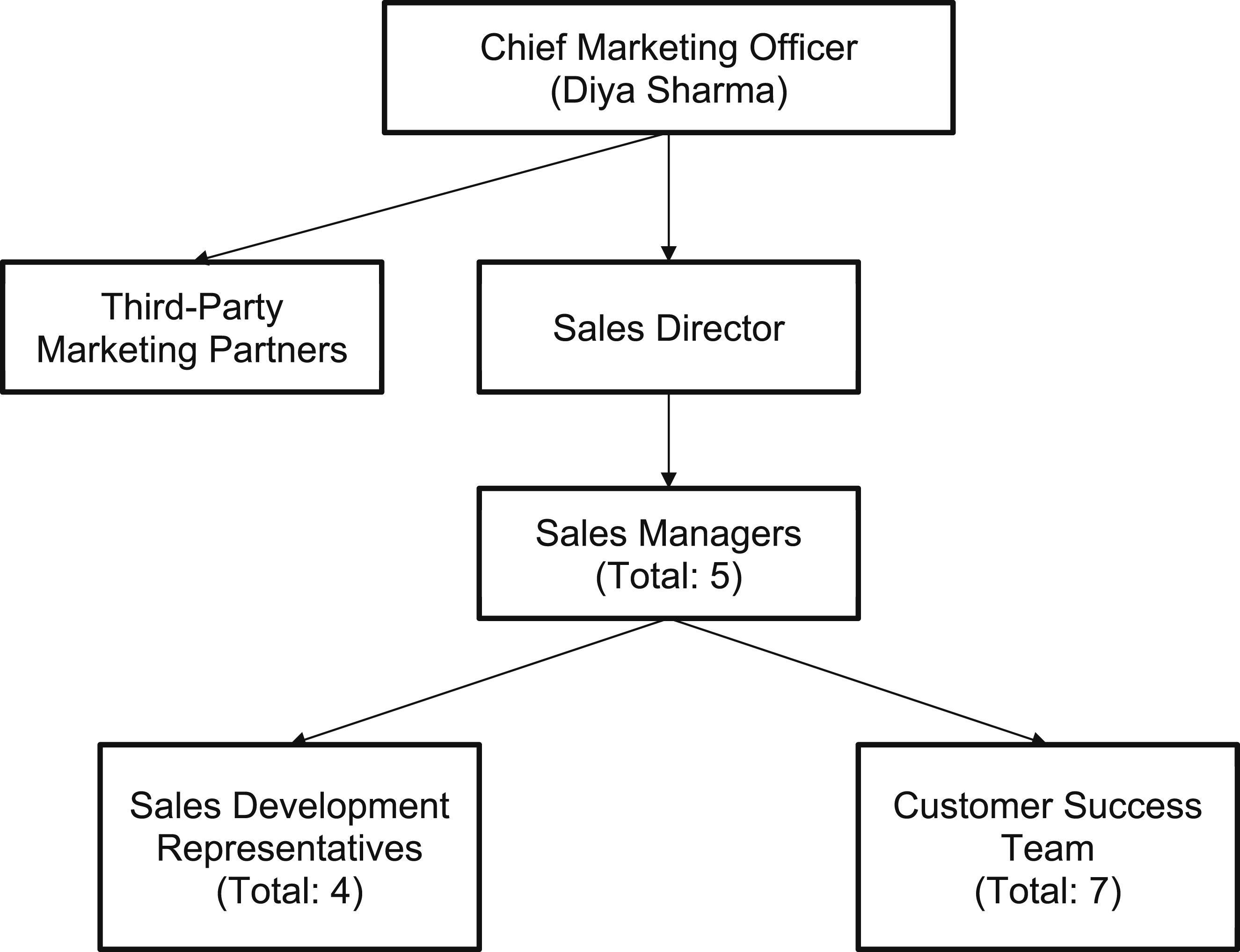
CSPL’s global presence and focus on innovation helped the company attract a diverse client base spanning e-commerce, finance, health, and public sector industries from various countries, including India, the UK, and South Africa. CSPL is also continuously upgrading its platform capabilities to accommodate more clients and establish itself as an expert in the conversational technology market. However, CSPL’s efforts to grow its client base and explore new markets are being held back by outdated data practices and clunky sales processes. Currently, CSPL employees are manually storing customer details in local Excel files and relying on spreadsheets to piece together the data needed for sales reports, which is time-consuming and error-prone. These manual processes adversely affected employee coordination and reduced the efficiency of sales processes. Moreover, as data privacy concerns are on the rise and competitors are using data analytics to provide personalized services, CSPL management is giving high priority to digital initiatives that can effectively leverage customer data without compromising on the privacy standards.
CRM project foundations
To unify data access and streamline sales processes, Aarav stressed the need for a CRM solution that seamlessly integrates with CSPL’s internal systems and provides a 360-degree view of the customers. Recognizing the complexities associated with CRM implementation, Diya suggested putting together a cross-functional Steering Committee (SC) to oversee the implementation process. Following Diya’s proposal, the SC was formed with representatives from sales, marketing, information technology (IT), and operations to identify processes that can make use of the CRM features to improve their effectiveness. The SC is also given the responsibility to monitor the deployment of a CRM solution in line with CSPL’s organizational goals and stakeholders’ feedback. The SC commissioned Diya as its chairperson and charged her with leading the project’s strategic direction. As SC’s chairperson, Diya was also responsible for coordinating with CSPL’s leadership and making decisions regarding the project’s time frame, scope, and budget.
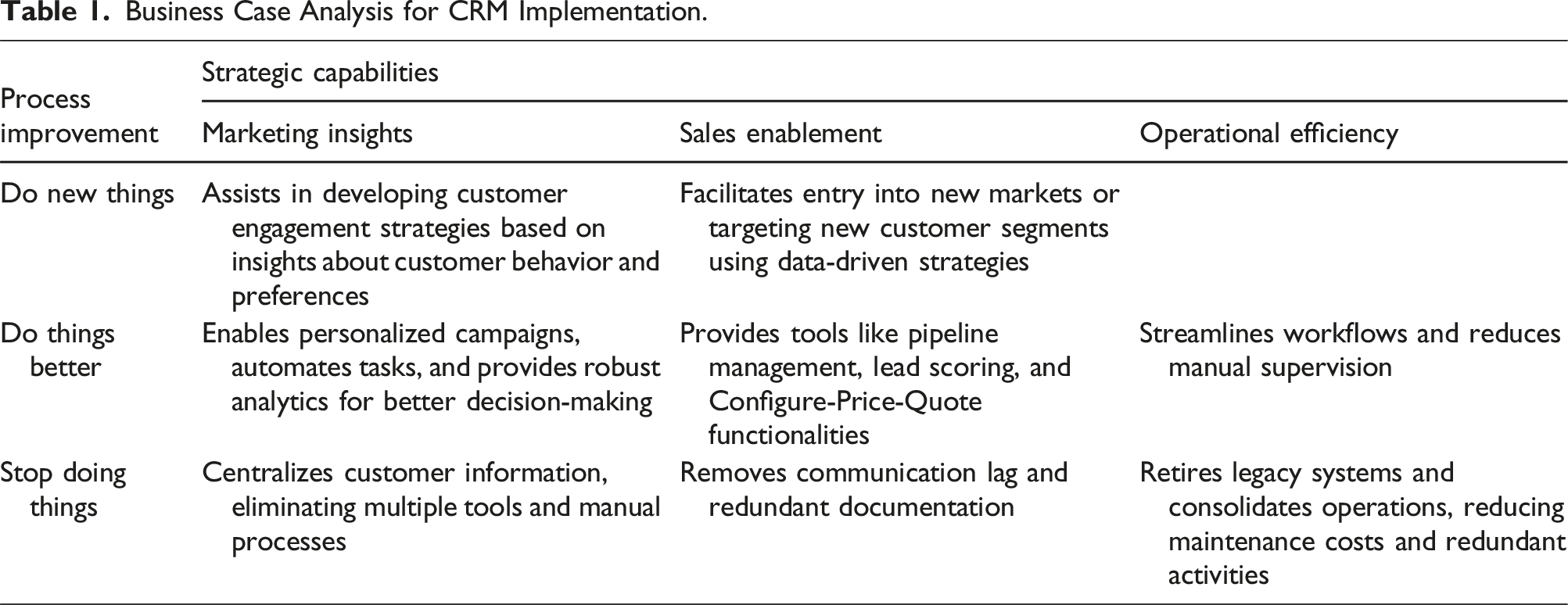
Before commencing the CRM development process, the steering committee performed a comprehensive assessment of the role played by the CRM solution in improving CSPL’s existing business processes and augmenting the organization’s strategic capabilities (refer to Table 1). The SC also collaborated with internal and external stakeholders to assess current data management processes and understand the impact of CSPL’s technology interfaces on customer experience. Based on the above insights, the SC created a comprehensive checklist of CRM features and incorporated it into the Request for Proposal (RFP) that will be circulated to third-party IT consultancy firms specializing in CRM deployment. To support their evaluation, the RFP mapped the identified CRM features into four categories, including: (1) Data Gathering and Storage: The CRM must collect customer information from a range of sources such as websites, social media, email, and online repositories. It needs to be equipped with the tools required for collecting data from the internet, monitoring social media sites, and conducting surveys. (2) Data Integration and Management: CRM should provide a 360-degree view of customers by bringing together data from different touchpoints in the customer journey. It also needs to let employees access only the data relevant to their roles and ensure that customer information is stored in line with privacy laws like GDPR and CCPA. (3) Data Analysis: The CRM should contain real-time interactive dashboards, built-in analytical tools, and offer advanced AI-based predictions. It should assist personalized communication by tailoring the message based on the customer’s past interaction. (4) Interaction Management: CRM should offer a unified interface through which customers can interact through WhatsApp, social media, email, and phone. It should integrate with other service platforms to ensure the timely resolution of customer grievances. Business Case Analysis for CRM Implementation.
CRM implementation roadmap
Based on the specified CRM needs, the SC engaged in elaborate discussions and analyzed the data further to obtain a deeper understanding of how the proposed CRM solution will integrate with existing systems. Building on these observations, the SC outlined a detailed CRM implementation blueprint that would ensure an integrated CRM solution that corresponds to the organization’s requirements. This iterative plan considers organizational constraints and CRM capabilities to provide a strategic roadmap to tackle the implementation challenges. The next subsections provide an elaborate description of the six phases that characterize the CRM implementation process.
Phase 1: Evaluating CRM solutions
Steps Involved in Evaluating Existing CRM Solutions.

Breakdown of CRM Implementation and Ongoing Operational Expenses.
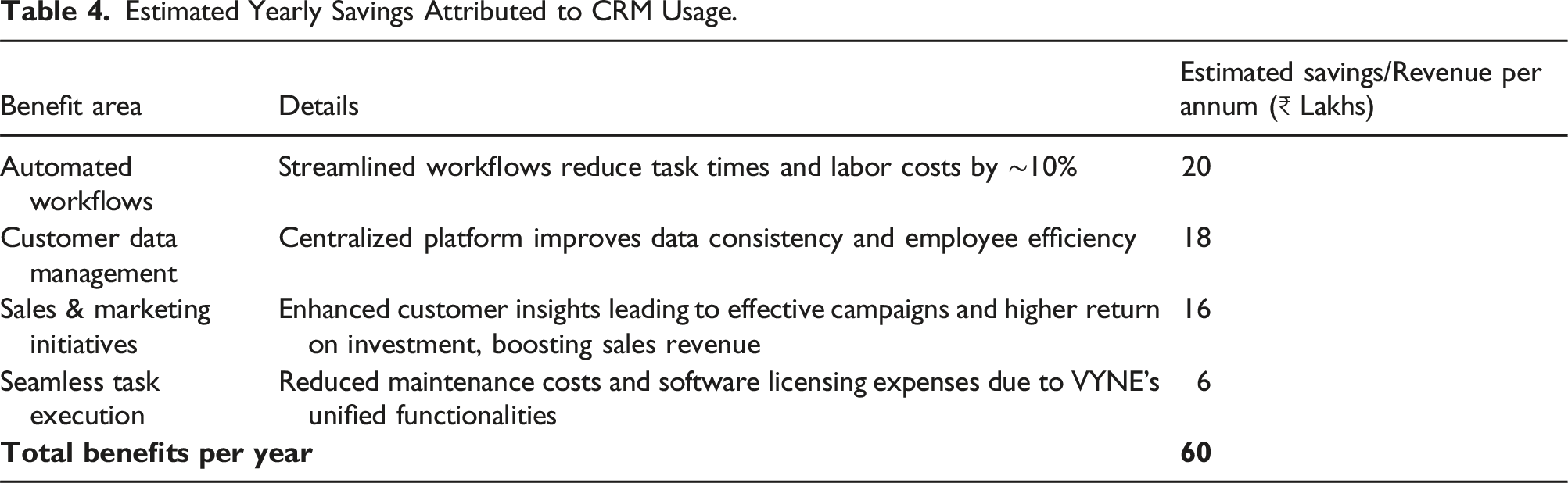
Estimated Yearly Savings Attributed to CRM Usage.
Phase 2: Platform selection
The SC utilized the system capability checklist to assess the different CRM platforms identified in phase 1 and eventually selected BRAN CRM (anonymized) and VYNE CRM for further assessment. Despite BRAN CRM offering comparable benefits at a reduced implementation cost of ₹15 lakhs and operational costs of ₹10 lakhs per annum, the SC chose VYNE CRM for its strategic benefits, such as: (1) Scalability: VYNE is specifically designed to accommodate massive data sets and support large enterprises, making it a great fit for CSPL’s expansion goals. (2) Integration Capabilities: VYNE offers seamless integration with various business tools, enabling streamlined end-to-end solutions. (3) Customization: VYNE provides extensive options for tailoring the CRM to meet specific and complex business needs. (4) Industry Expertise: VYNE is backed by a strong reputation and widespread adoption across industries, offering robust support and resources
Phase 3: Finalizing implementation team
After identifying the CRM platform, the SC initiated the CRM customization and data migration process with the help of a dedicated implementation team. The team was selected through an RFP sent to CRM consulting firms with expertise in VYNE CRM. In addition to CRM features, the RFP also outlined CSPL’s goals, current systems, and the scope of work. The proposals were evaluated based on factors like the firm’s experience, customization capabilities, proposed timeline, and budget. Shortlisted firms presented their proposals, which were assessed for robustness, interoperability, and technical feasibility. References were contacted to validate the participant’s past performance. After detailed evaluation and negotiations on project scope, timelines, costs, and service terms, a formal contract was signed with the MIGRATE consultancy firm (anonymized).
Phase 4: Project implementation
The CRM implementation process involved Diya, the members of SC, and the members of the MIGRATE consulting firm. The stakeholders ensured that the CRM implementation was effectively aligned with the organization’s objectives, budget, and timelines. The implementation was done with the help of the Scrum framework and lasted for 6 months. Through regular meetings and progress updates, the implementation team was able to successfully configure the VYNE CRM to embed within CSPL’s technology stack and transfer customer data from multiple systems into the CRM database without compromising data consistency. During the implementation, the team also addressed issues that undermined the CRM’s reliability and compatibility with other software applications used for messaging, email marketing, and offering customer support. Finally, the MIGRATE testing experts performed a usability assessment of the CRM solution using established usability heuristics. The system was further refined to address the usability concerns and provide a seamless user experience.
Phase 5: Training and launch
To improve the adoption of the new CRM solution, the implementation team made it mandatory for all the CSPL employees to undergo a comprehensive CRM training program conducted by MIGRATE. The training program aimed at developing the human resource capabilities to fully harness the CRM functionality and improve organizational performance. Once all CSPL employees had completed their training, the CRM system was put into action across the company and fully integrated into the company’s core processes. During the initial days of CRM roll-out, employees kept copies of customer data that was uploaded to the CRM to ensure data safety in the event of system failures, and the MIGRATE implementation team closely watched over the CRM system to identify and resolve the problems that might arise during operations.
Phase 6: Project closure
Before wrapping up the project, the SC and implementation team documented the entire implementation process with a special emphasis on the challenges faced during the CRM implementation. The documented issues include the process followed for data cleansing and deduplication, usability issues, employee resistance, and compatibility issues arising from the CRM’s integration with third-party software applications. The documentation contained a detailed overview of the modifications that were implemented in the VYNE software to facilitate the identification of potential issues that may arise in the future. Finally, the report also documented the technical glitches and roll-out challenges that emerged during and after the implementation. CSPL management also transferred the CRM maintenance responsibility solution to MIGRATE consultancy and signed a software maintenance agreement that lists the system evaluations that need to be undertaken periodically. The project concluded with a pledge by CSPL management to perform regular audits of CSPL’s technology ecosystem and regularly update it to meet the latest technology and industry standards.
Impact of CRM solution on CSPL
During the initial weeks of CRM implementation, CSPL resolved a number of long-standing problems pertaining to data management and helped in achieving data synchronization across all of CSPL’s digital platforms. The CRM system also gave the top management real-time visibility of the sales performance and enabled employees to track the status of different tasks in the sales pipeline. With the CRM in place, CSPL was also able to see benefits like: (1) Standardization: CRM streamlined the selling processes, enabling teams to be more efficient and enhancing data consistency, which minimized errors. (2) Improved Quality of Data: CRM gave employees a 360-degree view of the customer, which helped employees to make better-educated decisions and boosted their trust in the data insights. (3) Increased Visibility: By streamlining the data analytics process, CRM streamlined the process of monitoring the sales performance and made it easy to offer sales performance-tied incentives. (4) Enhanced Coordination: CRM’s centralized database ensured that everyone in the organization had access to the same real-time customer information, which enriched the employee experience and facilitated collaboration.
Despite initial optimism, employees slowly started feeling frustrated with the additional workload that arises from using CRM systems, and this was also reflected in their declining engagement. Employees also reported their frustration during team meetings and conversations with top management. The issues highlighted by the employees in their feedback include: (1) Disruption of Workflow and Complexity: With CRM receiving frequent updates, getting used to the features in the new system made it increasingly difficult for teams to maintain concentration. The constant overhauls impacted day-to-day workflows, and the need to keep track of the changes in these updates decreased the productivity of the employees. (2) Mechanization: With CRM automating most of the sales processes, the personal touch of sales started to slip away. Both employees and customers felt that their interactions were mechanized, and this hampered the emotional connection between the CSPL’s stakeholders. (3) Pressure from Metrics: There was a growing push to hit the numbers, which often made the customer feel abandoned and workers feel disconnected. While employees acknowledged that streamlining workflows based on CRM metrics showed short-term success, they were worried about the long-term impact of this strategy on customer relationships and loyalty.
The CRM’s impact extended beyond the sales team, affecting other departments and overall productivity. Employees, particularly new recruits, struggled with time-intensive processes and confusing system requirements, resulting in inconsistent usage. Linking incentives to CRM opportunities instilled pressure but failed to integrate the system into daily workflows effectively. This resistance, combined with declining customer relationship quality, has hindered CSPL’s ability to measure the success of its CRM solution, necessitating a re-evaluation of its strategy to balance efficiency with human-centric employee management and customer engagement.
Although the CRM was effective from a technological perspective and in line with the CSPL’s needs, management recognized that they had yet to address the issues caused by the misalignment of technology, corporate goals, and employee preferences. Dissatisfaction is steadily rising among employees because their performance incentives are measured using CRM data, forcing them to constantly update sales statuses instead of focusing on productive tasks. Further, a few employees were also complaining about redundant processes, where the same data had to be entered by multiple employees. These duplications sometimes resulted in inconsistencies, affecting the entire team.
There has been a lot of resistance from new hires, who believe the CRM isn’t doing much to help them close deals but is adding to their existing workload. CSPL needs to address this new employee-system disconnect immediately, as it is impacting CSPL’s day-to-day operations, with sales suffering the most. This resistance, as well as falling customer relationship quality, also made it difficult to measure the return on investment from CSPL’s CRM solution. CSPL is now reassessing its approach and has started focusing on the change management program to balance efficiency and human-driven management.
Charting the course ahead
The CRM solution, meant to simplify sales and improve customer relations, is held back by employee resistance, as many perceive little value in constantly updating the customer data or using CRM for simple tasks. While CRM holds promise, its success lies in how well it matches the employees’ expectations and reduces their workload. Diya has to overcome these obstacles by establishing a customer-driven culture and improving employees’ perception of CRM as an instrument for driving customer experience improvement, rather than another load on their shoulders.
Aarav wants Diya to create a thoughtful, crafted change management plan that will enable employees to use the CRM system more effectively and align the employees’ priorities to the organizational customers-first strategy. Given that CSPL’s processes are built on teamwork, the change management initiative should make it easier for employees to provide ongoing feedback and updates to integrate CRM seamlessly into their daily routines. As Diya prepares the initial draft of the change management initiative, she is struggling to simultaneously balance the technical and cultural transformations needed to fully leverage the CRM system and achieve the organizational objectives.
Questions for discussion
(1) Considering CSPL is still in its early stages of growth, do you think it was the right time to implement a CRM system? Were there any alternative approaches that CSPL could have taken to manage customer relationships more effectively? (2) Compare the CSPL’s CRM implementation process with alternative enterprise project methodologies. How does CSPL’s approach align or differ in addressing process improvement and strategic goals? (3) What are the important factors contributing to the underutilization of CSPL’s CRM system? What steps can the company take to address these challenges and make better use of the system? (4) If you were leading the steering committee, how would you approach the CRM implementation process at CSPL to incorporate the elements of change management right from the beginning? Discuss the key steps involved in your approach, the potential concerns that need to be considered, and the mitigation strategies to address them. (5) How can CSPL’s leadership transform the organization’s mindset from viewing the CRM as just a sales management tool to fully realizing its potential? (6) What key performance indicators (KPIs) should CSPL establish to assess the business value derived from the CRM system? In what ways can these KPIs assist CSPL in evaluating the return on investment (ROI) of its CRM implementation?”
Footnotes
Author Notes
The names of the organizations and CRM platforms referenced in the case study have been anonymized, as the intent is not to evaluate the features provided by the platforms or critique the effectiveness of project management, but rather to illustrate broader patterns and insights relevant to CRM implementation.
Acknowledgments
The author would like to thank the editorial team and the anonymous reviewers for their valuable input and constructive suggestions, which helped to improve this paper.
Declaration of conflicting interests
The author(s) declared no potential conflicts of interest with respect to the research, authorship, and/or publication of this article.
Funding
The author(s) received no financial support for the research, authorship, and/or publication of this article.

Data Availability Statement
The data used in this study are available in the case study content and teaching note. No additional external datasets were used or generated.