Abstract
CEO of DigitaLandmarks, Lilian Rabin created a virtual reality immersive window called La Fenêtre immersive. The window has been displayed in malls or stations in order to discover touristic locations and trigger action from consumers. In order to refine his sales pitch in order to reach more malls or stations, in September 2025, Lilian wants to understand the impact of the window on consumers. The case explores the impact of the window through immersion and presence. The case attempts to model consumer behavior in order to refine the sales pitch and find new targets where the window could be deployed.
Keywords
Learning outcomes
The following four learning outcomes are related to the four questions indicated below to lead the case. • To examine the link between technological immersion and presence • To identify variables from consumer’s behavior facing La Fenêtre Immersive • To identify sales arguments Lilian could use • To evaluate other settings and contexts where La Fenêtre Immersive could be effective
Introduction
The use of Virtual reality (VR) in tourism contexts has grown exponentially in recent years and is set to grow even further. Market value amounted to US$728.6 millions in 2023, up to 26.4% between 2024 and 2032. It should reach US$5.7 billions in 2032. Among used, 360-degree virtual tour is widely spread, amounting US$2.5 billions in 2032. Individual market represents 47% (source: https://www.gminsights.com/fr/industry-analysis/virtual-tourism-market). Hence, destination managers have adopted VR as a marketing tool. But few researchers really assess the impact of VR on consumers’ behaviors. The case aims to understand the impact of a virtual reality device on consumers in a tourism environment. The literature on immersion, presence, and attention is presented, followed by the SOR model. Then, the story of DigitaLandmarks is presented.
Immersion, presence, performance
Immersion can be defined combining the techno- and user-centered perspectives (Nilsson et al., 2016): immersion must be regarded as an objectively measurable property of the system and not the product of the user’s reaction to being enveloped by technology. It stands for what the technology delivers (in all sensory modalities) in order to preserves fidelity in relation to their equivalent real-world sensory modalities.
Immersion, Presence, Performance (IPP) framework developed by Bystrom et al. (1999) remains a foundational model for understanding user experience in virtual environments. It positions immersion as a set of objective technological parameters, presence as a subjective psychological state, and performance as the measurable outcome of interaction. Crucially, the model highlights presence as the mediating mechanism through which immersion influences performance. While this conceptualization provided an important early step in clarifying the dynamics of virtual reality experiences, subsequent research has sought to refine and extend these ideas, particularly in relation to the complexity of presence.
Cummings and Bailenson’s (2016) meta-analysis of 83 studies represents a significant advancement in this regard. Their work systematically evaluated the technological factors most strongly associated with the sense of presence and provided empirical support for aspects of the IPP framework. They found that variables such as motion tracking, field of view, and stereoscopic vision are particularly influential in shaping presence, while visual and auditory fidelity play more moderate roles. This synthesis not only validated Bystrom et al.’s claim that immersion fosters presence but also offered a clearer prioritization of which technical features are most impactful. Importantly, their analysis further confirmed the mediating role of presence by showing that improvements in immersion yield positive effects on user outcomes primarily through enhanced presence rather than directly.
At the same time, Slater’s theoretical contributions have shifted the discourse from a purely technological focus toward a deeper understanding of the psychological mechanisms underpinning presence. Slater (2009) introduced the concepts of “place illusion” (the feeling of being located in a virtual environment) and “plausibility illusion” (the extent to which events in the virtual environment appear to be actually occurring). This distinction reframes presence not simply as a by-product of immersion but as the outcome of both sensory fidelity and the credibility of the simulated context. In this perspective, immersion facilitates place illusion by providing perceptual realism, while plausibility illusion depends on the coherence, responsiveness, and meaningfulness of the virtual environment. Together, these dimensions explain why some virtual experiences are compelling despite limited technological immersion, while others fail to generate presence despite high fidelity.
By integrating these more recent insights, the evolution of the IPP framework demonstrates a shift from a linear, technology-driven model to a more nuanced account that acknowledges the interaction between system design, user cognition, and contextual factors. While immersion continues to be recognized as a necessary condition for presence, presence itself is now understood as multifaceted, involving not only perceptual absorption but also narrative plausibility and social credibility. This expanded view has important implications for performance outcomes: training, learning, and behavioral change are most effective when virtual environments combine technical immersion with compelling content and coherent scenarios.
In this sense, the IPP framework remains highly relevant but requires reinterpretation in light of subsequent research. Its original premise—that immersion influences performance through presence—still holds, yet presence is now conceptualized less as a single psychological state and more as a layered construct shaped by technological, cognitive, and contextual variables. This evolution underscores the need for VR research to move beyond measuring immersion in purely technical terms and instead to consider how perceptual fidelity, plausibility, and user engagement jointly determine the effectiveness of virtual experiences.
View has important implications for performance outcomes: training, learning, and behavioral change are most effective when virtual environments combine technical immersion with compelling content and coherent scenarios.
Stimulus–organism–response
The Stimulus–Organism–Response (S-O-R) paradigm, originally formulated by Mehrabian and Russell (1974), has become a central theoretical framework for understanding the relationship between environmental stimuli, emotional states, and behavioral outcomes. The fundamental proposition of the model is that environmental or situational stimuli do not directly determine behavior but rather exert their influence through the individual’s affective responses. In this sense, behavior is mediated by emotion, with the organism’s internal state serving as the critical link between external stimuli and observable responses.
According to Mehrabian and Russell (1974), the full range of emotional reactions can be described using three primary dimensions: pleasure, arousal, and dominance. Pleasure captures the extent to which an individual feels positive, happy, or satisfied in a given situation, and it is conceptually distinct from constructs such as preference or liking, which can also be influenced by the stimulating properties of the environment. Arousal reflects the degree of activation or readiness for action, representing the extent to which an individual feels alert, energized, or stimulated by situational cues. Dominance, in contrast, refers to perceptions of control or submission within a given context, with higher dominance indicating a sense of control and lower dominance corresponding to feelings of being overpowered by the environment. Together, these three dimensions provide a parsimonious yet comprehensive structure for conceptualizing affective responses to environmental conditions.
The model further posits that these emotional states give rise to two general classes of behavioral outcomes, namely approach and avoidance behaviors. Environments that evoke pleasurable, moderately arousing, and controllable experiences are more likely to elicit approach responses such as exploration, engagement, and prolonged interaction. Conversely, environments associated with displeasure, high or low arousal extremes, or reduced dominance tend to evoke avoidance responses, including withdrawal, disengagement, or shortened exposure. In this way, the S-O-R framework provides a dynamic mechanism for explaining how environmental factors such as store atmospherics, spatial design, or sensory cues can influence consumer behavior through the mediation of emotional states.
Subsequent research in marketing and consumer behavior has widely applied this model to contexts such as retail atmospherics, service environments, and online settings. Its enduring influence lies in its ability to capture the affective mechanisms that mediate between external stimuli and behavioral responses, offering both theoretical clarity and empirical applicability. By framing emotions along the dimensions of pleasure, arousal, and dominance, the Mehrabian-Russell model continues to provide a robust foundation for examining how environmental stimuli shape consumer experiences and behaviors through the organism’s internal states.
Company background
DigitaLandmarks
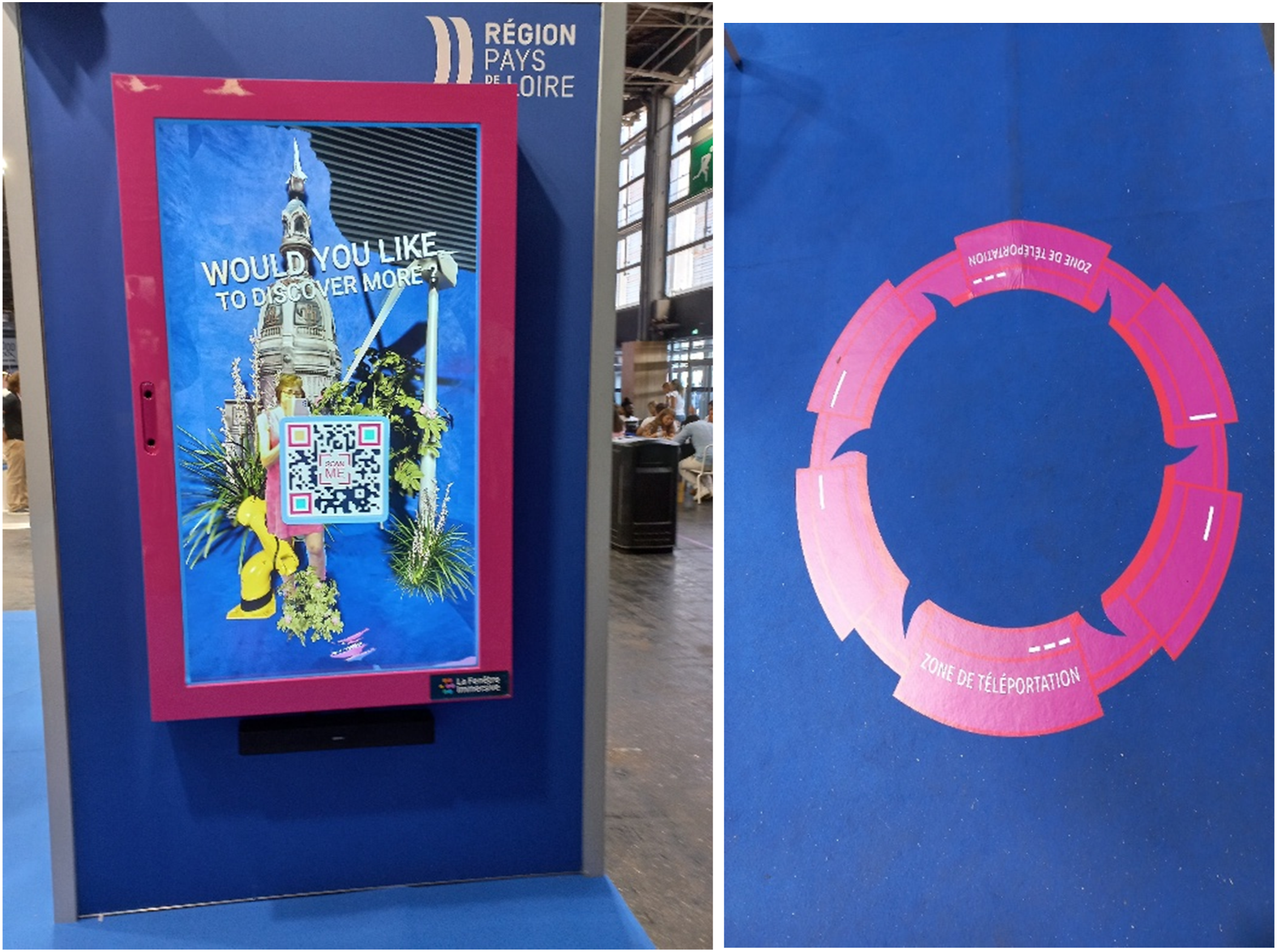
Created by Lilian Rabin, DigitaLandmarks is a French creative studio specializing in immersive and experiential communication. Its mission is to design innovative visual devices that capture attention in high-traffic environments. The studio’s flagship innovation, La Fenêtre Immersive (“The Immersive Window”), is a compact, mobile, and sustainable medium that delivers sensory-rich experiences without the need for headsets or wearable devices. Users simply step into a designated “teleportation zone” to be immersed in audiovisual content. Lilian gives more details about the device: The device consists of a large screen called the window. A vortex appears in the center of the screen. Further away, on the ground, is a pink circle in which users must stand. It is the teleportation zone. Several people can stand there together to share the experience. Of course, there is no need for a VR headset. It is very simple and fluid. When the experience begins, users are projected into the vortex, which they say resembles flames, with a magical quality. The technology is designed to transform passive audiences into active participants. It triggers emotional engagement through immersion. The experience then begins. Users are immersed in the landscape that forms the theme, for example Ireland or Futuroscope, a theme park.
La Fenêtre Immersive demonstrates how experiential technologies can combine sensory marketing with measurable engagement. It highlights the role of physical spaces in creating viral, shareable experiences that extend beyond the point of contact. La Fenêtre Immersive provides impact for users, venues, and brands. Lilian explains how the three levels work: It can impact three targets. For users, La Fenêtre Immersive offers memorable and rewarding experiences. For venues, it enhances attractiveness and differentiation. For brands, it ensures visibility, message memorization, and engagement metrics. We can add a fourth level: bypassers. Some consumers do not have time to try it or are too shy to do it, but they enjoy looking at it. It provides them with fun experience. They can also participate by encouraging users, applauding as they did for rugby or dancing with the Irish. They form an audience that encourages users. La Fenêtre Immersive offers them a less demanding way to participate than being at the center of the window, but some prefer to watch first.
Lilian adds that it has been deployed in several settings so far.
Deployment cases
La Fenêtre Immersive has been displayed in several settings to promote various contents. 1. Klépierre Shopping Centers (Nantes, Paris, Bordeaux) o Goal: Promote the Futuroscope theme park. o Results: Over 10,000 interactions in 12 days; 40M + impressions; 96.8% of users expressed intent to visit the park. 2. Gare Montparnasse (Paris) o Goal: Promote the Anjou region. o Results: 2.5 M impressions in 1 month; 96% message recall. 3. VivaTech Trade Show (Paris, Pays-de-la-Loire Region) o Goal: Increase booth traffic and highlight innovation. o Results: +15% booth traffic; 92% memorization rate. 4. Gare du Nord (Paris) o Goal: Support the Rugby World Cup campaign. o Results: More than 50,000 users in 7 weeks; 92% positive feedback; 74% social sharing. 5. Beaugrenelle Department Store (Paris) o Goal: Promote Northern Ireland tourism. o Results: 5000+ teleportations in 1 week; 1M + impressions; 97% satisfaction rate.
For each, Lilian gives more details. It was deployed in shopping centres to promote Futuroscope, a theme park located in western France. Hence shopping centres in Nantes and Bordeaux, which are major cities in the west, and Paris of course, where the trains depart from. It was deployed in Gare Montparnasse, a Parisian station that serves western France, particularly Anjou, a region highlighted by La Fenêtre Immersive. People enjoyed having their feet in the water, being able to pet a small deer and being surrounded by wind turbines. They talked about it afterwards, in a very precise and amused way. Each time, it was possible at the end to win trips via a QR code or to find out more about the destination, but this was not always done. It was then deployed at Viva Tech, a major digital event that attracts professionals over three days and then the general public. It was very well received. People said it felt like getting ready for a fairground ride. A ritual linked to the pink circle. It was then deployed in another Parisian station during the Rugby World Cup. Users were invited to kick the ball handed to them by world champion Antoine Dupont. A thunderous applause could then be heard. Children loved this experience and couldn't stop playing. Users were flattered to be playing alongside a champion and to be stars in their own right. Finally, it was deployed in a Parisian shopping center during Irish Week around St Patrick's Day. Users danced with Irish people remotely and visited Game of Thrones filming locations. Even those who were not in the pink circle clapped their hands and accompanied the users.
In conclusion, DigitaLandmarks positions itself as a bridge between creativity, technology, and marketing strategy. By emphasizing accessibility, emotion, and sustainability, La Fenêtre Immervice illustrates how immersive media can generate both consumer value and brand impact. As Lilian concludes, Now that all these installations have already proven successful, I need to continue marketing them. To do this, I need to understand the reasons behind its impact, why it appeals and how it appeals, and what effect it has on consumer behavior. This will enable me to refine my sales pitch and perhaps consider new B2B targets other than shopping centers and railway stations.
Summary of the situation
Creator of DigitaLandmarks, Lilian Rabin designed La Fenêtre Immersive, an immersive device that promotes tourism-related content. Installed in high-traffic areas such as shopping centers and train stations, La Fenêtre Immersive allows users to be transported to tourist destinations and enjoy a rich experience. In September 2025, Lilian wants to understand the impact of La Fenêtre Immersive on consumers in order to refine his marketing pitch and find new B2B targets where La Fenêtre Immersive can be installed. The Immersion, Presence, Performance (IPP) and SOR conceptual frameworks will enable him to understand the impact on the consumer.
Questions of the issues
Each question is related to one above-mentioned learning objective. Q1. Using Immersion, Presence, Performance (IPP) framework, explain the link between technological immersion and presence in the case of La Fenêtre Immersive. Q2. Using SOR framework and examples from Appendix 2, determine the variables that are relevant in the case of La Fenêtre Immersive and could be assessed. Q3. Understanding how La Fenêtre Immersive works, what sales arguments could Lilian use to convince companies of the impact of the window? Q4. In what other settings and contexts, could Lilian suggest his Fenêtre Immersive?
Footnotes
Author note
This case was made possible through the generous cooperation of Lilian Rabin and observations in different settings where La Fenêtre Immersive was installed. He allowed the authors several interviews and time to share information about the project. The case is intended as a basic for class discussion about the impact of virtual reality on consumers.

Funding
The authors received no financial support for the research, authorship, and/or publication of this article.
Declaration of conflicting interests
The authors declared no potential conflicts of interest with respect to the research, authorship, and/or publication of this article.
Author biography
Appendix
Pictures of La Fenêtre Immersive taken by the author. It shows the screen at the end of the experience, when the QR code is displayed. The second picture shows the pink circle, the teleportation zone.