






Abstract
After the success of Gurucool’s free Padhai App, their organisation was looking for alternatives to generate revenue from three broad options: expanding offline centres, adding premium features to old app or developing a new entirely premium app. The venture evolved from operating five offline learning centres with quality-assured tutors to launch the Padhaai mobile application surviving multiple external disruptions. Gurucool positioned itself as ‘India’s largest free learning platform’ with over 3000 curated courses in eight regional languages. By April 2024, despite initial traction, the company faced declining user engagement and session time. At their annual meeting aimed at discussing growth alternatives, Adil Meraj advocated reopening physical centres to provide blended learning experiences and rebuilding trust, while Khansa Fahad recommended the enhancement of the digital platform through AI-driven personalisation. This case examines how resource-constrained startups navigate competitive industry forces, identify unmet customer needs, apply lean methodologies, and develop strategic roadmaps while maintaining their social mission of making learning equitable and meaningful.
Keywords
It was early April 2024 in New Delhi. Adil Meraj and Khansa Fahad, co-founders of Gurucool 1 XYZ Private Limited, were preparing for the review meeting with the Board of Directors at their Jamia Nagar office. The meeting was called to discuss the growth options related to their online learning platform. Two years earlier, in August 2022, Gurucool launched the Padhaai mobile application (Gurucool, 2025), a free learning platform for Grades 6–12 and for competitive exam preparation. Despite the initial interest and traction among the users, the app’s usage rate and average session time rapidly declined. This mirrored the struggles of the Indian EdTech market during that time. The EdTech sector in India was struggling and over 90% of free learning apps were abandoned within 3 months (Anand and Anand, 2025). Even big Giants like Byjus were facing serious issues.
To grow, Gurucool team was contemplating to go back to their initial plan of launching physical centres combined with the online learning app, providing a blended learning experience to the students. The team had discussed and argued about the scale of expansion of offline centres. Adil Meraj favoured reopening and expanding brick-and-mortar centres, while Khansa Fahad wanted to prioritise the online experience further. Gurucool’s key executives were all set for their meeting to discuss future strategies for their startup.
Ideation and incubation of Gurucool
Having seen their parents struggle with finding a suitable tutor during their school time, they had a first-hand experience of the challenges associated with finding the right balance between quality and affordability. This was the challenge that remained stuck in their minds. In 2019, when Adil and Khansa were in their pre-final and second year of engineering, they conceptualised and launched Gurucool as a hyperlocal tuition aggregator service. With Gurucool, they offered a platform to search for reliable tutors within close proximity of the students and standardise the delivery and quality of service. They had a non-conventional tutoring model with a structured learning experience, including attendance tracking, curated study material, doubt-clearing sessions, and progress tracking.
Before onboarding, the tutors were screened and provided with teaching kits as a quality assurance measure. The tutors were also given an evaluation framework to measure the learning outcomes. This tutor aggregator model was well received by both parents and children, as it not only gave them better access to quality educators but also helped them to regularly track the outcomes. However, the personal tuition model was still expensive for many students. To address this concern of the parents, the founders experimented with a shared tutor model, where multiple students were taught at one of the tutees’ homes. However, this model did not gain much momentum, as hosting sessions at a tutee’s home was often not feasible due to space constraints.
Adil and Khansa, determined to continue their mission, realised that they had to develop something more practical. Khansa and Adil borrowed one million rupees (INR) from their families and utilised their savings to start their first offline tuition centre in March 2019 in Jamia Nagar, New Delhi. To maintain quality, the founders decided to limit the batch size to 15 students and focused on giving them a rounded exposure by not just limiting to academics but also conducting classes on hobbies (e.g. calligraphy) and skill development (e.g. coding, robotics, and UI/UX) as well. Additionally, the calm persona of the instructors (teachers were called ‘Cool Gurus’) and the lively decor of the centres made it a fun place where students loved to hang out and dedicate time towards learning and upskilling. The positive feedback of the first centre led to requests from the students and parents to open more such centres. This led to the setting up of four more such centres within the vicinity of Jamia Nagar. Within a short span of a few months, four more such centres were set up within the vicinity.
In hindsight, this might have appeared simple and small yet, and it was unheard of at the time for an education service provider of such a small size, consisting of a team of just two, to use structured processes and protocols. Being engineering students, breaking down a problem, analysis, and a methodical way of designing solutions was something that came naturally to both Adil and Khansa. The co-founders also aimed to transform the traditional image of a strict and formal tutor into that of a more approachable, fun and engaging teacher.
Closure of offline centres
In December 2019, protests of the Citizenship Amendment Act erupted in Shaheen Bagh, Jamia Nagar (BBC News, 2020), leading to a curfew-like situation. The Shaheen Bagh incident affected their operations significantly. Despite the turbulence, the founders remained hopeful about the revival of the centres. Unfortunately, they faced another blow in the form of the COVID-19 pandemic in early 2020. The whole country came to a standstill due to the nationwide lockdown. As a result of restrictions, uncertainty, and continued cash burn, they were forced to close their centres. During that period, the co-founders also attempted to start online tuition services but realised that most tutors lacked the skills and resources required to deliver classes using online pedagogy. These challenges lead to the shutdown of all five centres. With prolonged restrictions and cash burn, ultimately all five centres were forced to close.
The co-founders encountered a severe resource crunch in the coming 2 years and often ran out of ideas to sustain their venture. Additionally, they were trying to balance their academics during this entire time. However, they remained deeply committed to the vision to ‘curate the world’s knowledge and make learning equitable and meaningful’. Adil graduated in 2021, and Khansa a year later; both were committed to reviving Gurucool and opted out of the job placements in their college.
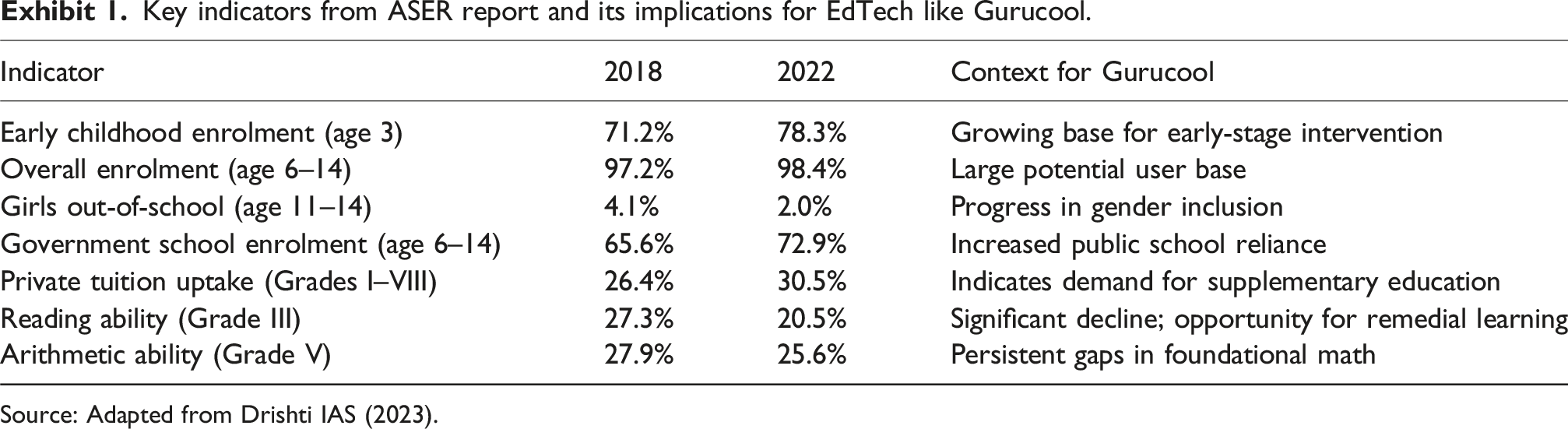
In Jan 2022, the Annual Status of Education Report was published by Pratham, a not-for-profit organisation that focuses on quality education for underprivileged children in India. This report estimates children’s schooling and learning levels in rural India. The report highlighted a decline in basic reading and arithmetic skills amongst school-going children; the gap was more acute in rural areas due to limited access to technology and online material for teachers and students. Adil and Khansa were growing restless but remained determined. Over the next few weeks, they had several brainstorming sessions over innumerable cups of coffee. They began rethinking and exploring how they could integrate technology to make learning more accessible and affordable. Khansa and Adil envisioned a model that could blend digital and physical learning, recognising that each had limitations when used in isolation on learners. Adil Meraj reiterated their vision in an interview, ‘We understood that physical learning has limitations. Digital is necessary for the democratisation of education because it brings together a vast pool of content and essential tools from around the world. But it lacks the soul’.
They finally decided to start an online education content curation platform that could help learners by providing all their learning resources, such as video playlists from YouTube, flashcard quizzes, and printable course packs. While both co-founders had engineering degrees – an advantage in understanding the technical aspects – it was not enough to develop the platform at scale. They needed funding. They needed a team. Once again, they relied on their bootstrapped funds to build an initial team for software development, hiring several interns from nearby colleges. Their close affiliation with their alma mater, Jamia Millia Islamia University, helped them gain access to students who volunteered to help them develop the content and provide vital support in building the technology foundation. The mobile application journey started with some basic paper sketches. Soon, with the help of the interns, they developed a high-fidelity wireframe, which they were able to showcase to investors and were able to secure a funding of $150,000 in November 2021. This investment enabled them to scale their prototype into a full-fledged platform and hire a small team to manage social media marketing.
Padhai App development
Key indicators from ASER report and its implications for EdTech like Gurucool.
Source: Adapted from Drishti IAS (2023).
Soon they had detailed discussion on the broader implications of the report and how Gurucool could work towards improving the situation, especially for children from underprivileged and low-income families. They guided their product development team to incorporate the elements of UI/UX and conducted enough A/B tests to make their platform highly user-friendly. Their app has class-wise and subject-wise classification. Through several iterations, they finally developed and launched their app on 12th August 2022. The Gurucool team would need a strong marketing promotion strategy to increase the adoption of the Padhaai app.
Marketing and promotion of Padhaai App
Padhaai app was positioned as India’s largest free learning platform, with over 3000+ curated courses in eight regional languages catering to K12, competitive exam preparation and skill-based learning aspirants. However, promoting the app was not less challenging. As of June 2022, there were 2.65 million (Statista, 2023) android apps in the marketplace, of which 3.87 million (Wylie, 2025).
As huge number of apps were available in the education category, promoting the Padhai-App in such a crowded marketplace was the next big challenge. The Gurucool Team initially tried promoting the app using the most common digital marketing channels, such as PPC, display ads, FB, and Instagram ads. Still, these channels required high cash burns with low engagement and conversion. Adil Ahmed, the newly joined COO, suggested that building and leveraging the personal brand of key executives can also help Gurucool develop its brand. He cited examples of Elon Musk, whose personal branding activities helped Companies like Tesla and SpaceX. He further cited examples of D2C brands like Suta and Sleepy Owl. Adil Ahmed, an intern, joined the Gurucool’s team as co-founder and COO in October 2022. He had already played a crucial role in extensive business development and curating hundreds of courses for the Gurucool platform.
Ahmad understood the limitations of paid digital campaigns and emphasised that a shift towards offline engagement and organic marketing would be more helpful. Then, he devised the recipe of community-driven initiatives and social media brand-building as key promotional tactics. Adil and Khansa were potential faces for this strategy. However, due to some personal commitment, Khansa did not want to leave Delhi for a while. Adil Meraj took the responsibility of leading the brand’s offline presence, engaging directly with schools and communities. Soon, they initiated several on-ground campaigns, which were organically spread using digital platforms. Adil Meraj visited hundreds of schools across the country. They launched the #mission10000 campaign to onboard 10,000 students in the next 30 days.
The Higher Education Department of the Government of Bihar recognised the Padhai app and approved it as a pilot project (Yunus, 2022). This boosted Gurucool’s morale. The endorsement from the higher education department also helped Gurucool’s team gain access to a broader network of students and institutions, strengthening its credibility. As of April 2024, Gurucool had six phygital centres. Adil Meraj, through his outreach efforts across India, had been able to take the Gurucool’s Padhai app to 20,000 Gram Panchayats (Unacademy, 2025).
Gurucool aspired to be the ‘EdTech of the developing world’, catering to students and educators even beyond India. The platform had amassed more than 250k users and had gained a reach of 10 million across social media platforms. Despite the Padhai app being enthusiastically adopted by users, its continual usage, course completion, and average session time were still a significant cause of concern. The response with physical centres was high, along with app usage. However, there were limited physical centres available with the Gurucool team, and they were considering increasing the numbers soon but their Covid 19 experience, followed by the closure of the physical centres, was still fresh in their minds.
The boardroom debate
The tension in the room was palpable. Outside, the early summer heat of Delhi had cast a dry haze over the city, but inside the air-conditioned Gurucool office, the co-founders and leadership team were locked in debate. Meraj was in favour of opening more offline centres. He believed that in-person teaching could bring out trust and motivation in students. He added that students and parents from small cities would be more inclined towards offline centres. ‘Parents in these regions still equate quality education with physical classrooms’, he emphasised. He then gave the example of the National Education Policy (NEP) 2020, wherein blended learning was encouraged, and Gurucool’s phygital model aligned with the NEP 2020s vision. ‘Our physical centres were thriving before COVID-19. If we expand strategically, Padhaai can become a supplement rather than a substitute for structured offline learning’. He argued in a positive and polite tone.
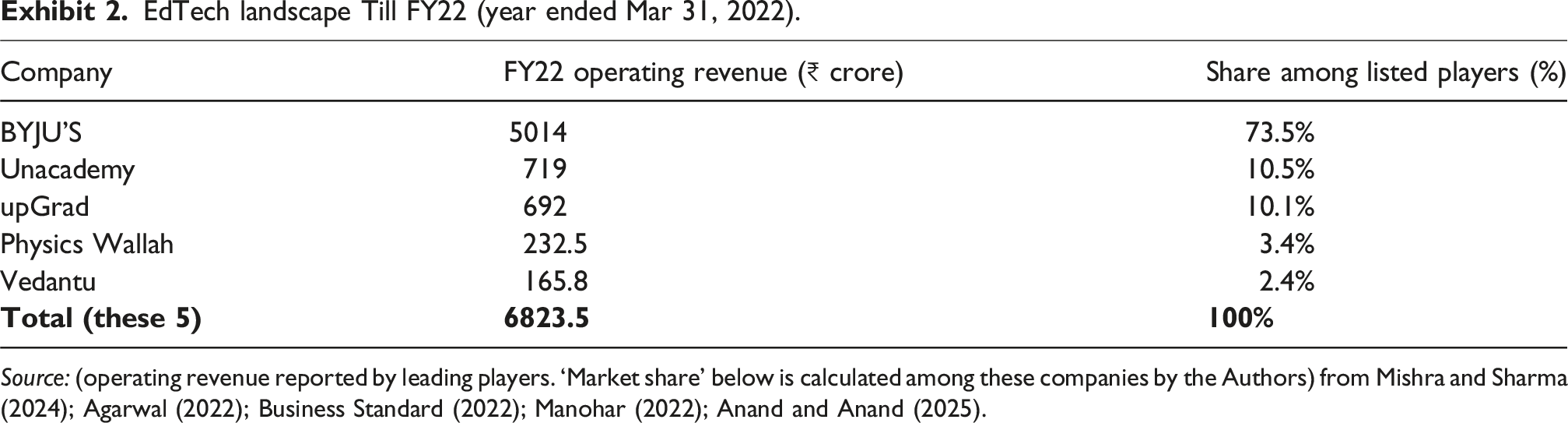
EdTech landscape Till FY22 (year ended Mar 31, 2022).
Source: (operating revenue reported by leading players. ‘Market share’ below is calculated among these companies by the Authors) from Mishra and Sharma (2024); Agarwal (2022); Business Standard (2022); Manohar (2022); Anand and Anand (2025).
Adil Ahmad also nodded with affirmation in support of Khansa Fahad. He suggested that by using the latest AI technologies, Gurucool could address the learning gaps of young learners. ‘We should aim to create a truly adaptive learning experience, where students feel like they have a personal tutor, even if they’re studying alone’, he added. But Ahmad also cautioned that they can’t add more money to an already free application, hinting that they did not charge any money for the Padhai app. Ahmed looked at Fatima, the senior developer who along with Ahmed, looked after the product development efforts at Gurucool. Fatima had joined the Gurucool team just 3 months back and had been an indispensable force in troubleshooting the backend and front-end issues for the platform.
Fatima, with some hesitation, suggested developing a premium app that is more powerful than Padhaai. She said, ‘We can launch a two-tiered model in which the Padhaai app remains free, but we can also introduce a premium AI-powered platform with structured courses having interactive features and mentorship support’. Fatima hinted towards a flexible pricing model. There could be an affordable subscription for mass adoption and a premium option for students seeking advanced features, such as live doubt-solving, personalised coaching, and hybrid learning access.
For a moment, the room fell silent. Khansa was smiling at Fatima, Ahmad and Meraj. Ahmed believed that a hybrid approach would allow them to leverage Padhaai as a lead generation tool while creating a sustainable revenue stream through the premium app. A tiered model, he added, would balance affordability and profitability, ensuring that Gurucool remained accessible while still growing as a business. But Meraj wasn’t ready to concede. He asked, ‘and what about our offline centres?’ He continued with perplexity on his face, ‘Should we also not consider expanding our phygital centre as we did earlier before COVID-19?’
Closing
The debate was far from over, but a direction was emerging. Gurucool was no longer simply deciding between offline and online expansion. It wanted to redefine its identity in a rapidly evolving EdTech space. Their decision now would shape their future in a booming yet unpredictable industry.
Assignment Questions
(1) Analyse the key challenges Gurucool faced in the Indian EdTech industry using Porter’s Five Forces. How should these forces influence their strategic options? (2) Identify the major unmet jobs-to-be-done for Gurucool’s users (students and parents) using the Value proposition Canvas. What are the implications of identifying these jobs for Gurucool’s product enhancement? (3) How should Gurucool apply Lean Startup principles such as Minimal Viable Product (MVP) testing and user feedback to iteratively improve its app and offline offerings? (4) Create a Strategy Canvas comparing Gurucool with 3–4 rivals (online/offline) on 8–10 key factors.
Footnotes

Funding
The authors received no financial support for the research, authorship, and/or publication of this article.
Declaration of conflicting interests
The authors declared no potential conflicts of interest with respect to the research, authorship, and/or publication of this article.