







Abstract
Artificial Intelligence (AI) is revolutionizing the e-commerce sector, enabling online retailers to create intelligent, adaptive, and highly personalized shopping experiences. This article explores how AI-powered webshops are transforming online shopping, their adoption, benefits and challenges, and the implications for future retail considerations for consumers and businesses.
Keywords
Introduction
With the exponential growth of digital commerce, online retailers are constantly seeking innovative solutions to improve user experience, efficiency, and profitability. Artificial Intelligence, encompassing machine learning, natural language processing, and computer vision, has emerged as a transformative force in this domain. AI-powered webshops leverage these technologies to automate processes, predict consumer behavior, and deliver personalized experiences at scale.
AI is becoming ubiquitous, with different AI platforms advertised as a “help” to consumers on every level. However, as Moerland and Kafrouni (2021) observed, “For non-experts in the field of AI, it is difficult to get a deep understand of what exactly particular AI tools do and how they operate.” We are merely scratching the surface of what AI can do, and those who are on the cutting-edge of AI technologies have a distinct advantage over those who aren’t adopting them to their full extent—or at all.
AI technologies in online shopping
An online store that uses artificial intelligence to enhance customer experience and automate business operations is now commonly referred to as an “AI-powered webshop.” AI is meant to improve customer experience, customer satisfaction, and customer loyalty to the brand, but because it is still relatively new technology, more research could verify how consumers adopt and use the technology. As I covered in my book, Digital Marketing and Analytics, we are only starting to see what AI can do. Artificial Intelligence (AI) and Machine Learning (ML) have the ability to automate processes and increase accuracy, responsiveness, and agility (Manko 2024a). How do we determine if the AI we’re incorporate is effective? Nagy and Hajdú (2021) and others posit that using the technology acceptance model (TAM) can be the best way to analyze the question of trust and consumer acceptance of Artificial Intelligence in online retail.
It is important for companies to incorporate this technology on their own platforms so they can control the data. Consumers will be using it with or without them. For example, ChatGPT allows users to interact when online shopping. AI-powered chatbots like ChatGPT can “enhance customer engagement, provide personalized recommendations, and improve overall customer experiences. This opens up avenues for businesses to leverage AI technologies in various interactive activities, such as customer support, personalized marketing, and virtual assistants. Further exploration of these opportunities can lead to the development of innovative AI-driven solutions that cater to evolving customer needs and preferences” (Huang 2023).
In 2020, Mari made these remarks about Amazon Alexa and similar voice assistants.
While performing complex tasks with consumers, VAs become more human-like exchange partners. As these AI-enabled devices learn consumer preferences and habits, they introduce biases and heuristics likely to affect individual and collective shopping behavior while posing new opportunities and threats for managers.
Because these voice assistants assume a “central relational role” with consumers, this places them in a position to progressively mediate market interactions and increasingly influence consumption decisions increasingly (Mari, 2020).
Before moving too far into the future of AI, let’s analyze how AI interacts with consumers online and the current benefits they get from using it in their everyday decision-making processes (Figure 1). AI works as a personal assistant to recommend products. (Source: Google Gemini).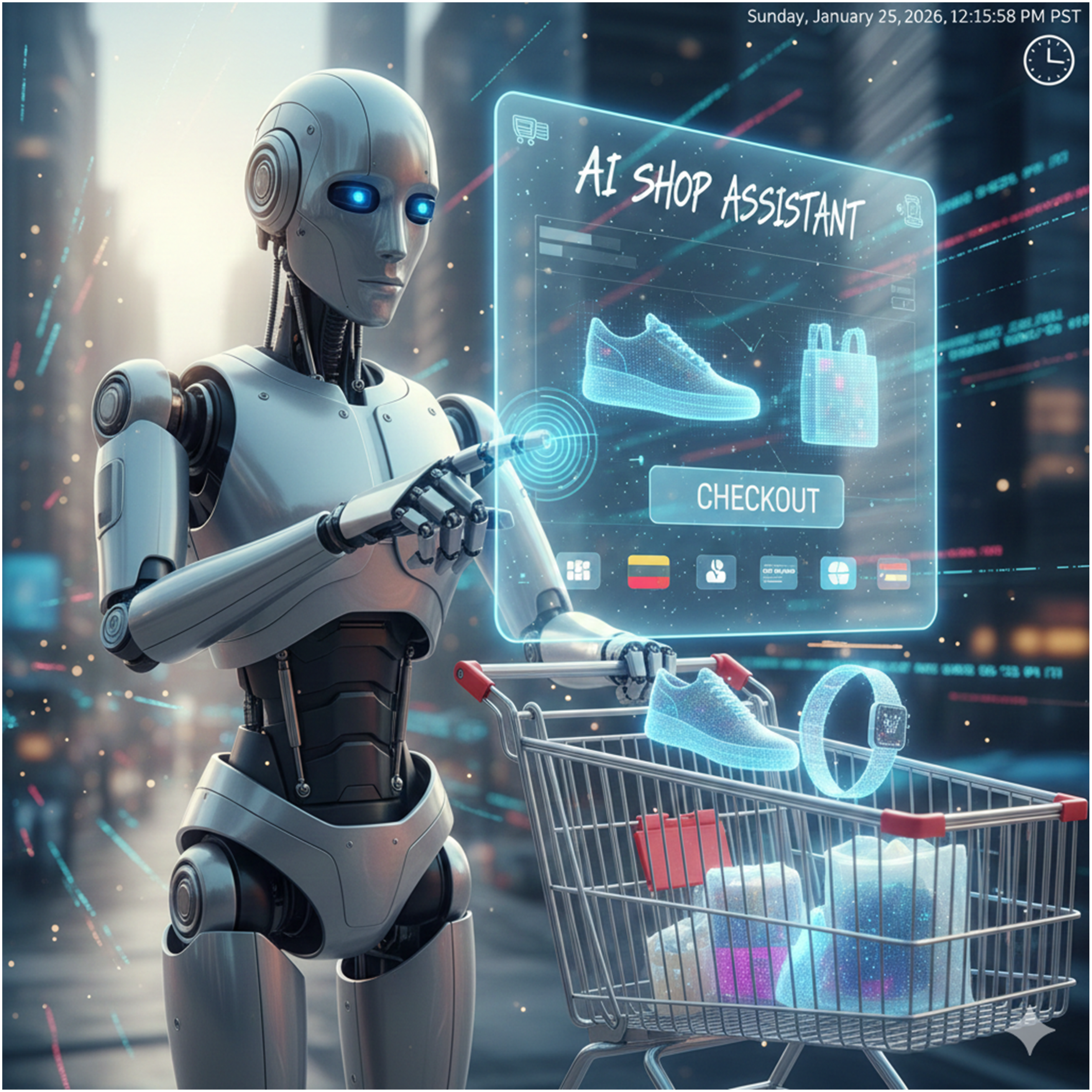
Personalized product recommendations
One of the most visible applications of AI in e-commerce is the recommendation engine. By analyzing browsing history, past purchases, demographic data, and real-time interactions, AI algorithms can suggest products tailored to individual preferences. This not only enhances customer satisfaction but also increases conversion rates and average order value. AI automates processes that before would have required data analysis and manual targeting.
Artificial Intelligence replies to customer inquiries, sending reminders about the wish lists and tailored alerts on shopping deals the customers. Moreover, AI helps businesses to deal dynamically inventing new modes of communication to engage customers. Also, AI contributes to the process with more accurate data and enabled e-commerce shops to find the right customers (Ramya and Karthikeyan 2024).
These AI recommendations are so effective that consumers often comment that they merely have to think about an item and they will be targeted online to purchase it. Hooli (2025) suggested that more than personalized, these experiences are now “hyperpersonalized,” and “adapt to individual preferences in real-time.” How is this possible? “The integration of sophisticated machine learning algorithms enables retailers to process vast amounts of customer data… Deep learning architectures, particularly neural collaborative filtering and transformer-based models, have revolutionized recommendation systems, while generative AI technologies are transforming demand forecasting and supply chain optimization. Beyond these core applications, AI permeates every aspect of retail operations, including dynamic pricing, computer vision analytics, chatbot-powered customer service, and warehouse automation. … As the retail landscape continues to evolve, AI emerges not merely as a competitive advantage but as an essential foundation for sustainable success in an increasingly digital marketplace.” (Ibid)
Chatbots and virtual assistants
AI-driven chatbots and virtual shopping assistants provide real-time support, answer customer queries, and guide users through the purchasing process. These systems use natural language processing to understand and respond to customer requests, often resolving issues without human intervention and reducing operational costs.
Consumers benefit from “human-like interaction in online environments” that “can quickly resolve most costumer queries,” and because these AI chatbots aren’t human, they are always available (Chakraborty et al., 2024).
Visual search and image recognition
Computer vision, a subset of AI, enables visual search capabilities in webshops. Shoppers can upload images to find similar products, bridging the gap between inspiration and purchase. AI-powered image recognition also automates product tagging and categorization, making inventory management more efficient.
This could be especially impactful to allow shoppers to search for specific items, incorporate new items into existing décor, or make clothing and other fashion purchases. AI can incorporate customized recommendations based on sizing, style, and previous purchases, digital try-on, and styling to help consumers view apparel online (Ademstu et al., 2023). It is also possible to customize clothing in a fast and cost-effective fashion (Manko 2024b).
Dynamic pricing
AI algorithms analyze market trends, competitor pricing, demand fluctuations, and user behavior to adjust prices in real time. This dynamic pricing strategy allows webshops to maximize profits while remaining competitive and responsive to market changes. These personalized deals may influence users to buy from one platform over another, especially as they attempt to combat the effects of inflation.
In order to best incorporate AI into retail platforms, companies must look at past, present, and forecasted consumer behavior (Figure 2). Integration of shopping options into social media allows users to buy targeted products and services with one click. (Source: Pixabay, content creator geralt. Used by permission).
Online consumer behavior
Online consumer behavior studies how individuals search, evaluate, and make purchasing decisions for products and services in a digital environment. It involves understanding the psychological and behavioral patterns that drive online actions, such as website navigation, product research, and final purchase, influenced by factors like price, convenience, trust, and social media.
We have covered the importance of brand in other literature reviews. As commerce has moved online to e-commerce, it is important for a brand to continue to reinforce brand awareness, brand association, perceived quality, and brand loyalty, and to offer a superior customer experience (Manko and Jose 2022). As shopping becomes personalized, the stakes rise higher and higher, to top the company who is currently able to offer the best service.
Xiong (2022) points out that “consumers are a product of the times,” meaning that people are influenced by historical, cultural, and media environments, which form their online buying behavior. For instance, we know that online commerce has grown significantly following the COVID-19 crisis and with consequent achievements in technology. We also know that “technology plays a central role in Gen Z shopping experiences” (Bunea et al., 2024), as technological advancements are often adopted quicker by younger generations. Established businesses may need to change their model to keep up with their audience. “Personalization, in particular, is highly valued by Gen Z consumers…This generation expects a seamless integration of shopping channels and personalized recommendations based on AI-driven algorithms” (Ibid.)
There are different stages of the purchasing process with different levels of technological advancement and different levels of involvement within them (Moerland and Kafrouni 2021). These aspects can be used to assess the effectiveness of AI tools used by consumers. Within the different stages of shopping, consumers have different interactions online:
In the product awareness and product interest stage, the main exposure is the integrated portal and web video. In the product information search stage, the main contact is with search engines and online communities; in the purchase stage, the main contact is with e-commerce websites; after using the product, the main contact is with the online community (Xiong 2022).
Key aspects of online consumer behavior
Digital interaction
This includes how consumers search for products, navigate through e-commerce sites, and interact with digital content like product reviews and social media posts.
Pham et al. (2024) analyzed search behavior, looking at various aspects such as “search intensity, which is defined as the amount of time and quantity of information consumers spend on searches before making a purchase” and “search time [which] refers to the time consumers are willing to spend in gathering decision-making information.”
Decision-making process
Analyzing the “why” behind a purchase, including factors that influence choices, such as promotions, price comparisons, and the need for specific products.
Customer experience
How consumers feel about a brand’s online presence, which includes website aesthetics, ease of use, and customer service.
Influence of digital factors
The role of digital-specific elements, such as the convenience of mobile shopping, the availability of a wide product selection, and transparency in delivery and shipping.
Social and emotional factors
How emotions, social surroundings, and cultural backgrounds influence online buying habits.
How businesses use this information
Businesses can use this information to tailor strategies that effectively attract and convert customers; improve products and services and the overall customer journey; develop pricing strategies that optimize their pricing models; and build trust and loyalty by understanding what drives online purchases and catering to their customers.
Benefits of AI-Powered webshops
As mentioned above, AI Powered Webshops offer the benefit of enhanced personalization. Highly customized shopping experiences increase customer loyalty and satisfaction. AI also automates routine tasks such as customer service, inventory management, and order processing to reduce costs and human errors leading to operational efficiency. Data-driven insights from AI systems support improved decision making strategic. Finally, AI solution allows all these activities at scale. The ability to handle large volumes of data and transactions supports business growth without proportional increases in staff.
We previously mentioned fashion and other specific avenues for AI. Another area of innovation is grocery shopping. Consumers have benefited from ordering online and accessing their previous grocery lists and receiving personalized recommendations for some years now. The latest technological advances include personalized shopping applications, VR applications, metaverse shopping, and numerous functions on smart devices, such as voice control, using handwritten shopping lists and more) (Stecuła et al., 2024).
At this point, the retail industry has already been transformed in recent years, and customer expectations have evolved as well. We are seeing the scope of AI powered technologies increase. In order to optimize their operations in a dynamic retail landscape, Qureshi and Khan (2025) believe more study is on “factors that enhance customers’ retail shopping experiences, customers’ concerns about AI powered technologies, the key factor that drives the customers’ purchase intention, the challenges in integrating AI powered technologies into retail setting and the external factors which effects the customers to integrate AI powered technologies into their retail shopping experiences.” Next, we will look at the best ways to determine how consumers are accepting AI technology.
Technology acceptance model
The Technology Acceptance Model (TAM) is a theory that says users are more likely to adopt a new technology if they perceive it as both useful and easy to use. These two factors determine a user’s intention to use the technology, which in turn predicts their actual usage. This model is widely used to predict and understand user behavior toward new technologies.
Using this TAM model, Vazirani (2024) suggests that “AI and marketing is going to grow significantly in the future,” based on the following observations over increased computing power, reduced costs, and the use of advanced machine learning models: For the majority of consumers, buying products online has become an incredibly practical option. In recent years, due to technology advances, it has become more popular. Use of AI in shopping apps or web pages has attracted more consumers. People are now more comfortable and more familiar with the technology.
Again, most consumers are familiar with the idea that AI. uses advanced technologies that can mimic human intelligence and perform tasks that normally require human reasoning and creativity. can help companies improve their marketing and sales strategies through data analysis, content generation, customer engagement, and performance optimization. can create chatbots that can communicate with customers, deliver targeted ads that match customer interests, produce engaging and relevant content for different platforms, identify and prioritize leads, and also provide personalized recommendations and feedback.
The question then becomes “How do consumers perceive the use of AI in online shopping and how does it affect their intention to buy?” (Bunea et al., 2024).
Applications and implications
Using TAM to calculate the benefits of AI can identify potential obstacles to technology adoption based on user perception, guide the design of user-friendly and value-added systems that are easy to use and have obvious consumer benefits, develop training programs that emphasize user-friendliness and provide step-by-step instructions if ease of use is a concern, and monitor adoption rates and factors that influence them to track how user attitudes change over time.
One of the drawbacks to adoption is the need for consumers to share personal information. Over time, consumers have become more willing to share personal privacy if they can see the benefits, such as personalized recommendations, intelligent advertising, shopping efficiency, and reduced costs. However, when consumers see negative effects like spam and misuse of their information, they are then more likely to opt out. Wang et al. (2021) observe, “A win-win situation with benefit maximization for both consumers and e-commerce platforms [exists] under the condition that consumers’ privacy is well protected.”
In his doctoral dissertation J.V. Madhani developed his own model to measure the intention to adopt AI tools. He used the following categories: Perceived Usefulness, Perceived Ease of Use, Utilitarian Benefits, Social benefits, Trust on Internet, and Trust in AI tools and found these to be “efficient predictors of consumer’s intention to adopt AI tools in online shopping” further taking into consideration the consumers’ demographics. Prediction of adoptability allows businesses to offer the level of technology that consumers are comfortable with (Madhani).
Challenges and ethical considerations
So, we see that despite its advantages, integrating AI into online shopping presents challenges. Hooli (2025) says these challenges include “data quality issues, organizational resistance, ethical considerations, and substantial financial investments. The evidence suggests that achieving meaningful returns from AI requires not just technological sophistication but comprehensive organizational learning capabilities, strategic vision, and robust governance frameworks.”
Data privacy and security are paramount, as AI systems require access to extensive user data. There is also the risk of algorithmic bias, which can lead to unfair or discriminatory outcomes. Transparency in AI decision-making and adherence to ethical guidelines are essential to maintain consumer trust. In order to improve customer satisfaction and loyalty, businesses must consider contextual factors and leverage AI in a customer centric manner as well as addressing privacy concerns and incorporating personalized recommendation effectively (Maharjan 2024).
Ademtsu et al. (2023) address these factors specifically in the fashion industry:
Data privacy, algorithmic bias, sustainability, and the possible effects on employment and labor practises in the fashion sector are all topics that might be researched. It’s crucial to make sure AI technologies are created and applied in a just and responsible way. It is crucial to investigate how AI can close the gap between offline and online purchasing experiences given the advent of multichannel retail.
AI doesn’t inherently have its own set of moral or best practices, so they must be programmed in.
This is especially important when the fact that AI is programmed to take human jobs: “McKinsey Global Institute predicts that intelligent agents and robots could replace up to 30 percent of the world's current human labor by 2030. Artificial intelligence is impacting the longer term of virtually every industry and each person” (Ramya and Karthikeyan 2024). AI will not only suggest purchases, but in an article by Muslikhin et al. (2021), they explained how AI will become the pickers for the actual merchandise. They developed an “Artificial Intelligence of Things (AIoT)-based automated picking system,” developed an online shop, and automated the shipping systems. The online interface displayed offers, payments, verification, and stock updates and then robotic manipulators selected items from shelves in store. They concluded, “Our system performance is proven by experiments to meet the expectations in evaluating efficiency, speed, and convenience of the system.” Is this the wave of the future? Completely unstocked stores? There are already Amazon Go stores that calculate the shopper’s purchase and then you without the need for checkout with “Just Walk Out” technology. Customers only need to scan a code from the Amazon app to take advantage of the technology.
In 2022, we analyzed the Wegman and cited it as one of the best grocery chains that was using cutting-edge technologies to reach customers, including big data analytics to personalize the customer experience, the Wegman’s app, a mixture of traditional grocery store, self-service, e-grocers, and online deliver, and automation and robots. Not even three years later, these perks are standard (Manko 2022). Wolniak et al. (2024) explain how this smartphone scanning technology may work on a larger scale in the future and the benefits to consumers. Customers may be able to: Scan items as they shop, for a faster shopping experience that eliminates the need to place products on a belt conveyor, scan them and then pack them into bags, and also reducing or eliminating the need to wait in checkout lines. Add or remove items from the virtual cart at any time. Control their purchases in terms of products, prices, and the overall total payment for shopping. Make informed purchasing decisions with instant price and product information. Get additional features through the mobile app such as digital receipts and shopping lists. Track spending in real-time and manage budgets more effectively.
It also helps staff by: Reducing staff required at checkout counters, allowing resources to be allocated to other areas of the store. Ensuring accurate pricing and inventory management with automated systems. Allowing faster, contactless payment options through the app or dedicated terminals. Reducing congestion at traditional checkout areas.
There are inherently also potential problems with the technology. Wolniak et al. call out malfunctions or glitches in scanners or apps, connectivity issues, increase risk of theft or misuse through making intentional scanning errors, unintentional errors that lead to incorrect totals or missed products including human error or barcodes that don’t register, etc. The reduction of staff that may look good on paper also allows for some of these abuses of the system, and may also make some customers feel less safe in their shopping experience with no human oversight. As with everything, the more the technology is put into place, the more people will get used to it and accept it as normal.
Future outlook
The future of AI in online shopping is promising, with ongoing advancements in natural language understanding, predictive analytics, and immersive technologies such as augmented reality. AI-powered webshops are expected to become even more intuitive, anticipatory, and responsive to individual needs, further blurring the line between physical and digital retail experiences.
In addition, “as e-commerce systems continue to evolve, they cater to an increasingly diverse global audience, fundamentally transforming the way individuals shop and businesses operate” (Nofirda and Ikram 2023). Making ecommerce platforms accessible will ensure users with visual, auditory, or motor disabilities; cognitive challenges; or situational limitations experience a “comprehensive and inclusive approach” to online shopping that gives them the same options as everyone else.
Jarek and Mazurek called for “especially ideas about implementing AI into marketing, designing innovations and the ideas on how to incorporate new skills into marketing team required by the new technology” in 2019. They were correct in predicting that “AI influences all aspects of marketing mix impacting both consumer value delivery as well as the marketing organization and management,” and despite the time that has passed, we would argue that we are “still at the level of experimenting with it,” and testing the limits of what it can accomplish (Jarek and Mazurek, 2019).
AI technology can “improve the whole shopping experience,” and we still have not seen all the ways “chatbots powered by AI, smart mirrors, augmented reality (AR) applications, and virtual showrooms” can be utilized (Ademtsu et al., 2023). AI has touchpoints from start to finish. They use the fashion industry as an example.
AI has the potential to significantly improve inventory management, demand forecasting, and logistics in the fashion industry. Research can examine how supply chain process optimization, waste reduction, sustainability enhancement, and general operational efficiency can be improved using AI approaches like machine learning and predictive analytics. Pattern creation, trend forecasting, and other creative aspects of the fashion industry can benefit from AI algorithms. Understanding the interaction between human designers and AI systems, as well as how AI may enhance human creativity and push the limits of design innovation in the fashion sector, might be the main areas of research. These research ramifications demonstrate how interdisciplinary it is to investigate how AI is transforming the clothing and fashion product buying experience. Numerous disciplines, including consumer behavior, human-computer interface, data science, ethics, supply chain management, and fashion design. (Ibid)
AI technology may replace some human interactions, but it will never be a substitute for human innovation. Using AI as a tool to automate processes, analyze data, and run the mundane tasks of business frees human minds for creativity and dreaming the next big thing.
Conclusion
Artificial Intelligence is reshaping the landscape of online shopping through AI-powered webshops. By enhancing personalization, efficiency, and scalability, AI offers substantial benefits to both consumers and retailers. However, addressing challenges related to data privacy, ethics, and transparency remains crucial for sustainable growth and trust in AI-driven e-commerce.
Questions
How does artificial intelligence personalize the online shopping experience for individual customers? What are some examples of AI technologies used to improve customer service in online retail? In what ways can AI-powered recommendation systems influence purchasing decisions on e-commerce platforms? What challenges do online retailers face when implementing AI solutions in their webshops? How does artificial intelligence help detect and prevent fraud in online shopping environments?
Footnotes
Acknowledgments

Funding
The authors received no financial support for the research, authorship, and/or publication of this article.
Declaration of conflicting interests
The authors declared no potential conflicts of interest with respect to the research, authorship, and/or publication of this article.