







Abstract
This teaching case examines AquaTech’s critical decision to overcome the ‘black box’ dilemma of open-ocean aquaculture – a traditional industry reliant on veteran farmers’ tacit knowledge for feed management in highly volatile environments. This subjectivity created severe financial and environmental risks, including costly resource waste and crippling downstream supply chain inefficiencies due to low inventory accuracy. The case details the implementation of an innovative AI system that fuses computer vision, sonar, and IoT sensors to provide real-time, empirical data on fish satiety and biomass. The AI pilot demonstrated decisive operational superiority, leading to a substantial increase in Feed Conversion Ratio (FCR) efficiency, which simultaneously drove down feed costs, significantly increased harvest yield, and reduced environmental impact. This digital transformation illustrates the profound potential for traditional industries to solve persistent challenges by adopting new technology.
Introduction
On a humid afternoon in Penghu, Mr. Liu, the CIO of AquaTech stood on the swaying deck of a feed barge, staring into the dark blue waters of the Taiwan Strait. Beneath him, in a submerged net cage the size of a basketball court, thousands of Cobia (Rachycentron canadum) were swimming. ‘For generations, aquaculture was practiced as an art rather than a science, defined by the tacit knowledge and “gut instinct” of veteran farmers who gauged hunger merely by the splash of fish on the surface. Yet, as CIO Chang glanced at his tablet, he saw the industry’s future in high definition. Streaming from 20 m below the surface was a live dashboard of empirical truth: precise biomass weight, individual fish metrics, and real-time hunger analysis’.
‘We are managing a biological asset we cannot see’, Chang remarked to his operations Director. ‘For years, we guessed. We guessed how many fish survived, we guessed how much they ate, and our sales team guessed what we could sell’ (Chang, personal communication, March, 2025).
Feed management in marine aquaculture is a critical operational challenge, requiring operators to balance maximizing fish growth against minimizing costly waste in an uncontrolled environment (Munguti et al., 2021). The difficulty lies in achieving an optimal Feed Conversion Ratio (FCR) because strong currents and poor underwater visibility make it impossible for human staff to accurately determine when fish are satiated (Fry et al., 2018). This subjectivity creates a dual risk: overfeeding wastes the most expensive input and risks environmental fines due to seabed pollution (eutrophication), while underfeeding leads to slow, uneven growth and lower market value. Recent advancements in AI technology and computer vision have shifted the paradigm by offering the necessary precision and data visibility to solve this persistent dilemma. AquaTech had recently exploring a new AI-driven solution for solving these challenges.
Aquaculture industry
The premium aquaculture industry in Taiwan has evolved into a sophisticated landscape where traditional maritime expertise meets cutting-edge biotechnology. This sector is defined by two distinct strategic paths: Offshore Cage Mariculture and Land-based Controlled Systems. Firms like AquaTech (AquaTech) and Upwelling Fresh utilize the natural deep-water currents of the Taiwan Strait to raise high-value species like Cobia and Pompano, focusing on a ‘Sea-to-Table’ philosophy and sustainability metrics such as the Responsible Fisheries Index (RFI). In contrast, land-based players like Anyong Fresh and Hi-Q Tech mitigate environmental volatility through technological interventions – specifically called Cells Alive System (CAS) freezing technology and Recirculating Aquaculture Systems (RAS) – to target the health-conscious boutique market. Meanwhile, industrial giants like Tuna Rich leverage large-scale offshore operations to secure international ASC certifications, focusing on the global B2B export market. Collectively, these firms represent a shift away from commodity fishing toaward a high-margin, brand-driven ecosystem that prioritizes traceability, resource governance, and specialized retail experiences.
Aquaculture – the cultivation of aquatic life – is increasingly global, with Mariculture (saltwater farming) rapidly moving towards large-scale, intelligent offshore net cage culture. This model is vital for global food security and aligns strongly with the UN Sustainable Development Goals (SDGs), particularly Goal 12 (Responsible Consumption and Production), by reducing reliance on scarce land resources. According to the FAO’s State of World Fisheries and Aquaculture 2024, aquaculture now provides over 50% of the global seafood supply.1 Offshore cages are crucial for marine aquaculture because they provide a controlled, secure environment to cultivate high-value species like Cobia (Chu et al., 2020). This approach naturally reduces parasites and pollution, leading to improved fish health and enhanced Feed Conversion Ratios (FCRs). These operational advantages minimize risks like red tides and toxic bottom sedum ents, allowing for the cultivation of high-value, migratory species.
Norwegian-style offshore cages and soft-style offshore cages (Figure 1) differ mainly in their structural design and ability to withstand ocean conditions. Norwegian-style cages use rigid or semi-rigid circular frames, typically made from high-density polyethylene (HDPE), that float on the surface and support deep net pens below. These systems are widely used in salmon farming and are suitable for moderately exposed offshore environments. In contrast, soft-style offshore cages rely on flexible net structures and tensioned mooring systems that can move with waves and currents. Some designs are submersible, allowing them to sink below strong waves during storms. This flexibility makes soft-style cages better suited for high-energy offshore locations. Norwegian-style versus soft-style offshore cages (generated by Gemini AI).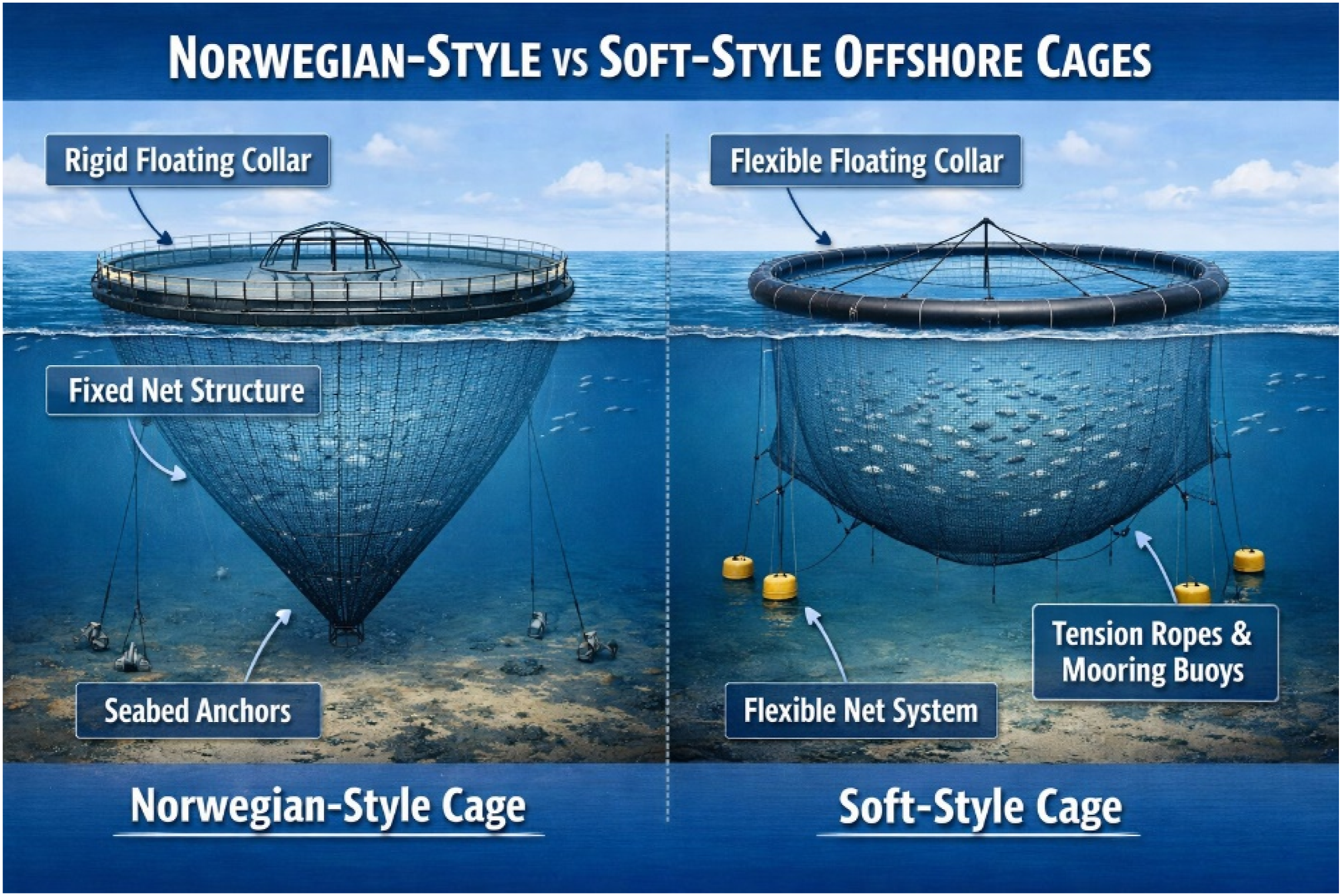
Company background
AquaTech was established in 2003 by Mr. Chang Tannhou. His personal health journey, following a recovery from cancer, inspired him to create a new standard for food safety. This vision led to the founding of what became Taiwan’s first fully vertically integrated agricultural enterprise, operating a comprehensive ‘Farm-to-Table’ model that manages both production and online and offline sales channels. The company’s foundational commitment to health drove an exhaustive search for the ideal, pollution-free farming environment, culminating in the selection of the pristine offshore waters near Penghu (Pescadores Islands), a group of about 90 islands located in the Taiwan Strait, just 50 km west of Taiwan as its exclusive aquaculture base. AquaTech’s core mission is to raise zero-pollution fish. This commitment is enforced by rigorous quality standards: every batch of product not only meets but surpasses strict EU contaminant detection standards. By managing the entire value chain, AquaTech reinforces its dedication to providing the market with premium, traceable, and healthy seafood.
Challenges
Despite continuous advances in offshore net cage design, the mariculture industry still faces many challenges. First, unlike the calm, visible environment of freshwater ponds, the open ocean is inherently volatile. Waves, high turbidity, and strong currents severely complicate feed distribution and render traditional visual inspection of the fish and seabed impossible. Second, offshore cage aquaculture faces critical instability due to an inherent data deficit, despite the necessity for high technological integration. This vulnerability stems primarily from the unpredictable dynamics affecting the supply chain and cost management. The core operational challenge is the lack of granular environmental data. Current public maritime information provides only basic metrics, lacking the critical current speed and flow direction needed to optimize costly feed delivery. This results in waste, poor Feed Conversion Ratios (FCRs), and elevated operational expenses.
Traditionally, fish farmers rely entirely on manual visual checks, a method that is inadequate for accurately tracking the changing biomass (size and number) of fish deep underwater. CIO Chang clarifies the severe consequence: this lack of internal visibility “prevents precise fish counting and leads to significant forecasting errors.” The resulting inaccuracy forces the business to face two severe and costly supply chain risks: either oversupply (which burdens the company with high inventory costs) or undersupply (resulting in lost sales opportunities). This situation highlights the urgent need for robust, real-time underwater data to guarantee efficiency and reliability across the entire supply chain.
Solution
To address the challenges of manual feeding, monitoring, sizing, and counting fish, AquaTech deployed an innovative, integrated system built around computer vision to achieve essential precision management. AquaTech’s core solution fuses underwater image recognition with sonar technology for real-time population monitoring. As CIO Chang stated, this system ‘effectively simplifies manual recording of fish count and size and drastically reduces human measurement error’.
How AI system work
The process begins with high-resolution underwater cameras and specialized lighting deployed inside the net cages. Captured images are fed into a Deep Learning model trained by AI, which then performs key steps: (1) Identification: Automatically recognizes complete fish bodies while using tracking techniques to avoid double-counting. (2) Measurement: Uses image segmentation to measure the fish’s tail-to-head length without removing the fish from the water. (3) Prediction: Converts length data into an accurate prediction of the fish’s total biomass using species-specific formulas.
This data is processed in the cloud and sent instantly to the farm’s management system to guide resource allocation and optimize feed formulation and quantity (Figure 2). AI image recognition on fish monitoring (generated by Gemini AI).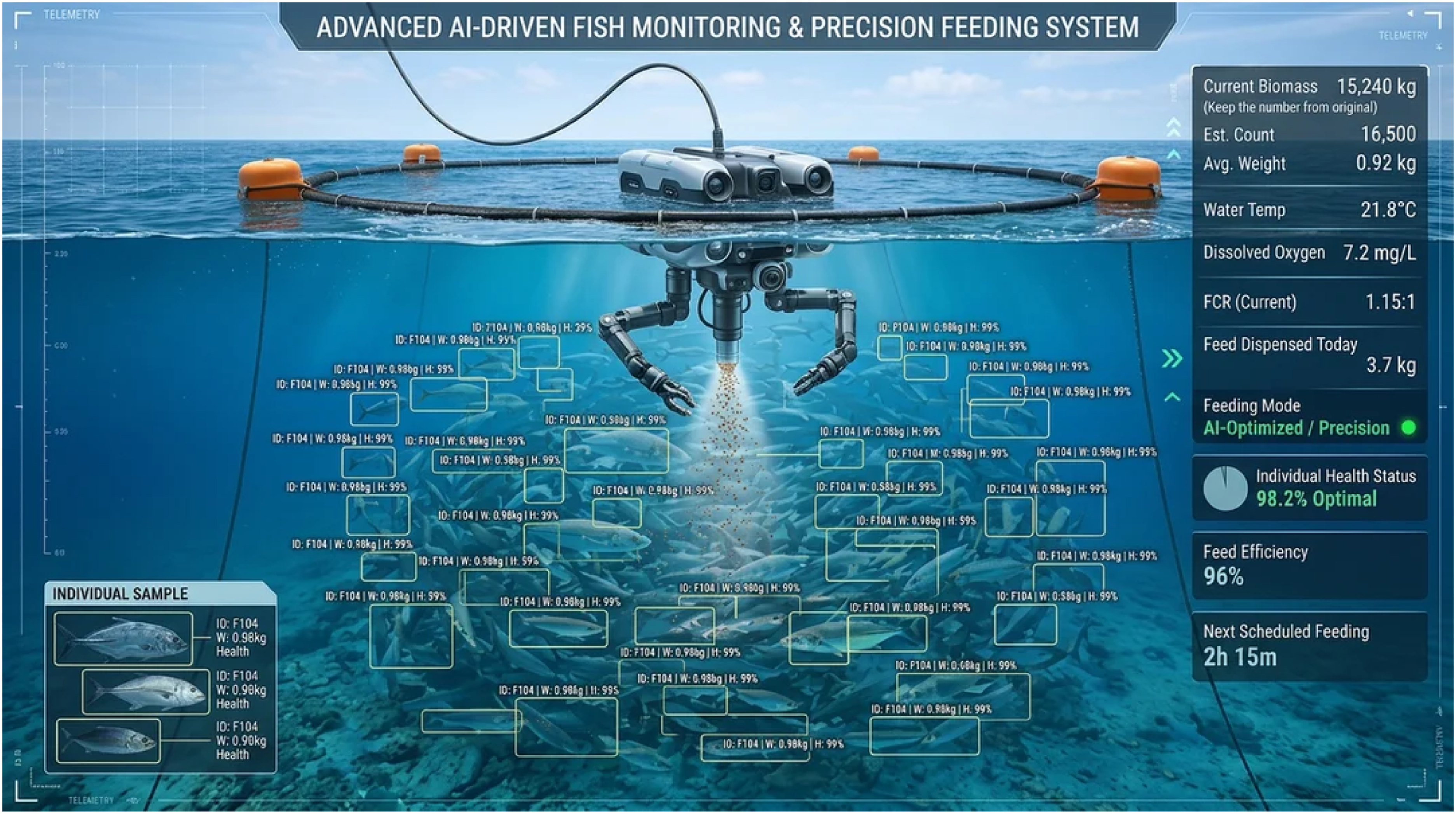
Algorithm
The solution moved beyond simple cameras. It utilized a fusion of technologies: (1) Stereo Imaging & Computer Vision: Using Mask-RCNN and ResNet50 algorithms, the system identifies fish outlines in muddy water, calculating ‘Fork Length’ to estimate weight without touching the fish. (2) Active Sonar: To count biomass density in parts of the cage the camera could not see. (3) Environmental IoT: Sensors to measure current velocity and direction.
Training model
The system was designed to mimic – and surpass – the veteran farmer. • Is the fish hungry? The AI analyses the ‘frenzy’ behaviours (speed and angle of swimming). If activity drops, the fish are satiated. The machine cuts the feed instantly. • Is the current too strong? If the IoT sensors detect strong currents that would wash pellets out of the cage before they can be eaten, the feeder pauses.
‘In ideal conditions, the algorithm is 95% accurate’, Chang noted. ‘But the ocean is rarely ideal. Our goal was to see if it could beat a human in a storm’.
Model accuracy
The system is augmented by underwater sonar technology, which analyses acoustic signals to verify the total fish count and size distribution. This acoustic cross-check, which uses signal resonance, further enhances the overall system’s accuracy and reliability. While the algorithm achieves 95% accuracy in controlled tests, CIO Chang acknowledged the complexities of the environment: ‘We are committed to ensuring the system maintains over 80% accuracy despite real-world environmental factors like climate, waves, and external interference’. This precision is fundamental to maximizing the farm’s efficiency and reliability (Figure 3). Process of underwater stereo image verification.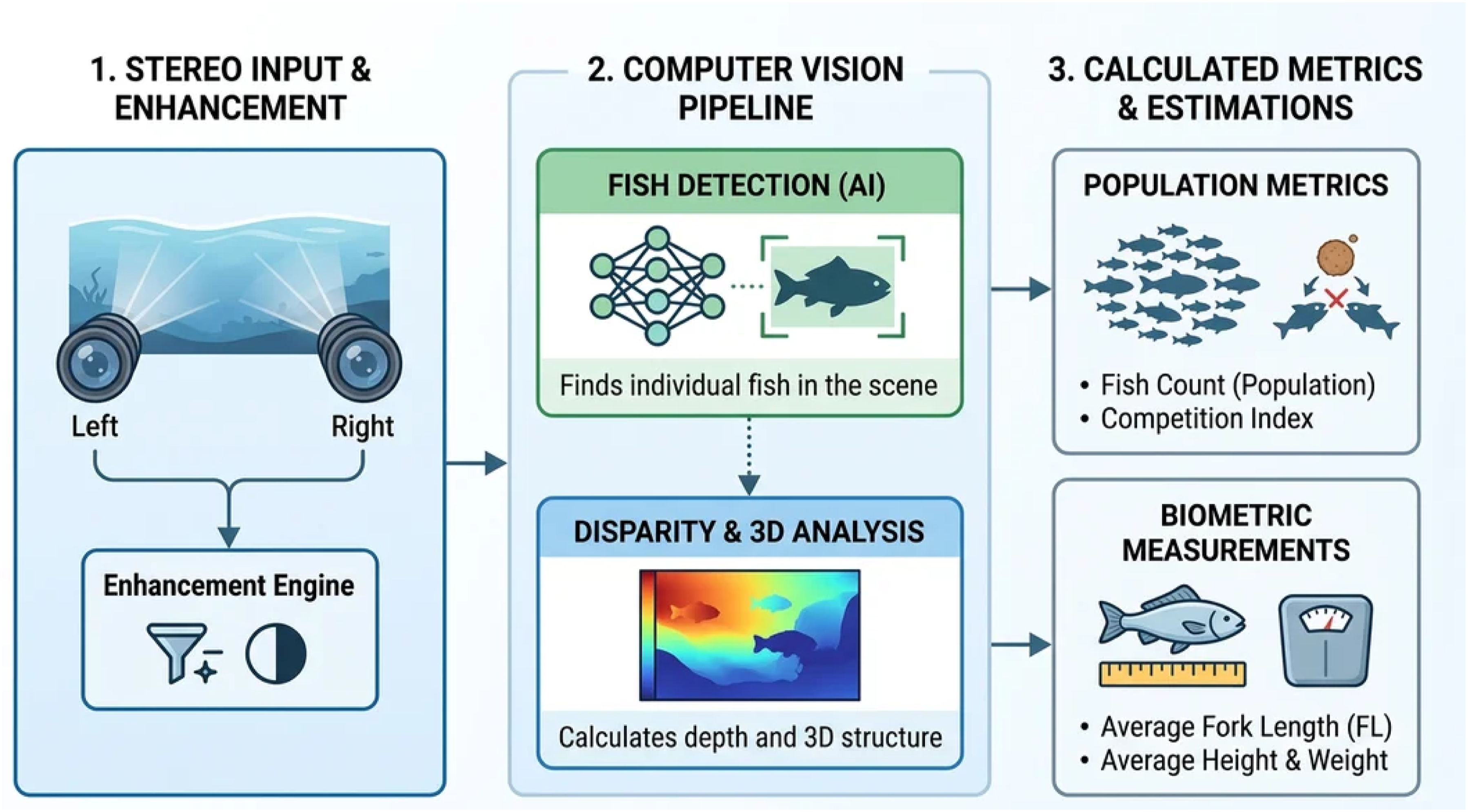
AI pilot test design
AquaTech conducted a rigorous experiment. Two cages with identical fish stocks and environmental conditions were selected. • Cage A (Control): Fed by veteran staff with 20 years of experience. • Cage B (Treatment): Fed by the AI system.
Outcome
The pilot results clearly demonstrate the AI-driven feeding solution’s decisive advantage over the traditional manual approach in terms of feeding precision, efficiency, and efficacy. The AI system delivered a significantly superior Feed Conversion Ratio (FCR) of 2.33, compared to the manual group’s 2.8, representing a 20% increase in feed efficiency. This operational improvement translated directly into production gain: the total Meat Conversion improved from 1,500 kg (manual) to 1,875 kg (AI), showing that the AI approach achieved a 25% higher total meat production. This combination of higher precision reducing feed costs and higher yield per cycle maximizes the overall revenue potential of the farm. The pilot results align with prior academic findings (Besson et al., 2016), reinforcing the principle that improving the Feed Conversion Ratio (FCR) is the most direct and operationally quantifiable measure for mitigating negative environmental impacts in aquaculture. In particular, the AI brings the positive environmental impact – The ‘Residual Feed Rate’ (waste) dropped significantly, meaning less pollution on the seabed.
The shift to AI-driven precision feeding resulted in immediate and significant operational gains across key performance indicators. The primary success lay in maximizing the utilization of the most expensive input: feed. The implementation achieved a substantial 23% reduction in total feed cost, leading directly to lower operational expenditure. This efficiency was mirrored by a 21% increase in Fish Yield. This improvement in yield is validated by the optimized Feed Conversion Ratio (FCR), confirming that the AI successfully delivered more saleable biomass while consuming less feed. The system immediately enhanced both cost efficiency and overall production output.
Previously, the entire supply chain was undermined by a lack of visibility, with fish sizing accuracy at only 80%. This led to the sales team facing constant issues: either overselling product that had not reached market size or underselling stock due to unrecognized accelerated growth rates. The implementation of the AI system, which provides real-time biomass data, immediately fixed these costly downstream inefficiencies. As a result, Inventory Accuracy rose sharply to 90%, and Inventory Turnover nearly tripled, jumping from 4% to 14%. Most significantly, by enabling accurate prediction of precise harvest dates, the sales team secured vital pre-orders, causing revenue during the pilot period to surge from approximately €250,000 to €600,000.
Lesson learned
The primary lesson learned is that digital transformation is a dual challenge: first, overcoming the limitations of human intuition and the lack of visibility to achieve operational efficiency, and second, strategically integrating that newfound data into the external value chain. The AI system proved that codified, real-time data provided a superior, tireless understanding of fish biology than the fish farmer’s tacit knowledge, resulting in a 20% increase in feed cost reduction. This success then generated the next strategic imperative: leveraging that precision data (90% accuracy) to transition from risk mitigation to premium market creation by ‘bridging the gap between a sensor in the ocean and a plate in Taipei’.
Key players in the sector (authors’ work).

Result of underwater stereo image verification (source).

Result of Test versus Control Group (source: AquaTech 2025).
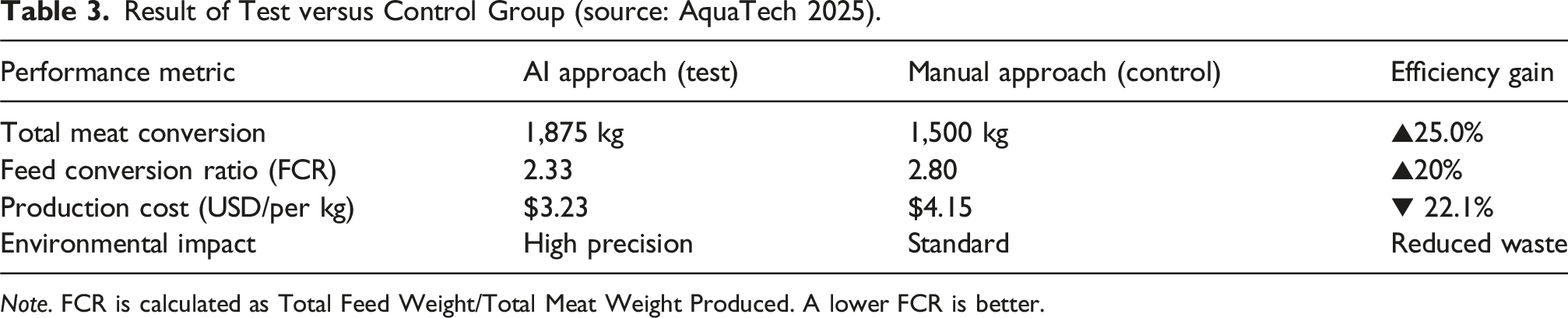
Note. FCR is calculated as Total Feed Weight/Total Meat Weight Produced. A lower FCR is better.
Outcome of pre versus after AI adoption (source: AquaTech 2025).

Outcome of pre versus after AI adoption (Source: AquaTech 2025).

Discussion questions
(1) What were the main challenges AquaTech faced in managing fish farms before adopting the AI system? (2) What advantages did the company gain from using data and AI? (3) Based on the case results, what business benefits did AquaTech achieve after implementing the AI system? (4) Why is accurate data important for business decision-making? (5) What challenges might companies face when introducing new technologies such as AI into traditional industries? (Consider factors such as employee skills and organizational change.) (6) Do you think other traditional industries could benefit from similar digital transformation? Provide examples of industries where data and AI could improve operations.
Footnotes

Ethical considerations
This article does not contain any studies with human or animal participants. The case study presented here derives from the authors’ experience, though some of the case information is fictional in order to maintain anonymity.
Funding
The authors received no financial support for the research, authorship, and/or publication of this article.
Declaration of conflicting interests
The authors declared no potential conflicts of interest with respect to the research, authorship, and/or publication of this article.