






Abstract
The case highlights the Ethical Implications around Neuralink’s first Human Implant. Elon Musk’s visionary device (a brain implant) capable of empowering individuals to control external devices through their thoughts, stands out as a remarkable scientific innovation towards helping patients with neurological disabilities. Although, research on brain interface devices to help individuals with special needs was prominent since the 1960’s. However, the human trials of Neuralink sparked controversies related to data safety, data ownership and potential misuse of the unique technology features. Hence, it would be highly interesting to see how the technology giants plan on tackling the ethical issues surrounding human trials.
Keywords
Introduction
Neuralink, an Elon Musk’s venture, had placed brain implants (a chip called N1) in human beings in early 2024. 1 The chip was designed to artificially stimulate the human brain to gain control on body parts that were paralyzed. In the long term, Neuralink was believed to augment memory, enhance cognitive abilities and combine human consciousness with artificial intelligence. 2 However, by late 2025, some quarters questioned the ethical lapses in developing the N1 chip and the ethics surrounding monitoring and manipulating human brain by a private, for-profit company. Though hailed as a leap of faith in brain-machine interfaces (BMIs), some scientists and commentators were skeptical over the consequences of artificially controlling the human brain.
BMIs
Brain-computer interfaces, also referred to as brain-machine interfaces (BMIs), were real-time technological systems that used a recording array to capture neural activity (as electrical, chemical, or magnetic signals). Mathematical algorithms were then used to transform the captured data into a functional output, such as physiological or behavioral conditional signals. 3 Brain-computer interfaces, or BCIs, had their roots in the discoveries made by Hans Berger about the electrical activity of the brain and the development of electroencephalography (EEG). In 1924, Berger pioneered using EEG to record human brain activity. Human BCI research was not initiated until the 1970s, despite studies on monkeys started in 1960s. 4
Since then, numerous instruments and techniques were used by global scientific community to identify anomalies in a person’s brain structure or brain operations. Further, BCIs facilitated communication between the person’s brain and external devices like computers/robotic limbs by acquiring, manipulating, analyzing, and translating brain signals. 5 This way BCIs helped individuals with severe disabilities regain their independence.
Technological advancements enabled electrophysiological signals to be captured using non-invasive, semi-invasive, and invasive sensors that could be positioned under, over, and inside the brain, respectively. Using these sensors, brain signals were converted into instructions that could be tailored in real time to suit user’s requirements. The use of brain-computer interface (BCI) electrophysiological impulses to directly control a computer cursor by a human or an animal was arguably the most widely used application.
In the following decades, technological advancements prompted medical community to assist those who have lost or damaged bodily parts. Similarly, BCIs were used in a multitude of fields outside of medicine and healthcare, including cognitive science, bio-cybernetics, security and authentication, gaming and entertainment, industrial automation, education, advertisement and neuromarketing, neuroergonomics, corporate training, and wellness initiatives (Refer Figure 1 for uses of BCIs). Many entrepreneurs began investing and experimenting with different avenues and prospects that BCI technology presented.6,7 (Refer Annexure 1 for BCI startups across the world) Various uses of BMIs.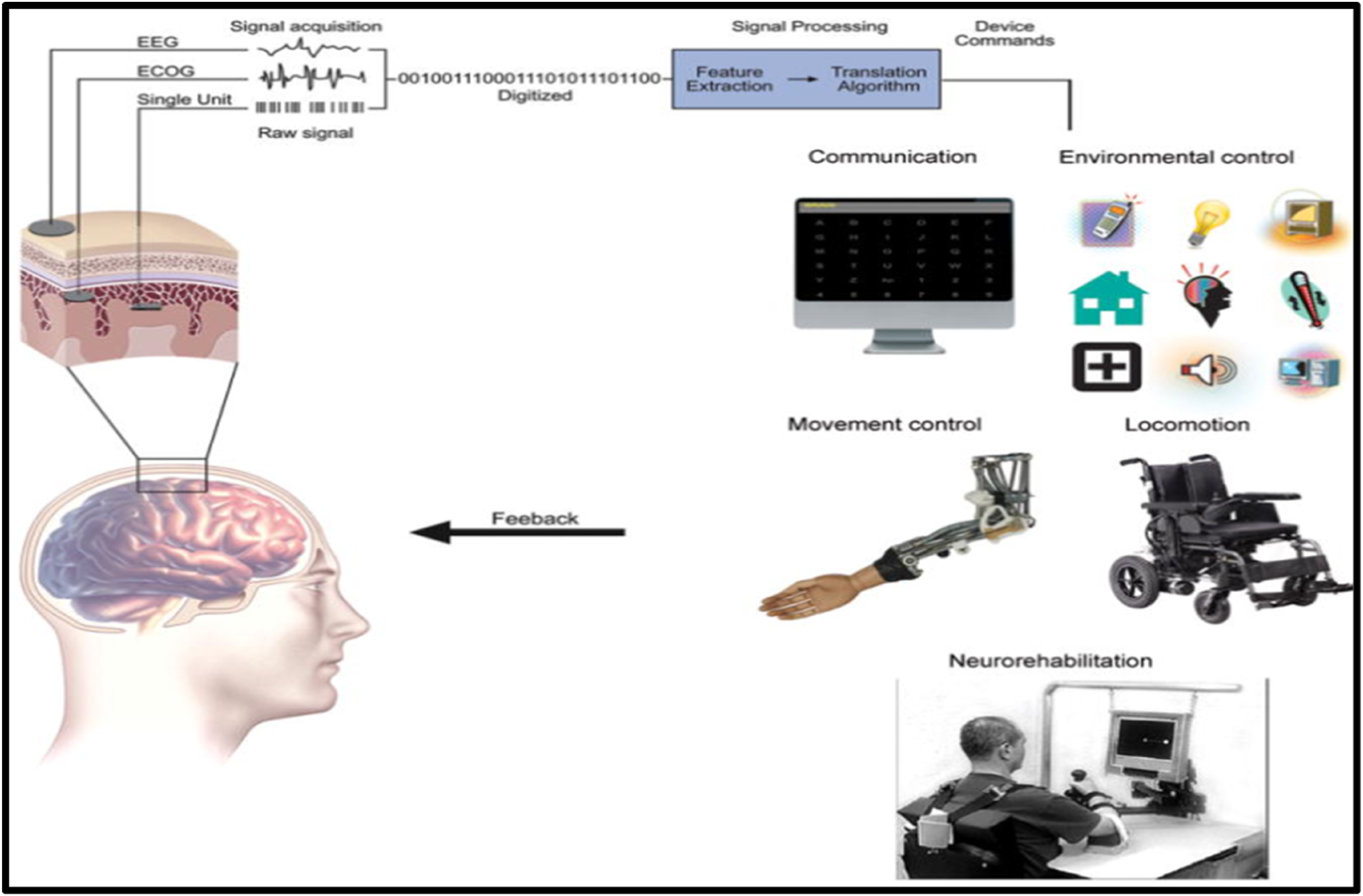
Note: Adapted from 8
Private ventures like Neuralink began invasive human trials on January 28, 2024, with the objective of curing mental illness, neurological conditions like dementia and Alzheimer’s, paralysis, and blindness by inserting a tiny chip with 1024 electrodes spaced across 64 threads, following FDA approval for such trials in 2023. 9 However, by the end of 2024 Neuralink was mired in controversy surrounding ethics of controlling human brains. The onus was on the company to clear doubts and to prove that the brain implants will not be misused, to build confidence in the Neuralink brand. But the debate associated with the origins of N1 has not been helping the cause.
Controversial beginnings
Mr. Elon Musk, a billionaire 10 and a Co-founder/CEO of Tesla and Space Exploration Technologies Corp, founded the neurotechnology startup Neuralink that developed an implantable brain-computer interface to translate thoughts into action. Launched in 2016, the private venture had claimed that its neural device would enable people with paraplegia to regain movement and restore vision back those who are born blind.
To collect data from neural threads that extended across different sections of the brain of the subject, the firm designed a fully automated neurosurgical robot to embed the brain chip underneath the skull. Given that brain activity was recorded by the sensors within the implanted brain chip, Neuralink’s technology worked on electrophysiological technology. Consequently, the firm employed machine learning algorithms and artificial intelligence agents to deduce information from the enormous amount of data collected through the brain implant. 11
Animal testing of the chips developed by Neuralink began in 2017 through a collaboration with the staff of the California National Primate Research Center (CNPRC), at UC Davis. As a part of the agreement, CNPRC received funding of around $800,000 from Neuralink to facilitate the trials. However, Neuralink concluded the trails at UC Davis facility and Neuralink commenced the testing on animals within a 6000 sq. ft. vivarium built to house the monkeys in the year 2020.
By 2022, many accounts expressed concerns over testing methods. Former employees of Neuralink raised doubts about the transparency of the testing process and treatment of animals. The major allegation was that the protocols of animal testing were not followed, and testing was rushed, which resulted in death of 1500 animals, including more than 280 sheep, pigs, monkeys, mice, and rats, since 2018. 12 The number of animal deaths was said to be a rough estimate as the company had not kept precise records of the number of animals tested and killed. Traditionally, in animal testing, researchers tested one element at a time to draw appropriate conclusions before further tests. However, Neuralink did not provide enough time between tests to draw appropriate conclusions and to rectify any procedural lapses, which lead to repeated tests. Failed or inconclusive experiments had to be reconducted, which resulted in further deaths of animals. Animal deaths were attributed to inadequate time for testing staff due to rushed schedules to meet tight deadlines. 13
Employees alleged that CEO Elon Musk’s pressure to speed-up chip development process resulted in substandard experiments taking life of animals. Company records revealed that at 6.37 am (Pacific time) of February 8th of 2022, CEO forwarded a news item which applauded Swiss researchers for enabling a paralyzed man to walk by implanting a chip and wrote “We could enable people to use their hands and walk again in daily life!.” Within less than 10 minutes he sent another message reprimanding them say “In general, we are simply not moving fast enough. It is driving me nuts!.” Some employees alleged that the CEO threatened to stop operations of Neuralink, unless quick progress was made.
In early 2022, the U.S. Department of Agriculture’s Inspector General started to investigate violations of the Animal Welfare Act, which established protocols for treating and testing animals started an investigation. 14 Also, the US Department of Transportation launched inquiries for illegal transportation of pathogen-laced devices removed from the animals after the invasive BCI experimentation. 15
In response to the probes, Neuralink acknowledged that the animals were put to death based on planned schedules in order to extract historical data for analysis. Some of them were euthanized based on expert advice from the veterinary medical team at UC Davis in response to unauthorized usage of a bio-glue to seal the brain holes after insertion of the BCI chips, device failures and suspected device-associated infections. 16 Furthermore, the firm released a three-minute video of a male primate with implanted chips playing “mind pong.”
During the same period, U.S. Food and Drug Administration (FDA) rejected Neuralink’s appeal to start human trials citing an array of issues that needed to be sorted, including lithium battery, wiring the brain and insertion and excretion of device in and out of the brain cells. As a result, Neuralink’s human trails encountered severe backlash with regards to handling the threats induced by the invasive BCI Technology. However, the company received approval for human trails from FDA in May 2023. In March 2024, the company performed the first human trail, that is, by implanting a Neuralink product called as “Telepathy-enabling users to control of computers and phones, with their thoughts,” on a 29-year-old paralytic patient named “Noland Arbaugh.” Soon after the implant, the patient claimed that his dependency on others was reduced. He stated that the invasive procedure needed to be additionally evaluated for safety and effectiveness by collecting data over long time. 17
Though the initial implants revealed encouraging results, concerns surrounding medical safety, privacy, ethics, and security associated with the implants were still debated and the scientific community was searching for answers for these concerns. Some answers emerged from advancements in AI and signal processing technologies that permitted non-invasive implants. These non-invasive implants enhanced human-computer interactions as they provided various techniques to quell certain concerns related to safety, privacy and ethics apart from reducing costs. These advancements also allowed the scientists in designing “automatic artifact identification and removal algorithms and develop convolutional neural network-based deep learning models for BCI performance enhancement. However, the development of deep learning models required large data sets from reliable and repeatable trials of BCI experiments to train the models.” 18
Challenges and potential threats of BCI
Although BCI technology looked most promising with an expected market growth from $1.74 billion in 2022 to $6.2 billion by 2030 and an increased application potential across multiple avenues, nevertheless, there was still a long way to go before the technology could be fully utilized. As the technology was still under trials for multiple applications such as thought decoding (to help the speech-deprived), human memory extension (extended storage through decoding of brain signals), telepathic communication (user control of devices with their thoughts), automation and control (home and industrial automation/control), intelligence sharing between individuals (sharing of thoughts between individuals), brain energy harvesting (utilization of energy harvested from the brain to run low-energy external devices), and localized brain-computer interface (development of BCIs to capture signals specific to the functionality of a targeted body part). 19
Further, the BCI technology faced multiple challenges with regard to privacy, safety, security, ethical, legal and social concerns. On the technical side convenience, flexibility, durability, affordability and profitability were also challenges that needed to be addressed. Further at the macro level, lack of standard regulations, human trials and big data management needed to be addressed prior to enable a global scale implementation.
Privacy
The BCI systems provided access to various signals across the brain, that is, the BCIs were capable of extracting users’ sensitive personal information without their consent. Furthermore, the signals were susceptible to attackers during transmission through linked networked devices. 20
Security
As the BCI technology was new and not robust enough, it was highly vulnerable to cyber-attacks within the signal acquisition/processing phase and the machine learning model development/sensory feedback phase, that is, risks arising from signal tampering/intervention leading to faulty and biased outcomes from alteration of commands and risk of hijacking leading to actions contrary to the will of the subject. Additionally, the technology suffered from issues related to data management, data ownership/accountability, and potential misuse of the data collected from the subject. 21
Safety
The safety concerns generally arose in the pursuit of invasive BCI methods wherein a BCI chip was implanted into the brain, leading to multiple aftereffects such as damage to the nerve cells/blood vessels and severe infections such as blood clots, swelling, tissue damage, etc. Furthermore, the natural defence systems might have been triggered from an adverse effect of interaction of the brain with the implanted electrode chip, evoking several health risks. Moreover, permanent brain damage could also have been expected due to the nanotoxicity present within the implanted electrodes. Additionally, the corrosion of the electrode chip from the internal environment of the brain, with an average pH value of around 7.2, might as well have led to fatalities from severe brain damages. In addition, due to the limited life expectancy of the electrode, the patient needed to be repeatedly operated on for replacement of the electrodes in a timely manner. Further, the right placement of the electrode within the brain also stood crucial towards reducing the internal brain damages. 22
Ethical, legal, & social concerns
The advancement of BCI technology had raised several ethical, legal, and social concerns with regards to the privacy and security issues that were still pertinent with the technology, alarming safety concerns and adverse health impacts from invasive BCI procedures, social fairness and equity related to technology accessibility at a global level, and accountability and legal obligations pertaining to technological mishaps. 23
Convenience/flexibility
The non-invasive BCI devices were connected to the user, limiting their mobility. Furthermore, as a part of human trials, the technology called for user presence for longer durations at definite time intervals to collect data for calibration and development of machine learning models, disregarding the convenience and flexibility of the users. 24
Human trails
Since the BCI systems were built to benefit the disabled, each version of the technology development called for human trials before full-scale implementation. A lack of volunteers who could risk their lives as part of the trials was observed as one of the most crucial issues towards the timely development of the BCI technologies and generalization of results from the trails. 25
Conclusion
Although, the introduction of BCI technology was undertaken to assist the disabled. Nonetheless, academicians and researchers from the medical field were drawn to technology to assist with the detection, diagnosis, restoration, and rehabilitation of ailments. Further, technology also drew experts from a variety of industries to help develop decision-support systems, usability testing platforms, stimuli-based advertising systems, advanced teaching mechanisms, immersive gaming environments, and entertainment applications, etc. However, since the technology had not yet maturity, it was imperative to identify viable strategies to address the challenges and threats faced by the technology for full-scale rollout.
The potential strategies that could be implemented to mitigate risks from BCI technologies included the imposition of strict legal norms. As well as restrictions aimed at identifying and reducing the occurrence of BCI-related risks such as intellectual property issues, cybersecurity breaches, accountability for injury, accessibility, privacy, and protection of personal data; the integration of BCI technologies with advanced cryptographic techniques such as blockchains to reduce security concerns; enhanced transparency through compliance with privacy policies; and raised awareness of the BCI risks, fostering subjects to avoid potential abuses. 26 Establishment of universal standards by consulting all stakeholders and research communities was top priority to reduce the threats of BCIs. Furthermore, to ensure long-term health of subjects, introduction of procedures from regulatory authorities prior to the technology’s commercialization were strongly advised.
In addition, the development of sound ethical frameworks to accompany future BCI technological developments stood crucial to ensure responsible development and ethical compliance of the technology. Also, ethical priorities were to be defined for the development and deployment of BCIs in an accessible and equitable fashion. 27 Nonetheless, revised governance strategies needed to be formulated considering the functionality differences between the BCIs. 28 Likewise, exhaustive studies/trials/experiments needed to be embarked on through research collaboratives for critical testing of the technology toward addressing the above-mentioned challenges in order to unlock the full potential of the BCI technology. 29
Discussion questions
Q1: How the Brain-Machine-Interface (BMI) help humans in dealing with incurable ailments? Q2: How this technology will enable revolutionizing medial-healthcare industry. Q3: What kind of signal capturing and processing technologies have enabled using the BMIs in medical treatments? Q4: What are the business opportunities and challenges involved in large scale adoption of BMI technology? Q5: What are the ethical considerations that Neuralink has to abide by while controlling human brain through a computer and the resulting data security concerns?
Footnotes

Funding
The authors received no financial support for the research, authorship, and/or publication of this article.
Declaration of conflicting interests
The authors declared no potential conflicts of interest with respect to the research, authorship, and/or publication of this article.