







Abstract
Public relations research has paid considerable attention to foreign terrorist crises but relatively little attention to domestic ones—despite the growing salience of domestic terrorism in the United States. This study content analyzes 30 years of network television news coverage of domestic terrorism to gain insight into four theoretical issues of enduring interest within the literature on news framing and crisis management: sourcing, contextualization, ideological labeling, and definitional uncertainty. Results indicate that the sources called upon to contextualize domestic terrorism have shifted over time, that ideological labels are more often applied on the right than the left, and that definitional uncertainty has increased markedly in recent years. Implications for the theory and practice of public relations and crisis management are discussed.
In October of 2020, 13 right-wing extremists were arrested in a failed attempt to kidnap Democratic Michigan Governor Gretchen Whitmer and try her for treason over her COVID-19 lockdown response. As government officials and reporters began to make sense of the crisis, there was considerable debate about whether the extremist group should be referred to as militias or domestic terrorists. President Trump, for example, refused to condemn the attempted kidnapping as terrorism. Governor Whitmer responded in a tweet saying, “They’re not ‘militias’. They’re domestic terrorists. . .words matter” (Cummings, 2020). A local Detroit news station also tweeted that “After much discussion in our newsroom, we’ve decided that moving forward, we will be using the term ‘domestic terrorism’ or ‘domestic terrorist’, rather than militia” as these words “better define the subjects of the investigation” (Local 4 WDIV, 2020). Such debates underscore the constitutive yet contested nature of terror crises: there is no settled definition of terrorism and the construction/management of terrorist crises depends entirely on who does the defining (Schlesinger et al., 1984).
This reality makes terrorism a unique public relations crisis—most obviously for governments, but also for the large institutional actors who shape socio-political understandings, such as news organizations and social media companies. Because terrorism directly affects the health, safety, and public opinion of a nation (Heath and Waymer, 2014; Holbrook, 2014), such attacks put the reputation of governments and politicians at risk as their main job is to protect public safety (Canel, 2012). One of the biggest challenges for governments is controlling the flow of information during the aftermath of a terrorist attack. Terrorism demands a response (Richards, 2004), but quelling the concerns of the public can be challenging because the enemy is often unknown and terror investigations take time and are largely classified on account of national security (Crijns et al., 2017). Media organizations, the main communicators of terror information and governmental responses, sometimes inflame the situation by sensationalizing coverage and attributing responsibility for the terror events in polarizing/political ways (Crijns et al., 2017). Accordingly, scholars have long been interested in how the press has framed discussions of international terror crises (e.g. Gerhards and Schäfer, 2014; Lazar and Lazar, 2004; Papacharissi and Oliveira, 2008), knowing that such framing can significantly affect public opinion and reveal how governments address these crises.
Noticeably lacking in scholarly discussions of framing and managing terrorist crises, however, is the issue of domestic terrorism in the United States. By domestic terrorism, we mean acts committed by U.S. citizens within national borders that aim to do one or more of the following: “(i) to intimidate or coerce a civilian population; (ii) to influence the policy of a government by intimidation or coercion; or (iii) to affect the conduct of a government by mass destruction, assassination, or kidnapping” (Federal Bureau of Investigation, 2015, para. 3). Whereas the framing of international terrorism in U.S. media fits neatly within familiar “us versus them” and “vengeful killer” frames (Powell, 2011), government, industry, and media officials face additional challenges when defining and attributing responsibility for acts of terror when the perpetrators are either homegrown, and thus more connected to the beliefs, values, and ideals of the nation, or have become citizens of a nation, which calls into question immigration and naturalization processes, a persistent political debate in the U.S. Recent research on the framing of domestic terrorism crises in the United States has taken steps to better understand this unique crisis context (e.g. Morin, 2016; Walter et al., 2017), but several key questions remain—questions that become all the more urgent as acts of domestic terrorism become more salient in the U.S.
The present study helps answer some of these questions. Through a content analysis of 30 years of network television news coverage in the United States, we provide insight into four theoretical issues of enduring interest within the literature on framing in the context of domestic terrorism crises. The first is sourcing. Sourcing outside voices is a common public relations and media strategy in response to crises (Dimitrova and Strömbäck, 2009; Van der Meer et al., 2017). We thus consider, in light of the mixed evidence about sourcing during political crises (Bennett et al., 2008; Nacos, 1996; Wigley and Fontenot, 2011), which voices have prominently contributed to domestic terrorism framing in the United States over the past three decades. The second issue is contextualization. Scholars point out that news is often “fragmented” (Bennett, 2012) or “episodic” (Iyengar, 1991) in nature, thus failing to adequately contextualize current events. Public relations practitioners often work to influence the contextualization of events during crises, so we consider if and how news coverage contextualizes domestic terrorism in relation to past domestic and international events. Third, we examine responsibility framing by tracking how news organizations and political elites highlight ideological orientation as a means of assigning blame for domestic terrorism (D’Alessio, 2012; Hallahan, 1999; Puglisi and Snyder, 2011). Given that domestic terrorism can come from either the extreme right or extreme left, we explore ideological labeling of terrorist groups and consider what such labels might suggest about news bias and management strategy over time. Finally, we look at definitional uncertainty. Public relations practitioners know well that frames are a contest over definitions (Hallahan, 1999; Lecheler and de Vreese, 2019; Terkildsen et al, 1998). We therefore consider the extent to which there is uncertainty around the application of this designation and if/how the terrorism “debate” functions as a crisis response in and of itself. Taken together, these analyses work with the broadest dataset on this topic yet complied to provide needed insight into how governmental and media actors attempt to manage this consequential but understudied public relations crisis in the United States.
Terrorism and news framing in the United States
The media serve as the primary source of information during terrorist crises (Crijns et al., 2017). Yet, media narratives and those sourced to discuss terrorism can raise significant concerns for the victims of terror attacks and the governmental actors who must manage these crises (Picard, 1989). Labeling an event as “terrorism” by governmental and media actors can increase the importance assigned to an incident and negatively impact the political leaders who are responsible for maintaining public safety. Such framing can also have legal implications as the “terrorist” label creates a “frame of mind that allows greater freedom of action by the state” (Chomsky and Herman, 1979: 7). Conversely, not constructing the terror frame after a violent event diminishes the severity of such attacks and limits judicial action.
Accordingly, scholars have long been interested in media portrayals of terrorist groups and activities, though most of this coverage has focused on foreign terrorism (e.g. Gerhards and Schäfer, 2014; Lazar and Lazar, 2004; Papacharissi and Oliveira, 2008). Only a handful of studies have tracked trends in news coverage of domestic terrorism. Those that have typically take one of two paths. The first is to compare news treatment of domestic and foreign terrorists. For instance, in a content analysis of major national print publications and online media sources, Powell (2011) found that domestic terrorists are predominately framed as intelligent, individual, and mentally unstable, while also being less violent than foreign terrorists. Crenshaw (2014), meanwhile, found that in the coverage of domestic terrorism, “the attacker’s American identity was only focused on to accent his deranged, disturbed nature” while coverage of foreign terrorism used American labels to “reiterate an attacker’s otherness” (p. 374).
The second path extends previous work on “the outsider” to explore the more recent phenomenon of terrorist attacks that are committed by U.S. citizens in service of international ethnic and/or cultural identities. For example, in an analysis of the 2010 Times Square bomber Faisal Shahzad, a Pakistani American, Chuang and Roemer (2013) found that Shahzad’s American citizenship made him no less an outsider in media coverage. Rather, his “insider” status helped him “hide in plain sight” (p. 101). In a comparison of the 2009 Fort Hood shooting and the 2013 Navy Yard shooting, Morin (2016) found that although these incidents were very similar, only Muslim American Nidal Malik Hasan, the Fort Hood shooter, was framed as an extreme terrorist. Aaron Alexis, the Navy Yard shooter, was discussed as “mentally ill” (p. 987). And, in the aftermath of the 2016 Orlando Pulse Nightclub shooting by Omar Mateen, a U.S. citizen and a Muslim, Walter et al. (2017) found that two competing news frames—the Islamic terrorist frame and homophobic hate crime frame—had differing effects on perceptions of the event and support for the LGBTQ victims.
This body of literature demonstrates a clear strategy for managing specific domestic terror crises: frame domestic terrorists as less threatening compared to international terrorists and marginalize foreign identities regardless of citizenship. Beyond press framing of individual terrorists, however, little is known about how news organizations position domestic terrorist acts and the voices who contribute to this framing over time. A longitudinal analysis is necessary to reveal if and how strategies for managing domestic terror crises have evolved. We thus contribute to this emerging scholarship by studying television news coverage of domestic terrorism over time to gain needed insight into several theoretical issues central to research on news framing during public relations crises.
Framing and domestic terrorism in theoretical context
Framing, in Entman’s (2004) influential conception, involves “selecting or highlighting some facets of events or issues, and making connections among them so as to promote a particular interpretation, evaluation, and/or solution” (p. 5). Framing is central to the study of public relations and also “one of the primary conceptual frameworks for understanding how publics make meaning of terrorism” (Storie et al., 2014: 43). As a construct, framing is broad enough that there is utility in asking in any given context “what are the textual (or visual) components carrying the frame” (Lecheler and de Vreese, 2019: 4)? We focus here on four.
The first is sourcing. A key component of successfully managing terrorist-related crises is controlling the flow of information (Wigley and Fontenot, 2011). This includes determining which terrorist frames become prominent (e.g. lone wolf vs vengeful killer) and which sources are included in the press (Van der Meer et al., 2017). Calling on expert and outside sources is a common management strategy by news organizations as they attempt to make sense of the often-ambiguous circumstances that surround moments of crisis (Veil, 2012). Scholars also suggest that the effectiveness of crisis response efforts is increasingly contingent on perceptions of source credibility (van Zoonen and van der Meer, 2015). Crisis management is thus not only about the steps taken to remedy or rebuild after a crisis, but who becomes the “face” of the crisis response. Research suggests that government and military officials are common sources in U.S. media (e.g. Bennett et al., 2008; Entman, 2004). Other sources called upon during crises include other news organizations, organizations relevant to the crisis, and the general public (e.g. eyewitnesses, affected groups; van der Meer et al., 2017). Whereas some research indicates that government sources tend to dominate news coverage during crises (Bennett et al., 2008), other studies have found a wide range of non-government voices included as well (e.g. community members, eyewitnesses; Nacos, 1996; Wigley and Fontenot, 2011). Given these competing expectations and the importance of sources for crisis management, we pose the following research question:
Second, we explore contextualization. Among the most enduring criticisms of television news is that reporters generally do a poor job of situating stories within broader trends. For example, Bennett’s (2012) discussion of “information biases” in news coverage points to “fragmentation” as one of four common news reporting devices. In his words, news coverage tends toward “the isolation of stories from each other and from their larger contexts” with the result that “news generally comes to us in sketchy, dramatic capsules that make it difficult to see the causes of problems, their historical significance, or the connections across issues” (p. 47). Fragmentation is consistent with Iyengar’s (1991) characterization of “episodic frames” which, in contrast to “thematic frames,” focus on isolated moments that news reporters present largely without connection to the broader context. Importantly, the distinction between news that is more fragmented/episodic and that which is more contextualized/thematic is a consequential one. Research has shown that such differences can affect attitudes about important political issues (Gross, 2008). For public relations practitioners, these different public reactions might provide cues about how to best navigate the crisis. With this in mind, we consider whether news organizations contextualize domestic terror in relation to past events as a means of framing and managing these crises.
Our third interest is in responsibility framing, specifically via ideological labeling. According to Hallahan (1999), “beyond matters of definition, most issues and social problems entail questions of cause and responsibility (i.e. who should be credited or blamed for events)” (p. 219). In the framing literature, such labels are sometimes referred to as “small cues” (Shah et al., 2010). Small cues become particularly important in the context of domestic terrorism because, unlike foreign terrorism, the politics of domestic groups are often possible to label along America’s familiar right/left political divide. Accordingly, the extent and manner in which news coverage applies labels such as “rightwing” and “leftwing,” might shed some light on ideological bias in news coverage—a topic of longstanding interest to scholars (e.g. D’Alessio, 2012; Puglisi and Snyder, 2011). Similarly, if seemingly neutral labels such as “radical” are assigned disproportionately to one group, this too might indicate bias when attributing responsibility. Such patterns have implications for public understandings, given that citizens regularly employ ideological labels as heuristics when coming to judgments about important public issues (Zaller, 1992). Given the lack of research that would support a clear expectation about ideological bias on the topic of domestic terrorism, we pose a third research question:
Finally, we examine definitional uncertainty around the designation of a given act as “domestic terror/ism.” Framing in the context of public relations crises is largely a contest over definitions, with those on competing sides of an issue struggling to get their preferred designation to take hold or remain ascendant (Hallahan, 1999). For instance, scholars have shown how strategic actors on both sides of the abortion debate worked to influence journalists’ use of the “pro-choice” and “pro-life” labels (Terkildsen et al., 1998). In the context of domestic terrorism, there is no one definition (Schlesinger et al., 1984) and there is increasing discussion of what acts warrant that designation, as opposed to (or in addition to) labels such as “hate crime” or “mass shooting.” Accordingly, questioning the terror/ism label as a means of deflecting blame can function as a crisis response strategy in and of itself (see Boin et al., 2010). These are particularly weighty public relations battles when it comes to domestic terrorism because the outcomes matter for public opinion, legal action, and political power (Chomsky and Herman, 1979; Jenkins and Daddario, 2017). With this in mind, we pose a final research question:
Method
Census
This analysis focused on a census of broadcast television news coverage of “domestic terror/ism” between January 1, 1990, and January 1, 2020. This lengthy period of analysis was chosen to a) provide the broadest such dataset on domestic terrorism crises to date and b) encompass the period before and after the 1995 bombing of the Alfred P. Murrah federal building in Oklahoma City, the deadliest act of domestic terrorism in U.S. history. We analyze broadcast news because it provides the most consistent news format over our period of analysis, permitting us to offer over-time analyses that might otherwise be less meaningful.
Searching for “domestic terror” or “domestic terrorism,” we used two databases (Factiva and NexisUni) to retrieve full-text news transcripts from ABC, CBS, and NBC. Focusing our search in this way necessarily excluded certain events (school shootings, for instance) that some would label as terrorism. But that was precisely the goal: our interest is in those instances when reporters and crisis managers were willing to use such explicit terms. We manually scanned each article for relevance, excluding stories that centrally discussed acts of foreign terror committed on “domestic” U.S. soil (e.g. the 9/11 attacks). This search procedure produced 577 stories (ABC = 225; CBS = 213; NBC = 139), which should comprise the census of explicit discussion of domestic terrorism on broadcast news during our analysis period.
Coding
Using the single story as our unit of analysis, we undertook a quantitative content analysis of the following categories.
Sourcing
Nine codes, adapted from Dimitrova and Strömbäck (2009) and Wigley and Fontenot (2011), tracked sourcing. Group Voice indicated when someone identified as a domestic terrorist or associated with a domestic terror organization was sourced. Group Association indicated when a family member of a domestic terrorist or someone identified as a “terrorist supporter” was sourced. Victims indicated when a domestic terror survivor or a victim’s family member was sourced. President indicated when the President of the United States was sourced. Non-President Government indicated when local, state, or federal government officials (e.g. local police, the FBI, Congressional Representatives) were sourced. Industry/Organization indicated when those in the private or corporate sector (e.g. business owners, corporate spokespeople) were sourced. Experts indicated when academics, think tanks, authors, or any other domestic terrorism “expert” were sourced. Other Press indicated when someone from a news organization other than the network covering the story was sourced. Public indicated when someone identified as the “public” or as a “witness” was sourced.
Contextualization
Three codes tracked contextualization. Other Domestic Terrorism indicated when an act, agent, or the topic of domestic terrorism was mentioned in connection with other domestic groups, movements, or events (e.g. “In 2012, a domestic terrorist, Floyd Clarks, attacked Family Research Council because they were against same-sex marriage. It was a terrorist attack. This was another terrorist attack.”). Other Foreign Terrorism indicated when an act, agent, or the topic of domestic terrorism was mentioned in connection with international terrorism/terrorists (e.g. “It is no more or less terroristic than what they did in New York or Pennsylvania or Washington, DC. It’s an act of terrorism. It’s just domestic terrorism.”). Finally, in cases where either Other Domestic or Foreign Terrorism was coded as present, we coded Mere Mention. This measure noted whether the discussion of the past cases of terrorism amounted to a single sentence or less.
Ideological labels
Three codes tracked ideological labels. Leftwing indicated when acts of domestic terrorism were explicitly labeled as coming from a leftwing or liberal political ideology (e.g. “What about the alt-left? They came charging at the—as you say—the alt-right.”). Rightwing indicated when acts of domestic terrorism were explicitly labeled as coming from a rightwing or conservative political ideology (e.g. “Arizona has a long history going back, especially to the late 1960s, of what we call radical, extreme-right patriot activity.”). Radical indicated when suspected terrorist groups were labeled as radical, fringe, or extreme/ists (e.g. “In a free society, we can never 100% prevent the actions of the aberrant lunatic fringe.”).
Definitional uncertainty
One code tracked definitional uncertainty. Questioning identified when the application of “domestic terror/ism” as a designation was questioned or debated (e.g. “I know at one point you said this was not terror-related. Some people do argue that this is domestic terrorism, how do you differentiate this?”).
Reliability
Coding was completed by the four authors, each of whom coded some parts of the data and served as a reliability check by independently cross-coding other parts. Intercoder reliability was checked for each coding pair on at least 8% of the sample drawn at random. Krippendorff’s alpha, calculated using ReCal, was as follows: group voice (0.93), group association (1.0), victims (0.91), president (1.0), non-president government (0.93), industry/organization (0.71), experts (0.84), other press (0.82), public (0.95), other domestic terrorism (0.91), domestic terrorism mere mention (0.86), foreign terrorism (1.0), foreign terrorism mere mention (0.90), leftwing (1.0), rightwing (1.0), radical (1.0), and questioning (0.81).
Reporting
Throughout the results section we report trends without statistical tests; working with the census renders inferential statistics unnecessary. To enhance the descriptive utility of our analysis—something too often ignored (Gerring, 2012)—we provide qualitative elaboration.
Results
In the average year from the beginning of 1990 to the beginning of 2020, broadcast-television news included roughly 19 stories referring to “domestic terror/ism.” Figure 1 displays the quantity of coverage over time (in absolute terms and via a 3-year centered moving average), demonstrating considerable variation in the distribution of these stories.
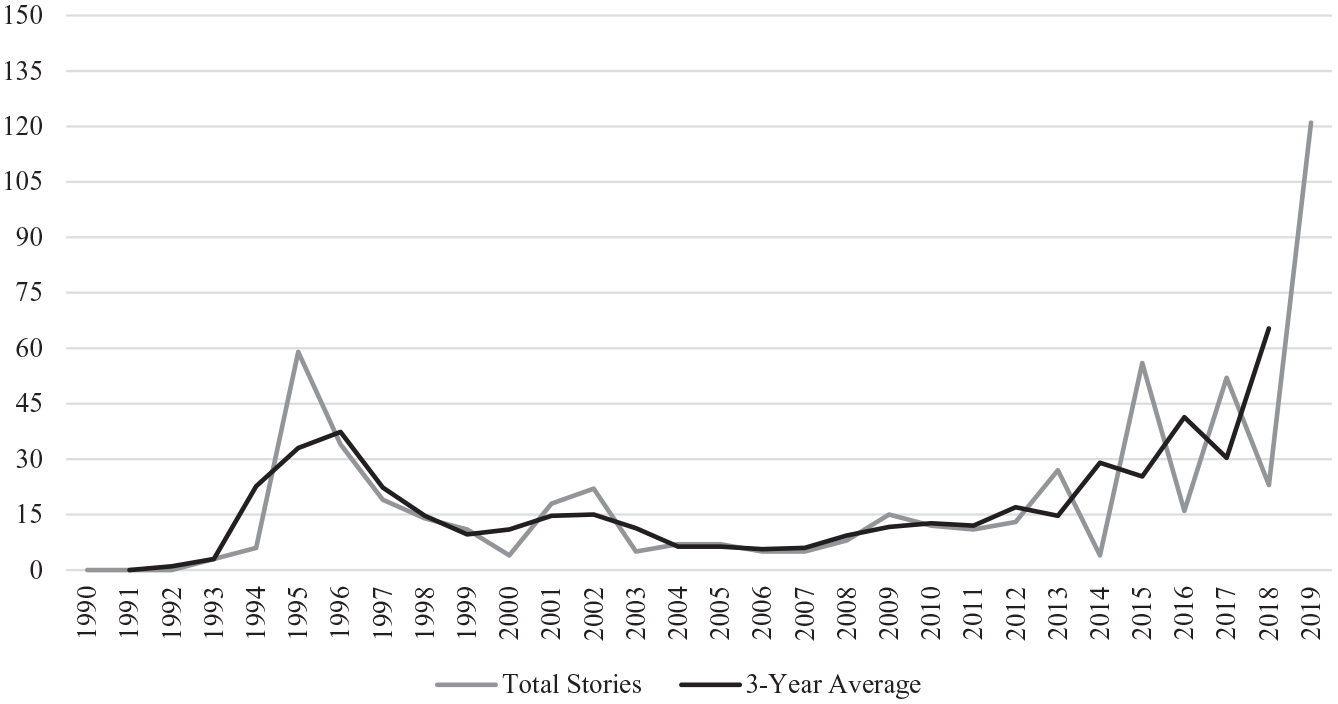
News stories referencing “domestic terror/ism” over time.
Two patterns are especially noteworthy. First, in 1995 the Oklahoma City bombing dominated news coverage. This was the point at which domestic terrorism first meaningfully entered the news agenda during this period of analysis, having received just nine stories in the 5 years prior. Even more striking is the recent growth in coverage. The years 2015 and 2017 both approached 1995 in total stories mentioning domestic terrorism (focusing especially on the shooting of nine African Americans at a South Carolina church, the killing of four Marines in Tennessee, the violence at a white supremacist rally in Virginia, and the Las Vegas massacre). The year 2019 was in a league of its own, with substantial coverage centered on the San Diego synagogue shooting, the El Paso Walmart shooting, and the Dayton, Ohio shooting. There was also a shooting at a Jewish market in New Jersey, a stabbing that occurred during a Hanukkah party in New York, and multiple foiled plots, all of which were labeled as domestic terrorism in the news. Clearly, the U.S. is in an era of heightened attention to domestic terrorism.
RQ1: Sourcing
Our first research question asked which sources were most prominent in news coverage of domestic terrorism. Table 1 displays the percentage of stories that included each source, overall and by decade. Looking first at the overall trends, it is clear that Non-President Government sources dominate news coverage. This reflects the voices of both law enforcement and government officials. For example, after the 2019 El Paso shooting, Former El Paso Congressman and then-2020 presidential candidate Beto O’Rourke was often sourced to make sense of the tragedy in his hometown. El Paso Police Chief Greg Allen was also sourced to explain the massacre. Associates of the group responsible for the attack and other press organizations were rarely sourced.
Sourcing in news stories of “domestic terror/ism.”
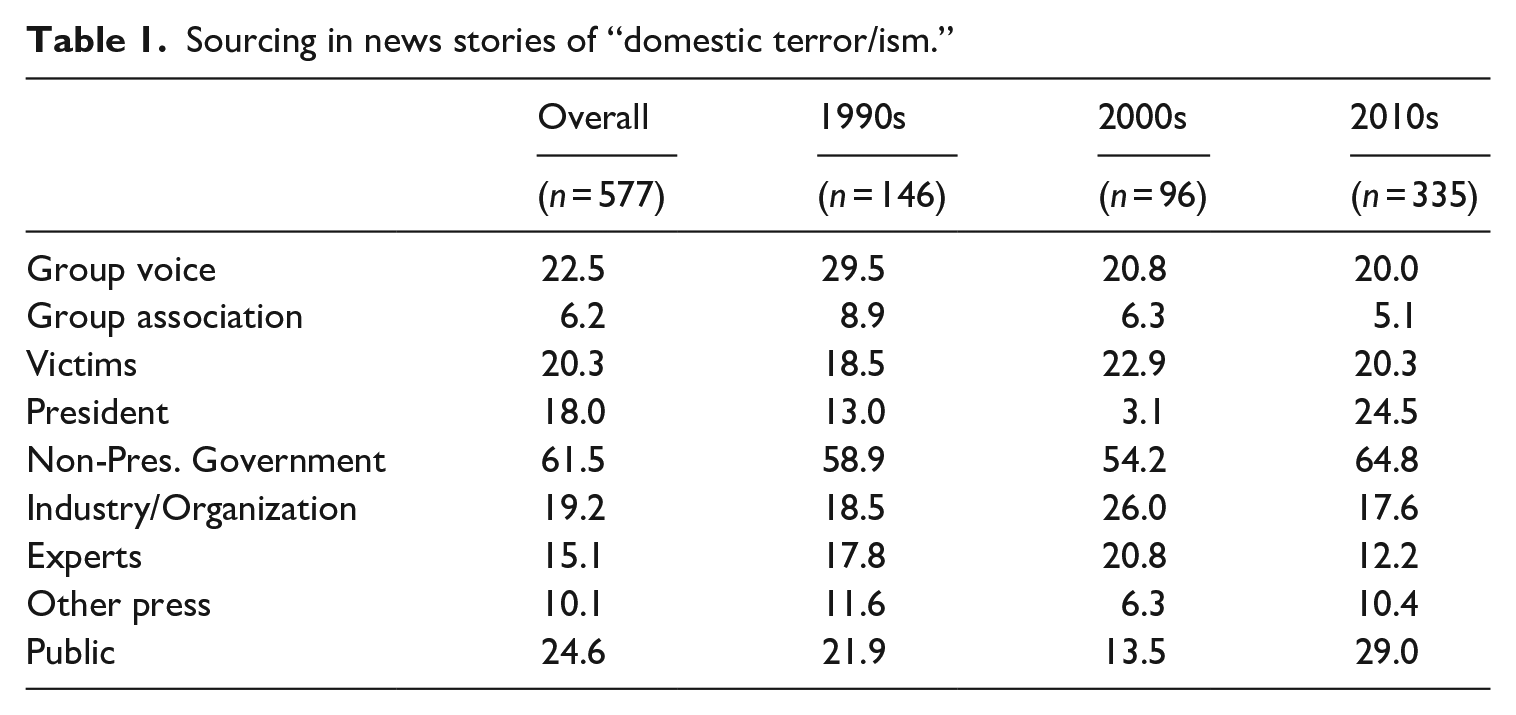
Looking at the decade-level splits highlights two additional patterns. First, in recent years, the president has become a more important source—now present nearly twice as often as the previous high in the 1990s. Second, expert voices have declined in recent years. After the Oklahoma City bombing, news networks regularly sourced engineering, terrorism, and explosive experts to explain the bombing (e.g. how it happened, how one could make a homemade bomb) as there had not yet been an attack of that magnitude. Morris Dees, the then-Director of the Southern Poverty Law Center that monitored hate groups in the United States, was also often called upon to lend insight into domestic terrorists and militia organizations. As domestic terrorism crises have become more common and understood, such expert sources have appeared less frequently.
RQ2: Contextualization
Our second research question focused on contextualization. This turned out to be a common, though not dominant, practice. Overall, 51.5% of the news stories discussed domestic terrorism in relation to other acts of domestic terrorism or foreign terrorism. However, some of this contextualization occurred as a mere mention. Typically, in these single-sentence-or-less cases, the reporter simply name-checked a previous act of terror or used it as an attention-getting lede. Focusing our analysis on only the fuller cases (i.e. two sentence of contextualization or more), we find that 35.0% of the stories included contextualization. Discussions of other domestic terrorism (23.4%) contributed somewhat more to this contextualization than did discussions of foreign terrorism (18.7%).
In the 35% of stories that did offer meaningful contextualization, it was common for reporters, government officials, and other crisis managers to anchor their discussion of specific domestic terrorism attacks in other notable domestic and foreign attacks, such as the Oklahoma City bombing or the 9/11 terror attacks. This comparison tendency was often tied to the shocking scale of those attacks. For example, on May 4, 1995, CBS host Dan Rather described the Oklahoma bombing as the worst domestic terrorist attack in America. Understandably, 9/11 was a common reference point for journalists and grounded much of the foreign terrorism contextualization from that point forward. Previous domestic and foreign terror events were also called upon to explain the various techniques used during attacks. After the arrests of twelve members of the Viper militia who were plotting to bomb government buildings in Arizona, for instance, ABC reporter Barry Serafin noted how the bombing materials were similar to those used for the Oklahoma bombing. In another ABC report, a 2001 anthrax attack was linked to the Iraqi technique of making biological weapons. Finally, it was common for the outcome of previous terror attacks (e.g. indictment charges, enhanced security measures) to be used to inform how the federal government or private entities could or should respond to current domestic terror events.
Importantly, such contextualization was more common in the presence of certain sources. Table 2 reveals this pattern (focusing on only those cases where the contextualization comprised at least two sentences). Stories with sources tended to be more involved, so it is understandable that, for six of the nine source categories, contextualization was more common with the source present than when absent. What is more revealing is the considerable variation that exists in the “difference” column, which shows how much more common contextualization was when each source was present. Other press sources were particularly likely to increase the likelihood of contextualization, with presidents, government actors, and the group responsible for the attack also making an especially noticeable difference. In these patterns, the opportunity for strategic communicators to shape the narrative that emerges in these moments is clear.
Contextualization in news stories of “domestic terror/ism.”.
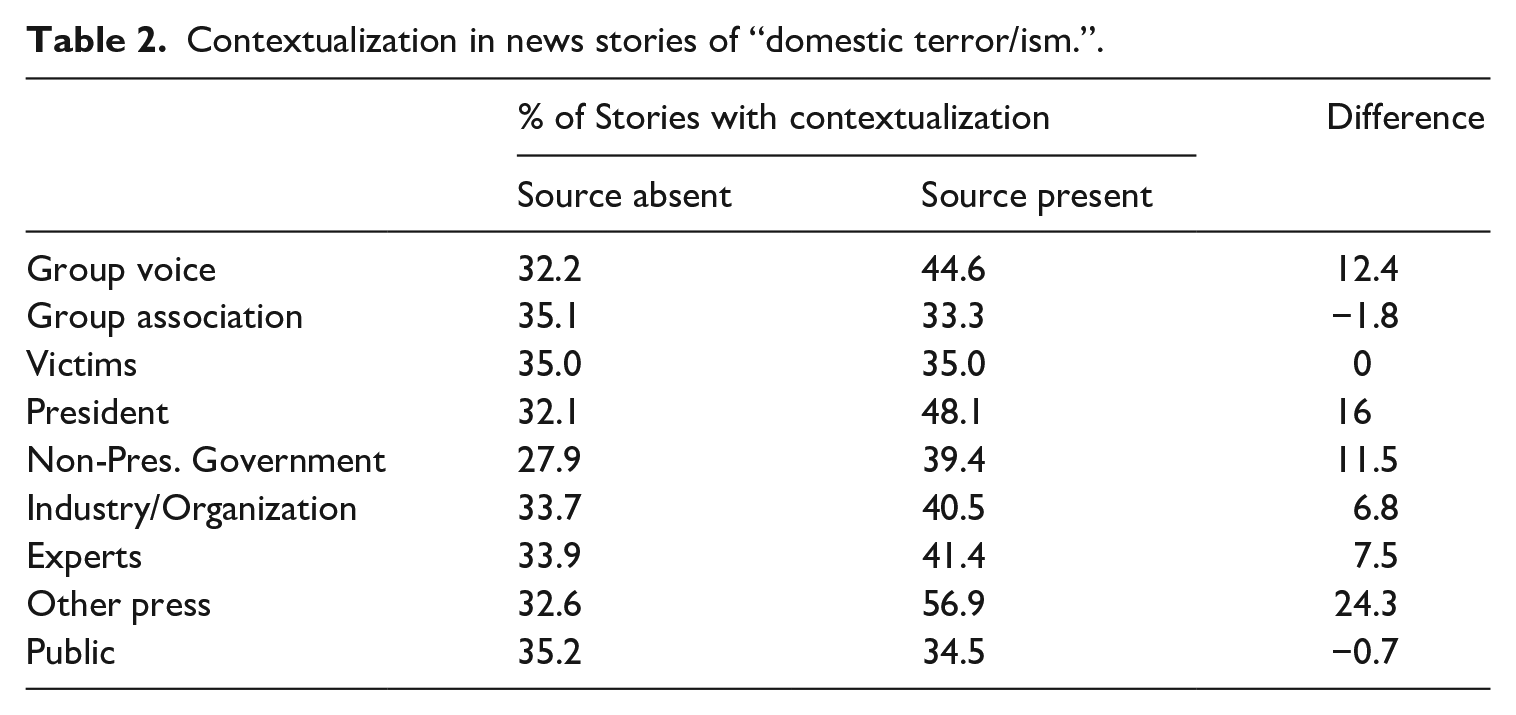
A few examples help characterize this relationship between sources and contextualization. After a series of fires caused by the Earth Liberation Front (ELF) in 2001, an environmental organization with a history of domestic terror, CBS sourced Newsweek reporter Dan Glick, who covered the group’s 1998 attack on the Vail Ski Resort in Colorado, to explain how the group evaded authorities. Also common was for government officials or presidents to discuss other acts of terror to condemn the inaction of others while praising their crisis management strategies. After the 2019 mass shootings in Texas and Ohio, nearly every one of the 2020 Democratic presidential candidates criticized President Trump, suggesting the continued violence was due to his unresponsiveness to previous domestic terror incidents. When NBC reporter Chuck Todd asked Julian Castro if Trump had “the credibility to fix the problem,” Castro responded saying, “Unfortunately, he doesn’t have any credibility anymore. You know, when he didn’t step up right away and condemn the neo-Nazis after Charlottesville . . .he doesn’t have any credibility.”
RQ3: Ideological labeling
Our third research question addressed responsibility framing via ideological labeling. The most common labels were not explicitly partisan: groups were labeled as “radical,” “fringe,” or “extreme” in 24.6% of stories. More striking was the use of partisan labels, which turned out to be quite lopsided. Whereas rightwing labels were present in 9.7% of the stories, leftwing labels were present in just 2.6%. Nor was this discrepancy an artifact of the considerable attention the networks paid to the Oklahoma City bombing, which was conducted by rightwing terrorists. Excluding stories from 1995, the networks used rightwing labels in 9.1% of their stories, compared to 2.7% for leftwing labels. Notably, virtually all of the leftwing labels that did occur were a feature of the 2010s as opposed to prior decades. Indeed, there were only two total uses of leftwing labels in the 1990s and 2000s.
Once again, a few examples help illustrate the nature of these patterns. When news programs discussed acts of domestic terrorism motivated by leftwing ideologies (e.g. eco-terrorism), they rarely described them as either leftists or leftwing in orientation. Those that did occurred mostly in 2017 (40.0%) and 2019 (33.3%) and focused on the violence that erupted during the white supremacist rally in Charlottesville, Virginia, and a protest in Portland, Oregon between right-wing extremists and left-wing anti-fascists. Importantly, the left-wing label was mostly used as a general descriptor for political liberals (e.g. protestors described as part of the alt-left), not in reference to a specific act of domestic terror. In contrast, the term “rightwing” was more definitively used to describe the person or group who had committed an act of terror and was more evenly distributed over time. In a 1995 20/20 special on ABC, Timothy McVeigh was discussed as being known for his extreme, rightwing views. Similarly, ABC reporter Lisa McRee discussed biochemist and terrorist Larry Harris as part of a rightwing extremist group.
RQ4: Definitional uncertainty
Finally, we were interested in definitional uncertainty. This was not a common feature overall: just 9.4% of stories questioned whether “domestic terror/ism” was an appropriate label for the events described. However, this type of questioning has in recent years become an increasingly common part of news coverage. In fact, nearly 90% of all questioning that occurred in these stories happened in just the 5 years since 2015. Since then, the average year saw 23.5% of stories question the designation of “domestic terror/ism.”
Given that such definitional uncertainties are playing out in contemporary news reporting, we looked closely at this coverage to better understand its nature. Sometimes this questioning was simply the result of details still emerging in breaking news. But, in other cases, strategic communication was more centrally at work. Two patterns emerged along these lines. First, the domestic terror/ism classification was sometimes questioned based on motivation. For example, after the 2017 Las Vegas mass shooting, an ABC reporter asked the Las Vegas Sheriff how to differentiate between domestic terrorism and other crimes. Sheriff Joseph Lombardo responded, “Well, we have to establish what his motivation is first, and there’s motivating factors associated with terrorism, other than a distraught person just intending to cause mass casualty.”
Second, political elites often debated the domestic terror/ism label, demonstrating the political nature of the term. In response to the 2013 Boston City marathon bombings, for instance, President Obama was reluctant to label the attacks as domestic terrorism, even though other White House officials readily used the term. When asked why the president was holding back, CBS White House Correspondent Major Garrett said, “the president simply did not want to invoke that word and get ahead of the facts or evidence in the case.” In another example, President Trump did not label the 2017 white supremacist rally as domestic terrorism, even though many in the Republican party did denounce the violence as such. As an explanation, reporter Hallie Jackson posited, “He [Trump] did not say the words white nationalist or white supremacist or Neo-Nazi or domestic terrorism. Potentially it’s because that is obviously a legal definition and the Department of Justice would get involved with that.”
Discussion
This study focused on the framing of domestic terrorism in U.S. broadcast news, a crisis context that is increasingly salient in U.S. politics but that has received relatively little scholarly attention. Several points warrant discussion.
Sourcing was common in news coverage of domestic terrorism, but there was considerable variation in the voices sourced over time. Expert voices were more prominent in the 1990s and 2000s than they have been in the past decade. Presidential voices are now contributing more to the framing of domestic terrorism than they once did. These shifts in sourcing may indicate an evolution in expectations of responsibility and response in cases of domestic terrorism. The Situational Crisis Communication Theory (SCCT) posits that crisis response strategies should be based on perceived responsibility, crisis history, and prior relational reputation (Coombs, 2007); there is greater potential for reputational damage if an organization has a history of crisis and the public deems the organization responsible for the current crisis. In the context of domestic terrorism, the United States is the “organization” and presidents are the “face” of the organization (Eshbaugh-Soha, 2011). In the 1990s, when domestic terrorism was still a relatively new phenomenon in the U.S., the public was perhaps less likely to blame the government or president for not preventing the attacks, so a direct response was not as necessary. Terrorists were dismissed as lone-wolf radicals, with industry leaders called upon to contextualize and explain this “fringe” behavior. As domestic terrorism has become more frequent (crisis history), there is more responsibility placed on the government for failing to act (attribution of responsibility), which helps explain the increase in government responses. Taking SCCT into account, government officials should be mindful of how the current trajectory of domestic terrorism in the United States will only compound the problem, necessitating even greater responses and actions.
Our findings also revealed that journalists often contextualized domestic terrorism in relation to past incidents of domestic terror. In some respects, this provides a counterexample to the familiar news tendency toward fragmented, episodic coverage (see Bennett, 2012; Iyengar, 1991). However, some of this contextualization was cursory in nature, little more than a passing mention to a past event. With that said, more than one third of the stories included fuller contextualization. This prompts the question of how much contextualization is necessary. A goal of complete contextualization (i.e. every news story situating every domestic terror event in relation to past events) would be infeasible given the constraints of time and resources that television news faces, and might not be desirable even if it were feasible. After all, there might be events that are not well suited to being discussed in terms of past events, and forcing them into a contextual narrative might not ultimately benefit public understanding. The presence of key sources—especially other press, presidents, government actors, and the terrorist groups themselves—made contextualization more likely. From a public relations perspective, then, the fact that more than one third of domestic terrorism stories included useful contextualization is a reason for optimism.
Also noteworthy is that news coverage did not regularly apply explicit ideological labels when focused on domestic terrorism. The general hesitance to apply such labels likely reflects the powerful commercial underpinnings of U.S. broadcast news: In cases where motivations are unclear, explicitly characterizing domestic terrorism as coming from either the right or left potentially alienates audiences who watch broadcast news and identify as either group. However, to the extent that reporters and crisis managers did invoke labels that signaled a particular ideological leaning, there was a notable difference in their application of those labels on the political right and left. Specifically, the political right was identified more often. Much of this disparity should reflect real-world variation in terrorism. In the period examined here, rightwing extremists were responsible for more acts of domestic terrorism than were leftwing extremists (Juarez, 2019; Nowrasteh, 2017). Still, our data reveal that television news coverage did not follow the heightened salience of leftwing terrorism that occurred between 2000 and 2010. Consider that, by one estimate, domestic terrorist attacks motivated by leftwing extremists in the 2000s increased by 80% (Ideological Motivations of Terrorism in the United States, 1970–2016, 2017).
Such labeling has particular consequences for politicians who are running for office and may seek to be less divisive to maintain favorable public opinion. Using ideologically-loaded labels might increase partisan polarization and result in a “double crisis” where the “crisis response is so ineffective or inappropriate that it appears to create a second crisis” (Coombs, 2015: 146). This certainly was the case after the Charlottesville, Virginia protests where President Trump referred to those on the alt-right who incited the violence as “very fine people.” These comments created a secondary controversy, apart from the actual terror incident, that dominated news coverage. Media organizations also have weighty considerations. Beyond the comparatively simple news decision of when and how to ascribe an ideological label to a given terrorist group, media organizations are facing the growing crisis of how to manage the flow of ideas (e.g. conspiracy theories) that might incite violence. In the wake of the deadly insurrection at the U.S. Capitol in January 2021, several major social media platforms, such as Facebook and Twitter, deactivated accounts—including President Donald Trump’s—that they viewed as inciting violence. Such decisions hinge, in part, on the ideological motivations of all involved, as well as on how people in power define the violent events that prompt the shift.
Along these lines, our findings point to the increasing debate surrounding the label “domestic terror/ism” in the recent political and news environment. Although reporters, law enforcement, and politicians did question the domestic terror/ism classification before 2012, a qualitative review of the texts indicated that this uncertainty was mostly tied to a lack of information. Questioning after 2012 highlighted the importance of the term concerning motivation, judicial action, and party politics, demonstrating how questioning the crisis designation (i.e. terrorism) can function as a crisis response in and of itself. For example, one debate surrounding the motivations for the terror attacks centered on the mental health of the perpetrator. While psychological distress can indeed spur terrorist activity (see Horgan, 2017), we identified that mental health debates were primarily used to dismiss the terror classification, effectively shifting blame for the crisis from governmental leaders and their policies to individual perpetrators and their “disturbed” mental states. Such a response strategy is common during governmental crises as political legitimacy is tied to protecting public safety and order, which terrorism significantly undermines (Boin et al., 2010). Whereas the “us versus them” frame common in foreign terrorism coverage creates an easy rhetorical scapegoat for politicians who must answer for these crises, domestic terrorism perpetrators are harder to vilify due to their national and political connections. Reclassifying domestic terror crises as mental health crises through definitional uncertainty, then, is a politically expedient way of explaining domestic terror behavior and reconstituting governmental legitimacy, even if such a rhetorical move is “unwarranted and misleading” (Horgan, 2017: 201).
Similar to the use of ideological labels, the recent uptick of “domestic terror/ism” questioning between political elites indicates that the label now heavily functions as a political weapon. Scholars have noted that “terrorism” is not just a crime designation but a means through which individuals and groups of people are strategically marginalized and silenced in society (Chomsky and Herman, 1979). Those managing terror crises may be more or less motivated to apply the terrorism label depending on their association with the accused person/group. This was certainly the case during both the Obama and Trump administrations. Obama was sometimes reluctant to call out Islamic-motivated terrorism by U.S. citizens because he did not want to alienate U.S. citizens who follow the Islamic faith or lump a few extremists with the many Muslims that exist peacefully around the world (Diaz, 2016), thereby supporting critiques of his immigration policies and the naturalization of certain cultural/religious groups. Trump ardently criticized Obama for this choice during his 2016 campaign. When the 2017 white supremacist rally occurred, Trump critics were quick to point out the political hypocrisy (Beauchamp, 2017). In both examples, the cultural/political identity of the perpetrator(s), if attached to the act of terror, had the potential to serve as a negative indictment of the president’s political orientation and policy positions. Because campaigning is a continuous process where politicians are ever-mindful of their issue framing, we may see the term used less and less, or dismissed as a partisan ploy, which could have serious judicial and legal implications for dealing with these crimes (Jenkins and Daddario, 2017).
Another explanation is that the increase in questioning signals the broadening of the acts considered to be domestic terror/ism. Discussions of domestic terrorism in the 1990s were largely anchored to the Oklahoma City bombing, which fit the mold of a typical expression of terrorism (see Sui et al., 2017). After 2012, acts questioned as domestic terrorism took the form of mass shootings, serial sniper shootings, and rally protests. Even though mass shootings and protest violence match the legal definition of terrorism (see Federal Bureau of Investigation, 2015), reporters and government officials are still grappling with how to classify these events. This finding helps explain why some notable cases that have been labeled domestic terrorism by activists and commentators (e.g. the mass shooting in Newtown, CT) did not show up in the present analysis. Crises are constructed and perceptual (Penrose, 2000). Those who face reputational threats because of domestic terrorism (e.g. government officials) likely prefer a more limited definition. Clearly, reporters, government officials, industry leaders, and experts play an important role in determining what “counts” as domestic terrorism—and the increased questioning of the domestic terror/ism label highlights this public relations tension.
Limitations and future research
This research was limited by our focus on just one form of news. Focusing on just this form was justifiable to facilitate a more precise longitudinal analysis, but future research would benefit from considering other forms that might have different coverage of domestic terrorism. Additionally, space constraints prevented us from undertaking a separate analysis of strategic communicators to more directly explore the role they played in influencing news coverage. Future research that tracks, for example, presidential communication in the aftermath of domestic terrorism could build on the insights offered here. Future research should also seek to interrogate explanations of terrorism beyond the left/right ideological divide. Although the left/right binary is widely used in news discourse to categorize political events and actors, terrorism can certainly span a range of ideological motivations. Finally, analyzing news discourse that explicitly used the label “domestic terror/ism” necessarily excluded some events that publics may have perceived as terror-related. Future scholars will do well to expand the search terms to capture the full range of domestic terrorism labeling debates. These and other lines of inquiry could usefully expand our knowledge of a crisis that is, sadly, increasingly salient.
Footnotes
Funding
The author(s) received no financial support for the research, authorship, and/or publication of this article.
