







Abstract
Despite being one of the fastest growing and highly influential segments of the U.S. population, Latino/a/xs have been largely underrepresented in the public relations field. In response to the scarcity of research examining the role and influence of Latinas in public relations, this study contributes a unique perspective by providing new insights into the challenges U.S. Latinas face in the public relations industry, their coping strategies, and how those may vary based on cultural identities (immigrant, first-generation, and non-immigrant Latinas). Through 24 in-depth interviews with Latinas working in mid-management and senior-executive level roles, this study reveals inclusion, intersectionality, isolation, language, pay equity, and pigeonholing as key challenges to career advancement; and identifies action, rational thinking, avoidance, emotional support, instrumental support, and personal advocacy as main coping strategies used to address these challenges. Findings also provide recommendations and a timely call for greater cultural sensitivities, accountability, and DEIB in public relations.
Keywords
Introduction
In 2020, Latino/a/xs 1 comprised 62.1 million of the U.S. population, representing almost 19% of the total population (Krogstad and Noe-Bustamante, 2021; U.S. Bureau of Labor Statistics). Despite the fact that Latino/a/xs are one of the fastest-growing segments of the population, represent a spending power of US$1.5 trillion (Sanchez, 2021), and are among the highest users of social media (De Armas and McCaskill, 2018), they remain largely invisible in the public relations profession (Ford and Appelbaum, 2006, Len-Rios, 1998, 2002, Pompper, 2004, 2007, Radanovich, 2014, Vardeman-Winter and Place, 2017).
According to data from the 2020 U.S. Bureau of Labor Statistics (2020), only 13.6% of public relations specialists identified as Latino/a/x or Hispanic compared to 83.3% who identified as White. Even more concerning is the lack of diversity in public relations management as only 7.6% of public relations and fundraising managers identified as Latino/a/x or Hispanic compared to 91% who identified as White. However, the data do not reveal the demographics using both gender and race, so we have no way of knowing what percent of Latino/a/xs or Hispanics working in public relations are women.
Decades of research have shown that White women are dominating the field of public relations, but there is a lack of studies examining roles and unique experiences from diverse backgrounds (Ford and Appelbaum, 2006, L.A. Grunig and Toth, 2006, Vardeman-Winter and Place, 2017). More specifically, scholars also have identified a scarcity of research and called for a greater need to understand Latino/a/xs in public relations (Len-Rios, 1998, 2002, Pompper, 2004, 2007; Radanovich, 2014, Vardeman-Winter and Place, 2017).
For this study, we focused on the experiences of Latina public relations practitioners as scholars have declared that we know “far too little about why Latinas are so conspicuously absent from management ranks” (Pompper, 2007: 292) and little progress has been made in addressing these issues. Furthermore, White women constitute the majority of the public relations industry (Vardeman-Winter and Place, 2017) and therefore it is important to recognize differences among different groups of women and understand the value they bring (Topic et al., 2020), and the power they have to advance diversity, equity, inclusion, and belonging (DEIB) in organizations. As members of the fastest-growing segment of the U.S. population, it’s important to be inclusive of Latino/a/x PR professionals who may not only bring a greater understanding of multicultural and international audiences, but also may reflect the communities they serve.
To address this gap in public relations scholarship, we conducted 24 in-depth interviews with Latinas working in mid-management and senior-executive level positions. We consulted coping theory, cultural and ethnic identity, acculturation, and intersectionality to provide a proper context and theoretical framework. The purpose of the study was to discover what challenges these women have faced in advancing in their public relations careers, how they coped, and overcome these challenges. One significant contribution of this study is that 19 of the 24 participants identified as immigrants or first-generation Latinas, which allowed us to compare and contrast their experiences in public relations with the five individuals who identified as non-immigrant Latinas. Through their personal stories, we identified key recommendations for improving DEIB in public relations leadership.
Literature review
Latinas in public relations
The public relations industry faces the challenge of limited cultural and ethnic diversity in the industry. Unfortunately, the data shows that BIPOC (Black, Indigenous, and People of Color) individuals have been underrepresented in public relations roles for years and continue to lag behind the general U.S. population. According to a 2019 PRWeek report, more than half of U.S. public relations agencies lacked people of color in executive leadership or board roles (Moore, 2020). However, the business case for diversity is strong as reported by a 2020 McKinsey study, which found that companies with greater gender and ethnic diversity in leadership roles were more profitable than their peers (Dixon-Fyle et al., 2020).
As the fastest-growing racial and ethnic group in the U.S. population (Krogstad and Noe-Bustamante, 2021), the Latino/a/x or Hispanic community is visibly missing from the public relations industry. In fact, there have been very few studies about Latinas in public relations and the realities of their experiences in the industry. Previous studies focused on the experiences of women of color as a whole have indicated low numbers of Latinas in public relations, as well as challenges relating to low salaries, stereotypes, and the tendency to pigeon-hole practitioners into “ethnic” roles and projects (Abeyta and Hackett, 2002, Len-Rios, 1998, Meng and Neill, 2021, Pompper, 2004, 2007). For example, women of color are treated differently from their White counterparts, especially in terms of pay, promotion, and perceptions of job roles and responsibilities (Len-Rios, 1998). As evidence, a study on compensation in public relations agencies found that men earn an average of US$6072 more than women when controlling for other factors such as years of experience, while ethnic minorities earned US$9302 less than White individuals working in public relations agency settings (Muehlbauer and Rockland, 2017). This becomes an issue for women of color who face “dual discrimination” (p. 333) because they are already being paid less than men and additionally are being paid less than White women (Vardeman-Winter and Place, 2017).
In response to these challenges, Pompper (2007) found that Latinas were changing jobs or starting their own businesses rather than negotiating solutions with their employers, which has been referred to as “out-spiraling career moves” (Bell and Nkomo, 2001: 161). This reality further threatens any progress in improving diversity in public relations. However, more recent research investigating how U.S. Latina public relations leaders are addressing current issues and new challenges are lacking.
For the purposes of this research, being a Latina is defined as any person of Latin American descent (e.g., South America, Central America, Mexico, and Caribbean islands) residing in the U.S., whereas being Hispanic refers to any person who shares the common language of Spanish. The researchers used the term Latina since all of the participants in this study have a lineage connection to a country in Latin America and not all are native Spanish speakers. Additionally, this study recognizes cultural and ethnic differences among U.S. Latinas as (1) immigrant or foreign-born Latinas who came to the U.S. as a child, teen, or young adult; (2) first-generation Latinas who were born in the U.S. and were raised by immigrant parents; and (3) non-immigrant Latinas who were born in the U.S. and have generations of established family history.
Identity theory and intersectionality
One theoretical concept foundational to this study is identity, which refers to “a person’s conception of self within a particular social, geographical, cultural, and political context” (Yep, 1998: 79 as cited in Oetzel, 2009). Scholars have suggested that identity is socially constructed, multifaceted and fluid (Oetzel, 2009). Some core concepts associated with identity theory are ascribed identity and avowed identity (Oetzel, 2009). Ascription refers to the “process of assigning in another person what you think his or her identity should be,” while avowal refers to the “process of telling others what identity(ies) you wish to present or how you see yourself” (p. 62). Ascribed identity becomes relevant for Latinas working in public relations because others have expectations of them based on their gender and social norms (Collier, 1994, Neill and Meng, 2021, Sha, 2001). Aldoory and Toth (2004) pointed out that if men and women act in accordance with gendered role expectations, they are more highly perceived as leaders, but if they display “incongruent gender characteristics…they are perceived as ineffective” (p. 161). For example, women are expected to enact traditionally feminine characteristics such as “passivity, nurturance, gentleness, and emotionality” (Sha, 2001: p. 157). However, in leadership roles, women also can face the challenge to adopt traditional masculine characteristics to be considered more effective leaders including being “decisive, direct, rational, authoritative, and aggressive” as opposed to being “cautious, receptive, indirect, emotional, and polite” (Aldoory, 1998: 97, Baker, 1991).
Adding to the complexity of identity for Latina leaders is intersectionality, a concept originating from legal scholar Kimberlé Crenshaw (1991), who used the term to express how gender, race, and economic and social class work collectively to exclude women of color from opportunities (Nielsen, 2011). Particularly relevant to identity research are subjugated ascriptions or “identities given to others that put them in a lower or inferior position compared to one’s own group” (Oetzel, 2009: 75). Consistent with this concept, Cose (1993) conducted interviews with African-American or Black professionals, which revealed others’ low expectations for them and anticipation of failure (L.A. Grunig, et al., 2008). Similarly, Pompper (2007) found that Latinas perceived that “they are neither fully valued nor trusted to offer the full range of abilities that male and Anglo practitioners are assumed to have” (p. 304). Further, Pompper (2007) suggested at the time of her study that Latinas were inclined to accept their low status and pay, and even “mask their femininity and ethnicity” (p. 304) to conform to ‘‘what is normal’’ at work (Bell et al., 1993: 18).
More recently and relevant to this study, scholars have extended the list of social-cultural identities to also include nationality (Golombisky, 2015, Vardeman-Winter and Place, 2017). Particularly relevant to a study on the cultural identity of Latinas is language, which is a means of expressing one’s cultural identity (Oetzel, 2009). In this domain, ethnolinguistic identity theory (ELIT) is centered “on the conditions upon which identity differentiation occurs, particularly around language and identity” (Oetzel, 2009: 70; Giles and Johnson, 1981). Based on this theory, three factors that are essential to consider are status, “the degree to which a language is valued and spoken in a society”; demography, which has to do with the number of people who speak the language in a given community or country; and institutional support in the areas of economic, political and media organizations (Oetzel, 2009: 71). Indeed, Pompper (2007) found that some Latinas in the U.S. embraced their role as an “ethnic insider” (p. 306) and marketability as bilingual public relations practitioners.
As a field that represents stakeholder perspectives and management, there is a need for greater cultural diversity, equity, inclusion, and belonging in public relations. As L.A. Grunig, J.E. Grunig and Dozier (2002) explained, “practitioners from different racial, ethnic, and cultural backgrounds are needed in excellent public relations departments, not just for the benefit of these diverse practitioners, but because they make the organization more effective” (p.12). As further justification for research in this domain, public relations scholars have emphasized that “most research on diversity examines one identity rather than multiple identities” (Vardeman-Winter and Place, 2017: 329).
Acculturation stressors
As the fastest-growing cultural and ethnic population in the U.S., Latinos are not a monolithic group and represent a diversity of social, economic, and demographic factors (Cruz and Blancero, 2017). In the acculturation process (Berry, 2003), individuals experience different stages associated with acculturation such as integration (retaining original culture), assimilation (replacing original culture with host culture), separation (withdrawal from host culture), and marginalization (rejecting original and host culture). For Latinas who identify as either immigrant or first-generation, this process can be difficult and stressful as they live and manage their identities in dual worlds by navigating through adopting a new culture (i.e., acculturation) while retaining pieces or all of their original culture (i.e., enculturation) that affects so many aspects of their lives such as traditions, language, media, music, food, and jobs. Cruz and Blancero (2017) recognized the Latino experience as unique and identified several acculturation stressors that Latinos face during the Latino acculturation–enculturation (LAE) process, such as perceived discrimination, English-language difficulties, cultural and social isolation, and bicultural stress.
Coping theory
As a key theoretical framework for this study, we consulted coping theory, which can be applied to acculturation stressors. Coping has been defined as “the set of cognitive and behavioral processes in response to emotionally arousing, stress-inducing interactions with the environment aimed at bringing forth more desirable emotional states and reduced levels of stress” (Duhachek, 2005: 42). In response to these stressful situations, Duhachek (2005) identified eight means of coping: (1) Action refers to addressing the issue directly; (2) rational thinking refers to not letting one’s emotions drive behavior; (3) emotional support refers to seeking intangible resources that improve one’s emotional state of mind (e.g., advice, guidance, listening, understanding); (4) instrumental support refers to seeking tangible resources to address the issue (e.g., mentorship, sponsorship, trainings, funded programs); (5) positive thinking refers to psychologically seeing the issue in a positive light; (6) avoidance refers intentionally distancing (physically or psychologically) oneself from the issue; (7) emotional venting refers to expressing one’s feelings; and (8) denial refers to refusing to recognize the issue (pp. 44–46).
Other scholars noted key coping strategies from women in public relations. For example, Meng and Neill (2022) examined the lack of instrumental support, such as mentoring or sponsoring programs, at the organizational level to better support public relations female leaders as they navigate obstacles. Consistent with taking action as a means of coping, Pompper (2007) found that Latinas working in public relations focused on building their skills, pursuing continuing education, improving their language skills, building their network, and consulting with mentors, all with a goal of advancing in their careers. In a recent study focused on the experiences of women in public relations leadership in general, Neill and Meng (2021) found that women of color perceived others’ expectations of them exceeded those of their male colleagues and they coped by “working harder, engaging in positive thinking and not dwelling on times when they were overlooked for promotions or treated unfairly” (p. 11).
The literature focused on acculturation also provides insights into coping strategies, known as bicultural supports, specifically tied to challenges faced by immigrants and first-generation Latinas. These include developing a bicultural identity, maintaining their ethnic identity, achieving bilingual fluency, and developing social connections (Cruz and Blancero, 2017: 494). These strategies can result in achieved identity, which is characterized by a “clear, confident sense of one’s own ethnicity” (Phinney, 1993: 71), such that when one is confronted with negative messages about their cultural identity, they are able to move on and not be discouraged by them (Oetzel, 2009).
Based on this theoretical framework, the purpose of this study is to address the gaps in the literature by examining some of the specific challenges faced by U.S. Latinas currently working in public relations; how they cope with these challenges; and share practical recommendations for how to improve DEIB in public relations moving forward. This review of the literature suggests several issues related to Latinas working in public relations that deserve more scholarly attention. Therefore, we proposed the following research questions: • • •
Method
Due to the scarcity of research related to Latinas working in public relations and the research questions, qualitative research was the chosen method. The unit of analysis was the interview transcripts featuring each Latina’s own voice as they described their unique experiences relating to career advancement, challenges, and coping strategies, and shared suggestions for how to improve the industry in terms of recruitment and retention.
Sampling
To answer the research questions, we conducted 24 in-depth interviews with women working in mid-management and senior-executive level positions. For eligibility, the participants were required to self-identify as Latina or Hispanic and be working in mid-management or senior-level agency or in-house roles in public relations. We specifically focused on those working in leadership roles because we were interested in understanding how they successfully advanced into their current roles and how they coped and overcame obstacles to career advancement. The participants were recruited through a purposive and maximum variation sampling via personal networks (n = 4), snowballing sampling (n = 20), and through membership of local chapter directories of Public Relations Society of America (PRSA) and the Hispanic Public Relations Association (HPRA). This varied approach generated a maximum variation sample (Tracy, 2013) that was illustrated by participants’ type of organization, in-house versus agency, geographic location, years of experience, and Latin American heritage.
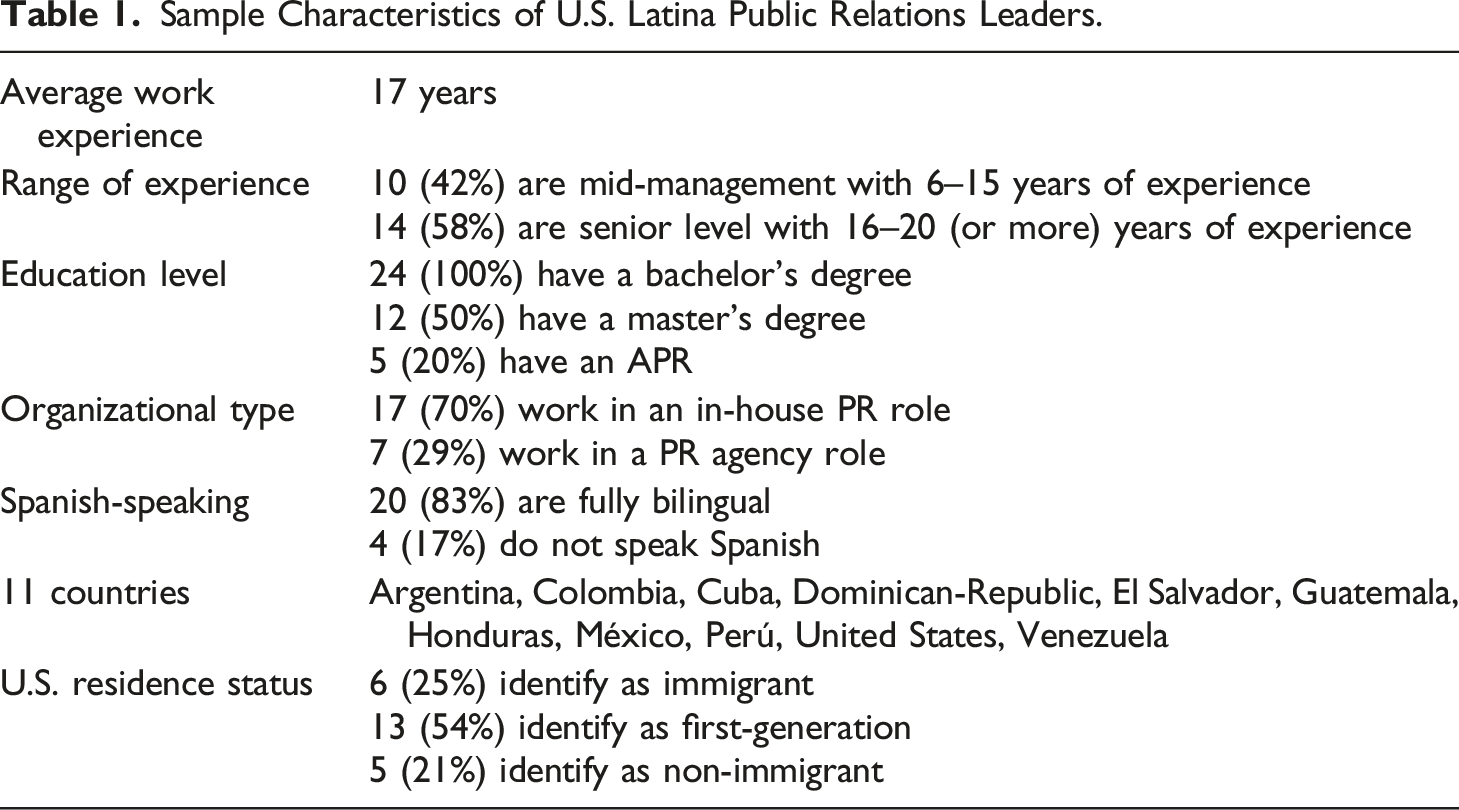
The average years of work experience for the sample was 17 years: 10 (42%) of the participants were mid-career (6–15 years of experience) and the remaining 14 (58%) participants had 16-20 or more years of public relations experience. Most of the participants had an in-house role (n = 17) and the rest worked in a public relations agency role (n = 7). Participants came from Puerto Rico, a U.S. territory, and 10 Latin American countries including Argentina, Colombia, Cuba, Dominican Republic, El Salvador, Guatemala, Honduras, Mexico, Peru, and Venezuela. Our sample included six immigrant Latinas to the U.S., 13 first-generation Latinas, and five non-immigrant Latinas whose families were based in the United States for generations. Three identified as Mexican-American, one as Cuban-American, and another as having roots in South America. We attribute the greater number of participants (19) coming from immigrant and first-generation Latinas to immigration growth patterns with one-third of all Latinos being born outside of the U.S. (Funk and Lopez, 2022). Table 1.
All interviews were conducted by either phone or video conferencing (via Zoom) between June and September 2021. The same interview guide (see Appendix A) was used for all interviews and was externally reviewed by two Latina public relations practitioners prior to the start of the study and revised based on their feedback. Examples of questions included: “What role did mentors play in your career development?” “Did you face any challenges (professionally and personally) in advancing in your public relations career and how did you address them?” “What are some key lessons you have learned as a PR professional?” “What are some ways that organizations can recruit and retain Latinas in public relations roles?” As appropriate, follow-up prompts were used to delve deeper into these issues or to seek clarification, especially concerning their cultural or ethnic identities and how that shaped their perspectives and career advancement choices.
The study followed IRB guidelines, which were approved on May 31, 2021, and all participants were provided consent forms to protect their confidentiality. Due to this study not receiving any grant funding, the respondents were not compensated for their participation. All interviews were audio-recorded and transcribed for analysis producing a total of 363 pages of typed, single-spaced text, representing almost 27 h of interviews or an average of 67 min per interview.
Data analysis
The transcripts were analyzed using common procedures for qualitative data analysis (Miles and Huberman, 1994). More specifically, the researchers used a reflexive thematic analysis process by using existing theory to provide a lens through which the authors analyzed and interpreted the data collected (Braun and Clarke, 2021). This analytical stage involved complete and repetitive immersion in the data with reading, reflecting, writing memos, summarizing, and reflecting again. Since thematic analysis is not a singular approach and can encompass multiple variations (Braun and Clarke, 2021), the authors also chose to incorporate a codebook encompassing themes and coder reliability to ensure consistency. Both researchers coded each interview individually under general categories associated with the conceptual framework and key variables that were the focus of the study such as coping, intersectionality, and race/ethnicity. Next composite code sheets were created electronically using QDA Miner software reflecting all of the respondents’ comments related to each category. To confirm the reliability of the categories, a random sample of 20% of the transcripts was coded by both researchers, which calculated 88.6% agreement. Following data reduction, both researchers qualitatively analyzed the code sheets and wrote memos identifying additional insights, which were then discussed and agreed upon by both authors.
Additionally, one of the researchers identifies as Latina and used personal reflexivity when analyzing the data to reflect on her public relations background and former immigrant upbringing and how that contributed to her approach to the study. Since reflexivity refers to the continuous process of self-reflection and recognizing one’s subjective role in designing, conducting, and analyzing the research (Finlay, 1998), it was important to be transparent with the participants, dwell in the data, and have honest dialogue exchanges with the co-author, who identified as non-Latina, throughout this process.
Findings
In response to each research question, the results illustrate the item most commonly experienced by Latinas and features quotes that illustrate each of these items based on the highest number of people who experienced them.
RQ1: Challenges to career advancement
The first research question addressed the most common challenges Latina public relations professionals are facing in terms of career advancement, and any key differences based on their cultural and ethnic identity (immigrant, first generation, and non-immigrant). The results were analyzed and categorized into six major themes: lack of inclusion, intersectionality, isolation, language expectations, pay & promotion equity, and pigeonholing.
Lack of inclusion
Immigrant and first-generation Latinas described experiencing a lack of inclusion in public relations, especially by their colleagues who often failed to see them as team members. Why are we not invited to this? Am I not the lead for X brand managing 30-people across the network? How am I not involved? Or we're having a round table and we’re bringing somebody from each office. Hey, remember our office? Why are we not involved? - [Cuban-El Salvadorian senior account supervisor]
Other Latinas described feeling frustrated with the lack of inclusion in projects. You find yourself in a situation a lot of times, just because you're Hispanic, you're the go-to person for that campaign. And then once you're given that campaign, your voice doesn't automatically matter. It's just, here's the thing, here's what we're going to do. And it's hard to say, no, that's incorrect or no, that's wrong. And then when you see these bigger articles about like, well, who was in the room when that campaign was going on and…that's a crazy campaign. And it's like, well, there may have been a Hispanic or two, or a person of color in the room that might have said something and been ignored. So, I feel like that's difficult. And just kind of, as a PR professional, you should be able to voice your opinion and have a stance on things but a lot of times you don't feel that you can. - [Dominican agency co-founder]
On the other hand, several non-immigrant Latinas didn’t feel a lack of inclusion due to not having experienced acculturation stressors. When I felt excluded, and it was more like, this is not a natural fit, but they know there’s no real reason to exclude me. It’s because, for the most part, if I think about all the different workplaces I was in, it’s because my values didn’t necessarily align with the people, their common values of a certain group. - [Mexican-American agency owner]
Intersectionality
First-generation and immigrant Latinas described facing the challenges of intersectionality (more so than non-immigrants), especially where they encountered stereotypes and microaggressions as a result of other identities at play. As a communications professional, I work with language. I only know the one, so in some ways, I feel like I’ve put myself at a professional disadvantage because I didn’t grow into that part of my personal identity perhaps. But I don’t know that that’s completely held me back. The culture and the food and I don’t know Spanish, but I can dance to Celia Cruz. There are moments that are authentically Cuban that are at the foundation of who I am, whether or not I know the language, and more so than anything Jewish, frankly. The other half of me is Jewish ethnically. My grandmother came from Austria, so she’s also an immigrant. So, I really identify more as a first-generation American who happens to be Latina and a [descendant of a] Holocaust survivor. - [Cuban agency vice president]
She added that others’ ascribed identity for her includes expectations to be bilingual based on her physical appearance: I think language is as important as one makes it a part of their identity. You look at me or people look at me and tell me that they know that I’m something, probably Spanish something. And so that’s going to be a part of my identity simply because of what I look like. I have a good enough answer to the micro-aggression of “why you don’t speak Spanish?” but my identity is still wrapped up in being a Cuban Jew, a Jewish Cuban, Juban. It’s a wonderful mix.
Isolation
Immigrant and first-generation Latinas described feeling isolation in public relations. Not only does it seem they have greater difficulty entering the public relations industry, but when they do, they are often the only Latina or among a few on their team. I would say the only thing that I wish was that I was not the only one…I think while I wish there were more of us, I’m glad that I am where I am because it makes it so that I can draw focus to diversity and inclusion matters, right? That I can be authentic in that way and not known to be a talking head for that. Because I think it’s important that we look to not just open the door for ourselves but open the door for others and create more opportunities. - [Cuban senior director of communications] I’m used to it, to be honest, because I’ve worked in very large agencies where that’s always the case or most often the case. So, I’ve gotten used to it, and I’m comfortable with it. I obviously wish it was different, but it’s not. And I still think that we have a long way to go to change it. We have even larger issues because once you get there, it’s not only that you’re there, but it’s like sustaining, maintaining your reputation, your work, your opportunities, your pay. I mean, all of those things are constant. I would say constant work, and sometimes even constant battles. So, the more the merrier, but at the end of the day we still have so much work to do, the industry does. - [Mexican communications manager]
In contrast, non-immigrant Latinas didn’t seem to take notice of the isolation as much or see it as a negative because they were more focused on building their careers and delivering results: I was the youngest director level person they had in the company at the time. And an HR person happened to see what my maiden name was and came to me and asked me why I didn’t acknowledge my heritage more. And it had never dawned on me because where I grew up, we were all the same. And she said, you know, you really should take advantage of programs that we have for training, and for educational opportunities that are geared toward ethnic minorities. And it was the first time I really thought of myself as an ethnic minority, to be honest with you because everybody was the same in South Louisiana. You’re all Cajuns, you were either Cajun or Creole. And it opened up a whole new world. - [Senior vice president of marketing & communications]
Language
Many of the immigrant and first-generation Latinas described two primary issues with language: (1) the expectation or assumption of speaking Spanish because of their appearance or name, an example of ascribed identity, and (2) pressure to speak perfect English in the workplace to avoid subjugated ascriptions. First-generation Latinas often spoke about the pressure to be bilingual and manage a seamless co-existence. The other difficulty I have is I pronounce everything in Spanish in my brain first and so sometimes my i's and my e's are not what they should be and so I'm not necessarily embarrassed by it, but I will get corrected sometimes if I mispronounce something with an accent even though it doesn't always come out, but is it niche or is it ni[sh]e? It's really small things like that where if I don't go on Google and double-check the pronunciation of something, I often get it wrong because I pronounce it in Spanish in my brain first. - [Cuban agency owner]
Similarly, immigrant Latinas also felt the pressure to capitalize on their bilingual skills, as well as increased pressure to perfect the English language. I struggle with the head of global PR who's an American woman that has an amazing dominance of English and I'll never write like her. But I have the pressure of producing perfectly written material in English because it's a global communication, so it goes out in the whole world. And so, I feel like I am always striving to be a better writer. And if I could go back in time, then I'd probably do more of that, try, better resources, get more tutoring when I was younger. - [Honduran public relations manager].
On the other hand, non-immigrant Latinas shared their frustrations about being expected to speak Spanish, which was perceived as a microaggression and problematic since most of them had been raised in households that only spoke English because their families had experienced discrimination for speaking Spanish years before. I think oftentimes you know automatically people just sort of doubt your work ethic, or doubt your education or expect me to start speaking with an accent, or, you know, expect me to have, you know, broken English or something…I was actually in a meeting once and this was… many years ago, and someone had come up to me and said, “Wow, you're very well-spoken.” And I said, “Well, why wouldn't I be?” - [Mexican-American communications director]
Pay & promotion equity
While several first-generation Latinas revealed a lack of pay & promotion equity, it appeared to be predominant among immigrant Latinas. I definitely know for a fact that I was earning a lot less than my White male counterpart in a department. And yet, I came with more experience. And it’s almost like I have to prove myself time and time and time again to show that I am worthy of the role that I’m actually in. And I have to do two or three times the work that someone who is not a Latina would have to do. - [Cuban global chief communications officer]. I've made the mistake of just taking any salary. I didn’t know a lot about negotiation until recently. And so, when I think of all of the salary offers that I’ve had in 15 years, that could have been a little bit more flexible. I was so scared that if I had asked for a higher salary at the time, that they would be like we’re just going to give this job to another candidate. And of course, that’s ridiculous now. But because of the scarcity, I would just take whatever they offered me. - [Guatemalan communications strategist].
This lack of pay equity leads to retention concerns and a perception of not being valued by their organizations: If we don’t get equal pay, then there’s very little you can do to retain us and why should we stay, right? Like I mean my colleagues that just happened to be White are making anywhere from $20,000 to $30,000 more…why should we stay? - [Mexican communications manager].
Pigeonholing
Additionally, many first-generation and immigrant Latinas described being pigeonholed throughout different stages of their careers. Some Latina professionals embraced being assigned to multicultural work, while others desired to work on more mainstream or general market projects. I will say, for the most part, people do want to share their heritage, their insights, and who they are with a non-multicultural team. However, that person needs to be welcomed as a full project team member, and…I need to be recognized not only as a Hispanic audience expert, but I am an expert public relations practitioner. So, I don’t want to be invited to the project just so I show up for the Hispanic brainstorm. I am part of the project because I am an expert in communications that happens to add Hispanic knowledge. - [Puerto Rican agency general manager].
Other Latina professionals described feeling trapped in Hispanic-only projects because there was no one else to do it and frustrated by the lack of resources. Oftentimes, Latinas will be placed in roles that the organization is lacking. I initially started leading consumer [a division] that didn’t specifically have a multicultural arm. And so that eventually evolved into leading the Hispanic [division] for the organization. Oftentimes that will automatically be something that leadership expects of you. And it’s hard to turn that down when you think that you bring expertise that others don’t have. At the same time, sometimes it could serve as a disadvantage because you may not always have the same budgets or the same understanding. You may face additional hurdles because not everybody understands either the value of what you’re being asked. And so sometimes, certain roles may require that you have expertise with certain markets or potentially speak a language. Usually, in my opinion, that has never resulted in an increase in pay. Like you’re not going to earn more because you speak another language. - [Mexican senior director of communications].
RQ2: Coping strategies
The second research question addressed the main coping strategies Latina public relations practitioners are using to address challenges they face to career advancement. Based on previous literature from Duhachek (2005) and Baker and Berenbaum (2007), this study identified rational thinking, action, avoidance, emotional support, and instrumental support as primary coping strategies, and introduced personal advocacy as an emerging form of coping.
Rational thinking
In the first coping strategy, immigrant and first-generation Latinas described the importance of having “thick skin” and not being overtaken by emotions. As I said, you couldn’t be a Black Latina who made it into the C-Suite if you sort of jumped and reacted to every microaggression, I think that is the absolute truth. You’re sort of learning to have thick skin. You learn to remain focused on the work and to pierce through. My entire life and I would even say my career, for my entire life, I’ve prided myself in contradicting stereotypes, so that every single time, when it came back to me and [they] said, “Well, wow, well you’re so well-spoken for a fill-in-the-blank.” I couldn't be offended every time that happened, or I’d be offended every day of my life, right? So, you learned to have thick skin, and you learned how to make it about the work. And I think the most important is that you learn you have to be prepared, more than prepared, you have to be over-prepared. - [Dominican chief communications officer].
Action
In the second coping strategy, immigrant and first-generation Latinas described taking action especially in response to challenges related to pay & promotion equity and pigeonholing.
Some Latinas described being emotionally receptive because they were proud to celebrate their cultural identities and Spanish-speaking capabilities, or rationally receptive because they saw a golden opportunity to leverage their Latina-ness and monetize their unique skills and knowledge. I think if there’s one thing I want Latinas to understand, it’s that you are wearing your ticket to success in this industry. And it can be in a multicultural division for global brands and help them reach their U.S., Hispanic, or Latino consumers. It could be helping global brands reach these markets, and knowing the music, the culture, the language, all of these things are going to really, really help you. That’s what’s helped me increase my salary and make myself marketable, is exactly these things. - [Honduran public relations manager].
Meanwhile, other women refused to be placed in a niche that they believed offered little to no opportunities for career mobility or advancement. When we were presented in front of the president, the managers were there and they started talking about the reorganization and what the impact is, and what all that means. They said, do you have any questions? And I said, I actually have a request. And the president says, What is it? And I said, it’s extremely important to me that I’m not assigned only to any activities or efforts related to the Hispanic market. And of course, they both looked at each other. Why is that? And I was like – I am proud of my heritage, and I welcome any opportunity to work on those types of efforts, but that is not my sole interest or expertise. - [Dominican senior publicist].
Yet at other times, some Latinas decided to leave their current positions and reinvent themselves by opening up their own public relations firms to experience more autonomy and grow professionally.
Avoidance
For some immigrant and first-generation Latinas, they felt the need to tone down their “Latina-ness” in order to avoid a stressor. Whenever I go to St Louis, even sometimes my own boss, she'd be like, tone down. Maybe you don't have to put the red lipstick on. It was always just like, don't scare them away. Like don't scare them into thinking you're like this crazy Latina that is coming in loud and rambunctious. And I got it, and I still get it to a sense, but there's also a part of me that ‘s like, why do we have to continue to mold ourselves to somebody else's expectation? I think one of the things, one of the reasons I ended up stepping away from PR for a time period… I was at a point where I said, I don't want to feel that I'm constantly having to censor myself or hide myself or not being my true self because it's making other people uncomfortable. So, it got to a point that I had to take a step back and say, I'm not going to come back and work in this industry until I find a place that fits with my style, that fits with my thinking, that has an appreciation for me, and really committed to at this point where I am. - [Cuban senior-El Salvadorean account supervisor].
Non-immigrant Latinas chose to elevate their work ethic and reputations as top performers to avoid being judged (fairly or unfairly) by any cultural or ethnic identifiers. Yes, I have the heritage but I’m also a fifth generation. So, I’m more of a New Orleanian, frankly, than affiliated with any ethnic group and that includes my Native American heritage. These were always stigmas, more so than things to celebrate. So, I think I’m from an age where you were taught not to talk about gender in the workplace, not to talk about diversity in the workplace. And I think we need to understand that this hasn't changed overnight, and it’s going to take us a lot longer to get there, and we need to be respectful of the fact that there are people who were actually penalized for talking about this stuff in the workplace, that are still in the workplace. - [Senior vice president of marketing & communications].
Emotional support
Unlike non-immigrant Latinas, several first-generation and immigrant Latinas openly shared their struggles with mental health and isolation during the acculturation process and working as pioneer public relations professionals. This was harder for Latinas who worked in predominantly White organizations, as opposed to those Latinas who found work in multicultural roles or agencies. In both cases, finding mentors and support groups was crucial to building their sense of belonging. Additionally, these Latinas described the need for emotional support when it came to their dual role of being a breadwinner and family caretaker of not only their children, but also of their aging parents. Having flexible work schedules and employers who valued their professional talents, while recognizing and respecting their cultural and family commitments, made a huge difference in their career advancement and overall well-being. I have three kids still in school, family issues, and I think this is unique to some families. I’m dealing – kind of a sandwich generation – with my mom. Before my father died, I was dealing with him as well. And then my children. And so, I was being pulled in a lot of directions. - [Argentinian-Colombian senior manager of external relations].
Instrumental support
Latinas also described the importance of having mentors from outside of public relations, access to training, and membership to associations such as HPRA to provide instrumental support throughout their careers. I think by partnering with organizations that certainly cater to Latinas or Hispanics… I think of HACE [Hispanic Alliance for Career Enhancement]. I think of HPRA. I think that’s important. It’s a go-to source that a lot of comms, especially Hispanic comms people go to, but also expand those opportunities to other areas. There are a lot of organizations that particularly now as it relates to DEI, whatever they did before that was more cosmetic and trying to have a diversity topic or checkbox. That’s not acceptable anymore. And those organizations now have to have something that’s more meaningful, that’s richer in their offerings, because more and more the future is looking brown, black, and yellow. And it will be missed opportunities and they will go elsewhere. - [Dominican senior publicist].
Personal advocacy
A new form of coping strategy emerged known as personal advocacy that was evident among several immigrant, non-immigrant, and first-generation Latinas. This study revealed multiple instances of Latinas asserting and advocating for themselves, especially in terms of pay equity, promotions, and pigeonholing. If you want to be considered for a promotion or be considered for a raise or work on something new, put yourself out there. You know, I’ve done this before or I would love to do this. Just always be proactive. There’s nothing wrong with somebody that’s too proactive… You have nothing to lose. - [Peruvian vice president of digital communications]. And I felt like I was already at a place with this company that I just said to myself, if she doesn’t help me grow and help push through this promotion, then I’m going to go speak with our owner because he’s the one that hired me… And I felt like I had to do that and basically, it didn’t have to get to that. I think I reached a point where I was just like, you know what, I’m done. I don’t give a shit. I’m ready to go and if you don’t promote me, then I’m out. And I felt confident because I was getting job offers that I was literally turning down just because I liked where I was. So, definitely speaking up and advocating and not being afraid. Make a case for yourself and speak up. - [Cuban agency vice president]. In terms of training, I actually have been very aggressive in seeking after training and professional development opportunities for myself and seeking after employment at organizations that will sponsor my professional development, and I've tried to model that for my subordinates as well. In terms of promotions, certainly earlier in my career, I saw my male counterparts, who I felt were more self-confident, but not necessarily doing any better or more or higher quality work than me getting advanced. And I think some of it was just an assumption that at some point I would be taking time off to raise children and that I wouldn't be as good an investment in professional advancement opportunities because family caregiving was just assumed to be a future distraction for me, even though I was not married for most of my career and I've never had children. So, I don't know if that was because I was Latina or because I was a woman, but either way it stinks. - [Mexican-American director of communications].
RQ3: Recommendations for improving DEIB in public relations
The third research question addressed the Latina leaders’ recommendations for improving DEIB in public relations leadership. This study identified four primary recommendations for company leaders to consider implementing.
Provide instrumental support
One area that needs vast improvement to avoid employee burnout is a greater understanding of the lack of resources for multicultural work and the need for instrumental support inside the organization to increase retention. I want to stay in my job because I feel valued, and I think that's a huge part of it, you know… And so, I think if an agency can value that person, and offer promotions and opportunities, leadership conferences, just like I've had, you know, they'll stay in that position. [Mexican-American communications director].
Avoid tokenism
As previously discussed, Latinas provide a wide range of services and capabilities that go beyond multicultural public relations and should be given more opportunities to do so. In particular, first-generation and immigrant Latinas described the need to educate and remind their leadership about their capabilities. They pick your brain solely for the sake of picking into the Latina’s brain. But I think if you want to retain them long-term, don’t tokenize them as this is the token Latina. She can come in and give us advice on this campaign because it’s specifically targeted toward the U.S. Hispanic market. No, we want to be involved in all campaigns. We want to give our voice as a Latina on all kinds of campaigns, whether it’s targeted to us or not, because our brains are useful for more than just telling us how we purchase and spend money. - [Cuban vice president].
On the other hand, several non-immigrant Latinas described the difficulty in being labeled as the “Latina representative,” which was often perceived as a microaggression and an unrealistic expectation. To be the voice for all Latinas. That ain’t me, sorry. It’s just an unrealistic expectation of anyone to represent everything or to catch everything. If something is insensitive, that you would know. But you don’t always know, because you don’t have all of these experiences. I think over the years I’ve learned I don’t have to. I don’t have to speak on behalf of anyone or anything other than myself. - [Cuban-American former head of social media].
Build a pipeline
Many Latinas noted the importance of reaching out and pulling others up. By having more promotion opportunities to reach senior-management roles, they can serve on hiring committees and advocate for diverse job candidates. I would say, you want to see more Hispanic women in particular involved, ask them to participate, make the invite, make the ask happen; reach out to them. Many times, people don’t get involved because no one asks. No one said come and join me. So, I would say that’s the number one thing. As far as retention, there’s nothing like leadership to help retain people. Because then you feel a certain connection, you feel like you have to give back, you feel like I learned from this, therefore, it’s my chance to pay it forward. So, I would say, after you get them involved, help them lead. - [Cuban global chief communications officer].
First-generation and immigrant Latinas mainly noted their roles as pioneer public relations professionals in the sense that they were the first in their families to either earn a public relations degree (or related field such as communications or journalism) and subsequently work in the public relations industry. Several of these participants noted financial struggles, cultural difficulties, and lack of family guidance as they navigated through college and their careers. Indeed, some of our interview participants discussed having non-traditional credentials and career paths to help pay for their college education, which prevented them from participating in paid internships. For those reasons, they often did not graduate with extensive internship experience, and had to build their careers from the ground up. Due to these initial hardships and learning through trial by fire, several of our participants expressed a deep desire and commitment to help the next generation of Latina public relations professionals.
Authentic DEIB investment
The last recommendation underlines the importance of authenticity and accountability for long-term DEIB. Some of our participants noted the change in their company’s (or client’s) leadership perception toward multicultural public relations work in the wake of the George Floyd protests. While there is a greater need and appreciation for the DEIB work within organizations, it has to be authentic to be sustainable. Well, the DEI thing has been around for a while as I mentioned. I think that what’s changing is the approach to it. So, understanding that it has to be meaningful, that it has to have substance, and that it has to have an actual metric and a goal within the organization as to why they’re building it. In other words, don’t just be a PR agency that’s out here trying to buy a U.S. Hispanic agency, just so that you can say that you have a U.S. Hispanic capability when you really don’t. You’re just a PR agency that bought one, for instance. Or don’t just be the brand that sponsors only those U.S. conferences to say that you support Latinos and check off the box…There’s got to be a balance. - [Venezuelan-Dominican senior vice president].
Discussion
Theoretical and practical implications
This study contributes new insights of Latina public relations leaders to further enhance DEIB best practices in public relations. In an effort to further illuminate the unique leadership experiences and career advancement path of Latinas in public relations, this study focused on 24 Latina public relations leaders in mid-management and senior-executive roles. In an effort to provide an additional unique contribution to the literature, this study not only recognizes participants’ Latin American heritage representing 10 different countries, but also highlights key differences and similarities among the Latinas who identified as first-generation (n = 13), immigrants (n = 6), and non-immigrants (n = 5).
In the first research question, we uncovered six primary challenges related to their career advancement: inclusion, intersectionality, isolation, language, pay & promotion equity, and pigeonholing. And in the second research question, we explored six coping strategies used to confront these challenges: rational thinking, action, avoidance, emotional support, instrumental support, and personal advocacy. A notable key finding from this study is regarding language identity and ascribed identities associated with others’ perceptions regarding their proficiencies and expectations. Previous literature examined the expectation for Latinas to speak Spanish and be fully bilingual (Pompper, 2007). Radanovich (2014) identified language as one of the three main perceived barriers to entry for Latinos mainly because English is their second language and public relations requires proficiency in speaking and writing in English. This study contributes to the literature by revealing key differences among immigrant, first-generation, and non-immigrant Latinas. Participants who immigrated to the U.S. at an early age or as young adults shared their insecurities and pressure to speak perfect English as they acculturated to a new country, while maintaining their native cultural and linguistic abilities. They coped by leaning into their bilingual fluency and seeking emotional support to provide opportunities for social connectedness. This is consistent with some of the recommendations in the literature regarding successful acculturation strategies or bicultural supports (Cruz and Blancero, 2017). Meanwhile, first-generation Latinas described feeling pressure to be fully bilingual and were often placed in roles expecting them to speak English and Spanish proficiently with little to no resources. They asked for instrumental support through additional resources or funding to take on these tasks that were often treated as a cultural tax. On the other hand, non-immigrant Latinas, whose families have been in the U.S. for multiple generations, experienced a different type of expectation (often perceived as microaggressions) when they were automatically expected to speak Spanish based on their surnames or physical appearance, or received surprise reactions from colleagues when they spoke perfect English without an accent. These issues are evidence of subjugated ascriptions or identities given to Latinas by their colleagues “that put them in a lower or inferior position” (Oetzel, 2009: p. 75). Non-immigrant Latinas mainly coped through avoidance and rational thinking by working harder and focusing on performance and results. They didn’t want to be judged or limited by any physical, cultural, or ethnic identifiers, but rather be recognized by the quality and influence of their work.
One interesting note to make is regarding the usage of emotional and instrumental support by Latinas. In a recent study, Meng and Neill (2022) found that many women in public relations did not actively seek out instrumental support on an organizational level in fear of jeopardizing any future career prospects or opportunities (p. 164). This study found that Latinas sought out both types of support as coping strategies, especially when faced with challenges related to isolation, language, and lack of inclusion. Many Latinas noted the importance of having mentors and employee resource groups in their organizations to provide emotional support, as well as instrumental support by having access to professional development opportunities, funding, or resources to do their job well.
A second notable key finding from this study is pigeonholing and the different coping strategies Latinas are using, which is consistent with ascribed identity (Oetzel, 2009). Previous studies found that Latinas did not view this role as limiting because they could give back and stay connected to the Latino community (Len-Rios, 1998, Pompper, 2007, Radanovich, 2014). While some immigrant and first-generation Latinas were receptive to being pigeonholed or placed in the “Latino box” due to their innate sense of cultural pride and identity, as well as perceptions of it being their “golden tickets to success,” an increasing number of Latinas demonstrated personal advocacy by explicitly expressing their desire to not do multicultural work and instead be recognized for their full scope of public relations skill sets. This response is very different from the concept of acquiescence, which is to passively submit or comply in a given role or situation. Pompper (2004) revealed that practitioners’ acquiescence was based on feeling voiceless, excluded, underpaid, and unsupported by leadership. Additionally, other Latinas took direct action by resigning from their positions and opening up their own agencies, thereby reinventing their roles and taking ownership of their careers. This is consistent with findings from Pompper (2004), which indicated that practitioners start their own agencies in response to discrimination or feelings of dissatisfaction with the industry, which she referred to as out-spiraling career moves (Pompper, 2007, Bell and Nkomo, 2001). Indeed, while Latinas have been successful in advancing into management positions, retention remains a major issue due to challenges such as pigeonholing, language expectations, and lack of pay & promotion equity. As one participant expressed, “why should we stay when we are paid US$20,000 to US$30,000 less per year than our colleagues?”
From a theoretical perspective, this study provides new insights related to the challenges and coping strategies of U.S. Latinas, especially providing visibility to Latinas who were raised by immigrant parents or families and how acculturation stressors played a role in their leadership growth (see Figure 1). Challenges and coping strategies model for U.S. Latinas (immigrant and first-gen) in public relations.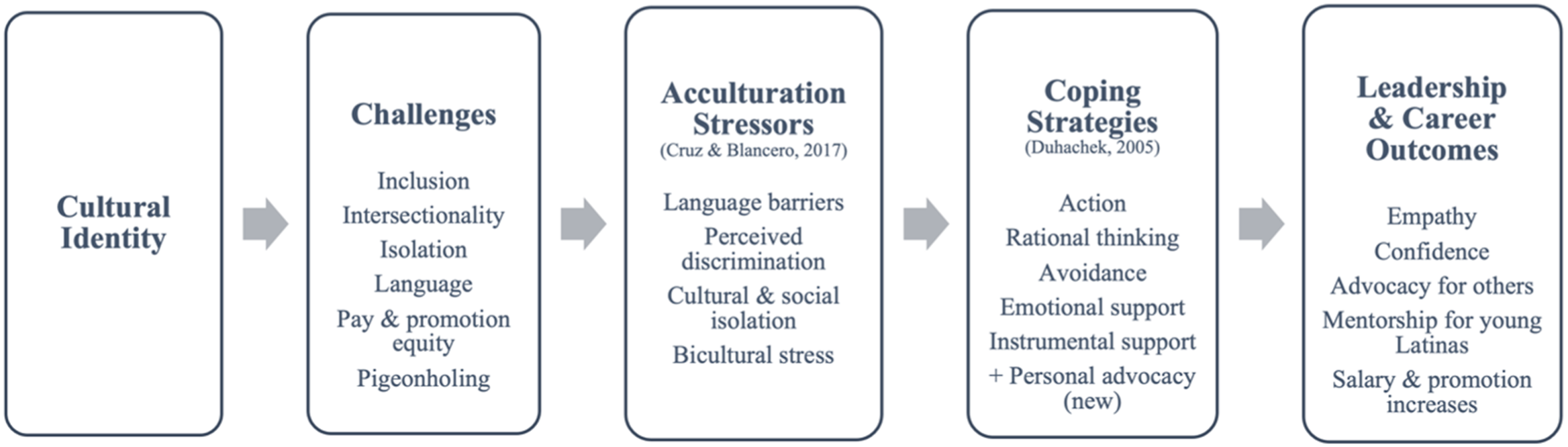
As this linear model explains, immigrant and first-generation Latinas bring their unique cultural or ethnic identities to the workplace and face different types of career-advancement challenges. These challenges are further exacerbated through acculturation stressors that stem from their intercultural identities and experiences. They use a number of key coping strategies to address these issues and as a result demonstrate leadership qualities and characteristics that are helpful to them as leaders in public relations, but also as exemplars for future generations of Latina practitioners.
As a novel contribution to our theoretical framework of coping theory, this study introduced personal advocacy as a new method of coping. For example, several of the immigrant and first-generation Latinas described taking risks when speaking with their bosses about their lack of pay equity or feeling empowered to ask for a promotion because they knew the value of their work. Additionally, many Latinas felt the need to explain to senior leaders that their value, credentials, and expertise covers a wider range of public relations than just multicultural or Hispanic public relations. Indeed, this is an example of Latina public relations professionals expressing their avowed identities and coping by advocating for themselves. It was a testament to their own personal advocacy efforts, initiative, and endurance that these women had been successful in advancing into mid-management and senior-executive level positions. Part of their success was due to the fact that these women took action through building collaborative relationships with their colleagues, personal networks, or social connections (Cruz and Blancero, 2017). Indeed, as women who had advanced to mid to senior-level positions, they are examples of resilience in the face of adversity (Moreno et al., 2019). Their stories and advice provide a roadmap for young professionals interested in advancing to public relations leadership roles, particularly their recommendations on how to cope with the challenges they may face along the way.
Overall, these key findings offer several practical implications for senior leadership in order to value and retain Latina public relations practitioners, as posed by the third research question. First of all, Latinas want to be assigned meaningful work and be involved in strategic planning and leadership decision-making, not just translation projects or tactical add-on services. Secondly, Latinas should be fairly compensated for their work with salaries comparable to their colleagues, especially when they have the applicable credentials. In this sample, 50% have a master’s degree and 20% earned their APR certification indicating a high level of professionalism and education in public relations. Third, senior leadership needs to promote Latinas into mid-management and senior-level positions, and appoint them to hiring committees so they have the opportunity to advocate for diverse job candidates, particularly those with “non-traditional credentials” and experiences. In addition, employers should create and support employee resource groups as a means of mentoring and supporting employees of color. Fourth, senior leaders also need to be aware of microaggressions that can be demeaning to colleagues from historically-marginalized groups, and provide the necessary training across the organization. Fifth, employers need to recognize the varying degrees of what it means to be a Latina in the U.S. and respect differences among immigrants, first-generation, and non-immigrants. No Latina can be the voice “of all Latinas” and instead they want to be seen and appreciated for who they uniquely are and what they bring to the table.
Limitations and recommendations for future research
While this study provided new insights into the working experiences of Latinas in public relations, the study was limited to the perspectives of 24 women working in the U.S. and cannot be generalizable to the U.S. or globally. Furthermore, the study represents the voices of mid-level and senior-level practitioners. Future research should examine the experiences of early-career Latinas as they navigate the path from graduating college to building their careers in public relations. Another limitation is that the research team included one Latina woman and one White woman, which may have impacted the interpretation of the interview data. For these reasons, we have included many direct quotes that allowed the participants to describe their personal experiences in their own words. Another limitation associated with interviewing mid-level and senior-level executives is their accessibility due to time and status constraints as well as the “instinct to protect against intrusion into potentially sensitive matters” (Hertz and Imber, 1995: 41). For these reasons, it is difficult to interview business executives for more than an hour. Finally, it’s important to note that the research team conducted interviews during the summer of 2021 while the global pandemic was still in effect and participants were primarily working remotely and under new stressors, so it is difficult to determine how these circumstances impacted their experiences. Future research can include surveys to reach a wider audience of Latina practitioners across the U.S. to gain more varied perspectives.
Conclusion
This study makes a highly relevant and timely contribution to the fairly new body of knowledge on DEIB in public relations by offering new insights into examining the challenges and coping strategies of Latina leaders in public relations. Furthermore, this study contributes to the scarcity of research by being one of the first to solely address the lack of scholarly attention to Latina public relations practitioners, who despite being a part of the fastest-growing population in the U.S., remain largely underrepresented in the public relations industry. In addition, this study recognized any differences that emerged from their cultural or ethnic identity as immigrant, first generation, and non-immigrant Latinas working in U.S. public relations.
Sample Characteristics of U.S. Latina Public Relations Leaders.
While all the women overall shared personal and professional challenges in their career trajectories, they were hopeful for positive organizational changes and believed in their roles as leaders, changemakers, and future mentors. These findings hope to provide both scholars and company leaders with a greater understanding of the existing challenges U.S. Latinas face in public relations and bring visibility to their coping strategies and recommendations for improving the industry for the next generation of public relations leaders.
Footnotes
Acknowledgements
The authors would like to acknowledge the incredible 24 Latinas who shared their stories of tribulation and triumph to make this research project possible. Additionally, the authors would like to thank the reviewers for their support and valuable feedback to this study.
Declaration of conflicting interests
The author(s) declared no potential conflicts of interest with respect to the research, authorship, and/or publication of this article.
Funding
The author(s) received no financial support for the research, authorship, and/or publication of this article.

Note
Appendix
Author biographies
Rosalynn A. Vasquez, Ph.D., MBA, is an assistant professor of public relations at Baylor University and teaches undergraduate and graduate courses in public relations. Her research interests include PR leadership, sustainability, and DEIB. Vasquez worked as a PR practitioner for 15 years in corporate, agency, and nonprofit.
Marlene S. Neill, Ph.D., APR, is an associate professor and graduate program director at Baylor University and teaches courses in advertising and public relations. Her researchinterests include public relations leadership and ethics. Neill worked for almost 12 years in government and nonprofit public relations.