






Abstract
Public relations scholars have greatly impacted the understanding of employee engagement in terms of definitions, theory development, antecedents, outcomes, and progressing scholarship to explore changes in the modern workplace. Yet, understanding the nuances around being disengaged is absent from most of the public relations literature. In addition, although much is known about the connection between employee engagement and internal communication, little has been identified about how internal communication contributes to or ameliorates the experience of being disengaged. Therefore, public relations researchers have the chance to move scholarship on disengagement forward by examining it as a unique concept separate from engagement and exploring the function of internal communication with disengagement.
Introduction
Over the last decade, public relations scholarship centered around internal audiences has grown exponentially (Lee and Yue, 2020). Many of the studies that investigate this key stakeholder group focus on employee engagement and its important connection to public relations activities, specifically internal communication (e.g., Karanges et al., 2015; Ewing et al., 2019; Verčič and Vokič, 2017). In doing so, public relations scholarship has been able to move both internal communication and employee engagement forward by advancing novel insights and contributing to theory development (Lemon, 2019a).
Recent scholarship has advanced the relationship between internal communication and employee engagement by focusing on the value of such communication for internal stakeholders. For example, Arif et al. (2023) found internal communication leads to employees making strategic contributions to an organization, such as taking on leadership roles and understanding long-term goals, when mediated by employee engagement. In addition, Špoljarić and Verčič (2022) determined that satisfaction with internal communication and employee engagement can enhance brand perceptions, which positively impacts employee satisfaction and retention. Verčič and Men (2023) suggested that clear, strategic internal communication can increase a brand’s internal reputation by demonstrating how the work environment is innovative and exciting, which leads to greater employee engagement.
Despite many of the conclusions developed over the last decade or so that address the connections between internal communication and employee engagement, most workplaces drastically changed during and following the COVID-19 pandemic. Specifically, the American Psychological Association’s 2021 Work and Well-Being Survey revealed that stress levels among employees have led to increased job dissatisfaction. In 2021, two out of five individuals reported their intent to change jobs within the year, up from one in three in 2019 due to workplace stress (American Psychological Association). One of the causes of workplace stress for some was the rise in telework because of the COVID-19 pandemic (Adamovic, 2022). Overall, the changes brought about by the COVID-19 pandemic resulted in U.S. employees reporting disengagement levels 12% higher in February 2021 as compared to January 2020 (Elflein, 2021).
Furthermore, a 2023 Gallup report found 66% of the U.S. workforce is disengaged (Harter, 2023). This Gallup survey, compiled by a random sample of 15,000 full and part-time U.S. employees, looked at specific elements in the workplace that linked back to feelings of engagement or disengagement, including, “profitability, productivity, customer service, retention, safety and overall wellbeing” (Harter, para. 4). What Gallup concluded is that an actively disengaged employee finds themselves wrestling with feelings of disgruntlement and disloyalty simply because they feel their workplace needs are unmet. Additionally, the Gallup results showed that workers under the age of 35 tend to be more disengaged than workers over 35, and women are more inclined to experience feelings of disengagement (Harter). Job type and options for either remote or on-site work impacted some degree of disengagement, though most of these issues came from residual post-pandemic experiences, impacting careers in healthcare and white-collar occupations.
Given the shift in modern workplaces and the prevalence of disengagement, developing a new line of inquiry for public relations scholars who focus on internal communication and employee engagement may be fruitful. Therefore, the purpose of this paper is to offer a trajectory for public relations scholars looking to advance theory building and understanding of employee engagement by examining the fundamental underpinnings of disengagement. Scholars have acknowledged that a central task for organizations is to discover how to engage those who are disengaged (Johnston and Taylor, 2018).
Understanding the nuances around being disengaged is absent from most of the public relations literature, yet previous scholars have suggested a new line of inquiry around the construct. For example, Heide and Simonsson (2018) called for further investigations into the complexities of organizational life, such as issues of work-life balance and the tensions that underpin employee engagement—disengagement is an example of a tension. Shen and Ren (2023) encouraged future research to examine employee disengagement as an independent construct to enhance understanding. Given scholar’s dominant focus on the positive aspects of engagement, Lemon (2019b) proposed that future research scrutinize the negative experiences associated with engagement. In addition, although much is known about the connection between employee engagement and internal communication, little has been identified about how internal communication contributes to or ameliorates the experience of being disengaged.
The ensuing paper begins with an overview of employee engagement scholarship followed, including current trends in research such as quietly quitting. A section that addresses the investigations public relations scholars have conducted into the disengagement phenomenon is also included. The paper then transitions to reimaging disengagement, helping to set the stage for a renewed research agenda for employee engagement and internal communication scholars. Specific suggestions for future research conclude the paper.
Review of relevant literature
Public relations scholarship has a long history of examining engagement in various contexts. Complex situations and applied problems are often solved when engagement is used as the lens for understanding (Johnston and Taylor, 2018). For example, engagement has been primarily studied with social media platforms to investigate how social communities engage with brands and other online users (Men et al., 2018). In addition, engagement has been studied under the umbrella of corporate social responsibility (CSR) (Devin and Lane, 2014). To illustrate, Lim and Jiang (2023) found that trust mediates the relationship between dialogic CSR communication and brand loyalty. Engagement has also been used as a way to extend theory building related to organization-public relationships (see Zhan and Zhao, 2023). One important context in which public relations scholars dedicate time and effort to investigating is engagement among and with internal stakeholders.
The foundational employee engagement
The concept of employee engagement has been around for multiple decades, with the initial definition being provided by Kahn (1990). He stated that employee engagement is defined as the “harnessing of organization members’ selves to their work roles; in engagement, people employ and express themselves physically, cognitively, and emotionally during role performances” (p. 694). The definition was further revised by incorporating the concept of psychological presence, which leads to performance, growth, and experience outcomes (Kahn, 1992).
Definitions of employee engagement.
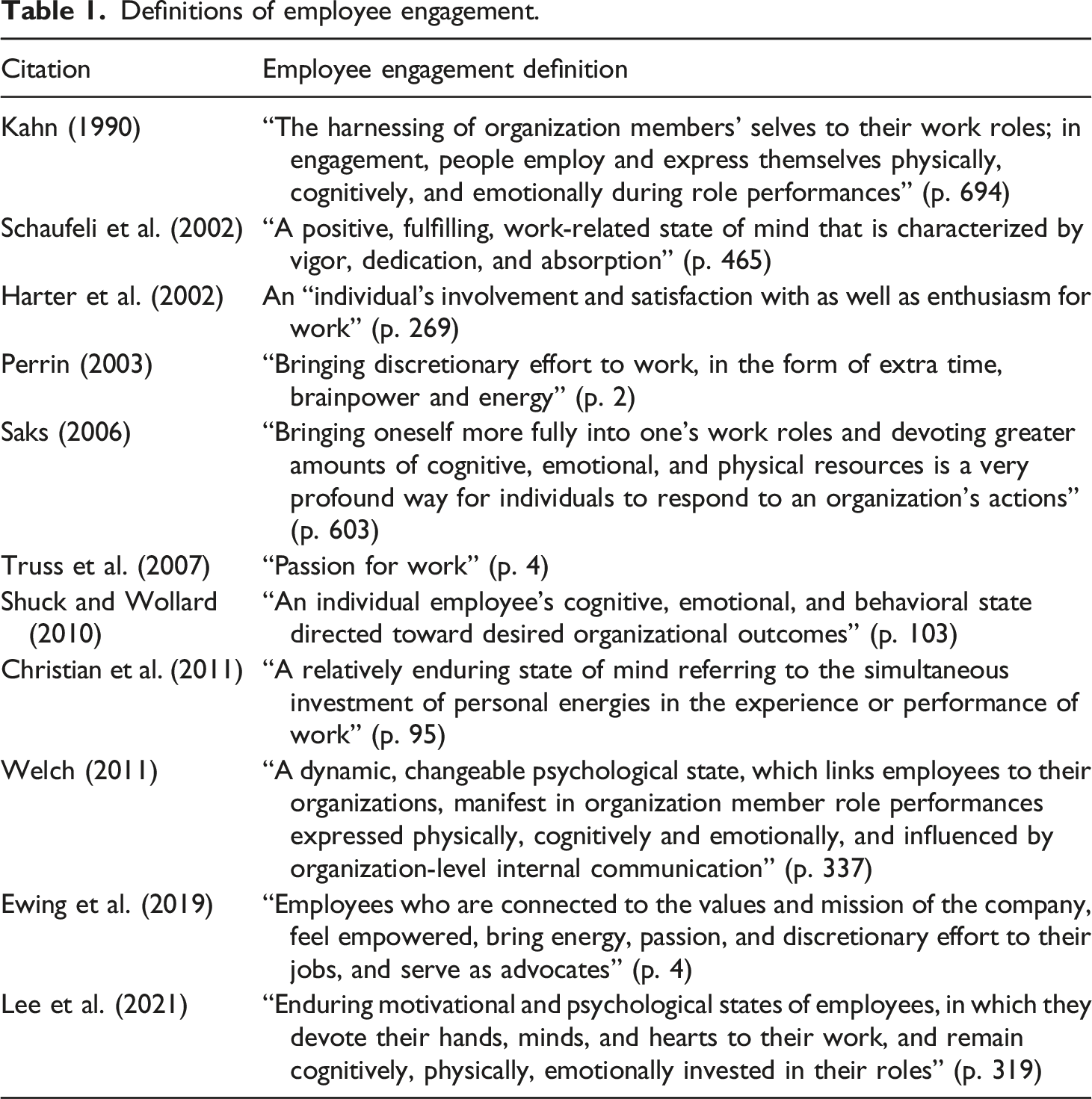
Although the definitions have shifted, emphasis on the amount of effort exerted by the employee, whether it be physically, cognitively, or emotionally, seems to be the focus of how scholars discuss and define employee engagement. e.g., Schaufeli et al. (2002) shared how an engaged employee is one who is absorbed in the work. Saks (2006) discussed that being engaged requires someone to bring their full self into the workplace. Ewing et al. (2019) argued that one component of employee engagement is exercising a certain level of discretionary effort. And in most cases, this high level of absorption and effort on behalf of the employee is done to the extent that it solely benefits the organization (e.g., Shuck and Wollard, 2010; Welch, 2011), with little to no concern for the individual impact of such exertion over time.
In addition to definitions, scholars have advanced understanding around the antecedents that impact the level to which employees are willing to engage. For example, Men (2012) investigated the extent to which the organization’s reputation influences employee engagement. Found that opportunities for employee voice are a strong indicator of an employee’s level of engagement. Leadership has also been researched as an important antecedent for employee engagement (e.g., Jiang and Luo, 2018; Men and Stacks, 2013; Meng and Berger, 2019). Job resources and working conditions also play a role in employee engagement (D’Aprix, 2009; Saks and Gruman, 2014) along with an organization’s corporate social responsibility (CSR) initiatives (Duthler and Dhanesh, 2018).
One of public relations scholars’ greatest contributions to understanding employee engagement is articulating and investigating the role of internal communication as an antecedent. These advancements have been possible because, for many scholars, engagement is conceptualized as communication (Johnston and Taylor, 2018). Feedback satisfaction, informal communication, and meeting communication all play a part in fostering employee engagement (Verčič and Vokič, 2017). Specifically, employee-centric communication that addresses employees’ needs in terms of preferred content and channels is vital to employee engagement (Ruck and Welch, 2012). Therefore, when internal communication related to organizational issues is generated and disseminated to meet the communication needs of employees, research shows that employees will be more engaged (Walden et al., 2017). Public relations scholarship and its encouragement of employee-centric processes and practices illustrates the value of internal stakeholders, which leads to flourishing employees and long-term stability for organizations.
Recent advancements in employee engagement scholarship
The rise of social media and increased diversity, equity, and inclusion efforts in workplaces across the country have changed how we look at and understand employee engagement. The following sections highlight some of the recent advancements in employee engagement scholarship within the public relations discipline.
Social media
Recent employee engagement studies have considered the impact of social media beyond the company’s intranet, which was the focus of previous scholarship (e.g., Mishra et al., 2014). For example, Men et al. (2020) found that when companies incorporate internal Instagram use, employees report a higher level of perceived organizational transparency and identification, which leads to higher engagement. Internal social media use refers to content sharing, tagging, and collaboration between the organization’s social platforms and its employees (Men et al.). As a result of these actions, employees feel a higher sense of belonging to and identification with their organization through increased attentiveness, emotional connection, empowerment, meaning, and purpose in their workplace (Men et al.). Internal communication satisfaction and higher employee engagement also lead to a better external brand, helping the employer remain attractive to current employees while appealing to potential employees (Špoljarić and Verčič, 2022). Although social media has many benefits related to developing organizational culture, it can also lead to stress among employees, specifically regarding supervisor expectations and the 24/7 nature of most social media platforms.
Diversity, equity, and inclusion
The much-needed rise of diversity, equity, and inclusion efforts in the workplace has led to further insight into employee engagement, specifically concerning the role of leadership in the workplace. For example, Lee et al. (2021) found that diversity-oriented leadership enhances the quality and quantity of internal communication and racial minority employees’ perceived fairness of the organization. Both perceived internal communication quality and fairness were identified as important indicators of employee engagement and advocacy on behalf of the organization (Lee et al.).
With the rise in diversity, equity, and inclusion research, scholars are beginning to suggest that organizations should embrace the entirety of each employee. For example, organizations should not ignore or attempt to suppress employees’ religious and/or spiritual lives, but instead, be responsive and accommodative to this identity (Smudde, 2021). As a result, employees will be more satisfied, feel more inclined to contribute to the organization’s success, and be more engaged in their work (Smudde). Along with incorporating the whole employee, emphasis on the need for expressing care (Lemon and Boman, 2022) and love (Einwiller et al., 2021) toward employees has moved to the forefront of scholarly discussions. Creating an environment that respects each employee’s perspectives, experiences, and individuality through an ongoing dialogue is essential to creating a workplace in which employees feel supported by their organization (Lemon & Boman). Without such support, experiences of disengagement are most likely to occur.
Post-pandemic workplaces
Amidst the novel COVID-19 pandemic, how employees engaged in the workplace drastically changed since the ways in which internal communication was disseminated and supported transformed. For example, Dhanesh and Picherit-Duthler (2021) found that two-way communication, which the authors defined as “two-way, bi-directional flows of communication between employees and their organizations that make employees feel heard” and internal crisis communication, which is “content that aims to strengthen trust in and identification with the organization by explicating the organization’s values, strategies, and long-term outlook,” were most predictive of employee engagement when making the move to remote or hybrid work (p. 307). The study also found that social connection acted as a mediator in the relationship between employee engagement and the new ways in which employees were working (Dhanesh & Picherit-Duthler). Similarly, Einwiller et al. (2021) found that informational and relational communication significantly influenced employees’ perception of employer support during the pandemic.
Despite the insights gleaned from examining a major crisis in real-time and its impact on employee engagement, the post-pandemic work era is bolstered by experiences of disengagement (Elflein, 2021). These experiences have led to the rise in popularity of the term, quietly quitting. Formica and Sfodera (2022) explained that quiet quitting is “the limited commitment of employees to carry out the assigned duties and to relinquish from any other task not specified in their job description” (p. 900).
Quietly quitting
When someone quietly quits, the employee has not formally turned in a letter of resignation nor do they intend to do so. However, the employee has shifted their attitudes about work to be more negative and in turn, dedicated less time and effort to their work. Instead of going above and beyond the roles and responsibilities of their job, which is what previously defined an engaged employee (see Lemon and Palenchar, 2018), when employees quietly quit, they are performing the basic necessities of their jobs simply as a way to get by and do the bare minimum (Green, 2022). Salem describes quiet quitting as “mentally checking out of work for the sake of our health and wellbeing” (2022, p. 480).
A few studies have demonstrated that the quietly quitting coping strategy is possibly a byproduct of the pandemic. For example, Picchi (2022) discussed that the COVID-19 pandemic led to many layoffs, and although most people found new jobs or were rehired, the strain on the existing employees remains since they are often asked to do more with the same resources, and in some cases, less pay. The act of quietly quitting is a response to the strain the pandemic left on employees. While American workers may have disengaged in the workplace for many years, Selyukh (2022) suggested that employees who are under 35 years of age have become less engaged and are more concerned with matters outside of the workplace. Disengagement in the workplace impacts the overall attitude and opportunities management might give employees, particularly if it is seen that effort is not being put into the work a person has been hired to complete (Kim, 2023).
Disengagement in public relations
The preceding literature review hinted where and how disengagement may occur in the workplace—ultimately, it is an important, yet separate undercurrent of employee engagement that demands additional investigations. Kahn (1990) offered a preliminary definition of disengagement as the idea that employees “withdraw and defend themselves physically; cognitively; or emotionally during role performances” p. 694). A disengaged workforce may lead to negative behaviors, where employees speak poorly about the employer to external stakeholders (Kang and Sung, 2017).
After conducting a review of public relations literature, minimal studies surfaced at this moment in time examining disengagement. Conceptual papers and think pieces have initiated the conversation in the field. For example, Heide and Simonsson (2018) discussed the tensions of employee engagement that lead to the “dark sides of engagement,” where engagement is seen as a tool to control workers or becomes an inhibitor to being a good parent or maintaining a healthy work-life balance (p. 211). These tensions and others should be explored and understood versus swept under the rug in an attempt to forget them (Heide & Simonsson). Pieczka (2018) suggested that employee engagement is “a highly technical, instrumental discourse about the comprehensive control of employees’ experience of work,” where organizations focus on how employees can be monetized (p. 554). The idea is that organizations create conditions at work so that employees dedicate an extraordinary amount of time and effort to their work roles (Pieczka)—given these high-pressured and demanding conditions, it is no surprise that employees eventually disengage from their roles.
In addition, very few empirical studies have investigated disengagement. For example, Shen and Ren (2023) were some of the first scholars to look at employee disengagement. The study offered a new conceptualization of disengagement as “employees’ indifference to work (attitudinal), slacking off on the job, and withdrawing from their work, organizations, and colleagues (behavioral)” (p. 7). Shen and Ren also illustrated that employee disengagement is different from negative engagement, burnout, and psychological distancing, establishing it as a unique, independent construct. This conceptualization built upon Lemon and Palenchar’s (2018) definition that focused on the behavioral dimension, where being disengaged is the act of completing the minimum job requirements. This “discretionary effort” was also illuminated in Lemon’s (2019b) case study of a government contractor, where such effort overtime led to employee disengagement since the high expectations did not have realistic, long-term sustainability (p. 8).
Rethinking disengagement
Given the dearth of literature in public relations exploring the various dimensions of disengagement, and the role of internal communication, we call for public relations scholars to purposefully pursue this as a new line of inquiry. This future research agenda would continue the informative and meaningful impact employee engagement scholars are currently making. In addition, disengagement could be explored within the context of other public relations phenomena such as digital or online disengagement, corporate social responsibility disengagement, and civic or political disengagement.
Public relations scholars have impacted the understanding of employee engagement in terms of definitions, theory development, antecedents, and progressing scholarship to explore changes in the modern workplace. The same contributions can and should be made for disengagement. To extend theory building, we suggest incorporating the foundational underpinnings of Herzberg’s Two Factor or Motivation-Hygiene Theory from the organizational communication discipline and propose that the dimensions of disengagement and engagement should be considered independent of each other. In this way, engagement is not the opposite of disengagement but stands alone as its own distinct construct. This nuanced conceptualization becomes the foundation for disengagement theory building and could be applied to the different contexts in which engagement is explored within public relations. For example, online disengagement should be explored as a different and separate behavior/response/process than online engagement. Of note, public relations scholars should be doing more to pull theories and insights from outside disciplines such as organizational communication to enhance the interdisciplinary of our work.
Although Herzberg’s theory is focused on motivations for job satisfaction and job dissatisfaction, the application and use of distinct dimensions can be applied to public relations understanding of disengagement and engagement. Herzberg (1974) suggested that both job dissatisfaction and job satisfaction were constructed through different factors associated with work. The motivation factors that lead to job satisfaction include “outgrowth of achievement, recognition (verbal), the work itself (challenging), responsibility, and advancement (promotion)” (Miner, 2015, p. 63). On the contrary, the hygiene factors that lead to job dissatisfaction include “company policy and administrative practices, supervision (technical quality), interpersonal relations (especially with supervision), physical working conditions, job security, benefits, and salary” (Miner, p. 63).
In other words, what leads to an employee being satisfied with the job is different from what cultivates employee dissatisfaction (Herzberg, 1987). The factors for both job satisfaction and motivation are discrete and disparate from those that produce job dissatisfaction and lack of motivation (Herzberg, 1987). This important distinction demonstrates that “the opposite of job satisfaction is not job dissatisfaction but, rather, no job satisfaction; and similarly, the opposite of job dissatisfaction is not job satisfaction, but no job dissatisfaction” (Herzberg, 1987, p. 9).
Additionally, certain people may require both factors, while others might be inspired by one set of factors over the other (Miner, 2015). Therefore, Herzberg (1974) suggested developing profiles to encourage investigations into which factors impact an employee’s satisfaction as well as the factors that lead to dissatisfaction. This requires an assessment of employees’ feelings and experiences to better understand what motivates them as well as what hygiene needs must be met (Herzberg). The motivation and hygiene factors will shift and change over time, illustrating the temporality of experiencing both job dissatisfaction and job satisfaction (Miner).
Although the Motivation-Hygiene Theory has undergone theoretical controversies over the years (see Miner, 2015), the conceptual underpinnings are useful in further exploring disengagement as a distinct concept and process. First, because engagement and disengagement are disparate concepts and processes, they need to be studied separately. The absence of engagement does not mean disengagement; it simply means no engagement. Similarly, if disengagement is not present, it does not mean an employee is engaged—it means the employee is not disengaged.
Second, this initial conceptualization suggests that both engagement and disengagement might be situated on continua. In this way, times might exist when a certain level of disengagement is acceptable from a managerial perspective. Take for example, the quietly quitting phenomenon. Employees are simply doing the bare minimum required to meet what is outlined in their job description and nothing more. They also might seem emotionally checked out while completing work tasks. This is a form of disengagement, but not to the extent that employees are not getting their job done, which means the impact on the organization is most likely minimal. Therefore, quietly quitting sits on the disengagement continuum but not at the very end, making this type of disengagement somewhat “acceptable” and not a fire-able offense.
Third, Herzberg’s conclusion about the temporal aspects of job satisfaction and dissatisfaction can also be applied to employee engagement and disengagement. Once an employee is engaged, is that all we need to know? Of course not. The period in which a person is engaged is going to shift and change depending on a variety of factors. The same temporality holds true for disengagement, in which a person will not be disengaged for the duration of their employment but might be for some amount of time. The factors impacting the duration of engagement and disengagement will be unique to each individual employee.
This leads to the fourth element adapted from the Motivation-Hygiene Theory and applied to both engagement and disengagement, which is the motivation-hygiene profile to understand the unique needs of employees. Herzberg (1976) stated that “social scientists have too long neglected the language and experience of people at work” (p. 54). Similarly, more work could be done to understand employees and their experiences with both disengagement and engagement, knowing that disengagement and engagement are distinct and unique, exist on a continuum, and have a temporal nature. Finding unique ways to profile and segment internal audiences will enhance all forms of internal communication. Advancing scholarship surrounding disengagement may be the opportunity to re-envision how organizations define and communicate both to and with internal audiences.
A new research agenda for public relations scholars
Public relations researchers have the chance to move scholarship on disengagement forward by (a) examining it as a unique concept separate from engagement; and (b) exploring the function of internal communication, which includes dialogic and informal communication, with disengagement. These broad lines of inquiry set the foundation for the following suggestions of future research.
Antecedents of disengagement
The antecedents of employee engagement have been established by existing research (e.g., Duthler and Dhanesh, 2018; Jiang and Luo, 2018; Men, 2012; Men and Stacks, 2013). Therefore, scholars should pursue studies that assess the relationship between the confirmed antecedents and disengagement. Specific lines of inquiry should look at how organizational reputation; employee voice; leadership; job resources; working conditions; CSR; and internal communication impact the disengagement experience, keeping in mind that the antecedents for disengagement might be dissimilar to those for engagement. For example, what types of job resources or working conditions lead to employees choosing to disengage? Or how does leadership create a disengaged workforce? In addition, what happens when an organization does fulfill its CSR initiatives; how does that impact disengagement?
Where research is conducted is also important, so that the implications are relevant across the organizational landscape. Future research needs to consider context, focusing on specific types of organizations and in certain locations. Small businesses and consortiums should be considered as well as large, international organizations. Specific focus on science organizations or others in the STEM field would also be an important context for future work. Focusing on women-led and owned organizations and co-ops should also be areas of focus for future research.
Similarly, scholarship should explore the intersectionality of employees’ identities. Embracing the entirety of the individual is key in cultivating employee engagement (Lemon and Boman, 2022). Yet, how does disengagement manifest differently among individuals of different sexual orientations, races, genders, nationality, and religions? Additionally, identities that public relations scholarship has yet to realize might also play a role in disengagement, which warrants future investigation.
Outcomes of disengagement
In addition to the antecedents, future research should explore the impact disengagement has on previously studied outcomes, recognizing that the repercussions of disengagement will be different than engagement. Scholars have demonstrated how employee engagement leads to greater commitment; retention; satisfaction; and external reputation (e.g., Arif et al., 2023; Špoljarić and Verčič, 2022; Verčič and Men, 2023). Yet, how do these outcomes shift and change when employees feel indifferent about their work (attitudinal) or opt to not fulfil their roles and responsibilities (behavioral)? How does disengagement impact employee retention and commitment? How do external audiences perceive a disengaged workforce, which could impact the organizations reputation? Exploring the various outcomes associate with disengagement is crucial for both practice and theory building.
In addition, employee engagement is often an outcome of successful internal communication (Karanges et al., 2015; Verčič and Vokič, 2017). Therefore, scholarship should explore this important connection by asking how does internal communication impact disengagement? The next section offers specific suggestions for future research to move understanding of disengagement forward.
Specific lines of inquiry for future research
The first suggestion for future research is to investigate the foundation of disengagement. Pieczka (2018) argued that instead of applying more and more effort to research engagement, it is time to ask: how is disengagement embedded within organizations across the world? Shen and Jiang (2019) called for future research to explore the ebb and flow of role enactment in the workplace and how engaged workers might experience burnout. Kahn (1990) suggested that engagement includes fluctuations between being involved and committed on one end of the spectrum and disengagement on the other, where all the dimensions from one end to the other need to be explored and understood. In addition, Lane and Kent (2018) argued that much of engagement scholarship describes what it does instead of what it actually is. Therefore, questions such as what is disengagement? What unique conditions lead to disengagement? How are engagement, disengagement, and burnout conceptually disparate? Why do people experience burnout instead of disengagement or vice versa? In addition, researchers should consider investigating the longitudinal effects of exerting high levels of engagement. In doing so, the long-term implications of employee engagement could be revealed, a significant aspect of the phenomenon that is missing from the current body of literature.
Given the post-pandemic landscape, Taylor (2023) suggested that future research should explore how employee health and wellness can be cultivated, advising that the general public is watching how organizations treat their employees. Therefore, future studies to look at the ways certain organizations can circumvent disengagement through organizational norms and dedicated internal programs. In the event employees do disengage, how do they individually cope with these experiences? What could an organization do to help employees transition away from being disengaged? What types of internal communication impact coping strategies including quietly quitting? These questions and others should be explored.
Verčič and Vokič (2017) suggested that internal communication and employee engagement are in a continuous cycle, working together. Therefore, a line of inquiry related to disengagement should focus specifically on the role of internal communication, asking questions such as what is the role of internal communication when an employee disengages? How can internal communication reinvigorate the disengaged employee? Or how did internal communication or lack thereof contribute to disengagement? Future research must conceptualize internal communication beyond the traditional corporate, top-down communication, and two-way communication to incorporate dialogue. It also needs to see employee needs as unique and individual, which means the ways in which internal audiences are defined must reflect that complexity. In addition, research should examine if/how social media usage contributes to disengagement given the stress that accompanies such communication. Often social media relies on surveys to capture users’ experiences or analysis of online data. Therefore, future research should consider using interviews or focus groups as the method to capture the impact of being accessible 24/7.
Last, future research should further examine the role of diversity, equity, and inclusion in the workplace and the connection to disengagement. Specifically, researchers should examine how these efforts impact the engagement experiences of employees who identify with different minority groups and how this may lead to diversity fatigue and disengagement. Diversity fatigue is defined as “a variation in the extent to which someone experiences a diminished response to or desensitization toward diversity efforts” (Smith et al., 2021, p. 658). This fatigue can in fact lead to feelings of resentment, disengagement, and future research should investigate these individualized experiences.
Conclusion
Taylor (2018) stated that the field of public relations is transforming from seeing relationships with stakeholders as tasks to managed and assessed to a co-creational philosophy that values stakeholders and sees them as meaning-making partners. This paper aligns with this lens, by offering ways to better understand how employees experience disengagement and how internal communication contributes to or minimizes those experiences. The suggested lines of inquiry set the stage for a new research agenda for employee engagement scholars within the public relations discipline by examining the ways in which disengagement is a distinct and unique concept separate from engagement.
Footnotes
Declaration of conflicting interests
The author(s) declared no potential conflicts of interest with respect to the research, authorship, and/or publication of this article.
Funding
The author(s) received no financial support for the research, authorship, and/or publication of this article.
